In this article, I will focus on the AI Agents That Will Replace Your 40-Hour Work Week In 2026. These innovative AI technologies are altering the way firms handle the perform the same task over and over again jobs, such as writing content, coding, making videos, and automating workflows.
With the help of these smart agents, businesses will save time and increase productivity and will be able to move their workforce to more strategic and value-added activities rather than on operational activities.
Key Points & AI Agents That Will Replace Your 40-Hour Work Week In 2026
AutoGPT – Autonomous AI that completes complex tasks, plans workflows, learns actions, and executes without constant human input.
ChatGPT Enterprise – AI assistant for business tasks, automates writing, research, summaries, and scheduling with enterprise‑level security.
Jasper AI – Generates high‑quality marketing content, blog posts, ads, and social media text faster than human writers.
Synthesia – AI video creator automating presentations, training videos, and voiceovers without cameras, actors, or production teams.
GitHub Copilot – AI coding partner that writes, debugs, and suggests code, accelerating software development significantly.
Notion AI – Smart workspace assistant that summarizes, drafts, organizes, and brainstorms content inside Notion projects seamlessly.
Tome AI – Narrative design AI that builds compelling presentations, storyboards, and pitches without traditional slide creation.
Zapier AI – Connects apps to automate workflows, triggers actions, and removes repetitive tasks without manual intervention.
Murphy by Runway – AI video editor automatically produces, edits, and enhances footage using natural language instructions.
Claude 3 Workspace – Enterprise AI for brainstorming, analysis, and writing with deep context across business data and documents.
10 AI Agents That Will Replace Your 40-Hour Work Week In 2026
1. AutoGPT
AutoGPTs are self-directed AIs developed using large language models, allowing them to plan, carry out, and modify multiple steps in processes without needing to be prompted by humans.
These agents can independently research, write, test, and improve automation workflows in writing, data analysis, programming, and automations.

By 2026, AutoGPTs will be embedded in business processes and APIs, allowing teams to fully hand-off processes such as campaigns, reports, and customer outreach.
It shifts routine work to handle intricate objectives as multiple steps in a sequence that previously would have taken hours of oversight to accomplish.
AutoGPT Features
- Multi-part tasks can be performed autonomously without continuous human guidance.
- Can autonomously research, draft, test, and refine workflow processes.
- Works to be more efficient by learning and adapting over time.
- For automation from beginning to end, can work with other software and business rules.
| Pros | Cons |
|---|---|
| Can autonomously plan, execute, and iterate multi-step workflows efficiently. | High dependency on accurate prompts; errors can propagate without oversight. |
| Reduces hours spent on research, drafting, testing, and reporting. | Requires careful integration into APIs and business rules to avoid workflow disruption. |
| Learns and adapts to improve task execution over time. | May not fully handle highly creative or subjective decision-making tasks. |
| Ideal for automating repetitive business operations. | Potential data security risks if handling sensitive information autonomously. |
2. ChatGPT Enterprise
OpenAI’s ChatGPT Enterprise integrates with business applications to enhance knowledge work at scale across various functions.
It incorporates enhanced GPT models, including long-context reasoning and multimodal input capabilities, with enterprise-grade security, admin controls, and flexible integration and plug-in dimensions to proprietary internal data.
Teams gain measurable efficiency improvements from report writing, data analytics, meeting notes, and internal process automations.
Enterprise AI customers maximize use case generation and experience reduced cycle times, with AI applied at routine content writing and decision support, freeing people to do higher-order tasks.
ChatGPT Enterprise Features
- Provides large businesses with modules to add to their own version of this program for security, administrative control, and access to their data.
- This program is capable of drafting reports, performing data analysis, and summarize meetings.
- Provides large teams with the ability to make decisions and produce large amounts of written material in a short time.
| Pros | Cons |
|---|---|
| Handles large-scale text analysis, report generation, and meeting summarization. | High cost for small businesses or startups with limited budgets. |
| Enterprise-level security and admin controls protect sensitive data. | AI may occasionally produce hallucinated or inaccurate summaries. |
| Can integrate with internal databases and apps for real-time assistance. | Requires staff training to maximize adoption and effectiveness. |
| Speeds up decision-making and internal communication across departments. | Over-reliance could reduce critical human evaluation in decision-making. |
3. Jasper AI
Jasper AI is an artificial intelligence company geared toward marketing and managing marketing and content operations.
In 2026, it’s more than just a writing assistant — it’s specialized AI agents that automate full marketing workflows, including brand templates, voice customizations, and automated campaign deliveries.
Jasper can provide SEO optimized content, social media posts, emails (including sequential) and strategic briefs. Jasper significantly lowers the amount of time spent doing manual content creation.
Jasper also has contextual mem- ory and pipeline features which replace hours of repetitive creative work and help maintain consistency across large marketing efforts.
Jasper AI Features
- Content creation for Blogs, Social Media, and SEO is done by this program.
- Collaborates on campaigns to ensure consistency with branding.
- Can completely provide marketing campaigns and email marketing.
- Can remember the content and instructions of complex tasks.
| Pros | Cons |
|---|---|
| Automates marketing workflows like SEO content, social media, and campaigns. | Limited nuance in creative storytelling compared to human writers. |
| Maintains brand voice consistency across large-scale campaigns. | Contextual memory may fail if input data is inconsistent or incomplete. |
| Reduces repetitive content creation tasks significantly. | Subscription-based pricing can be expensive for freelancers or small teams. |
| Can generate strategic briefs quickly for decision-making. | Requires supervision to avoid plagiarism or factual inaccuracies. |
4. Synthesia
Synthesia converts text and scripts into produced videos with realistic avatars and speaking in over 160 languages.
Synthesia eliminates shooting, editing, and post production by automating video production. This allows businesses to produce captivating visual content in minutes, rather than days.
The Interactive Video Agent features provide real-time engagement. Synthesia illustrates how corporate communication and storytelling can be done without the use of traditional media workflows.
Synthesia Features
- Uses AI, and realistic avatars to create videos from written text.
- Provides translation and voiceover in 160+ languages.
- Shooting videos, editing, and doing post-production is no longer necessary.
- Synthesia allows for the simple creation of videos that are interactive, localized, and even videos that are multilingual.
| Pros | Cons |
|---|---|
| Converts scripts into realistic AI videos with avatars and speech. | Limited customization compared to fully human-produced video content. |
| Supports 160+ languages, ideal for global businesses. | May lack emotional nuance for storytelling or training videos. |
| Eliminates time-intensive shooting, editing, and post-production. | Quality may vary depending on AI training and script complexity. |
| Reduces production costs and accelerates video content creation. | Subscription or usage fees can add up for large-scale deployments. |
5. GitHub Copilot
GitHub Copilot is integrated into IDEs and development workflows to assist in code generation, code revision, and code debugging.
With Copilot, By 2026, it will allow complete workspace autonomy – writing functions, suggesting pull requests, creating tests, and self explaining code modifications.

Copilot minimizes the time developers spend on repetitive and boilerplate coding, while improving the overall quality and expediting the delivery cycles.
For groups, Copilot provides unwavering pair-programming support, essentially performing the previously burdensome tasks required to manage and grow software codebases.
GitHub Copilot Features
- The AI coding assistant will create and edit code, and also find and fix debugging errors.
- Provides suggestions, tests, and pull requests in real time.
- Coding repetitive tasks is no longer necessary and the coding development cycles will continue to improve.
- This program is like your partner who codes with you and is more effective to improve your coding productivity.
| Pros | Cons |
|---|---|
| Generates, refines, and debugs code inside IDEs efficiently. | May introduce subtle bugs if blindly accepted without review. |
| Accelerates coding workflows and reduces repetitive tasks. | Limited understanding of project-specific business logic. |
| Assists in testing, pull requests, and documentation generation. | Learning curve for teams unfamiliar with AI-assisted coding. |
| Acts as a reliable pair-programming partner for developers. | Cannot fully replace creative algorithm design or architectural decisions. |
6. Notion AI
Notion AI integrates generative intelligence within the Notion workspace ecosystem, assisting teams with automating writing, document summarization, knowledge base Q&A, and project workflow structuring.
With the ability to drive deep contextual understanding from models like Claude, Notion AI streamlines note-taking, research, meeting follow-ups, and task organization.

This agent essentially performs a lot of tedious information organizing and content structuring drafting within teams, allowing users to dedicate their attention on strategy and execution, instead of focusing on formatting and summarizing manually.
Notion AI Features
- The automation of document summary, note organization, and answer to the user’s questions is done by Notion AI.
- Meeting tasks, research, and notes are also automated by Notion AI.
- Combines optimally with team Notion workflows.
- Lessens time spent on manual drafting and document management.
| Pros | Cons |
|---|---|
| Summarizes documents, answers queries, and structures workflows. | May misinterpret ambiguous content or complex knowledge bases. |
| Automates note-taking, research, and meeting follow-ups. | Limited offline capabilities; requires consistent cloud access. |
| Enhances productivity for teams managing large volumes of information. | Context understanding depends on data input quality. |
| Reduces manual drafting and organizational tasks significantly. | Over-reliance may reduce critical thinking during document review. |
7. Tome AI
Tome AI is an AI-powered storytelling and presentation tool that quickly converts basic prompts and information into narrative documents, pitch decks, interactive reports, and visual stories.
By automating the design and content creation processes, Tome saves users the hours normally spent on slide and layout design.

Users input high-level information and context, and Tome’s agentic workflows generate complete richly formatted documents aligned with specific business objectives
Saving enormous amounts of time on communication and reporting activities within an organization.
Tome AI Features
- Converts prompts and data into narrative documents or presentations.
- Slide design and formatting automation for professional finishes.
- Pitch decks, interactive reports, and visual storytelling.
- Time-saving in corporate communications and reporting.
| Pros | Cons |
|---|---|
| Quickly creates narrative documents, pitch decks, and interactive reports. | Design limitations compared to fully manual creative tools. |
| Automates slide formatting and visual storytelling. | Can generate repetitive or generic presentation content. |
| Saves hours in communication and reporting processes. | Context accuracy depends on the quality of input prompts. |
| Tailors outputs for business goals efficiently. | Cannot fully replace human intuition for persuasive messaging. |
8. Zapier AI
Zapier AI augments the Zapier automation platform using natural-language processing, enabling customers to articulate workflows in everyday terms and have Zapier create multi-step app automations over a thousand app integrations.

Rather than manually setting up triggers and conditions, Zapier AI accomplishes the heavy-lifting by interpreting high-level goals, establishing the necessary actions, and managing edge case conditions.
This AI agent relieves teams of the need for custom coding and workflow engineering. Empowering non-technical users with automation and significantly reducing the time spent linking applications and performing repetitive data tasks.
Zapier AI Features
- Plain language commands to create multi-step automation.
- Thousands of apps auto-connected without manual set up.
- Repetitive tasks and workflow triggers done automatically.
- Operates efficiently with no tech team to non-technical teams.
| Pros | Cons |
|---|---|
| Builds multi-step app automations from plain English commands. | May misconfigure complex workflows if conditions are ambiguous. |
| Reduces time spent scripting and connecting apps manually. | Limited customization for very niche or uncommon app integrations. |
| Makes automation accessible to non-technical teams. | Requires ongoing monitoring to ensure workflows continue functioning correctly. |
| Supports thousands of services and repetitive task automation. | Not ideal for tasks requiring human judgment or creativity. |
9. Murphy by Runway
Runway’s AI ecosystem, including agents like ‘Murphy,’ supports creative video workflows and automates video editing.
Among other things, agents can create motion graphics, remove backgrounds, and build cinematic sequences with light editing effort.

In 2026, Runway’s tools are advanced enough to do professional video editing. By automating backend processes, Runway’s agents allow creators to make high-quality videos
Regardless of their technical skills, which reduces production time significantly for digital media teams. (Tool details from directory context).
Murphy by Runway Features
- Video editing, motion effects, and compositing tasks automation.
- Cuts digital media project production time.
- Content creation of high quality for non-experts.
- AI and cinematic effects for editing workflows.
| Pros | Cons |
|---|---|
| Automates complex video editing tasks like motion effects and compositing. | May lack human creativity in cinematic storytelling. |
| Reduces production time dramatically for digital media projects. | Some outputs may require manual fine-tuning for perfection. |
| Enables creators with limited technical skills to produce high-quality videos. | Subscription costs can be high for small teams. |
| Handles repetitive editing workflows efficiently. | AI may misinterpret artistic intent or subtle nuances. |
10. Claude 3 Workspace
Claude 3 Workspace provides an opportunity to experience powerful AI productivity technology utilizing Claude models’ reasoning abilities and large context windows.
This technology provides advanced analysis of large documents, generation of organized documents, synthesis of documents via summary, and completion of documents requiring significant logic.
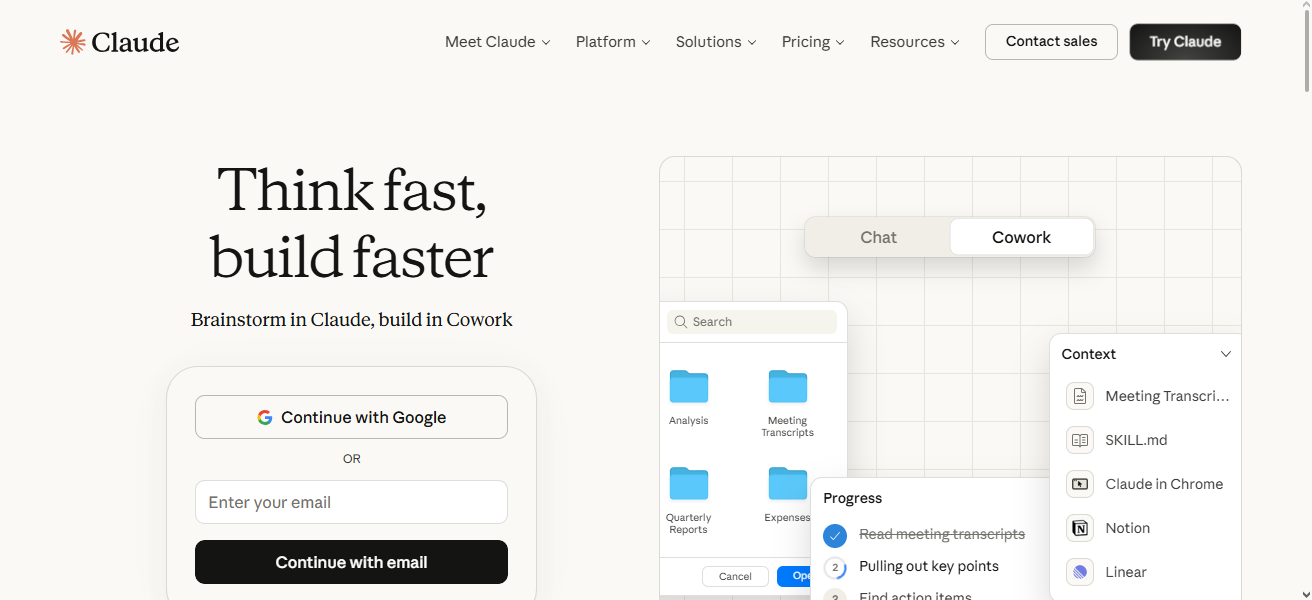
By 2026, Workspace Claude will provide the ability to analyze and interpret in a logical manner, as well as write reports of a complex nature using Spreadsheets and Presentation software.
Teams will be able to transfer the responsibility of their long form analysis and their organized plan creation to the agent, thereby eliminating hours of manual synthesis and drafting.
Claude 3 Workspace Features
- Deep document analysis and writing structure work.
- Spreadsheets, presentations, and collaboration tools integration.
- Long context reasoning and complex report production.
- Long analysis, research summaries, and workflow automation.
| Pros | Cons |
|---|---|
| Performs deep document analysis, structured writing, and logic-intensive tasks. | May produce over-generalized summaries for highly detailed projects. |
| Integrates with spreadsheets, presentations, and collaboration tools. | Learning curve for employees to fully leverage AI capabilities. |
| Automates long-form analysis and reporting efficiently. | Over-reliance may reduce hands-on critical thinking by staff. |
| Handles large context windows, suitable for enterprise-scale workflows. | Subscription and integration costs could be prohibitive for smaller organizations. |
Conclsuion
To sum up, how AI Agents That Will Replace Your 40-Hour Work Week In 2026 are changing the future of the workplace is staggering.
These tools handle automating the creation of content, writing code, producing videos, managing workflows, analyzing data, etc.
These tools save invaluable time, improve productivity, and eliminate tedious job functions. Invaluable time is saved so that humans can concentrate on higher-order thinking, creativity, and important strategic decisions.
FAQ
AI agents are intelligent software systems capable of automating repetitive, complex, or multi-step tasks previously done by humans.
They autonomously plan, execute, and iterate workflows using large language models, APIs, and learned task strategies.
It enhances productivity but works best alongside humans for supervision, decision-making, and creative judgment.
Content creation, marketing campaigns, SEO writing, social media posts, and email sequences.