This article will cover how AI models predict Ethereum’s future and how these models assist investors, traders, and analysts in estimating future price movement.
- Key Points & 10 AI Models Forecasting Ethereum’s Future
- 10 AI Models Forecasting Ethereum’s Future
- 1. Gemini (Google)
- 2. Grok (xAI)
- 3. ChatGPT (OpenAI)
- 4. Copilot
- 5. DeepSeek
- 6. LightGBM
- 7. WalletInvestor AI System
- 8. CoinCodex AI Predictor
- 9. TradingView AI Models
- 10. Finbold AI Agent
- Which AI model is Considered most suitable for long-term Ethereum forecasting and why?
- How To Choos AI Models Forecasting Ethereum’s Future
- Conclsuion
- FAQ
AI tools such as Gemini (Google), which is an advanced reasoning system, and Grok (xAI), which is a sentiment-driven system, bring together and analyze technical data, on-chain data, and the macroeconomy to predict Ethereum price movements in the short and long term.
Key Points & 10 AI Models Forecasting Ethereum’s Future
- Gemini (Google): Uses Google’s advanced language models to analyze Ethereum’s market sentiment and potential growth.
- Grok (xAI): Elon Musk’s xAI tool interprets Ethereum trends through conversational reasoning and predictive modeling.
- ChatGPT (OpenAI): Provides Ethereum forecasts by synthesizing historical data, expert insights, and probabilistic market scenarios.
- Copilot: Microsoft’s AI companion offers contextual Ethereum predictions, blending financial data with user-specific insights.
- DeepSeek: Employs deep learning algorithms to uncover hidden Ethereum price patterns and long-term investment opportunities.
- LightGBM: Gradient boosting framework predicts Ethereum price movements using structured financial datasets and technical indicators.
- WalletInvestor AI System: Delivers Ethereum forecasts through algorithmic modeling, emphasizing short-term price fluctuations and trading signals.
- CoinCodex AI Predictor: Aggregates Ethereum data from multiple exchanges, projecting price trends with statistical learning techniques.
- TradingView AI Models: Combines chart analysis, community sentiment, and AI-driven signals to forecast Ethereum’s trajectory.
- Finbold AI Agent: Offers Ethereum predictions by merging financial news, macroeconomic indicators, and machine learning analytics.
10 AI Models Forecasting Ethereum’s Future
1. Gemini (Google)
Google DeepMind’s Gemini employs multi-modal reasoning and large-scale data integration efforts to create Ethereum trend forecasts.
Its most recent model, Gemini 3.1 (March 2026) provides improvements to context and macroeconomic correlation analysis.

With rollups and layered institutional adoption, Gemini predicts Ethereum could reach bullish scenarios of $7,000 to $18,000.
However, Gemini foresees risks related to liquidity fragmentation across networks and regulatory risks. Its integration of macroeconomics, blockchain data, and AI, makes Gemini one of Ethereum’s most bullish forecasters.
Gemini (Google) Features
- Multimodal Forecasting: Forecasting ETH combines blockchain analytics, macroeconomic factors, and other relevant market news.
- Analytical Reasoning: Regulative shifts and structure of ETH may be proven empirically by Gemini.
- Analytics and Prediction: Probabilistic price and direction prediction based on the ETH forecast analytics of major institutions.
- Tier Reasoning: Models the up, down, and hold scenarios of ETH forecast on the basis of Layer-2 scaling and liquidity fragmentation.
| Pros | Cons |
|---|---|
| Combines market, macroeconomics, and blockchain data for deep insight | Can be complex — requires expert interpretation |
| Generates clear bullish/neutral/bearish scenarios | Predictions may vary widely across scenarios |
| High contextual reasoning on adoption & regulation | Big‑model overhead may slow real‑time updates |
| Institutional data integration supports long‑term forecasts | Limited transparency on internal weighting of data inputs |
2. Grok (xAI)
Grok, a sentiment analysis tool developed by xAI and linked to X (Twitter), handles analysis of social sentiment and real time data.
It identifies Ethereum prognoses between $4,000 and $12,000, focusing on macro trends (monetary easing and cycles of crypto adoption).

Grok’s unique feature is its live data, especially data relating to retail sentiment and narratives. Though early 2026 bans due to misuse of the app raise questions about overall reliability
Grok continues to strike the right balance between bullish growth and risk factors such as competing chains, regulatory pressures and even the possibility of misuse.
Grok (xAI) Features
- Streaming Data ETH Forecasting: Effectively tracks social-driven signals, news, and shifters of the Grok market.
- Post-Structured ETH Forecasting: Adjusts Ethereum forecast on the basis of social and market-driven signals.
- Regulative Forecast Influencer Identification: Risk connected to the forecast regulatory adoption changes on the ETH forecast.
| Pros | Cons |
|---|---|
| Excellent real‑time sentiment and narrative tracking | Heavy reliance on social sentiment can mislead forecasts |
| Quickly adjusts to breaking news and trends | May overreact to short‑term noise |
| Behavioral analysis captures retail & institutional signals | Sentiment sways can distort price estimates |
| Highlights adoption & regulatory risk dynamics | Less depth in macroeconomic analysis |
3. ChatGPT (OpenAI)
ChatGPT applies probabilistic reasoning and financial structuring to predict Ethereum’s price. It estimates Ethereum’s price to be anywhere between $3,000 to $9,000, due to uncertainty around demand and fee economics.
Some analyses for 2026 are showing short-term growth at around $2,800 levels which are considered more conservative due to decreasing base-layer fees and Layer-2 migrations.
ChatGPT emphasizes Ethereum’s settlement layer for DeFi and tokenized assets, but notes that unless we see more institutional inflows, upside will be limited due to reduced burn rate and supply growth.
ChatGPT (OpenAI) Features
- Analytical Ethereum Forecasting: Probable ETH price prediction based on an analytical range of $3,000 – $9,000.
- Up Reasoning: Macro influences, DeFi, and staking ETH adoption trends are reasoning up.
- Risk Inclusive Guidance: Short, medium, and long projects along with commentary on the risks are guides.
- Explanatory Forecasting: ETH prices are predictable, and ChatGPT illustrates the reasoning and models hypothesized.
| Pros | Cons |
|---|---|
| Strong structured reasoning & scenario explanations | Forecast range can be broad and non‑specific |
| Integrates macro, staking, and trend context | Not a specialized financial model |
| Offers interactive reasoning & explainability | Requires careful prompt engineering for accuracy |
| Useful for both short‑ and long‑term views | May lack real‑time data feeds without customization |
4. Copilot
Microsoft Copilot incorporates Microsoft’s AI, combined with Bing search and enterprise data, to generate structured financial forecasts.
Copilot forecasts Ethereum at $8,200–$10,200, showing a more moderate but stable projection. Copilot highlights Ethereum’s importance in institutional finance and more specifically, the tokenization and enterprise blockchain adoption.

Compared to other models, this forecast is less speculative and focuses more on adoption, infrastructure, and regulatory clarity.
Identified risks include regulations on staking and institutional demand growth being more gradual than expected.
Copilot (Microsoft) Features
- Enterprise-Focused Ethereum Models: Adoption of ETH into corporative finance and projects of tokenization.
- Analytics-Based Forecasting: Bing data and Microsoft search data is the predominant structure of forecast data.
- Standard Deviation Models: Focus less on speculation.
- Regulatory Orientation: Evaluates the influence of the legal dimension on the Institutional Ethereum adoption.
| Pros | Cons |
|---|---|
| Enterprise & institutional usage focus | Less emphasis on retail sentiment |
| Structured data from enterprise analytics | May overlook short‑term market signals |
| Stable, moderate forecasts ideal for risk‑averse users | Less adaptable in high‑volatility conditions |
| Includes legal and regulatory context | Can be conservative relative to bullish models |
5. DeepSeek
DeepSeek is a reasoning-based AI model with notable capabilities in relational reasoning and exam-style tasks.
Utilizing chain-of-thought reasoning for financial trend analysis, its efficacy is documented, however, research indicates such models may suffer a “reasoning collapse,” under circumstance, impacting prediction reliability.

With regard to forecasting Ethereum, DeepSeek typically is consistent with a macro-driven approach but is reliant on detailed prompt engineering and will necessitate human intervention to enhance performance.
Research indicates that predictions concerning finance tend to be irrelevant and unsupervised predictions will not possess reliability.
DeepSeek Features
- Reasoning Based AI: Performs significantly better than the rest of the participants in Ethereum trend analysis through chain-of-thought reasoning.
- Data-Centric Forecasting: Structured historical and market data are utilized to make forecasts.
- Prompt Engineering: Forecasts become more reliable through well implemented prompt engineering.
- Reasoning Bias: Contrary to the rest of the participants, focuses more on reasoning and less on speculative market analysis.
| Pros | Cons |
|---|---|
| Excels at logical, reasoning‑based analysis | Accuracy depends heavily on prompt design |
| Uses structured historical data for forecasts | Not optimized for real‑time price feeds |
| Less influenced by hype and noise | Limited automated market update capability |
| Deep analytical focus rather than speculation | May struggle with spontaneous market shifts |
6. LightGBM
LightGBM is a machine learning model based on gradient boosting and is commonly used in quantitative trading and crypto forecasting.
In contrast to LLMs, it uses a set of inputs that include historical pricing data, technical indicators, and time-series analysis.
In the case of Ethereum, LightGBM-based systems are used to make short to medium-term predictions, and not long-term projections.
While it is strong in the recognition of patterns and backtesting, it does not excel in the recognition of patterns and backtesting
It does not excel in the recognition of patterns and does not perform backtesting. On a standalone basis, it is not the best model and is used to hedge funds and algorithmic trading firms.
LightGBM Features
- Gradient Boosting Model: Historical price data and technical indicators are used to predict the short and medium term price movements.
- Time Series Analysis: Particularly good at analyzing Ethereum and other highly volatile markets.
- Training Speed: Training and retraining is fast.
- Backtesting: Commonly used in algorithmic trading to prove the reliability of predictions.
| Pros | Cons |
|---|---|
| Very strong pattern recognition in time series | Focused mainly on historical indicators |
| Fast training and efficient performance | Less capable with macro & sentiment data |
| Helpful for technical traders and algos | Not suited for long‑term macro forecasting |
| Often used in backtested risk models | Doesn’t inherently understand news impact |
7. WalletInvestor AI System
Automated technical analysis and AI trend modeling have been used in predicting the prices of cryptocurrencies by Wallet Investor.
It is known for conservative long-term predictions (meaning bearish predictions) and focusing on risk from price volatility.

For Ethereum, the Wallet Investor predictive models prioritize previously occurring price cycles, resistance levels, risk metrics, and historical innovation metrics.
Critics argue losing disruptive growth potential, but from the perspective of risk, it is a sensible approach. It is more reactive (and not predictive) and the forecast is changed with the price momentum often.
WalletInvestor AI System Features
- Automated Technical Analysis: AI-driven automated trend analyses are used to predict Ethereum prices.
- Risk Forecasting: Applies a bearish or conservative outlook on price predictions to emphasize volatility.
- Price Momentum Forecasting: Adjusts predictions based on price momentum and direction.
- Market Cycle Forecasting: Uses Ethereum historical price cycles to forecast corrections.
| Pros | Cons |
|---|---|
| Simple technical AI‑based forecasts | Can be overly bearish or conservative |
| Highlights volatility and risk levels clearly | Limited macroeconomic context |
| Adaptive trend updates via past price movement | May lag in sudden market shifts |
| Accessible for beginner investors | Not ideal for institutional forecasting |
8. CoinCodex AI Predictor
CoinCodex employs AI along with technical indicators, sentiment indexes, and macro signals. Their predictions for Ethereum are dynamic and frequently subject to multiple outcomes (bullish, neutral, bearish).
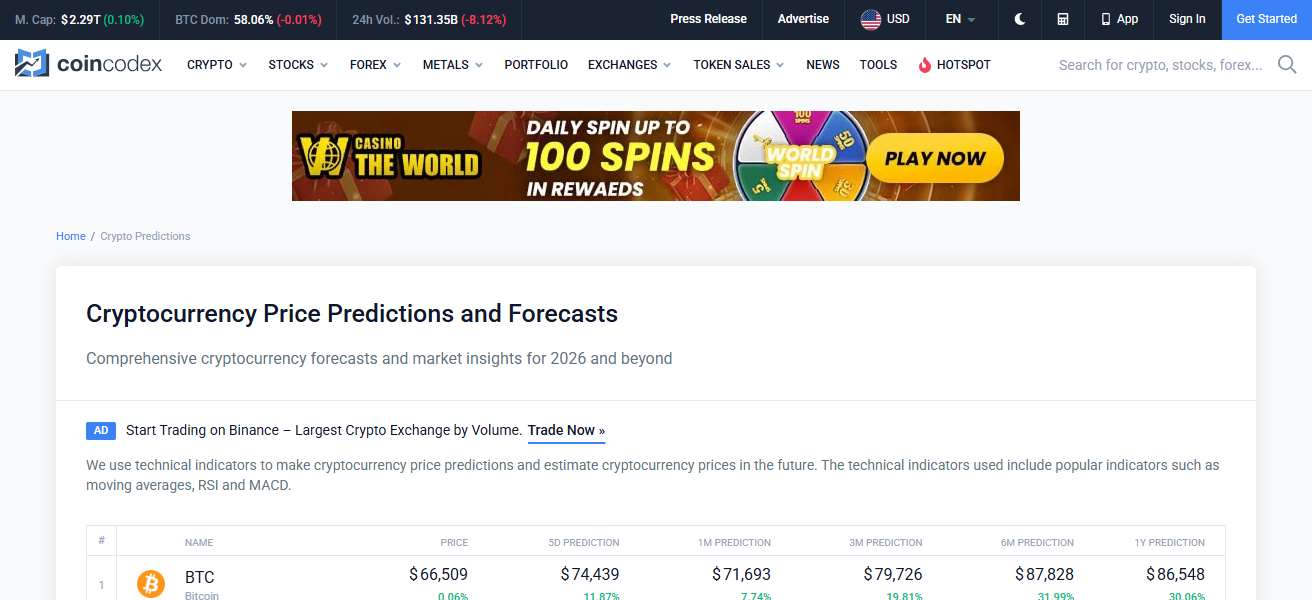
They utilize the Fear & Greed Index combined with other on-chain metrics and trend indicators. CoinCodex is better suited for short to medium term forecasting than long-term valuations.
They offer probability forecasts instead of providing fixed endpoints to help traders understand the range of volatility as opposed to a single target price.
CoinCodex AI Predictor Features
- Multi-Factor Predictions: Offers multiple price prediction scenarios for Ethereum (bullish, neutral, bearish).
- Sentiment Analysis Optimized: Uses the Fear and Greed Index and social sentiment metrics.
- On-Chain Data Analysis: Detects patterns in Ethereum network data.
- Inclusive Forecasting: Provides a range of likelihoods for price movements instead of a single prediction.
| Pros | Cons |
|---|---|
| Offers multiple price scenario views | May overwhelm with too many possibilities |
| Integrates sentiment and on‑chain metrics | Forecasts not always actionable alone |
| Probability‑based outputs improve risk framing | Dependent on quality of input indicators |
| Useful for medium‑term decisions | Less precise for long‑term valuation targets |
9. TradingView AI Models
TradingView has integrated AI into its charting ecosystem, where users can add their own scripts and utilize AI alongside technical indicators and community scripts as a form of machine learning.
On tradingview, Ethereum predictions utilize charting patterns, RSI, MACD, and other algorithms.
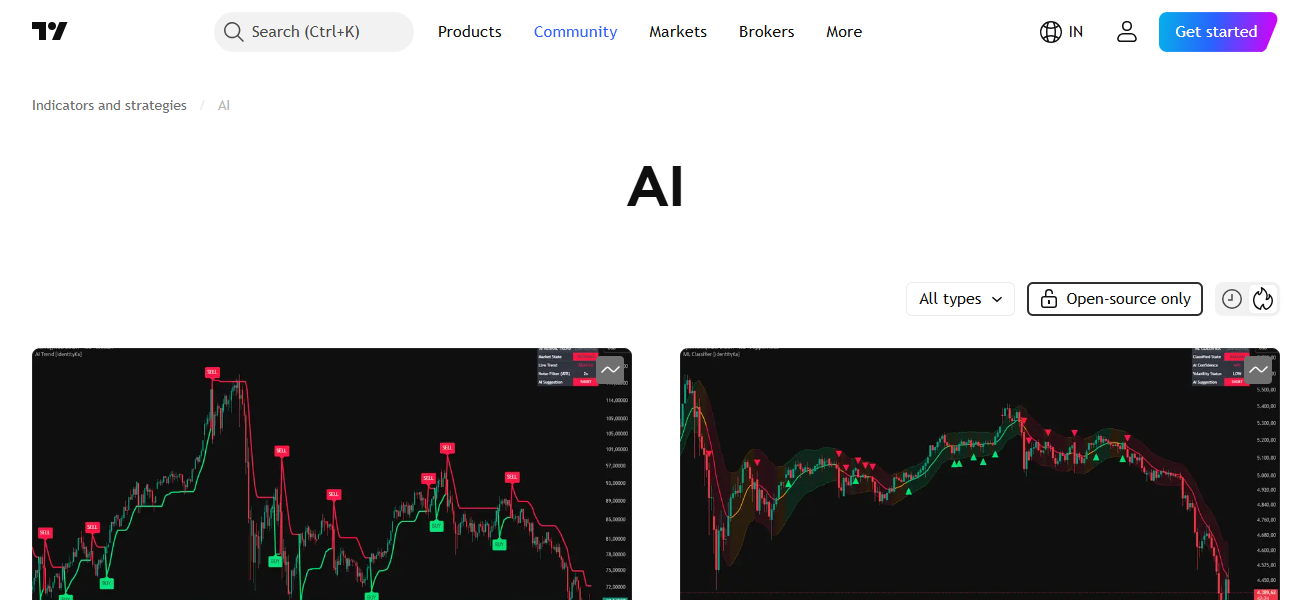
Based on already computed community AI predictions, Ethereum could range from $3,000 to $18,000, depending on market behavior.
These models are used to make real-time trading decisions, and they are constructed to be most effective for short-term predictions rather than long-term risk horizon macro forecasts.
TradingView AI Models Features
- Technical Indicator Integration: AI combines with technical indicators such as RSI and MACD for trading strategies.
- Community Algorithm Integration: Enhances prediction accuracy through the use of algorithms created by users.
- Real-Time Trading Insights: Along with the changing conditions in the market, continually updated predictions are made.
- Adaptive Learning: Learns from the evaluation of previous predictions and the input of the trader to improve the accuracy of their forecasts.
| Pros | Cons |
|---|---|
| Excellent chart pattern and indicator synergy | Heavy reliance on technical indicators |
| Leverages community scripts for diverse strategies | Forecast quality varies by script quality |
| Real‑time signals support trading decisions | Not designed for macro forecasting |
| Adaptive learning improves over time | Lacks unified macro narrative integration |
10. Finbold AI Agent
Finbold’s AI agent combines prediction data from several different sources, such as ChatGPT and market data tools, and forms consensus forecasts.
It focuses more on the aggregation of the AI data, rather than the generation of any new data from independent models.
Specifically, Finbold publishes consensus AI predictions for Ethereum, and describes potential bullish (institutional adoption, scaling upgrades) and bearish (regulation, competition) catalysts and risks. Finbold’s overview is valuable, though its predictions rely on the more or less biased models of the AI.
Finbold AI Agent Features
- Consensus Forecasting: Eth predictions are refined by taking the average of multiple AIs.
- Macro and Micro Insights: Adoption trends, regulations, and other market drivers.
- Balanced Risk Analysis: Identifies bullish drivers and risks related to Ethereum.
- Data Aggregation Strength: The better and more numerous the underlying AI sources are, the better the forecast.
| Pros | Cons |
|---|---|
| Aggregates multiple models for consensus | Dependent on underlying model quality |
| Balanced risk and reward perspectives | Consensus may dilute sharp forecasts |
| Integrates macro & micro signals | Not specialized — generalist approach |
| Highlights both growth drivers and threats | Can be slower to reflect market shifts |
Which AI model is Considered most suitable for long-term Ethereum forecasting and why?
Extended Horizon: While most models forecast up to 1–5 years, CoinCodex estimates Ethereum prices until 2050.
Data Integration: Incorporates historical price data, moving averages (50-day, 200-day), RSI, and volatility.
Macro Perspective: Uses market sentiment (Fear & Greed Index) and adoption trends for long-term horizons.
Consistency: Offers estimates for end of year, to cut out daily fluctuations.
Transparency: Offers clear price predictions (e.g. $4,295 by 2030, $10,297 by 2050).
How To Choos AI Models Forecasting Ethereum’s Future
Forecast time period – Depending on your goal, decide long term (Gemini, Copilot) vs short term (Grok, TradingView).
Data Type – See if the AI considers technical, on-chain, sentiment, or macro data.
Trustworthiness – Seek models that back up the presented model with historical backtesting (LightGBM, DeepSeek).
Scenario Analysis – Prefer models with multiple outcomes (ex: CoinCodex, Gemini) to single predictions.
Risk Consideration – Analyze whether the AI accounts for the ever-changing nature and regulation of the data, volatility, and the adoption model.
User-friendliness – Think of the means of the interface and practicality for trading and research.
Conclsuion
To sum up, AI models predicting Ethereum, help traders, investors, and analysts to develop their strategies. From scenario planning for the long-term with Gemini to monitoring real-time sentiment with Grok, each model has their built-in advantages, as well as drawbacks.
Using multiple AI models can improve precision and help Ethereum traders and investors mitigate risk and make better choices.
FAQ
Gemini (Google) is considered most suitable due to multimodal data and scenario-based reasoning.
Yes, models like Grok (xAI) and TradingView AI focus on real-time sentiment and technical indicators.
No, they provide probabilistic forecasts, not guaranteed prices.
They analyze social media, news, and retail behavior to gauge market trends.