This article tells about Best AI Solutions For Financial Data Lineage Tracking AI-powered tools are being used by financial institutions more and more frequently to assist in tracking how data flows, transforms and affects reporting.
- Key Poinst & Best AI Platforms for Financial Data Lineage Tracking
- 10 Best AI Platforms for Financial Data Lineage Tracking
- 1. Atlan
- 2. Alation
- 3. Julius AI
- 4. OvalEdge
- 5. Informatica Enterprise Data Catalog
- 6. Collibra Data Intelligence Cloud
- 7. Microsoft Purview
- 8. Talend Data Fabric
- 9. IBM Knowledge Catalog
- 10. MANTA Automated Lineage
- How To Choose Best AI Platforms for Financial Data Lineage Tracking
- Cocnlsuion
- FAQ
They provide automated lineage, ensure compliance, enhance governance and deliver actionable insights. The appropriate solution allows organizations to preserve accuracy, transparency, and efficiency in managing complex flows of financial data.
Key Poinst & Best AI Platforms for Financial Data Lineage Tracking
Atlan Cloud-native platform enabling financial teams to visualize, track, and govern complex data lineage seamlessly.
Alation Focuses on governance, showing data origins, ownership, and trust levels for financial compliance assurance.
Julius AI Simplifies financial data lineage by answering relational queries, ensuring transparency across distributed financial systems.
OvalEdge Open-source lineage solution offering AI-driven automation, governance support, and scalable financial data tracking.
Informatica Enterprise Data Catalog Provides automated lineage mapping, compliance monitoring, and metadata management for financial institutions globally.
Collibra Data Intelligence Cloud Delivers governance, lineage visualization, and compliance tools tailored for financial data ecosystems.
Microsoft Purview Integrates with Azure, offering automated lineage tracking, compliance reporting, and financial data governance.
Talend Data Fabric Combines integration and governance, ensuring financial data lineage transparency across hybrid environments.
IBM Knowledge Catalog AI-powered catalog enabling financial institutions to trace, govern, and secure sensitive data lineage.
MANTA Automated Lineage Specialized in deep lineage visualization, helping financial firms meet regulatory requirements efficiently.
10 Best AI Platforms for Financial Data Lineage Tracking
1. Atlan
Atlan is a next generation, AI‑native metadata and data intelligence platform specializing in end‑to‑end automated data lineage, tracing the nodes of its lineage between sources via pipelines, warehouses and BI tools to ML workflows.
It builds cross‑system, column‑level lineage with impact and root‑cause analysis built in to speed trust and compliance across complex environments.
Atlan connects broad 100+ connectors, proactively syncs and updates the lineage while contextualizing the metadata that leads up to them by embedding it inside your BI & analytics tool for a fast decision‑making environment.
| Pros | Cons |
|---|---|
| End-to-end automated lineage across pipelines, warehouses, BI, and ML workflows. | Advanced features can be overwhelming for smaller teams. |
| Cross-system, column-level lineage with impact and root-cause analysis. | Higher cost for mid-market deployments. |
| Supports 100+ connectors and proactive lineage updates. | May require training for full utilization. |
| Embeds contextual metadata in BI and analytics tools for faster decision-making. | Implementation can be complex in highly customized environments. |
2. Alation
Alation is a popular data intelligence and cataloging platform, renowned for its search‑driven discovery and adoption in BI communities and by analysts.
It leads lineage by collecting metadata and query history that show how data moves through systems and reports.
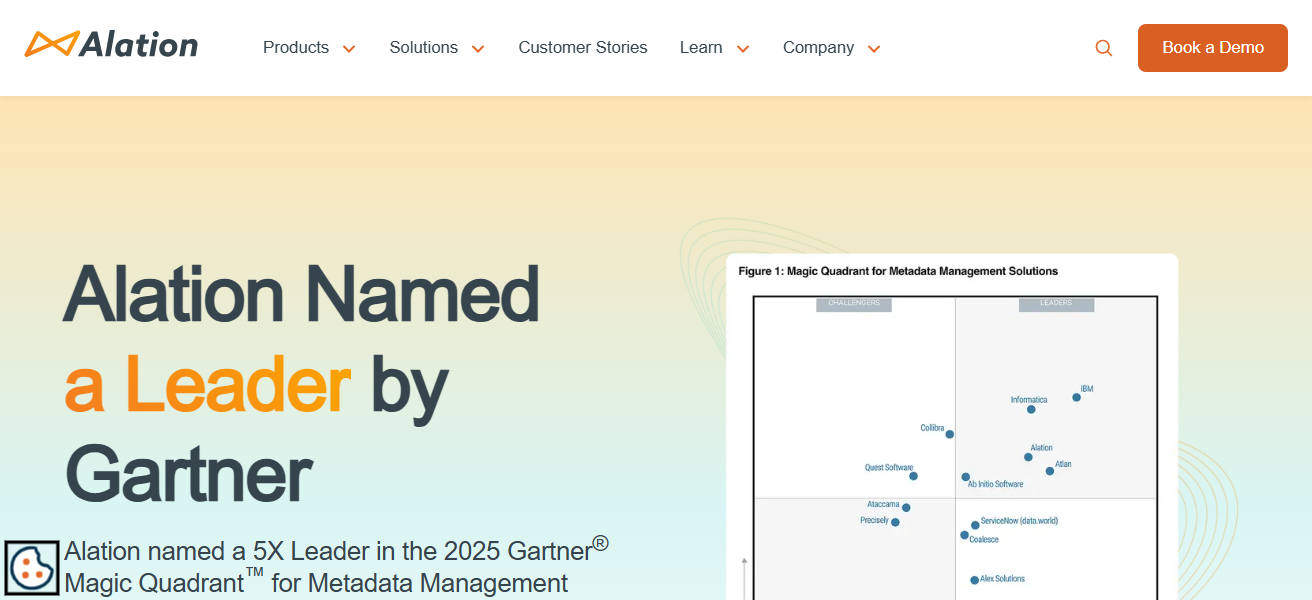
Although more oriented towards catalogue, governance and business context rather than deep technical lineage books, Alation’s strong behavioral analytics helps pontential users to understand usage patterns as well as asset trust that makes it useful for governance‑centered lineage insights.
| Pros | Cons |
|---|---|
| Strong search-driven discovery for datasets and reports. | Focused more on catalog and governance than deep technical lineage. |
| Behavioral analytics helps understand usage patterns and asset trust. | Limited full automation for complex pipeline lineage. |
| Supports business-centric governance and metadata management. | May not provide granular lineage for technical engineers. |
| Widely adopted by analyst and BI communities. | Setup and integration can be time-intensive in large environments. |
3. Julius AI
Julius AI is an AI-powered tool for conversational data analysis that allows users to ask natural-language questions about dataset relationships.
Rather than deliver a complete lineage map as traditional tools do, Julius AI reads table and columns relation to answer questions like which tables feed a report or what are the dependencies between assets.
It connects to databases like Snowflake, BigQuery and PostgreSQL so it learns structure over time, making it available for business users who are exploring lineage.
| Pros | Cons |
|---|---|
| Natural-language queries to explore dataset relationships. | Does not produce full lineage maps. |
| Interprets table and column dependencies for easier analysis. | Limited use for compliance or audit purposes. |
| Learns dataset structure over time, improving insights. | Technical depth less than traditional lineage tools. |
| Business-user friendly interface for exploring lineage. | Best suited for exploration rather than enterprise governance. |
4. OvalEdge
Overall, OvalEdge is a unified data intelligence platform to capture metadata, lineage, quality & governance in one place.
It generates lineage that connects data sources, ETL jobs, pipelines and BI tools — allowing teams to see how their data flows through and is used across environments.
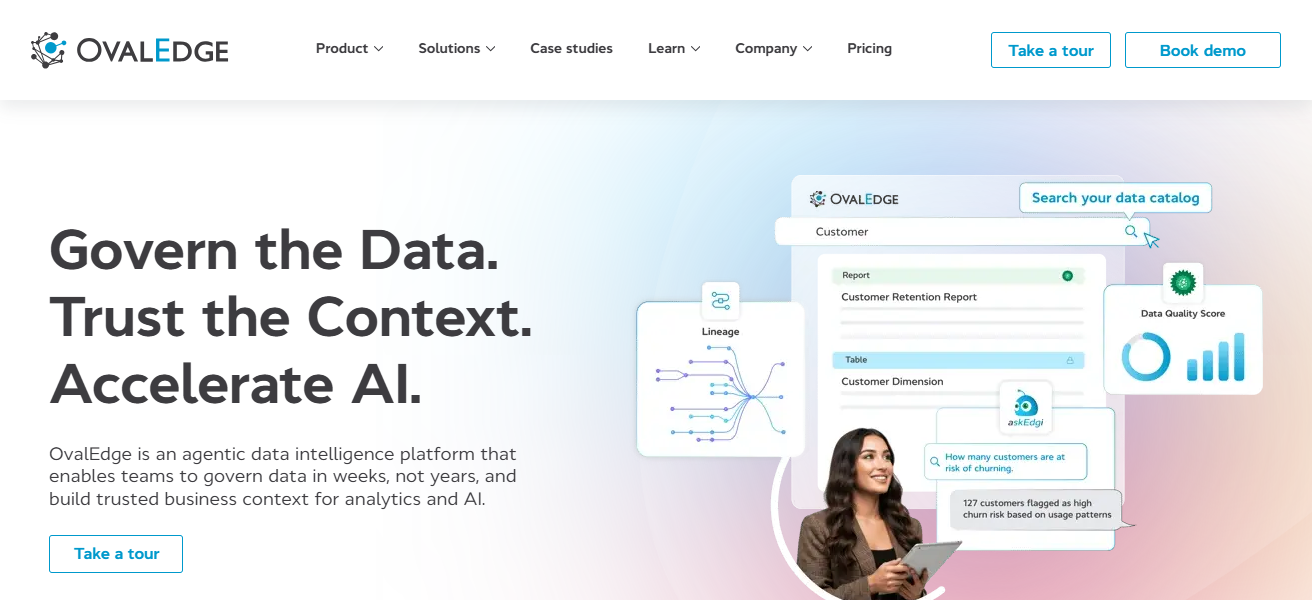
It provide a shared ecosystem that provides visibility of who accessed data and the transformations
Performed on it in context together for technical as well as business users, making it apt to cater any governance or operational lineage workflows.
| Pros | Cons |
|---|---|
| Combines metadata, lineage, data quality, and governance. | UI can be complex for new users. |
| Visualizes data transformations and access patterns. | Large complex data estates may require configuration. |
| Facilitates compliance visibility and audit tracking. | Advanced lineage features may require technical expertise. |
| Suitable for both technical and business users. | Some advanced reporting may need customization. |
5. Informatica Enterprise Data Catalog
Informatica (part of Informatica Intelligent Data Management Cloud) provides complete enterprise metadata and lineage solutions.
It scans through metadata across the ETL, cloud, mainframe, BI and data lakes provides extensive impact analysis as well as compliance reporting.
Its pedigree is closely related to its larger governance suite and fuels hybrid environments, although users report a sharper learning curve and UI that can be orthodox for complex deployments.
| Pros | Cons |
|---|---|
| Scans metadata across ETL, cloud, mainframe, BI, and data lakes. | Steep learning curve for new users. |
| Provides detailed impact analysis and compliance reporting. | Traditional UI can slow adoption. |
| Supports hybrid and multi-environment deployments. | Complex deployment for smaller teams. |
| Integrates with broader governance and data management suite. | May require specialized training for advanced features. |
6. Collibra Data Intelligence Cloud
Collibra is an enterprise governance platform with visual, column‑level lineage integrated with policy management, business glossary, and trust scores.
Collibra’s lineage includes sources to analytics, governance workflows and rich compliance context making it very well suited for industries where audit is mandated such as finance or pharmaceutical.
This structured, governance and stewardship-oriented approach ensures that technical metadata aligns with business processes.
| Pros | Cons |
|---|---|
| Visual, column-level lineage with governance integration. | Technical lineage depth may be less granular than specialized tools. |
| Supports policy management, business glossary, and trust scores. | Implementation can be lengthy. |
| Ideal for regulated industries with strict audit requirements. | Primarily governance-focused rather than technical. |
| Strong stewardship workflows for aligning business and technical metadata. | Licensing costs can be high. |
7. Microsoft Purview
Microsoft Purview (part of the purview suite now) is a unified data governance and compliance service that encompasses lineages across Azure data services and various other enterprise sources.
It creates entity‑ and column‑level lineage graphs by crawling metadata which enables teams to get a view of data movement and transformation.
Integrating tightly with Azure, Power BI and Microsoft 365 ecosystems, Purview also supports classifications and access policies as a piece of its governance stack
| Pros | Cons |
|---|---|
| Captures lineage across Azure services and diverse enterprise sources. | Best suited for Azure-centric environments. |
| Builds entity- and column-level lineage graphs. | Limited connectors outside Microsoft stack. |
| Supports classifications and access policies. | Full automation setup may require expertise. |
| Integrates with Power BI and Microsoft 365 ecosystems. | Less flexible for non-Microsoft ecosystems. |
8. Talend Data Fabric
Talend Data Fabric is a comprehensive data integration and governance solution with the capability of tracking data lineage on ETL and transformation processes.
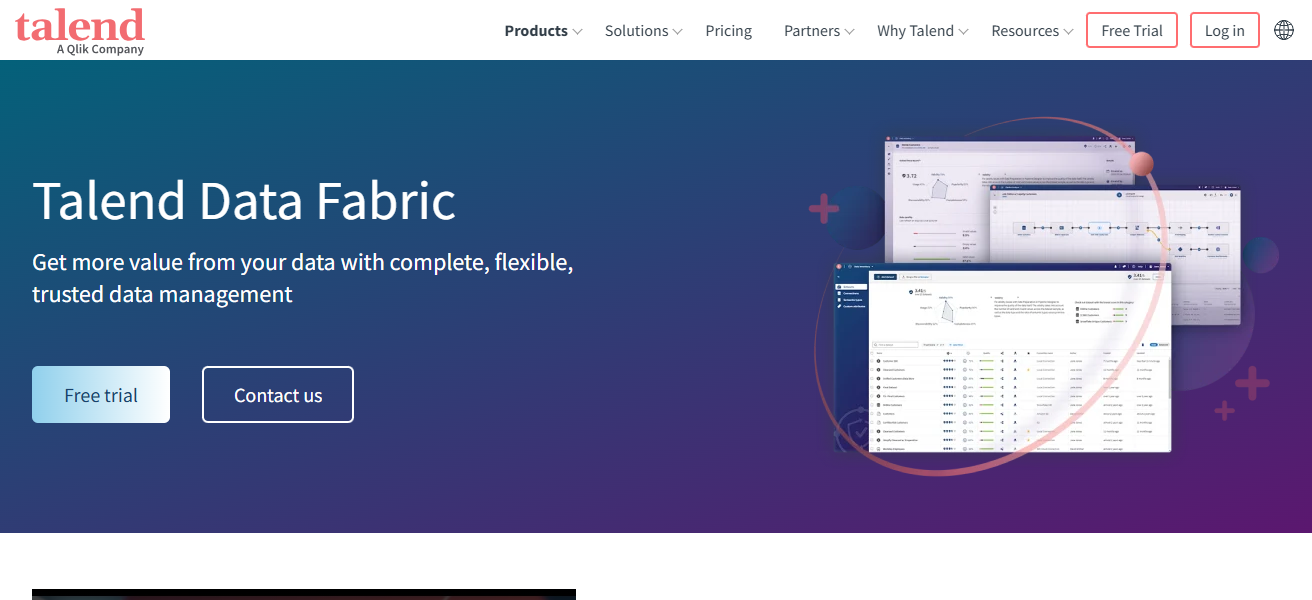
It helps visualize lineage across hybrid cloud and on‑premises environments, captures real time lineage for data movements, and connects lineage with data quality and governance capabilities.
Talend’s coverage of data lakes, warehouses and processing engines is so good that it makes them a flexible choice for complex data pipelines.
| Pros | Cons |
|---|---|
| Tracks ETL and transformation workflows with lineage. | UI and visualization can be dense for users. |
| Supports real-time lineage capture across hybrid cloud/on-prem. | Some advanced integrations need technical expertise. |
| Links lineage with data quality and governance features. | Limited AI-driven automation compared to other platforms. |
| Flexible for complex data pipelines and multiple environments. | Learning curve for mastering full feature set. |
9. IBM Knowledge Catalog
Watson Studio: IBM Knowledge CatalogIBM watsonx It can be logically grouped by creating a data ecosystem that organizes technical and business metadata, which provides lineage and supports governance initiatives.
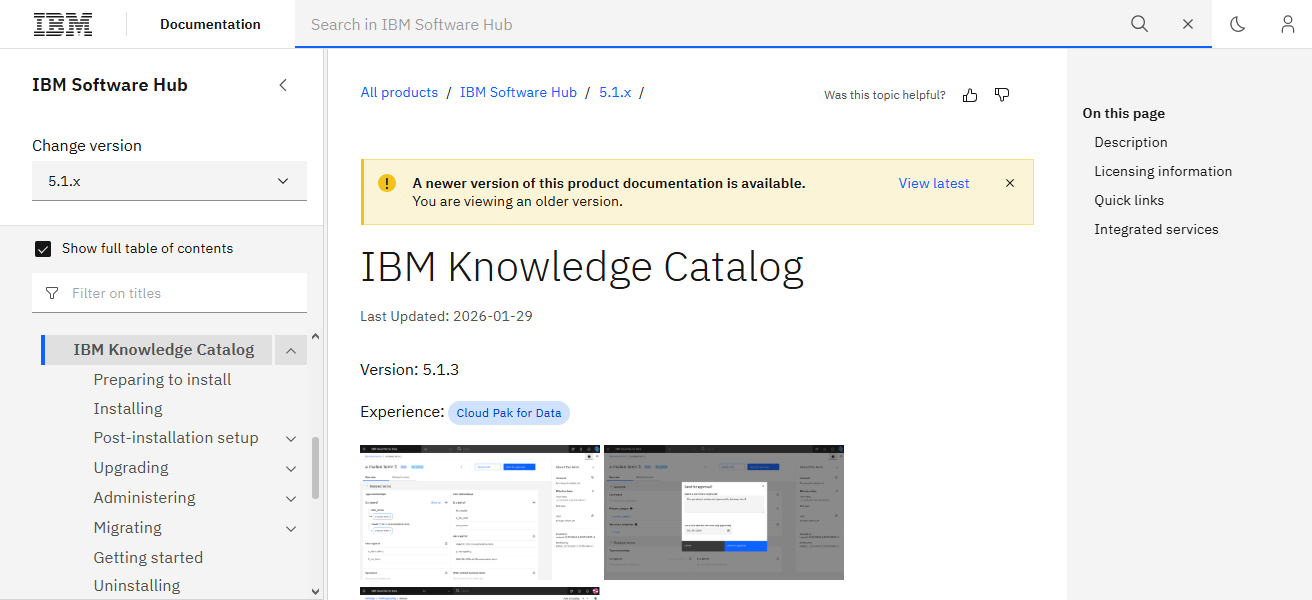
Prometheus subsequently announced that it has integrated with IBM Manta Data Lineage to automate the scanning of data flows from their origin all the way to consumption.
This combination gives deep observability into complex pipelines, enables hybrid and multicloud environments, and helps teams debug errors and ensure audit readiness.
| Pros | Cons |
|---|---|
| Integrates with IBM MANTA for automated lineage scanning. | Integration complexity can be high. |
| Supports hybrid and multi-cloud pipelines. | Requires familiarity with IBM ecosystem. |
| Combines technical and business metadata for audit readiness. | Licensing and cost can be significant. |
| Helps trace errors and ensures compliance and governance. | Implementation may require specialized skills. |
10. MANTA Automated Lineage
MANTA (now a part of IBM’s lineage solutions) specializes in automated, deep-dive on-lineage discovery which is done by parsing code, ETL definitions and query logic.
Its active lineage generated dynamic, cross‑platform jobs having deep release graphs of transformation performed on data.
MANTA’s focus on automation and granular technical detail makes it particularly helpful for engineering teams that require fine-grain impact analysis, as well as continuous monitoring of lineage paths across extensive data estates.
| Pros | Cons |
|---|---|
| Fully automated, detailed technical lineage. | Less business-user friendly interface. |
| Produces real-time, in-depth lineage graphs. | Strong technical expertise required. |
| Parses code, ETL, and queries for precise impact analysis. | Primarily focused on engineering pipelines. |
| Ideal for large-scale, complex data estates. | Less suited for governance or cataloging tasks. |
How To Choose Best AI Platforms for Financial Data Lineage Tracking
Check Integration Capabilities Select a platform that seamlessly integrates with your current data formulas, be it data warehouses, ETL tools, BI platforms or cloud services.
Evaluate AI & Automation Strength With strong AI come automated lineage discovery, natural‑language querying, and root‑cause analysis. This minimizes manual effort and provides quicker insights.
Consider Compliance Support With financial institutions, select tools that have robust governance, policy enforcement and audit trail capabilities.
Look at Usability Intuitive and business context ensures analysts and non‑technical teams can leverage lineage insights effectively.
Review Scalability & Performance Confirm that the tool can help you work with the volume and complexity of your data, especially with large systems.
Examine Support & Community Good documentation, vendor support and user community can reduce the time needed to deploy solutions and resolve their problems.
Cocnlsuion
Conclusion The selection of an appropriate AI platform for financial data lineage is paramount to guarantee precise tracking, adherence to regulations, and efficient operations.
Other powerful platforms such as Atlan, Collibra, MANTA and Informatica offer considerable automation/ governance & tech depth.
With an emphasis on integration, usability, AI-driven insights and regulatory support organizations can confidently manage complex data flows with reduced risk while accelerating decision-making across their financial data ecosystems.
FAQ
Data lineage tracking maps how data flows from source to destination, showing transformations and dependencies.
Atlan, MANTA, Talend, and IBM Knowledge Catalog provide automated end-to-end lineage.
Yes, tools like Julius AI, Atlan, and Alation offer user-friendly, business-focused insights.
Enterprise-level tools can be costly, but pricing varies based on features, connectors, and deployment size.