In this article, I will talk about the best Odoo alternatives for Inventory Management that can help simplify your business processes.
- Key Points & Best Odoo Alternatives for Inventory Management
- 10 Best Odoo Alternatives for Inventory Management
- 1. Fishbowl Inventory
- 2. Zoho Inventory
- 3. Cin7 Core
- 4. Megaventory
- 5. Unleashed Software
- 6. Kintone
- 7. Extensiv 3PL Warehouse Manager
- 8. NetSuite ERP
- 9. QuickBooks Commerce
- 10. SAP Business One
- How To Choose Best Odoo Alternatives for Inventory Management
- Conclsuion
- FAQ
Selecting the best kinds of inventory software is important for precision, productivity, and advancement.
Odoo is widely used, but there are numerous alternatives with more tailored functionality, improved scalability, or easier user interfaces. This will review some of the best tools for managing inventory, order, and warehouse operations.
Key Points & Best Odoo Alternatives for Inventory Management
| Alternative | Key Point |
|---|---|
| Fishbowl Inventory | Strong manufacturing and warehouse integration |
| Zoho Inventory | Affordable cloud-based solution with multichannel sales |
| Cin7 Core | Advanced automation and retail integrations |
| Megaventory | User-friendly interface with order management |
| Unleashed Software | Powerful analytics and real-time stock visibility |
| Kintone | Customizable workflows and collaboration features |
| Extensiv 3PL Warehouse Manager | Tailored for third-party logistics providers |
| NetSuite ERP | Comprehensive ERP with strong inventory control |
| QuickBooks Commerce | Easy integration with accounting and e-commerce |
| SAP Business One | Enterprise-grade inventory and supply chain management |
10 Best Odoo Alternatives for Inventory Management
1. Fishbowl Inventory
The strength of Fishbowl Inventory as an Odoo alternative takes shape in its easy integration with other systems and its strong manufacturing and warehouse capabilities.
Disssimilar from Odoo, Fishbowl emphasizes inventory control and automation, with additional features like advanced reorder point automation, tracking of multiple locations, and barcode scanning across multiple locations.
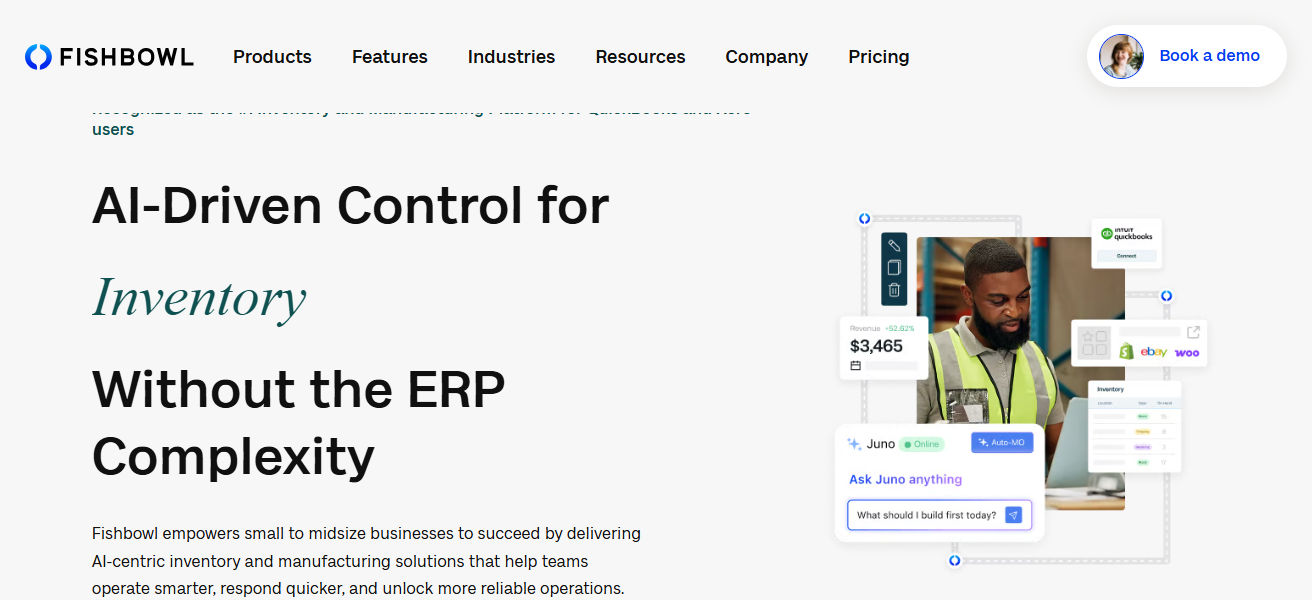
Fishbowl Inventory also provides efficiency and accuracy in real time with QuickBooks integration, best filling the needs of developing businesses.
The reliability of Fishbowl Inventory also comes from its ability to maintain complexity and flexibility in its inventory control systems.
Fishbowl Inventory Faetures
- Advanced Warehouse Management – Helps streamline warehouse operations through support for multi-location inventory, bin tracking, and barcode scanning.
- Manufacturing Integration – Provides a fully integrated solution for manufacturing businesses with work order management, a bill of materials, and production tracking.
- QuickBooks Integration – Provides seamless inventory sync for accurate accounting and reporting with QuickBooks.
- Automated Reordering – Tracks stock depletion and in turn, activates reorder triggers, preventing stockouts.
| Pros | Cons |
|---|---|
| Advanced manufacturing and warehouse management features | Can be expensive for small businesses |
| Seamless QuickBooks integration | Steeper learning curve for new users |
| Real-time inventory updates | Limited e-commerce platform integrations compared to others |
| Supports multi-location tracking | Requires additional modules for some advanced features |
| Automates reorder points to reduce stockouts | Interface may feel outdated to some users |
2. Zoho Inventory
Zoho Inventory is arguably among the best alternatives to Odoo for inventory management because of the blend of powerful functionality, user-friendly design, and focus on small and medium businesses.
Unlike Odoo, Zoho Inventory supports seamless multichannel selling, automatic order syncing, hassle-free integration, and a smooth connection to the Zoho ecosystem, leading cloud apps, and top eCommerce platforms.
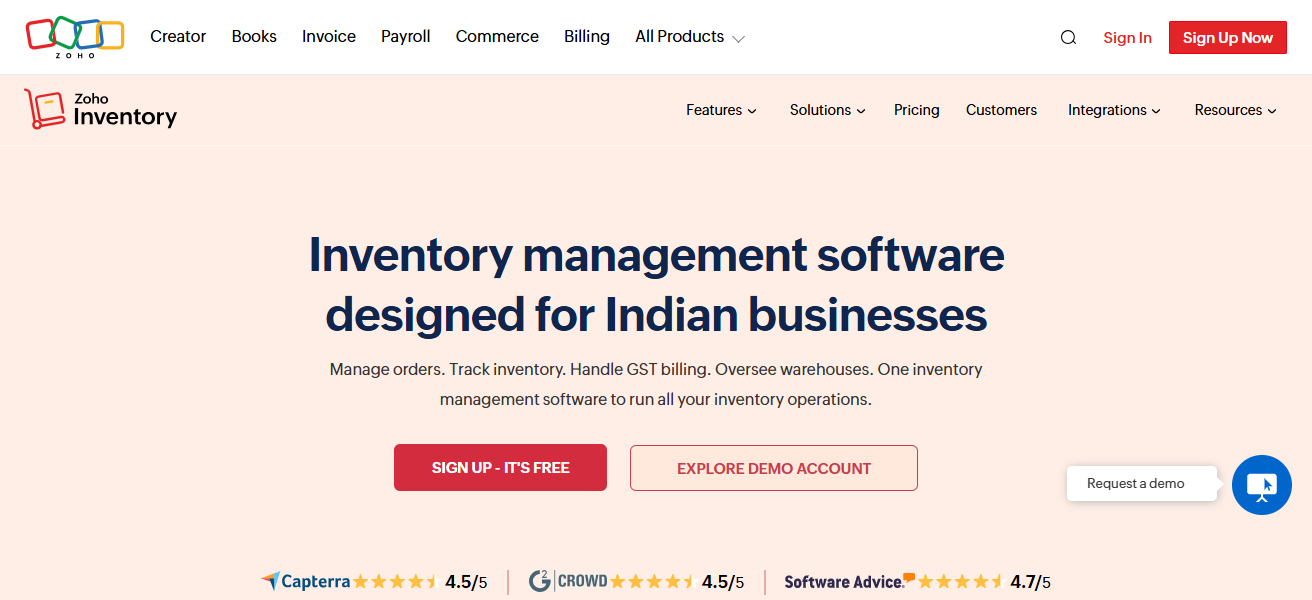
The ability to oversee all sales, purchases, and stock movements within a single dashboard is the functionality that most sets Zoho Inventory apart.
This feature minimizes time and error and highly equips Zoho Inventory, efficiency-wise, to be a cost-effective and scalable solution for a growing business.
Zoho Inventory Faetures
- Multi-Channel Selling – Centralizes order management through integrated sales on e-commerce platforms like Shopify, Amazon, and eBay.
- Order and Stock Automation – Efficiently manages backorders and streams cross-channel stock level updates.
- Invoicing and Accounting Integration – Provides seamless financial tracking through sync with Zoho Books and other accounting software.
- Real-Time Inventory Tracking – Offers immediate insights on stock movement, hence, smarter planning and error reduction.
| Pros | Cons |
|---|---|
| User-friendly and intuitive interface | Limited advanced manufacturing features |
| Multi-channel sales integration | Free plan has restricted features |
| Seamless integration with Zoho ecosystem | Reporting customization is limited |
| Automated order and stock syncing | Can be less suitable for very large businesses |
| Affordable for small to medium businesses | Some users report occasional syncing delays |
3. Cin7 Core
Cin7 Core is one of the best alternatives to Odoo for inventory management because it has a fully integrated cloud-based system that unifies inventory, sales, and supply chain management in real time.
Unlike Odoo, which can be complicated for multi warehouse and sales channel visibility, Cin7 Core end to end visibility is its strongest differentiator.
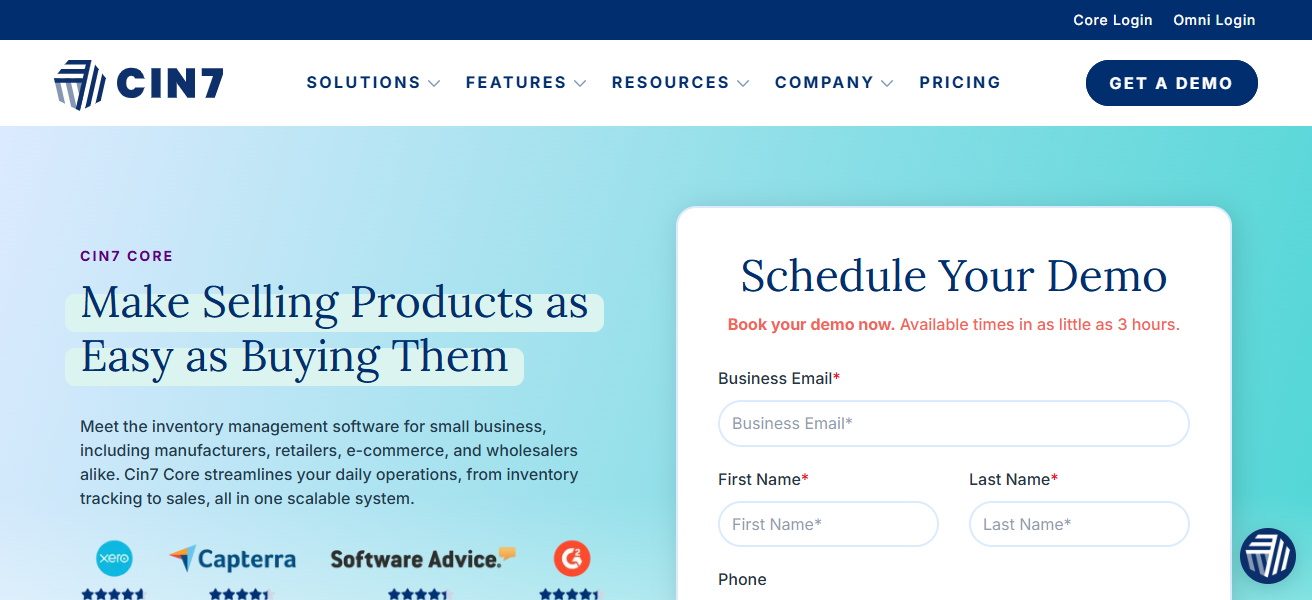
Cin7 Core’s complex inventory workflows are simplified by automated stock updates, integrated barcode scanning, and easy integrations with e-commerce and accounting software.
Cin7 is perfect for businesses that want to streamline their operations with more control, efficiency, and growth.
Cin7 Core Faetures
- Cloud-Based Inventory Management – Offers instant stock updates from all warehouses and locations.
- Multi-Channel Retail Integration – Offers seamless connections to e-commerce, POS, and marketplaces for integrated sales and inventory tracking.
- Barcode Scanning and Automation – Simplifies and streamlines processes in receiving, picking, and shipping, and minimizes human mistakes.
- Scalable System – Built to adapt to business growth, it can manage complex processes and high operational workloads.
| Pros | Cons |
|---|---|
| Cloud-based solution with end-to-end visibility | Can be pricey for small businesses |
| Strong multi-warehouse and multi-channel management | Setup may require professional assistance |
| Built-in barcode scanning and stock automation | Learning curve for complex workflows |
| Seamless e-commerce and accounting integration | Overkill for very small businesses |
| Scalable for growing operations | Some advanced features may require add-ons |
4. Megaventory
Odoo has a really good alternative to simple flexible inventory management; Megaventory. It suits small and medium sized businesses.
With Megaventory’s simpleness combined the the powerful tools of order management and production tracking, businesses don’t have to deal with the complex features of larger ERP systems.
Megaventory’s support in multi-location warehouses, batch tracking, and real-time stock updates makes businesses have to deal with more accurate and efficient inventory control.
It also has seamless integrations with accounting and e-commerce software. This will allow businesses to make operation more efficient, reduce errors, and scale. Overall, it is a practical and user-friendly choice.
Megaventory Faetures
- Easy-to-Use Interface – Inventory, order, and production tracking is seamless due to the design support for small and mid-sized companies.
- Multi-Warehouse Support – Tracks inventory in different places and updates in real-time.
- Batch and Serial Tracking – Guarantees quality management and regulation tracking of products.
- Order Management Integration – Sales, purchasing, and inventory management are consolidated in a single system.
| Pros | Cons |
|---|---|
| Simple, easy-to-use interface | Limited advanced analytics |
| Combines inventory, order management, and production tracking | Fewer integrations compared to larger ERPs |
| Supports multi-location warehouses and batch tracking | May lack scalability for very large enterprises |
| Real-time stock updates | Limited customization for complex workflows |
| Affordable for small to medium businesses | Reporting options are basic |
5. Unleashed Software
Unleashed Software, an Odoo alternative, excels in inventory management, emphasizing real-time tracking and control of stock, production, and sales.
With the ability to navigate intricate product costing and multi-warehouse functions, it stands apart in providing businesses with clear snapshots on profitability and inventory.
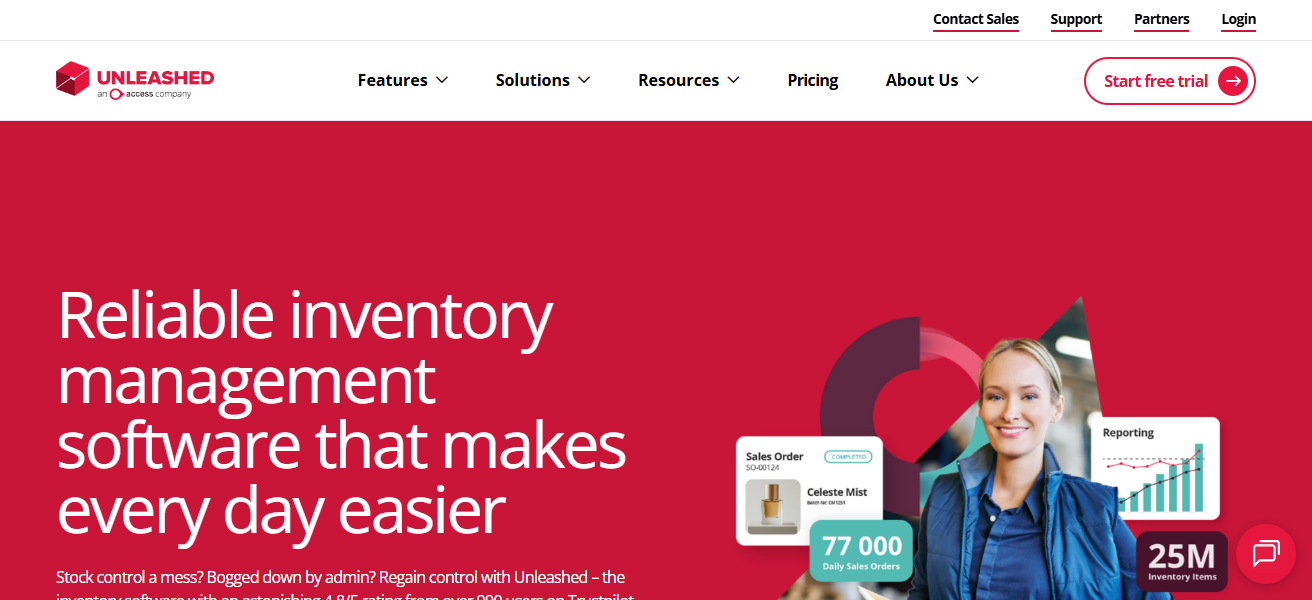
Unleashed integrates powerful analytics with an easy-to-use interface, unlike Odoo, providing employees the ability to manage inventory without lengthy training sessions.
This level of integration, combined with integration to accounting and e-commerce solutions, makes Unleashed a perfect fit for growing businesses.
Unleashed Software Faetures
- Real-Time Inventory Visibility – Gives accurate data on available stock across various warehouses.
- Costing and Profitability Analysis – Assists in effective pricing and inventory tactics by tracking product costs and profit margins.
- Multi-Warehouse Management – Effectively manages the stock distribution across various locations.
- Integration Capabilities – Accountancy, e-commerce, and CRM systems interoperability for operational efficiency.
| Pros | Cons |
|---|---|
| Handles complex product costing and multi-warehouse management | Can be expensive for small businesses |
| Real-time inventory visibility | Learning curve for beginners |
| Powerful analytics and reporting | Limited offline capabilities |
| Seamless integration with accounting and e-commerce | Some advanced features require add-ons |
| Intuitive interface for inventory teams | Customization can be limited without technical help |
6. Kintone
Kintone is an exceptional Odoo alternative for inventory management, as it is highly flexible and customizable with its no-code platform that can be built out for any business.
Users can create custom inventory applications, automation, and stock tracking for almost any business function without any technical burden.
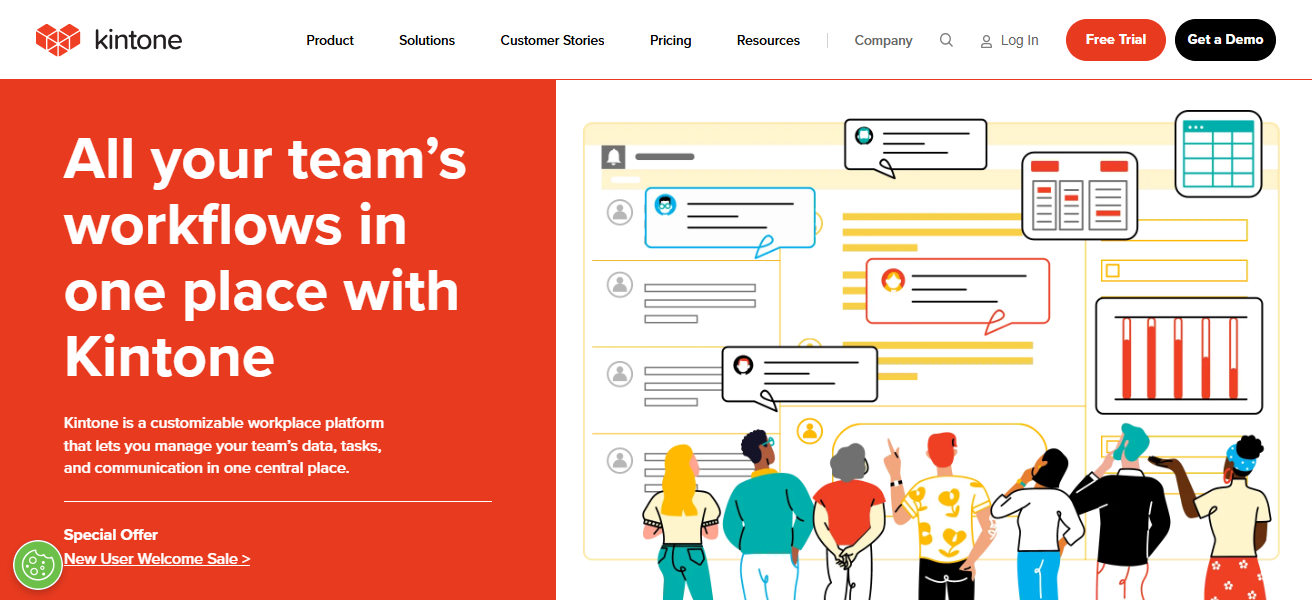
Unlike Odoo, Kintone strongly emphasizes customizability and collaboration across the business. Kintone provides real-time access for all team members, seamless reporting, and effortless integration with other tools.
This makes Kintone the ideal inventory management solution for businesses that require a flexible, scalable, and easy to use solution.
Kintone Faetures
- Customizable No-Code Platform – Enables users to build bespoke inventory management applications without code.
- Automation of Workflows – Minimizes manual processes by automating stock tracking, notifications, and reporting.
- Real-Time Collaboration – Teams can access and share updates on inventory data in real-time from any device.
- Integration with Other Tools – Merges with accounting, CRM, and e-commerce systems for seamless operations.
| Pros | Cons |
|---|---|
| Highly customizable no-code platform | Requires setup to create inventory apps |
| Flexible workflow automation | May need user training for non-technical staff |
| Real-time data and reporting | Less focused on traditional inventory features |
| Easy integration with other business tools | Not ideal for very large enterprises with complex ERP needs |
| Encourages team collaboration | Mobile experience can be limited |
7. Extensiv 3PL Warehouse Manager
Extensiv 3PL Warehouse Manager provides the best alternative to Odoo for inventory management. It is a tailored solution for inventory management for 3PL-based businesses.
What sets it apart is real-time visibility and control of outsourced warehouses. Users are able to track inventory in real time, manage orders, and automate shipping.
Unlike Odoo, it is designed to manage complex 3PL workflows, which decreases errors and streamlines fulfillment.
The integration of multiple e-commerce and accounting applications will enable Extensiv to provide businesses with outsourced warehouses precise control, quick processing, and scalable warehouse management and logistics.
Extensiv 3PL Warehouse Manager Faetures
- 3PL-Focused Management – Tailored for companies that outsource their warehouse services to third-party logistics providers.
- Real-Time Inventory Tracking – Tracks stock, as well as order, and fulfillment processing in real-time.
- Automated Shipping and Fulfillment – Streamlines the order picking, packing, and shipping process for multiple customers.
- Multi-Client Warehouse Support – Permits the management of multiple clients’ inventory from a single interface.
| Pros | Cons |
|---|---|
| Specialized for 3PL warehouse management | Less suitable for in-house inventory operations |
| Real-time inventory tracking and order automation | Pricing can be high for small businesses |
| Supports multi-client warehouses | Limited customization outside 3PL workflows |
| Seamless integration with e-commerce and accounting | Learning curve for new users |
| Reduces fulfillment errors and improves efficiency | Advanced reporting may require add-ons |
8. NetSuite ERP
NetSuite ERP stands out as a top Odoo alternative for inventory management due to its 100% integrated, cloud-based solution for inventory, finance, and supply chain management.
With cutting-edge features like advanced demand planning, multi-location inventory management, and real-time reporting
NetSuite helps businesses achieve superior control over their inventory and operational efficiency.
NetSuite, unlike Odoo, provides a scalable, enterprise-grade solution with automated workflows and advanced analytics to help businesses optimize their inventory, lower costs, and be more proactive in their decision-making.
This combination makes NetSuite one of the best options for growing businesses looking for a fully comprehensive inventory solution.
NetSuite ERP Faetures
- Integrated Cloud ERP – Offers an all-in-one solution for inventory, finance, sales, and supply chain management.
- Advanced Demand Planning – Plans and predicts demand and optimizes stock to avoid shortages or surplus.
- Multi-Location Stock Management – Monitors inventory in real-time across all global warehouses.
- Comprehensive Analytics and Reporting – Offers actionable insights to enhance decision-making and operational efficiency.
| Pros | Cons |
|---|---|
| Fully integrated cloud-based ERP | High cost, suited for medium to large businesses |
| Advanced demand planning and multi-location stock management | Complex implementation |
| Real-time reporting and analytics | Requires professional support for setup |
| Scalable and robust for growing businesses | Can be overwhelming for small teams |
| Automated workflows reduce manual errors | Customization can be complex and costly |
9. QuickBooks Commerce
QuickBooks Commerce is a great alternative to Odoo for managing inventory, especially for small to medium-sized companies that value simplicity as well as the ability to integrate with an accounting system.
One of QuickBooks’ wonderful differentiators is that it offers inventory management, order management, and sales tracking all in one suite. This is especially powerful when integrated with QuickBooks Accounting.
Also, there is an easy set up with Odoo as opposed to QuickBooks, and there is real time stock updating, support for sales across multiple channels, and automated reporting so manual errors are eliminated.
Because of all of this, QuickBooks Commerce is a great choice for companies that want solid inventory management, great operational runs, and financial reporting without the headaches that come with more complicated ERP systems.
QuickBooks Commerce Faetures
- Simple Inventory Management – Monitors stock, sales orders, and shipments in real-time.
- QuickBooks Integration – Connects with QuickBooks Accounting to ensure financial records are up to date.
- Order Consolidation Across Channels — Handles orders from different e-commerce channels in one location.
- Automated Stock Updates — Changes to stock levels are automatically reflected to avoid errors.
| Pros | Cons |
|---|---|
| Simple and user-friendly interface | Limited advanced inventory features |
| Seamless integration with QuickBooks Accounting | Not ideal for very large enterprises |
| Real-time stock updates and order tracking | Multi-warehouse support is limited |
| Supports multi-channel sales | Reporting and analytics are basic |
| Affordable for small to medium businesses | Customization options are minimal |
10. SAP Business One
SAP Business One stands out among the many Odoo alternatives available for ERP systems that include inventory management.
SAP Business One provides real-time inventory updates, batch and serial number management, and inventory and supply chain control analytics.
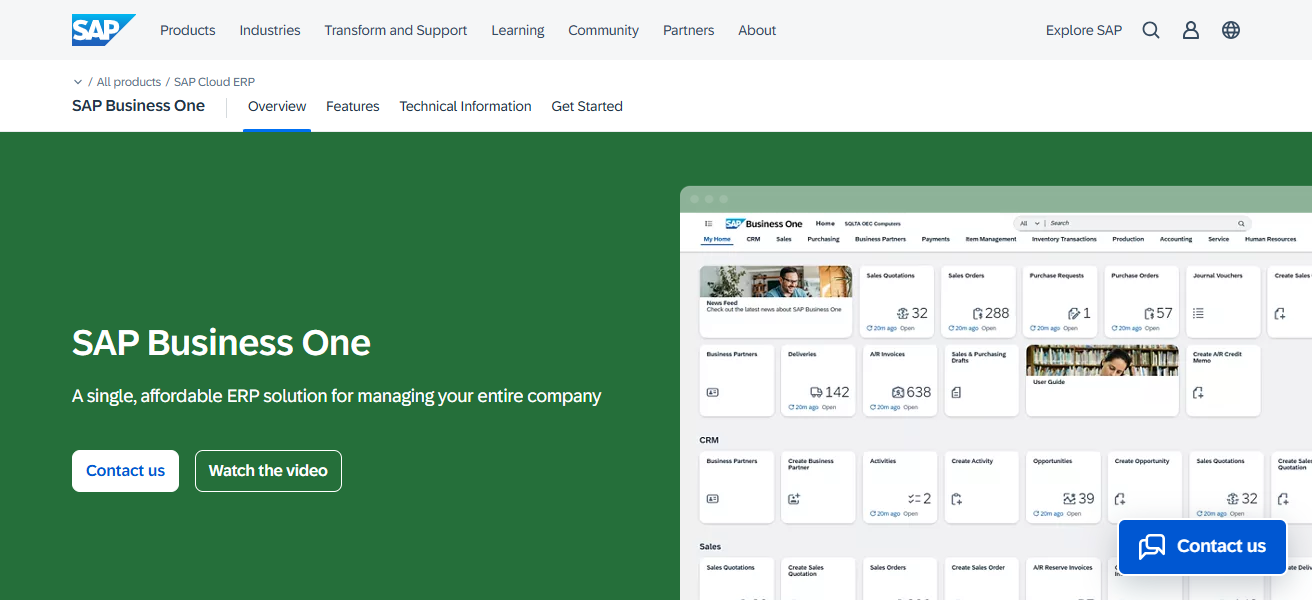
SAP Business One manages finance, sales, and production on one platform, unlike Odoo. SAP Business One is ideal for companies that require precise and efficient inventory management and oversight.
SAP Business One Faetures
- All-in-One ERP Solution — Integrates all aspects of inventory, finance, sales, and supply chain management.
- Compliance and Control — Batch and serial number tracking aids in compliance and control over product movement.
- Active Analytics and Reporting — Provides real-time actionable insights on stock levels and operations.
- Support for Multiple Warehouses and Locations — Effectively tracks inventory across multiple locations.
| Pros | Cons |
|---|---|
| Fully integrated ERP with inventory, finance, and supply chain | High cost for small businesses |
| Real-time inventory tracking and batch/serial number management | Implementation can be complex and time-consuming |
| Advanced analytics and reporting | Requires dedicated IT support for customization |
| Scalable for growing enterprises | Interface can feel complex for beginners |
| Streamlines decision-making and operations | Smaller businesses may not need all features |
How To Choose Best Odoo Alternatives for Inventory Management
- Business Size: select a system that suits your size and complexity for optimal functioning.
- Ease of Use: choose software that helps minimize training and user mistake propensity because of simplified processes.
- Integration Capability: look for systems that can streamline your processes by connecting with accounting, e-commerce, and CRM systems.
- Scalability: choose an option that allows you to add on as your company expands without drastically changing systems.
- Multi-Warehouse Support: Vital for companies that need to control inventories in several locations or distribution centers.
- Real-Time Tracking: supplies updated and precise data for strategic management of inventory and decision making.
- Automation Features: saves time and reduces the possibility of errors by automating orders, re-orders, and reports.
- Cost & ROI: look for a system that offers the most benefit with the lowest cost.
Conclsuion
To sum up, selecting an optimal Odoo alternative for inventory management fosters streamlined operations, enhanced accuracy, and drives growth.
Fishbowl, Zoho Inventory, Cin7 Core, and NetSuite ERP span small to large enterprises, and provide diverse tailored solutions.
Considering these attributes: usability, integrations, scalability, and automation, culminates in effective software selection for stock, order, and warehouse management.
FAQ
Software that provides similar or better inventory, order, and warehouse management features.
Alternatives can offer simpler interfaces, specialized features, or better scalability for your business.
Zoho Inventory and QuickBooks Commerce are ideal for small to medium-sized businesses.
Cin7 Core, Unleashed Software, and SAP Business One efficiently handle multiple warehouses.