This article will cover the AI Crypto Platforms Worth Switching To in 2026, including cutting edge innovations in combining blockchain and artificial intelligence.
- Key Points & AI Crypto Platforms Worth Switching To In 2026
- 10 AI Crypto Platforms Worth Switching To In 2026
- 1. Chainlink (LINK)
- 2. Bittensor (TAO)
- 3. Internet Computer (ICP)
- 4. NEAR Protocol (NEAR)
- 5. Render (RNDR)
- 6. Story IP (STORY)
- 7. Beldex (BDX)
- 8. Virtuals Protocol (VIRTUAL)
- 9. Artificial Superintelligence Alliance (FET/ASI)
- 10. The Graph (GRT)
- How To Choose AI Crypto Platforms Worth Switching To In 2026
- Conclsuion
- FAQ
With the rapid adoption of AI, these platforms are equipped with enhanced capabilities like decentralized compute and data, as well as autonomous agents.
Familiarity with their potential and various use cases, as well as growth possibilities, will assist you in making informed decisions in an emerging AI-driven crypto ecosystem.
Key Points & AI Crypto Platforms Worth Switching To In 2026
Chainlink (LINK) – Decentralized oracle network connecting real‑world data securely to smart contracts and AI ecosystems.
Bittensor (TAO) – Open decentralized machine‑learning network where models earn rewards for contributing valuable AI insights and computation.
Internet Computer (ICP) – On‑chain compute platform enabling AI applications to run directly on decentralized blockchain infrastructure.
NEAR Protocol (NEAR) – Scalable layer‑1 blockchain with AI tooling support and ecosystem growth for autonomous agents.
Render (RNDR) – Token‑incentivized decentralized GPU compute marketplace for AI workloads, graphics, and neural network training.
Story IP (STORY) – AI content and intellectual property platform where creators tokenize and monetize AI‑generated assets.
Beldex (BDX) – Privacy‑focused blockchain integrating AI tools for secure communications, transactions, and decentralized services.
Virtuals Protocol (VIRTUAL) – Decentralized platform for creating, launching, and co‑owning autonomous AI agents with real revenue potential.
Artificial Superintelligence Alliance (FET/ASI) – Unified ecosystem of AI projects advancing decentralized intelligence and autonomous agent collaboration.
The Graph (GRT) – Data indexing and querying layer crucial for AI analytics and smart contract interaction across blockchains.
10 AI Crypto Platforms Worth Switching To In 2026
1. Chainlink (LINK)
Chainlink (LINK) provides oracle services to thousands of blockchains. The token offers off-chain data monitoring and integration of real time data feeds.
This functionality is particularly important for AI systems. Off-chain and event verification data are critical to the trustless operation of autonomous agents.
As the AI workload on blockchains increases so does the value of Chainlink’s Cross-Chain Interoperability Protocol (CCIP).
The value of LINK will also increase as the demand for providing AI applications the ability to securely interact with multi-chain data increases.
LINK’s market cap being at ~8.75B in 2026 (estimated) represents the token’s liquidity and value as a foundational layer for the AI and blockchain ecosystem.
Chainlink (LINK) – Features
- Provides decentralized oracle networks that relay real world information to smart contracts in a secure manner.
- AI agents are able to access reliable and verified data off-chain for price feeds, events and data. (Blockchain Council)
- CCIP supports cross-chain communications for multi-chain AI applications.
- Highly utilized infrastructure in automated AI systems, DeFi, and gaming.
| Pros | Cons |
|---|---|
| Industry-leading oracle network with massive adoption across DeFi and AI ecosystems | Heavy dependence on continued demand for oracle services |
| CCIP enables secure cross-chain interoperability for AI and smart contracts | Competition from emerging oracle solutions |
| Strong liquidity and large market capitalization ensure stability | Growth may be slower due to already mature ecosystem |
| Reliable real-world data feeds for AI agents and automation | Complex integrations for new developers |
2. Bittensor (TAO)
Bittensor (TAO) is an open-source protocol that creates a decentralized marketplace on the blockchain for the training and sharing of machine-learning models.
Bittensor decentralizes the AI development process by paying network contributors in TAO tokens for the quality of data they provide.
Their subnet architecture is designed to provide economic alignment and purpose for each model to perform at or above the level of its marketing.
Growing post-halving token dynamics and real use metrics have granted institutional interest to TAO as a fundamental resource layer for decentralized AI training and collaboration.
Bittensor (TAO) – Features
- Decentralized machine-learning networks that allow models to collaborate and compete for rewards. (CoinDCX)
- Subnet architecture permits independent scaling for specialization in certain AI functions.
- Incentive systems that reward useful AI outputs instead of the mere provision of computational resources.
- Worldwide open marketplace for the training, sharing, and monetization of AI intelligence. (XT)
| Pros | Cons |
|---|---|
| Decentralized AI training marketplace with real economic incentives | Highly complex architecture for beginners |
| Subnet system enables specialized AI model development | Tokenomics can be difficult to understand |
| Rewards based on model usefulness, not speculation | Still evolving with scalability uncertainties |
| Growing institutional interest in decentralized AI networks | High volatility due to emerging market position |
3. Internet Computer (ICP)
Internet Computer (ICP) aims to work as a decentralized “World Computer,” running AI applications and compute-intensive workloads on-chain and not on centralized cloud services.
Its architecture enables high-throughput processing and on-chain data management, making it ideal for self-governing AI and decentralized machine learning applications.
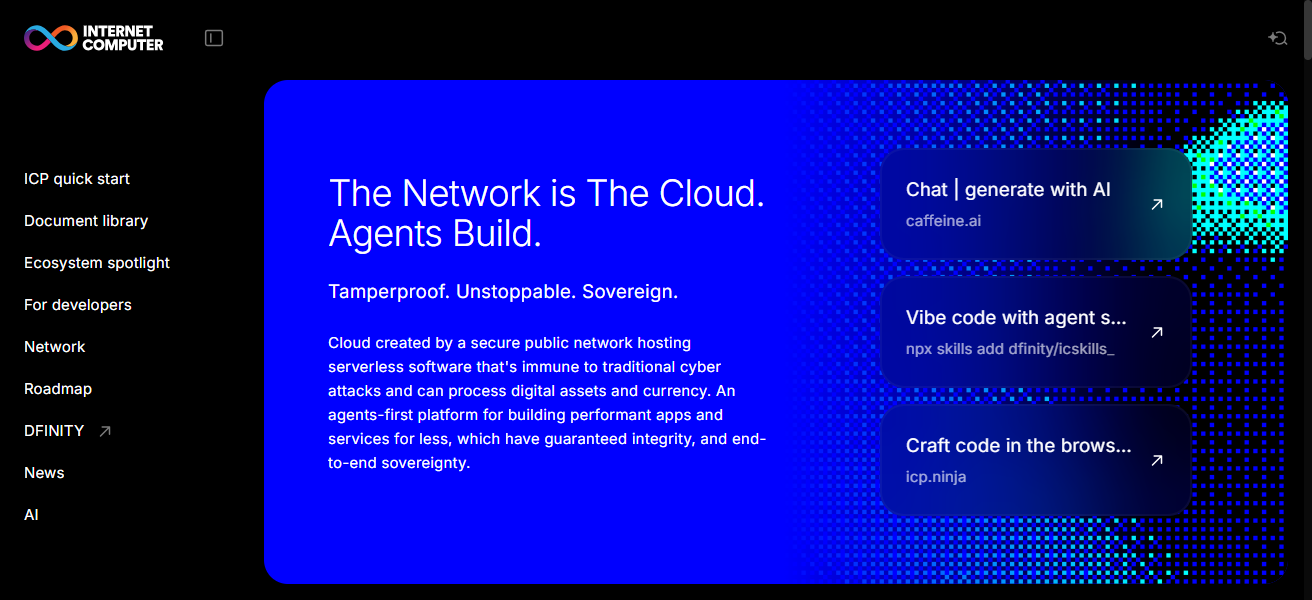
ICP aims to support Web3’s decentralized philosophy by offering scalable compute for AI workloads.
Developers can create AI-driven decentralized applications (dApps) that utilize on-chain storage and logic and, as a result, cloud vendor dependency can potentially be reduced.
Internet Computer (ICP) – Features
- Full-stack applications (frontend + backend) done on blockchain.
- Does not require centralized cloud providers for on-chain AI execution. (XT)
- AI workload smart contracts that are high throughput and scalable.
- Integrated storage and compute to support autonomous AI applications.
| Pros | Cons |
|---|---|
| Fully on-chain compute for AI applications without cloud dependency | Past reputation issues and market trust concerns |
| High throughput suitable for AI workloads and dApps | Developer adoption still growing slowly |
| Enables autonomous AI systems with integrated storage and logic | Complexity in building and deploying applications |
| Reduces reliance on centralized infrastructure providers | Competition from other scalable Layer-1 chains |
4. NEAR Protocol (NEAR)
NEAR Protocol (NEAR) is a Layer-1 blockchain that prioritizes scaling with low latency and AI-friendly execution.
NEAR is notable for its proprietary Nightshade sharding which provides fast finality and supports real-time transactions for AI agents and decentralized applications.
NEAR’s developer-focused design and growing ecosystem draws in projects creating AI agents and autonomous systems with on-chain logic prioritizing user experience.
As NEAR’s market cap is above $1.5B and growing in adoption, NEAR is crucial for hosting AI workflows and agentic infrastructure that need fast execution and inter-chain operability.
NEAR Protocol (NEAR) – Features
- For high scalability and fast transaction processing, it utilizes Nightshade sharding
- Building AI-powered decentralized applications is possible on developer-friendly platforms.
- For real-time AI agents interactions, low fees and fast finality is ideal.
- Autonomous AI agents are supported to work directly on-chain
| Pros | Cons |
|---|---|
| High scalability with Nightshade sharding technology | Faces competition from Ethereum Layer-2 solutions |
| Low transaction costs and fast finality for AI apps | Ecosystem still smaller than top-tier chains |
| Developer-friendly environment for AI and Web3 projects | Adoption depends on continued developer growth |
| Strong focus on user experience and onboarding | Market visibility lower than major competitors |
5. Render (RNDR)
Render (RNDR) is a decentralized GPU computing network that provides a blockchain-based solution to access underutilized GPU resources for the AI training, 3D rendering, generative computing, and complex ML workload activities that currently rely on centralized cloud providers.
Render enables decentralized high-performance computation and lowers the costs associated with the training of AI models by connecting GPU owners with developers and AI users.
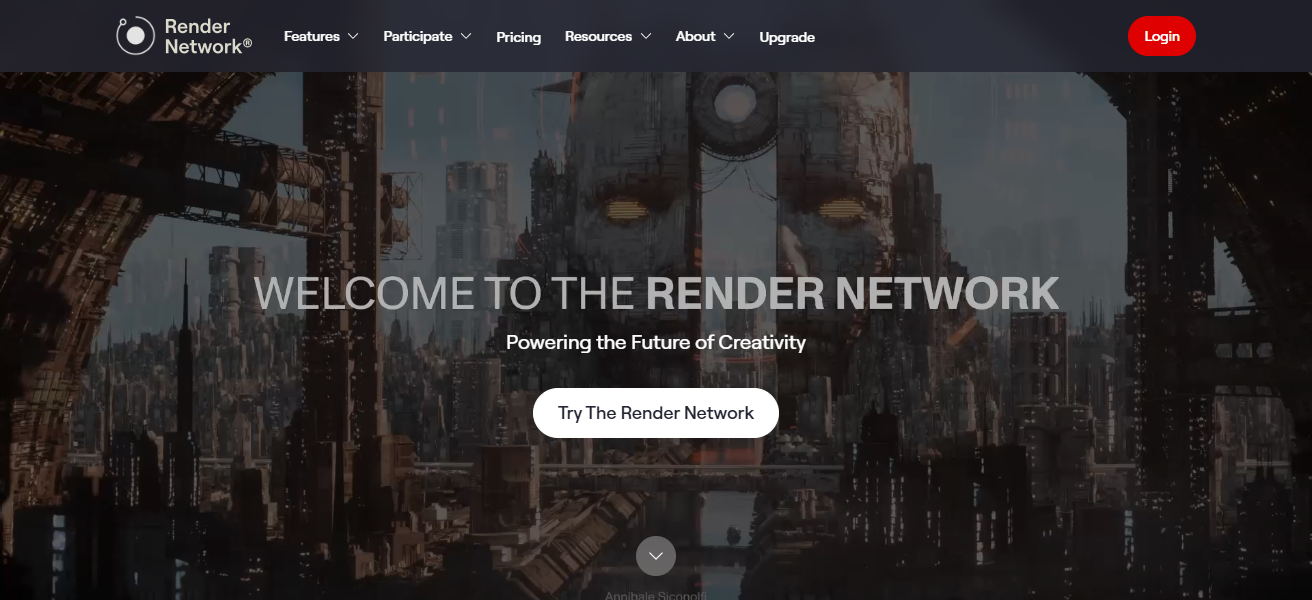
As the demand for GPU resources in the marketplace continues to increase, Render’s marketplace model provides the first tangible decentralized computing
Infrastructure as the marketplace model’s reliance on decentralized storage and computing increases to support the growing demand for AI workloads.
Render (RNDR) – Features
- Decentralized GPU network offering computing power for Artificial Intelligence and rendering tasks
- Links unused GPU resources, with high-performance computing requirements
- Assists in the process of AI training, 3D rendering, and generative content creation
- Decreases computation costs when compared to centralized cloud solutions
| Pros | Cons |
|---|---|
| Decentralized GPU marketplace for AI and rendering workloads | Dependent on GPU supply and network participation |
| Reduces cost of AI model training significantly | Competition from centralized cloud providers |
| Strong real-world use case with increasing demand | Token price tied to compute demand fluctuations |
| Supports AI, metaverse, and creative industries | Technical onboarding may be complex |
6. Story IP (STORY)
Story IP (STORY) utilizes blockchain technology for the first time to turn intellectual property rights into programmable on-chain assets.
The blockchain technology allows creators to register, license, and monetize their intellectual property automatically through smart contracts.
Story solves the intellectual property (IP) bottleneck problem that limits access to rights-cleared data, one of the most important components to building AI models.
Story’s technology transforms IP into machine-readable and enforceable assets to automate licensing and royalty payments.
Story also provides the on-chain governance needed to manage AI training datasets and other creative features. By focusing on IP, Story fuels the AI content development and decentralized creative economy.
Story IP (STORY) – Features
- Transforming IP into programmable, tokenized on-chain assets
- Automated licensing and royalties through smart contracts
- Structured, rights cleared datasets for use by AI models
- Creates the economy through clear ownership and monetization
| Pros | Cons |
|---|---|
| Innovative IP tokenization for AI training datasets and content | Still early-stage with limited adoption |
| Enables automated licensing and royalty distribution | Regulatory uncertainty around intellectual property rights |
| Makes IP programmable and machine-readable for AI | Ecosystem and tooling still developing |
| Unlocks new revenue streams for creators and developers | Market awareness relatively low |
7. Beldex (BDX)
Beldex (BDX) combines advanced cryptography with AI to provide privacy‐first blockchain tech and apps for secure decentralized transactions, communication, and interaction.
Beldex offers products utilizing AI (via federated learning) for data privacy, including the encrypted messaging app BChat, decentralized VPN (BelNet), and a privacy-focused browser.
BDX, the native token, provides ecosystem services, masternode staking, and transaction powering. Despite the regulatory risks associated with privacy coins, Beldex’s integrated ecosystem offers a unique analytical approach to decentralized privacy.
Beldex (BDX) – Features
- Focused on privacy, blockchain providing anonymous transactions and communication
- Ecosystem offerings include encrypted messaging and a decentralized VPN
- AI techniques such as federated learning used for privacy-preserving optimization
- Provides secure and censorship-free applications and services
| Pros | Cons |
|---|---|
| Strong privacy features with AI-enhanced secure communication tools | Regulatory risks for privacy-focused cryptocurrencies |
| Ecosystem includes VPN, messaging, and browser services | Limited mainstream adoption compared to major chains |
| Uses federated learning for privacy-preserving AI optimization | Lower liquidity and visibility in global markets |
| Focus on confidential transactions and decentralized privacy | Potential scrutiny from governments and institutions |
8. Virtuals Protocol (VIRTUAL)
Virtuals Protocol (VIRTUAL) is building a decentralized on-chain ecosystem for AI agents, where autonomous digital entities perform, engage, and monetize tasks within the gaming, entertainment, and social spheres.
Every AI agent developed within the Virtuals ecosystem is designed with a unique, tokenized governance and revenue-share model, which fosters community engagement in the ownership and development of agents.

The VIRTUAL token is the primary currency for all liquidity and transactional purpose within the agent interactions.
Agents create live and revenue-generating use cases outside of speculation by operating across environments, such as games and messaging platforms, which serve to monetize the integrated AI.
Virtuals Protocol (VIRTUAL) – Features
- Tokenized ownership models for autonomous AI agents
- AI agents can earn revenue through gaming, social, and digital channels
- Decentralized infrastructure for the creation, deployment, and management of AI agents
- Community governance and co-ownership of AI assets supported
| Pros | Cons |
|---|---|
| Enables monetizable AI agents with real-world use cases | Highly speculative and early-stage ecosystem |
| Tokenized ownership and revenue-sharing for AI agents | Long-term sustainability still unproven |
| Strong integration with gaming and digital environments | Dependent on user adoption and engagement |
| New model for decentralized AI economies | Market volatility due to hype cycles |
9. Artificial Superintelligence Alliance (FET/ASI)
Artificial Superintelligence Alliance (ASI) integrates major decentralized AI initiatives, including Fetch.ai, SingularityNET, and Ocean Protocol, into a singular interconnected ecosystem along the ASI token narrative.
This alliance builds the infrastructure, marketplaces, data marketplaces, AI agents, and compute-to-data flow services that fuel the advancement of decentralized intelligence.
The ASI token (migrating from FET) will allow access, staking, governance, and model marketplaces on a multitude of chains
Which will make it a foundational token for the providing services and funding collaboration for Open AI and Decentralized General Intelligence.
Artificial Superintelligence Alliance (FET/ASI) – Features
- объединяет (merges) ecosystems of Fetch.ai, SingularityNET and Ocean Protocol ([CoinDCX-Blog][5])
- Concerned with self-driving AI agents, and data marketplaces with decentralized intelligence
- Cross-platform interoperability for AI services and data exchange
- Governance, staking, and utilization of AI services are included in token utility
| Pros | Cons |
|---|---|
| Combines multiple major AI projects into one ecosystem | Integration complexity between merged platforms |
| Strong focus on decentralized AGI and collaboration | Token transition (FET to ASI) may confuse investors |
| Broad utility including data, agents, and marketplaces | Execution risk in aligning multiple ecosystems |
| Large-scale vision with cross-chain interoperability | Still evolving governance and coordination structure |
10. The Graph (GRT)
The Graph (GRT) is the decentralized indexing and transfer protocol that allows users to access the data available on the various blockchains.
The Graph has also been called the “Google of blockchains.” It allows developers and AI agents to access and retrieve data that is both organized and reliable.
Thanks to The Graph, developers can analyze data, monitor events in real time, and build AI applications.
The Graph currently processes billions of queries each month, providing the infrastructure for AI, on-chain analytics, and autonomous systems that require efficient access to data.
The Graph (GRT) – Features
- Decentralized indexing protocol allows for efficient blockchain data queries
- Employs subgraphs and GraphQL for access to organization data
- Facilitates the real-time blockchain data retrieval by AI agents and dApps
- Serves as primary data infrastructure layer for Web3 analytics and AI
| Pros | Cons |
|---|---|
| Essential indexing protocol for blockchain and AI data access | Revenue depends on query demand growth |
| Supports multiple chains with high query performance | Competition from alternative data solutions |
| Critical infrastructure for analytics and AI applications | Token utility may not directly reflect adoption |
| Enables efficient data retrieval for dApps and AI agents | Requires technical knowledge for optimal use |
How To Choose AI Crypto Platforms Worth Switching To In 2026
- Security First – Look for strong encryption, multi-factor authentication, and an open audit process.
- Regulatory Compliance – Review their local and global crypto regulations to ensure legal protection.
- AI Capabilities – Advanced features like predictive analytics, sentiment analysis , and automated trading bots are beneficial.
- Ease of Use – User-friendly interfaces and organized dashboards are a bonus.
- Profitability Tools – Go for advanced arbitrage detection, and portfolio optimization passive income features.
- Cost & Fees – Review different subscription options and compare fees, profit-sharing, and transaction costs.
- Transparency – Look for clear performance reports and avoid platforms with unclear or hidden strategies.
- Scalability – Platforms with crypto and stock scability are great for diversified assets.
- Reputation – Look for reviews and histories of the platform to see how it has performed in prior market changes.
Conclsuion
In closing, artificial intelligence based crypto platforms are integrating smart automation with decentralized systems to transform the future of blockchain. Evaluating platforms based on true utility, solid tech, and a long-term perspective will serve users well.
With the anticipated rapid growth of innovation in 2026, migrating to potential AI crypto projects will enhance opportunities, efficiency, and competitive advantage in the fast-changing digital economy.
FAQ
Because AI integration is rapidly growing, offering better efficiency, automation, and new earning opportunities in crypto ecosystems.
They can be safe if well-researched, but risks remain due to volatility, early-stage development, and regulatory uncertainty.
They generate revenue through transaction fees, AI services, data marketplaces, staking, and decentralized applications.
They offer more advanced functionality, but “better” depends on your goals—utility vs store of value.