This article will explore how AI Tools That Detect Rug Pulls and Frauds assist staying safe as an investor in the crypto market.
- Key Points & 18 AI Tools That Detect Rug Pulls and Frauds
- 17 AI Tools That Detect Rug Pulls and Frauds
- 1. MagicVest
- 2. RugScanAI
- 3. Crypto Guard‑AI
- 4. RugShield AI
- 5. RugGuardian AI
- 6. Sharpe AI Rug Check
- 7. ChainAware.ai Rug Pull Detector
- 8. ChainAware.ai Fraud Detector
- 9. GoPlus Security
- 10. Honeypot.is
- 11. RugCheck (Quicknode listing)
- 12. De.Fi Scanner
- 13. Quick Intel
- 14. DEXTools Monitoring Tools
- 15. Token Sniffer
- 16. PeckShield AegisWeb3 (from community lists)
- 17. RugTool Checker
- How Accurate are AI tools at predicting rug pulls compared to manual Audits?
- What features Make MagicVest effective for memecoin rug pull detection?
- Cocnlsuion
- FAQ
With the help of cutting-edge tools such as machine learning, data analytics, and up-to-the-minute information, AI tools help identify suspicious behaviors
Smart contract scam, and fraud detection, assisting customers in safer and more intelligent investments in the fast-growing world of digital assets.
Key Points & 18 AI Tools That Detect Rug Pulls and Frauds
MagicVest – AI crypto intelligence that predicts token pumps and flags likely rug pulls by analyzing smart contracts, liquidity signals, whale wallets, and sentiment.
RugScanAI – AI‑powered platform focused on early rug pull detection using machine learning on contract code and on‑chain token metrics.
Crypto Guard‑AI – Real‑time on‑chain monitoring AI that detects scams, rug pulls, and abnormal wallet behavior with instant alerts.
RugShield AI – Solana‑focused anti‑rug engine with real‑time RugScore™ ratings, liquidity scanning, and dev wallet monitoring.
RugGuardian AI – Machine learning system continuously scanning tokens for rug pull patterns and triggering alerts on suspicious behavior.
Sharpe AI Rug Check – Free token security scanner that audits contracts, honeypot behavior, liquidity locks, and holder distribution for rug risk.
ChainAware.ai Rug Pull Detector – AI that predicts rug pull risk by analyzing behavioral histories of creators and liquidity providers.
ChainAware.ai Fraud Detector – Web3 predictive fraud engine that detects scams and fraudulent wallet patterns across multiple blockchains.
GoPlus Security – Rug pull and smart contract risk scanner integrating data feeds for on‑chain vulnerability checks.
Honeypot.is – Rug and honeypot scanner that flags tokens where selling is restricted, preventing liquidity exit scams.
RugCheck (Quicknode listing) – Token risk scanner for detecting potential rug pull red flags using on‑chain token data.
De.Fi Scanner – Token and contract risk scanning tool, helping identify potentially unsafe DeFi projects prior to investing.
Quick Intel – Real‑time token insights and risk analytics that help spot suspicious tokens early in their lifecycle.
DEXTools Monitoring Tools – Liquidity and trading behavior monitoring that helps expose rug and rug‑like dump patterns.
Token Sniffer – Automated on‑chain scanner that detects suspicious contract code and common rug pull attributes.
PeckShield AegisWeb3 (from community lists) – Chrome/Web3 extension providing alerts on phishing scams, blacklisted contracts, and risk signals.
RugTool Checker – Free risk score checker that uses red flags (unaudited contracts, unlocked liquidity, top wallet distribution) to assess rug probability.
17 AI Tools That Detect Rug Pulls and Frauds
1. MagicVest
MagicVest uses proprietary algorithms to help identify high-risk memecoins before they perform rug pulls.
MagicVest offers a unique feature called MagicScore, which takes over 250 different real-time signals, encompassing everything from liquidity, whale movement, developer activity, and social sentiment to provide users with safety and pump predictions.
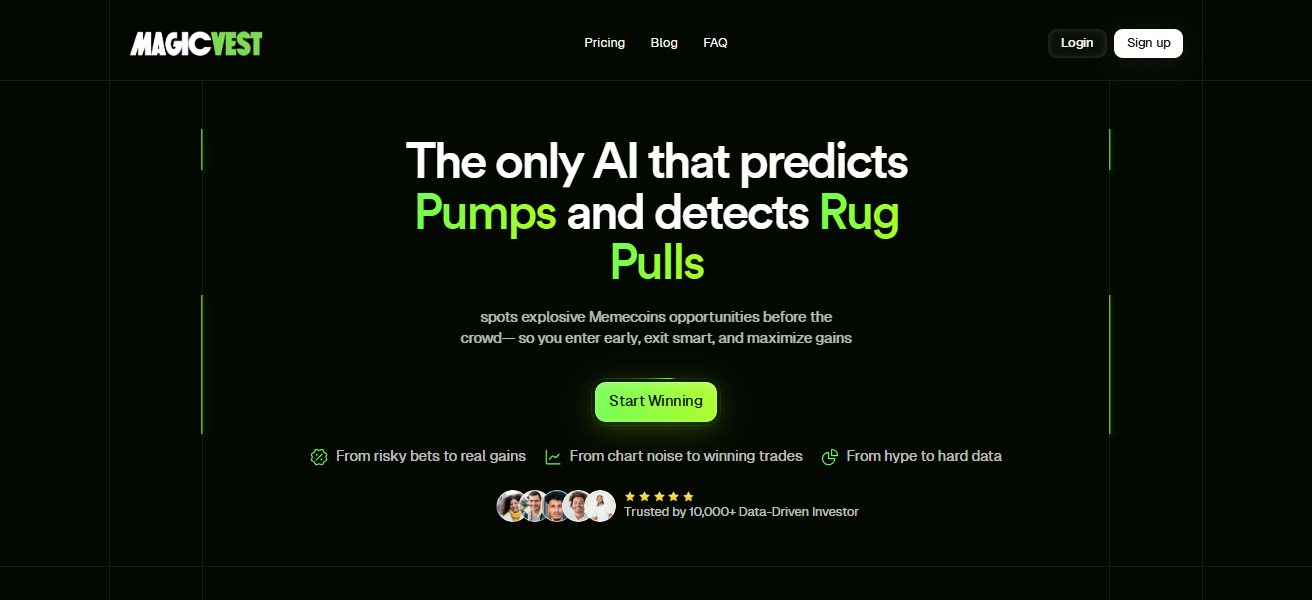
MagicVest also offers real-time trading signals, safety warnings, and hands-off trading features, which allows users to avoid memecoins with unlocked liquidity or fake pump scams that are common before rug pulls occur.
| Pros | Cons |
|---|---|
| Proprietary MagicScore™ integrates 250+ signals for real-time risk assessment. | Focused heavily on memecoins; may not cover all DeFi tokens comprehensively. |
| Detects fake engagement and whale manipulation quickly. | Requires familiarity with DEX operations to interpret some insights. |
| Continuous monitoring of new tokens on multiple DEXs. | Limited support for certain less popular chains. |
| Provides buy/sell signals and alerts to prevent losses. | High dependency on AI predictions; false positives possible. |
2. RugScanAI
RugScanAI is an AI-powered tool for crypto security that detects suspicious rug pull behavior on Solana and other networks.
Founded in 2025, it utilizes machine learning, applied to thousands of historical rug pull scenarios, to identify suspicious characteristics in contracts and on-chain behavioral patterns.
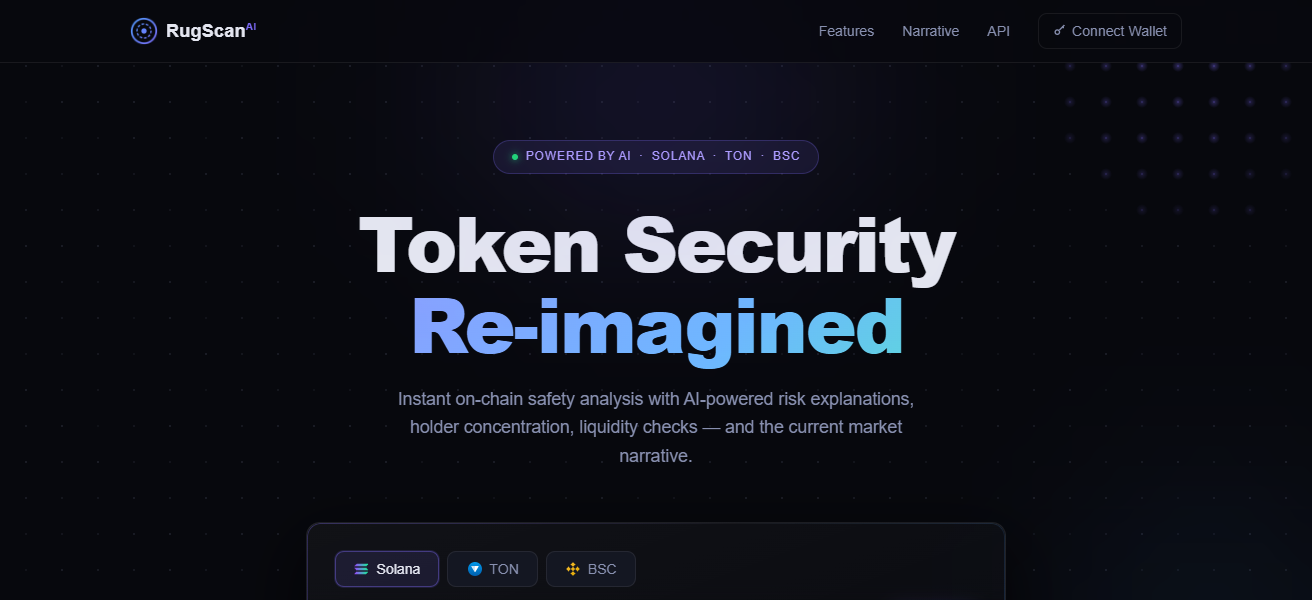
The RugScanAI engine reviews smart contracts for backdoors, liquidity locks, and suspicious token distribution. It also uses NLP to assess the community’s sentiment.
This analysis generates a risk score reflecting the likelihood of a rug pull. The system provides real-time monitoring and investor alerts, protecting them from losing money.
| Pros | Cons |
|---|---|
| AI trained on thousands of historical rug pulls for predictive accuracy. | Primarily focused on Solana; Ethereum or BNB support may be limited. |
| Real-time alerts and risk scoring for investors. | NLP sentiment analysis may produce false signals from hype campaigns. |
| Detects smart contract backdoors, liquidity locks, and holder distribution anomalies. | New or novel contract structures may escape detection. |
| Helps investors act proactively before committing funds. | Limited free tier; premium features may be costly for small investors. |
3. Crypto Guard‑AI
Using AI models that detect dangerous activity patterns that are on-chain, Crypto Guard-AI provides real-time, automated identification of crypto scams, irrefutably deceptive scams, and suspicious activities around crypto wallets.
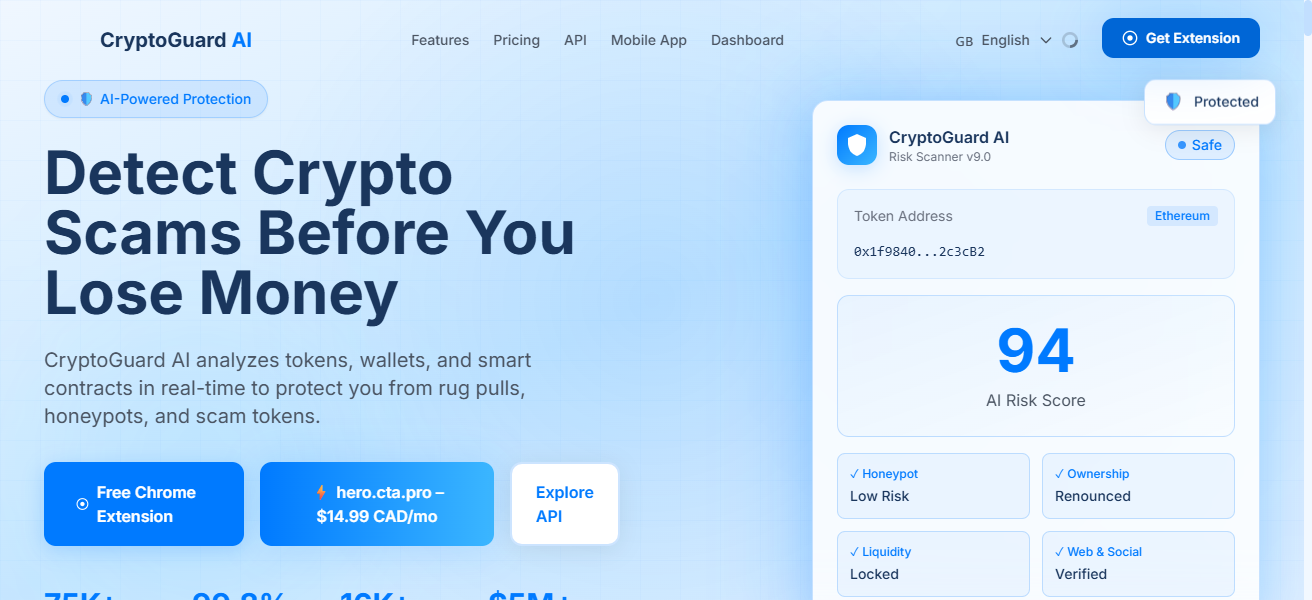
Instead of depending on alerts from social media, we monitor wallets, liquidity, and contract interactions, and manually set off alerts for activities such as dev wallet liquidity drain and honeypots before price dumps.
Crypto Guard-AI provides real-time scam alerts in Telegram, Discord, and email, as well as risk score analytics, to enable crypto traders to apply effective risk management in deflationary crypto markets.
| Pros | Cons |
|---|---|
| Real-time tracking of wallets, liquidity events, and contracts. | User interface can be complex for beginners. |
| Detects abnormal wallet behavior and honeypots early. | Some alerts may require manual verification to confirm risk. |
| Delivers instant notifications via Telegram, Discord, or email. | Mainly covers widely used chains; obscure tokens may not be fully analyzed. |
| AI models continuously learn from new scam patterns. | False positives possible during volatile market conditions. |
4. RugShield AI
RugShield AI, including the RugShield integration with TrendGenie, provides one of the first DeFi safety scanning services, simplifying complex, on-chain risk metrics into traffic-light scores on the Ethereum and BNB chains.
It identifies honeypot behavior, ownership concentration, and scam contract flags to assess whether users can lose access to their funds.
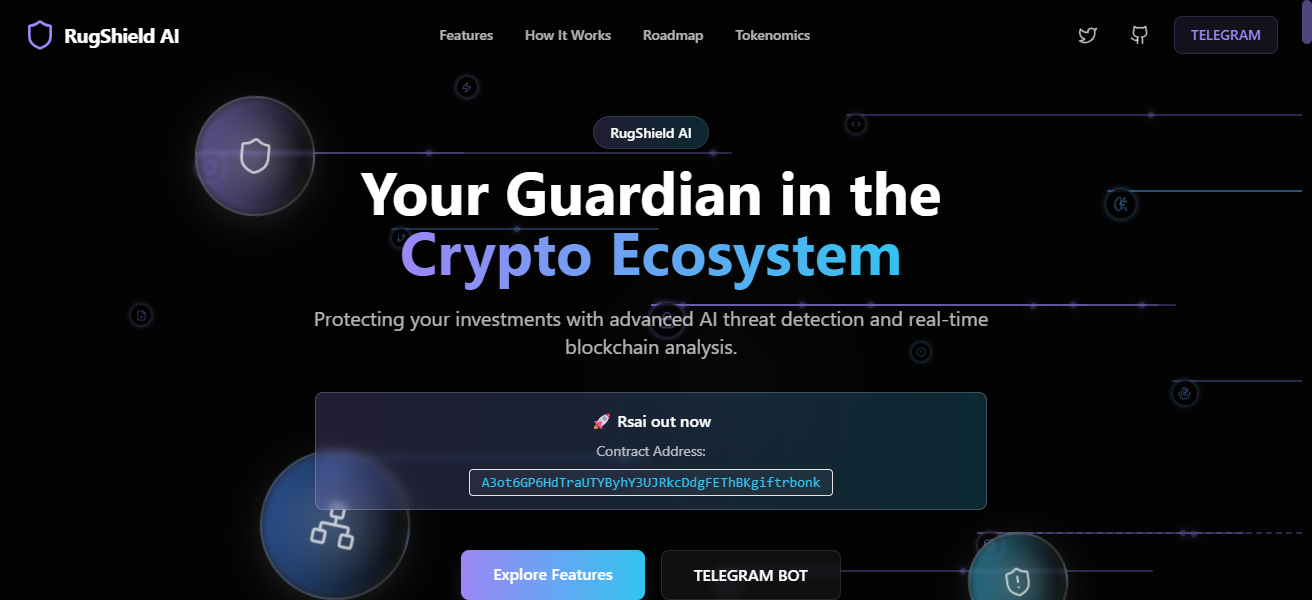
RugShield provides users with a simplified overview of the entire situation and is tailored to the varying degrees of experience users may have, including novices. It offers users the opportunity to conduct a complete safety assessment prior to performing an extensive set of due diligence.
| Pros | Cons |
|---|---|
| Simplifies complex on-chain metrics into a clear traffic-light score. | Focuses mainly on Ethereum and BNB Chain; smaller networks limited. |
| Detects honeypots, suspicious contracts, and ownership concentration. | May not detect highly sophisticated or custom scam contracts. |
| Accessible for beginners and professionals alike. | Risk score may oversimplify multi-factor scenarios. |
| Quick preliminary check before deep due diligence. | Dependency on AI scoring may miss nuanced human behavior signals. |
5. RugGuardian AI
Dedicated to DeFi’s cleanup, RugGuardian AI is a pioneering protection platform designed to preemptively detect scams and rug pulls in the DeFi space.
Using large language models (LLMs) and machine learning, it evaluates multiple on-chain parameters — such as anomalies in liquidity movement, atypical token transfers, and developer activity — to identify high-risk projects.
With RugGuardian’s predictive intelligence, investors are alerted to emerging threats, allowing them to sidestep fraudulent tokens and safeguard their investments in fast-changing, high-risk environments.
| Pros | Cons |
|---|---|
| Uses LLMs and machine learning to detect early signs of rug pulls. | Complex AI models may require subscription for full access. |
| Monitors liquidity movements and unusual token transfers. | Can produce false positives on newly launched legitimate tokens. |
| Provides early warning alerts to protect capital. | Not fully decentralized; centralized monitoring could be a concern. |
| Covers multiple blockchains and token types. | May be less effective on small, private networks. |
6. Sharpe AI Rug Check
Sharpe AI Rug Check is a complimentary token security scanner that assesses risk before investing in a new token on over 20 different blockchains.
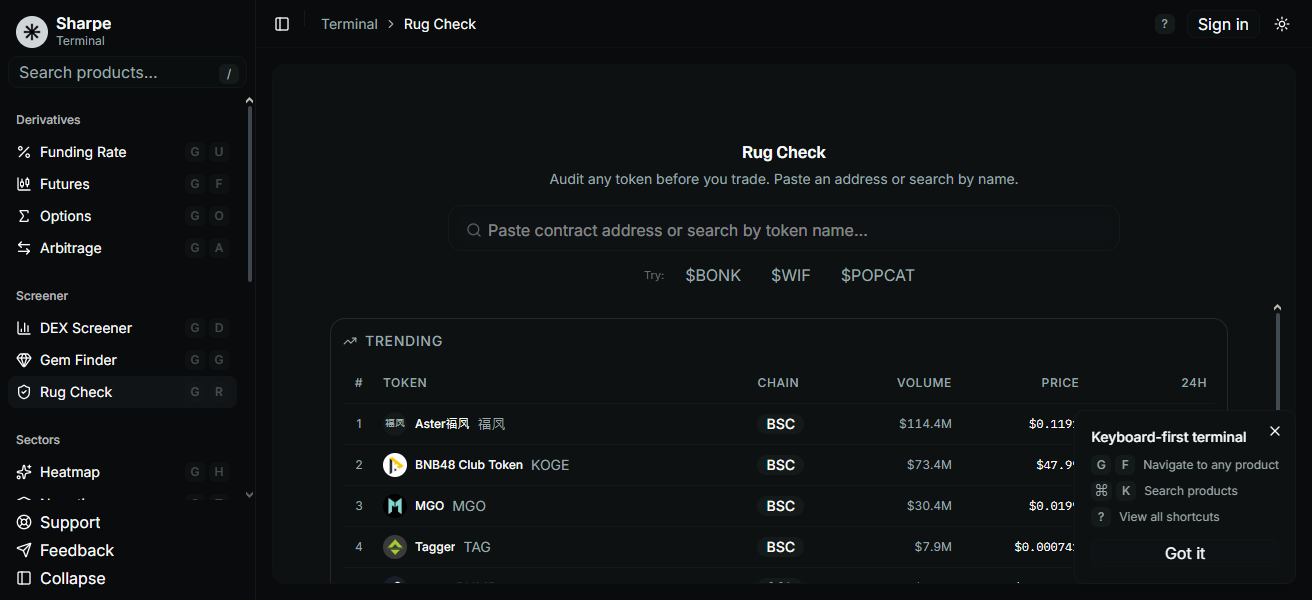
It assesses the risk of honeypots (tokens that restrict sell transactions), checks burn & lock liquidity, and evaluates smart contracts for minting privileges and owner controls that can be exercised. Additionally, Sharpe checks the distribution of token holders for centralization.
By analyzing tokens from multiple perspectives, Sharpe gives users the tools necessary to conduct quality pre-trade research and avoid fraudulent or risky tokens.
| Pros | Cons |
|---|---|
| Free multi-chain scanner covering 20+ blockchains. | UI may feel cluttered due to extensive analytics. |
| Detects honeypot scams and liquidity risks. | Cannot catch highly customized scam contracts. |
| Checks smart contract privileges and holder distribution. | Alerts can be overwhelming for new users. |
| Empowers pre-trade research and informed decisions. | Limited real-time dynamic monitoring; mainly pre-trade focused. |
7. ChainAware.ai Rug Pull Detector
ChainAware.ai analyzes the potential of a token or a liquidity pull performing a rug pull with predictive AI. This is done prior to the committing of funds by the investors.
Traditional contract scanners are limited to reading code. ChainAware.ai utilizes a behavioral history of project creators and liquidity providers within a dataset of 14 million+ Web3 wallet profiles.
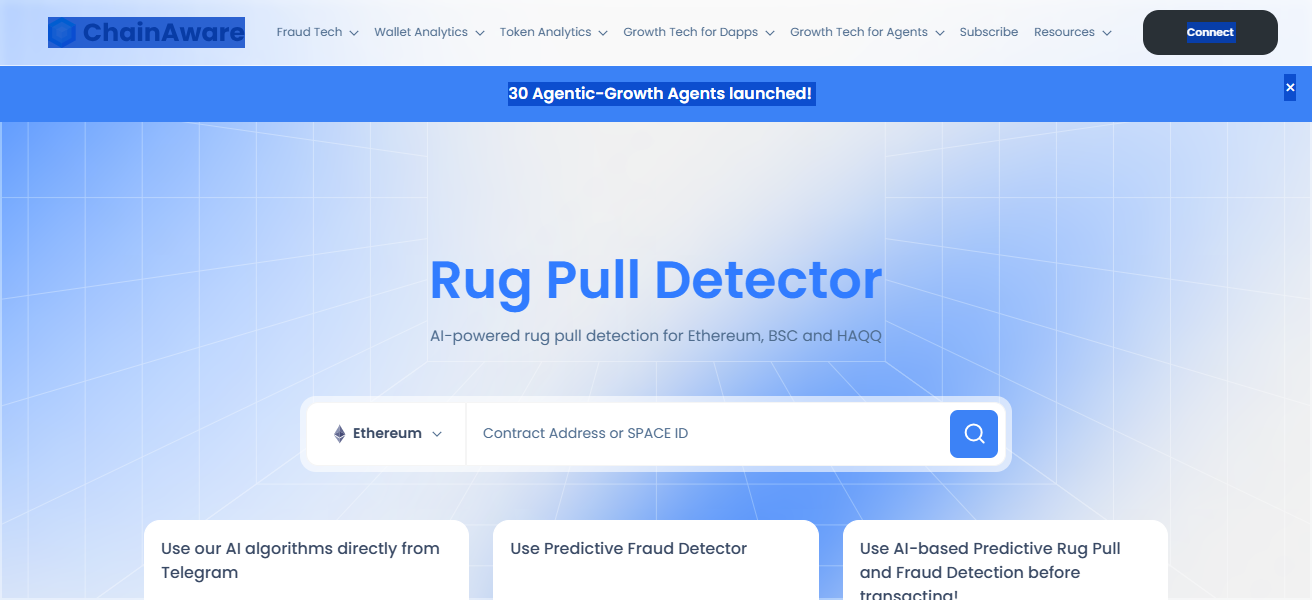
With the behavioral history wallet profiles, ChainAware.ai pattern analyzes a total of 8 major blockchains, Ethereum, BNB, Base, Polygon, Solana, etc.
This is done to formulate a “Trust Score” which is attached to contracts and predictive behavioral history scores of previous scams.
| Pros | Cons |
|---|---|
| Predictive AI using behavioral history of creators and liquidity providers. | May require subscription for full dataset access. |
| Integrates patterns across 8 major blockchains. | Less effective on brand-new, unverified projects. |
| Generates forward-looking Trust Score for risk assessment. | False positives possible if historic data is incomplete. |
| Helps users avoid rug pull projects proactively. | Advanced metrics may require technical understanding to interpret. |
8. ChainAware.ai Fraud Detector
The ChainAware.ai Fraud Detector utilizes predictive AI technology to evaluate on-chain transaction histories to predict, and warn, potential fraudulent activity via wallet addresses, before malicious actions are taken.
Traditional fraud detection systems utilize forensic lists to detect known bad actors. In contrast, ChainAware.ai Fraud Detector examines and interprets different behavioral patterns.
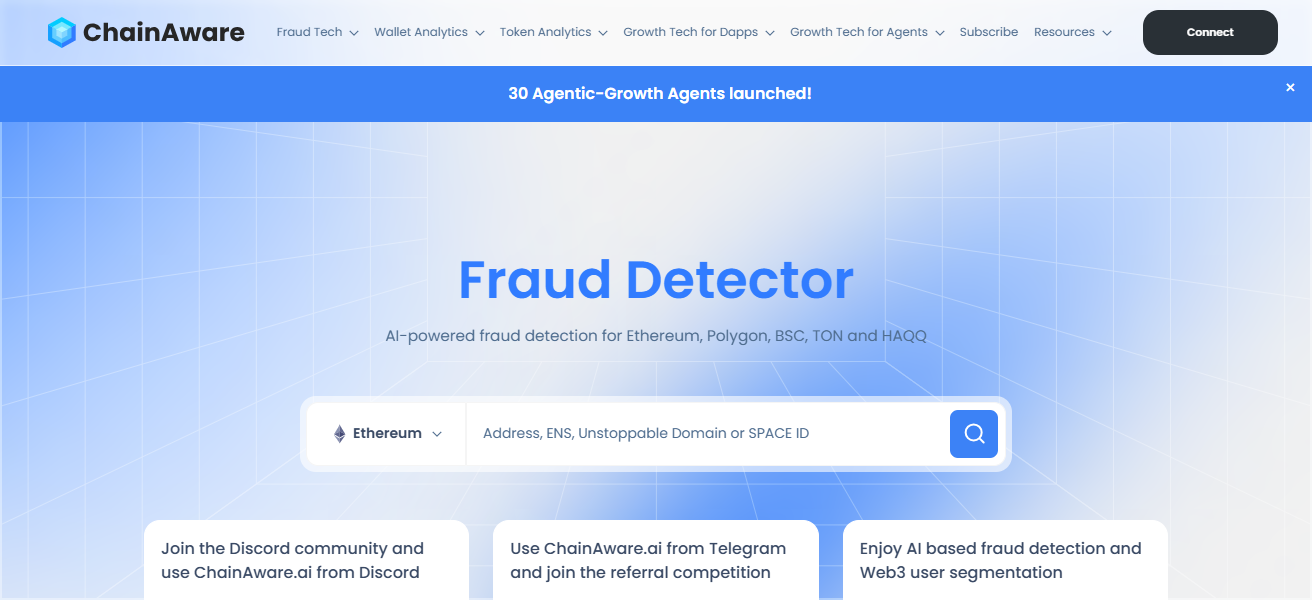
It is able to detect and predict suspicious activities with approximately 98% accuracy on Ethereum and BNB Smart Chain.
The tool is built in a way to provide real-time risk scores to users and protocols before they make any transactions and onboard new wallets.
| Pros | Cons |
|---|---|
| Predictive AI using behavioral history of creators and liquidity providers. | May require subscription for full dataset access. |
| Integrates patterns across 8 major blockchains. | Less effective on brand-new, unverified projects. |
| Generates forward-looking Trust Score for risk assessment. | False positives possible if historic data is incomplete. |
| Helps users avoid rug pull projects proactively. | Advanced metrics may require technical understanding to interpret. |
9. GoPlus Security
GoPlus Security powers one of the most integrated APIs for smart contract risk-scanning across Web3 and more than 30 blockchain networks.
It conducts rule-based contract analyses to identify standard risks, including honeypot traps, owner privileges (e.g., unlimited minting)
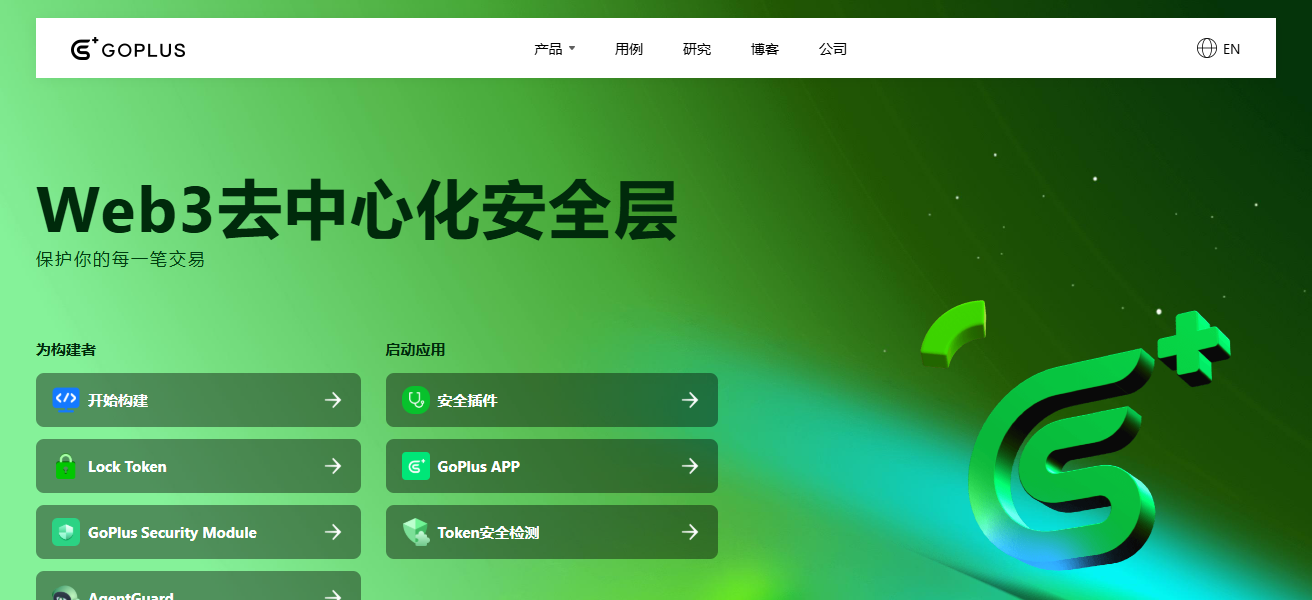
blacklist and/or whitelist functions, proxy upgrade pathways, trading taxes, and liquidity locking. In 2024 alone, GoPlus identified more than 67,000 honeypot tokens on major chains.
Its permissionless API, which provides preliminary scanning results in ~10 seconds, has become the first line of defense against scams in wallets, explorers, and trading platforms, cementing its place as an essential tool.
| Pros | Cons |
|---|---|
| Supports 30+ blockchains for broad coverage. | Mainly API-driven; may require technical integration. |
| Detects honeypots, owner privileges, and liquidity locking. | Some complex contract patterns may bypass rules-based analysis. |
| Provides first-line scanning results in ~10 seconds. | Alerts may be too technical for casual users. |
| Widely integrated across wallets and explorers. | Real-time predictive intelligence limited; focuses on static risk scanning. |
10. Honeypot.is
Honeypot.is is a specialized scam detection tool that finds tokens that are marked as honeypots, (i.e. selling is restricted) as well as scams that are rug pull variant scams.
It detects these by attempting to simulate a sell transaction on a token contract to see if the contract will allow sells to go through or if it blocks sells under certain conditions.
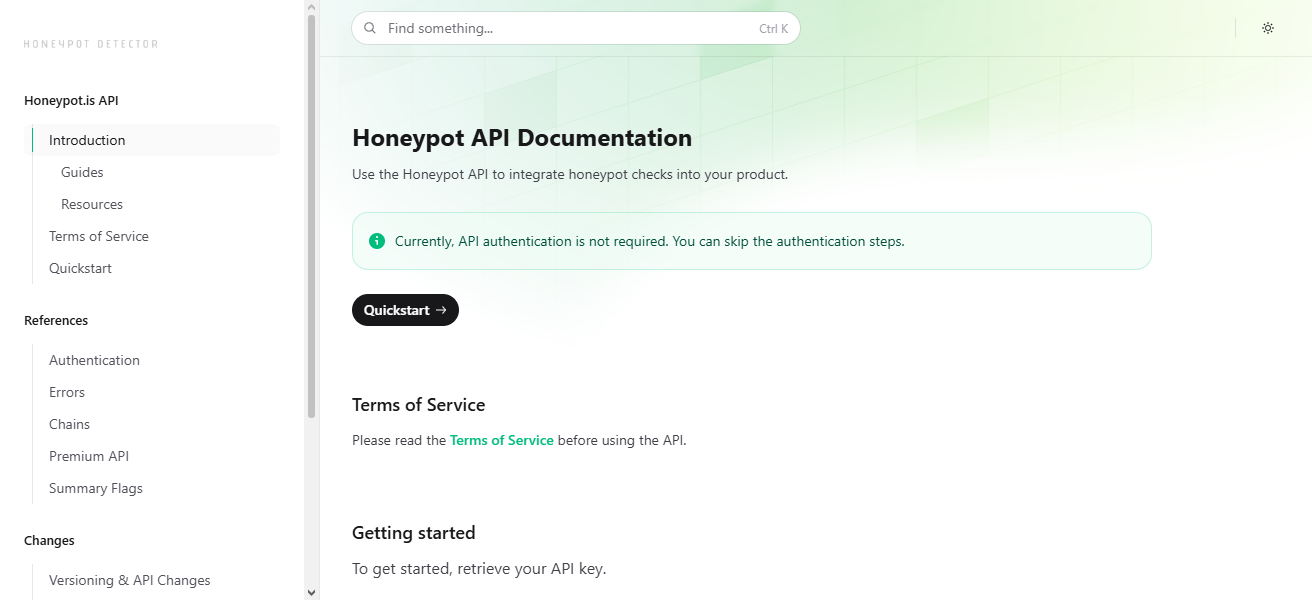
Honeypot.is detects these issues before retail traders see them on the live market so users are able to avoid tokens that trap traders with promises of gains and then prevent exits, a problem that is on the rise with decentralized exchanges.
| Pros | Cons |
|---|---|
| Detects tokens where selling is blocked (classic honeypot). | Limited to honeypot detection; other rug indicators not covered. |
| Simulates sell transactions safely. | Only applicable to live or recently launched tokens. |
| Helps users avoid locked or scam tokens before investing. | Cannot detect off-chain manipulation like social engineering. |
| Straightforward, beginner-friendly interface. | Limited analytics; does not provide predictive scoring. |
11. RugCheck (Quicknode listing)
RugCheck is integrated into Quicknode’s token scanners, which provide real-time risk alerts to traders by assessing on-chain data for contracting anomalies and threats.
This tool enables traders to evaluate tokens before purchasing by assessing the liquidity, contract flags, transfer rules, and holder patterns.

It identifies if a token is at risk of a rug pull or a honeypot using previously set risk parameters. RugCheck is more optimal as a fast pre-trade scan in conjunction with more extensive analysis tools.
| Pros | Cons |
|---|---|
| Real-time risk signals from on-chain data. | Primarily designed for Ethereum and mainnets; smaller chains limited. |
| Checks liquidity, contract flags, and holder behavior. | May produce false positives on legitimate low-liquidity tokens. |
| Rapid pre-trade scan with easy-to-read results. | Lacks predictive AI for forward-looking risk. |
| Complements deeper analysis tools. | Interface and alerts may be too basic for advanced traders. |
12. De.Fi Scanner
De.Fi Scanner is a versatile multi-chain risk assessment tool focused on scanning tokens, NFTs, and liquidity pools across over 10 networks, providing detailed risk assessment reports.
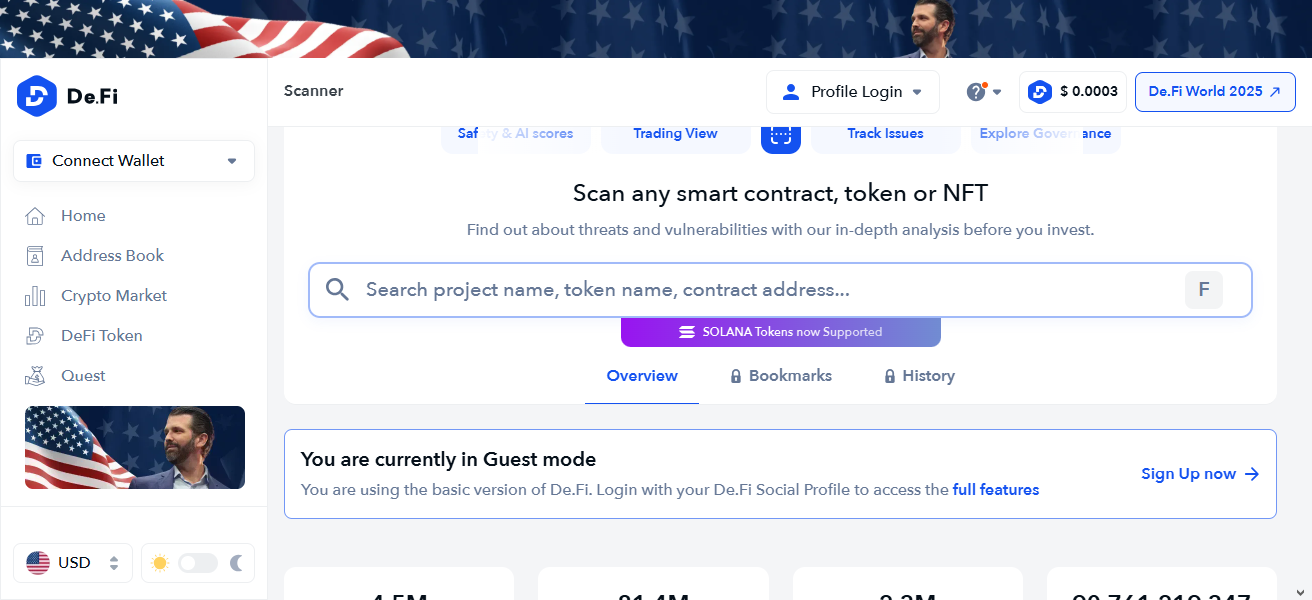
As a ‘portfolio antivirus’, it combines contract risk, liquidity risk, permission flags, market metadata, and social and exchange data into visual risk reports and reports in PDF format.
Such a broad approach helps users managing intricate portfolios identify scam or rug pull risks on a broader level across all their holdings and not just on individual tokens.
| Pros | Cons |
|---|---|
| Multi-chain risk assessment across tokens, NFTs, and liquidity pools. | Reports may be complex for beginners. |
| Produces visual risk reports and exportable PDFs. | Real-time alerts limited; mainly a portfolio overview tool. |
| Aggregates contract risk, liquidity vulnerability, and market metadata. | False negatives possible if new scam patterns emerge. |
| Enables holistic view of entire holdings. | Less focused on real-time pre-trade alerts. |
13. Quick Intel
Quick Intel offers real-time risk analytics and token insights to protect traders’ decisions concerning new or trending tokens.
It integrates on-chain and market data such as liquidity, holder distribution, trade volume, and behavioral history to quickly flag fraudulent tokens.

Quick Intel acts as pre-trade research tool, and enables users to identify opportunities, and prevent losses, which integrates with advanced contract scanner and activity behavior analytics.
| Pros | Cons |
|---|---|
| Combines on-chain and market data for token risk insights. | Mainly pre-trade research; not real-time predictive. |
| Highlights liquidity, holder distribution, trade volume, and historical behavior. | Less effective for brand-new tokens without sufficient history. |
| Fast identification of suspicious tokens. | Alerts may require additional manual verification. |
| Complements deeper contract analysis. | Limited coverage on obscure blockchains. |
14. DEXTools Monitoring Tools
Tools from DEXTools provide monitoring services including real-time tracking of liquidity and trading patterns on decentralized exchanges.
Though not an AI-based rug algorithm, these tools help users track rug-like occurrences, including abrupt liquidity pulls, increased sell pressure, and irregular trading.
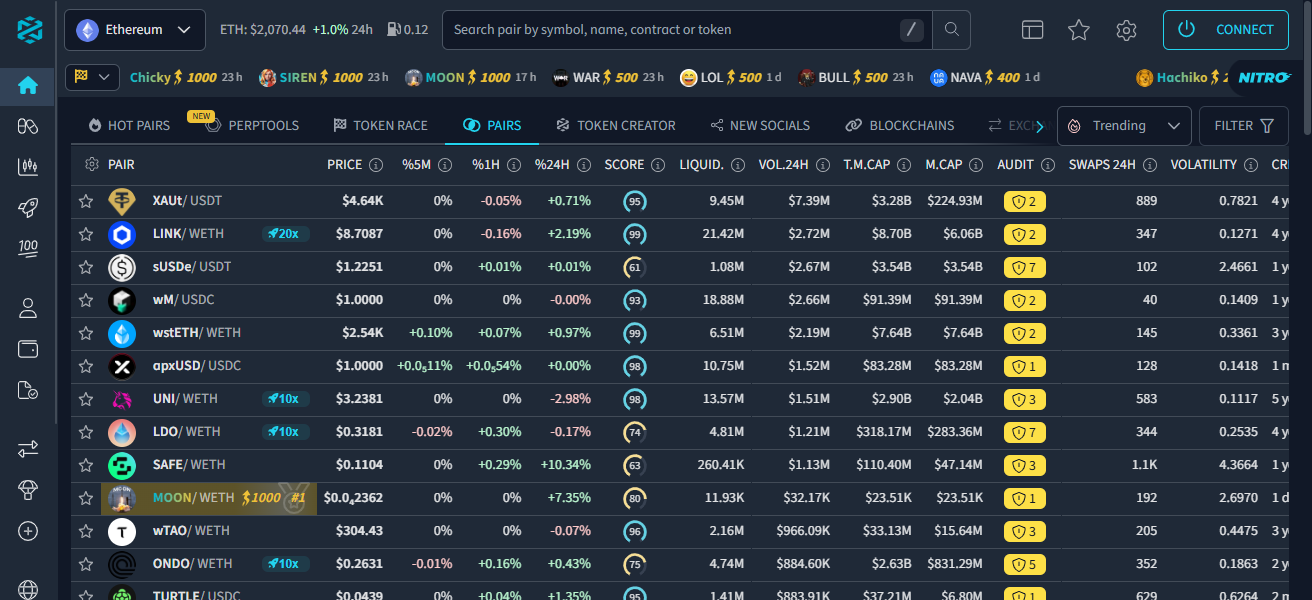
DEXTools integrates with risk scanners, allowing users to utilize DEXTools monitoring in addition to Context and Alerts to help in fast-moving token situations in which rug pulls are common.
| Pros | Cons |
|---|---|
| Tracks live liquidity and trading behaviors. | Not AI-powered; relies on pattern recognition. |
| Helps detect sudden liquidity withdrawals and abnormal trades. | May not detect sophisticated hidden contract manipulations. |
| Provides early warning in fast-moving markets. | Requires cross-referencing with other scanners for complete risk assessment. |
| Useful for monitoring multiple DEXs. | Alerts may generate false positives during normal market volatility. |
15. Token Sniffer
Token Sniffer is an EVM token risk scanner that is used by many people. The developers use a patent-matching method and contract similarity method to find and evaluate potential risk projects.
Each scanner contract is compared to a database of known scam templates to produce a risk score (0-100) based on contract similarity to known scams and results of a buy/sell simulation.
Due to the nature of this scanner, it is extremely effective at identifying copy-paste scam contracts and standard rug pulling strategy used. Token Sniffer should be used along other tools to get a more comprehensive safety evaluation.
| Pros | Cons |
|---|---|
| Detects malicious contract templates via pattern matching. | Mainly EVM-focused; less effective on non-Ethereum chains. |
| Generates risk scores (0–100) for tokens. | Cannot fully replace thorough manual contract audits. |
| Effective for copy-paste scams and standard rug patterns. | New innovative scams may bypass template checks. |
| Quick pre-trade evaluation. | Limited real-time tracking; snapshot-based analysis. |
16. PeckShield AegisWeb3 (from community lists)
PeckShield’s AegisWeb3 is a Web3 community phishing, rug pull, and blacklisted wallet detection browser extension and monitoring tool.
It alerts users to risky wallet addresses and suspicious contract activity, and threats to known wallet addresses.
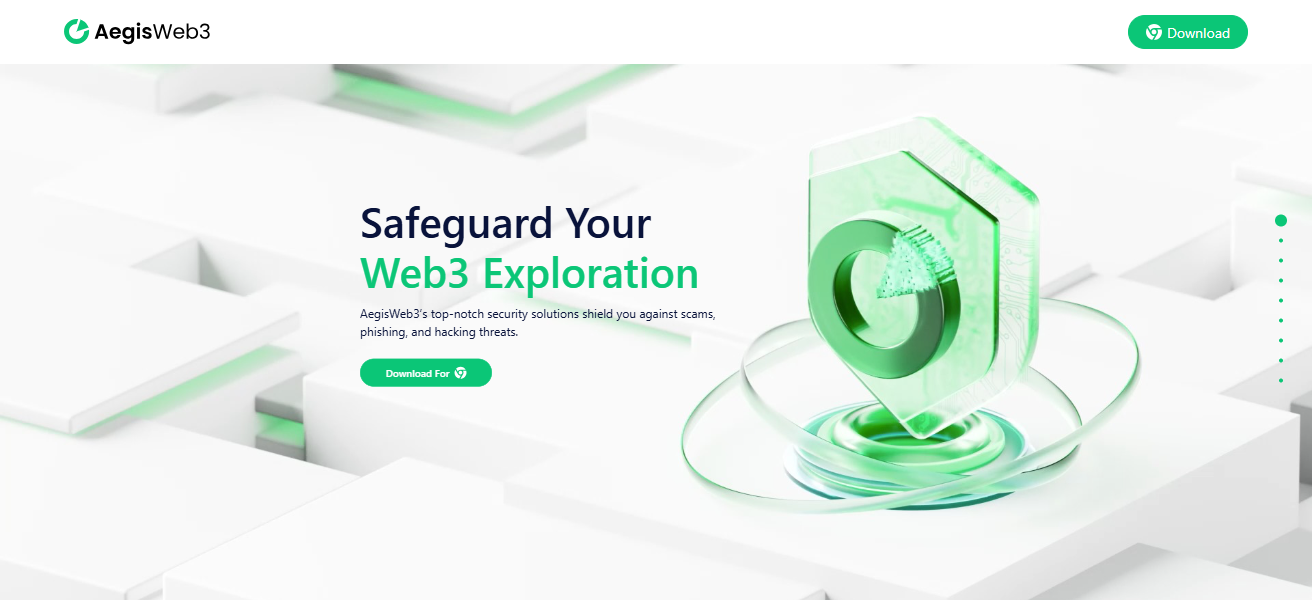
Although it is not an AI tool, the Alerts System and Threat Intelligence Feeds layers AegisWeb3’s defense against common challenges facing users when interacting with crypto.
| Pros | Cons |
|---|---|
| Provides real-time notifications on risky addresses. | Not fully AI-driven; relies on threat intelligence feeds. |
| Detects phishing scams, rug pulls, and blacklisted wallets. | Limited predictive capabilities; reactive rather than proactive. |
| Browser extension for easy access. | Alerts may overwhelm users if many flagged addresses exist. |
| Practical layer of defense for daily crypto interaction. | Not ideal for institutional portfolio monitoring. |
17. RugTool Checker
RugTool Checker is a free tool that analyzes risk based on common rug pull red flags like unlocked liquidity, centralization of ownership, and contracts without audits.
RugTool Individually evaluates each of these and combines his findings into a score, which makes it easier for users to see the degree of risk associated with a token.

It’s more of a heuristic tool, rather than predictive, but it is still a useful tool to quickly assess the risk of new DeFi tokens. (general know-your-risk purpose in Web3)
| Pros | Cons |
|---|---|
| Free and quick risk-scoring tool. | Heuristic-based; lacks predictive AI. |
| Flags common rug pull indicators like unlocked liquidity. | Cannot cover advanced or customized scam contracts. |
| Easy interpretation for rapid token assessment. | Limited multi-chain support. |
| Helps traders quickly evaluate token risk. | Provides a high-level overview; deeper due diligence still needed. |
How Accurate are AI tools at predicting rug pulls compared to manual Audits?
AI Tools – Predictive Power: Predictive behavior analysis helps determine when rug pulls may happen.
AI Tools – Real Time Monitoring: Track wallets, liquidity, and transactions, and identify anomalies faster than a human.
AI Tools – Historical Pattern Recognition: Identify trends that are not manually trackable.
AI Tools – Limitations: Scam detection is limited to the training data, and new scam types may produce false positives.
Manual Audits – Code Analysis: Experts evaluate and identify if there are existing backdoors in the code.
Manual Audits – Accuracy: Detecting and predicting behavior are two different things. They will be accurate in predicting.
Manual Audits – Limitations: They are usually time consuming and expensive with insufficient behavioral analysis.
What features Make MagicVest effective for memecoin rug pull detection?
Smart Contract Analysis MagicVest analyzes smart contracts for harmful hidden code, detecting backdoors and questionable minting functions.
Liquidity Lock Monitoring MagicVest determines whether the liquidity is locked, or if it can be removed instantly.
Token Distribution Insights MagicVest analyzes holders to find whales and developer wallets that can perform a dump.
Real-Time Risk Scoring MagicVest scores risk of memecoins in real-time and notifies users if a memecoin is risky.
Developer Wallet Tracking MagicVest analyzes developer wallets and their activity for anything suspicious or scamming related.
Honeypot Detection System MagicVest protects users from honeypot scams by identifying tokens you can buy, but not sell.
Trading Activity Monitoring MagicVest keeps track of abnormal trading activity, like coordinated pumping, and signals to users.
Cocnlsuion
In summary, AI’s potential for detecting rug pulls and frauds is a benefit for both the safety of crypto and the peace of mind for investors.
These tools identify the risk involved in early stages by evaluating smart contracts, behavioral patterns of the market, and records of transactions.
Although they will never be able to completely eliminate the possibility of fraud, the tools minimize the risk considerably and provide investors with a greater opportunity to provide a safer and more educated involvement in the evolving world of cryptocurrency.
FAQ
AI tools analyze blockchain data to identify scams, risky tokens, and fraudulent crypto projects early.
They use machine learning, smart contract analysis, and transaction tracking to find suspicious patterns.
They are highly useful but not 100% accurate; users should combine them with personal research.
Yes, they monitor real-time data to identify unusual behavior in newly launched tokens quickly.