
This article identifies groundbreaking AI firms supported by NVIDIA that are changing the future of generative artificial intelligence, cloud computing, self-driving cars, healthcare, enterprise technology, and more.
Additionally, information on the propulsion technology of NVIDIA’s investments and GPU ecosystem, the key aspects of the companies and some of the advantages and disadvantages, will be covered.
What are factors that an AI company needs to have to be worthy of NVIDIA’s investment?
- Innovative AI Technologies: Requires the power of NVIDIA GPUs to help train, run inference on, and improve AI models, for example.
- Strong ROI Potential: Designs products to fulfill market gaps with AI products at scale.
- Enterprise AI Cloud Infrastructure: Build the AI Empires. Fast, reliable, and scalable enterprise resources.
- Widespread AI Solutions: Solutions are adopted globally and help improve productivity and efficiency through automation and enhanced decision-making.
- Sustained Technology Development: Long term goals are supported with a sustained agility to improve and innovate. This is seen through partnerships, and new business strategies.
Key Points & Best AI Companies Backed by NVIDIA
| Company | Explanation |
|---|---|
| OpenAI | Develops ChatGPT using Nvidia GPUs, accelerating advanced AI model training efficiently. |
| Anthropic | Builds Claude AI models emphasizing safety, research, and reliable artificial intelligence development. |
| xAI | Elon Musk’s AI startup leverages Nvidia backing for powerful AI innovations globally. |
| CoreWeave | Provides GPU cloud infrastructure enabling enterprises to train large AI models efficiently. |
| Nebius Group | Delivers AI-focused cloud infrastructure supporting scalable machine learning workloads worldwide efficiently. |
| Scale AI | Supplies high-quality labeled data improving AI model accuracy and performance consistently. |
| Wayve | Creates autonomous driving software using AI for safer intelligent vehicle navigation systems. |
| Baseten | Simplifies AI model deployment with scalable inference infrastructure for developers worldwide. |
| Synthesia | Generates realistic AI avatar videos for enterprise communication, training, and marketing purposes. |
| Recursion Pharmaceuticals | Uses AI to accelerate drug discovery, improving biomedical research and development speed. |
10 Best AI Companies Backed by NVIDIA
1. OpenAI
OpenAI is an influential company developing AI with the backing of NVIDIA with whom they have collaborated and received infrastructural support. OpenAI has developed ChatGPT, the GPT series of models, and other complex multimodal AI, and for all of these tasks, OpenAI uses NVIDIA’s expansive hardware.
This partnership describes how modern hardware and software progress synergistically in the AI space. OpenAI has also recently broadened the scopes of its applications in coding, research, and education, as well as in business productivity and even scientific research and discovery.
All of these factors, partnered with the focus and commitment of OpenAI to developing safer and more advanced AI, make this company among the best examples of pioneering AI development with the backing of NVIDIA’s cutting edge computing capabilities.
OpenAI – Key Features
- Develops highly innovative GPTs & ChatGPT AI models
- Fully multimodal, text, image & voice
- APIs for developers and enterprise
- Uses NVIDIA GPUs for large-scale AI trainings
- Continuously enhances AI Safety & Reasoning
| Pros | Cons |
|---|---|
| Strong collaboration with NVIDIA ensures cutting-edge GPU access | Heavy reliance on NVIDIA may limit diversification of infrastructure |
| Pioneering models like GPT series and ChatGPT | Faces criticism over closed-source approach compared to open research |
| Broad applications in coding, education, research, and productivity | Ethical and safety challenges in scaling powerful AI models |
| Commitment to safer AI development | High operational costs due to massive compute requirements |
2. Anthropic
Anthropic is one of the most renowned AI research organizations in the development of safe, reliable, and interpretable AI. Anthropic is most known for its development of the family of Claude Large Language Models.
Anthropic combines innovative AI with the responsible practice of development and thus benefits from NVIDIA’s support and Ecosystem of GPUs to develop and train more powerful models.

Claude is famous for its capability to perform tasks of coding, reasoning, and for its ability to engage in long context conversations. As the demand of enterprises for reliable Generative AI systems grows, Anthropic is one of the leading innovators in the business of safe AI and the alignment of models.
Anthropic – Key Features
- Claude AI model family with continuous improvements
- Excellent long-context document understanding
- Places strong emphasis on AI Safety & Development
- Delivers strong Coding and Reasoning
- Enterprise-level Safety & Reliability
| Pros | Cons |
|---|---|
| Focused on safe, interpretable AI | Still relatively new compared to OpenAI, less ecosystem maturity |
| Claude models excel in reasoning and long-context conversations | Limited public access compared to competitors |
| Strong enterprise demand for reliable AI alignment | Heavy dependence on NVIDIA’s GPU ecosystem |
| Reputation for responsible AI practices | May face slower adoption outside enterprise-focused markets |
3. xAI
xAI, by Elon Musk, aims to build more capable general artificial intelligence to tackle hard scientific and real problems. Thanks to NVIDIA’s investment, xAI gets closer to one of the biggest roadblocks in cutting-edge AI research and that is the vast GPU use.
xAI is creating Grok, a reasoning, coding, and real-time info conversational assistant. xAI is using a significant portion of its resources on infrastructure

featuring some of the largest GPU clusters on the planet, and is focused on more than chat and are optimizing for scientific reasoning and discovery. xAI has rapidly become one of NVIDIA’s most observed AI portfolio companies.
xAI — Key Features
- Grok AI model with improvements with focus on AI Safety and Developments
- Conversational AI
- Research on Scientific Reasoning & Discovery
- Uses a lot of NVIDIA GPU
- Supports real-time information and coding
- Strong focus on frontier AI
| Pros | Cons |
|---|---|
| Backed by Elon Musk, strong vision for general AI | Early-stage company, less proven track record |
| Grok assistant optimized for real-time reasoning and coding | Heavy infrastructure costs due to massive GPU clusters |
| Focus on scientific reasoning and discovery | Risk of overextension beyond conversational AI |
| Significant NVIDIA investment and support | Competitive pressure from OpenAI and Anthropic |
4. CoreWeave
Offering one of the fastest growing AI cloud infrastructure solutions, CoreWeave provides GPU-accelerated cloud infrastructure for compute intensive machine learning.
After specializing in graphics processing, the company has now built an AI-native cloud infrastructure focused on serving startups, enterprises, and leading AI research labs.
With NVIDIA’s investment, CoreWeave will build even more clusters of high power GPUs that have been optimized for the training and inference processes.
CoreWeave’s clients are often attracted to the cost savings of not having to build an on-premise infrastructure that would be extremely expensive.
The worldwide demand for AI compute resources is rapidly increasing, and CoreWeave is one of the companies making a large impact on providing the required GPU resources to continue the development of the AI systems of the next generation.
CoreWeave – Key Features
- AI-native cloud infrastructure
- High-performance GPU computing clusters
- Truly optimized for AI training/inference
- Flexible for enterprise cloud resources
- Fast adaptable deployment of AI workloads
| Pros | Cons |
|---|---|
| Fast-growing GPU cloud infrastructure provider | Competes with giants like AWS, Azure, and Google Cloud |
| Cost-effective alternative to on-premise AI compute | Heavy reliance on NVIDIA hardware availability |
| Strong appeal to startups and research labs | May face scalability challenges with global demand |
| Optimized clusters for training and inference | Limited brand recognition compared to hyperscalers |
5. Nebius Group
Nebius Group builds cloud infrastructure harnessing the power of AI, ML, and large scale computing. There’s a synergy of services, storage, and networking provided by GPU-powered cloud offerings, along with AI development tools.
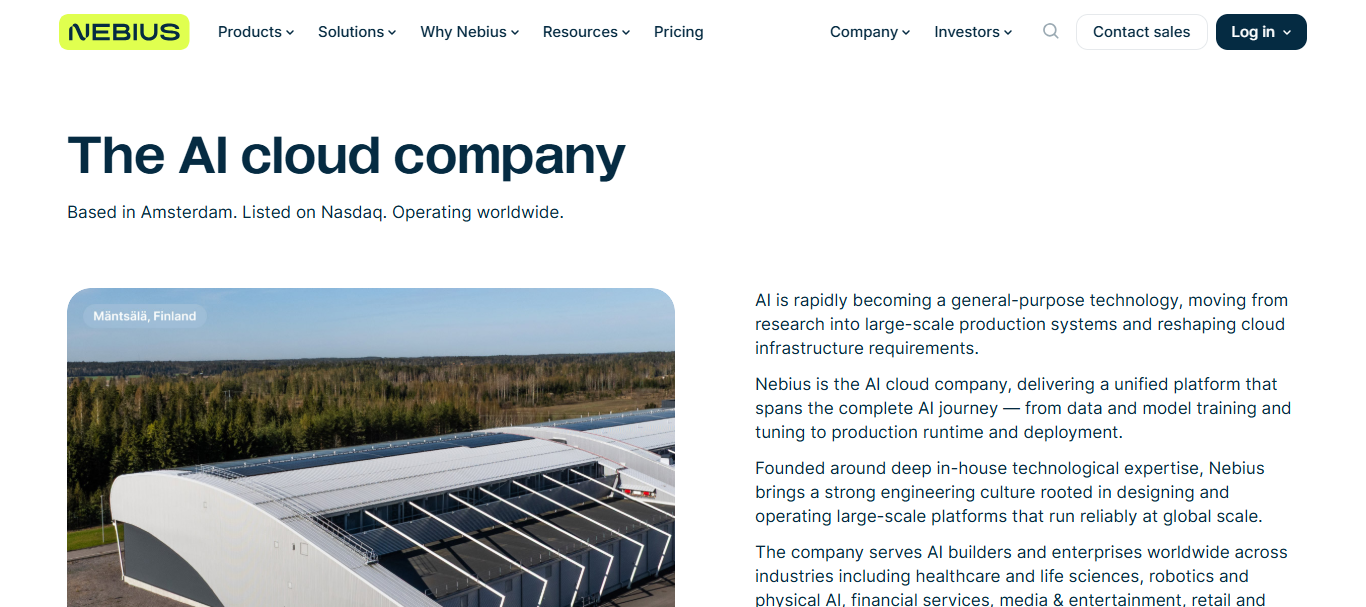
The prompts given show confidence in Nebius’ ability to deliver to the growing needs of AI infrastructures. They provide an environment that allows developers to train, deploy, and scale models with ease, and that is a significant value added offering compared
To traditional cloud environments. Nebius provides an AI-first architecture that allows developers to use generative AI applications in a more cost-effective, and more importantly, efficient manner.
Nebius Group – Key Features
- AI-first approach cloud computing
- Integrated systems of GPU, storage & network
- Optimized cloud systems for ML
- Eases scaling and deployments for AI
- Enterprise-grade cloud systems for Generative AI
| Pros | Cons |
|---|---|
| AI-first cloud architecture for efficiency | Less globally recognized compared to AWS or Azure |
| Provides synergy of storage, networking, and AI tools | Market penetration still limited |
| Cost-effective scaling for generative AI apps | May face challenges in enterprise adoption |
| Developer-friendly environment for training and deployment | Competition from established cloud providers |
6. Scale AI
Scale AI builds the necessary data infrastructure on which trustworthy and reliable AI systems can be built. The offerings of Scale AI include data annotation, model evaluation, reinforcement learning, and AI services and testing.

Scale AI’s work in model evaluation frameworks is an important development and area of focus as more and more sophisticated and larger scale AI systems are developed and used.
The evaluation frameworks developed by Scale AI assist users in assessing the quality, safety, and reliability of AI systems and models prior to their use.
Scale AI – Key Features
- Leading the industry in AI data annotation
- AI model evaluation
- Data for Reinforcement Learning
- Testing for AI Safety & Performance
- Includes enterprise and government AI.
| Pros | Cons |
|---|---|
| Builds critical data infrastructure for AI reliability | Dependent on demand for large-scale AI training |
| Strong expertise in annotation, evaluation, and RL | Annotation-heavy workflows can be resource-intensive |
| Evaluation frameworks improve AI safety and trust | Faces competition from other data labeling firms |
| Trusted by enterprises for model reliability | Scaling annotation quality across domains is challenging |
7. Wayve
Wayve is a revolutionary autonomous driving company that creates driving software based on AI that helps cars learn through real-world driving.
Unlike other companies that employ a lot of methods that are more structured, Wayve is focused on end-to-end machine learning that requires enormous data collection of driving samples.

NVIDIA is known to have participated in Wayve’s big fundraising round. Wayve’s software wants to help cars be more flexible and adaptable in traffic conditions, all while limiting the usage of extremely expensive mapping systems.
Wayve is building infrastructure focused on designing AI for self-driving cars that are more safe and flexible, and as the transportation systems become automated, Wayve is striving to be more innovative and advanced.
Wayve: Key Features
- Autonomous driving AI.
- Learns from driving data.
- Less reliance on HD maps.
- Scalable self-driving software.
- AI adaptive decisions for driving.
| Pros | Cons |
|---|---|
| End-to-end ML approach for autonomous driving | Requires massive real-world driving data collection |
| Flexible, adaptable AI for traffic conditions | Safety and regulatory hurdles in autonomous driving |
| Reduces reliance on expensive mapping systems | Competes with giants like Tesla and Waymo |
| Backed by NVIDIA’s investment | Long timeline for mass adoption of self-driving tech |
8. Baseten
Baseten is a company that makes it easier for software developers to design, implement and manage machine learning models using a lot less infrastructure.

Baseten uses GPU resources that are optimized and makes it way easier for developers to implement large scale generative AI applications on their software.
Baseten makes a lot of sense opportunistically for AI, due to the buzz and hype around AI, Baseten is focused on improving the efficiency of its operations along with decreasing latency.
Baseten: Key Features
- Makes AI model deployment easier.
- Fast, GPU-based inference.
- Supports different ML frameworks.
- Less latency for AI.
- Easy to use APIs & deployment tools.
| Pros | Cons |
|---|---|
| Simplifies ML deployment for developers | Smaller ecosystem compared to major AI platforms |
| Optimized GPU usage reduces latency | May face scalability challenges with enterprise workloads |
| Enables large-scale generative AI apps easily | Limited differentiation beyond developer tooling |
| Focused on efficiency and accessibility | Competes with established MLOps platforms |
9. Synthesia
Synthesia lives up to its motto of ‘creators of a new reality’ with its innovative use of AI in the enterprise video production space. By creating cutting edge, believable, digital actors that can be multilingual, Synthesia is breaking the barriers for enterprise level filming and editing.
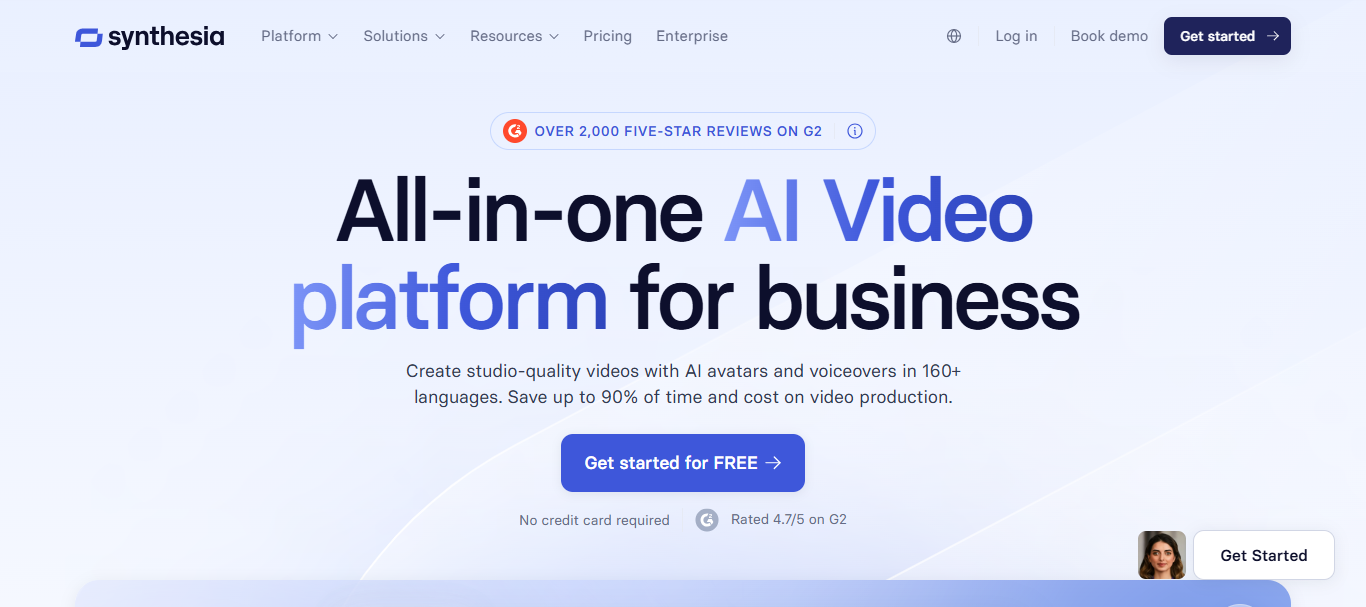
Synthesia’s clients can now create training, demonstrations, simulations, and company wide messages all without filming. Synthesia has made filming new costs and has allowed companies to create new videos at a faster pace.
Companies in education, healthcare, finance, and tech are able to use Synthesia to provide content for their customers across the world. As long as Synthesia keeps improving the realism, their voice generation and avatars, they will be at a level above the rest in the generation of content.
Synthesia: Key Features
- Creates real, human-like AI videos.
- Can make videos in different languages.
- Fast corporate video generation.
- Digital avatars that can be tailored.
- Great for training and corporate videos.
| Pros | Cons |
|---|---|
| Innovative AI video production with digital actors | Concerns about deepfake misuse and ethics |
| Multilingual avatars expand global reach | Realism of avatars still evolving |
| Saves costs and time in enterprise video creation | Limited applications outside corporate/education |
| Strong adoption in training, healthcare, and finance | Faces competition from other AI video startups |
10. Recursion Pharmaceuticals
Recursion Pharmaceuticals uses AI, automation, and biological data to try and transform the slow and longstanding methods of pharmaceuticals and drug development — to create a new methodology of drug discovery. As a direct investment of NVIDIA, they are using the right methods and the right tools.

To do this, they are analyzing cellular biology and the countless experiments with the aid of machine learning that is running on NVIDIA’s high performance computing. This is going to help researchers to identify new and unexplored biological connections that have the potential
To create new treatments. By transforming the use of AI and automation in biology, Recursion is changing the future of the pharmaceuticals while accelerating the use of technologies to discover new medications.
Recursion Pharmaceuticals: Key Features
- AI & ML driven drug development.
- Automates scientific research.
- Uses NVIDIA to power research.
- Speeds research and development.
| Pros | Cons |
|---|---|
| AI-driven drug discovery accelerates research | Drug development still faces long regulatory timelines |
| Uses NVIDIA HPC for cellular biology analysis | High costs of biological experimentation |
| Potential to uncover new treatments faster | Risk of overpromising results in pharma |
| Transforming traditional pharma workflows | Competes with other AI-biotech firms |
How To Pick The Right NVIDIA-Backed AI Company
- Understand Your Needs: Understand the reasons you want to implement AI into your business. Do you want to automate, analyze, create content, conduct research, or develop software?
- Review AI Competency: Evaluate the AI models from each company. Pay attention to the models’ accuracy, reasoning, multimodality, and solutions for the specific verticals.
- Evaluate Scalability and Infrastructure: Pick the companies with scalable GPU infrastructures that have the potential to grow with your business.
- Examine Enterprise Integrations: Verify that the platforms seamlessly integrate with the business softwares, clouds, APIs, and productivity tools.
- Consider Price and Availability: Analyze the enterprise plans, subscriptions, occurrence of free tiers, and availability worldwide.
- Evaluate Security and Compliance: Opt for companies that offer data protection, encryption, a compliance focus, and enterprise-grade security.
Cocnsluion
In summary, the leading AI companies supported by NVIDIA are reshaping the entire field of AI using the latest research, state-of-the-art GPU infrastructure, and cutting-edge real-world applications.
The advances being made by these companies, from generative AI and cloud computing to autonomous driving and even healthcare, are altering technologies in even more areas.
The right AI company for you will depend on your actual business goals and the needs of your industry. NVIDIA-supported innovators are especially good options for continuing and long-lasting growth.
FAQ
What are NVIDIA-backed AI companies?
NVIDIA-backed AI companies are startups and enterprises that receive investment, strategic partnerships, or GPU infrastructure support from NVIDIA.
Why does NVIDIA invest in AI companies?
NVIDIA invests in innovative AI companies to accelerate artificial intelligence development and expand its GPU ecosystem.
Which is the most popular NVIDIA-backed AI company?
OpenAI is one of the most well-known NVIDIA-backed AI companies due to the success of ChatGPT and GPT models.
What industries do NVIDIA-backed AI companies serve?
They serve healthcare, cloud computing, autonomous vehicles, enterprise software, robotics, cybersecurity, and generative AI.