
In this article, the objective is to identify the Best AI Inference Providers for businesses and developers who are looking to deploy, manage, and develop scalable platforms for artificial intelligence applications.
These platforms have sophisticated computing infrastructures, efficient AI models, faster processing, and legitimate APIs for modern AI workloads. We are going to analyze their features, benefits, and limitations and which enterprise and developing requirements they support the best.
Key Points
| AI Inference Provider | Explanation |
|---|---|
| OpenAI | Provides scalable AI model inference with advanced GPT models and developer-friendly APIs. |
| Amazon Web Services | Offers cloud-based AI inference through flexible infrastructure and optimized machine learning services. |
| Google Cloud | Delivers powerful AI inference using TPU acceleration and enterprise machine learning platforms. |
| Microsoft Azure | Provides enterprise AI inference with Azure AI services and powerful cloud computing. |
| NVIDIA | Enables high-performance AI inference using GPUs, TensorRT, and accelerated computing technologies. |
| Groq | Delivers ultra-fast AI inference using specialized language processing hardware technology. |
| Together AI | Provides optimized open-source model inference with scalable cloud AI infrastructure solutions. |
| Cerebras Systems | Offers rapid AI inference through innovative wafer-scale computing architecture platforms. |
| Hugging Face | Provides accessible AI inference APIs supporting thousands of open-source models. |
| Replicate | Enables simple AI model deployment and inference through developer-focused APIs. |
1. OpenAI
OpenAI excels in offering extensive large language models through cloud-based APIs. Their large language models have enabled developers to bring the power of language into their applications. Here they have incorporated coding features, automation, and AI agents.

OpenAI eases the burden of scaling large models by providing fast, efficient, and secure infrastructures. Startups, developers, and large enterprises can all take advantage of their large language models due to their support for various model sizes.
Developers can now create applications with AI capabilities without having to build a machine learning infrastructure themselves.
OpenAI – Key Features
- Advanced Large Language Models OpenAI hosts sophisticated GPT models that help language comprehension, content generation, coding, question answering, and the development of complex AI tools.
- Scalable API Infrastructure OpenAI provides friendly APIs for developers that help businesses to embed the AI features into their websites, apps, and automation and enterprise workflows.
- Generative AI Capabilities AI features that help in text, image, and code generation, data analysis, and the development of AI agents are available on the platform.
- Fast AI Inference Performance OpenAI provides optimally designed cloud infrastructure that achieves efficient processing and fast response times for demanding and high traffic AI tasks.
- Enterprise Security & Reliability OpenAI provides designed enterprise security and business sensitive data privacy focused solutions.
| Pros | Cons |
|---|---|
| Advanced GPT models deliver strong language understanding and generation capabilities. | Higher usage costs can become expensive for large-scale applications. |
| Easy-to-use APIs simplify AI integration for developers and businesses. | Limited control over underlying model architecture and training data. |
| Supports multiple AI tasks including text, coding, and automation. | API dependency may create vendor lock-in risks. |
| Reliable infrastructure provides fast and scalable AI inference. | Some complex industry-specific tasks may require additional customization. |
| Enterprise security features support business-level AI adoption. | Data privacy concerns require careful configuration and compliance management. |
| Wide industry adoption provides proven AI solutions. | Availability and performance can vary during high-demand periods. |
2. Amazon Web Services (AWS)
Amazon Web Services utilizes the cloud computing power to provide advanced AI capabilities through a machine learning framework as a service. AWS provides tools like Amazon SageMaker to host machine learning models and perform real-time inferences.
AWS also provides various AI frameworks along with GPU and accelerator support – making machine learning models more cost efficient and performing better. Due to the breadth of features AWS provides for AI and machine learning
They are a preferred solution for building recommendation systems, predictive analytics, computer vision, and generative AI applications. Their global cloud infrastructure gives AWS an edge of security, scalability, and AI deployments over all other services.
Amazon Web Services (AWS) – Key Features
- Amazon SageMaker Integration With AWS SageMaker, businesses can develop, train, deploy, and manage machine learning models in a fully scalable inference environment.
- Flexible Computing Infrastructure AWS offers the optimal balance of performance, cost, and workload by providing access to GPUs, CPUs, and AI accelerators.
- Real-Time Model Deployment Models can be deployed to AI tools and applications that make predictions and recommendations, automate, and act, in real-time.
- Enterprise Cloud Security Protecting enterprises’ data and compliance needs is central to AWS’s AI security and infrastructure solutions.
| Pros | Cons |
|---|---|
| Powerful SageMaker tools simplify machine learning model deployment. | AWS services can be complex for beginners to configure. |
| Flexible infrastructure supports different AI workload requirements. | Pricing structure can become difficult to manage at scale. |
| Strong security and compliance features support enterprises. | Requires technical expertise for advanced AI implementations. |
| Global cloud availability ensures reliable AI deployment worldwide. | Managing multiple AWS services increases operational complexity. |
| Supports multiple AI frameworks and hardware options. | Learning curve is higher compared with simpler AI platforms. |
| Amazon Bedrock enables access to multiple foundation models. | Some advanced features require additional AWS ecosystem knowledge. |
3. Google Cloud
High-performance, AI, and cloud-enhanced inference become easily accessible through Google Cloud. Google Cloud utilizes AI workload and machine learning (ML) model deployments and management through tensor processing units (TPUs), graphic processing units (GPUs), and Vertex AI services.
From here, developers can harness Google Cloud’s platform to build applications with generative AI, natural language processing (NLP), image processing and recognition, and predictive analytics and modeling.
Google’s AI inference tool is offered through its cloud platform with comprehensive integration of AI and an extensive in-house research capability. Google Cloud helps organizations run sophisticated AI models with relatively low operational overhead and no reliability concerns.
Google Cloud – Key Features
- Google Vertex AI Google Cloud’s Vertex AI streamlines the ML workflow by allowing users to easily create and manage ML models and their deployments.
- TPU Hardware Acceleration Google’s TPUs facilitate rapid AI inference and ML task processing.
- Generative AI Focus Google Cloud embraces LLMs, AI agents, text and image generation, and enterprise-based AI use cases.
- Machine Learning Improvement Tools are provided for the enhancement of model performance, scalability, and operational use.
| Pros | Cons |
|---|---|
| Vertex AI provides complete machine learning development tools. | Pricing can increase significantly for heavy AI workloads. |
| TPU acceleration delivers high-performance AI inference capabilities. | Requires specialized knowledge for advanced implementations. |
| Strong generative AI capabilities support modern applications. | Migration from other cloud providers may require effort. |
| Excellent data analytics integration improves AI decision-making. | Some enterprise features have a complex setup process. |
| Powerful infrastructure supports large-scale AI deployments. | Documentation can be overwhelming for new users. |
| Google research expertise improves AI technology innovation. | Smaller ecosystem compared with some competitors in certain areas. |
4. Microsoft Azure
Microsoft Azure offers enterprise-targeted AI inference and cloud AI ML infrastructure through Azure AI services. Azure provides AI model deployment, process automation, and intelligent capabilities integration to business applications.
Its AI inference functionality for natural language processing (NLP), computer vision, generative AI, and custom ML models is built-in. Azure ML streamlines the management of the model deployment, monitoring, and optimization across various environments for developers.
Azure offers a comprehensive set of enterprise security and compliance features, along with Microsoft product integration, making it the most adopted enterprise AI solution.
Microsoft Azure – Key Features
- Microsoft Azure AI Services Microsoft Azure encompasses many readily available AI services for natural language processing, vision, speech, and automation.
- Microsoft Azure Machine Learning Azure ML assists in the training, deployment, and monitoring of customized ML models.
- Enterprise Security Azure combines strong security controls and protection of data and identity with compliance and regulatory standards.
- Generative AI Azure’s support of LLMs and enterprise AI creates a robust environment for AI applications.
| Pros | Cons |
|---|---|
| Strong enterprise AI solutions integrate with Microsoft products. | Azure pricing models can be complicated to understand. |
| Azure Machine Learning supports complete AI lifecycle management. | Requires technical expertise for advanced AI deployment. |
| Excellent security and compliance features for businesses. | Some services may have regional availability limitations. |
| Hybrid cloud support provides flexible deployment options. | Management complexity increases with multiple Azure services. |
| Integration with Microsoft ecosystem improves productivity. | AI services may require additional configuration for customization. |
| Supports enterprise-level generative AI applications. | Costs can rise with large-scale AI usage. |
5. NVIDIA
NVIDIA’s advanced AI infrastructure utilizes powerful inference engines, AI accelerators, and software tools centered on high-performance GPUs. Many medical, robotic, and vehicular AI solutions are built on NVIDIA’s hardware.

NVIDIA’s AI modeling tools help developers maximize the speed of AI models and decrease the cost and latency of the required computing. NVIDIA’s dominant place in AI computing hardware offers powerful and scalable AI infrastructure. Therefore, NVIDIA’s hardware solutions remain essential and unmatched.
NVIDIA – Key Features
- AI Data Center SolutionsComplete AI Infrastructure Solutions for enterprises, cloud providers, and research institutions are offered by NVIDIA.
- Developer AI ToolsAI model development and deployment can be done more easily with the software and development kits provided by NVIDIA.
- Low-Latency ProcessingReal-time AI applications, such as robotics and autonomous systems, as well as conversational AI, are possible with NVIDIA’s hardware.
- TensorRT Optimization Technology AI models can achieve higher performance with lower latency and faster inference by using TensorRT in applications.
| Pros | Cons |
|---|---|
| Industry-leading GPUs provide exceptional AI inference performance. | NVIDIA hardware solutions can be expensive for smaller businesses. |
| TensorRT optimization improves speed and reduces latency. | Requires specialized knowledge for optimization and deployment. |
| Powerful AI infrastructure supports advanced computing workloads. | Hardware availability can sometimes be limited due to demand. |
| Wide ecosystem supports developers and AI researchers. | High-performance systems require significant power consumption. |
| Strong adoption across multiple industries ensures reliability. | Software ecosystem may require additional learning time. |
| Excellent support for real-time AI applications. | Infrastructure investment can be high for enterprises. |
6. Groq
Groq offers an even faster inference solution by employing a specialized language processing unit (LPU), which is an AI inference accelerator. LPU’s design focuses on processing AI tasks not only faster, but with less latency than traditional GPU-based frameworks.

The Groq LPU also aids in the rapid processing of large language models and conversational AI. Furthermore, Groq Cloud empowers developers with access to advanced AI modeling tools that can be processed faster than ever.
Groq’s innovative hardware design fits the needs of businesses with high-throughput AI tasks that require near-instant response times.
Groq – Key Features
- Ultra-Fast AI InferenceExtremely fast execution of AI models is possible with the specialized LPU technology from Groq.
- Low Latency ResponsesRapid AI responses are suitable for real-time and conversational AI applications.
- Specialized LPU ArchitectureFor the efficient inference of large language models, Groq employs custom hardware with specialized architecture.
- High Throughput ProcessingGroq empowers organizations to submit large numbers of requests for AI processing while maintaining consistent performance.
| Pros | Cons |
|---|---|
| Extremely fast inference performance with specialized LPU technology. | Limited ecosystem compared with major cloud providers. |
| Low latency makes it suitable for real-time AI applications. | Hardware availability may be restricted in some regions. |
| Efficient architecture improves AI processing speed. | Fewer enterprise tools compared with AWS or Azure. |
| Simple API access allows quick AI model usage. | Newer technology with a smaller market presence. |
| High throughput supports large-scale AI workloads. | Limited customization options compared with traditional infrastructure. |
| Optimized for large language model inference. | May not support every AI workload type. |
7. Together AI
Together AI builds AI inference infrastructure that centers on open-source AI models and AI generative applications. With Together AI, developers, and businesses can leverage open-source models with ease. Together AI provides inference APIs, GPU, and fine-tuning tools.
The AI models support applications such as chatbots, content generation, coding assistants, and AI agents. Together AI combines the flexibility of open-source tools with the scalability of the cloud.
In doing so, Together AI enables organizations to simplify their development processes while providing high-performance AI inference that modern applications demand.
Together AI – Key Features
- Open Source Model SupportApplication development with multiple open source AI model options.
- Scale AI InfrastructureAccess to cloud computing for the deployment and scaling of AI applications.
- Model CustomizationAbility to adjust models to fit specific business needs.
- Generative AIIncludes support for chatbots, content generation, coding assistants, and AI agent applications.
- Fast Inference APIsThe provision of fast and reliable execution APIs for models.
| Pros | Cons |
|---|---|
| Strong support for open-source AI models. | Smaller ecosystem compared with major cloud platforms. |
| Provides scalable infrastructure for generative AI applications. | Enterprise features may be less mature. |
| Flexible model customization and fine-tuning options. | Requires technical knowledge for advanced customization. |
| Optimized inference APIs improve application performance. | Limited global infrastructure compared with hyperscalers. |
| Developer-friendly platform simplifies AI deployment. | Model availability depends on supported open-source options. |
| Helps reduce infrastructure management complexity. | Pricing may vary based on computing requirements. |
8. Cerebras Systems
Cerebras Systems builds large AI inference solutions with their wafer scale computing and advanced AI inference hardware. Their Cerebras Wafer Scale Engine (WSE) provides massive computing power designed to accelerate artificial intelligence workloads.

Cerebras focuses on the training and inference of AI models and builds large wafers that contain thousands of processing cores. Cerebras systems are used for large language models, scientific computing, and AI for the enterprise.
Their infrastructure provides organizations the ability to solve large and complex AI workloads more efficiently and effectively when compared to traditional systems.
Cerebras Systems – Key Features
- Wafer Scale Computing Pioneering large scale AI chip design.
- Fast AI Processing Speeds up the processing of complex AI models.
- Large Language Models Assists companies in the running and optimization of large AI models.
- Compute Intensive Research Supports simulation and complex research with high throughput computing.
| Pros | Cons |
|---|---|
| Wafer-scale technology provides exceptional AI computing power. | Hardware solutions are expensive for smaller organizations. |
| High-speed processing improves large AI model performance. | Limited availability compared with mainstream AI providers. |
| Designed specifically for demanding AI workloads. | Requires specialized infrastructure knowledge. |
| Supports large language models efficiently. | Smaller software ecosystem than NVIDIA or cloud platforms. |
| Provides innovative AI acceleration technology. | Adoption is still developing across industries. |
| Useful for scientific and enterprise research applications. | Deployment complexity can be higher than cloud-based solutions. |
9. Hugging Face
Hugging Face is another favorite AI inference provider. You can access plenty of open source machine learning models on Hugging Face via their platform or APIs. NLP, CV, Audio, and other multimodal AI models have inference endpoints for deploy.
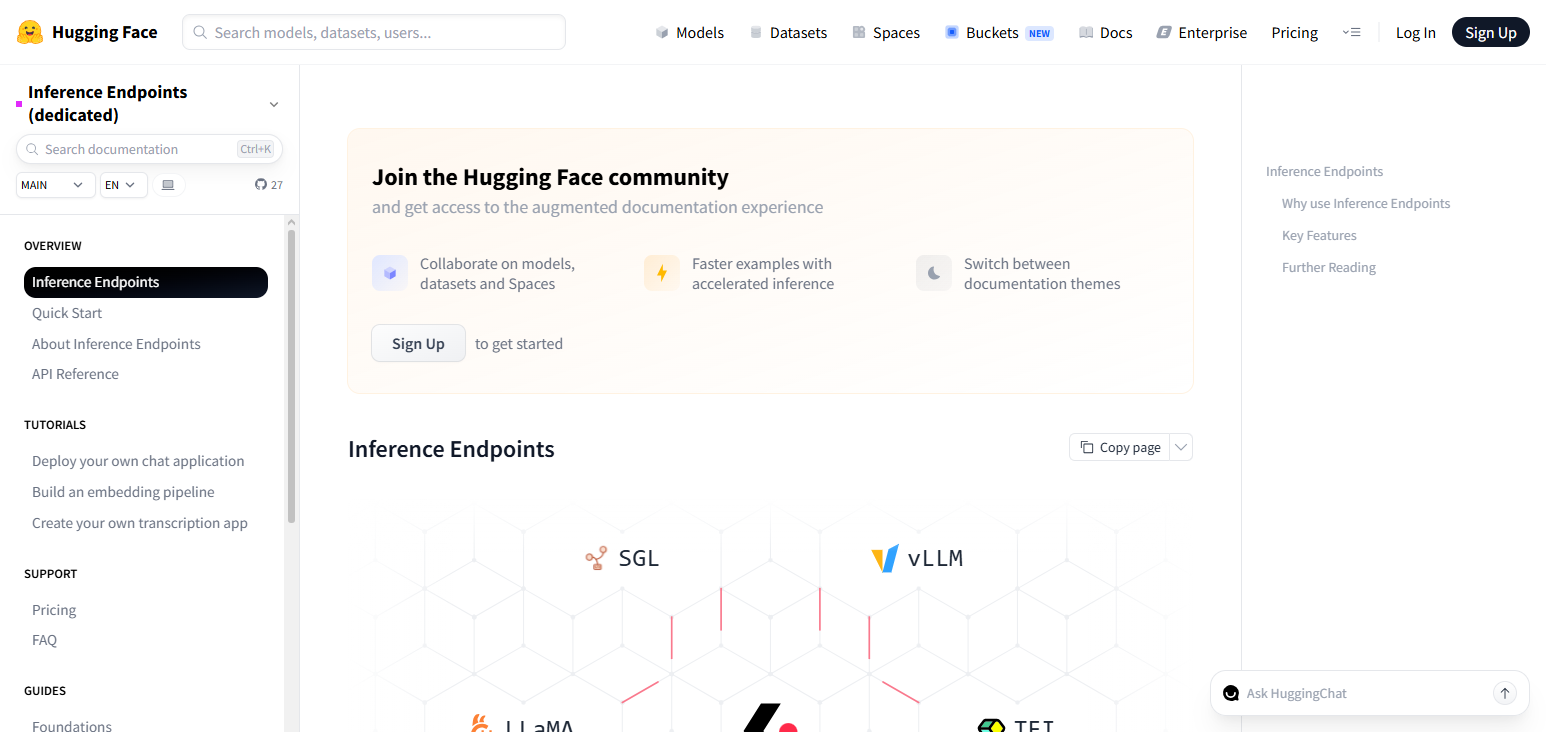
Hugging Face users can employ AI model customization for their organization’s use cases. Hugging Face is popular for experimenting, building, and scaling AI-powered applications because there is a large repository of models, and there are plenty of frameworks for deploying models.
Hugging Face – Key Features
- Large Model Collection Thousands of machine learning models available as a public resource.
- Inference APIs Enables the deployment of AI models through an API connection.
- Open-Source AI Community Hugging Face promotes global collaboration within the research and development community.
- Multimodal Support Applications that deal with language, vision, audio, and other modalities are all supported by the platform.
| Pros | Cons |
|---|---|
| Large open-source AI model library provides extensive choices. | Many models require technical expertise for optimization. |
| Supports NLP, vision, audio, and multimodal applications. | Performance depends heavily on selected models. |
| Strong developer community encourages collaboration and innovation. | Enterprise support options may require additional plans. |
| Flexible model customization improves application development. | Managing self-hosted models requires infrastructure knowledge. |
| Easy access to AI inference APIs. | Open-source models may vary in quality and reliability. |
| Supports experimentation and research workflows. | Scaling large deployments can require additional resources. |
10. Replicate
If you are looking for an AI inference platform that makes model running easy with simple APIs, look no further than Replicate. Their platform supports thousands of AI models for image generation, text processing, video creation, speech recognition, automation, and many more tasks.

Replicate makes life easy on developers by implementing model deployment, scaling, and hardware on the back end so developers can add features to their apps with little to no machine learning knowledge.
Replicate provides an easy interface, and plenty of flexible hosting options, thus removing the friction for Developers and Startups building AI-enabled products.
Replicate – Key Features
- Effortless AI Model IntegrationDevelopers are able to implement AI models with ease, using simplistic coding interfaces.
- Extensive Model AccessUsers have access to countless AI models for a multitude of use cases.
- Accessible Coding InterfacesAI use is simplified via development interfaces that are easy to code.
- Infrastructure is Self ManagedThe platform automatically manages all hardware, scaling, and model use requirements.
| Pros | Cons |
|---|---|
| Simple APIs make AI model deployment easy. | Limited control over infrastructure compared with self-hosting. |
| Large collection of AI models supports many use cases. | Costs may increase with frequent model usage. |
| Requires minimal machine learning infrastructure management. | Performance depends on available hosted models. |
| Supports creative AI applications like images and videos. | Enterprise-level features are more limited. |
| Fast experimentation helps developers build prototypes quickly. | Less suitable for highly customized AI environments. |
| Developer-friendly platform reduces deployment complexity. | Smaller ecosystem compared with major cloud providers. |
Conclusion
To summarize, the Best AI Inference Providers help companies build fast, scalable, and dependable AI applications. Providers, including OpenAI, AWS, Google Cloud, Azure, and NVIDIA, offer advanced infrastructure, models, and tools.
Performance, cost, security, and target application determine model choice. These AI inference solutions will drive continuous cross-industry innovation.
FAQ
Why are AI Inference Providers important?
They help organizations deploy AI models faster, reduce infrastructure costs, improve performance, and deliver real-time AI responses.
Which is the best AI Inference Provider?
OpenAI, AWS, Google Cloud, Microsoft Azure, NVIDIA, and Groq are among the top AI inference providers.
What features should businesses look for in AI inference platforms?
Businesses should consider speed, scalability, API support, security, pricing, model availability, and integration capabilities.
Is OpenAI suitable for AI inference workloads?
Yes, OpenAI provides powerful GPT models, scalable APIs, and reliable infrastructure for various AI applications.