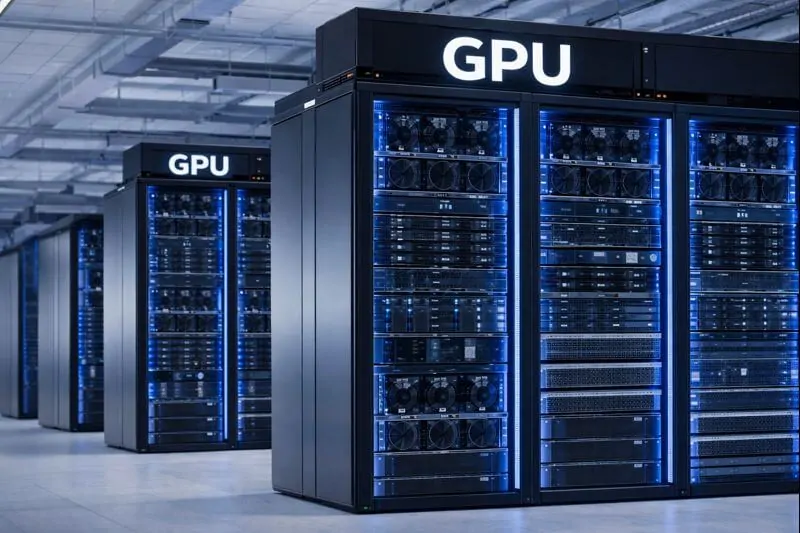
In this article today we will be discussing the best GPU hosting platforms for AI applications. Training and deploying AI models require powerful hardware that most teams can’t afford to buy.
The answer to this problem is the flexible pricing and scalable infrastructure of cloud GPU hosting. I’ll break down ten providers, their GPU models, pricing, performance, and key benefits so you can make an informed decision.
How We Pick the Top GPU Hosting Providers for AI Applications
- GPU Diversity We verify that the platform has modern GPUs like H100, H200, A100, and B200, as well as budget options like RTX 4090.
- Pricing and Billing: We consider hourly rates and billing options, such as per-second or per-minute billing, spot and reserved plans.
- Performance: We consider VRAM, compute power, and fast storage, to ensure the platform can handle both training and inference.
- Scalability: We like platforms that scale from a single GPU to large multi-GPU clusters with fast networking like InfiniBand.
- Deployment: Looking for fast deployment, pre-installed ML tools, container support, API access, and serverless options.
- Reliability and Availability We take into account uptime, GPU availability, locations of data centers and the quality of infrastructure.
AI Workload Support: We investigate the support for fine-tuning, LLM inference, image generation and batch processing. - Supporting ecosystem: We look at documentation, customer support, Kubernetes & Terraform integration, and community resources.
Key Points & Best GPU Hosting Platforms for AI Applications
| Platform | Description | Pricing (approx.) | GPU Models |
|---|---|---|---|
| RunPod | Dedicated and community cloud GPUs for affordable training, serverless inference. | RTX 4090 from $0.34/hr and A100 PCIe from $1.19/hr on Community Cloud. H100 SXM $2.69/hr (Community) to $4.39/hr (Secure). | 30+ models, including A100, H100, RTX 6000 Ada, and L4/L40 series. Also H200, B200, RTX 5090/4090/3090. |
| CoreWeave | Enterprise-grade AI infrastructure built for large-scale frontier model training workloads. | H100 $6.16, H200 $6.31, B200 $8.60 per GPU/hr, GB200 NVL72 $10.50 per GPU/hr. Sold as 8-GPU nodes (H100 node $49.24/hr). | GB300 NVL72, GB200 NVL72, B300, B200, RTX PRO 6000, H100, H200, GH200, L40, L40S, A100. |
| Lambda Labs | Developer-friendly cloud GPUs and workstations tailored for machine learning teams. | H100 SXM $3.99–$4.29/hr, B200 $6.69–$6.99/hr, A100 (40GB) $1.99/hr. | B200, H100, GH200, A100, A10, A6000, V100. |
| Vast.ai | Peer-to-peer GPU rental marketplace focused on low-cost compute for AI. | H100 SXM from $1.73/hr (median $1.93), RTX 4090 from $0.27/hr (median $0.50), A100 SXM4 from $0.35/hr. Host-set prices. | H100, H200, B200, A100, L40S, RTX 5090, 4090, 3090, plus older cards. |
| Modal | Serverless GPU compute for fast inference, batch jobs, and fine-tuning. | Per-second billing: H100 about $3.95/hr, A100 80GB $2.50/hr, B200 $6.25/hr, L4 $0.80/hr, T4 $0.59/hr. CPU and memory are billed extra. | B300, B200, H200, H100, RTX PRO 6000, A100, L40S, A10, L4, T4. |
| DigitalOcean (Gradient GPU Droplets) | Accessible cloud GPU Droplets alongside standard cloud infrastructure and services. | H100 $4.41/hr, H200 $4.47/hr, MI300X $2.59/hr, L40S $1.57/hr, RTX 4000 $0.76/hr. | NVIDIA H100, H200, L40S, RTX 4000/6000 Ada, and AMD MI300X/MI325X. Spot: B300, MI350X, MI355X. |
| Baseten | Deploy and scale production AI inference workloads on serverless GPUs. | Per-minute billing: T4 $0.63/hr, L4 $0.85/hr, A100 $4.00/hr, H100 $6.50/hr, B200 $9.98/hr. | T4, L4, A10G, A100 80GB, H100 (MIG and full), B200. |
| SaladCloud | Distributed consumer GPU network offering budget-friendly compute for AI workloads. | RTX 4090 $0.16 (Batch) to $0.33/hr (High priority); RTX 5090 $0.25 to $0.50/hr. RTX 3090 from $0.09/hr. | 35 GPU models, mainly consumer cards such as RTX 5090, 4090, and 3090. |
| Hyperstack | Cloud GPU instances well suited for AI and machine learning. | H200 SXM $3.99/hr, H100 SXM $3.20/hr, H100 PCIe $2.50/hr, RTX PRO 6000 SE $1.85/hr. A100 about $1.35/hr, L40 $1.00/hr, A6000 $0.50/hr. | GB200 NVL72, B200, B300, H200, H100, A100, RTX Pro 6000 SE, L40, RTX A6000. |
| Together AI | Platform for running and hosting open-source AI models and inference. | H100 $3.99/hr and H200 $5.99/hr on-demand; B200 $8.19/hr. Dedicated endpoint: H100 $5.49/hr. Reserved rates are lower. | H100, H200, B200, B300, GB200 NVL72. |
10 Best GPU Hosting Platforms for AI Applications
1. RunPod
RunPod is a GPU cloud that combines secure dedicated data centers with a community marketplace, making serious compute affordable for startups and solo developers. It has over 30 GPU models including 16GB RTX A4000 and 24GB RTX 4090, 80GB H100 and A100, and 141GB H200 and Blackwell B200.
Prices start at approximately $0.27 per hour for an RTX A5000 and range from $2.69 to $4.39 for an H100 SXM, depending on the tier. You pay for pods by the second, they deliver the full performance of the gpu for training and they can be launched in less than thirty seconds.
Autoscaled inference workers on serverless endpoints Multi-node clusters with up to 64 GPUs It is ideal for LLM fine-tuning, image generation, video synthesis, AI agents and batch inference with shared storage attached across multi-GPU clusters.
RunPod Key Benefits
- The flexibility of the Secure Cloud and Community Cloud tiers allows you to balance reliability and cost.
- Per second billing means short jobs cost only a fraction of an hour.
- Serverless endpoints and multi-GPU clusters for anything from experiments to production inference.
2. CoreWeave
CoreWeave is a Kubernetes-based hyperscale cloud, AI-first for frontier model labs and enterprises that require massive, reliable GPU capacity. The catalog includes 11 GPU models, including GB300 and GB200 NVL72 racks, HGX B200, H200 and H100 systems with 80GB to 141GB memory, and L40S and A100 cards.
L40 inference is priced from about $1.25 per GPU-hour and H100 costs $6.16 per GPU-hour, with sales of eight-GPU nodes. Performance is powered by HGX nodes connected by InfiniBand and rack-scale Blackwell systems ideal for distributed training.
The deployment is Kubernetes native with Slurm on Kubernetes (SUNK) available for scheduling training jobs. It handles pretraining, fine-tuning and large-scale inference, scales to thousands of GPUs with multi-year reserved contracts, and data egress is free.
Core Weave Key Benefits
- Enterprise-grade infrastructure designed for large scale AI and frontier model training.
- Access to latest hardware including Blackwell GB200 and B200 systems.
- Kubernetes-native design with Slurm support simplifies large distributed training jobs.
- Reserved contracts and high-speed InfiniBand networking for thousands of GPUs.
3. Lambda Labs
Lambda Labs is a developer-centric AI cloud with simple pricing, pre-installed machine learning software and rapid access to high-end NVIDIA hardware. It catalog includes B200, H100, GH200, A100, A10, A6000 and older V100 cards, with 80GB on A100 and H100 and 180GB on B200.
The on-demand pricing starts at roughly $1.09 per GPU-hour, with the H100 SXM at nearly $3.99 to $4.29 and the A100 80GB at about $1.79 in eight-GPU nodes. Lambda Stack comes with PyTorch, CUDA and NCCL out of the box.
Teams can launch self-serve instances with SSH access, or purchase 1-Click Clusters of 16 to over 2,000 GPUs connected with InfiniBand networking for distributed training. It works well for training, fine-tuning and research, while private cloud options cater to larger enterprises that need dedicated capacity.
Lambda Labs Key Benefits
- Developer-friendly environment with preinstalled ML stack (PyTorch, CUDA, NCCL)
- On-demand pricing that’s clear, simple and no complex tiers.
- 1-Click Clusters enable teams to quickly spin up large multi-GPU training environments.
- For teams that have outgrown shared instances, private cloud and dedicated workstation options are ideal.
4. Vast.ai
Vast.ai is a peer-to-peer GPU marketplace where independent hosts and data centers can list spare capacity, and renters can compare offers to pick the cheapest machine that meets their needs. The hardware available includes consumer RTX 3090, 4090 and 5090 cards from 24GB to 32GB of VRAM, and datacenter H100, H200, B200, A100 and L40S GPUs.
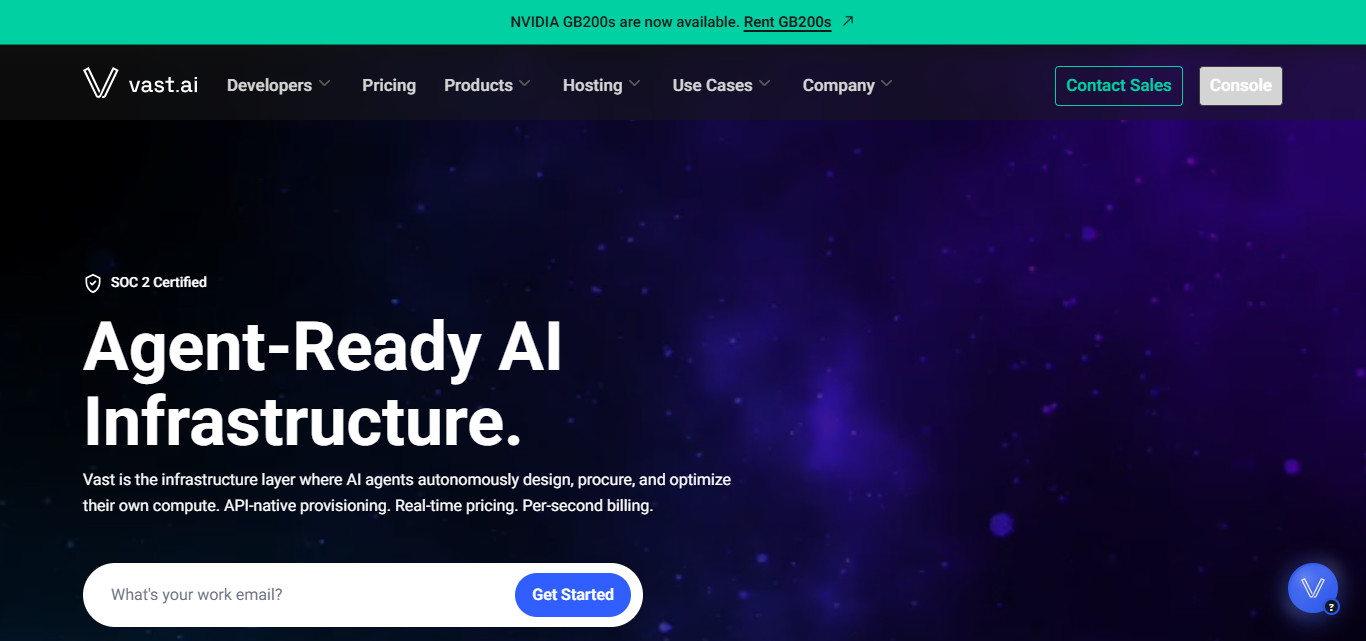
Starting prices are very low, with an RTX 3090 at about $0.09 per hour, an RTX 4090 at $0.27, and an H100 SXM at $1.73. The performance and reliability of each host are different and renters check verification and reliability scores.
Instances run as Docker containers and are billed per second for GPU time, per byte for bandwidth, and per byte for storage. Ideal for fine-tuning, experiments, rendering, and batch jobs. Multi-GPU machines can handle larger training runs.
Vast.ai Key Benefits
- Marketplace competition keeps prices among the lowest, especially on consumer GPUs.
- You can filter offers and choose the machine by price, GPU type and reliability score.
- GPU time and Storage are charged per second, so you don’t pay for minutes you don’t use.
- The massive hardware range from RTX 3090 to H100 and B200 fits almost any budget.
5. Modal
Modal is a serverless cloud platform that enables developers to run GPU workloads, define infrastructure in Python, without having to manage servers, clusters or YAML files. It has T4 with 16GB, L4 and A10 with 24GB, L40S with 48GB, A100 with 40GB and 80GB, H100 with 80GB, H200 with 141GB, RTX PRO 6000, B200 and B300.
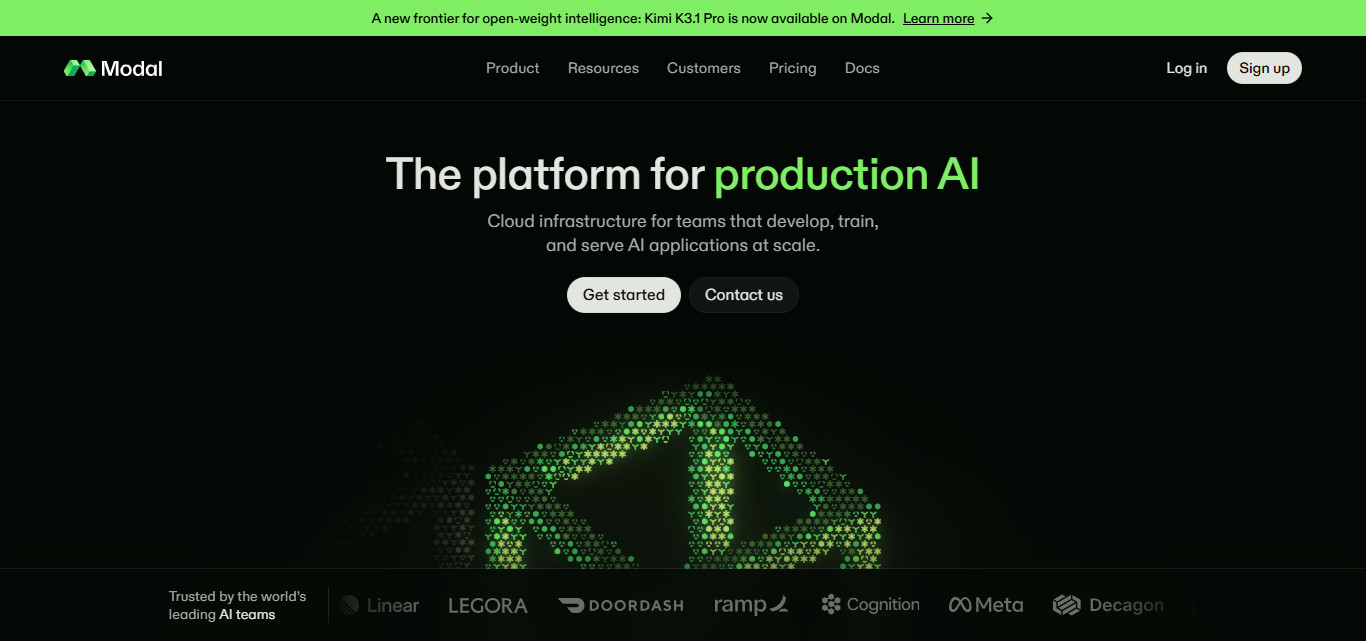
Billing is per second, so a T4 costs close to $0.59/hour, an A100 80GB costs around $2.50 and an H100 costs around $3.95. Containers start fast, scale to zero when not in use, and can attach to up to 8 GPUs. Fits inference endpoints, batch processing, fine-tuning and scheduled jobs. It is scalable to over 100 GPUs on demand without quota requests. CPU and memory are billed separately.
Mode Key Benefits
- Fully serverless: you write Python and Modal takes care of servers, scaling, and containers.
- Scale-to-zero and per second billing, so you never pay for idle GPUs.
- Access to many GPU types from T4 to B200 without quota requests
- Great for bursty workloads such as batch jobs, fine-tuning and inference APIs.
6. DigitalOcean (Gradient GPU Droplets)
DigitalOcean’s Gradient GPU Droplets, we’re bringing GPU computing to a cloud platform our users know and love, providing developers and small teams with easy, predictable access to AI hardware. AMD Instinct MI300X with 192GB and MI325X with 256GB, H200 with 141GB, H100 with 80GB, RTX 4000 Ada, RTX 6000 Ada with 48GB, L40S with 80GB .
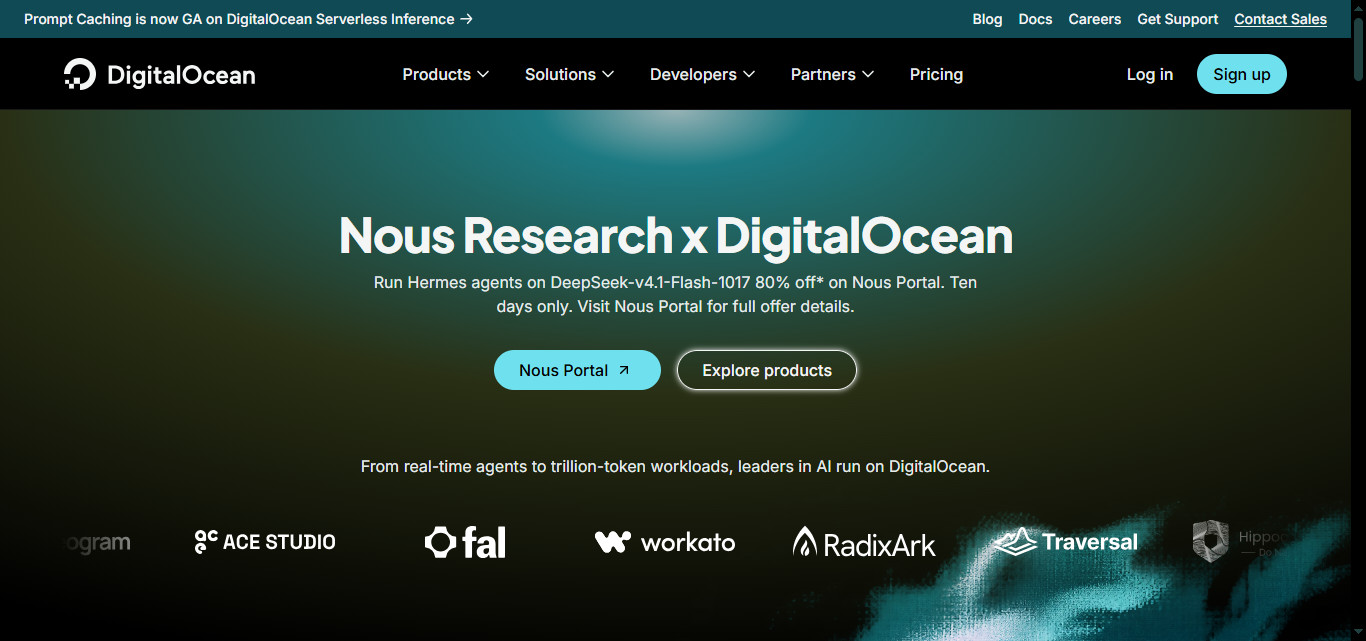
With the August 2026 update, on-demand pricing begins at $0.76/hr for the RTX 4000 Ada, $1.57/hr for the L40S, $2.59/hr for the MI300X and $4.41/hr for the H100. Droplets are available in single- or eight-GPU variants with NVMe storage, and are charged by the second
After a minimum five minutes. They integrate with Kubernetes, are suitable for training, inference and HPC. Reserved or spot plans reduce costs for sustained workloads. Also we have bare metal by contract.
DigitalOcean (Gradient GPU Droplets) Key Benefits
- Simple, familiar cloud interface that is easy for small teams to use.
- Choose between single-GPU or 8-GPU configurations with either NVIDIA or AMD GPUs.
- Predictable pricing options including reserved and spot for longer workloads .
- Integrates with DigitalOcean’s native cloud services, like Kubernetes and storage.
7. Baseten
Baseten is an inference platform that allows you to deploy, serve, and scale standard ML models in production without having to run Kubernetes yourself. Dedicated deployments of T4 come with 16GB, L4 and A10G with 24GB, A100 with 80GB, a fractional H100 MIG with 40GB, a full H100 with 80GB and B200 with 180GB.
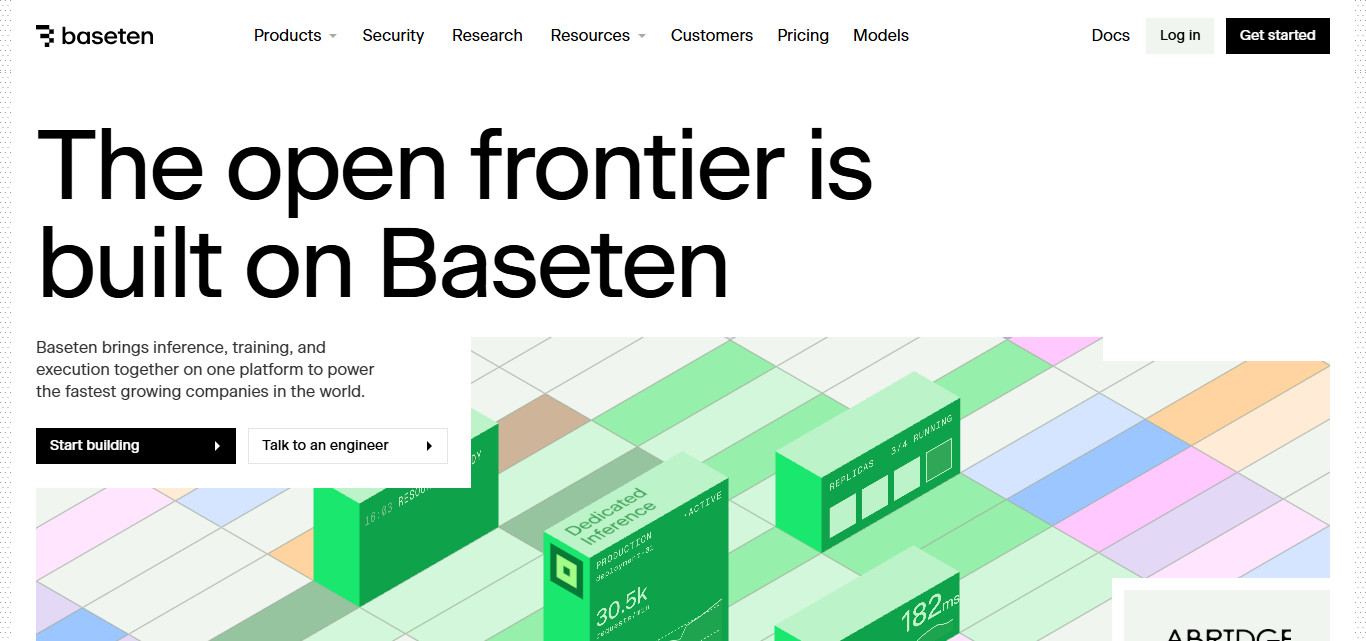
Billing is per minute and starts at $0.63/hour for a T4, with an A100 at nearly $4.00, an H100 at $6.50, and a B200 at nearly $9.98. With Baseten Inference Stack and Truss framework, packaging is easy and inference is fast.
Models run as autoscaling, zero-scalable replicas, on Baseten’s cloud, or your own. It works with LLMs, image models and custom or fine-tuned models. Per-token Model APIs and volume discounts for larger teams.
Baseten Key Benefits
- Built for production inference, so you can serve models without managing infrastructure.
- Autoscaling replicas, including scale to zero, costs align with traffic.
- Truss framework and optimized inference stack accelerate model packaging and serving.
- Pricing flexibility between dedicated GPU deployments and per-token Model APIs.
8. SaladCloud
SaladCloud is a distributed cloud that aggregates idle consumer GPUs from hundreds of thousands of contributors, offering some of the lowest GPU prices around. Its catalog features 35 different GPU models, mainly consumer cards such as RTX 5090 with 32GB, RTX 4090 and 3090 with 24GB and RTX 5080 with 16GB.
Prices are based on four tiers of priority, so an RTX 3090 runs you about $0.09/hour, an RTX 4090 runs $0.16-0.33, and an RTX 5090 costs $0.25-0.50. Great for inference , not for frontier training . Nodes are home machines with variable networking .
Workloads run as containers via the Salad Container Engine, billed by the second. It supports image generation, video synthesis, transcription and batch inference and scales to thousands of nodes.
SaladCloud Key Benefits
- Very low prices due to a distributed network of consumer GPUs.
- Four levels of priority allow you to trade off availability vs. cost.
- Setup is simple with container based deployment and per second billing.
- Well suited for cost-sensitive inference such as image generation, transcription and batch jobs.
9. Hyperstack
Hyperstack is a GPU cloud with on-demand, reserved and spot NVIDIA virtual machines for AI training, inference and fine-tuning. The list includes the GB200 NVL72, B200, B300, H200 with 141GB, H100 and A100 with 80GB, RTX Pro 6000 SE with 96GB, L40 and A6000 with 48GB and A4000 with 16GB.
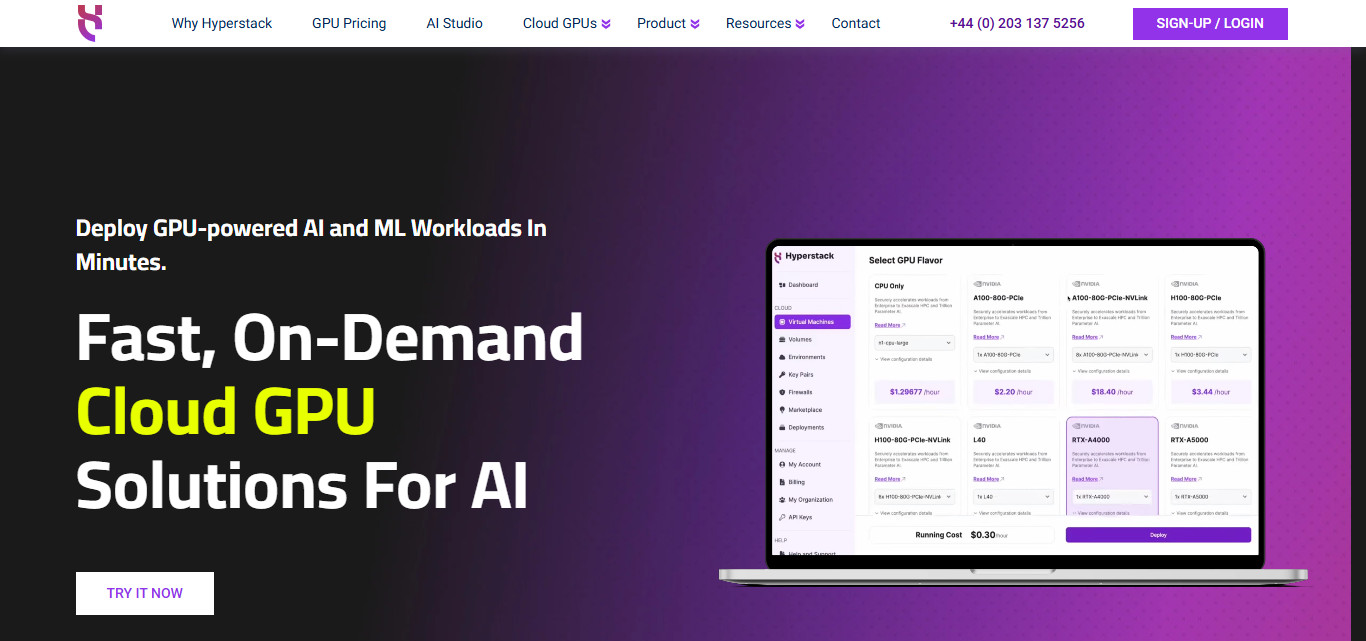
Prices start at $0.15/hour for an A4000, $0.50 for A6000, $1.00 for L40, $1.35 for A100, and $2.50 for H100 PCIe. NVMe-backed storage and 350 Gbps networking on A100 and H100 systems help address bottlenecks in distributed training.
Kubernetes is supported. Users can deploy via a dashboard, API or Terraform provider. Lowering costs with reserved pricing and spot VMs, Hyperstack is a good fit for LLM training, rendering, and production inference.
Hyperstack Key Benefits
- On-demand, reserved and spot VMs can help reduce your costs.
- Wide range of GPUs from budget A4000, A6000 cards, to H100, H200, Blackwell systems.
- NVMe storage and high-speed networking remove distributed training bottlenecks .
- Simple to automate and deploy on Kubernetes with dashboard, API and Terraform support.
10. Together AI
Together AI is an AI acceleration cloud, best known for hosting open-source models through serverless APIs, and renting out dedicated GPUs and clusters for teams who want control. Hardware: NVIDIA H100 (80GB), H200 (141GB), B200 (180GB), B300, and GB200 NVL72 systems.
The site lists prices from $1.75 per GPU-hour, with on-demand H100 clusters at $3.99, H200 at $5.99 and B200 at $8.19, while a dedicated H100 endpoint costs $5.49. Optimized inference stack and kernels speed up training and serving.
We offer deployment options including per-token serverless, single-GPU dedicated endpoints, instant clusters and reserved capacity. 8 to 4,000 GPU clusters with NVLink and InfiniBand fabric, supporting inference, fine-tuning, pretraining, and large multi-node training jobs. Reduced Rates for Reserved Terms.
Together.ai Key Benefits
- Powerful platform for deploying and serving Open Source models through serverless APIs.
- Four ways to purchase compute: per-token, dedicated endpoints, instant clusters, reserved capacity.
- Optimized inference stack & kernels accelerate inference and reduce cost-per-token.
Clusters can scale from a few GPUs to thousands using NVLink and InfiniBand networking.
Conclusion
Conclusion Choosing the right GPU hosting platforms for AI applications depends on your workload, budget, and scale. CoreWeave and Together AI work for enterprise training. Vast.ai and SaladCloud are the cheapest.
RunPod, Lambda Labs, DigitalOcean, and Hyperstack provide a good balance of cost and simplicity, while Modal and Baseten are great for serverless inference. Compare prices, GPU models, scalability – then start small and scale with confidence.
FAQ
Which platform is the cheapest?
Vast.ai and SaladCloud usually offer the lowest prices, with variable reliability.
Which is best for large-scale enterprise training?
CoreWeave suits enterprises needing massive, InfiniBand-connected GPU clusters for frontier training.
Which is best for beginners and developers?
Lambda Labs and DigitalOcean offer simple setup and predictable, developer-friendly pricing.
Which is best for serverless inference?
Modal, Baseten, RunPod scale automatically and charge only for active usage.