In this post , I will explore some AI crypto tools adapting to individual risk profiles to facilitate smarter trading decisions.
- What Are AI Crypto Trading Tools?
- Key Points & AI Crypto Tools That Adapt to Your Personal Risk Profile Automatically
- 10 AI Crypto Tools That Adapt to Your Personal Risk Profile Automatically
- 1. AlgosOne
- 2. Stoic AI
- 3. BitsStrategy
- 4. 3Commas
- 5. Cryptohopper
- 6. Pionex
- 7. Coinrule
- 8. Octobot
- 9. Kryll.io
- 10. TradeSanta
- Are AI Crypto Tools Safe To Use?
- How To Choose AI Crypto Tools That Adapt to Your Personal Risk Profile Automatically
- Cocnlsuion
- FAQ
These tools leverage AI to identify relevant trading patterns, execute relevant trading strategies, and manage risks within predetermined levels.
Appreciating their functionalities helps you to identify the tools that best mitigate the risks associated with trading crypto.
What Are AI Crypto Trading Tools?
Automated trading systems utilize artificial intelligence to evaluate and trade in different financial markets while replacing most human involvement with automation.
AI trading systems evaluate various types of data, including statistical data, price movement of assets, and economic sentiment data.
Machine learning is integrated in these systems to improve profitability and reduced trading related risks, in addition to removing emotional bias when trading.
These systems are increasingly attractive to investors because they trade with more precision and in atime when financial markets are rapidly changing.
Key Points & AI Crypto Tools That Adapt to Your Personal Risk Profile Automatically
AlgosOne AlgosOne uses AI to adjust trades, reducing risk exposure automatically during volatile crypto market conditions.
Stoic AI Stoic AI rebalances portfolios dynamically, aligning strategies with predefined user risk tolerance and market changes.
BitsStrategy BitsStrategy adapts trading decisions using AI, optimizing position sizes based on user-defined risk preferences continuously.
3Commas 3Commas provides automated bots with customizable stop-loss and take-profit features for managing personalized trading risk.
Cryptohopper Cryptohopper combines AI signals and strategies to adjust trading behavior according to user risk tolerance levels.
Pionex Pionex offers built-in bots that automatically optimize trading strategies based on volatility and user-defined risk settings.
Coinrule Coinrule executes rule-based strategies, allowing users to define risk conditions and automate trades without coding.
OctoBot OctoBot enables full customization, letting users design AI strategies tailored to specific personal risk management needs.
Kryll.io Kryll.io uses visual strategy builder to create AI-driven trading systems aligned with individual risk preferences.
TradeSanta TradeSanta automates crypto trading with preset strategies, adjusting execution based on user risk and market trends.
10 AI Crypto Tools That Adapt to Your Personal Risk Profile Automatically
1. AlgosOne
Compared to competitors, AlgosOne is the most autonomous trading tool and is capable of operating with the most minimal user involvement.
Other tools, such as 3Commas and Coinrule, require more user configuration and trading bots. AlgosOne utilizes machine learning to determine market sentiment
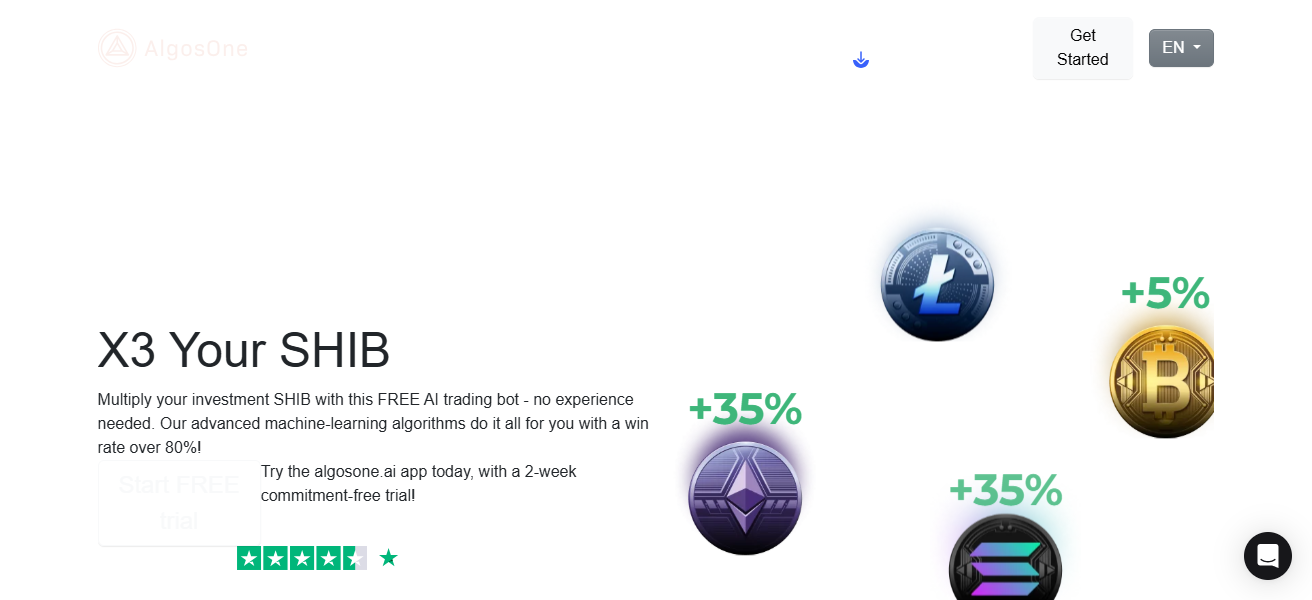
As well as market volatility and liquidity, and in doing so, is capable of autonomously adjusting position sizes and exposures in real time.
Furthermore, unlike Pionex and TradeSanta, which are limited to preset trading bots, AlgosOne is truly autonomous and dynamic. AlgosOne is also more suitable for hands-off investors due to its unique profit-sharing model.
AlgosOne Features
- Fully autonomous AI trading with minimal real-time market sentiment and volatility analysis risk adjustment (use) market analysis for volatility and other risks) risk analysis).
- Control and manage risk with dynamic position sizing and capital allocation
- Performance-based model that strives to make the platform as profitable as the user
| Pros | Cons |
|---|---|
| Fully automated, minimal user input required | Limited transparency (black-box system) |
| Advanced AI adapts to market volatility in real time | Less control for manual traders |
| Dynamic risk management and position sizing | Not ideal for strategy customization |
| Performance-aligned fee structure | May not suit beginners wanting guidance |
| Hedge-fund-like automation approach | Dependence on AI decisions only |
2. Stoic AI
Unlike Cryptohopper or BitsStrategy, Stoic AI focuses on automation by portfolio levels rather than trade positions. Stoic AI focuses on automation by portfolio levels rather than positions on individual trades.
They provide predefined strategies like market-neutral or fixed-income crypto portfolio strategies that also consider user individual risk tolerance.
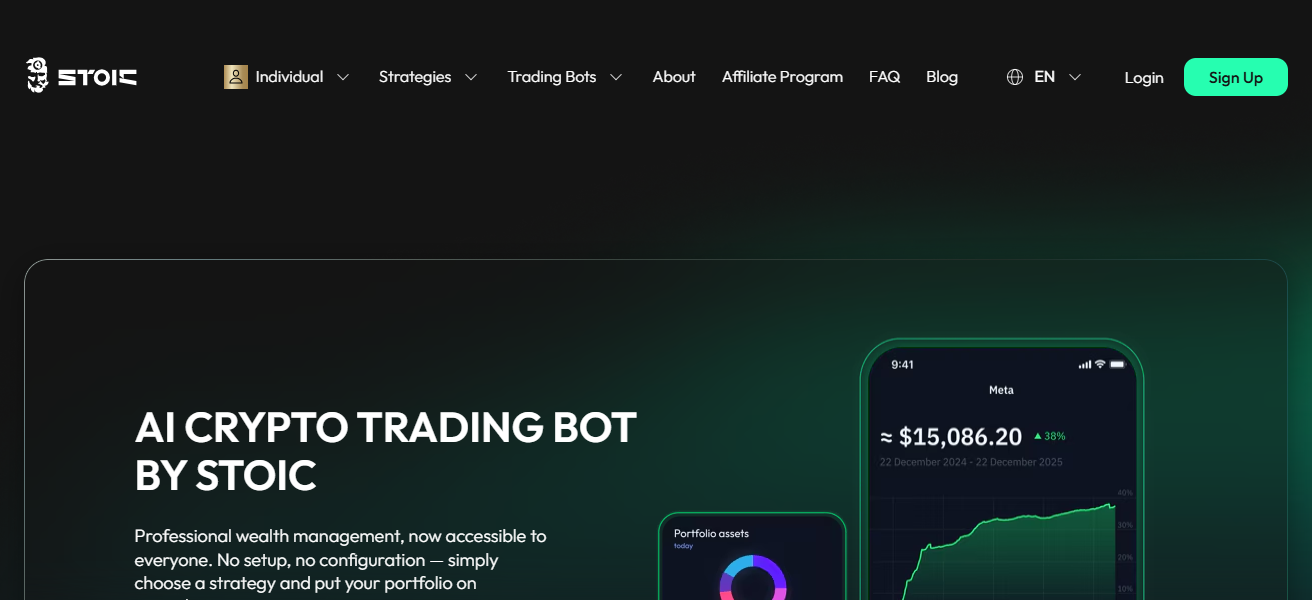
In contrast to black-box automation of AlgosOne, Stoic AI offers more transparency on its allocation and rebalancing strategies.
The direct exchange integration allows for better security compared to some centralized bots. Stoic AI constantly redistributes assets according to market cycles to minimize drawdown during bearish cycles.
These unique features make Stoic AI ideal for passive investors with a preference for long-term portfolio strategies rather than active trading.
Stoic AI Features
- Automation at the portfolio level as opposed to automation at the individual trade level
- (Stoic AI) has market-neutral, fixed income, and indexed portfolios as automated rebalancing strategies that adjust to market cycles and risk exposure (drag and drop features) training (Stoic AI) as non-custodial API integrated
| Pros | Cons |
|---|---|
| Portfolio-level automation reduces overall risk | Limited control over individual trades |
| Predefined strategies for different risk levels | Less flexibility than custom bot platforms |
| Non-custodial integration improves security | Not ideal for active traders |
| Automatic rebalancing during market cycles | Fewer customization features |
| Transparent allocation logic | Strategy options are limited |
3. BitsStrategy
BitsStrategy stands out with adaptive algorithmic trading that provides a balance between user trading autonomy and user control.
AI determines market volatility and other trading parameters, plus market and other trading parameters, plus user-controlled parameters.

In terms of stick-based rational trading, BitsStrategy displays more intelligent, data-driven logic. Divestiture techniques are also used to mitigate volatility by spreading overseer control to multiple assets.
The balance between automation and user control makes BitsStrategy an ideal trading platform for intermediate level traders who smart automation and active direction over interceptor control and risk strategy parameters.
BitsStrategy Features
- Semi-automated system balancing of control and automation
- AI analysis of technical indicators with clever market volatility risk adjustments.
- Strategic position sizing based on user risk and volatility
| Pros | Cons |
|---|---|
| AI-driven adaptive trading decisions | Not fully autonomous like advanced AI tools |
| Balances automation with user control | Requires some trading knowledge |
| Dynamic position sizing reduces risk | Fewer ready-made templates |
| Supports diversification strategies | Less beginner-friendly than simpler tools |
| More intelligent than rule-based systems | Limited popularity and ecosystem |
4. 3Commas
3Commas’s platforms offer distinguishing flexibility and risk management tools that competitor platforms like TradeSanta do not offer.
They offer various bot options, including grid and DCA bots. They also offer customizable stop-loss, take-profit, and trail features.
While Stoic AI offers portfolio level automation, 3Commas offers trade level detail, automation, and execution. They also allow users to integrate with multiple exchange accounts for spread risk management.
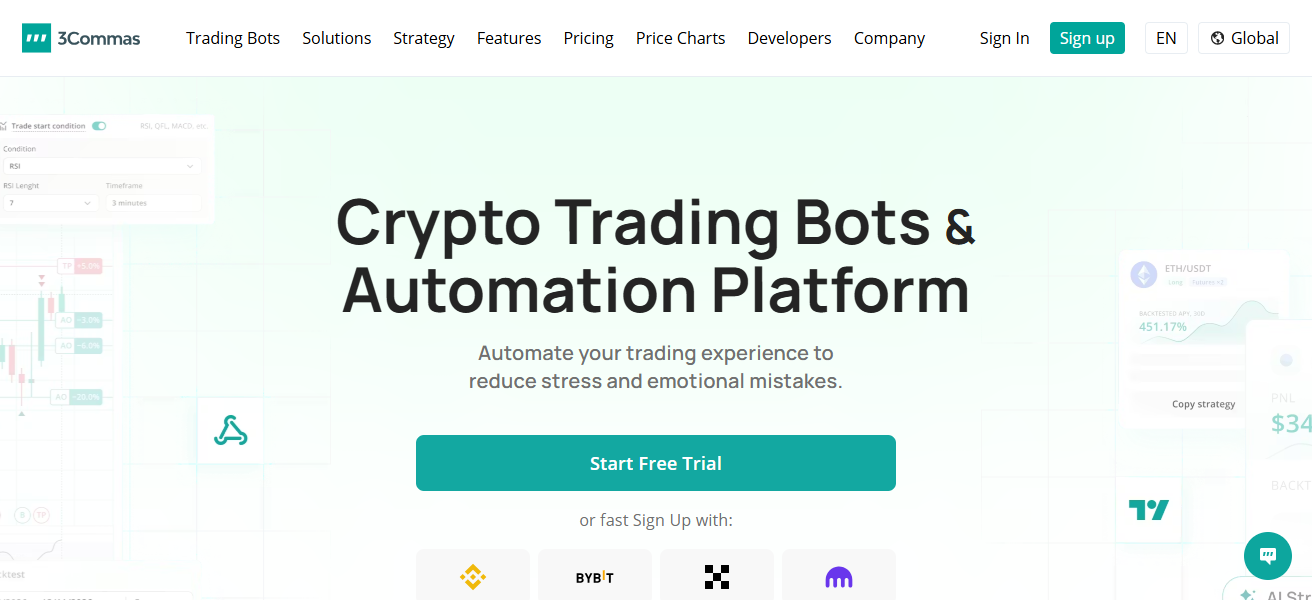
They do offer off AIs like AlgosOne, however, their SmartTrade terminal offers trade control and flexibility that is not offered by other services.
This is the reason 3Commas is the go to for active users with several levels of risk control and trade flexibility rather than AI automation.
3Commas Features
- Different market conditions (DCA, Grid, and signal bots) have multiple bots ([tastycrypto][2])
- Stop-loss, take-profit, and trailing features ([AI Tools Fusion][3]) have Smarttrade terminals
- Portfolio management ([tastycrypto][2]) has multiple exchange integration
- Signal automation and strategy building with AI ([infobro.ai][4])
| Pros | Cons |
|---|---|
| Highly customizable trading bots | Not fully AI-driven automation |
| Strong risk management tools (stop-loss, trailing) | Can be complex for beginners |
| Supports multiple exchanges | Requires manual configuration |
| SmartTrade terminal for precise execution | Subscription costs can be high |
| Suitable for active traders | Learning curve for advanced features |
5. Cryptohopper
Cryptohopper combines AI signals with marketplace strategies exceeding the versatility of Coinrule with its set templates.
In addition, the tool’s AI is further advanced as it utilizes the tool to its full capabilities with average AI aggregation, and distribution as well as trade optimization based on market conditions and the user’s risk tolerance.
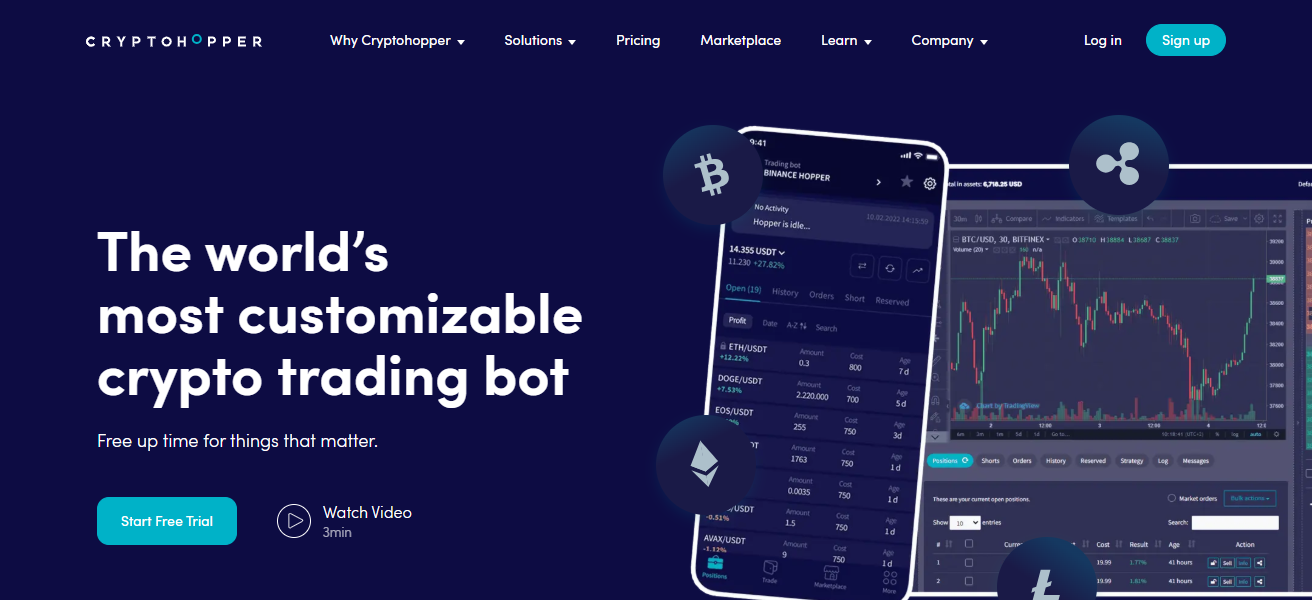
For this reason, the tool is suitable for the more advanced trading users. Overall, its combination of flexibility along with AI trade optimization makes it more suitable
for the beginner or less advanced level trader than Pionex as it suits more advanced traders who value the ability to customize and build a trading system based on a set of rules.
Cryptohopper Features
- Algorithm Intelligence combines multiple strategies automatically ([Stoic AI][1])
- Marketplace for strategies with pre-configured as well as customizable bots
- Advanced backtesting functionality with historical data for risk assessment evaluation ([tastycrypto][2])
- Trade in the cloud with support for multiple exchanges
| Pros | Cons |
|---|---|
| AI-powered strategy selection | Slightly less manual control than some tools |
| Marketplace for ready-made strategies | Advanced features require paid plans |
| Strong backtesting capabilities | Can become expensive |
| Works across multiple exchanges | Interface may feel complex initially |
| Suitable for all skill levels | Performance depends on chosen strategies |
6. Pionex
Pionex is a trading platform that incorporates automatic trading bots into their own platform, while most competitors like Kryll.io or OctoBot integrate services outside of their platform.
They have the largest number of free bots that can be used like arbitrage and grid trading bots that adapt to changing market conditions.
Although it offers less customizability, Pionex is more beginner-friendly than 3Commas, and the trading fees are lower, offering a larger cost advantage than most competitors.

Using PionexGPT, users can easily set the level of risk by generating a strategy using “natural language” and this gives users the benefit of more inexpensive automated trading.
Although AlgosOne is more sophisticated with its AIs, users can get the most simple and efficient trading with the least amount of risk to their portfolios using the built-in automation that Pionex offers.
Pionex Features
- Over 16 free trading bots such as grid and DCA bots ([Bingx Exchange][5])
- Integrated exchange so no third parties are needed ([AI Tools Fusion][3])
- Via PionexGPT, users can create strategies with prompts ([Coin Bureau][6])
- Automated trading with low fees and trades executed 24/7
| Pros | Cons |
|---|---|
| Built-in bots with no extra cost | Limited customization compared to others |
| Very low trading fees | Less advanced AI capabilities |
| Beginner-friendly interface | Locked into its own exchange |
| Multiple free bot strategies available | Fewer advanced analytics tools |
| Automated trading with minimal setup | Not ideal for complex strategies |
7. Coinrule
Coinrule relies on automated trading that is a bit more predictable than its competitors, and focuses on more rule or condition based automation than those that use AIs like Stoic AI or Cryptohopper.
The platform offers users the ability to set “if-this-then-that” strategies with specific price conditions and a variety of other signals to create risk conditions.
This platform offers its users more control than BitsStrategy in adaptive learning. Users who are just starting out with automated trading can use the prebuilt strategies in the library to get underway faster.

Although OctoBot is similar in that it can be used without coding, Coinrule still offers more structured automation.
The traders that are most successful on Coinrule are those that prefer to have the AI or dynamic rules be less active, and instead, have their trading be consistent with the set risk controls present.
This platform accomplishes this objective without the use of complex or sophisticated learning models.
Coinrule Features
- Rule-based trading automation with logic
- 250+ templates for different trading strategies for users to easily set up
- User friendly as no coding is required
- Users can set custom risk parameters for their trading strategies
| Pros | Cons |
|---|---|
| Easy rule-based automation (no coding) | Lacks advanced AI learning |
| Highly transparent strategy execution | Limited adaptability to market changes |
| Large library of templates | Less dynamic than AI-driven tools |
| Beginner-friendly platform | Strategy complexity is limited |
| Good control over risk conditions | Requires manual rule setup |
8. Octobot
Compared to more traditional competitors like AlgosOne or Stoic AI, OctoBot has an unparalleled level of customizability because it is an open-source platform.
With the ability to write and configure strategies in Python, users can connect other AI tools or trading signals.
Risk management can also be adjusted by users to an even finer degree, such as the ability to configure custom stop-loss logic and dynamic position size.

This is in contrast to Pionex or TradeSanta, which are more beginner-friendly. Regardless, OctoBot offers total transparency and independence from any centralized offerings
Fantastic for advanced developers looking for a highly personalized experience and advanced automated trading system utilizing AI to cater to their unique risk patterns.
OctoBot Features
- Fully customizable strategies on an open-source solution
- Advanced AI to be integrated via scripting with Python
- TradingView and other platforms can be used for external signals
- Users have complete control on how to manage and execute their risks
| Pros | Cons |
|---|---|
| Open-source and highly customizable | Requires programming knowledge |
| Full control over trading strategies | Not beginner-friendly |
| Supports AI and external integrations | Setup and maintenance can be complex |
| No dependency on centralized systems | Time-consuming to configure |
| Ideal for advanced users | Lacks plug-and-play simplicity |
9. Kryll.io
Unlike OctoBot and OctoBot, Kryll.io has a more intuitive strategy builder and a more streamlined user experience because strategy development is as simple as drag and drop.
Coding is not even necessary, as users can create workflows by collating indicators, triggers, and forms of risk management.

Compared to Coinrule, this level of organizational strategy freedom is unrivaled. Kryll has a marketplace to buy and sell strategies, but also has a unique pay as you go model, which is much preferred over the overpriced subscription fees of trading bots like 3Commas.
With the ability to back-test, Kryll allows users to analyze risk in a more controlled environment prior to live trading. The interplay of risk control and simplicity makes Kryll an effective trading platform.
Kryll.io Features
- Use a visual Builder to create strategies
- Market for strategies to either buy or rent trading bots
- Tools for backtesting to see how a strategy performs
- Flexible usage with a model that charges per use
| Pros | Cons |
|---|---|
| Visual drag-and-drop strategy builder | Pay-as-you-go cost can add up |
| No coding required for customization | Less powerful than coding-based tools |
| Strategy marketplace available | Limited deep AI automation |
| Backtesting helps reduce risk | Interface may take time to learn |
| Flexible and creative strategy design | Not fully automated AI system |
10. TradeSanta
Compared to the more complex trading platforms such as Cryptohopper or BitsStrategy, TradeSanta’s focus on simplicity makes it a more beginner-friendly platform.
TradeSanta has preconfigured bots for long and short strategies and includes built-in risk management (stop-loss and take-profit).
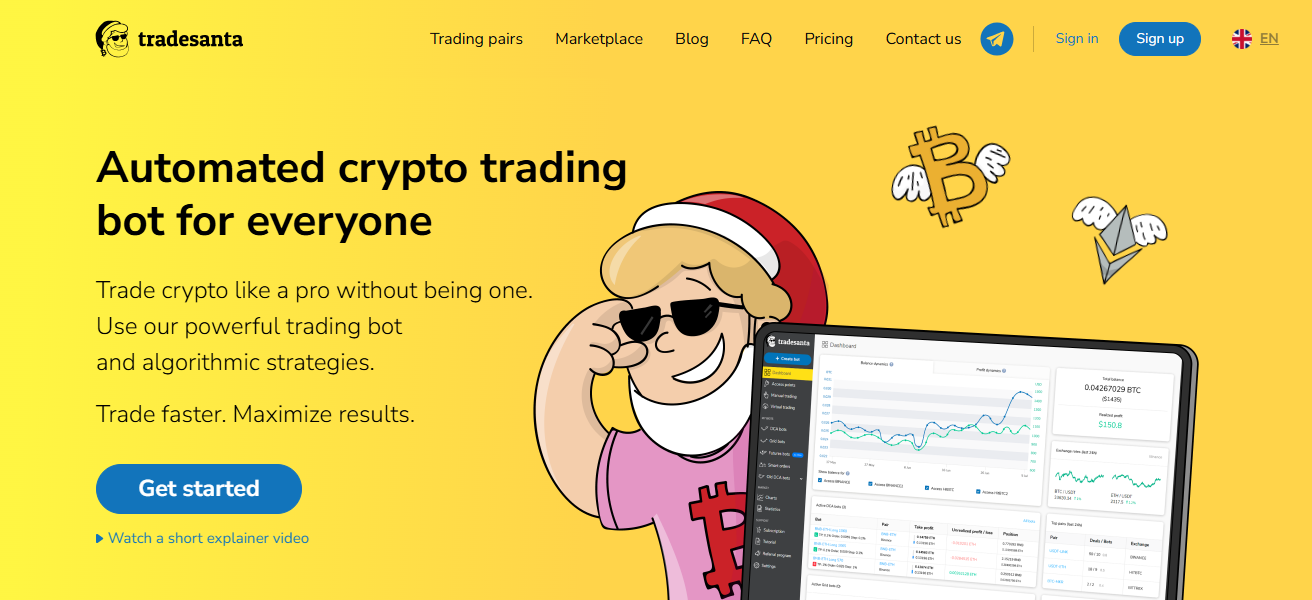
While 3Commas offers more customization options, TradeSanta offers more rapid configuration. Their cloud-based system means no manual monitoring (meaning it will auto-trade over the weekend).
While AlgosOne has more advanced AI capabilities, TradeSanta has more reliable automation for basic trading strategies.
If you need more straightforward trading, and need more basic risk management, then TradeSanta offers more than complex and adaptive AI systems.
TradeSanta Features
- Bots configured to execute longs, shorts, and DCA as well as other strategies
- Automation is done in the cloud with 24/7 operational support
- Tools for risk management such as stop-loss and take-profit are included
- Straightforward design for easy navigation and a fast configuration.
| Pros | Cons |
|---|---|
| Very easy to use for beginners | Limited advanced features |
| Preconfigured bots for quick setup | Less customization than competitors |
| Cloud-based 24/7 trading | Not deeply AI-driven |
| Basic risk management tools included | Fewer strategy options |
| Low maintenance required | Not suitable for complex trading needs |
Are AI Crypto Tools Safe To Use?
AI crypto tools analyze market data, identify trends and patterns, and change trading strategies to be less risky.
These tools use stop-loss orders, diversification, and dynamic position sizing to potentially lose the least amount of money.
However, the cryptocurrency market is extremely volatile and unpredictable. Global issues, public sentiment, and unpredictable sudden price swings influence cryptocurrencies.
Because of the uncertainty in the market and the tools, users should always prepare to lose money.
How To Choose AI Crypto Tools That Adapt to Your Personal Risk Profile Automatically
Establish Risk LevelIdentify your risk level; conservative, moderate, or aggressive, prior to selecting any AI trading tool.
Consider Level of AutomationDepending on the level of control you prefer, select choice fully automated tools (AlgosOne) or semi-automated tools (3Commas).
Risk Management FeaturesEnsure the tools offer stop-loss, take-profit and dynamic position sizing.
AI Strategy EvaluationSelect tools with dynamic evaluation of strategies to align with market volatility and trends.
Control OptionsSelect tools with the most options related to strategy if you would like control over the trades.
User-FriendlyPlatforms such as TradeSanta and Pionex are recommended for novices so that they can engage with trading activities.
Testing FeaturesSelect tools that you can test strategies on prior to live trading.
Focus on Portfolio Management Vs TradingChoose Stoic AI for portfolio management or Cryptohopper for trading level tools.
API Security & AccessEnsure that there’s non-custodial access and an API that’s easily integrated to the exchange.
Price & FeesEnsure to compare subscription fees, trading costs, and profit-sharing before selecting any tools.
Cocnlsuion
In cocnlusion AI crypto tools that tailor to your risk profile provide smarter and more efficient trading through automation and real-time risk management.
It streamlines decision making, limits emotional trading, and integrates your personal trading strategy.
The tools are not guaranteed to work and success largely depends on the tools being set up right and maintaining a realistic perspective on market volatility.
FAQ
They adjust trade size, strategy, and exposure based on your selected risk level.
No, many tools are beginner-friendly with prebuilt strategies and automation.
AI tools learn and adapt, while rule-based tools follow fixed instructions.
Yes, AI bots operate continuously without manual intervention.
Yes, most tools use API keys to trade directly on your exchange account.