
This article will focus on AI tools that analyze your portfolio performance. These technologies incorporate analytics, automation, and machine learning to monitor investments, assess diversification, and identify risks.
Engaging with AI allows investors to better understand the health of their portfolio and improve their approach to ensure their analytics-driven decisions yield financial growth, and optimize their strategies on the risks that concern them.
Key Points & AI Tools That Check If Your Portfolio Is Performing Well
Kubera – Tracks investments across multiple accounts, giving real-time portfolio performance insights with automated analysis.
Zerodha Varsity AI – Provides intelligent portfolio health checks, highlighting risks and diversification gaps instantly.
Wealthfront – Uses AI-driven algorithms to monitor portfolio growth, risk exposure, and tax-loss harvesting opportunities.
Morningstar Direct – Offers AI-powered analytics to evaluate portfolio returns, risk-adjusted performance, and benchmark comparisons.
SigFig – Automatically analyzes portfolio performance, suggesting rebalancing strategies for better long-term investment outcomes.
Personal Capital – AI tracks spending, investments, and portfolio performance, ensuring financial goals align with progress.
QuantConnect – Provides algorithmic backtesting tools to measure portfolio performance against historical market data and scenarios.
Betterment – AI evaluates portfolio efficiency, recommending adjustments to maximize returns while minimizing unnecessary risks.
Portfolio Visualizer – Uses advanced simulations and AI models to assess portfolio performance under varying market conditions.
Ziggma – AI-powered scoring system evaluates portfolio diversification, performance, and risk exposure for smarter investing.
10 AI Tools That Check If Your Portfolio Is Performing Well
1. Kubera
Kubera is an intelligent portfolio importer that pulls in investments from a range of different accounts, including brokerage accounts and crypto accounts.
It gives a full view of investments and allows for performance evaluation of real estate and even collectibles. It has AI that analyzes and provides insights for improvement, portfolio growth, and risk from the evaluator’s perspective.
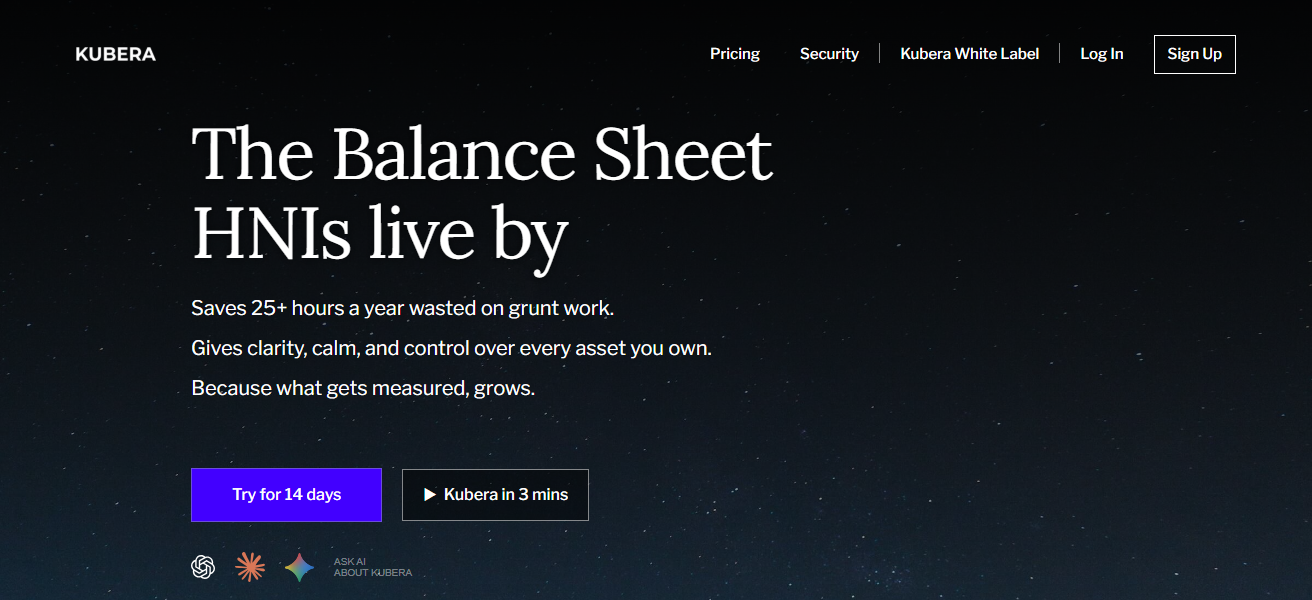
The intelligent dashboards simplify everything for the investor and tell them if their portfolio is doing well and where it could use adjustments. It tracks all of this from data imports from banks and exchanges around the world.
Kubera Features
- Get unified insight on valuation of varying assets such as stocks, real estate, crypto, collectibles.
- Gain automated insight on real-time valuations with report generation for linked accounts.
- Assess portfolio of linked accounts to evaluate long term growth with historical portfolio performance charts.
- The tool has global bank and exchange data integrations.
| Pros | Cons |
|---|---|
| Tracks diverse assets including stocks, crypto, real estate, and collectibles. | Subscription-based, may feel expensive for casual investors. |
| Provides real-time valuation and automated reporting across accounts. | Limited advanced analytics compared to professional-grade tools. |
| Easy-to-use dashboards simplify portfolio performance evaluation. | Focused more on tracking than predictive modeling. |
| Supports global banks and exchanges for accurate data integration. | Best suited for individuals, less for institutional investors. |
2. Zerodha Varsity AI
Zerodha Varsity AI is an analysis and learning tool built to familiarize the investor portfolio assessment and analysis. It uses analytics to create an investor-centered and custom risk/diversification/exposure insight.
It outlines the portfolio’s weaknesses and strengths and helps the investor maintain alignment to their financial goals by offering comparative analysis of the portfolio/holding to important financial market benchmarks.
To maintain resilient and profitable portfolios, Zerodha Varsity AI combines financial education and accessible analysis of beginner financial portfolios to provide the tools to the investor to create financial defenses.
Zerodha Varsity AI Features
- Get portfolio risk exposure and diversification with the use of AI.
- Understand financial concepts with ease as the tool explains the concepts using simplistic language.
- Get comparison of holdings with benchmark and market trends.
- Get performance analytics with educational content to enhance your investment insight.
| Pros | Cons |
|---|---|
| Offers AI-driven insights into risk exposure and diversification. | Primarily educational, not a full-fledged portfolio management tool. |
| Simplifies complex financial concepts for beginners. | Limited automation for active portfolio adjustments. |
| Helps compare holdings against benchmarks and market trends. | More focused on learning than professional-grade analytics. |
| Accessible and user-friendly for new investors. | May lack depth for advanced traders. |
3. Wealthfront
Wealthfront is an automated investment manager and robo-advisor that employs artificial intelligence to manage investment portfolios and provide continuous updates.
It evaluates how tax, diversification, and risk dimensions affect portfolios. It then offers ways to enhance returns through optimally balanced investment portfolios.
Additionally, Wealthfront’s artificial intelligence rebalancing algorithms neutrally mitigate bias to achieve all stated goals. The platform applies tax-loss harvesting in an attempt to enhance investors’ portfolios.
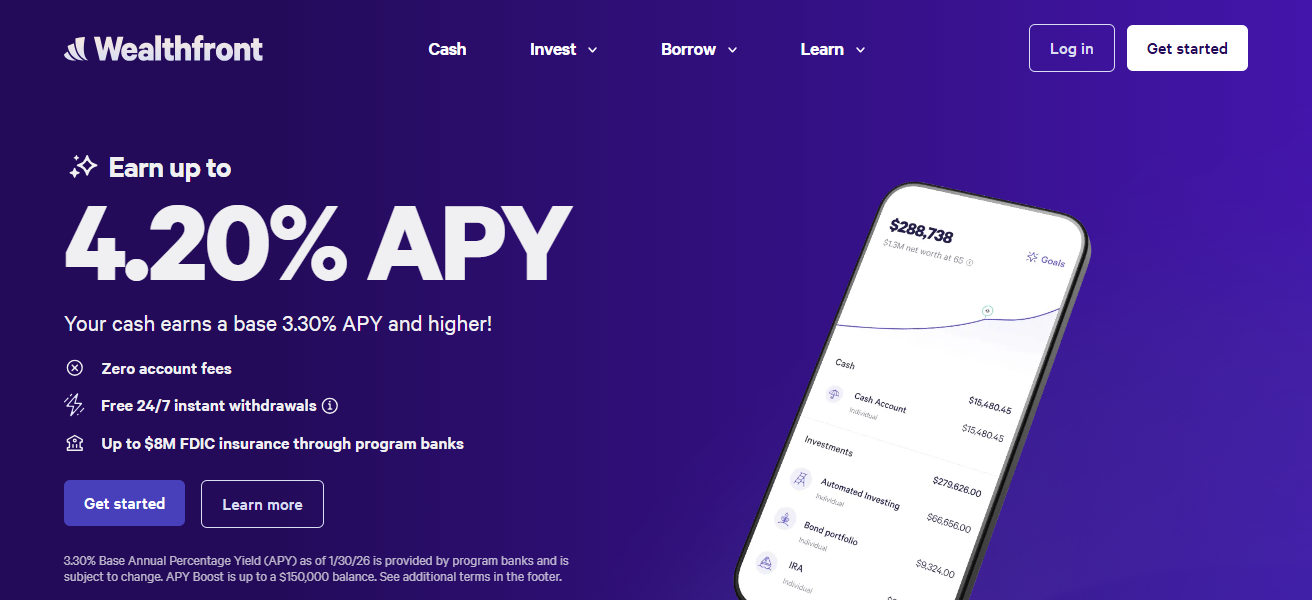
Wealthfront also helps investors achieve goals in the future by allowing investors to monitor the status of their portfolios.
The Wealthfront platform provides insights to portfolio investors, helping them to identify and take action to remedy problem areas.
This platform employs modern automated investment theory to manage investment portfolios and alleviate the additional risk.
Wealthfront Features
- Gain automated portfolio rebalancing using AI technology.
- Get improved after-tax returns using tax-loss harvesting and get your portfolio evaluated.
- The tool tracks long term goals such as retirement.
- Gain portfolio wealth estimation using pure AI gradings.
| Pros | Cons |
|---|---|
| Automated portfolio management with AI-driven rebalancing. | Limited customization for highly sophisticated investors. |
| Incorporates tax-loss harvesting to improve after-tax returns. | Focused mainly on U.S. investors. |
| Tracks progress toward long-term goals like retirement. | Less suitable for short-term active trading. |
| Intuitive dashboards simplify portfolio performance evaluation. | Requires trust in robo-advisor automation. |
4. Morningstar Direct
Morningstar Direct offers an artificial intelligence portfolio analysis and automated risk and performance analysis to investors, which aids them in investment education and helps them to achieve their goals in a timely manner.
The platform provides comprehensive investment instructions and portfolio education. It also helps to create and maintain an adequate structure to reduce future portfolio performance risks in the user’s/individual investors’ objectives.
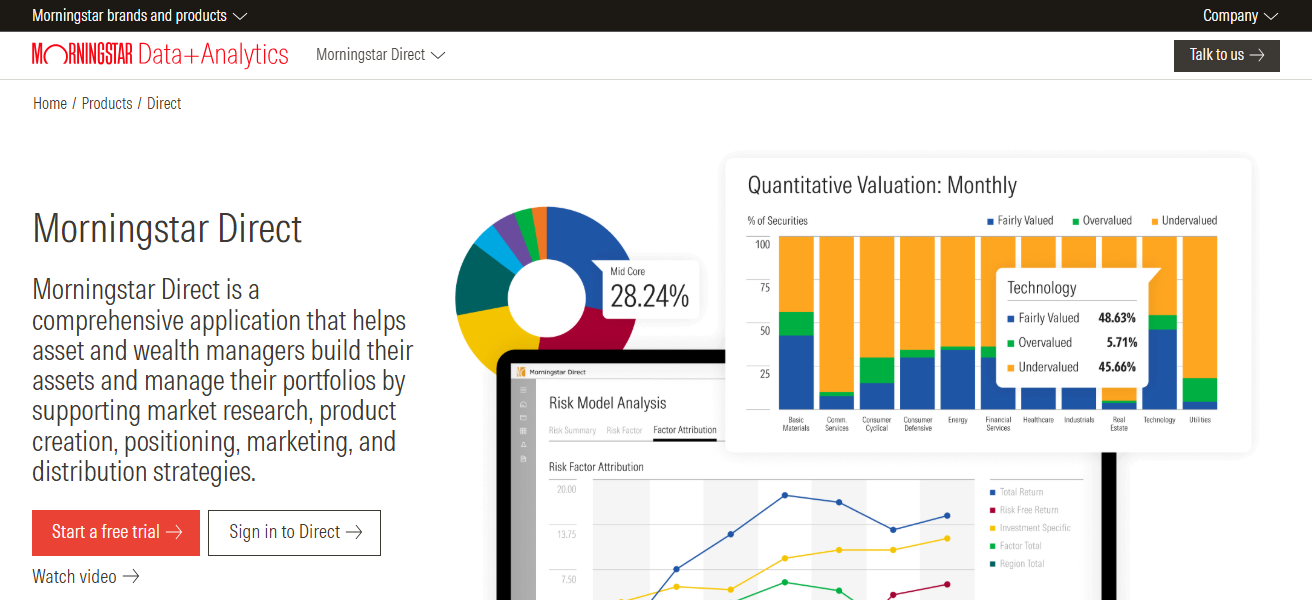
Additionally, the platform assists in creating the right investment objectives by using the right returns and risk in the analysis,
which helps in creating future investment goals and objectives, leading to sustained success. It also assists the users in creating their own portfolios. The platform is suitable and ideal for all types of users/investors, whether they are professionals or novices.
MorningStar Direct Features
- Get risk-adjusted investment portfolio analytics and performance data assessment.
- Get benchmark and scenario comparison tools to evaluate the portfolio.
- Get plenty of analytics on asset allocation and diversification.
- Get detailed portfolio analytics with heaps of reporting tools.
| Pros | Cons |
|---|---|
| Professional-grade analytics with risk-adjusted performance insights. | Expensive, geared toward institutions and professionals. |
| Offers scenario analysis and benchmarking tools. | Complex interface may overwhelm casual investors. |
| Provides deep insights into diversification and asset allocation. | Requires training to use effectively. |
| Comprehensive reporting features for detailed portfolio evaluation. | Not ideal for everyday retail investors. |
5. SigFig
SigFig is an AI-based investing management service. It allows users to track progress and improve performance against goals.
It connects to multiple brokerage accounts and integrates insights on current value, profits, losses, and diversification.
Their AI is geared towards developing strategy suggestions on how to rebalance portfolios to improve return on investments and mitigate risk.
Additionally, SigFig offers automated portfolio management, meaning that as your goals shift, so do your investments.
Investors receive individualized suggestions as the market changes and as the health of the portfolio changes.
Since their dashboards are highly intuitive, performance evaluation is made easier. Those pieces of the portfolio that may require the most attention are highlighted, and signal the greatest returns.
Portfolio management paired with smart analytics, mitigates an investor’s tendency to make emotional trading decisions.
SigFig Features
- Get insight on real-time portfolio performance and analytics with AI.
- Get portfolio returns optimized with AI portfolio rebalancing strategies.
- Get automated portfolio management to minimize emotional decision making.
- Get portfolio analytics and evaluation using simple AI dashboards.
| Pros | Cons |
|---|---|
| Connects with brokerage accounts for real-time performance tracking. | Limited advanced analytics compared to specialized platforms. |
| AI-driven rebalancing strategies optimize returns. | Focused mainly on U.S. markets. |
| Automated portfolio management reduces emotional decision-making. | Less suitable for highly active traders. |
| Simple dashboards make evaluation accessible. | May lack customization for complex portfolios. |
6. Personal Capital
Another portfolio management platform with AI is Personal Capital, which allows users to track their overall wealth.
It shows users a view of their complete financial situation and net worth by integrating investments, bank accounts, and retirement accounts.
Added features of retirement planning are also provided. AI offers users insights on their portfolio’s diversification, risk, and progress toward goals.

Users can see how their investments are performing relative to a benchmark, and AI suggests changes to rebalance the portfolio.
Underperforming assets can be easily identified due to the clarity of the visual. Portfolio management and financial planning done by AI, allows users to bring their investments to the optimistic.
Personal Capital Features
- Get all the investments, bank accounts, and retirement accounts consolidated in one place.
- AI Offers analytics and insight on portfolio as well as risk exposure.
- Get retirement tool which realigns your portfolio to your long-term goals.
- Get insight on portfolio performance with the AI based dashboards.
| Pros | Cons |
|---|---|
| Consolidates investments, bank accounts, and retirement funds in one dashboard. | More focused on financial planning than active trading. |
| AI-driven insights into diversification and risk exposure. | Limited advanced portfolio simulations. |
| Retirement planning tools align portfolios with long-term goals. | Premium advisory services can be costly. |
| Clear visualizations simplify performance evaluation. | Best suited for individuals, not institutions. |
7. QuantConnect
Using its own AI models, QuantConnect assesses the risk-adjusted returns, diversification, and exposure to market volatility, for algorithmic trading and portfolio analysis.
Investors can backtest different trading strategies to measure the portfolio’s outcomes under different scenarios.
While the platform provides investors with advanced analytics and AI models for risk assessment and portfolio optimization, it also has a collaborative environment for sharing algorithm improvements.
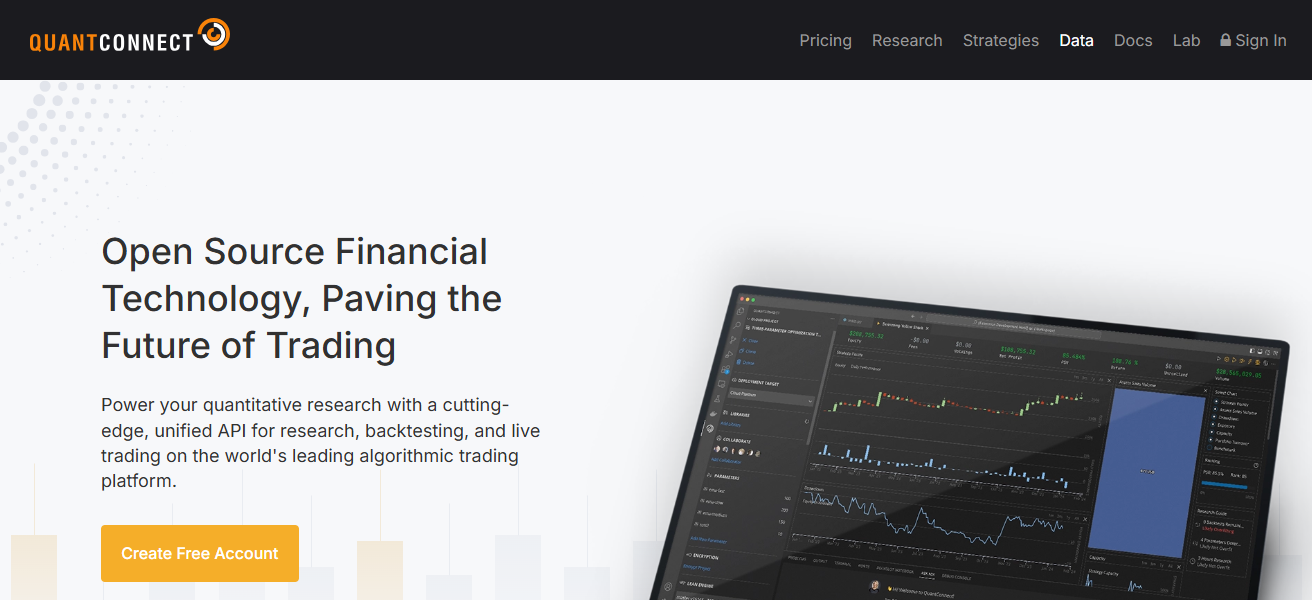
This platform allows backtested portfolios and algorithms to be adjusted for real-time performance.
Investors can also quantify the results of their portfolios and make adjustments to their portfolios, provide them the best chance for optimal performance over a long time horizon.
QuantConnect Features
- Backtesting of market trading strategies and algorithms is simplified using market historical data.
- Advanced analysis tailored to risk-adjusted returns.
- Environment for collaboration on trading strategy improvement.
- Optimization and performance tracking in real-time.
| Pros | Cons |
|---|---|
| Supports algorithmic backtesting with historical data. | Requires coding knowledge, not beginner-friendly. |
| Provides advanced analytics for risk-adjusted returns. | More complex than typical portfolio trackers. |
| Collaborative environment for sharing strategies. | Steeper learning curve for casual investors. |
| Enables real-time performance tracking and optimization. | Best suited for quantitative traders and developers. |
8. Betterment
Using AI, Betterment allows investors to manage their own portfolios by providing a robo-advisory service.
Their AI also recommends models and strategies to each investor based on their risk exposure, diversification of their investments, and the proximity of the investor to their financial goals.
Betterment has AI algorithms that rebalance portfolios in line with the investor’s financial goals, and performs tax-loss harvesting to optimize their returns after taxes.
Investors can also monitor their portfolios through p the dashboards and Betterment’s serves as a portfolio management platform that provides a high level of performance against a low level of input from the investor and uses AI algorithms to manage its performance on a continual basis.
Betterment Features
- AI-based strategy rebalancing for portfolios.
- After-tax returns improved through tax-loss harvesting.
- Dashboards show financial goal advancement.
- Portfolio management becomes streamlined.
| Pros | Cons |
|---|---|
| Automated portfolio rebalancing with AI-driven strategies. | Limited customization for advanced investors. |
| Incorporates tax-loss harvesting for better after-tax returns. | Focused mainly on U.S. investors. |
| Tracks progress toward financial goals with clear dashboards. | Less suitable for short-term trading. |
| Simplifies portfolio management for everyday users. | Relies heavily on automation, reducing investor control. |
9. Portfolio Visualizer
Portfolio Visualizer is a portfolio analytics tool that allows investors to analyze the performance of their portfolio.
They have multiple analytical techniques, including backtesting, incorporation of Monte Carlo techniques, and the ability to analyze factors of the portfolio and how they interact with each other. They give their clients the ability to analyze the portfolio in terms of diversification.
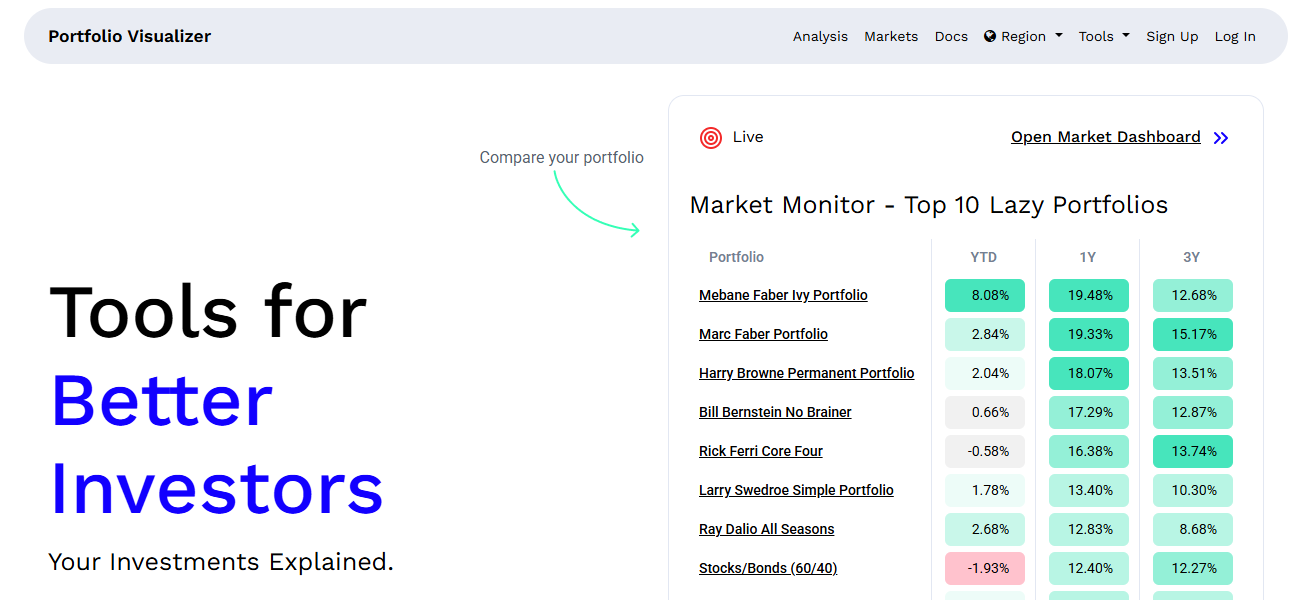
They analyze and adjust the portfolio against multiple benchmarks to improve the quality and performance of the portfolio.
They give clients the ability to visualize the performance of the portfolio with the assistance of their AI-driven technology.
Portfolio Visualizer Features
- Factor analysis, Monte Carlo simulations, and backtesting.
- Diversification and asset correlation insights.
- Vertical market condition scenario analysis.
- Financial data visualization.
| Pros | Cons |
|---|---|
| Offers backtesting, Monte Carlo simulations, and factor analysis. | Can be overwhelming for beginners. |
| Provides insights into diversification and correlations. | Requires manual input and setup. |
| Allows scenario testing under different market conditions. | Focused on analysis, not automated trading. |
| Clear visualizations simplify complex financial data. | Best suited for experienced investors. |
10. Ziggma
Ziggma is a portfolio management tool that offers the ability to analyze the performance of the tool, along with diversification, risk, and return of the assets on the platform.
They analyze and compare their portfolios against multiple benchmarks, identify assets that are underperforming, and offer ways to improve the performance of the portfolio.
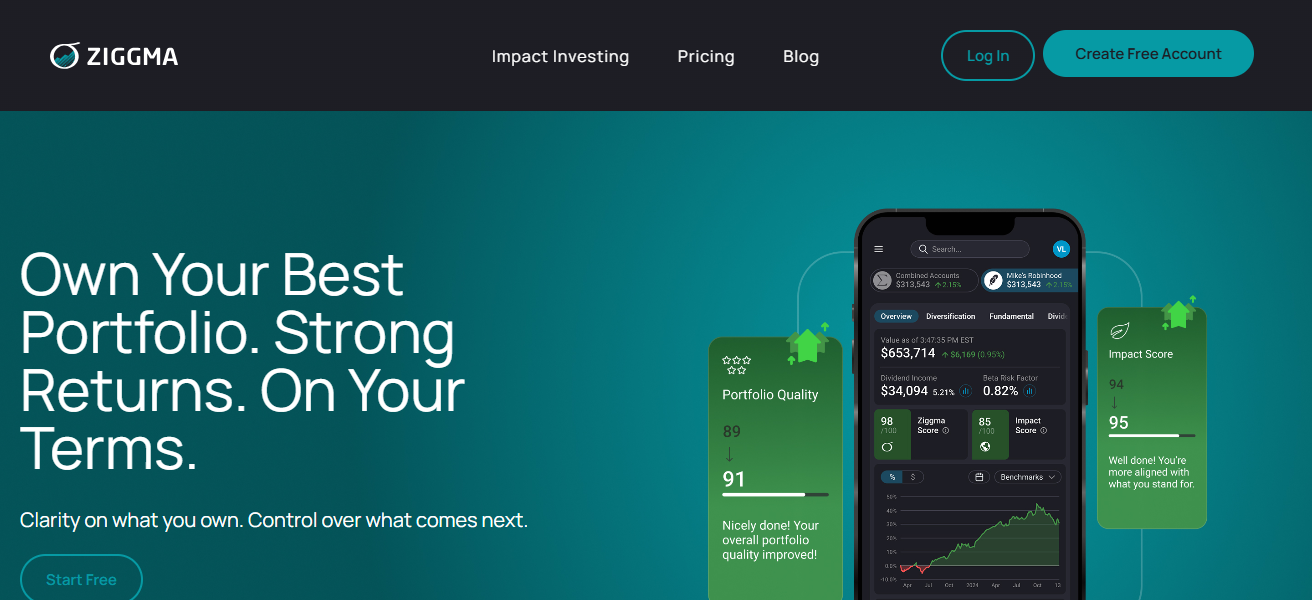
The AI offered by the tool is able to analyze the portfolio, offering the ability to balance the portfolio in order to improve performance to adjust to changing market conditions.
The tool offers a scoring model and personalized insight in order to maintain the performance of the portfolio.
Ziggma Features
- Portfolio analysis in seconds using proprietary scoring.
- Underperforming asset analysis with actionable insights.
- Diversification and correlation analysis led by AI.
- Evaluation through intuition-based dashboards.
| Pros | Cons |
|---|---|
| Offers backtesting, Monte Carlo simulations, and factor analysis. | Can be overwhelming for beginners. |
| Provides insights into diversification and correlations. | Requires manual input and setup. |
| Allows scenario testing under different market conditions. | Focused on analysis, not automated trading. |
| Clear visualizations simplify complex financial data. | Best suited for experienced investors. |
Conclsuion
To sum up, AI tools that analyze your portfolio’s performance give investors insights, automations, and risk assessments.
These tools make complex predictive analytics and diversification easy to manage. Investors can use AI-based techniques to manage predictive analytics and diversification. Investing becomes efficient and accurate, and portfolios can grow in the long run.
FAQ
Kubera tracks diverse assets like stocks, crypto, and real estate with real-time valuations.
It provides AI-driven insights into risk, diversification, and portfolio education for beginners.
Wealthfront automates portfolio rebalancing and tax-loss harvesting to optimize long-term returns.
SigFig connects to brokerage accounts, offering real-time tracking and AI-driven rebalancing.