This article covers AI systems that learn and iterate on your trading style. These sophisticated systems use machine learning to review your trading habits and adjust their strategies to improve decision making.
- What Are AI Trading Systems?
- Key Points & AI Systems That Learn Your Trading Style and Improve It
- 10 AI Systems That Learn Your Trading Style and Improve It
- 1. MetaTrader AI Plugins
- 2. Trade Ideas AI
- 3. Kavout Kai Score
- 4. EquBot (IBM Watson-powered)
- 5. TrendSpider
- 6. Zignaly AI Bots
- 7. Numerai Signals
- 8. Capitalise.ai
- 9. Tickeron AI Robots
- 10. AlgoTrader AI
- How To Choose AI Systems That Learn Your Trading Style and Improve It Explain
- Conclusion
- FAQ
These systems study and analyze both market behavior and your own trading preferences to help automate trading, optimize risk management, and improve overall trading performance.
What Are AI Trading Systems?
Artificial Intelligence (AI) trading systems use machine learning algorithms to analyze patterns and predict future behaviors from past and real-time data streams.
They learn to personalize systems around the trader’s preferences, risk tolerances, and strategy selections.
By constantly optimizing data streams, these systems determine the best entry and exit points, manage risk, and make smarter decisions.
Automation takes away the repetitive aspects, while Adaptive Intelligence (AI) focuses on refining and improving the strategy overall.
Combined, these offer a highly efficient, individualized, and statistically sound trading strategy. This culminates to a more consistent and enhanced performance respective to the market.
Key Points & AI Systems That Learn Your Trading Style and Improve It
MetaTrader AI Plugins Learns your trading history, adapts strategies, and automates decisions for consistent portfolio growth.
Trade Ideas AI Analyzes market patterns, tailors alerts to your style, and refines entries for profitability.
Kavout Kai Score Ranks stocks using machine learning, adapting recommendations to your trading preferences and risk tolerance.
EquBot (IBM Watson-powered) Processes financial data, learns your trading habits, and suggests personalized investment opportunities intelligently.
TrendSpider Automates chart analysis, learns your preferred indicators, and improves technical setups for better timing.
Zignaly AI Bots Customizes trading signals, mirrors your style, and continuously optimizes strategies for maximum returns.
Numerai Signals Crowdsourced AI models learn from your trades, refining predictions to align with your approach.
Capitalise.ai Lets you write trading rules in plain language, learns preferences, and automates strategy improvements.
Tickeron AI Robots Adapts to your trading style, provides scenario simulations, and enhances decision-making accuracy over time.
AlgoTrader AI Learns portfolio behavior, adjusts algorithms dynamically, and improves execution speed with personalized trading strategies.
10 AI Systems That Learn Your Trading Style and Improve It
1. MetaTrader AI Plugins
MetaTrader is a popular trading platform that allows AI plugins to be added. These AI modules help to analyze your trading style, pick out patterns in trades that you have done in the past, identify which strategies you prefer, and recommend new ones.
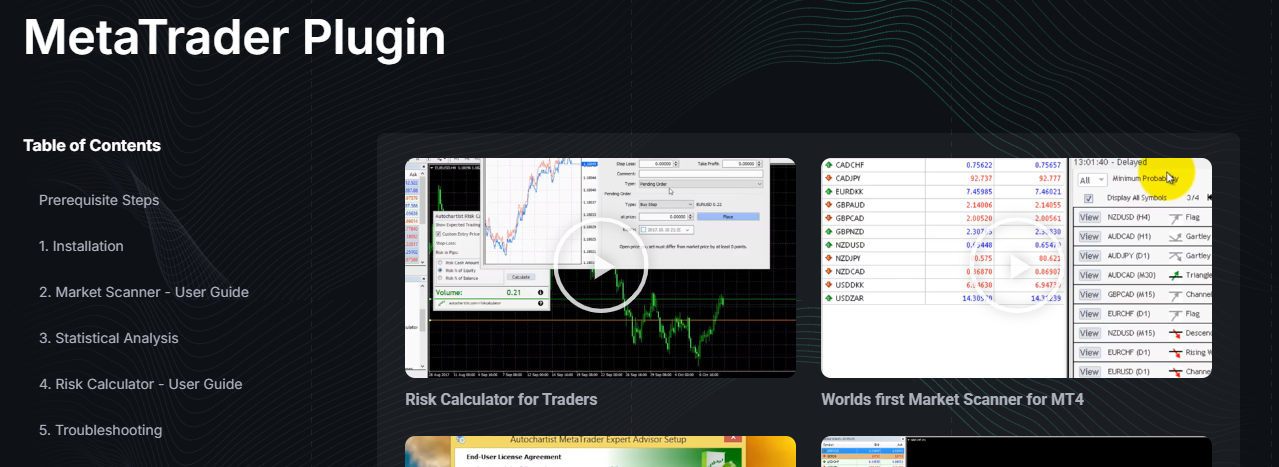
These plugins are great for trade execution, order placement, risk and position management, and help to adjust to new market conditions.
The AI works to adapt to your specific trading strategies. For trading automation and keeping your trading strategies, the MetaTrader AI plugins help to fit the human and trading machine aspect.
MetaTrader AI Plugins Features
- Automated Trade Execution – Trades are automatically executed based on specific criteria, thus lowering paperwork and easing daily tasks.
- Strategy Adaptation – Learns trading and provides recommendations for better strategies in the future.
- Risk Management Tools – Handles automatic management of stop-loss, take profit, and position size.
- Customizable Indicators – Facilitates AI-based indicators and plugins for your preferred technical configurations.
| Pros | Cons |
|---|---|
| Automates repetitive tasks like order placement and risk management. | Requires some coding knowledge for custom plugins. |
| Learns from your trading patterns, creating a personalized assistant. | Performance depends heavily on historical data quality. |
| Integrates seamlessly with the MetaTrader platform. | May over-optimize strategies for past market conditions. |
| Supports multiple asset classes and indicators. | AI recommendations may conflict with manual trading decisions. |
| Continuously improves with use, adapting to market changes. | Can be resource-intensive, slowing down the platform. |
2. Trade Ideas AI
Advanced machine learning powers Trade Ideas AI. This program provides tailor-made trading ideas based upon real-time observation data of the stock market.
Trade Ideas AI notices your trading behavior. Then identifies your targets, whether they are intraday, swing, or positional.
Its AI-enabled Holly system simulates trading scenarios thousands of times daily, ranking them based on probable profit.
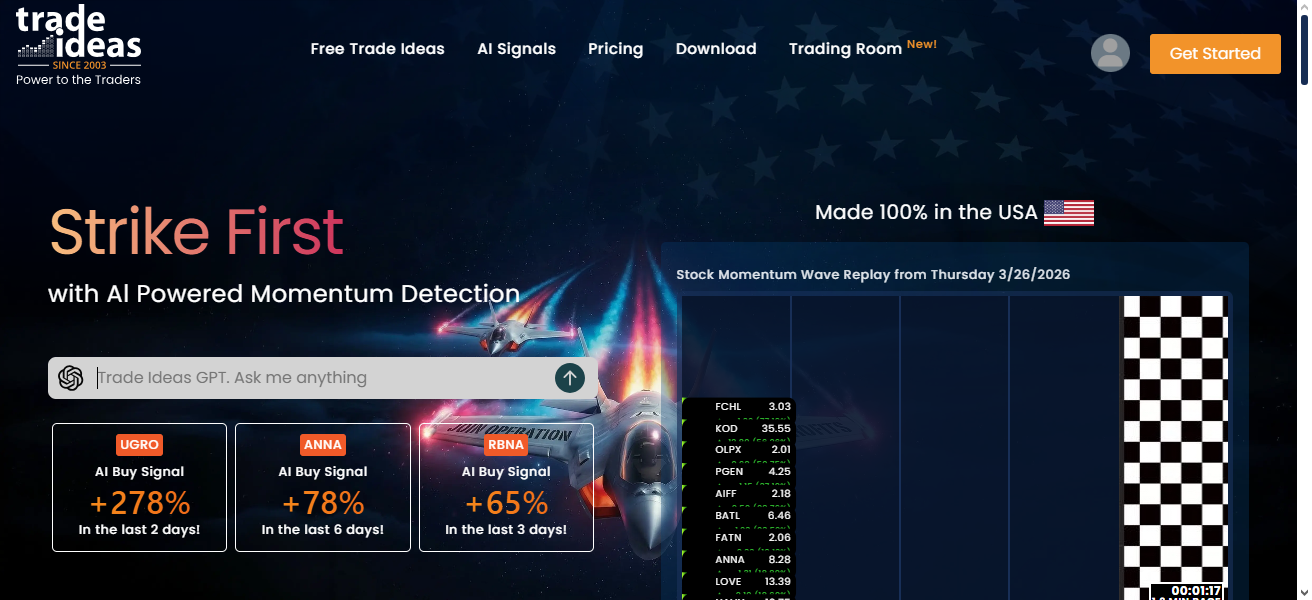
Holly also learns your trading habits by adapting to trades you accept or reject to make more fitting recommendations.
This unique AI program uses and improves your trading habits to take the guesswork out of trading by optimizing your trading targets and by consistently minimizing or improving your trading profits.
Trade Ideas AI Features
- Real Time Market Scanning – Trades based on set criteria are automatically executed, thus lowering paperwork, and easing daily tasks.
- AI-Powered “Holly” Engine – Modelling thousands of scenarios daily allows the identification of the best trades.
- Personalized Alerts – Recommendations are adjusted based on the acceptance or rejection of trade ideas.
- Backtesting integration – Before executing a strategy, it can be evaluated against historical data.
| Pros | Cons |
|---|---|
| Real-time market scanning for trade opportunities. | Subscription can be expensive for beginners. |
| “Holly” AI simulates thousands of scenarios daily. | High volume of alerts may overwhelm new traders. |
| Adapts to your trading preferences and style over time. | Requires learning curve to understand system outputs. |
| Combines pattern recognition with backtesting for accuracy. | Focused mainly on stocks; limited support for other assets. |
| Helps optimize entry and exit points, reducing guesswork. | Over-reliance may reduce independent decision-making skills. |
3. Kavout Kai Score
Kavout Kai Score uses artificial intelligence to assess the probable future performance of stocks. Once the system learns a trader’s risk tolerance and their target portfolio along with investment times, it customizes recommendations to their strategy.
AI examines historical performance, predictive fundamentals, relevant data sets, and several technical indicators before producing a single estimation score of an asset.
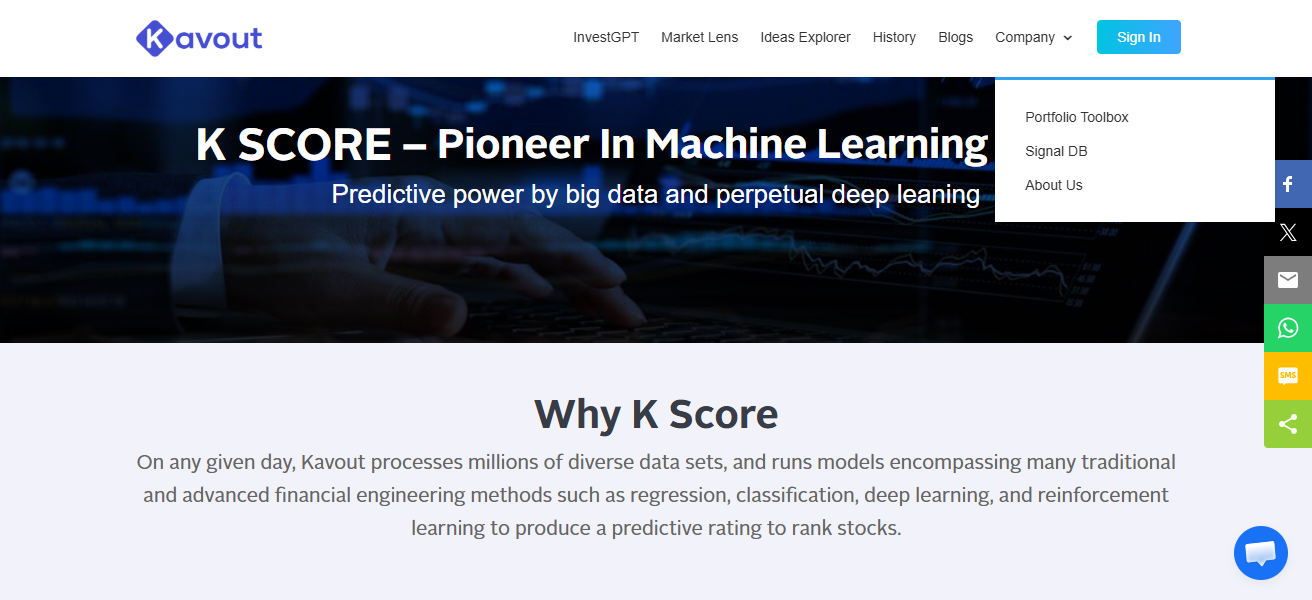
The system also modifies its estimation score based upon the previous trades it has learned. This assists traders in identifying stocks that correspond with their trading strategy. The system learns to prioritize trades that match their target portfolio.
Kavout Kai Score Features
- Predictive Stock Scoring – Stocks are given predictive scores and rankings for future performance.
- Multi-Data Integration – Scoring is based on integrated technical, fundamental, and alternative datasets.
- Personalization – Scoring is modified according to the user’s acceptable risk levels and portfolio.
- Adaptive Learning – Improves its recommendations as it learns which patterns lead to winning trades, and makes better recommendations as it learns which patterns lead to winning trades.
| Pros | Cons |
|---|---|
| Provides predictive stock scores based on AI analysis. | Scores may not capture sudden market shocks. |
| Integrates technical, fundamental, and alternative datasets. | Limited customization for individual trading rules. |
| Learns trader preferences and risk tolerance over time. | May overfit to historical patterns rather than current trends. |
| Helps prioritize stocks aligned with your strategy. | Less effective for very short-term trading. |
| Dynamic system that improves with continued use. | Subscription or data fees may be high for casual traders. |
4. EquBot (IBM Watson-powered)
EquBot leverages the analytical capacity of IBM Watson for Trade decisions so EquBot utilizes the unstructured data (earnings reports, Analyst Opinion, Social Media) that Watson can analyze to inform EquBot of Trade decisions.
Watson utilizes the unstructured data faster than the market can react. Watson will refine the process based on Trades being accepted or rejected.
Cognitive Computing along with Machine Learning is offered with EquBot so data will be analyzed in the deepest manner possible and aligned with your Trade habits.
EquBot (IBM Watson-powered) Features
- Cognitive Data Analysis – Analyzes both structured and unstructured data, including news, reports, and social media.
- AI-Based Recommendations – Recommends trades based on how your style.
- Adaptive Learning – Improves insights based on trades you choose to accept or dismiss.
- Trend Detection – Spots and alerts trends in the marketplace before they’re widely recognized
| Pros | Cons |
|---|---|
| Uses cognitive computing to analyze vast datasets, including unstructured data. | May require higher-level understanding of AI outputs. |
| Learns from your trades to align with investment style. | Complexity can be intimidating for beginners. |
| Can detect market trends before they are widely recognized. | Reliance on external news data may produce noisy signals. |
| Continuously refines recommendations based on your interactions. | Not optimized for ultra-short-term intraday trading. |
| Supports personalized, data-driven investment decisions. | Subscription and integration costs can be high. |
5. TrendSpider
TrendSpider automates technical analysis and trading using AI and learns from the user’s own analysis.
The AI recognizes trend lines, support and resistance levels, and chart patterns, and therefore lessens the work that traders do manually.
The AI also learns from user actions. If a user responds to an automated alert and if a user does not. TrendSpider adjusts its alerts and recommendations to each user’s preference.
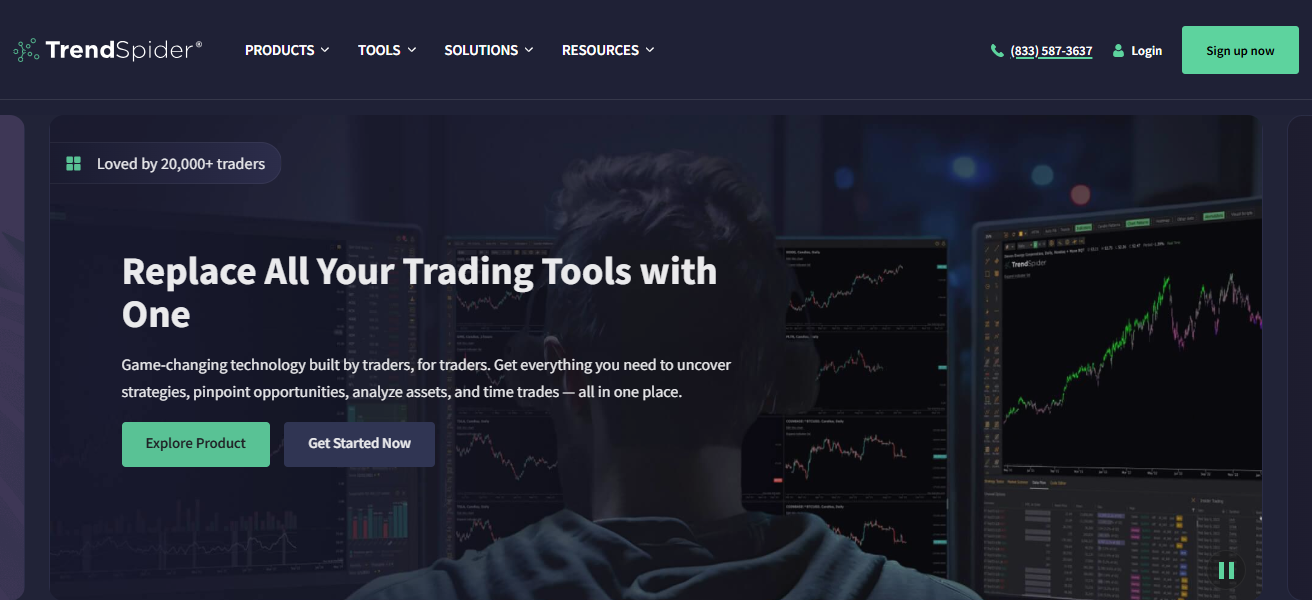
The backtesting engine also allows users to test strategies and adjust historical patterns to user trades.
For technical traders, efficiency combined with AI and personalization provides unique data-driven insights.
TrendSpider Features
- Automated Technical Analysis – Automatically finds and charts patterns like trend lines, support and resistance levels, etc.
- Adaptive Alerts – Changes your trading alerts and suggestions based on your trading habits.
- Backtesting Engine – Tests and validates your trading strategies on the historical data of the market.
- Time-Saving Tools – Less time spent on manual chart patterns and technical analysis.
| Pros | Cons |
|---|---|
| Automates technical analysis with AI-driven trendline detection. | Focused mainly on technical analysis, less on fundamentals. |
| Learns your charting patterns and strategy preferences. | Initial setup and learning curve can be steep. |
| Backtesting engine validates strategies before live execution. | May generate false positives in volatile markets. |
| Reduces manual effort in pattern recognition. | Subscription plans can be costly for casual traders. |
| Alerts and suggestions adapt over time to your style. | Requires internet connectivity for AI features to update. |
6. Zignaly AI Bots
A AI trading bot that Zignaly provides is capable of learning from each user’s trading style, new strategies, and new risk parameters.
The AI trading bot connects with the user’s exchange and executes trades that are previously set, then the AI learns from the user’s trading style and adjusts new strategies to be incorporated to set parameters.
The Zignaly bots are capable of learning to optimize the user’s trading strategy whether it be scalping, swing trades, or high frequency trading by executing trades and having the ability to make new trades with less errors.
Automation and personalization is the two enhancements of AI that are leveraged by traders to reduce and eliminate manual execution of strategies.
Zignaly AI Bots Features
- Automated Trading Bots – Trades automatically based on the strategy from the exchange you connected.
- AI-Driven Optimization – Adapts your trading habits and the performance of the system to better adapt.
- Risk Customization – Trades at your maximum level of risk.
- Strategy Versatility – Works with scalping, swing trades, and trading strategies focusing on the diversification of the portfolio.
| Pros | Cons |
|---|---|
| Automated trading bots execute strategies without constant oversight. | Success depends on proper initial bot configuration. |
| Adapts to your risk preferences and trading habits. | AI optimization may be limited by exchange API restrictions. |
| Monitors performance and fine-tunes bot parameters. | May not perform well in unpredictable market spikes. |
| Supports multiple strategies like scalping and swing trading. | Relatively limited analytical visualization tools. |
| Reduces manual trading errors and fatigue. | Requires exchange account connections, posing security considerations. |
7. Numerai Signals
At Numerai Signals, AI powers a hedge fund platform that creates and tests your trading strategies against large datasets.
When you submit a signal, the AI assesses how your strategy stacks up against thousands of others, and provides feedback in order to increase the predictive accuracy of your strategy.
The system incorporates your feedback and rebalances the significance of various components based on your strategies’ historical performance.

Additionally, strategies that yield positive results are paid, which fosters the creation of more rewarded strategies.
The Numerai platform gives the ability of traders to apply their own AI-optimized strategies while the system enhances strategies and the user’s trading style.
Numerai Signals Features
- Signal Submission Platform – Evaluate trader predictive models.
- Data-Informed Feedback – Benchmark your strategies with thousands of other models.
- Learning Mechanism – Modify your historical trading success to adapt factor weightings.
- Winner Takes All – Reward system high-performing strategies for continued refinement.
| Pros | Cons |
|---|---|
| Quantifies your trading strategy for objective evaluation. | Primarily for hedge fund or advanced quant traders. |
| Provides feedback for strategy improvement. | Less suitable for beginners without quantitative skills. |
| Learns from your historical performance to optimize signals. | Limited to markets supported by Numerai datasets. |
| Rewards high-performing strategies, encouraging refinement. | Dependence on large datasets may bias toward popular methods. |
| Bridges human intuition with machine learning insights. | Can be complex to interpret AI adjustments for personal style. |
8. Capitalise.ai
Capitalise.ai, traders can take their trading ideas in the form of natural language and transform these ideas into fully automated trading strategies.
The AI identifies your trading style and the strategies you employ to determine when to enter, exit, or manage risk along the way.
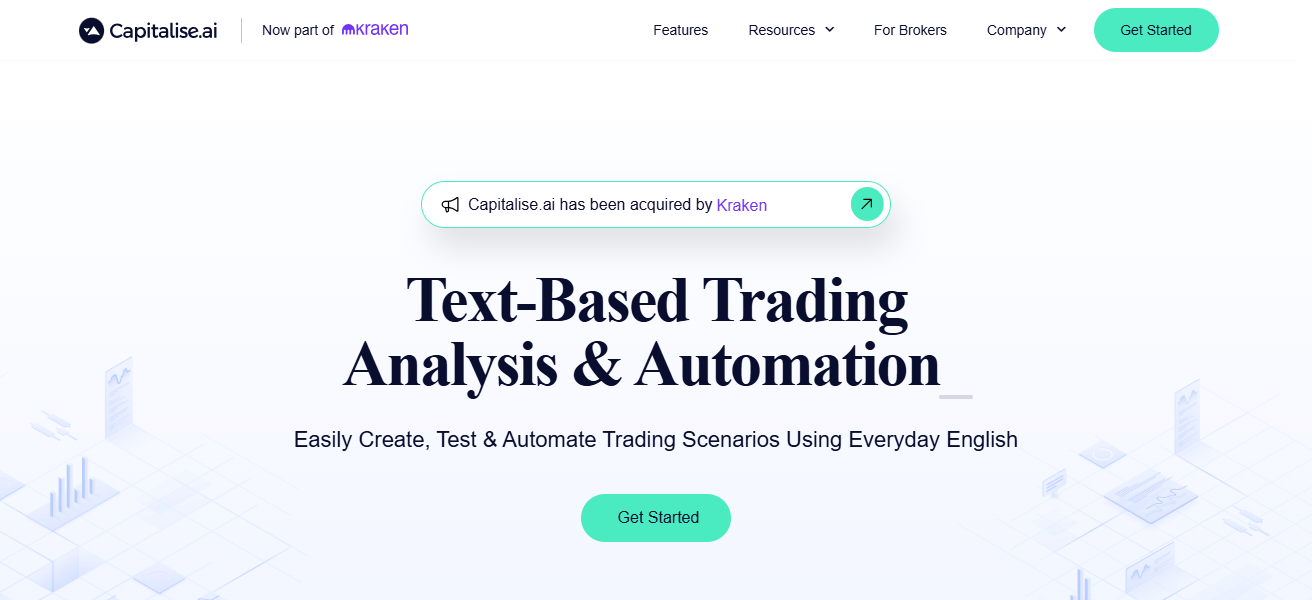
The AI continuously improves the automation of your strategy in a way that trading strategies aligned to your style.
Capitalise.ai improves your strategy while you relax, as the platform conducts backtests and trade simulations to locate and strengthen the weak areas of your strategies. The AI improves your trade execution and strategy as it enhances your trading consistency.
Capitalise.ai Features
- Natural Language Automation – Converts simple text prompts into automated trading strategies.
- Strategy Personalization – Identifies your preferred conditions and rules for a higher degree of automation.
- Backtesting and Simulation – Strategies must be validated prior to going live.
- Execution Consistency – Trades will be done according to your pre-defined rules with minimal human error.
| Pros | Cons |
|---|---|
| Converts natural language trading ideas into automated strategies. | Limited advanced customization without understanding scripting logic. |
| AI learns your preferred rules for entry, exit, and risk. | Backtesting depends on historical data quality. |
| Optimizes automated strategies over time. | May require trial-and-error for complex strategies. |
| Enhances consistency and strategy efficiency. | Subscription costs for premium automation features. |
| Reduces need for manual coding or technical skills. | AI may misinterpret ambiguous natural language commands. |
9. Tickeron AI Robots
AI Robots Tickeron uses algorithms to create an automated trading system which can be customized to fit your style of trading.
They can assess your previous trading patterns to create predictive analytics to settle trades. Additionally, they can create customized optimizations in decision making for positions, market entries & exits, and size of positions, based on prior trades.
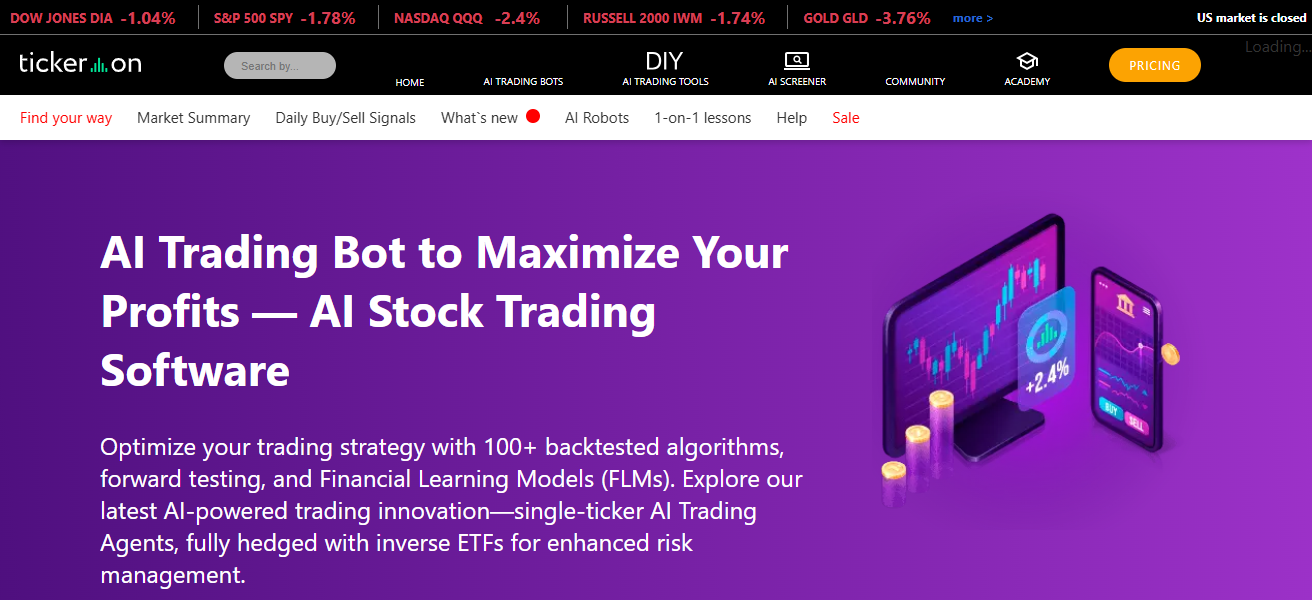
They can integrate both market sentiment (trading psychology) and technical analytics to determine the best and most decisive predictive market trade analytics to give trade alerts.
Over time, Tickeron AI manages to refine the entirety of its decision making processes and more skillfully create automated trades to suit your trading style.
This type of trading alerts and automated trading compliments a trader’s logic and trading psychology.
Tickeron AI Robots Features
- Uninterrupted Market Surveillance – Searches for recurring patterns that align with your trading history.
- Entry and Exit Recommendations – Provides optimal trade timing with the correct position sizing.
- Market Sentiment Analysis – Enhances the accuracy of trade signals based on the real-time market sentiment.
| Pros | Cons |
|---|---|
| Continuously scans markets for patterns matching your style. | May produce signals that require manual confirmation. |
| Optimizes trade entries, exits, and position sizes. | Best suited for active traders; less for long-term investors. |
| Incorporates real-time market sentiment for improved accuracy. | Subscription fees may be high for casual use. |
| AI evolves alongside your trading habits. | Performance can fluctuate in highly volatile markets. |
| Reduces human error through automation. | Requires integration with exchange accounts for live trading. |
10. AlgoTrader AI
AlgoTrader AI automates complex trading strategies at an institutional level. The AI can evaluate past trading decisions, portfolio outcomes, and trading execution to improve the quality of outcomes and trading efficiency.
The AI can backtest component strategies across various assets, identify defects, and modify rules according to the trader’s requests.
AlgoTrader AI can manage defects and the trader’s risk, rebalance the trading portfolio, and track the market.
Advanced traders looking for the best-dedicated analysis on trading performance will benefit from the high-level automation, testing, and strategy improvement system.
AlgoTrader AI Features
- Institutional Level Complexity – Automation that serves complex multi-asset strategies in scale.
- Learning Mechanism – Improve execution by learning on past trades and portfolio performance.
- Backtesting Across Assets – Backtests strategies against multiple markets’ historical data.
- Integrated Risk Management – Offers portfolio rebalancing, monitoring, and sophisticated risk management controls.
| Pros | Cons |
|---|---|
| Institutional-grade platform for complex strategy automation. | Designed for advanced traders; steep learning curve. |
| Learns from historical decisions to optimize future trades. | High setup and subscription costs. |
| Backtests strategies across multiple asset classes. | May be overkill for casual or small-scale traders. |
| Includes risk management and portfolio rebalancing tools. | Requires technical understanding for full feature utilization. |
| Adapts and evolves with your trading preferences. | Not beginner-friendly without prior trading experience. |
How To Choose AI Systems That Learn Your Trading Style and Improve It Explain
- Trading Goals – Choose a system that suits your own strategy, risk level, and assets.
- Adaptability – Make sure the AI can learn and make changes according to your own trading style and habits.
- Data & Analysis – Choose systems that employ current market conditions and data to make decisions and those that have back-testing capabilities.
- Level of Automation – Choose a system with either total autonomy (fully automated system) with no user input or one with assisted AI input.
- User Experience – Systems with a simple user interface (UI) will allow you to make less mistakes and take less time to learn.
- Performance Monitoring – Choose systems that can continuously adapt by monitoring and analyzing the data and results in order to improve.
- Security, Reliability, and Safety – Choose systems that will keep your data and money safe. Make sure the systems you choose have good-integrations or APIs to the exchanges & little to no downtime.
- Cost vs. Value – Compare the benefits of trading that you will gain and the important features vs. subscription cost to the system.
Conclusion
Overall, AI systems that understand your trading style offer powerful means to boost trading effectiveness and improve your decision-making process.
These tools examine your trading habits, modify your trading strategies, and improve your risk management optimization.
They provide you with individualized, insight derived from data and analytics. Although, these tools will never replace your judgement, they will aid you in becoming a better trader and will ease your mind when trading in a volatile market.
FAQ
By tracking your trades, preferences, and risk management habits over time.
Yes, they optimize strategies, entry/exit points, and risk management.
Not always; many platforms are user-friendly with pre-built AI tools.
Stocks, forex, crypto, commodities, and other supported financial instruments.