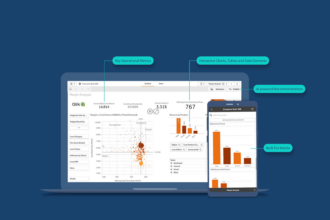
The Best AI Compliance Software for Financial Institutions that aids banks, fintechs, and financial institutions in effectively managing regulatory obligations will be covered in this article.
- Key Point & Best AI Compliance Software for Financial Institutions
- 1. NICE Actimize
- NICE Actimize – Key Features
- NICE Actimize – Pros and Cons
- 2. LexisNexis Risk Solutions
- LexisNexis Risk Solutions – Key Features
- LexisNexis Risk Solutions – Pros and Cons
- 3. ComplyAdvantage
- ComplyAdvantage – Key Features
- ComplyAdvantage – Pros & Cons
- 4. LSEG World‑Check
- LSEG World‑Check – Key Features
- LSEG World-Check – Pros & Cons
- 5. Fenergo
- Fenergo – Key Features
- Fenergo – Pros & Cons
- 6. Smarsh
- Smarsh – Key Features
- Smarsh – Pros & Cons
- 7. Global Relay
- Global Relay – Key Features
- Global Relay – Pros & Cons
- 8. MetricStream
- MetricStream – Key Features
- MetricStream – Pros & Cons
- 9. Archer IRM
- Archer IRM – Key Features
- Archer IRM Pros & Cons
- 10. SAS Anti‑Money Laundering (SAS Viya)
- SAS Anti‑Money Laundering (SAS Viya) – Key Features
- SAS Anti-Money Laundering (SAS Viya) Pros & Cons
- Conclusion
- FAQ
Real-time warnings, automated reporting, and improved decision-making are made possible by these AI-powered systems that simplify AML, KYC, risk management, and fraud detection. Learn how compliance teams can lower risk and increase operational efficiency with the use of technologies like NICE Actimize, LexisNexis, ComplyAdvantage, and SAS Viya.
Key Point & Best AI Compliance Software for Financial Institutions
| AI Compliance Software (Financial Institutions) | Key Compliance AI Point |
|---|---|
| NICE Actimize | AI‑powered AML, fraud detection, and regulatory compliance across global financial services. |
| LexisNexis Risk Solutions | Intelligent AI‑driven KYC/AML screening and identity risk analysis for compliance. |
| ComplyAdvantage | Uses machine learning to monitor transactions and detect financial crime in real time. |
| LSEG World‑Check | Global sanctions, PEP, and watchlist AI screening to ensure regulatory risk coverage. |
| Fenergo | Automates client onboarding and lifecycle compliance with AI workflow acceleration. |
| Smarsh | AI‑enhanced capture, archiving and supervised communications for compliance monitoring. |
| Global Relay | AI‑assisted messaging supervision and archiving to meet strict financial compliance requirements. |
| MetricStream | Unified GRC platform with AI contextual risk insights for regulatory and audit compliance. |
| Archer IRM | Integrated risk management using AI for compliance governance and controls automation. |
| SAS Anti‑Money Laundering (SAS Viya) | Advanced analytics and AI for fraud/AML detection and regulatory reporting. |
1. NICE Actimize
Banks, insurers, and securities companies use NICE Actimize, a top AI-powered financial crime, risk, and compliance platform, all over the world. It detects suspicious activities for fraud, trade monitoring, and anti-money laundering (AML) using sophisticated machine learning algorithms. By analyzing billions of transactions in real time, its risk-scoring engines lower false positives and increase investigator productivity.

NICE Actimize uses adaptive analytics to assist regulatory reporting, case management, and audit trails while learning from patterns to improve alerts. It helps organizations comply with international laws like BSA/AML, FATCA, and GDPR by enabling seamless compliance across silos. It improves accuracy, scalability, and operational controls in high-risk contexts and is regarded as the best AI compliance software for financial institutions.
NICE Actimize – Key Features
| Feature | Description |
|---|---|
| AML & Fraud Detection | Uses AI and machine learning to identify suspicious behavior in transactions. |
| Real‑Time Monitoring | Monitors activity across channels in real time to flag risks. |
| Case Management | Centralized investigation workflow with audit trails. |
| Adaptive Analytics | Learns patterns over time to reduce false positives. |
| Regulatory Reporting | Helps automate reports required by global standards. |
| Integrated Risk Platform | Supports fraud, AML, and trading surveillance together. |
NICE Actimize – Pros and Cons
Pros:
- Additional accuracy is gained from the powerful AI driven fraud and AML detection.
- Quick response to risks facilitated through real time monitoring and response across various channels.
- All three, fraud, AML, and Trade surveillance, are aided by the integrated risk suite, and traded surveillance.
- There are enhanced audit trails and case management for investigations.
- Extremely complex compliance requirements for large enterprises can be met through the scalability.
Cons:
- Relatively large time and resource investments may be necessary for the first implementation in an organization.
- The higher licensing costs can be prohibitive for smaller organizations.
- Users may need to be specially trained in order to fine-tune the AI models.
- Legacy systems, particularly in older organizations, can be integrated with.
- Customization is often professional services dependent.
2. LexisNexis Risk Solutions
For financial institutions, LexisNexis Risk Solutions offers AI-assisted compliance solutions that improve identity verification, sanctions screening, and client due diligence. Its Risk Intelligence platform gathers information about beneficial ownership, negative media, and international regulations using machine learning and natural language processing.
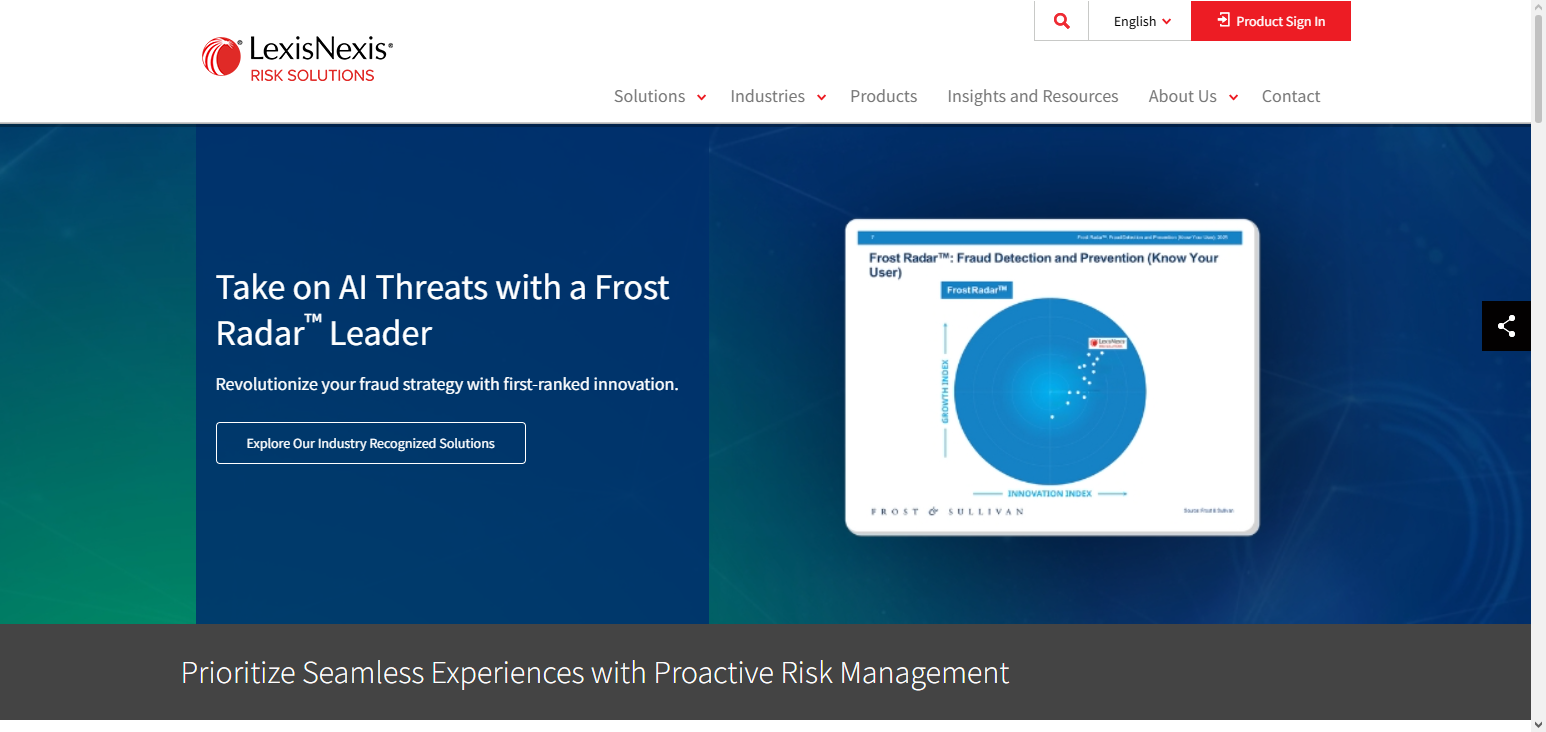
Deeper risk insights and quicker decisions during onboarding and continuous monitoring are made possible by merging structured and unstructured data.
Analytics from LexisNexis improve accuracy in KYC (Know Your Customer) and AML procedures while lowering the burden of manual reviews. By guaranteeing real-time risk scoring, automatic alerts, and richer profiles that support risk-based compliance strategies, this top AI compliance software for financial institutions assists businesses in adhering to changing rules.
LexisNexis Risk Solutions – Key Features
| Feature | Description |
|---|---|
| Risk Intelligence Data | Large global datasets for enhanced due diligence. |
| Analytics & Scoring | AI‑powered risk scoring for customers and entities. |
| Identity Verification | Confirms identities with authoritative data sources. |
| Adverse Media Screening | Uses NLP to detect negative news and risk indicators. |
| Regulatory Updates | Keeps compliance rules updated with regulatory changes. |
| API Integration | Connects with banking and onboarding systems. |
LexisNexis Risk Solutions – Pros and Cons
Pros:
- Improvement in KYC and risk intelligence is attributed to the large global databases.
- The quality of the end decision is improved by the AI based risk scanning.
- Additional media detection improves journalism due diligence.
- Ability to fit in existing workflows is achieved through the custom and adaptable API.
- Consistent updates in the regulations from the governing bodies help to keep compliance at an updated level.
Cons:
- Several smaller compliance teams can be overwhelmed by the complex presentation of the data.
- Increased costs for the subscriptions may be required based on the increased volume of data.
- There is a risk from excessive reliance on the quality of data from third parties.4. There may be some false positives, particularly with broader data sources.
- Non-technical users may find some aspects challenging.
3. ComplyAdvantage
ComplyAdvantage is an AI-powered technology that focuses on transaction monitoring, sanctions screening, and AML compliance. It connects the dots that conventional systems overlook by analyzing data from millions of global sources using proprietary machine learning algorithms to detect high-risk entities. Through contextual analysis, its real-time screening minimizes false positives while identifying penalties, PEPs (Politically Exposed Persons), and negative media.
ComplyAdvantage integrates with core financial systems via API-driven interface to provide smooth compliance procedures. Because of its agile design, it can adjust to changing risk situations and new regulatory needs. Acknowledged as the top AI compliance software for financial institutions, it provides compliance teams with automated workflows, predictive insights, and thorough audit logs for transparent regulatory reporting.
ComplyAdvantage – Key Features
| Feature | Description |
|---|---|
| Real‑Time Sanctions Screening | Continuously checks worldwide watchlists. |
| PEP & Adverse Media Detection | AI identifies high‑risk individuals and news links. |
| Transaction Monitoring | Machine learning analyzes patterns for AML. |
| False Positive Reduction | Contextual screening improves alert quality. |
| API‑First Design | Easy embedding into existing systems. |
| Automated Alerts | Real‑time notifications for compliance teams. |
ComplyAdvantage – Pros & Cons
Pros:
- Fast, real-time PEP and sanctions screening.
- Machine learning is used to improve accuracy and reduce false positives.
- APIs integrate easily with primary systems.
- Outstanding at detection and monitoring of AML risks.
- Data is frequently updated from sources that are new and global.
Cons:
- Does not include some features of comprehensive enterprise risk management.
- Costs associated with data and APIs may increase with volume.
- The community is limited with a smaller user base.
- Significant expertise is needed for complex tuning of alerts.
- Compliance workflows may require additional modules.
4. LSEG World‑Check
The London Stock Exchange Group’s LSEG World-Check is a global risk intelligence database for AML compliance, increased due diligence, and sanctions screening. It uses AI-enhanced research techniques to update and curate profiles of high-risk individuals and businesses, sanctions lists, and PEPs. World-Check enhances match quality by lowering false alerts and increasing investigative accuracy with entity resolution technology and pattern recognition.
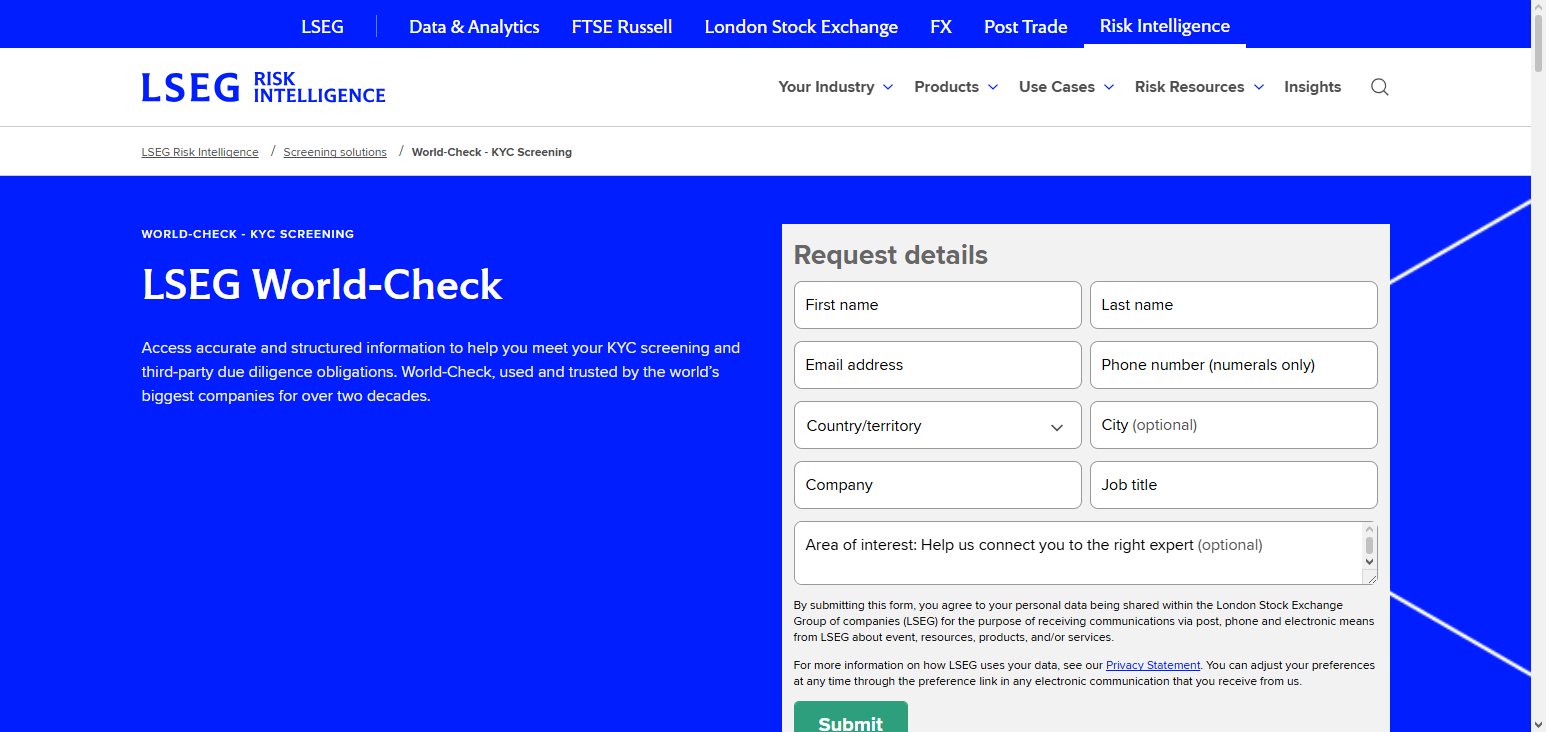
It is used by financial organizations for risk grading across geographies, monitoring, and customer onboarding. It enhances KYC and AML procedures as the best AI compliance software for financial organizations by offering accurate, richer data that supports thorough risk assessments and regulatory compliance in intricate international marketplaces.
LSEG World‑Check – Key Features
| Feature | Description |
|---|---|
| Global Risk Database | Extensive profiles of PEPs, sanctions, and high‑risk entities. |
| AI‑Enhanced Research | Machine learning improves entity matching accuracy. |
| Sanctions & Watchlist Screening | Continuous updates from global sources. |
| Risk Scoring | Assess risk levels for onboarding or monitoring. |
| Entity Resolution | Consolidates data with advanced matching logic. |
| Regulatory Coverage | Supports global compliance needs. |
LSEG World-Check – Pros & Cons
Pros:
- Strong risk and global sanctions databases.
- AI improves match accuracy and entity resolution.
- Trusted for AML/KYC screening.
- Strong data coverage and risk across jurisdictions.
- Frequent updates keep the data compliant across borders.
Cons:
- Subscription pricing may not be feasible for smaller businesses.
- Data bias may result in false positives.
- Data overload is likely with insufficient filtering.
- Integration is needed for real-time usage.
- Less workflow automation than complete suites.
5. Fenergo
For banks and asset managers, Fenergo offers a client lifecycle management platform that employs AI to automate KYC, AML, and regulatory onboarding procedures. Faster client acceptance and cheaper operating expenses are made possible by its intelligent data extraction and entity matching, which minimize manual entry. By examining trends and past compliance choices, machine learning algorithms enhance risk assessments by producing reliable and consistent results.
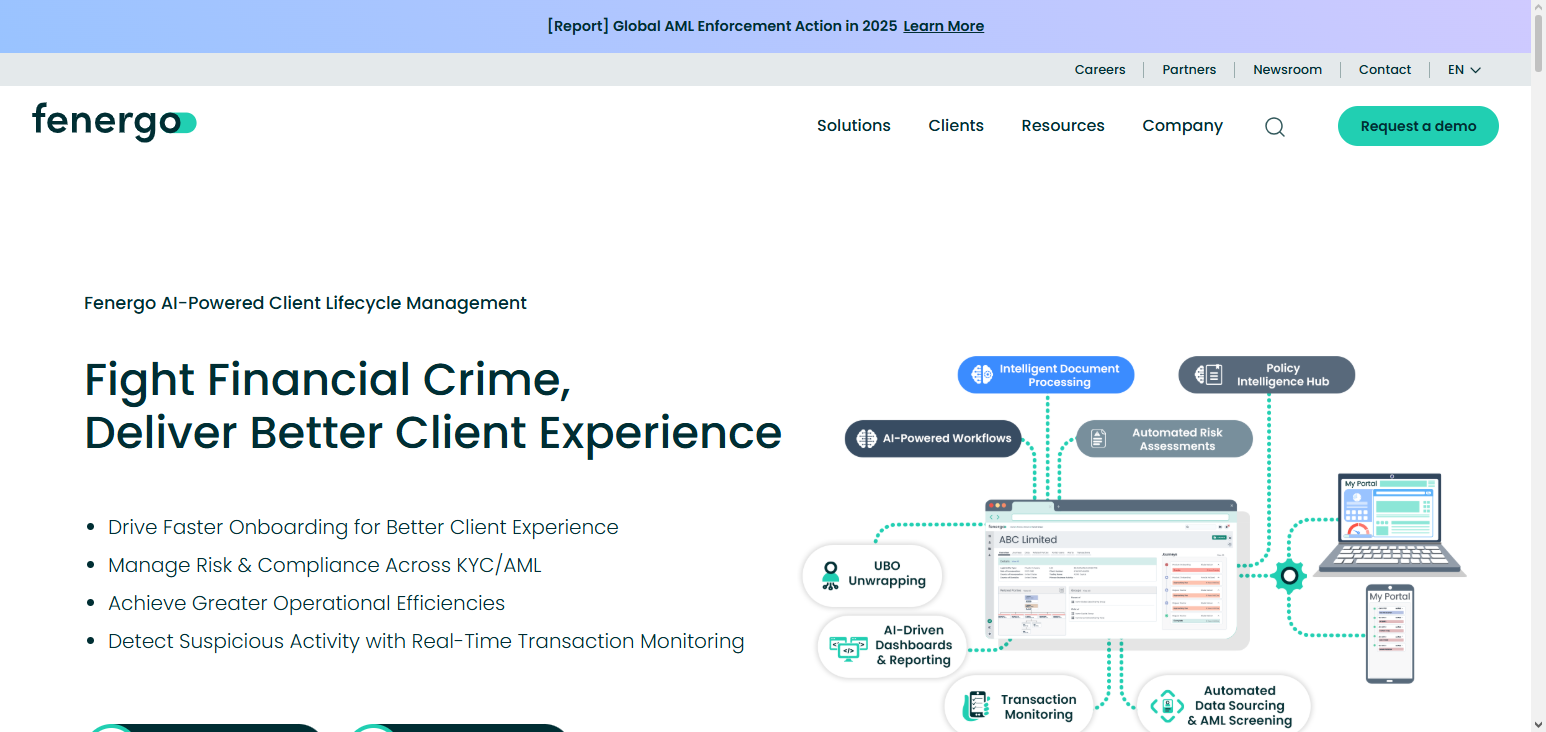
To guarantee adherence to changing standards, Fenergo enables worldwide rule sets and regulatory change management. Acknowledged as the best AI compliance software for financial institutions, it improves governance through real-time compliance checks, workflow automation, and clear audit trails that enable institutions to grow while lowering risk and regulatory fines.
Fenergo – Key Features
| Feature | Description |
|---|---|
| Client Lifecycle Management | Automates onboarding from start to finish. |
| KYC/AML Automation | AI extracts and validates customer data. |
| Workflow Automation | Reduces manual steps and errors. |
| Regulatory Rule Updates | Incorporates latest global requirements. |
| Data Matching | Smart entity and record matching with ML. |
| Audit & Compliance Reporting | Built‑in reporting and documentation. |
Fenergo – Pros & Cons
Pros:
- Moments of automation, but mostly strong client lifecycle management and onboarding automation.
- Autonomous KYC/AML functions reduce manual efforts.
- The AI component further improves accuracy in matching and data extraction.
- Handles multiple global regulatory rule sets.
- Significant operational efficiency.
Cons
- Lengthy and resource heavy implementations.
- Increased cost in customization complexity.
- Adoption requires change management
- Small financial institutions are not optimized.
- Compliance teams may need additional training.
6. Smarsh
Email, chat, social media, and collaboration platforms are just a few of the digital communications that Smarsh, an AI-centric communications governance and compliance solution, records, monitors, and stores. Its AI engines identify risk signs like insider trading or misconduct, classify information, and detect policy violations.
Smarsh’s analytics assist compliance organizations in enforcing retention policies for regulatory mandates including MiFID II, SEC, and FINRA, prioritizing investigations, and reducing noise from irrelevant communications.
Smarsh, the top AI compliance platform for financial institutions, helps businesses cut costs, enhance audit readiness, and lessen lawsuit risk from communication breaches by offering contextual insights, automated supervision, and scalable retention across channels.
Smarsh – Key Features
| Feature | Description |
|---|---|
| Unified Communications Archiving | Captures emails, chat, social, and collaboration tools. |
| AI‑Powered Supervision | Detects policy violations using machine learning. |
| Risk Classification | Classifies content for compliance workflows. |
| Search & Retrieval | Fast search for audit and eDiscovery. |
| Policy Management | Enforces retention and supervision rules. |
| Reporting Dashboards | Visualize communications risk over time. |
Smarsh – Pros & Cons
Pros:
- All-embracing myriad communications channels captured.
- Risky behaviour & policy violations are flagged by AI supervision.
- Meets the mandates of records retention compliance.
- Investigation timelines are shortened by means of sophisticated tools for search and discovery.
- Large volumes of data are easily manageable.
Cons:
- For smaller teams, the pricing structure may be prohibitive.
- A governance framework may be needed to regulate the influx of data.
- The Risk classification component may generate excessive false positives.
- The functionality is powerful; training is required for the use of advanced analytics.
- The interoperability of all systems may be of varying degrees of difficulty.
7. Global Relay
For financial institutions, Global Relay provides cloud-based compliance archiving, oversight, and e-discovery capabilities. It supports regulatory compliance with retention, surveillance, and legal discovery requirements by using AI and machine learning to monitor communications and identify risk patterns. Across communications and collaboration platforms, its analytical models identify unusual behavior or rules violations.
Global Relay improves audit readiness and investigation efficiency with quick retrieval and configurable search. As the top AI compliance software for financial institutions, it offers strong governance for metadata and electronic communications, assisting organizations in adhering to international regulations such as GDPR, FINRA, and SEC while lowering manual labor and enhancing risk management.
Global Relay – Key Features
| Feature | Description |
|---|---|
| Secure Archiving | Cloud storage for communications and metadata. |
| AI Monitoring | Detects anomalies and policy breaches with ML. |
| eDiscovery Tools | Fast retrieval of messages and data for investigations. |
| Multi‑Channel Support | Captures email, voice, chat, social platforms. |
| Compliance Reporting | Automated logs for audit readiness. |
| Risk Alerts | Real‑time notifications for suspicious content. |
Global Relay – Pros & Cons
Pros:
- Compliance coverage is good, with robust and secure archiving in the cloud.
- AI identifies communications of an unusual or risky nature.
- eDiscovery streamlines investigations.
- Voice, chat and social, as well as other channels, are captured.
- Compliance reports are generated automatically.
Cons:
- Captured data may lead to increased storage costs.
- The compliance aspect can result in added work if internal supervision policies are inadequate.
- Needs experienced users to handle management systems.
- It can get technically involved to set things up.
- Some analytics functionalities may involve add-ons.
8. MetricStream
MetricStream is an integrated governance, risk, and compliance (GRC) platform that uses AI to automate operations related to compliance, control monitoring, and risk assessments. Its predictive algorithms improve decision-making across business risk frameworks, detect new risks, and assess regulatory effects. Natural language processing powered by AI speeds up policy administration and compliance document classification.
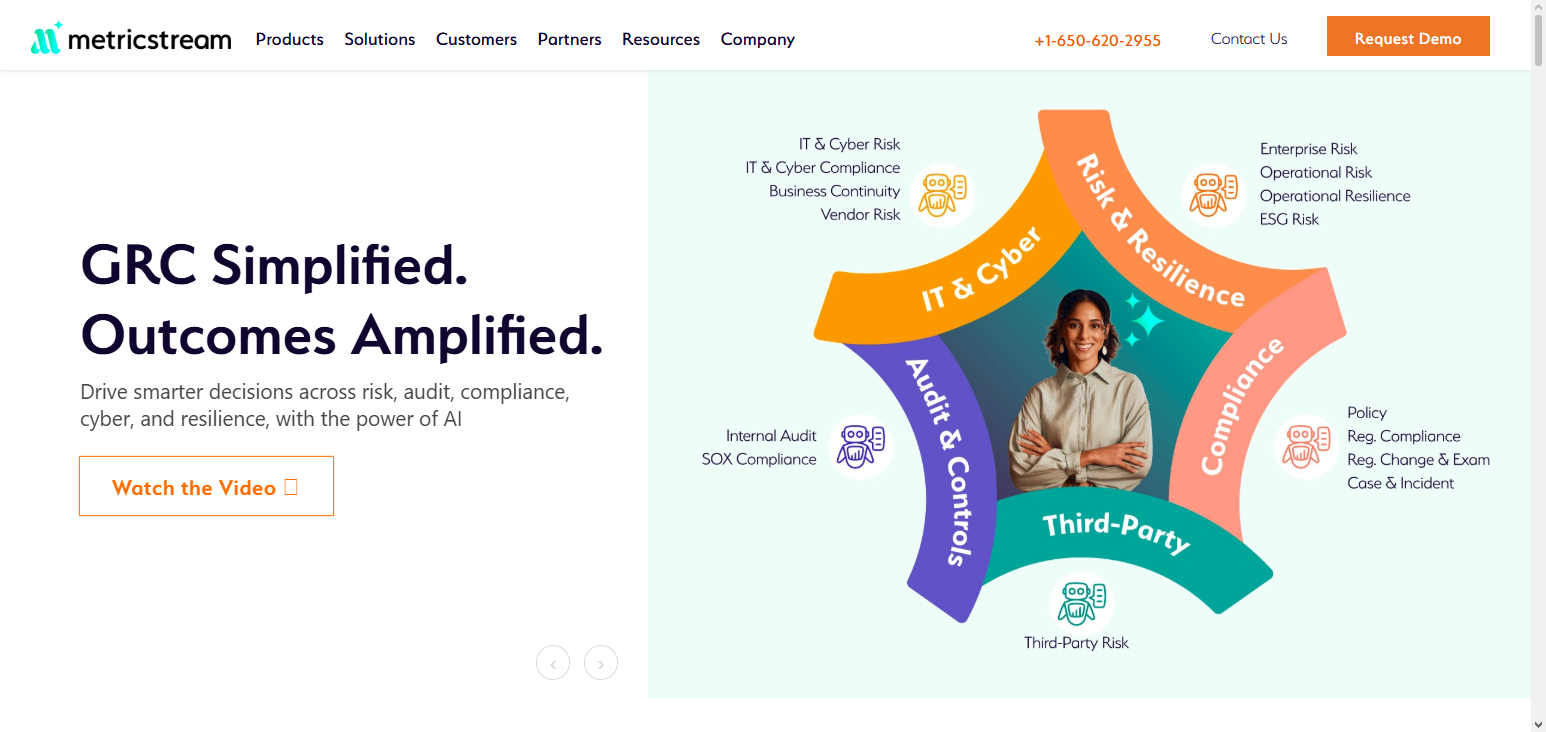
MetricStream facilitates cross-domain risk alignment, including vendor risk, operational resilience, audit, and regulatory change management. Acknowledged as the top AI compliance software for financial institutions, it facilitates automated reporting, continuous monitoring, and consolidated risk intelligence, minimizing human labor and enabling proactive management of intricate regulatory requirements in dynamic financial markets.
MetricStream – Key Features
| Feature | Description |
|---|---|
| Integrated GRC Platform | Governance, risk, and compliance in one suite. |
| Predictive Analytics | AI identifies emerging risks. |
| Policy & Document Management | Central control for compliance documentation. |
| Risk Assessments | Automated scoring and impact analysis. |
| Regulatory Change Management | Updates rules and requirements in real time. |
| Dashboards & Reporting | Visual insights and automated compliance reports. |
MetricStream – Pros & Cons
Pros:
- Single enterprise GRC platform.
- Predictive analytics identify risks earlier.
- Excellent policy management and documentation.
- Regulatory change management provides contingent compliance.
- Dashboards offer visibility in real-time.
Cons:
- A lot of time and thorough detailing is needed for planning the implementation.
- Initial costs can be quite large.
- Customization can involve outside consultants.
- Completion can be deemed difficult for smaller organisations.
- To use the system to its full potential, a lot of training is needed.
9. Archer IRM
RSA’s Archer IRM is an integrated risk management platform that unifies risk, compliance, and audit data using AI analytics. In order to help compliance teams prioritize remedial efforts, its machine learning capabilities improve risk rating, trend analysis, and predictive insights. Third-party risk, policy management, monitoring of regulatory changes, and incident response are all supported by Archer IRM. It provides real-time visibility into risk exposures and compliance gaps through customizable dashboards and workflows.
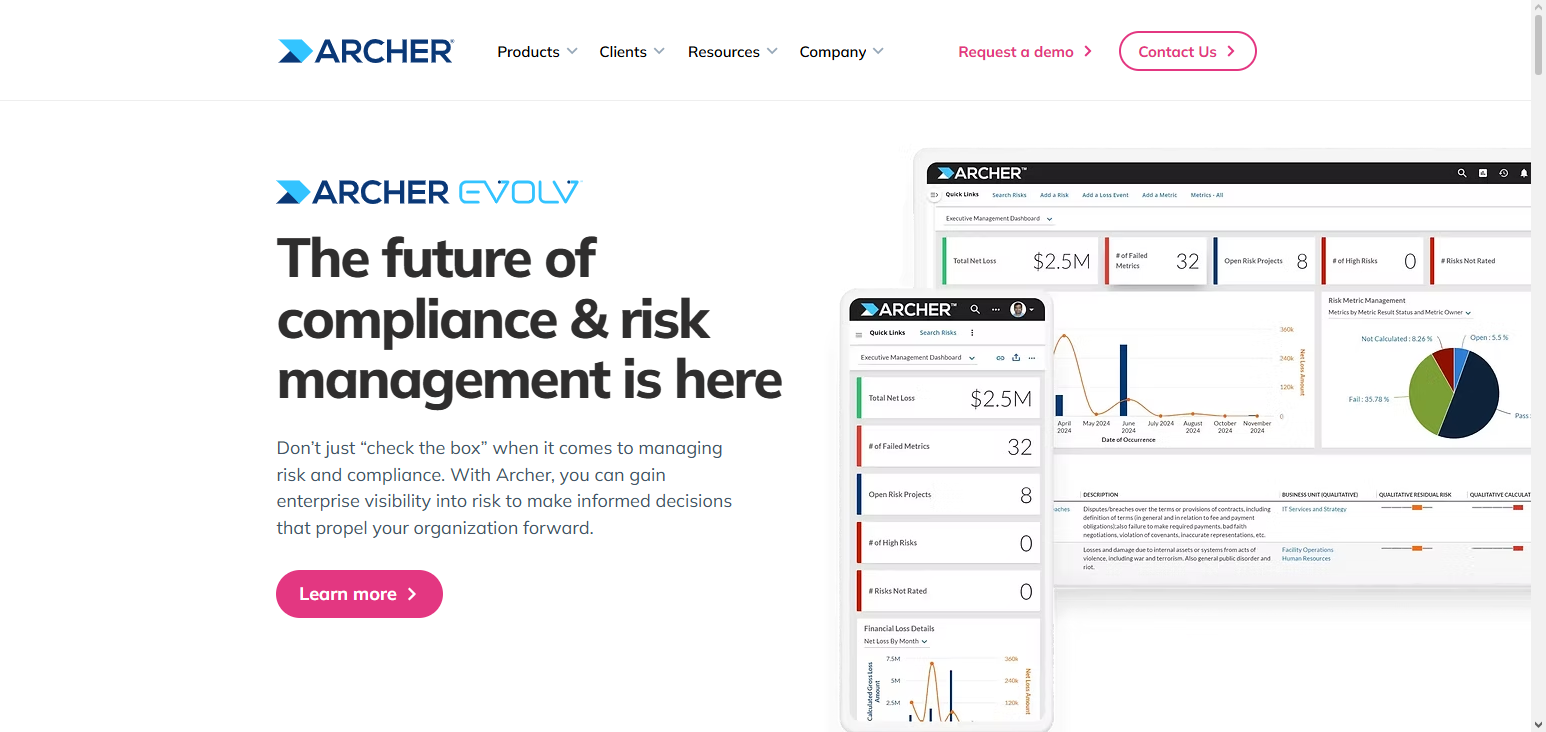
With automated documentation and actionable insights, Archer IRM, the best AI compliance software for financial institutions, assists organizations in proactively managing threats, coordinating risk strategies across business divisions, and meeting audit and regulatory reporting requirements.
Archer IRM – Key Features
| Feature | Description |
|---|---|
| Risk & Compliance Integration | Unified platform for multiple risk domains. |
| AI Analytics & Scoring | Machine learning enhances risk prioritization. |
| Incident & Issue Management | Tracks events and resolution steps. |
| Third‑Party Risk | Monitors vendor and partner compliance. |
| Dashboards & Reporting | Executive visibility into risk and compliance posture. |
| Automated Workflows | Reduces manual effort and errors. |
Archer IRM Pros & Cons
Pros:
- Risk and compliance management are fully integrated.
- Better risk hot-spotting courtesy of AI scoring.
- Includes third party risk and incident management.
- Executive dashboards are adjustable.
- Less administrative work due to automated task workflows.
Cons:
- Setting up and customizing can be time and cost-intensive.
- Broad functionality can be a burden.
- A governance framework is needed for it to be effective.
- Full functionality is unlikely for small teams.
- Older systems will need a lot of work to integrate.
10. SAS Anti‑Money Laundering (SAS Viya)
SAS Anti-Money Laundering on SAS Viya is an AI-enabled compliance solution that employs network analysis, machine learning, and advanced analytics to identify suspicious activity and money laundering. In order to find intricate patterns, connect entities, and reveal hidden linkages, it examines enormous transactional databases.
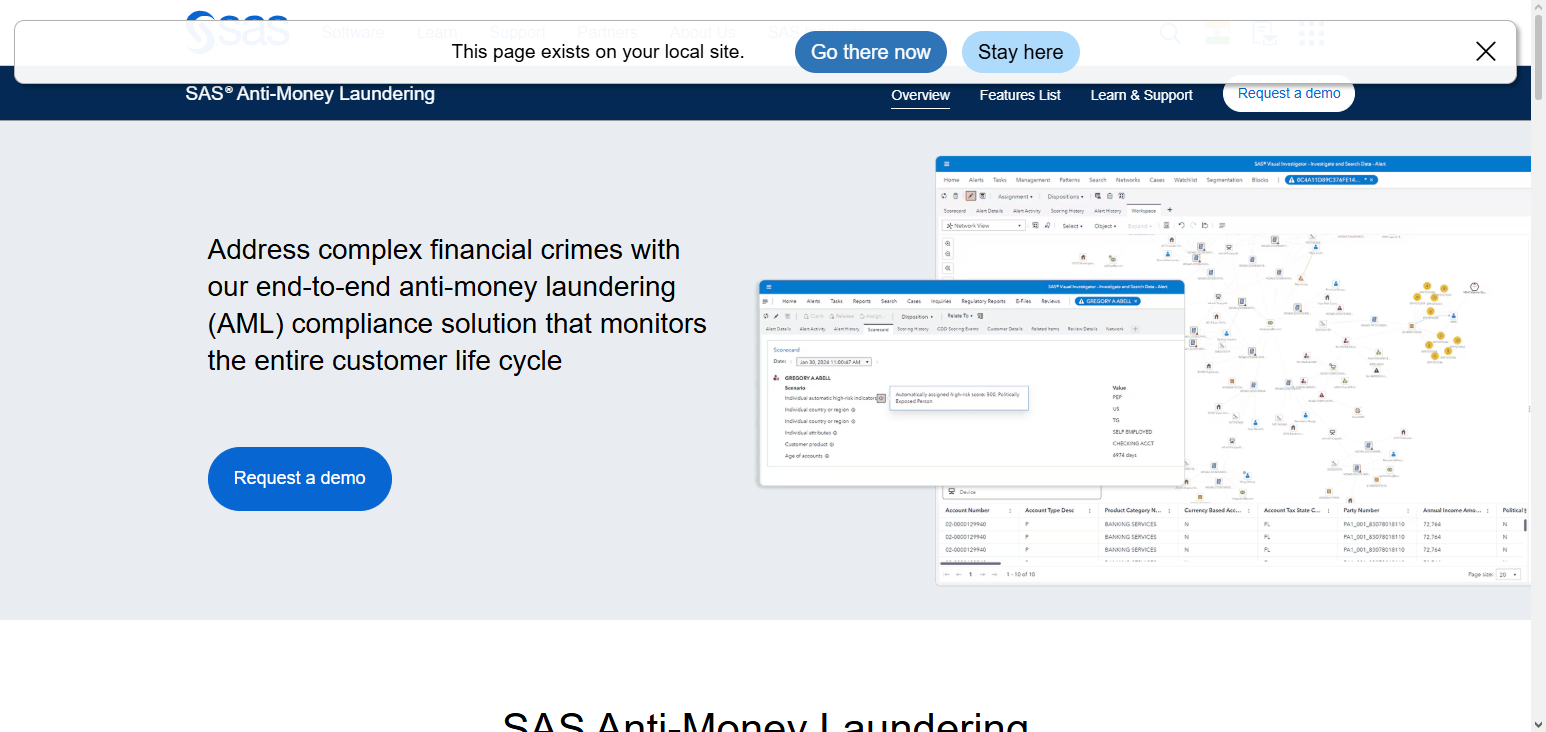
SAS reduces false positives and increases detection accuracy through automated model construction and continual learning. Compliance teams can modify models for performance and comprehend why alerts are created with explainable AI.
SAS AML, which is regarded as the best AI compliance software for financial institutions, helps organizations keep ahead of changing financial crime strategies with scalable, intelligent analytics by supporting regulatory reporting, risk scoring, and global compliance frameworks.
SAS Anti‑Money Laundering (SAS Viya) – Key Features
| Feature | Description |
|---|---|
| Advanced Analytics | AI models detect complex AML and fraud patterns. |
| Network Analysis | Reveals hidden connections between accounts and entities. |
| Machine Learning Models | Improves detection accuracy over time. |
| Explainable AI | Traceable insights for auditors and regulators. |
| Transaction Monitoring | Real‑time AML surveillance of financial data. |
| Reporting & Visualization | Interactive dashboards and compliance reporting tools. |
SAS Anti-Money Laundering (SAS Viya) Pros & Cons
Pros:
- For detection of AML, analytics and machine learning are used.
- Network analysis reveals previously unknown relationships.
- Explainable AI enhances audit transparency.
- Monitoring of transactions as they occur.
- Comprehensive visualization and reporting tools.
Cons:
- Implementation and licensing costs are high.
- Model tuning requires skilled users.
- Preparation of data may take a long time.
- Complexity may result in the need for specific dedicated analytics teams.
- Core banking systems integration requires additional work.
Conclusion
Risk management and regulatory compliance are more important than ever in the rapidly changing financial landscape of today. Financial institutions can detect fraud, monitor transactions, expedite KYC procedures, and guarantee regulatory compliance with the help of AI-powered solutions like NICE Actimize, LexisNexis Risk Solutions, ComplyAdvantage, LSEG World-Check, Fenergo, Smarsh, Global Relay, MetricStream, Archer IRM, and SAS Anti-Money Laundering (SAS Viya).
These solutions cut human tasks, lower errors, and improve decision-making by utilizing machine learning, predictive analytics, and real-time monitoring. Organizations may preserve trust, reduce risks, and function with confidence in a complicated, regulated environment by selecting the appropriate AI compliance software.
FAQ
AI compliance software uses artificial intelligence, machine learning, and advanced analytics to help financial institutions detect financial crimes, automate regulatory reporting, enhance KYC (Know Your Customer) and AML (Anti‑Money Laundering) processes, and ensure compliance with global regulations. These systems improve accuracy, reduce manual work, and provide real‑time monitoring.
AI enables faster detection of suspicious patterns, predictive risk scoring, reduced false positives, and adaptive learning. It processes large volumes of data that traditional rules‑based systems struggle with—improving efficiency and regulatory readiness.
Banks, insurance companies, fintech firms, brokerage houses, and any regulated financial institution benefit from AI compliance systems. These tools help comply with AML, sanctions screening, data retention, fraud prevention, and communications monitoring.
Key features include real‑time transaction monitoring, machine learning analytics, automated alerts, KYC/AML screening, advanced reporting, customizable workflows, integration capabilities, and strong audit trails.