This article focuses on The most Effective AI Platforms for Business Forecast Accuracy. Business forecasting allows companies to make informed decisions, optimize processes, and allocate resources efficiently.
- Key Points & Best AI Platforms For Business Forecast Accuracy
- 10 Best AI Platforms For Business Forecast Accuracy
- 1. IBM Watson Studio
- 2. Microsoft Azure AI
- 3. Google Cloud Vertex AI
- 4. Amazon Forecast
- 5. SAP Predictive Analytics
- 6. Oracle AI Cloud
- 7. DataRobot
- 8. H2O.ai
- 9. SAS Viya
- 10. Anaplan Predictive Insights
- How To Choose Best AI Platforms for Business Forecast Accuracy
- Conclusion
- FAQ
AI platforms are changing the way companies forecast demand, revenue, and market trends. In this article, we examine the most flexible and intelligent forecasting solutions that businesses of all sizes can rely on.
Key Points & Best AI Platforms For Business Forecast Accuracy
| AI Platform | Key Point |
|---|---|
| IBM Watson Studio | advanced predictive modeling with scalable machine learning pipelines |
| Microsoft Azure AI | integrated cloud ecosystem enabling seamless data forecasting |
| Google Cloud Vertex AI | automated ML workflows for demand and revenue prediction |
| Amazon Forecast | time-series forecasting optimized for retail and supply chain |
| SAP Predictive Analytics | enterprise-grade forecasting tailored for financial planning |
| Oracle AI Cloud | robust data integration for accurate business trend analysis |
| DataRobot | automated machine learning with explainable predictions |
| H2O.ai | open-source flexibility with strong predictive accuracy |
| SAS Viya | powerful statistical forecasting trusted in finance and healthcare |
| Anaplan Predictive Insights | scenario-based forecasting for strategic business planning |
10 Best AI Platforms For Business Forecast Accuracy
1. IBM Watson Studio
IBM Watson Studio is an AI platform that combines data science and machine learning with model deployment, development, and data preparation
Dashboards, and features automation, Natural Language Processing, and Predictive Analytics, making it ideal for data-rich environments that need predictive modelling, and analytics.
Watson supports numerous open-source frameworks, including Python, R, and TensorFlow, so it is easy for data scientists and analysts to work together.
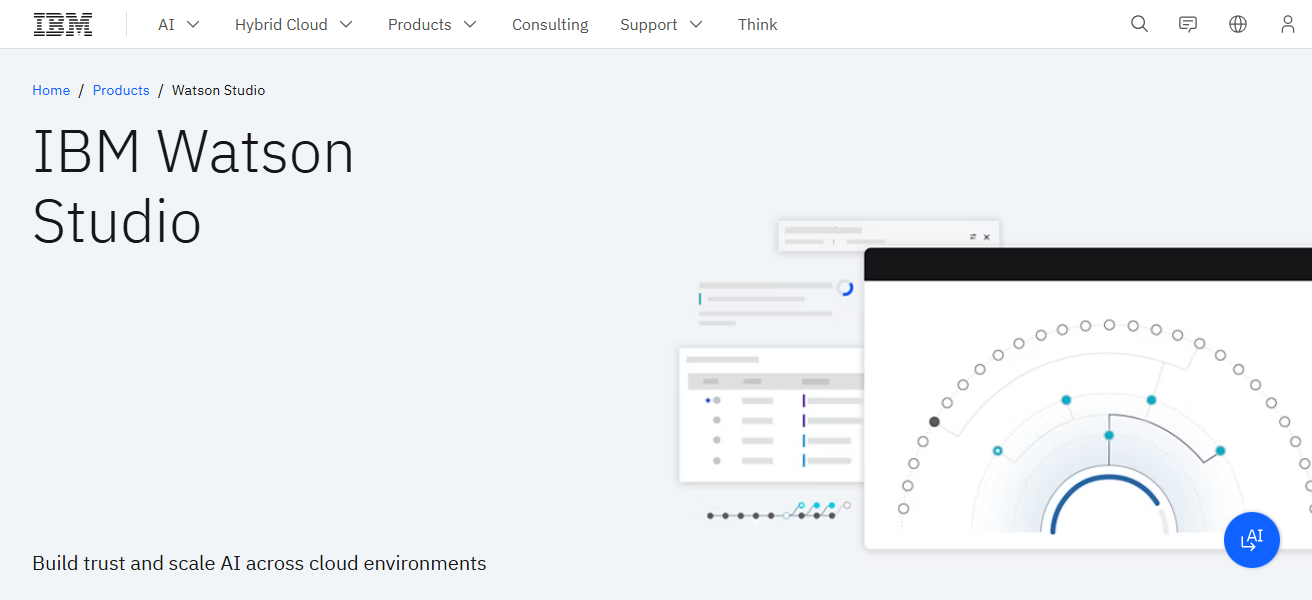
It has cloud integration for added scalability, enterprise-level governance, and automation, and added explainability features that explain model choice, boosting forecast accuracy, and model selection.
It has the best features for predictive modelling and analytics, and explains its features, ideal for data-rich environments, with complex business needs.
IBM Watson Studio Features
- Integrated data science environment: Everything from data preparation, to model building and deployment is in one workbench.
- Automated AI & explainability: Forecasts are more reliable and transparent with explainable models and AutoML.
- Collaboration support: Shared projects, notebooks and dashboards means seamless collaboration.
- Multi-framework support: Data science frameworks like Python, R and TensorFlow are fully supported.
| Pros | Cons |
|---|---|
| Supports multiple open-source frameworks like Python, R, TensorFlow. | Can be complex for beginners due to extensive features. |
| Automated modeling and explainable AI enhance forecast accuracy. | Higher cost for enterprise-scale deployments. |
| Strong integration with IBM Cloud Pak for Data for scalability. | Requires technical expertise for advanced customizations. |
| Collaboration-friendly for data scientists and analysts. | Cloud dependency may limit some on-premise use cases. |
| NLP and predictive analytics capabilities improve business insights. | Learning curve for integrating with existing legacy systems. |
2. Microsoft Azure AI
Microsoft Azure AI provides tools for developing, training, and deploying predictive models. It works especially well with Azure Machine Learning and helps businesses manage automated machine learning (AutoML), custom models, and MLOps.
Azure AI is especially good at predicting demand and customer and financial behavior, aided by powerful built-in time series features. Pre-trained cognitive services help fill data related gaps with text, speech, and image analysis.
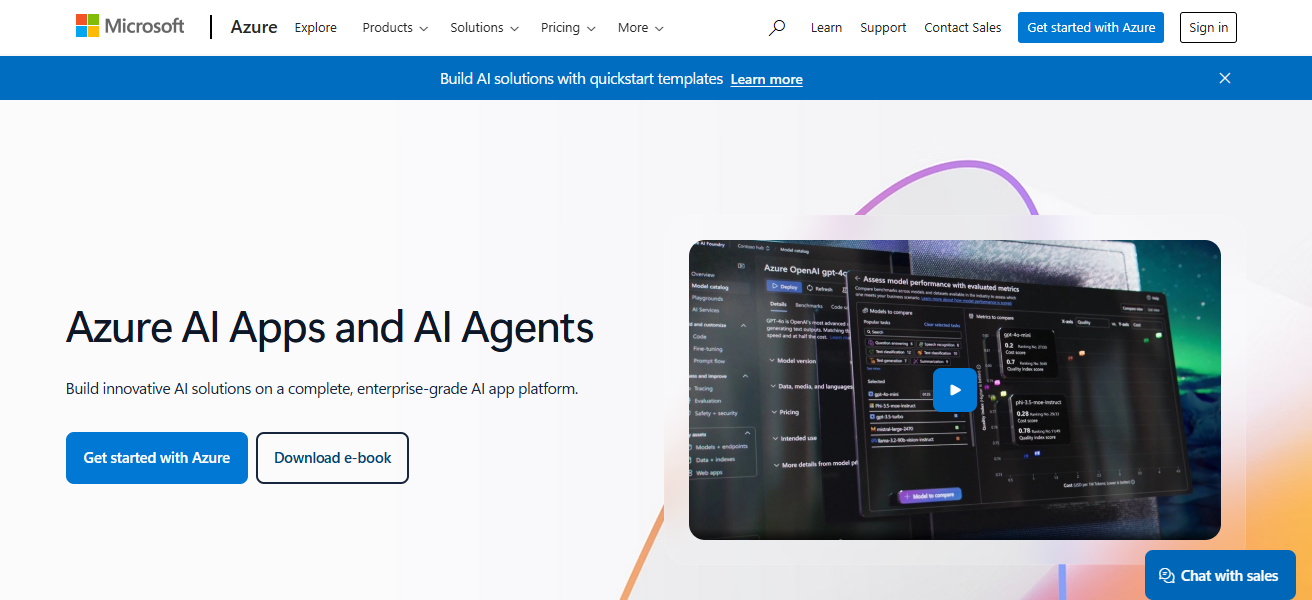
Businesses get the benefits of secure cloud infrastructure, enterprise reliability, and Microsoft 365 and Power BI integration.
Azure AI’s wide range of options makes it ideal for enterprises that want custom AI solutions but also need to deploy quickly and don’t have extensive machine-learning knowledge.
Microsoft Azure AI Features
- AutoML & MLOps: Forecasting workflows are optimized with the automation of model training and management.
- Scalable cloud infrastructure: Azure’s compute power is utilized for extensive enterprise and large data workloads.
- Integration with Power BI & 365: Predictions are linked to analytics and business applications in real-time.
- Pre-built cognitive services: Model forecasting is supplemented with text, speech, and image insights
| Pros | Cons |
|---|---|
| AutoML and MLOps simplify model development and deployment. | Can be expensive depending on usage and services selected. |
| Scalable for large datasets and enterprise-grade applications. | May require prior knowledge of Azure ecosystem. |
| Integrates with Microsoft 365 and Power BI for data insights. | Pre-trained models may not cover niche forecasting scenarios. |
| Strong security and compliance standards. | Custom model tuning can be complex for non-technical users. |
| Flexible for both quick deployments and advanced AI solutions. | Some advanced features need additional Azure services subscriptions. |
3. Google Cloud Vertex AI
Google Cloud Vertex AI helps you build and deploy ML models more efficiently. By combining and unifying Google’s AutoML and custom model training solutions, Vertex AI reduces complexity and boosts performance.
With Vertice AI’s scalable architecture alongside BigQuery, users can process large datasets and run time-series forecasts.
Features such as Explainable AI and Continuous Evaluation assist model monitoring and tune models, improving performance over time.
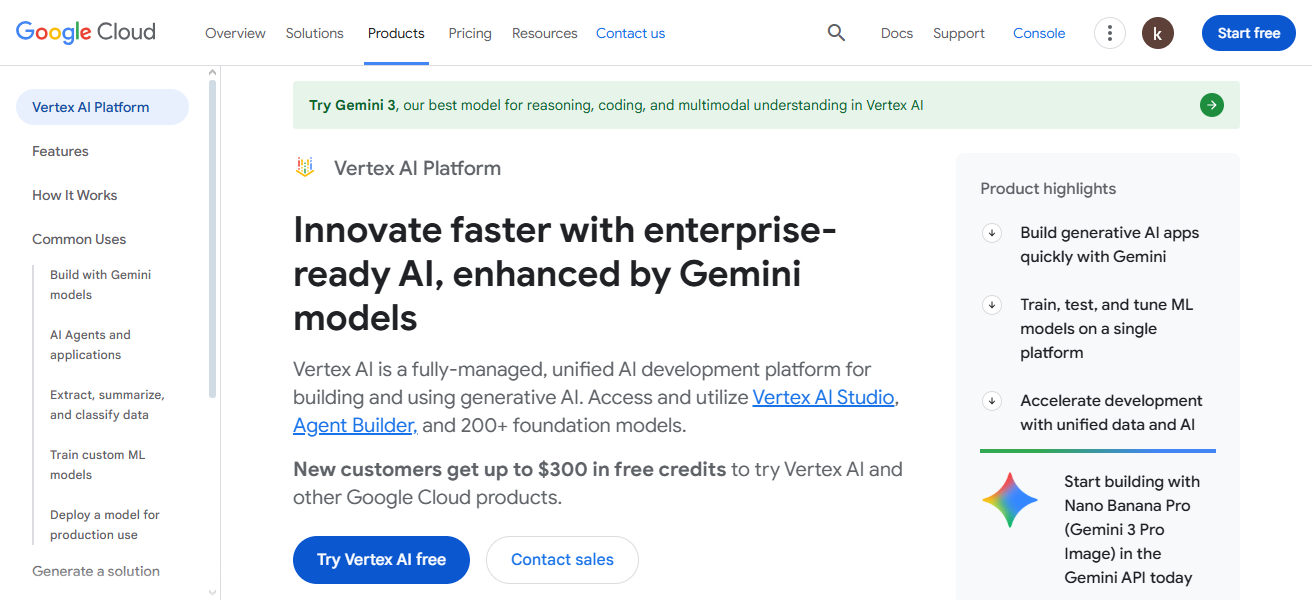
Built-in data labeling and automated data pipelines provide users with faster workflow options. Users have the added value of Google’s AI ecosystem which enhances experimentation.
With strong support for contemporary machine learning frameworks, Vertex AI assists users in creating dependable forecasts with diminished engineering complications and a quicker time to value.
Google Cloud Vertex AI Features
- Unified AI development: Custom model training and AutoML are combined on a single platform.
- BigQuery integration: Forecasting applications are supported with quick and large scale data processing.
- Explainable AI: Built in tools that explain model predictions improve trust and transparency.
- Pipelines and Workflows: End-to-end pipelines automate data preparation, training, and deployment.
| Pros | Cons |
|---|---|
| Combines AutoML and custom model training under one platform. | Platform complexity may overwhelm beginners. |
| Scalable architecture handles large datasets efficiently. | Costs can grow quickly with heavy usage. |
| Explainable AI and continuous evaluation improve forecast reliability. | Requires familiarity with Google Cloud ecosystem. |
| Built-in pipelines and data labeling speed up workflows. | Limited offline/on-premise deployment options. |
| Supports modern ML frameworks and experimentation. | Integration with non-Google tools may require extra work. |
4. Amazon Forecast
Amazon Forecast provides a fully managed service tailored to time-series forecasting. It analyzes past data and seasonal trends to predict future sales, inventory, and resources and does all this without requiring advanced knowledge in machine learning.
It goes through dozens of automated data models to find trends and optimizes for best accuracy. While scaling to extensive datasets, it can also integrate with S3 and QuickSight.
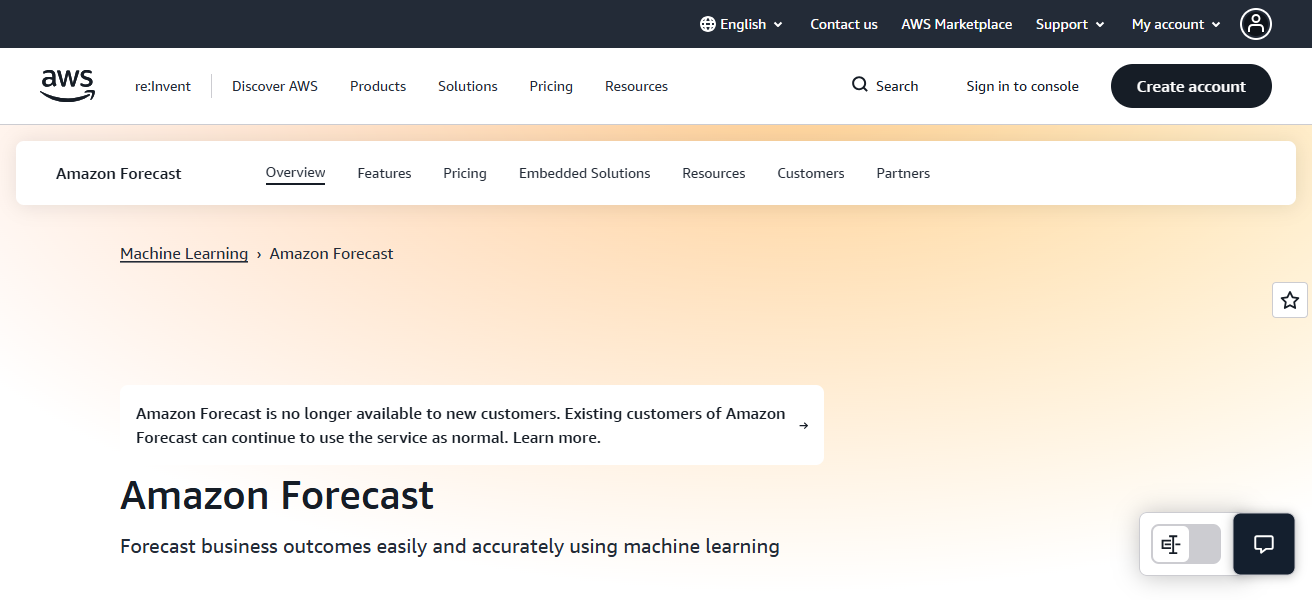
The service is best for manufacturing, retail, and logistics industries with the need for improved forecasting and minimal setup. It features high availability, top tier security, and pay-as-you-go pricing.
Amazon Forecast Features
- Purpose-built for time-series prediction: Forecasting accuracy is built into the design.
- Automated model selection: Analyzes and selects the most appropriate models without in-depth ML knowledge.
- Seamless integration with AWS analytics: Compatible with S3, QuickSight, and other AWS services.
- Scalability and flexibility: Easy to configure to handle large datasets and varying forecasting requirements
| Pros | Cons |
|---|---|
| Fully managed service with automated model selection. | Limited customization compared to full ML platforms. |
| Optimized for time-series forecasting, seasonality, and trends. | May require AWS ecosystem familiarity. |
| Scales to large datasets and integrates with AWS analytics tools. | Pay-as-you-go pricing may add up for large-scale operations. |
| Minimal ML expertise needed for setup. | Less flexibility for complex multi-factor forecasting scenarios. |
| High security and availability within AWS environment. | Primarily cloud-dependent; not suitable for offline deployments. |
5. SAP Predictive Analytics
In the SAP universe, SAP Predictive Analytics qualifies as a business-ready solution. This technology allows users to build models on analytics, employing features like simple user interfaces, automated workflows, and seamless connections to SAP’s operational data.
Time series forecasting, classifications, and clustering are some of the capabilities offered. Models can be built to forecast demand/supply chain issues, customer churn, and sales, among others.
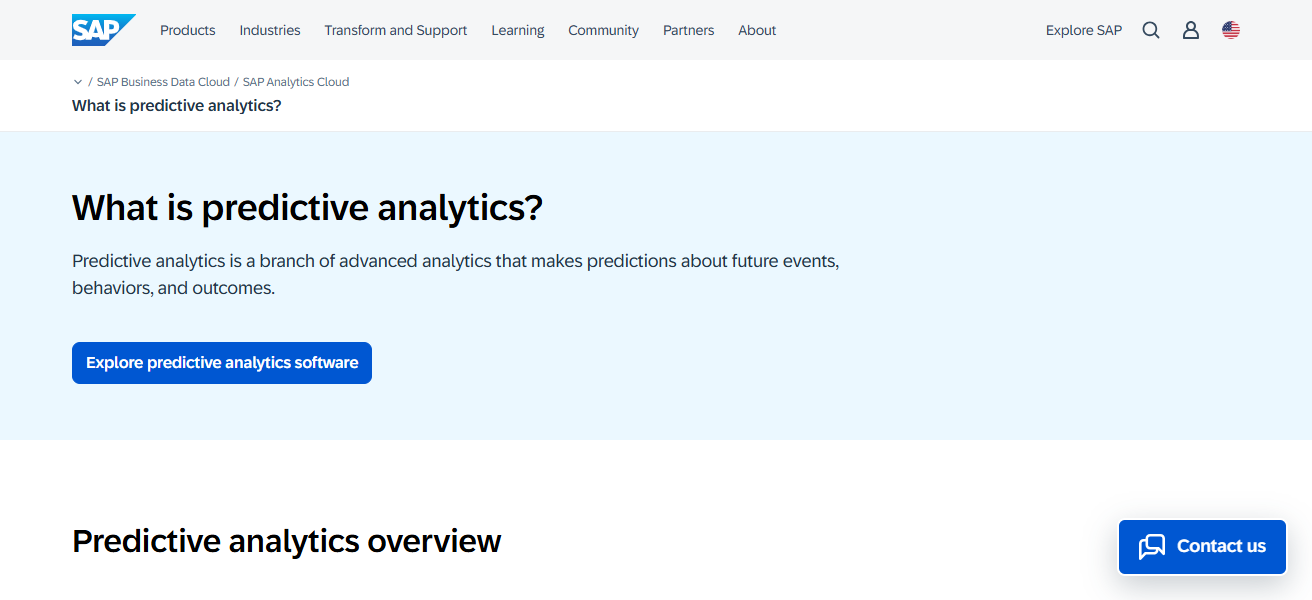
With SAP HANA, real-time insights and in-memory processing are accelerated. Considering the vast SAP investments many enterprises have, SAP Predictive Analytics enhances their business processes a step further with predictive intelligence.
Analysts are able to integrate models into SAP applications, ensuring that customer engagements, operations, and finance processes are responsive to the forecasts.
SAP Predictive Analytics Features
- Embedded in the SAP ecosystem: Real-time access to data for SAP applications and HANA.
- Automated workflows: Rapid model building and deployment with drag-and-drop tools.
- Support for time-series and classification: Forecast demand, churn, and trends across business units.
- Enterprise governance: Automated regulatory controls and monitoring are built into the system
| Pros | Cons |
|---|---|
| Seamless integration with SAP applications and HANA database. | Best suited for SAP customers; limited outside SAP ecosystem. |
| Intuitive tools for automated predictive modeling. | Requires SAP infrastructure investment. |
| Supports time-series, classification, and clustering forecasting. | Can be costly for small and medium businesses. |
| Real-time insights accelerate decision-making. | Advanced features need specialized knowledge. |
| Enterprise-ready with strong governance and scalability. | Limited flexibility for non-SAP data sources. |
6. Oracle AI Cloud
Oracle AI Cloud combines machine learning, data management, and enterprise analytics for accurate business forecasting. The platform utilizes automated feature engineering, model tuning, and scalable computing.
Users can develop tailored AI models and utilize pre-built solutions for forecasting revenue, demand, and risk.
Integration with other enterprise resource planning (ERP) and Oracle Analytics Cloud systems enhances cross-functional business visibility.
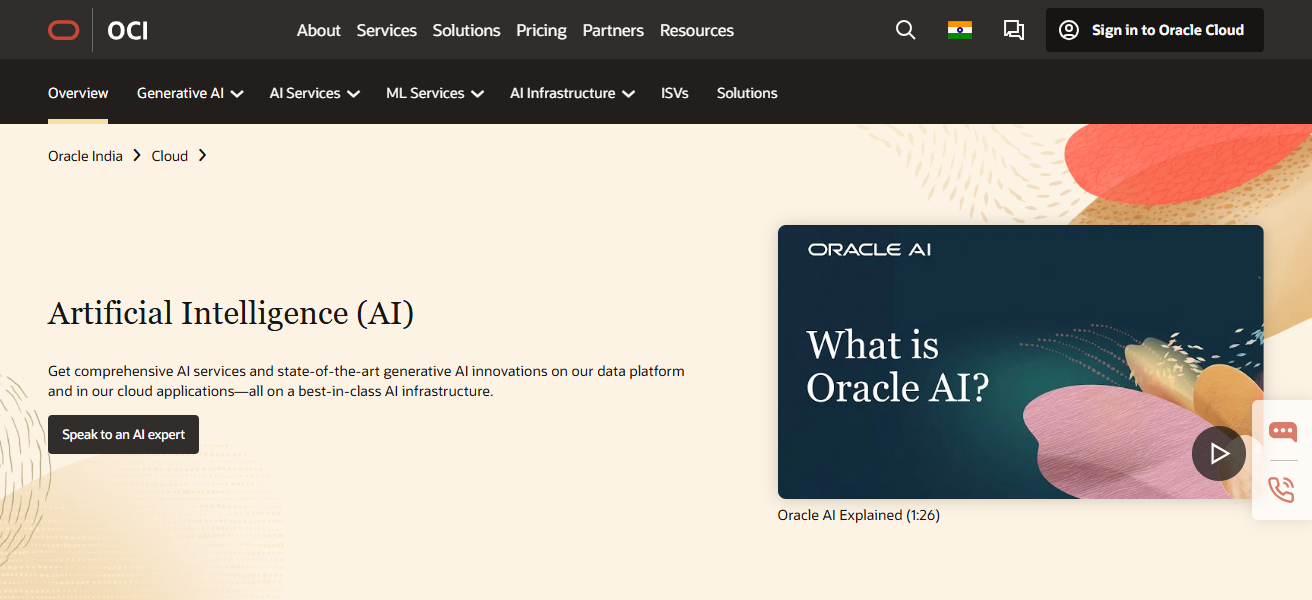
Oracle’s strong focus on safety and governance spans the entire AI lifecycle, ensuring critical business data is kept secure.
With easy model deployment and advanced analytics support, Oracle AI Cloud is ideal for organizations wanting a comprehensive AI and data platform that delivers predictive insights from enterprise data.
Oracle AI Cloud Features
- Integrated suite of AI and analytics: Forecasting integrated with data management and enterprise reporting.
- Automated feature engineering: Built-in optimizing tools reduce manual data preparation.
- ERP integration: Direct access to Oracle ERP systems provides coherent business insights.
- Infrastructure is secure and scalable: Performance and data governance at enterprise level.
| Pros | Cons |
|---|---|
| Unified platform combining AI, analytics, and data management. | Complex licensing and pricing structure. |
| Supports both custom and pre-built forecasting models. | Learning curve for non-Oracle users. |
| Integration with ERP systems enhances business-wide insights. | Cloud-centric; limited offline options. |
| Strong focus on data security and governance. | May require additional resources for model deployment. |
| Scalable and suitable for enterprise-grade AI applications. | Advanced analytics setup can be technically demanding. |
7. DataRobot
DataRobot streamlines process automation to predict and analyse data outcomes while putting in minimum human effort.
DataRobot automates and maximizes the model life cycle which includes automating data ingestion, feature engineering, setting the model, and for the final step, the model deployment.
Businesses can understand the drive behind the predictions, thanks to DataRobot’s extensive model documentation and explainability tools.
This in turn, fosters trust in the forecasting outcomes. To support time-series analysis for demand, sales, and operational forecasting across industries
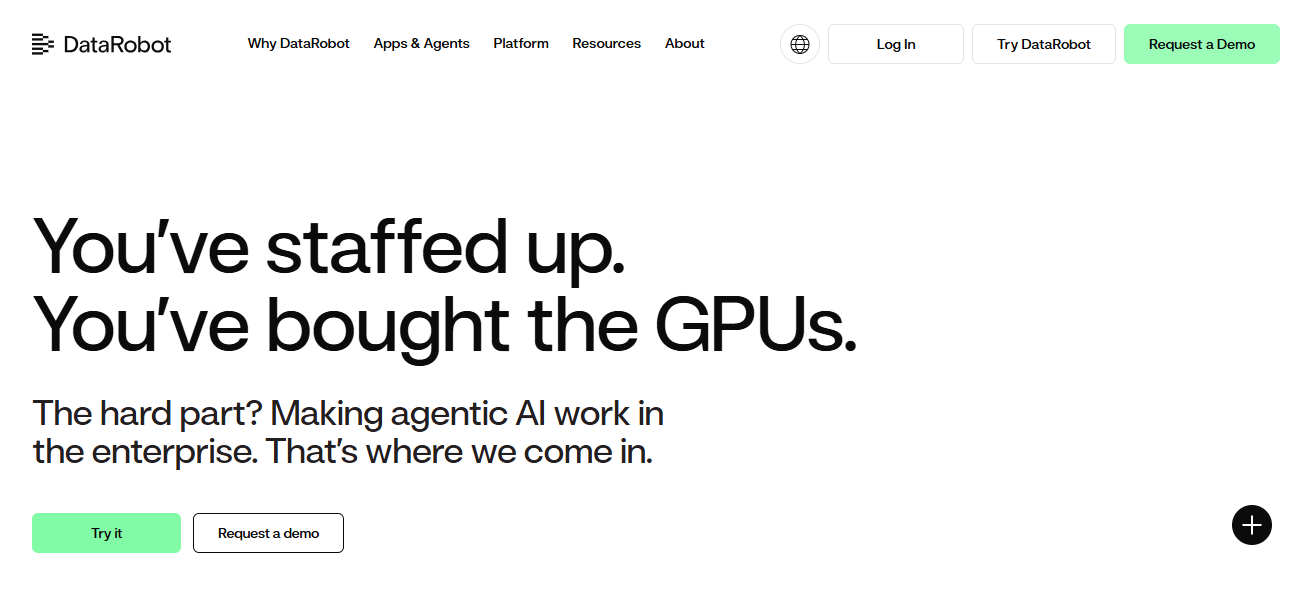
DataRobot has built monitoring and retraining capabilities to support and maintain the accuracy of the forecasting as the data evolves.
DataRobot fosters advanced analytic tools to both business analysts and data scientists through its simplified and user friendly interface.
DataRobot Features
- Fully automated ML lifecycle: Everything from data ingestion to deployment with minimal coding.
- Broad model library: Analyzes a large variety of models to provide the most precise predictions.
- Model explainability: With the help of visual aids, users comprehend the factors that influence the outcomes of the predictions.
- Live monitoring and retraining: Keeps models precise, as business data changes.
| Pros | Cons |
|---|---|
| Fully automated ML lifecycle reduces manual effort. | Higher subscription costs for smaller companies. |
| Extensive model library and explainability tools. | Some advanced customization requires coding knowledge. |
| Time-series support for demand, sales, and operations. | Can be resource-intensive for large datasets. |
| Monitoring and retraining maintain forecast accuracy. | Integration with non-standard data sources may need extra work. |
| User-friendly interface accelerates adoption for analysts. | Enterprise deployment may require IT involvement. |
8. H2O.ai
H2O.ai provides a flexible, open, scalable AI platform with strong time-series forecasting capabilities. H2O.ai’s AutoML evaluates and selects forecasting models tailored to users’ needs.
H2O.ai’s support for Python, R, and Spark provides versatility across multiple technology stacks. H2O.ai’s explainable AI features improve user understanding and manipulation of model behavior to enhance predictive accuracy.
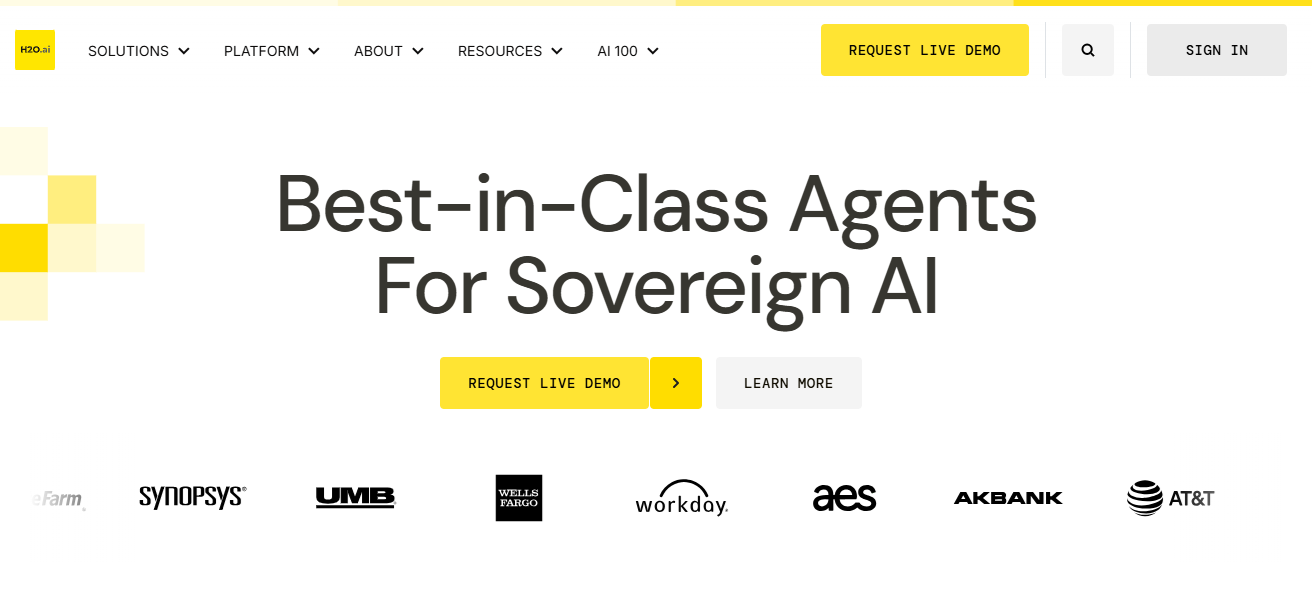
H2O.ai’s flexible deployment options, including hybrid, cloud, and on-premise, accommodate varied IT infrastructure.
H2O.ai is ideal for businesses needing accurate forecasts, providing robust time-series forecasting, a strong community, scalable performance, and enterprise support.
H2O.ai Features
- Open AutoML platform: Can automatically create and assess a variety of models for future prediction.
- Multi-language flexibility: Compatible with Python, R, and Spark for development versatility.
- Flexible deployment solutions: Cloud, on-prem, or hybrid systems meet varying IT requirements.
- Explainable AI toolkit: Aids in forecast refinement and model behavior interpretation.
| Pros | Cons |
|---|---|
| Open and scalable AI platform with AutoML capabilities. | Can be complex for beginners without data science skills. |
| Supports Python, R, and Spark frameworks. | Enterprise support may need additional investment. |
| Robust time-series forecasting and explainable AI features. | Limited built-in business analytics tools; mainly ML-focused. |
| Flexible deployment: cloud, on-premise, hybrid. | Community support is strong, but paid support can be expensive. |
| Strong performance optimization and model selection. | Advanced model tuning may require technical expertise. |
9. SAS Viya
SAS Viya provides analytics, data management, and machine learning. It has analytics features such as machine learning, data management, and forecasting tools.
These time-series forecasting tools manage seasonality, hierarchies, and causality. It offers code-based and visual model building which helps data scientists and business analysts.
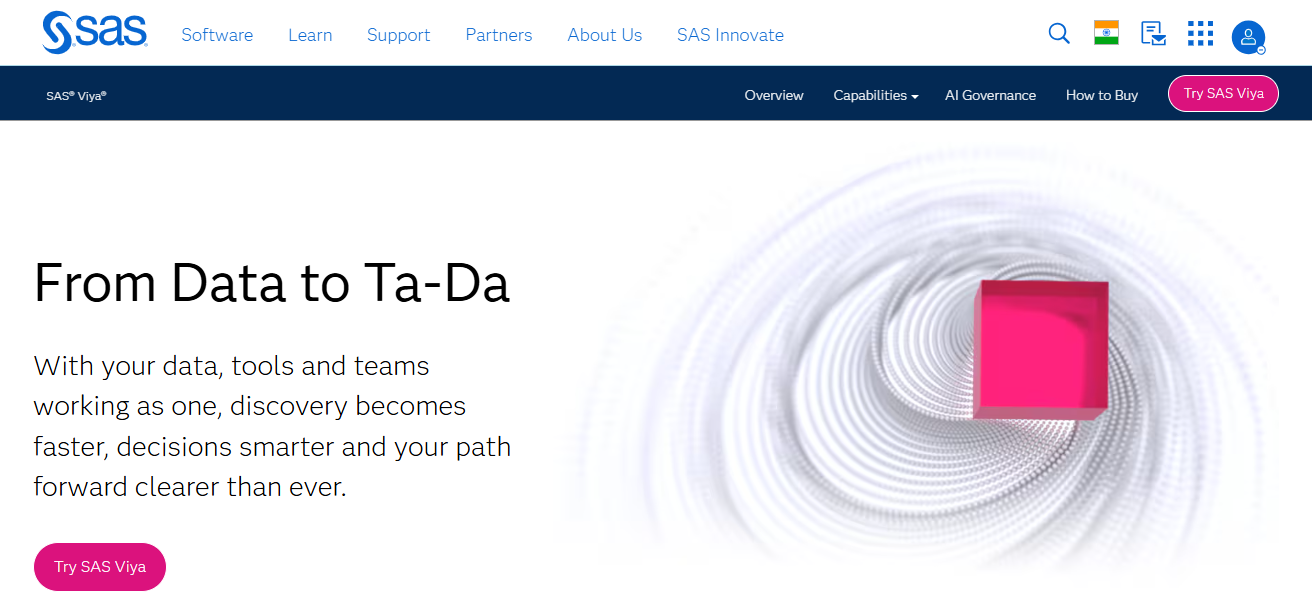
It has good statistical forecasting, real-time scoring, and model governance. It predictive operationalizes these features.
It has high scalability which helps it integrate with enterprise data sources. This is why SAS Viya is a good choice in forecasts for large companies in finance, healthcare, and supply chain. These features help it explain and manage forecasting regulation.
SAS Viya Features
- More features in time-series forecasting: Time-series forecasting with Supports seasonality, hierarchies, and causal relationships.
- Dual interface support: Visual analytics for business users plus code options for data scientists.
- Full variety of algorithm library: A diverse set of statistical and ML methods for forecasting.
- Real time scoring & governance: Ensures models have the same predictive consistency and compliance
| Pros | Cons |
|---|---|
| Handles complex time-series with seasonality and hierarchies. | High cost, especially for smaller enterprises. |
| Supports code-based and visual modeling for all skill levels. | Requires familiarity with SAS ecosystem. |
| Real-time scoring and model governance improve reliability. | Setup and deployment can be resource-intensive. |
| Extensive algorithm library ensures robust forecasting. | Less flexible for non-standard or unstructured datasets. |
| High scalability and enterprise-grade integration. | Training may be required for analysts to use full capabilities. |
10. Anaplan Predictive Insights
Anaplan Predictive Insights improves integrated forecasting and scenario analysis by adjusting estimates and enhancing business planning.
It is built using the Anaplan Connected Planning Platform and merges predictive modeling and real-time business updates across departments.
Users have the ability to adjust business plans by optimizing to forecasted demand, revenue, and cost metrics, and testing by simulating future outcomes and assumptions.
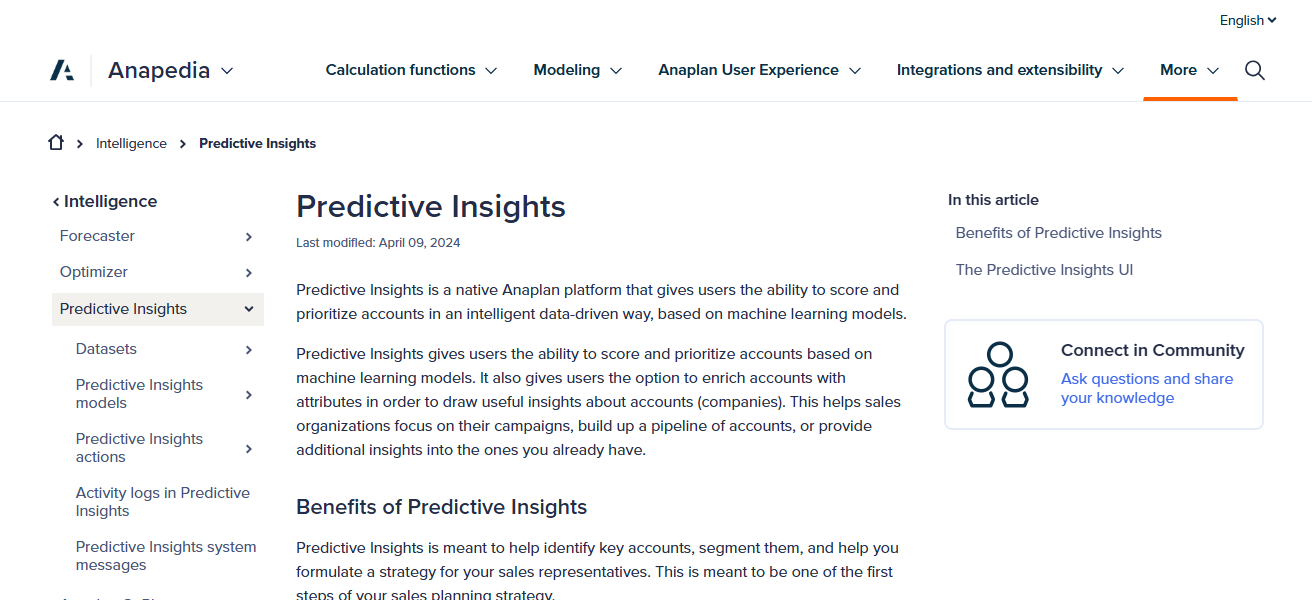
Anaplan enables business users to create predictive logic in its seamless modeling environment without extensive coding xperienced. The collaboration features remote alignment, improved forecast accuracy, and data flow automation.
Predictive Insights is primarily beneficial for large enterprises needing flexible planning, integrated cross-functional collaboration, and ongoing embedded forecasting in their strategic and operational workflows.
Anaplan Predictive Insights Features
- Integrated planning platform: Embeds predictive forecasts into business planning workflows.
- Scenario and what‑if analysis: Enables users to simulate different business outcomes.
- User friendly modeling: Streamlined interface for business users without extensive coding.
- Cross-departmental alignment: Integrates forecasts across finance, sales, and operations.
| Pros | Cons |
|---|---|
| Integrates forecasting directly into business planning workflows. | Best suited for businesses already using Anaplan; limited outside ecosystem. |
| Scenario analysis allows testing assumptions and optimization. | Advanced predictive modeling may be limited compared to full ML platforms. |
| Intuitive modeling for business users with minimal coding. | Performance can slow with extremely large datasets. |
| Enhances cross-functional collaboration and alignment. | Custom integrations with external data sources may require technical support. |
| Continuous forecasting supports agile decision-making. | Premium pricing for enterprise plans. |
How To Choose Best AI Platforms for Business Forecast Accuracy
- Accuracy & Reliability: Assess the range of forecasting models, the presence of AutoML, and the inclusion of Explainable AI for trustworthy predictions.
- Data Integration: Assess the ease with which the platform can connect to your existing databases, ERP, CRM, or any other cloud services.
- Scalability: Assess the platform in terms of your current data volume, and future data volume as your business grows.
- Ease of Use: Assess the learning curve associated with the platform’s interface, the presence of pre-built models, and the availability of low-code/no-code options.
- Customizability: Ability to create bespoke models to meet the unique demands of your business.
- Cost Efficiency: Analyze the range of costs incurred with platform licensing, and cloud costs, as well as ongoing maintenance costs.
- Support & Security: Enterprise-level support, the presence of data governance, and compliance features are must-haves.
- Collaboration & Deployment: Assess whether the platform allows for team collaboration, and the ease with which models can be deployed organization-wide.
Conclusion
To sum up, being able to pick the Best AI Platforms for Business Forecast Accuracy can change the way you make decisions, allocate resources, and improve the way you operate in your business.
IBM Watson Studio, Microsoft Azure AI, and Amazon Forecast are examples of businesses that have powerful and intelligent forecasting solutions that are also scalable and reliable.
Businesses that use AI to gain insights can accurately predict trends, reduce risks, and maintain their competitive edge.
FAQ
It measures how closely predicted outcomes match actual business results like sales or demand.
AI analyzes large datasets, detects patterns, and improves prediction accuracy faster than manual methods.
IBM Watson Studio, Microsoft Azure AI, Google Cloud Vertex AI, Amazon Forecast, SAP Predictive Analytics, Oracle AI Cloud, DataRobot, H2O.ai, SAS Viya, and Anaplan Predictive Insights.
Yes, many platforms offer scalable solutions suitable for small to large enterprises.