In this article, I will review top AI platforms for internal risk scoring that assist businesses in recognizing, assessing, and managing risk.
- Key Points & Best AI Platforms For Internal Risk Scoring
- 10 Best AI Platforms For Internal Risk Scoring
- 1. Deel
- 2. OneTrust
- 3. Anaconda
- 4. Resolver
- 5. Vanta
- 6. MetricStream
- 7. LogicGate
- 8. Riskonnect
- 9. ServiceNow Risk Management
- 10. IBM OpenPages
- How We Choose Best AI Platforms for Internal Risk Scoring
- Cocnlsuion
- FAQ
These platforms harness artificial intelligence to streamline risk assessments to aid in decision making and improve compliance in business processes.
Through the use of sophisticated analytics and real-time data, businesses can improve their ability to identify and mitigate threats, which will enhance their risk management systems.
Key Points & Best AI Platforms For Internal Risk Scoring
| AI Platform | Key Point |
|---|---|
| Deel | Best for global HR compliance risks |
| OneTrust | Best for privacy and regulatory compliance |
| Anaconda | Best for data scientists building risk models |
| Resolver | Best for incident and operational risk management |
| Vanta | Best for startups needing automated security compliance |
| MetricStream | Best for enterprise governance, risk, and compliance (GRC) |
| LogicGate | Best for workflow-driven risk scoring and automation |
| Riskonnect | Best for integrated enterprise risk management |
| ServiceNow Risk Management | Best for IT and cyber risk scoring |
| IBM OpenPages | Best for AI-powered financial and operational risk analytics |
10 Best AI Platforms For Internal Risk Scoring
1. Deel
Deel streamlines internal risk scoring by assisting businesses in compliance, payroll, and workforce-related risk management on a global scale.
Its AI systems identify, and assess potential risk scenarios such as, contractor misclassification, labor law breaches, tax liability, and global employment compliance.
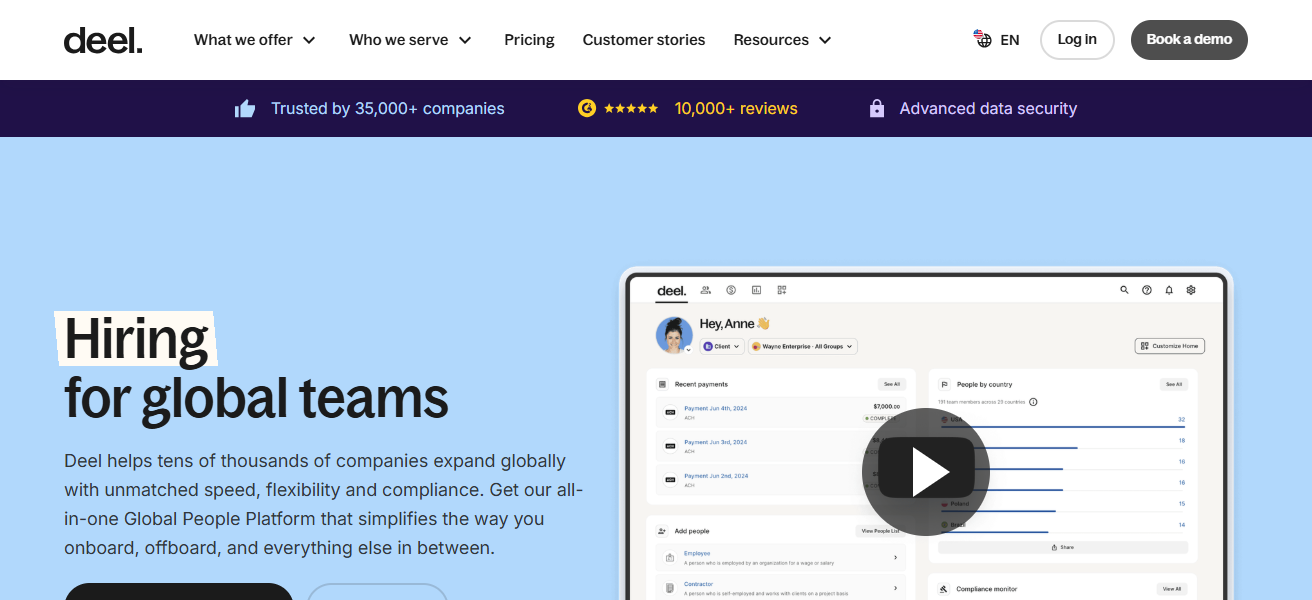
By integrating data, Deel provides real-time operational and regulatory risk assessments. This is particularly beneficial for rapidly scaling international teams that require automated risk transparency across various legal frameworks.
Deel Features
Global Compliance Automation — Identifies and manages compliance risk for contractors and employees across various countries.
Workforce Risk Dashboard — Provides overview of risks pertaining to the entire workforce such as misclassification and tax risk.
AI Compliance Alerts — Intelligent alerts that flag inconsistencies related to labor laws or payroll.
Integration with HR Systems — Merges with payroll and HR systems to facilitate the movement of risk related data.
| Pros | Cons |
|---|---|
| Strong global compliance and workforce risk visibility | Limited coverage beyond HR and payroll risks |
| AI flags contractor, tax, and labor law risks | Not a full enterprise GRC solution |
| Centralized employee and contractor data | Less customizable risk scoring models |
| Ideal for distributed and remote teams | Better suited for people-related risks only |
2. OneTrust
OneTrust is the primary platform for privacy, governance and compliance risk scoring. OneTrust’s AI evaluates the internal risks of an organization on the data protection, third-party, regulatory, and ESG compliance.
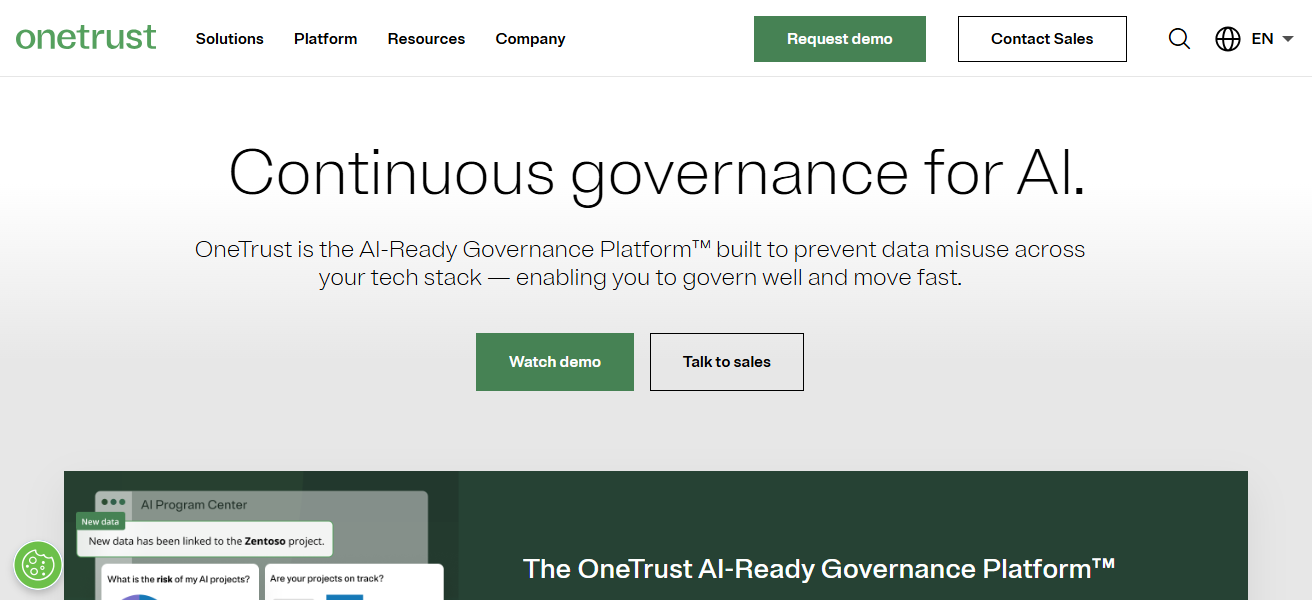
The response in risk, policy, and control assessment, OneTrust gives a score to each of the risks, which helps organizations take the right action to mitigate the risk.
This is especially suitable for enterprise organizations since the risk is extremely high on compliance and regulatory data.
OneTrust Features
Regulatory Mapping Tools — Identifies risks in relation to the current state of regulations and standards, especially those that are new or evolving.
Dynamic Risk Scoring Engine — Provides risk scoring in consideration of policies, controls, assessments and real-time data.
Privacy & Data Protection Frameworks — Measures compliance in relation to GDPR, CCPA and other global privacy laws.
Third Party Risk Management — Evaluates vendors and partners to identify potential areas of risk.
| Pros | Cons |
|---|---|
| Excellent privacy and compliance risk scoring | Can be complex to configure initially |
| Strong AI-driven third-party risk assessments | Higher cost for full feature access |
| Supports ESG, data protection, and regulatory mapping | Requires training for non-technical users |
| Scales well for large enterprises | Overkill for small organizations |
3. Anaconda
Anaconda allows internal risk scoring with secure data science and AI model building. Anaconda is used by organizations to create bespoke risk-scoring models, which include fraud detection, financial risk, and operational, cybersecurity, and operational risks.
Anaconda retains model risk and data exposure with enterprise-grade security, governance, and reproducibility.
Anaconda helps internal risk modeling at scale by enabling teams to build transparent and auditable AI models.
Anaconda Features
Custom AI Model Development — Empowers teams to create tailored models for scoring risks of different types.
Secure Data Science Environment — Provides enterprise level governance and security for sensitive data.
Reproducible Workflows — Guarantees traceability and audibility of models throughout their lifecycle.
Flexible Integration – Combines with a variety of frameworks and data sources for consolidated risk insights.
| Pros | Cons |
|---|---|
| Enables custom AI-based risk scoring models | Requires strong data science expertise |
| High transparency and model governance | No built-in ERM or compliance workflows |
| Secure environment for sensitive data | Setup can be resource-intensive |
| Flexible across multiple risk domains | Not a plug-and-play risk platform |
4. Resolver
Resolver is concerned with enterprise risk management (ERM) by consolidating incident data, audits, and assessments into one unified risk score.
AI-powered analytics are used to find trends, determine future problems, and assess the risk’s impact across silos. With dashboards, risk teams are able to assess and compare risks that are inherent, residual, and emerging in real time.
For organizations that need structured, data-driven internal risk scoring and compliance monitoring, Resolver is the best fit.
Resolver Features
ERM Risk Aggregation – Integrates incidents with unified risk scoring audits and assessments.
Trend Analysis Tools – Analyzes emerging risks and trends with AI.
Inherent vs. Residual Risk Comparison – Illustrates risk control changes to capture team insights.
Interactive Dashboards – Maps and visualizes the risk across various departments and functions simultaneously.
| Pros | Cons |
|---|---|
| Strong incident-based and ERM risk scoring | Limited advanced AI customization |
| Real-time dashboards and trend analysis | UI may feel dated to some users |
| Good integration of audits and assessments | Less focus on predictive modeling |
| Structured approach to internal risk | Better for traditional risk frameworks |
5. Vanta
Vanta offers automated security and compliance scanning risk scoring. It focuses on internal system monitoring, access control, and internal policy alignment, which strengthens security posture.
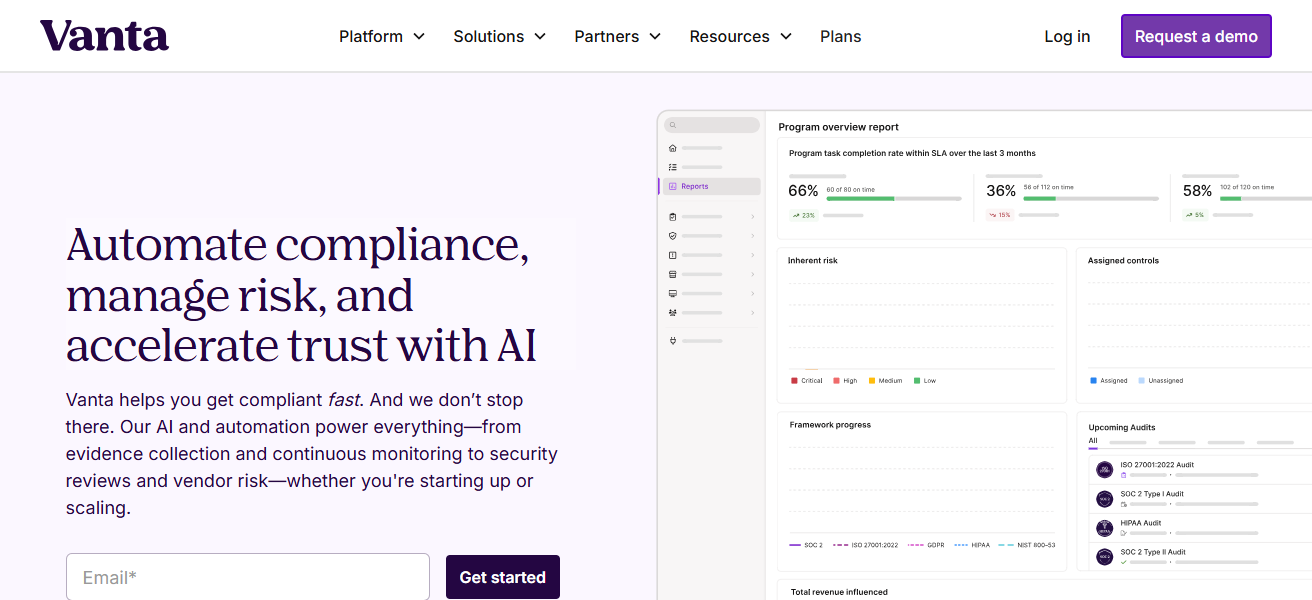
With respect to compliance alerts, Vanta closes gaps for SOC 2, ISO 27001, and the GDPR. Vanta delivers audit score, breach score, and trust score, while SaaS companies appreciate internal risk visibility score most.
Vanta Features
Continuous Monitoring – Keeps track of the automated security controls and compliance posture.
AI-Driven Gap Alerts – Highlights key framework deviations such as SOC2 and ISO 27001.
Real-Time Risk Scoring – Modifies and updates risk scores internally as policies and systems are updated.
Audit Readiness Tools – Minimizes manual effort to prepare organizations for 3rd party audits.
| Pros | Cons |
|---|---|
| Real-time security and compliance monitoring | Narrow focus on security-related risks |
| Automated risk scoring for audits | Limited customization for non-SaaS firms |
| Reduces audit preparation time | Less suitable for operational risk |
| Easy to deploy and maintain | Pricing may rise as teams scale |
6. MetricStream
Metricstream is a complete GRC platform with the ability of using AI to analyze and provide enterprise-wide risk scores to an organization across compliance, IT, operational, and financial areas.
It synthesizes internal controls, risk assessments, and incidents to provide unique insights. This accuracy helps with predictive analytics to identify and mitigate potential risk areas before they turn into problems.
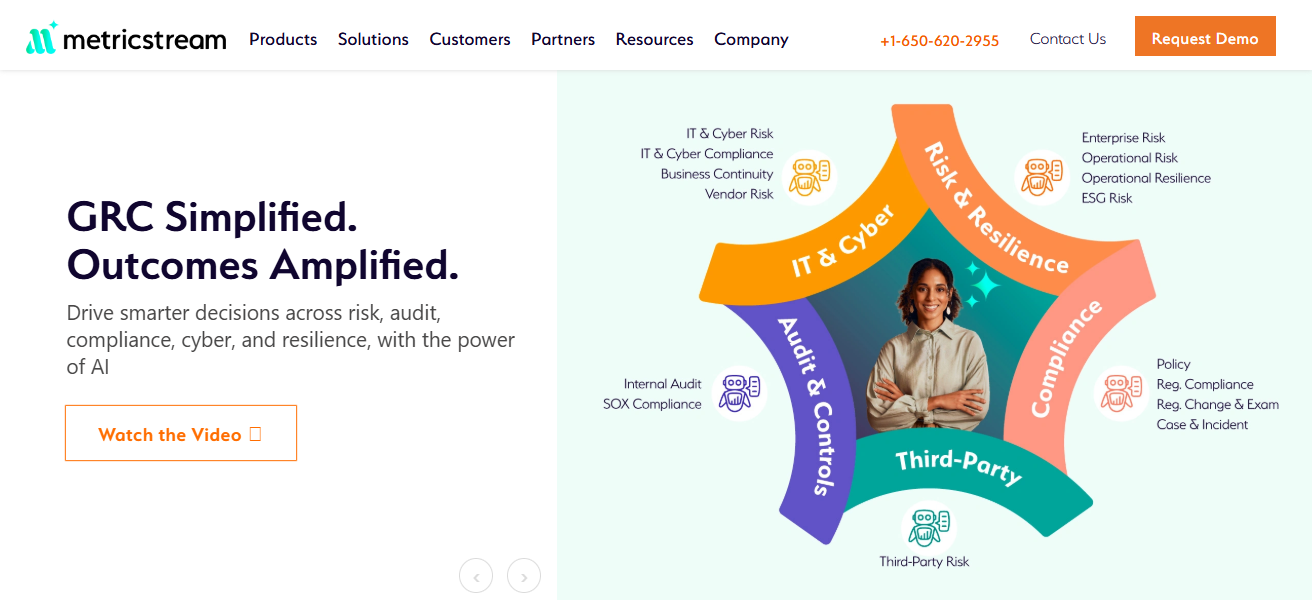
Given its scalability and depth of regulatory, it is suited large organizations with complex risk management.
MetricStream Features
Enterprise-Wide GRC platform – Integrates compliance with operational, IT, and financial risks.
Predictive risk analytics – Detects emerging issues and prior potential risk spikes.
Control and Assessment Management – Deep insights that link risk assessments with the controls.
Regulatory Content Library – Keeps track of compliance requirements pertaining to different industries.
| Pros | Cons |
|---|---|
| Enterprise-grade AI-driven GRC platform | Implementation can be lengthy |
| Covers financial, IT, operational risks | High total cost of ownership |
| Predictive analytics for proactive risk management | Requires dedicated risk teams |
| Highly scalable and regulation-ready | Complex for mid-sized companies |
7. LogicGate
The LogicGate platform is highly adaptable. It uses a no-code approach for flexible internal risk scoring customization.
With the use of AI and automation, businesses are able to create customized business solutions for scoring logic, risk thresholds, and mitigation tracking.
This platform fosters the collection and visualization of cross-functional risk data and improves accountability.
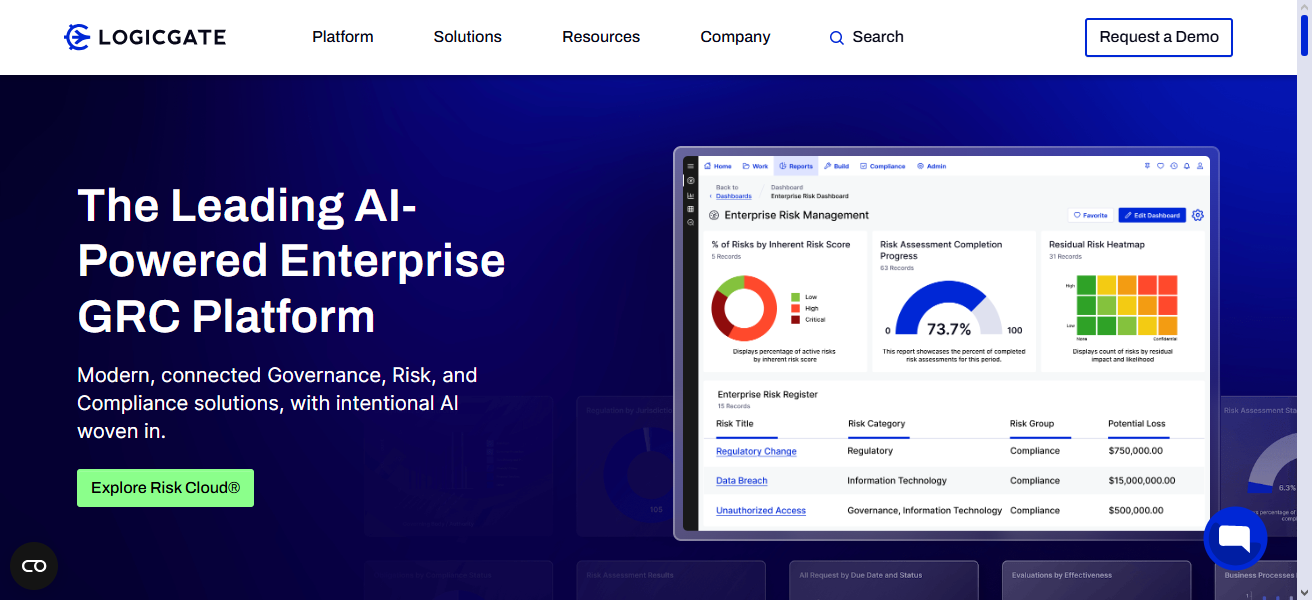
Its unique configurability is especially good for organizations that want to manage internal risk control downstream in the risk management lifecycle.
LogicGate Features
No-Code Risk Workflows – Create custom risk scoring and mitigation workflows without any coding.
Automated Risk Triggers — Triggers automated alerts from AI and rules based on certain criteria and events.
Collaborative Risk Portal — Allows users to collaborate and manage risk data and decisions in a centralized location.
Custom Scoring Logic — Adjust risk scoring to meet individual organizational requirements.
| Pros | Cons |
|---|---|
| No-code customization for risk workflows | Advanced analytics require add-ons |
| Flexible risk scoring logic | Less out-of-the-box regulatory content |
| Strong cross-department collaboration | Initial setup still needs planning |
| Good balance of control and automation | Not ideal for very small teams |
8. Riskonnect
Riskonnect utilizes AI to provide enterprise risk, compliance, and operational incidents across the enterprise. It integrates internal audits, assessments, and claims data into holistic risk profiles.
Increased and enhanced analytics identify correlations and potential risk in a particular zone of decision risk.
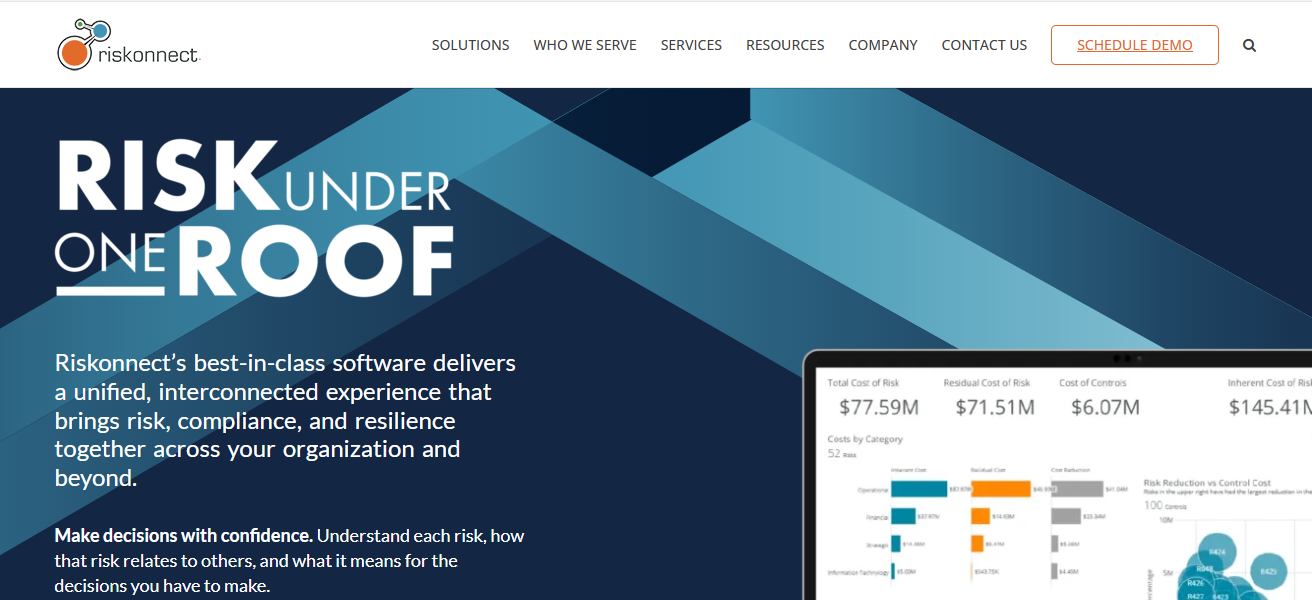
It has a primary focus on and is considered a leader in risk management solutions for the healthcare, manufacturing, and finance, which require ongoing, active, and quantifiable internal risk scoring.
Riskonnect Features
Consolidated Risk Intelligence — Integrates audit, claims, and operational data for consolidated scoring.
Advanced Analytics Engine — Identifies relationships and trends beyond the single perspective data.
Scenario Simulation — Evaluates potential risks and their consequences before they occur.
Industry-Focused Templates — Provides ready-to-use templates for industries, such as healthcare and manufacturing.
| Pros | Cons |
|---|---|
| Holistic view of enterprise and operational risk | UI can feel complex |
| Strong analytics for emerging risk detection | Custom reporting may take time |
| Industry-specific risk insights | Less emphasis on AI explainability |
| Good integration of claims and incidents | Training required for full adoption |
9. ServiceNow Risk Management
ServiceNow Risk Management is an internal risk scoring platform that uses automation to streamline risk detection, scoring, and response.
It provides real-time risk integration with IT, security, and compliance, and automates risk response across multiple enterprise systems.
The AI-driven response and risk automation makes ServiceNow a perfect candidate for organizations looking to embed risk scoring into processes that drive operational automation.
ServiceNow Risk Management Features
Integrated Risk Workflows — Achieves seamless integration of risk scoring with workflows of IT, security, and compliance.
Real-Time Prioritization — AI assigns risk scores in real time based on their severity and business impact.
Automated Remediation Tracking — Monitors remedial actions across different teams.
Scalable Enterprise Platform — Increases risk coverage as the organization’s complexity advances.
| Pros | Cons |
|---|---|
| Seamless integration with IT and security systems | Best value only if already using ServiceNow |
| Real-time AI-driven risk prioritization | Customization can increase costs |
| Strong workflow automation | Requires platform familiarity |
| Embeds risk into daily operations | Not lightweight to deploy |
10. IBM OpenPages
IBM OpenPages is an enterprise-level internal risk scoring platform with advanced AI capabilities designed for governance, risk, and compliance (GRC).
Utilizing IBM Watson technology, it catalogs and analyzes both unstructured and structured data to discover, score, and forecast risks.
OpenPages provides support across multiple domains, including regulatory compliance, operational risk, and financial risk.
OpenPages advanced analytics, scalability, and governance makes it optimal for highly regulated industries, such as banking and insurance, operational use.
IBM OpenPages Features
AI-Powered Risk Scoring — Employs sophisticated analytics to assign risk scores using both structured and unstructured data.
Watson-Driven Insights — Utilizes machine learning to analyze and predict risk trends.
Regulatory and Policy Integration — Synchronizes risk scoring with compliance and governance policies.
Enterprise Scalability — Tailored to intricate ecosystems such as financial services and extensive corporate portfolios.
| Pros | Cons |
|---|---|
| Powerful AI with predictive risk analytics | High complexity and enterprise focus |
| Handles structured and unstructured data | Expensive for smaller organizations |
| Strong regulatory and governance support | Longer deployment cycles |
| Ideal for highly regulated industries | Requires skilled risk professionals |
How We Choose Best AI Platforms for Internal Risk Scoring
- Accuracy of AI Risk Scoring – It measures the platform’s scoring and prioritization of internal risk.
- Data Integration – It measures the platform’s ability to integrate with internal systems and data.
- Automation And Intelligence – Evaluation of risk scenario automation to detect and respond to evolving AI.
- Flexibility of Customization – Evaluation of internal risk scoring with workflows and business tailored to your model.
- Compliance Evaluation – Evaluation of the platform to address regulatory, security, and privacy of various industries.
- Monitoring in Real Time – Evaluation of real time risk with alerts and updated risk scores.
- Performance and Scalability – Evaluation of the platform’s ability to scale to complex data and user enterprises.
- Dashboards and Reporting – Evaluation of the level of risk reports useful to the stakeholders and leadership.
- Data Governance and Security – Evaluation of access, protective controls, and audit of data governance.
- Implementation of Ease – Evaluation of time of deployment and the simplicity for internal staff.
Cocnlsuion
To sum up, the most effective AI platforms for internal risk scoring assist organizations in accurately recognizing, evaluating, and reducing risks in the most proactive manner possible.
These platforms, with the help of automation, real-time analytics, and predictive insights, assist in the enhancement of decision-making and compliance.
The demands of the business, the size of the business, the complexity of risks, and the required integration and customization for effective risk management are all important when making a decision.
FAQ
It’s a system that uses AI to identify, measure, and prioritize internal risks across business operations.
AI improves accuracy, speed, and predictive insights compared to manual risk assessments.
They score operational, compliance, security, financial, and third-party risks.
Some are customizable for small teams, but many are built for enterprise needs.