
The focus of this article is the Top AI-Driven Portfolio Rebalancing Tools for Retail Investors. These tools utilize cutting-edge algorithms and automations that help investors maintain the ideal asset allocations, mitigate risk, and enhance returns.
- Key Poinst & Best AI-Driven Portfolio Rebalancing Tools for Retail Investors
- 10 Best AI-Driven Portfolio Rebalancing Tools for Retail Investors
- 1. Wealthfront
- 2. Betterment
- 3. SigFig
- 4. Personal Capital
- 5. Schwab Intelligent Portfolios
- 6. M1 Finance
- 7. Qplum
- 8. Acorns
- 9. Zacks Advantage
- 10. InvestGlass
- Conclusion
- FAQ
Ranging from beginner platforms like Acorns to advanced AI-driven tools such as Qplum, we’ll analyze the best solutions that help with efficient investment management and portfolio balancing.
Key Poinst & Best AI-Driven Portfolio Rebalancing Tools for Retail Investors
| Tool | Key Points |
|---|---|
| Wealthfront | Automated portfolio rebalancing, tax-loss harvesting, AI-driven asset allocation, low fees |
| Betterment | AI-powered rebalancing, personalized financial goals, tax-efficient strategies, user-friendly interface |
| SigFig | Real-time monitoring, AI-based rebalancing, integrates with existing brokerage accounts |
| Personal Capital | Hybrid AI + human advisory, cash flow tracking, retirement planning, smart rebalancing |
| Schwab Intelligent Portfolios | Automated rebalancing, no advisory fees, AI-driven diversification across ETFs |
| M1 Finance | “Pie” investing structure, AI-assisted rebalancing, customizable portfolios, fractional shares |
| Qplum | AI + machine learning for risk management, automated rebalancing, hedge fund–style strategies |
| Acorns | Micro-investing, AI-driven rebalancing, round-up savings, beginner-friendly |
| Zacks Advantage | AI-powered rebalancing, tax-efficient portfolio management, personalized strategies |
| InvestGlass | AI-driven portfolio rebalancing, predictive analytics, customizable dashboards for retail investors |
10 Best AI-Driven Portfolio Rebalancing Tools for Retail Investors
1. Wealthfront
Tax-aware capability is one of the most predominant automated features of Wealthfront’s robo-advisor.
For example, Wealthfront tracks the portfolio’s drift daily and recalibrates the portfolio; however, the algorithm does not fully reallocate all positions due to trigger event tax implications.
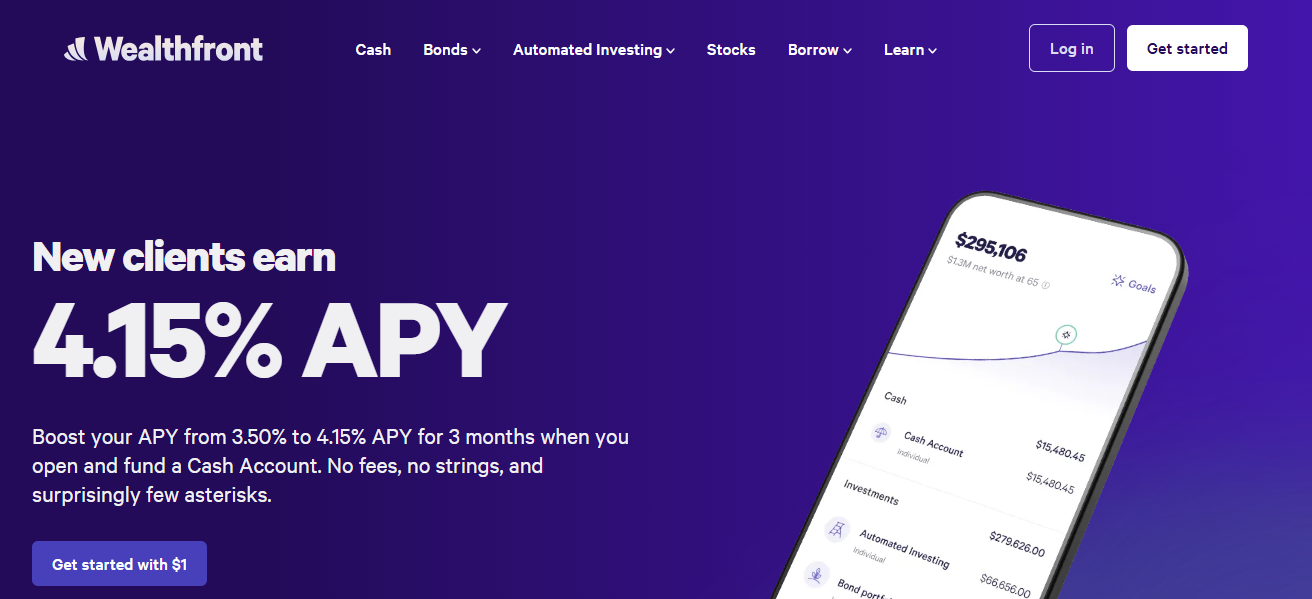
When rebalancing that is due to large capital gains, the algorithm is programmed to do a partial rebalancing or none at all to avoid a large tax impact.
Wealthfront also implements tax-loss harvesting on his or her account; for example, selling a declining ETF to take the losses and then replacing the ETF with a similar one without losing risk exposure.
| Feature | Description |
|---|---|
| Tax‑Loss Harvesting (TLH) | Offers daily TLH in taxable accounts, including stock-level harvesting for some portfolios for deeper tax efficiencies. |
| Dividend-Based Rebalancing | Reinvests dividends into underweight asset classes to reduce the need for tax‑inefficient trades. |
| Smart Beta / Factor Tilt | For high‑balance accounts, supports smart‑beta portfolios (factors like momentum, volatility, profitability) to enhance risk-adjusted returns. |
| Minimum Investment | Lower minimum to start (~$500) for many of its standard robo portfolios. |
| Automated Rebalancing | Monitors drift and rebalances periodically while considering tax‑efficiency. |
2. Betterment
Betterment also implements a rebalancing strategy for their accounts and they utilize rebalancing based only on new deposits in the account.
But they also use a mixed strategy. In this case, they balance with new flows as they use new cash deposits to buy the underweight assets or sell the overweight assets of the account.
When the account cash flows are not enough to balance the account to the target drifts, Betterment implements a selling and buying process to restore the target allocation on the account.
| Feature | Description |
|---|---|
| Reactive / Proactive Rebalancing | Uses both reactive rebalancing (via new cash flows) and proactive rebalance trades when drift exceeds thresholds. |
| Tax‑Coordinated Portfolios | Uses “asset location” — it optimizes where to place assets (taxable vs tax-advantaged) to minimize tax burden. |
| Goal‑Based Planning | Advanced AI or algorithmic planning engine that builds personalized roadmaps for investing goals like retirement or education. |
| Low Advisory Fee | Uses a transparent fee model (percentage of AUM) for its core robo‑advisor. |
| Human Hybrid Option | For premium users, access to certified financial planners (CFPs). |
3. SigFig
SigFig, now known as Tandems for selected business functions, initially provided customers with an automated, digital, robo-advisory service that offered automated portfolio rebalancing.
It tracks clients’ portfolios with smart software and rebalances them to stay within target allocation bands.
The market for fintech consumer-facing robo-advisory services is currently tightening, but the technology powering the rebalancing strategy for advisors remains strong
With a focus on automated rebalancing that adjusts to clients’ models on the fly based on their particular strategy, risk profile, and tax parameters.
| Feature | Description |
|---|---|
| Automatic Rebalancing | Automatically adjusts portfolio holdings to maintain target allocation. |
| Tax‑Loss Harvesting (TLH) | Actively sells losing lots to offset gains, while maintaining risk exposure by swapping into correlated ETFs. |
| Tax‑Optimized Sales | During rebalancing, the algorithm chooses which lots to sell in a tax-efficient way. |
| Tax-Efficient Migration | Moves income-generating assets to tax-sheltered accounts, and capital-gain‑sensitive ones to taxable, to optimize taxes. |
| Wash‑Sale Rule Avoidance | The TLH algorithm is designed to avoid wash sales by using correlated but not identical ETFs. |
4. Personal Capital
Personal Capital is a bit more on the “hybrid” side of the spectrum of advisory + robo tool. It automates the process of periodically instead of daily checking for drift in asset allocation, especially at the account sub-levels like retirement, brokerage, and cash, for portfolio rebalancing.
The software does recommend rebalancing trades, but is often designed to give clients and advisors discretion on the timing and methods of trade execution.
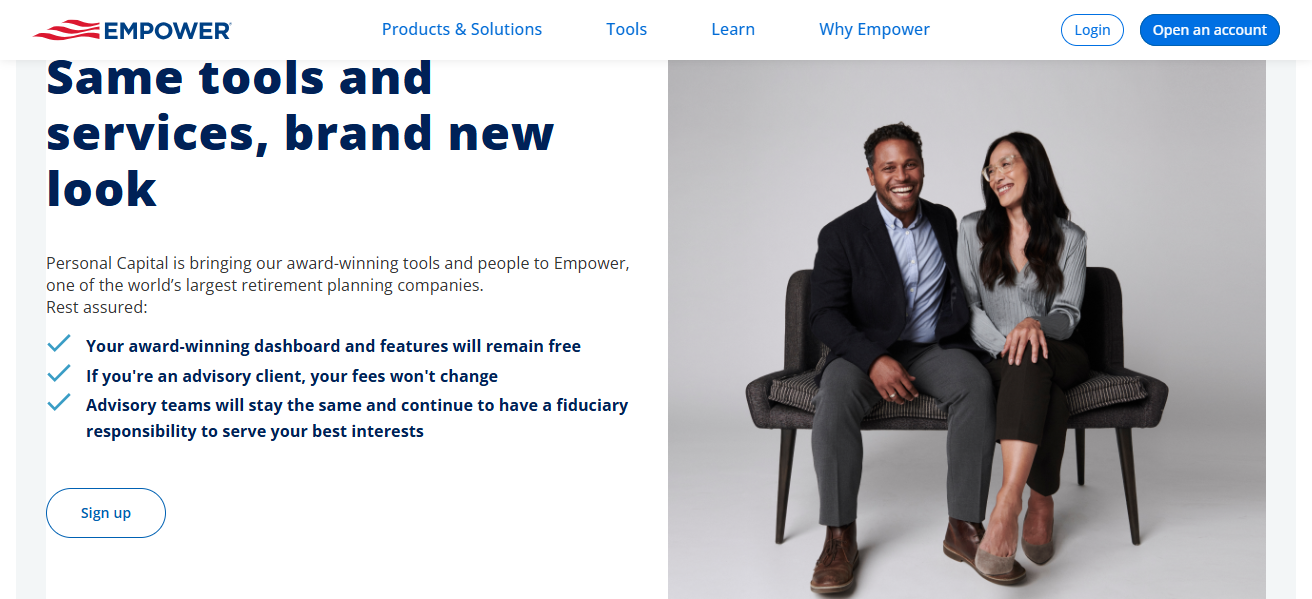
It also gives an overall and integrated view of a customer’s net worth that the software then uses to make more precise rebalancing decisions that take into account outside accounts.
| Feature | Description |
|---|---|
| Hybrid Model (Robo + Human) | Combines automated rebalancing with human financial advisor oversight. |
| Portfolio Drift Monitoring | Checks for allocation drift across multiple accounts and helps rebalance accordingly. |
| Holistic Financial View | Integrates your net worth, assets, liabilities — helping make smarter rebalancing decisions. |
| Cash Flow / Goal Planning | Uses predictive algorithms to help you plan for cash flows, retirement, and goals. |
| Performance Attribution | Provides rich analytics on performance, risk, and how rebalancing affects returns. |
5. Schwab Intelligent Portfolios
It’s Schwab’s robo-advisor with automatic rebalancing, but with a different philosophy: no advisory fees
But a mandatory minimum cash allocation in the portfolio. Due to that cash buffer, rebalancing is more gradual.
After a certain time, cash that is over the buffer is automatically invested. It is not possible to hold more cash than the buffer.
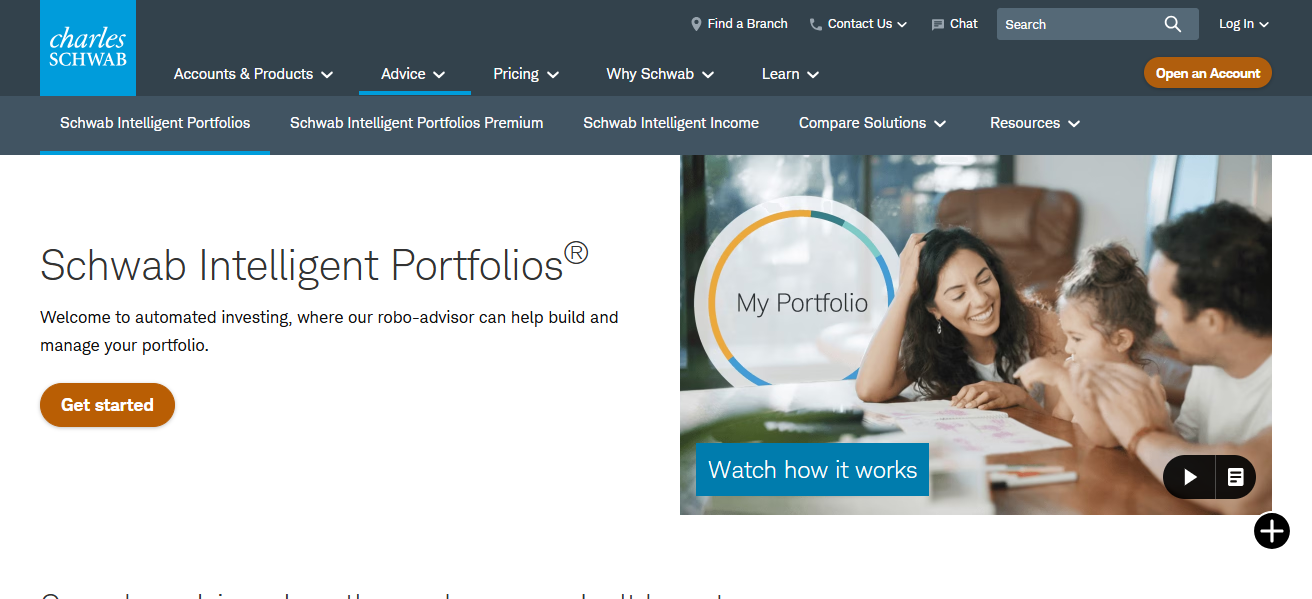
One could say that the cash is a buffer not only to the rebalancing going forward but to more sudden market movements.
As afdore (although powerful_ it’s rebalancing is not the most tax-efficient compared with certain tax-aware robo-advisors)
| Feature | Description |
|---|---|
| Automatic Rebalancing | Periodically rebalances based on drift from target asset allocations. |
| No Advisory Fee (Base) | Basic robo‑advisor doesn’t charge a management fee, though there are cash-allocation tradeoffs. |
| Tax‑Loss Harvesting (Premium) | Available for accounts with sufficiently high balance (e.g., $50,000+). |
| Cash Buffer | Maintains a cash allocation in portfolios to provide stability and liquidity. |
| Goal Tracking | Features to set and track financial goals, retirement, and more. |
6. M1 Finance
M1 Finance, via its nifty “Pie” metaphor gives investors great control: you create a pie with slices (ETFs or stocks) each with a target weight.
Each time you deposit funds, M1 will invest automatically into the underweight slices. Rebalancing is done
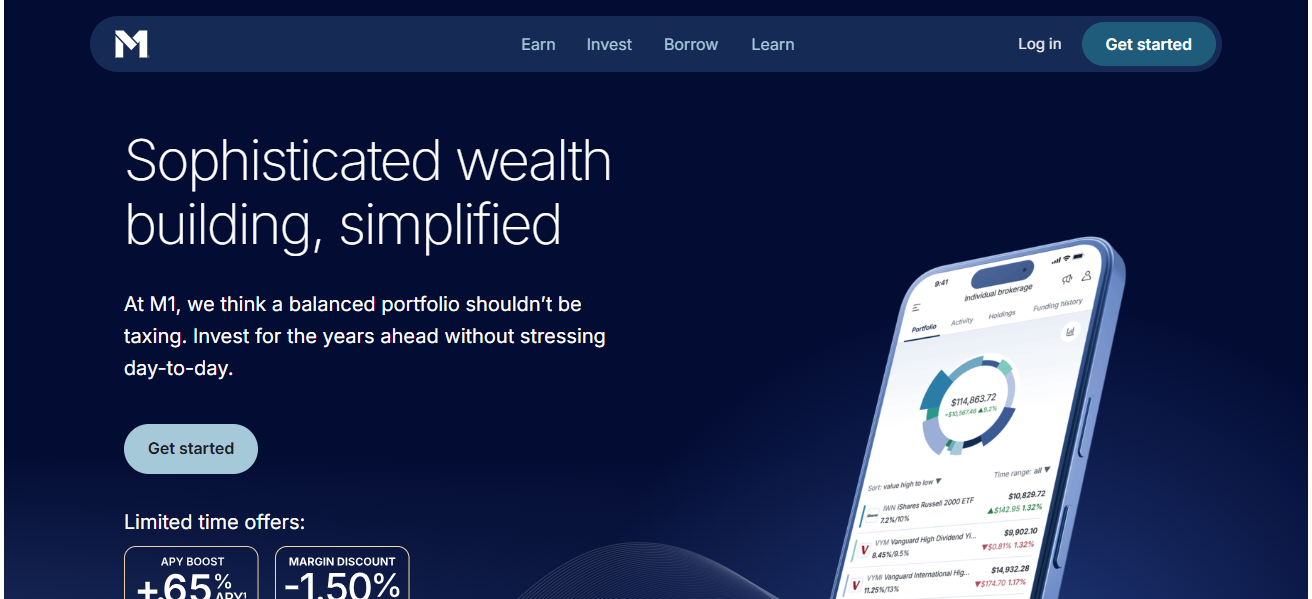
To the extent possible, via cash flows that is, new money is used to fill in gaps in the target allocation rather than selling existing holdings.
For manual rebalancing, you can just trigger it as well. For obvious reasons, M1 does not do tax-loss harvesting.
| Feature | Description |
|---|---|
| Pie-Based Allocation | Investors build “Pies” with slices (ETFs or stocks), each with a target percentage. |
| Auto‑Invest Rebalancing | New contributions are automatically directed to underweight slices to rebalance without selling. |
| Manual Rebalance Option | There’s a button to trigger a full rebalance when you want more control. |
| No Tax‑Loss Harvesting | Does not support TLH; rebalancing is mostly through contribution rather than selling. |
| Fractional Shares | Supports fractional shares, which helps efficient rebalancing and investment in small amounts. |
7. Qplum
It’s also more quantitatively driven than many other robo-advisors, relying on historical data, factor-based models, and AI or statistical techniques to manage portfolios.
The firm’s strategy is also more sophisticated as it employs algorithms to determine when to rebalance based on projected risk, returns, and factor exposures, making it more flexible than a fixed drift threshold.

For a strategy this sophisticated, it is a great way for investors to maintain balanced exposures without having to rebalance every individual asset.
| Feature | Description |
|---|---|
| Quant / Factor Models | Uses quantitative models and factor-based strategies (value, momentum, etc.) to define portfolio allocations. |
| Dynamic Rebalancing | Algorithm decides rebalancing actions based on risk models, expected returns, and factor exposures. |
| Risk‑Adjusted Optimization | Incorporates risk metrics (volatility, drawdown) in its rebalancing logic to maintain target risk. |
| Backtest‑Driven Strategy | Uses historical data and simulations to refine strategies and rebalance rules. |
| Goal-Oriented Portfolios | Allows retail investors to choose risk-level or factor-tilt goals, and the system builds accordingly. |
8. Acorns
Acorns’ service is built around micro-saving and is extremely beginner-friendly. It rounds up transactions to the nearest dollar, and invests the difference, and saves the round up.
Rebalancing is automated, if not particularly complex: rebalancing is service is done on a scheduled basis, typically quarterly, within a preset range of selected ETF portfolios.

Users expecting to have a very passive, set-and-forget service that builds savings over time will find it very effective, as they won’t have to spend any time managing the savings.
| Feature | Description |
|---|---|
| Round-Up Investing | Rounds up everyday transactions and invests the spare change automatically. |
| Periodic Rebalancing | Rebalances your portfolio (usually quarterly) between its pre-defined ETF-based buckets. |
| Passive Allocation | Uses pre-built risk-based portfolios, making rebalancing simpler and more predictable. |
| Low Barrier to Entry | Very low minimums, ideal for micro-investors and beginners. |
| Automatic Dividend Reinvestment | Reinvests dividends back into underweight asset classes as part of its rebalancing logic. |
9. Zacks Advantage
Zacks Advantage leverages quantitative models informed by Zacks Equity Research (ZER) and Zacks factor models to manage portfolios.
Zacks Advantage features model driven rebalancing where the system evaluates the stock/fund weightings in the portfolio and their target exposures and trades to realign this exposure with the quant model’s target.

These quant models inform the system how to optimally rebalance to achieve a target risk level and return from Zacks’ research rather than using a random or fixed rule approach.
| Feature | Description |
|---|---|
| Active + Passive Hybrid | Combines automated ETF-based investing with active management by Zacks Investment Management team. |
| Proprietary Forecast Model | Uses a 10‑year adaptive forecasting model to proactively adjust asset allocation. |
| Quant & Qualitative ETF Selection | Chooses ETFs based on Zacks’ proprietary ranking (fundamental, technical, cost). |
| Automatic Rebalancing | Monitors daily and rebalances to keep your portfolio in line with target allocations. |
| Tax‑Loss Harvesting | Automatically harvests losses for accounts over a threshold (e.g., $50,000) to improve after-tax returns. |
| Low Fees for Active Management | Management fees start relatively low (e.g., 0.35% for large accounts) compared to traditional active advisors. |
10. InvestGlass
InvestGlass is a financial technology firm that provides customer relationship management and portfolio management tools to financial advisors.
There is also automated, AI-assisted rebalancing. InvestGlass can continuously manage a portfolio by selling assets that have exceeded their targets and buying assets that are underweight, while optimizing tax efficiency and reducing transaction costs.
For end investors on InvestGlass-enabled platforms, this means portfolio rebalancing can happen much more frequently, and in much more complex ways than simple calendar based rebalancing.
| Feature | Description |
|---|---|
| AI‑Assisted Rebalancing | Provides AI-driven rebalancing capabilities for portfolios, optimizing for risk, allocation, and costs. |
| Portfolio Performance Monitoring | Real-time tracking of performance, risk metrics, and benchmarking. |
| Customizable Automation | Financial advisors can set rebalance rules, risk profiles, and triggers using InvestGlass’s platform. |
| Multi‑Asset Support | Can handle complex portfolios, including non-traditional or alternative assets via its PMS + CRM tools. |
| Regulatory & Reporting Tools | Built-in reporting modules for regulatory compliance and client communications. |
Conclusion
In conclusion, the automated rebalancing tools powered by AI assist retail investors in keeping up with the optimal asset allocation, minimizing the risk as well as enhancing the tax efficiency. Wealthfront
Betterment, and Qplum use AI driven strategies, and M1 Finance and Acorns automate the investing process for beginners.
The decision ought to be made in relation to the individual needs, tax ramifications, and the preferred automation level.
FAQ
Portfolio rebalancing is the process of adjusting your investments to maintain your target asset allocation and risk level.
AI-driven tools automatically monitor portfolio drift, execute trades, and optimize for taxes and risk, reducing manual effort.
Wealthfront, Betterment, SigFig, and Zacks Advantage provide automated tax-loss harvesting to improve after-tax returns.
Platforms like Acorns and M1 Finance allow micro-investing, while Wealthfront and Betterment have modest minimums.
Yes, M1 Finance, Qplum, and InvestGlass allow full customization, while Acorns and Betterment use preset portfolios.