This article will talk about AI Solutions for CFO Decision Support and how they help finance leaders make quicker, more intelligent, and more analytical decisions.
These AI Solutions simplify budgeting, forecasting, reporting, and risk assessment while reducing manual labor and improving precision.
These tools range from predictive analytics to real-time insights, allowing CFOs to improve strategic planning and financial optimization across their organizations.
Key Points & Best AI Solutions For CFO Decision Support
| AI Solution | Key Point |
|---|---|
| ChatFin | Comprehensive finance automation with anomaly detection and ERP integration |
| DataRails FP&A Genius | Advanced budgeting, forecasting, and collaborative planning |
| Cube Software | Streamlined FP&A workflows and scenario modeling |
| BlackLine | Automated reconciliations and enterprise-scale financial operations |
| Anaplan | Enterprise-wide planning and predictive analytics |
| Precoro | AI-driven procurement and spend management |
| Arya.ai | Banking-focused AI for compliance and risk management |
| AlphaSense | Market intelligence and real-time insights |
| Coefficient AI | Data connectivity, automation, and dashboard building |
| Workday Adaptive Planning | Cloud-based financial planning and workforce analytics |
10 Best AI Solutions For CFO Decision Support
1. ChatFin
ChatFin is a financial assistant powered by AI, which helps CFOs make quicker and better decisions.
It uses natural language processing to answer complicated questions in real time and pulls together different financial data.
CFOs no longer have to depend only on spreadsheets because he/she can and analyze cash flow, budget, forecast, and understand financial trends in real time.
Its AI analytics lessen the work executed by humans, detect trends, and identify risks. This gives finance leaders the ability to concentrate on strategic planning and data-centered decision making.
ChatFin — Features
- Financial Insight and Analysis powered by AI
- Answering finance-related questions in natural language
- Dashboards and Reporting in Real-time
- Automated Reporting of Trends and Forecasting
- Core Financial Solutions and Data Source Integration
- Anomalies and Risk Alerts
- No-Code solution for the Complexity of Finance Queries
| Pros | Cons |
|---|---|
| Real‑time financial insights with AI‑driven analysis. | May require data integration setup and training. |
| Natural language querying simplifies complex data access. | May struggle with niche accounting edge cases. |
| Reduces dependency on manual spreadsheet work. | Accuracy depends on quality of connected data. |
| Speeds decision support and forecasting responses. | May need customization for industry‑specific needs. |
2. DataRails FP&A Genius
DataRails FP&A Genius uses AI to streamline automation in financial reporting and forecasting, as well as in scenario analysis.
It syncs data from Excel and other ERP systems to provide CFOs insights and analytics on future trends. The system helps in planning and budgeting by detecting and analyzing trends, anomalies, and performance gaps.
It dashboards help finance leaders to visualize metrics and smoothen decision-making. With more accurate forecasting and fewer manual errors, DataRails aids CFOs to make detailed and informed strategic and operational financial decisions.
DataRails FP&A Genius — Features
- Convergence of FP&A Data in one Location (Excel + ERP)
- Automation of Financial Reporting and Closure Consolidation
- Forecasting and analysis of Variance Predictive
- Analysis of Scenarios and Modeling “what-if”
- Custom Dashboards and KPI Monitoring
- Versioning with Audit Trail
- Excel-inspired interface with control over the enterprise
| Pros | Cons |
|---|---|
| Strong automation of reporting and consolidation. | Can be complex to implement for larger finance teams. |
| Predictive forecasting improves planning accuracy. | Learning curve for non‑technical users. |
| Integrates Excel with FP&A workflows. | Premium features may add cost. |
| Reduces manual errors and improves audit readiness. | Custom reporting setup may need expert support. |
3. Cube Software
Cube Software integrates AI-driven financial planning with the familiarity of spreadsheets. Data is consolidated by CFOs from various departments, producing reports in real time, and scenario analysis is done to determine forecasts.
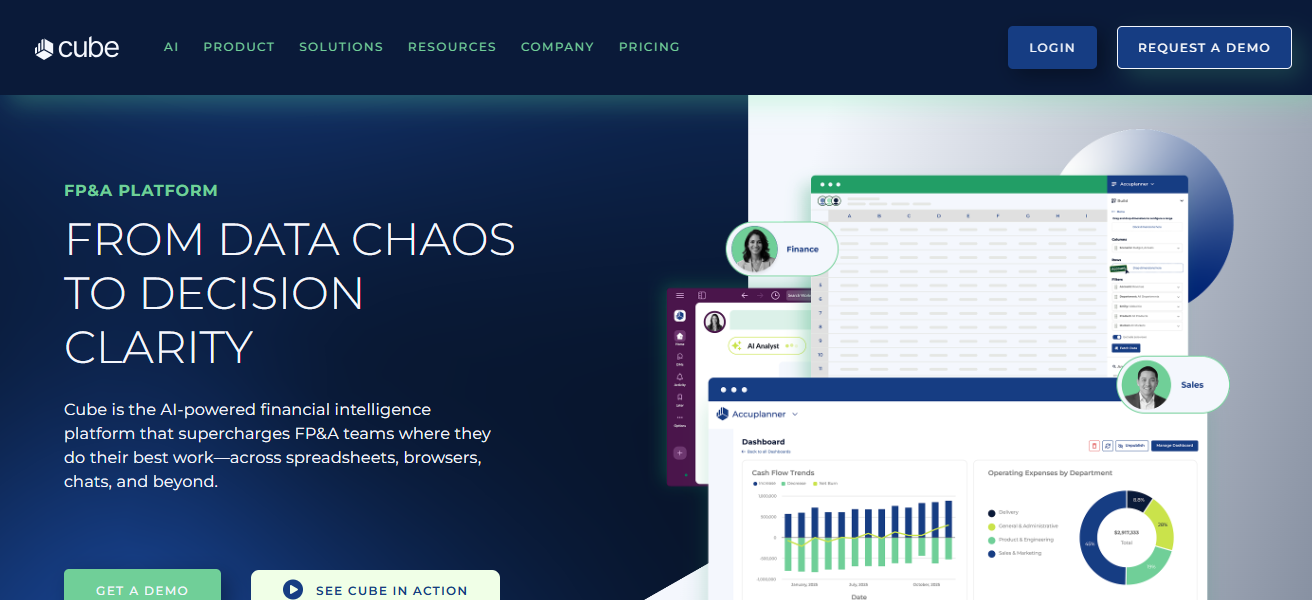
Cube’s AI recognizes patterns, deviations, and predictive insights to aid in strategic decisions. The interface is collaborative, allowing finance teams to streamline reporting, enhance accuracy, and eliminate data silos.
By alleviating time consuming activities, Cube enables CFOs to concentrate on the more important aspects of strategy, risk, and resource management.
Cube Software — Features
- FP&A Platform powered by spreadsheets
- Planning and Reporting with a Centralized Data Ecosystem
- Instant Updates by Each Department
- Predictive Insights and Modeling of Scenarios
- Integrated Collaborative Forecasting and Budgeting
- Access Controls by Role
- Traceability by Version Changes, History, and
| Pros | Cons |
|---|---|
| Spreadsheet‑centric, with powerful planning engines. | Spreadsheet users may face redundancies. |
| Real‑time scenario planning and forecasting. | Collaboration features can be limited for very large teams. |
| Improves data accuracy and reduces silos. | May lack advanced analytics compared with larger platforms. |
| Easy to adopt for Excel‑based teams. | Reporting depth limited without add‑ons. |
4. BlackLine
Automated smart solutions for finance and accounting offered by BlackLine include AI-powered tools for the reconciliation and close processes.
For CFOs, it eliminates manual processes, lessens mistakes, and provides up-to-date visibility to account balances, thereby ensuring precise financial reporting.
Its AI tools identify error discrepancies, improve audit readiness, and predict cash flow problems. BlackLine streamlines month-end closes and data integrity
Which empowers finance leaders to make quicker, data-driven decisions, concentrate on operational risk mitigation and cross the organization strategic initiatives.
BlackLine — Features
- Automation of Reconciliation of Accounts
- Orchestration of Tasks and Workflow for Closing Processes
- Real-time visibility and Continuous Accounting
- Tracking mismatches and sending alerts for variances.
- Support for audits and compliance.
- Financial risk mitigation and control systems.
- Dashboards tracking key performance indicators for period closes.
| Pros | Cons |
|---|---|
| Automates reconciliation and close processes. | Best suited for accounting heavy organizations. |
| Improves accuracy and reduces close cycle time. | Implementation and process changes can be resource‑heavy. |
| Strong compliance and controls visibility. | AI benefits focus more on operations than forecasting. |
| Enhances audit‑readiness and transparency. | Can be overkill for small finance teams. |
5. Anaplan
Anaplan is a cloud-based strategic planning tool that integrates AI for seamless cross-function support in finance, operations, and strategy for CFOs.
Anaplan’s tool sets for predictive analytics assist CFOs in calculating and forecasting revenue, expenses, and market trends.
CFOs are also aided in scenario planning for effective risk assessment and management. Anaplan also allows CFOs to customize and run various budget scenarios and align resources to their strategic objectives.
By integrating cross-departmental data, Anaplan removes operational silos, fosters a collaborative working environment, and enhances the overall performance from a management viewpoint. Anaplan empowers finance leaders to make AI-informed decisions.
Anaplan — Attributes
- Planning and modeling tools that are cloud-based.
- Planning across multiple functions.
- Continuous data updates.
- Advanced forecasting and predictive analytics.
- Flexible framework for business logic and modeling.
- Collaboration between finance and operations.
- Scale for entire enterprise and role-based user permissions.
| Pros | Cons |
|---|---|
| Highly flexible scenario planning and modeling. | Complex setup and higher learning curve. |
| Connects finance with broader business planning. | Costly for smaller companies. |
| Real‑time insights across departments. | May require dedicated admin resources. |
| Excellent for large‑scale integrated planning. | Too powerful for simple use‑cases. |
6. Precoro
Precoro, an AI-integrated procurement and spend management platform, assists CFOs with real-time company spend visibility and automates purchase order management, approval workflows, and vendor management to improve compliance and cost control.
They predict budget overs and control spending, while their AI assesses spending behaviors and detects savings.
Precoro provides CFOs data-based insights to manage operational spend and working capital optimally, and enhance financial discipline and strategic decision-making for improved profitability and with less financial risk.
Precoro — Attributes
- Procurement and spend management with AI.
- Purchase orders and approvals are automated.
- Managing vendors and tracking contracts.
- Budget controls and spending limits.
- Spend management and analytics with reporting on spending patterns.
- Workflows and alerts that can be customized.
- Compatible with accounting and ERP systems.
| Pros | Cons |
|---|---|
| Great spend management and procurement control. | Primarily focused on procurement, not full FP&A. |
| AI highlights spending trends and budget issues. | Limited deeper financial forecasting features. |
| Improves compliance and approval workflows. | AI insights depend on structured spend data. |
| Cost control insights for CFO budgeting. | Not holistic finance tool on its own. |
7. Arya.ai
Arya.ai provides an AI-driven platform for predictive analytics, automation, and cognitive insights for finance leaders.
Arya.ai’s platform helps CFOs with algorithms that predict revenue, assess risk, and identify anomalies in financial data.
The platform can be embedded with numerous enterprise resource planning (ERP) and accounting systems to give a unified view of important metrics.
Arya.ai’s AI models provide data-driven insights into simulated financial models to aid in strategic planning.
Arya.ai helps automate manual processes, improves data accuracy, and provides executives with data-driven, predictive decision making.
Arya.ai — Attributes
- Frameworks for predictive analytics and risk asserting.
- Financial data and anomaly detection.
- Creation of customized models and testing.
- Integration of data from various financial resources.
- Analysis of patterns and behavior.
- Integration through API.
| Pros | Cons |
|---|---|
| Advanced predictive analytics and modeling. | Requires skilled setup for custom models. |
| Detects anomalies and risk signals. | Integration complexity for legacy systems. |
| Flexible AI framework adapts to data needs. | Overpowered for basic finance tasks. |
| Supports simulation and forecasting. | Can need data science support in finance teams. |
8. AlphaSense
AlphaSense is an AI-powered market intelligence tool that helps CFOs analyze financial documents, analyst reports, news articles, and more.
Using natural language processing, AlphaSense helps users detect and understand trends, risks, and opportunities.
With AlphaSense, CFOs can analyze competitors, understand shifts in regulations and how they affect the market, and predict how the market will impact the organization.
By applying its artificial intelligence, AlphaSense reduces the complexity of data in order to streamline research and enhance the decision-making process. AlphaSense delivers timely intelligence to clients and helps them predict confidently.
AlphaSense — Attributes
- Market and business Intelligence using AI.
- Search by natural language across documents and news.
- Detection of patterns and risk.
- Analysis of competitors and benchmarking.
- Notices of changes in regulations and the industry
- Summarizations of structured data
- Tools for board and investor reporting
| Pros | Cons |
|---|---|
| Excellent market and competitive intelligence. | Not focused on internal financial operations. |
| AI scans large unstructured data sources. | Value varies by subscription tier. |
| Helps CFOs spot external risk and trends. | Learning efficient query crafting needed. |
| Useful for investor and strategic insights. | Doesn’t replace internal FP&A systems. |
9. Coefficient AI
Coefficient AI streamlines automation in reporting, analytics, and data extraction, enabling CFOs to make timely and precise decisions.
CFOs can construct dashboards, track KPIs, provide data updates, and analyze forecasts without manual work.
Coefficient AI discovers, analyzes, and reports trends and anomalies in data, helping finance leaders to make operational and strategic decisions.
This tool optimizes resources and enables scenario planning. By accelerating analyses and reducing human error, Coefficient AI empowers finance leaders to make strategic operational decisions.
Coefficient AI – Features
- Data extraction and transformation
- Integration of spreadsheets with CRM/ERP data
- Dashboards and KPI tracking in real time
- Automatic report creation
- Tools for data cleansing and validation
- Finance task workflows automation
- Business systems and data source connectors
| Pros | Cons |
|---|---|
| Automates data extraction and reporting. | Limited as a standalone planning tool. |
| Connects spreadsheets with ERP & CRM data. | Requires clean data for best performance. |
| Speeds up KPI tracking and analysis. | Not as comprehensive as full FP&A suites. |
| Reduces manual consolidation work. | AI may surface false positives if data misaligned. |
10. Workday Adaptive Planning
Adaptive Planning streamlines budgeting, forecasting, and financial modeling on a single AI-integrated platform.
CFOs can perform scenario analysis, cash flow forecasting, and integrate financial and business plans.
Adaptive Planning’s AI analytics improve decision-making by spotting and analyzing patterns, anomalies, and growth prospects.
The platform enhances data consistency and reporting transparency, promoting interdepartmental collaboration.
By automating data-related processes, Adaptive Planning frees finance leaders from operational tasks, driving strategic focus and proactive scenario-based risk management. It distinguishes itself as an essential solution for contemporary CFOs.
Workday Adaptive Planning – Features
- Budgeting and forecasting with AI
- Planning and modeling for multiple scenarios
- Real-time collaboration along with version control
- Analytics and dashboards with user-friendliness
- Tracking of KPIs and trends
- Compliance and security controls based on roles
- Integration with external data and Workday ecosystem
| Pros | Cons |
|---|---|
| Strong collaborative budgeting and forecasting. | Premium pricing for advanced features. |
| AI helps with scenario planning and trends. | Best performance when fully implemented. |
| Intuitive dashboards for CFO visibility. | Setup requires governance discipline. |
| Scales from mid‑size to enterprise finance. | Less customization flexibility than some competitors. |
Conclusion
To sum up, AI technologies assist CFOs in financial planning, forecasting, and reporting streamline, and Reporting, making data-driven decision AI faster.
ChatFin, DataRails, Anaplan, and Workday Adaptive Planning assist in accuracy, manual effort and real time insights.
BlackLine, Precoro, and AlphaSense help with compliance, spend control, and market intelligence. A company’s size, complexity, and strategic priorities determine the right solution.
FAQ
They are tools that use artificial intelligence to automate financial planning, forecasting, reporting, and analysis for faster, data-driven decisions.
AI platforms streamline budgeting by consolidating data, predicting outcomes, and enabling scenario planning to optimize resource allocation.
Yes, AI analyzes historical and real-time data to identify trends and provide more accurate predictions than manual methods.
Precoro and Coefficient AI excel at automating procurement, tracking expenses, and controlling budgets.
Yes, tools like Cube Software and Coefficient AI are scalable and user-friendly for small and mid-sized finance teams.