
This article examines the Best AI Tools for Corporate Governance Automation, focusing on how they assist organizations in optimizing compliance, risk management, and transparency.
With the rapid adoption of AI, automated governance tools help manage ethical decisions, compliance, and oversight in the data, analytics, and AI operational ecosystem.
Key Points & Best AI Tools for Corporate Governance Automation
| AI Tool | Key Point |
|---|---|
| Atlan | Data governance automation with strong bias reduction and transparency features |
| Holistic AI | Risk management across AI lifecycle, ensuring compliance with ethical standards |
| IBM Watsonx.governance | Enterprise-grade oversight with explainability and monitoring for large-scale AI deployments |
| Credo AI | Policy enforcement and regulatory compliance tailored to evolving AI laws |
| OneTrust AI Governance | Trust and transparency through automated compliance and audit trails |
| Knostic | Identity-centric controls for LLMs, focusing on secure AI usage |
| Monitaur | Lifecycle compliance with continuous monitoring of AI systems |
| Prompt Security | LLM red-teaming to detect vulnerabilities in generative AI |
| Domo AI Governance | Ethical AI deployment with integration into enterprise workflows |
| Fiddler AI | Explainability and monitoring for model performance and fairness |
10 Best AI Tools for Corporate Governance Automation
1. Atlan
Atlan is a contemporary collaboration and data governance platform that assists enterprises in automating corporate governance in complicated data ecosystems.
By using centralized data catalogs, automated metadata management, and policy enforcement, managers can maintain transparency and compliance.
Atlan assists companies with audit readiness and risk management through the use of AI-powered lineage tracking to describe data flow across systems.
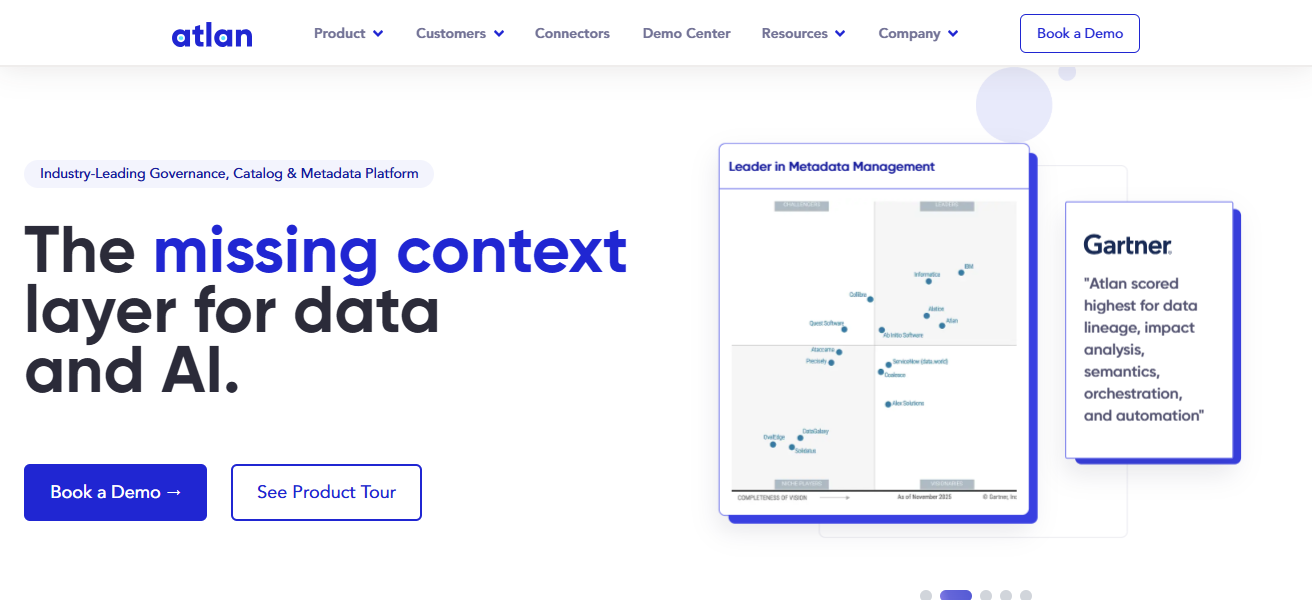
Its automation features cut down on the manual governance that has to be done, promoting governance on the use of data, accountability, and alignment with regulations to control the use of data.
For large enterprises with dispersed data teams, Atlan is particularly useful as it helps strengthen governance, compliance, and decision-making.
Atlan – Features
- Unified Data Catalog – Custom catalogs are automatically created for enterprise data for improved governance and data discovery.
- AI-Driven Lineage Tracking – Enhances transparency and auditability by clarifying the movement of data between applications.
- Policy Automation – Governance policies are automated, and manual tasks in data and workflow management are eliminated.
- Collaboration & Documentation – Assists with the collaborative documentation of data resources, policy, and standards organizationally.
| Pros | Cons |
|---|---|
| Strong data catalog and metadata automation | Can be complex for small teams |
| Excellent data lineage and visibility | Requires initial setup effort |
| Improves cross-team collaboration | Advanced features may need training |
| Scales well for large enterprises | Higher cost for full functionality |
2. Holistic AI
Holistic AI is concerned with the automation of end-to-end AI governance, risk, and compliance for enterprises applying AI at scale.
It helps organizations evaluate, track, and address AI risk and compliance issues pertaining to bias, fairness, explainability, and regulation.
The platform streamlines governance tasks, model documentation, and reporting, which helps boards and compliance teams to manage oversight.
Holistic AI is especially valuable for the automation of corporate governance where there is a significant need for accountability for AI.
By embedding risk assessments within business processes, it fosters the proactive adoption of responsible AI and enhances governance frameworks across the enterprise.
Holistic AI – Features
- AI Risk Management – Encompasses bias, fairness, explainability, and risk across the entire AI lifecycle.
- Automated Governance Workflows – Automatically performs governance checks and the associated compliance tasks.
- Model Transparency Tools – Facilitates audit and leadership documentation and reporting.
- Integrated Risk Monitoring – Changes in governance risk brought by AI systems are monitored continuously.
| Pros | Cons |
|---|---|
| End-to-end AI risk and governance coverage | Primarily focused on AI, not general data |
| Strong bias and fairness assessment | Less suitable for non-AI governance |
| Board-level reporting and oversight tools | May feel heavy for early-stage AI use |
| Supports ethical AI frameworks | Requires mature AI workflows |
3. IBM Watsonx.governance
IBM Watsonx.governance is an advanced AI governance solution designed specifically for enterprises in highly regulated industries. It simplifies the automation of governance for model life-cycle validation, monitoring, and compliance reporting.
The platform assists enterprises in implementing governance policy, auditing AI processes, and achieving compliance with international regulations.
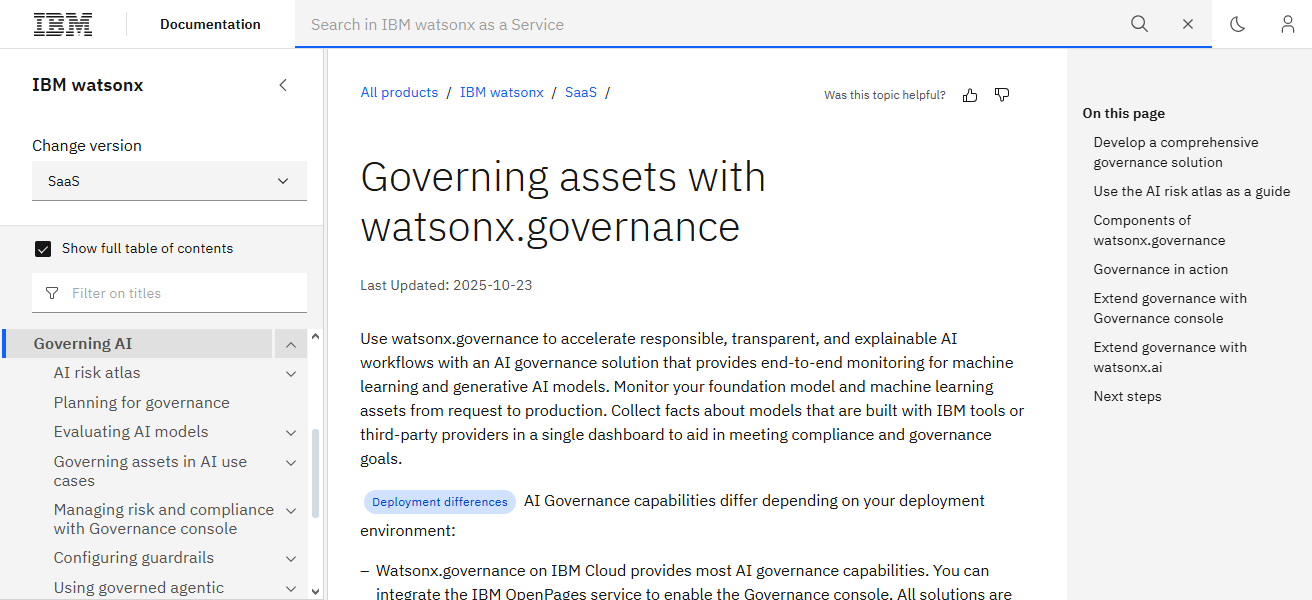
IBM Watsonx.governance facilitates the responsible use of AI with explainability and risk management features.
The solution is designed for large enterprises that require automation of scalable governance aligned with the company’s AI growth and innovation, regulatory requirements, and compliance with corporate governance.
IBM Watsonx.governance – Features
- Model Lifecycle Management – AI models are governed from creation to deletion, including active and inactive states.
- Explainability & Transparency – Stakeholders understand the rationale behind AI outcomes and decisions.
- Regulatory Compliance Support – Global policies and standards are integrated into AI applications.
- Real-Time Monitoring – Automatically measures performance and behavior of models.
| Pros | Cons |
|---|---|
| Enterprise-grade governance automation | Complex implementation process |
| Strong compliance and audit readiness | Best suited for large organizations |
| Built-in explainability and monitoring | Higher operational cost |
| Trusted for regulated industries | Less flexible for small teams |
4. Credo AI
Credo AI automates the integration of responsible AI governance into enterprise systems. It automates the alignment of internal governance frameworks/external regulations with AI policy management, risk assessments, and compliance workflow.
Since Credo AI values accountability, fairness, and transparency, it’s a viable candidate for corporate governance automation.
The platform’s governance documentation and audit trails empower leadership to manage AI risk more effectively.
The integration of governance directly into agile AI operations will facilitate responsible economic growth for the enterprise and society.
Credo AI – Features
- Policy Management Automation – Consolidates all governing policies pertaining to AI systems.
- Risk Assessment Frameworks – Identifies compliance and ethical risks associated with AI models.
- Audit Trails and Reporting – Maintains accountability by recording decisions, modifications, and evaluations.
- Governance Dashboards – AI compliance and performance monitoring through visual analytics.
| Pros | Cons |
|---|---|
| Strong focus on responsible AI practices | Limited non-AI governance features |
| Clear policy and risk management workflows | Still evolving ecosystem |
| Excellent documentation and audit trails | Requires cultural alignment |
| Supports regulatory alignment | May need integrations for full coverage |
5. OneTrust AI Governance
OneTrust AI Governance brings automation of risk and governance into the expanding AI ecosystem of OneTrust’s well-known compliance interoperability.
It aids in the management of AI inventories and the automation of compliance for the global regulation of AI in risk transcendence.
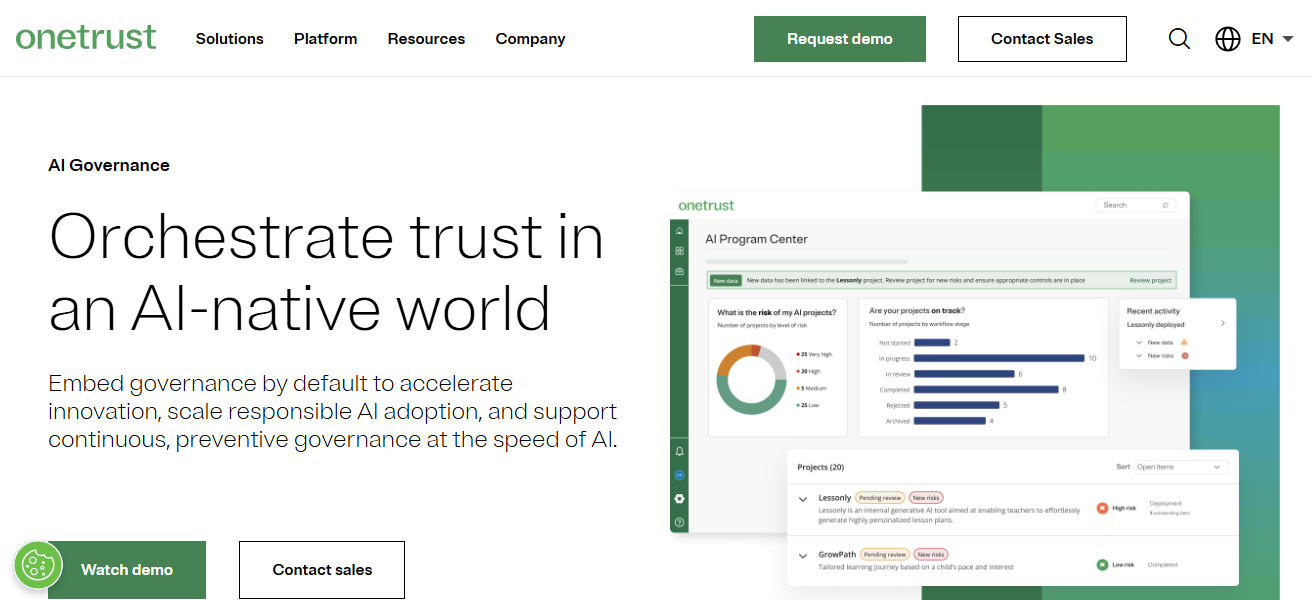
The platform fosters governance for corporate compliance in AI’s usage, data processing, and decision-making. For enterprises focusing on governance and regulatory responsiveness, OneTrust AI Governance is invaluable.
Its automation minimizes the corporate compliance burden while enhancing oversight, transparency, and accountability.
OneTrust AI Governance – Features
- AI Inventory Management – Assists in understanding the AI applications within the organization by tracking it.
- Risk & Impact Assessments – Identifies governance blind spots and potential compliance risks.
- Regulatory Compliance Workflows – Assurance of compliance with international regulations and adaptation to new requirements.
- Cross-Functional Visibility – Integration dashboards for the governance, legal, and risk silos.
| Pros | Cons |
|---|---|
| Strong regulatory and compliance focus | Can feel compliance-heavy |
| Integrates well with enterprise governance | Learning curve for new users |
| Centralized AI inventory management | Customization may require effort |
| Scales across departments | Cost increases with scale |
6. Knostic
Knostic emphasizes information governance by managing who is granted access to valuable information and insights within AI and analytics applications.
It streamlines access governance by making sure employees view information pertinent to their responsibilities. This reduces the risk of data exposure and strengthens adherence to internal policy frameworks
Thereby supporting corporate governance. For organizations with extensive analytics and AI applications, Knostic is particularly beneficial.
Knostic empowers leadership to exercise control, safeguard sensitive information, and foster ethical enterprise-wide governance by aligning information access with governance frameworks.
Knostic – Features
- Access Control Automation – Role-based restrictions on views of sensitive analytics and AI outputs are automatically enforced.
- Data Governance Enforcement – Policies governing data access are enforced in real time.
- Sensitive Data Protection – Minimizes the risk of exposure to sensitive data.
- Audit-Ready Reporting – Policy adherence and access behavior are tracked automatically.
| Pros | Cons |
|---|---|
| Precise access control for sensitive data | Narrow focus on information access |
| Reduces internal data exposure risks | Limited model governance features |
| Improves internal compliance | Best used alongside other tools |
| Role-based visibility improves security | Less focus on AI ethics |
7. Monitaur
Monitaur is an artificial intelligence governance and model risk management platform built for regulated industries. It automates the documentation, validation, and monitoring of various artificial intelligence and machine learning models.
Monitaur sustains corporate governance by documenting audit trails and compliance reports, aligned with regulatory standards.
Its governance automation keeps models accountable, explainable, and transparent for every part of the model’s life.
For organizations, operational risks and oversight concerns are diminished, which makes Monitaur ideal for businesses that need more structured, risk less, and compliant operational models.
Monitaur – Features
- Model Risk Governance – Helps with maintaining risk and compliance in the complete lifecycle of the AI model.
- Documentation & Validation – Generates audit-ready documentation, and structured documentation for compliance reviews.
- Regulatory Alignment Tools – Supports the team in complying with the industry regulations and legal governance for the specified vertical.
- Monitoring & Alerts – Alerts the user and monitors the model for any potential risk that can lead to abnormal behavior of the model.
| Pros | Cons |
|---|---|
| Strong model risk management features | Designed mainly for regulated sectors |
| Clear audit trails and documentation | Less flexibility for experimentation |
| Supports lifecycle model governance | Can be process-heavy |
| Improves regulatory compliance | Not ideal for lightweight AI teams |
8. Prompt Security
Prompt Security mitigates governance challenges pertaining to generative AI and prompt-based systems. It processes AI prompts to ensure automation of monitoring, validation, and protection to avoid data loss, prompt misuse, and policy breach.
For the automation of corporate governance, Prompt Security aids organizations in retaining control over the usage of generative AI across various teams.
By implementing governance policies at the prompt level, it increases prompt governance, security, compliance, and accountability.
This is especially important for organizations that have started using generative AI at scale and are trying to reduce governance and reputational risk.
Prompt Security – Features
- Prompt Monitoring – Monitors and authenticates AI prompts for potential violations of policy.
- Data Leakage Protection – Protects against the disclosure of sensitive information through AI prompts.
- Security Policy Enforcement – Automates governance at the prompt-level for GenAI systems.
- Real-Time Alerts – Provides instant notifications to teams for any prompt activities that are potentially risky.
| Pros | Cons |
|---|---|
| Specialized for generative AI governance | Limited beyond prompt-level risks |
| Prevents data leakage and misuse | Not a full AI governance platform |
| Real-time prompt monitoring | Best for GenAI-focused organizations |
| Enhances security and compliance | Needs integration with other tools |
9. Domo AI Governance
Domo AI Governance streamlines the process of embedding governance controls into business intelligence and analytics workflows.
It streamlines the automation of data governance, access controls, and compliance monitoring in Domo’s analytics platform.
So, companies can reduce their corporate governance burden and empower their teams with AI-driven insights.
Domo AI Governance assists leadership in the enterprise with accurate, secure, and responsible AI guidance.
Reducing the complexity of automation in governance increases the support for data-driven decisions within the organization’s policies and governing regulations.
Domo AI Governance – Features
- Governance in Analytics Workflow – Embeds governance in the business intelligence applications.
- Data Accuracy Controls – Ensures that the AI-driven insights are fed with curated and trusted data.
- Access & Compliance Monitoring – Automated checks on seeing/filtering who has access to data/cloud and under what conditions.
- Dashboard-Led Insights – Business outcomes governance visualized with metrics.
| Pros | Cons |
|---|---|
| Embedded governance within analytics | Best suited for Domo users |
| Simplifies data access and compliance | Less standalone governance use |
| Supports data-driven decision-making | Limited deep AI model governance |
| Reduces governance complexity | Platform-dependent |
10. Fiddler AI
Fiddler AI focuses on monitoring, explainability, and the automation of governance for AI models. It assists businesses in identifying bias, performance drifts, and potential compliance risks.
With the aid of Fiddler AI, transparent insights about governance and automated report generation for audits help manage the governance of AI systems.
This platform fits best for organizations that depend on AI for decision-making. Fiddler AI helps in building trust, accountability, and governance by ensuring that business operations models are fair, accurate, and compliant.
Fiddler AI – Features
- Model Monitoring & Drift Detection – Monitors the performance of AI and detects pattern shifts.
- Bias & Fairness Measurement – If bias or unevenness occurs in models, informs governance teams.
- Explainability Tools – Assists stakeholders in understanding the pathways of AI decision-making.
- Compliance Reporting – Reports for audits and regulatory assessments are automated.
| Pros | Cons |
|---|---|
| Excellent model explainability | Focused mainly on model monitoring |
| Real-time bias and drift detection | Limited data governance features |
| Strong compliance reporting | Requires mature AI deployment |
| Builds trust in AI decisions | Not ideal for non-AI governance |
Cocnsluion
In cocnsluion The best AI tools for corporate governance automation help organizations maintain compliance, manage risk, and ensure transparency as AI adoption grows.
By automating policy enforcement, monitoring, and reporting, these tools reduce manual effort and strengthen accountability.
Choosing the right solution depends on business size, regulatory needs, and the level of AI and data governance required.
FAQ
AI tools that automate governance tasks like compliance, risk monitoring, and policy enforcement across data and AI systems.
They improve accuracy, cut manual work, reduce risk, and ensure consistent governance across the enterprise.
Yes, most tools provide automated compliance checks and reporting for evolving regulations.
Holistic AI, Credo AI, and Fiddler AI are known for strong risk and bias monitoring features.