In this article, I will identify some of the Best AI Tools for Credit Portfolio Monitoring which allow financial institutions to manage risk, anticipate defaults, and refine the overall performance of the portfolio.
- Key Poinst & Best AI Tools for Credit Portfolio Monitoring
- 10 Best AI Tools for Credit Portfolio Monitoring
- 1. Mezzi
- 2. Origin
- 3. Sentieo
- 4. Kavout K Score
- 5. Kubera
- 6. Gaviti
- 7. HighRadius
- 8. FIS Credit Management
- 9. Experian PowerCurve
- 10. Zest AI
- How To Choose 10 Best AI Tools for Credit Portfolio Monitoring
- Cocnlsuion
- FAQ
These specialized AI solutions manage multiple real-time data and employ predictive analytics and automation to improve credit risk management, compliance, and more efficient and flexible credit decisioning in the ever-changing financial market.
Key Poinst & Best AI Tools for Credit Portfolio Monitoring
| Tool | Key Point |
|---|---|
| Mezzi | Portfolio-wide risk analysis and tax optimization |
| Origin | Comprehensive planning and portfolio guidance |
| Sentieo | NLP-powered financial document and sentiment analysis |
| Kavout K Score | Daily AI-driven stock performance predictions |
| Kubera | Tracks traditional and alternative assets like crypto and real estate |
| Gaviti | Automated credit management and collections optimization |
| HighRadius | AI-driven receivables and credit risk automation |
| FIS Credit Management | Enterprise-grade credit risk monitoring and compliance |
| Experian PowerCurve | Advanced credit scoring and decision analytics |
| Zest AI | Machine learning credit underwriting and bias reduction |
10 Best AI Tools for Credit Portfolio Monitoring
1. Mezzi
Mezzi is an AI-driven platform designed for real-time credit portfolio monitoring. It leverages machine learning algorithms to analyze borrower behavior, transaction history, and market conditions, providing predictive insights on credit risk.
Financial institutions can track early warning signals, delinquency trends, and exposure across various sectors.

Mezzi’s dashboards are highly interactive, allowing portfolio managers to segment portfolios, perform scenario analysis, and prioritize high-risk accounts efficiently.
By automating risk assessment, Mezzi reduces manual effort, improves decision-making accuracy, and helps organizations maintain healthy credit portfolios while complying with regulatory reporting standards.
Mezzi – Key Features
Real-Time Risk Monitoring Mezzi shows up-to-minute credit portfolio viability. Tracking changes in market conditions, borrower behavior, and payment patterns.
Predictive Analysis Forecasting defaults and delinquencies serves as the basis for institutions mitigating losses based on machine learning predictive modeling.
Interactive Dashboards Credit teams can monitor impulses, sector exposure, and KIP trends in conjunction with configurable visual dashboards.
Early Warning Alerts Users are alerted to new risks and can intervene early, thus streamlining the process to mitigate risk and eliminate the need for manual intervention.
| Pros | Cons |
|---|---|
| Real‑time credit monitoring detects risk early and improves proactive decision‑making. | May require high‑quality data inputs — poor data can reduce accuracy. |
| Uses machine learning to identify patterns in borrower behavior. | Can involve a learning curve for non‑technical users. |
| Provides interactive dashboards for exposure analysis. | Implementation may require IT/support overhead. |
| Reduces manual processes and error rates. | Integration with legacy systems might be complex. |
| Helps with regulatory reporting and scenario testing. | Advanced features may be costly for smaller firms. |
2. Origin
Origin is a high-end artificial intelligence system that specializes in credit risk management. It integrates advanced data analytics and forecasting models with assessing credit risk and evaluating credit portfolio performance.
The predictive analytics module assists in ongoing loan monitoring, payment history analysis, and macroeconomic monitoring in order to identify portfolios at risk of default.
It helps financial institutions optimize artificial intelligence lending and enhance capital utilization by rebalancing portfolio risk and exposure levels.

Along with credit risk stress testing and credit portfolio scenario analysis, automated reporting ensures credit risk portfolio management is efficient and effective.
The system’s ease of use empowers portfolio risk managers and credit risk officers to make effective portfolio risk management decisions.
Origin – Key Features
End-to-End Credit Lifecycle Support Origin provides and subsumes ongoing portfolio surveillance, ensuring risk management axis of credit portfolio management.
Scenario & Stress Testing Portfolios can be evaluated for various market conditions and economic recessions, and their performance predicted.
Automated Risk Scoring Risk prioritization is determined and automated by external factors, borrower characteristics, and loan performance data.
| Pros | Cons |
|---|---|
| End‑to‑end risk management with strong predictive analytics. | High initial setup costs for full deployment. |
| Continuously monitors loans and market indicators. | Advanced modeling may require training to interpret. |
| Offers stress testing and automated reporting. | May not be ideal for very small portfolios. |
| Improves capital allocation and risk prioritization. | Some customization may need third‑party consultants. |
| Supports portfolio segmentation and exposure tracking. | Complexity can overwhelm new users. |
3. Sentieo
Sentieo gives credit managers predictive insights based on aggregated financial statements, news, analytics, and market monitoring.
It uses AI to analyze data, and Sentieo uses natural language processing to determine the value of unstructured documents, enabling real-time assessment of risk and exposure to borrowers.

Sentieo offers visualization tools that outline sector concentration and set of portfolio trends and alerts.
The integration of Sentieo’s analytics assists institutions to make more informed decisions, manage their risk hands on, and minimize credit losses. It can be of particular assistance to organizations with varied and complex portfolios worldwide.
Sentieo – Key Features
Integrated Financial Research System Sentieo has gathered all of the company\’s financial data, news, legal documents, and analysts\’ opinions in one place, making it easy to evaluate credit comprehensively.
Natural Language Processing AI provides real-time insights from earnings calls and filings by distilling meaning from large unstructured documents.
Tracking Portfolio Performance by Developed Trends. Managers can utilize custom dashboards to view performance across different segments to identify and mitigate trends and risks.
| Pros | Cons |
|---|---|
| Excellent at aggregating structured + unstructured data. | NLP insights depend on data quality and coverage. |
| Real‑time monitoring with early warning signals. | Premium pricing for full feature access. |
| Combines financial analytics with news and documents. | Learning curve for advanced features. |
| Improves qualitative credit assessment. | Focused more on research than full portfolio ops. |
| Custom dashboards tailored to user needs. | May require integration with other tools for full credit lifecycle. |
4. Kavout K Score
K Score from Kavout combines AI and predictive modeling to generate scores for financial portfolios, including credit exposures.
K Score asseesses borrower risk and creditworthiness using the sentiment of market data, along with alternative data, and financial statements.

K Score assists portfolio managers in predicting defaults, managing risk/return balances, and adjusting credit strategies.
K Score provides a single, quantifiable measure of credit risk, enabling institutions to make faster and better decisions. Kavout is a market leader in providing a systematic, data-centric, credit portfolio risk management solution.
Kavout K Score – Key Features
Quantitative Risk Scoring Using sophisticated statistical modeling and machine learning, K Score can score and quantify credit risk.
Alternative Data Integration The tool goes beyond standard data and incorporates unique indicators and market sentiment for risk assessment.
Predictive Default Alerts Models can identify problem defaults before they occur, allowing for preventive measures to be put into place.
Decision Support Metrics Risk officers can utilize the score and analytics to manage the risk and return of their portfolios.
| Pros | Cons |
|---|---|
| Provides a clear risk score using quantitative data. | Black‑box scoring can lack interpretability. |
| Incorporates alternative data and market sentiment. | Best suited for data‑rich environments. |
| Helps optimize risk‑adjusted decisions. | Does not handle full portfolio operations alone. |
| Predictive insights enable early defaults detection. | Requires integration with other systems. |
| Enhances portfolio diversification assessment. | Scores need calibration for specific sectors. |
5. Kubera
Kubera is a complete financial and portfolio management solution that incorporates credit risk monitoring. Kubera aggregates financial data across multiple accounts to create a complete picture of credit risk.
AI analyzes loan performance and borrower activity to assess default risk and behavior. Kubera assists in scenario and risk adjusted forecasting and performance modeling across portfolios.

Credit managers have user-friendly dashboards that simplify the monitoring of risk management and performance interventions.
The automation and predictive analytics in Kubera create transparency and simplify credit management across multiple asset classes.
Kubera – Key Features
Holistic Asset & Liability View Kubera provides an integrated perspective of a portfolio’s health by merging financial accounts, credit exposures, and loans.
Trend Forecasting AI forecast from historical data to analze future performance and risk paremeters.
Custom Report Generation This tool allows report tailoring and displaying risk exposure and opportunity to stakeholders.
| Pros | Cons |
|---|---|
| Consolidates wealth + exposure data in one place. | Primarily a wealth view tool; less specialized for credit risk. |
| Simple dashboards enhance visibility of exposures. | Forecasting features less advanced than purpose‑built risk tools. |
| Useful for diversified asset classes. | Limited deep credit analytics compared to enterprise systems. |
| Helps monitor loan performance and trends. | Not tailored specifically to receivables risk. |
| Scenario modelling simplifies risk assessment. | Might need complementary AI tools for complex portfolios. |
6. Gaviti
Gaviti harnesses artificial intelligence to automate the collection and the monitoring of the accounts.
The software gets specialized in the prediction of late payments, the accounts that are at a higher price, and the forecasting of cash flow.
Gaviti uses the customer, payment, and marketplace historical data to determine the sequence of collection and the exposure that has to the collection.
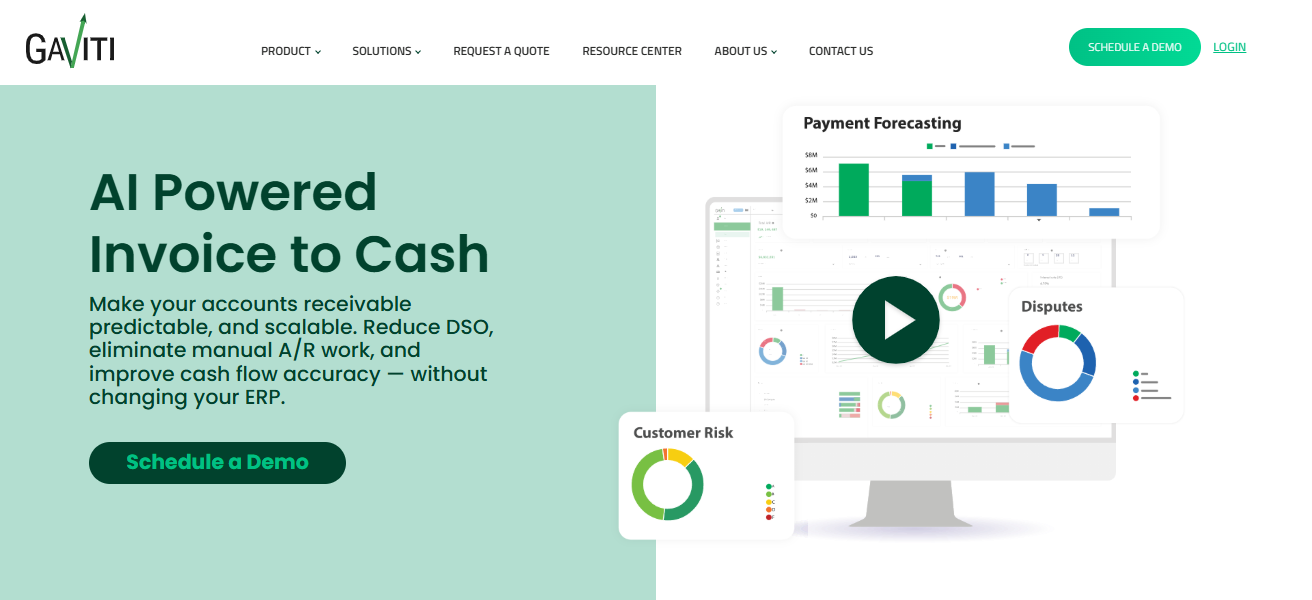
Gaviti obtains real-time monitoring, reporting, and notifications provided as vertical of credit of potential defaults.
Gaviti has a unique value proposition of improving collection of less complex portfolios while freeing collection credit managers to perform the higher value strategic initiatives.
Gaviti’s receivable management solution is ideal for businesses with complex and high customer accounts.
Gaviti – Key Features
Predictive Collections Prioritization AI prediction on receivables likely to default providing opportunity for high impact collection focus.
ERP Integration Integrates with enterprise solutions for real-time payment and receivables data fetching for precise tracking.
Days-Sales-Outstanding (DSO) Reduction This tool streamlines collection effort, parametering the portfolio for quality enhancement and cashflow improvement.
| Pros | Cons |
|---|---|
| AI focuses on accounts receivable and collections. | Not a complete credit decisioning platform. |
| Predictive models help prioritize collection efforts. | Best for businesses with defined AR processes. |
| Reduces days‑sales‑outstanding (DSO). | Collection predictions depend on historical accuracy. |
| Integrates with ERP for real‑time alerts. | Advanced analytics may need additional training. |
| Alerts high‑risk accounts early. | Doesn’t cover full credit portfolio analytics. |
7. HighRadius
HighRadius is an AI-enhanced platform intended for treasury and financial tasks separated into credit risk processing and portfolio monitoring.
This software is able to forecast and automate processes like credit scoring, risk collection, and processing, as well as using analytics to predict possible defaults.
This software is integrated with ERP systems to give real-time visibility on accounts receivable, loans that are outstanding, and customer payment behavior.
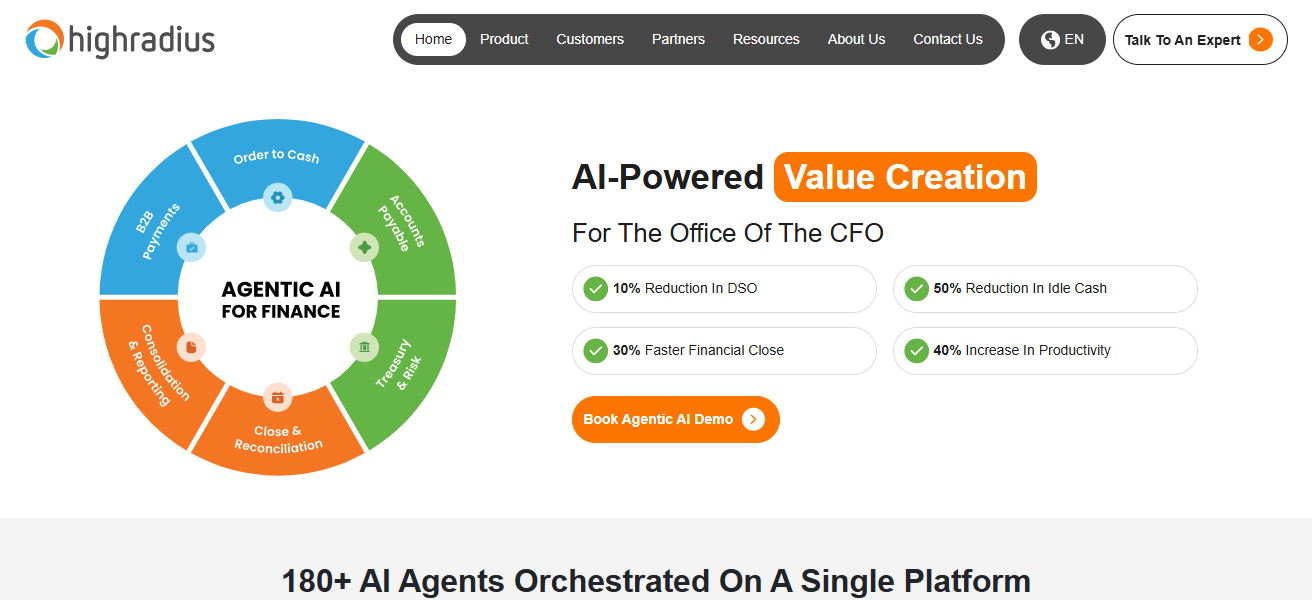
Payment AI systems are oriented to optimize credit limits as well as collection strategies and payment duration to reduce risk.
Other features like scenario simulations and dashboards improve trend analysis and give finance teams ability to make decisions in real-time and based on data. This software aids firms in maintaining good performance on portfolios and operating credits.
HighRadius – Key Features
Automated Credit Scoring & Limits AI models determine if the borrower represents a risk and recommend a credit limit to control the risk exposure.
Cash Flow & Collections Forecasting This tool predicts future cash inflows and overdue accounts providing an overdue account estimate for proper cash management.
ERP-Connected Workflows This tool offers integration with financial systems ensuring real-time data access across credit and AR functions.
| Pros | Cons |
|---|---|
| Automates scoring and collections forecasting. | Implementation can be resource intensive. |
| Integrates deeply with ERP systems. | May be costly for mid‑sized firms. |
| Reduces manual work and improves accuracy. | Training required for advanced modules. |
| Predictive analytics improve risk control. | Customization adds complexity. |
| Strong scenario and trend analysis tools. | Learning curve for non‑finance users. |
8. FIS Credit Management
FIS Credit Management is a comprehensive solution for enterprise credit risks and portfolio surveillance. Using AI and analytics, the system provides real-time surveillance of borrower behavior, credit risk, and portfolio performance.
The system’s risk- and default- delinquency management features include risk scoring, early warning triggers, and the simulation of multiple scenarios.
The system’s concentration dashboards and credit allocation suggestions optimize portfolio managerial oversight for policy adjustments.
Automated regulatory reporting and predictive analytics grant FIS compliance and strategic planning analytics. This solution is ideal for comprehensive credit management for banks, lenders, and other large financial institutions.
Enterprise-Level Risk Analytics Monitor large, complex portfolios with comprehensive, customizable analytics by wide-ranging risk metrics.
Early Warning & Predictive Alerts Speed preemptive actions to avoid losses by acting on escalating risks.
Exposure & Concentration Reporting Tools assist in pinpointing over-exposure to certain sectors or types of borrowers.
Compliance & Regulatory Supportm Integrated frameworks facilitate automated reporting and documentation to comply with regulatory requirements.
| Pros | Cons |
|---|---|
| Enterprise‑grade with robust risk scoring. | Can be expensive for smaller institutions. |
| Real‑time performance tracking and alerts. | Deployment may require long onboarding. |
| Strong regulatory reporting support. | Complexity can deter quick adoption. |
| Comprehensive exposure segmentation tools. | May need dedicated support team. |
| Scenario simulation aids strategic planning. | Too extensive for basic portfolios. |
9. Experian PowerCurve
Experian PowerCurve is a platform that leverages machine learning and behavioral scoring to provide analytic assessments of borrowers using AI for credit decisioning and portfolio assessment on an ongoing basis.
PowerCurve assesses borrower performance and predicts portfolio outcomes using behavioral scoring. The system analyzes active accounts, pending applications, and payment history on a continuous basis and provides alerts on accounts likely to default.

The system provides credit line recommendations, automates decisions, and ensures system users meet all regulatory compliance requirements.
The system dashboards and reports to portfolio administrators in order to measure and monitor performance, conduct portfolio stress testing, and prioritize portfolio risk mitigation and/or removal.
It is well known in the banking and lending industry for improving credit risk and portfolio performance management.
Experian PowerCurve – Key Features
Behavioral Scoring Models Integrates historical repayment behavior and predictive analytics to assess credit risk with greater accuracy.
Real-Time Decision Automation PowerCurve improves the velocity of credit decisions, while risk scores of the portfolio are updated continuously.
Credit Limit Optimization AI recommends credit limits based on performance trends, risk tolerance, and optimal limits.
Compliance & Audit Trails Documentation and reporting support built regulatory compliance and transparency.
| Pros | Cons |
|---|---|
| Combines machine learning + credit behavior scoring. | High cost for smaller lenders. |
| Real‑time alerts improve default mitigation. | Integration takes effort with existing systems. |
| Supports credit limit optimization. | Advanced analytics require training. |
| Automated decisions reduce manual bottlenecks. | Full benefits realized only with complete adoption. |
| Helps with compliance and reporting. | Overlapping features with other Experian tools can be confusing. |
10. Zest AI
Zest AI utilizes data science to improve how businesses perform credit underwriting and portfolio monitoring.
By looking at both traditional credit data and other data source types, risk assessment and prediction of future borrower behaviors is more accurate.
The platform automates credit risk scoring, detects early warning signs, and runs simulations of how portfolios would perform under different scenarios.
Zest AI enables more informed lending, decreases the risk of defaults, and assists lending businesses in adjusting credit limits and exposure.
The use of explainable AI in credit decisioning brings regulatory compliance, equity, and fairness. Zest AI streamlines operational processes while helping companies to improve the health of their credit portfolios.
Zest AI – Key Features
Machine Learning Underwriting Models Uses advanced algorithms and diverse datasets to improve the accuracy of predicting risk.
Explainable AI (XAI) Models support compliance and trust by providing clear reasons for decisions.
Alternative Data Utilization Uses traditional data to improve risk assessments in profiles of borrowers, which have little available credit history.
Portfolio Predictions Predictive capabilities provide insights that allow managers to forecast and adapt their strategies to emerging trends.
| Pros | Cons |
|---|---|
| Powerful machine learning for underwriting + monitoring. | Advanced models may seem opaque to users. |
| Includes alternative data for better accuracy. | Requires high‑quality data to perform well. |
| Explainable AI supports regulatory transparency. | Setup and model training take time. |
| Early warning detection reduces losses. | Best for lenders ready to invest in data science. |
| Scenario insights help portfolio resilience. | Part of larger suite — full value needs broader adoption. |
How To Choose 10 Best AI Tools for Credit Portfolio Monitoring
Define your most important requirements. Consider if you need real‑time risk alerts, predictive scoring, collections automation**, or *regulatory* reporting.
Data Integration Functionality. Look for tools that easily connect to your ERP/loan systems, credit bureaus, and internal databases.
Predictive Analytics & AI Capability. Determine if the tool has advanced AI/ML systems that can predict defaults, trends, and other stress scenario forecasting. Trust and compliance benefits come with tools that contain explainable AI.
Flexibility of Scale and Customization. Validate that the tool can adapt to your business’s portfolio as it expands or changes to accommodate regulatory or industry changes. Custom dashboards and adaptable reporting are benefits.
User-Friendliness & Integration Look for systems that offer customer support and training rather than systems that require high technical knowledge.
Cocnlsuion
In closing, Mezzi, Origin, Sentieo, and Zest AI’s credit portfolio monitoring AI software enables financial institutions to manage and optimize lending risks.
These services help institutions predict analytics while monitoring lending portfolios in real-time. These AI software tools reduce default rates and improve efficiency while satisfying regulatory requirements. Thus, they are fundamental to credit portfolio risk management today.
FAQ
It is the process of tracking and managing the risk, performance, and exposure of a lender’s credit portfolio using analytics and reporting tools.
AI improves accuracy, predicts defaults, automates reporting, and identifies risks faster than manual methods.
Some tools like Kubera and Gaviti are suitable for SMEs, while enterprise-focused tools like FIS or HighRadius are better for large institutions.
Yes, many platforms provide audit trails, automated reporting, and compliance features for banking regulations.
Most tools connect with ERP systems, loan management software, and credit bureaus for real-time data monitoring.