
In this article, I will discuss the Best AI Tools for Regulatory Monitoring, designed to help organizations stay compliant in a rapidly evolving regulatory landscape.
- Key Points & Best AI Tools For Regulatory Monitoring
- 10 Best AI Tools For Regulatory Monitoring
- 1. Compliance.ai
- 2. IBM Watson Compliance
- 3. SAS Regulatory Compliance
- 4. Microsoft Purview
- 5. Centraleyes
- 6. Thomson Reuters Regulatory Intelligence
- 7. Regology
- 8. Ascent RegTech
- 9. Clausematch
- 10. Quantifind
- How To Choose Best AI Tools for Regulatory Monitoring
- Cocnsluion
- FAQ
These AI-powered platforms automate the tracking of rules and regulations, provide real-time alerts, and streamline workflow management.
By leveraging advanced analytics and natural language processing, they reduce manual effort, minimize risks, and ensure efficient compliance across industries.
Key Points & Best AI Tools For Regulatory Monitoring
| Tool | Key Points |
|---|---|
| Compliance.ai | Real-time regulatory monitoring, automated alerts, jurisdiction coverage |
| IBM Watson Compliance | Explainable AI, audit-ready documentation, strong analytics |
| SAS Regulatory Compliance | Data-driven compliance, predictive analytics, risk detection |
| Microsoft Purview | AI governance, data policy management, integration with Microsoft ecosystem |
| Centraleyes | AI-powered risk register, policy management, compliance dashboards |
| Thomson Reuters Regulatory Intelligence | Global regulatory updates, customizable alerts, trusted legal insights |
| Regology | Automated compliance mapping, AI-driven regulatory change tracking |
| Ascent RegTech | AI-driven obligations management, reduces manual compliance workload |
| Clausematch | Policy lifecycle management, collaboration tools, audit trails |
| Quantifind | Risk intelligence, financial crime detection, regulatory compliance support |
10 Best AI Tools For Regulatory Monitoring
1. Compliance.ai
Compliance.ai is a financial service regulatory monitoring platform that employs artificial intelligence to simplify monitoring.
It automatically collects regulatory information from international authorities and provides alerts in real time.
The platform uses NLP to find pertinent regulations, analyze modifications, and monitor compliance obligations.
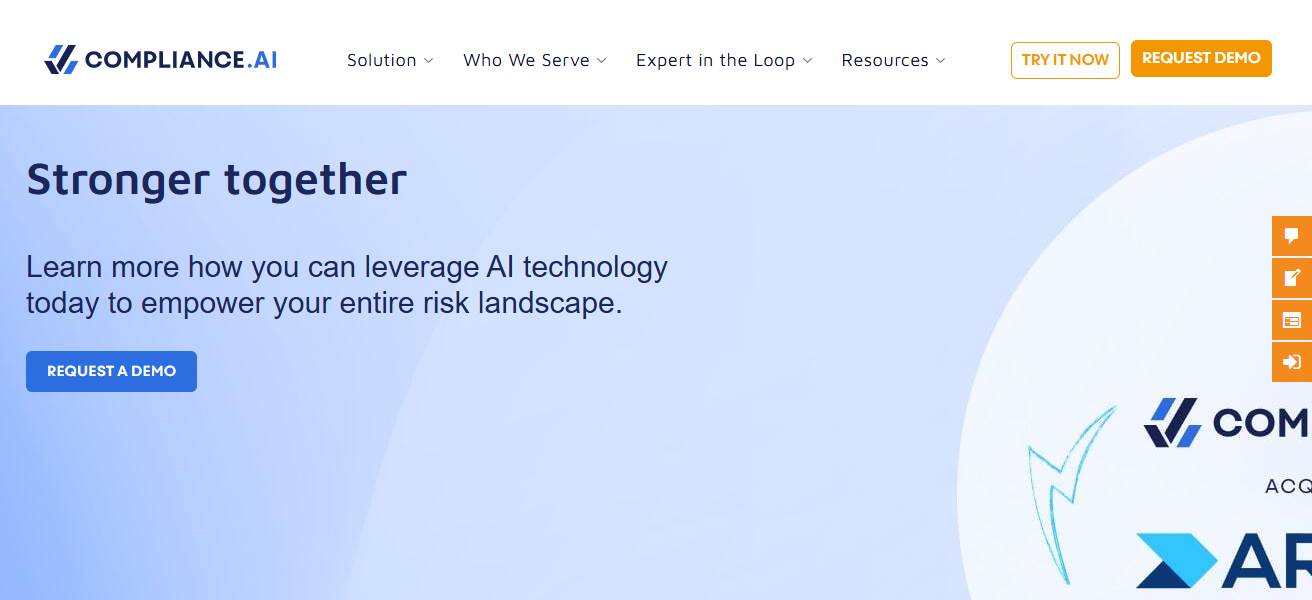
Compliance.ai assists compliance teams in diminishing manual research, increasing regulatory risk, and keeping an audit-ready record of updates.
The simplified dashboard allows users to adjust filters by jurisdiction, regulation category, and impact level.
Furthermore, the tool aids in workflow optimization so that important compliance updates are assigned to the appropriate personnel, increasing efficiency and making better decisions.
Compliance.ai Features
- Automated Regulatory Updates: Assures you get news for updates that could impact your business, while also allowing you to customize your updates by specifying jurisdiction, topic, and industry filters.
- Natural Language Processing (NLP): Summarizes changes, and obligations, and describes potential impacts of changes to upcoming regulatory documents (especially for the impenetrable ones).
- Custom Filtering & Search: Users mitigate the monitoring of regulations that annoy them, and instead, they concentrate on the important regulations, i.e., the ones that matter to them.
- Workflow & Task Management: Assists with the assignment of regulatory updates to specific employees, monitoring the completion status, and provides support for audit documentation.
| Pros | Cons |
|---|---|
| Strong real‑time regulatory update alerts. | Can be complex to configure initially. |
| Excellent NLP to extract key changes from documents. | Learning curve for non‑technical users. |
| Custom filters by jurisdiction and topic. | Some advanced analytics require higher plans. |
| Workflow assignment features improve team collaboration. | Interface may feel dense with large datasets. |
| Reduces manual research significantly. | Limited industry‑specific templates outside finance. |
2. IBM Watson Compliance
IBM Watson Compliance has developed a new way to detect compliance risks and monitor regulatory changes through the use of AI and cognitive computing.
Watson identifies possible violations, trends, and any relevant changes in regulations by analyzing both structured and unstructured data.
Watson is continually adapting its machine learning algorithms to better the relevance and accuracy of its alerts.
Watson also provides help with document analysis, contract review, and risk assessments, all of which help firms comply with complex regulations.
It provides dashboards and reporting to monitor compliance and integrates with workflows to support document reviews and risk assessments. It allows compliance teams to shift their attention to high-risk activities and more value-added processes.
IBM Watson Compliance Features
- Cognitive Document Analysis: Other AI tools can only work on one type of document, and either focus on rules and guidelines, or on unstructured content, but not both. IBM Watson is the only solution that can do both/
- Risk Detection & Scoring: Bottom line: IBM Watson identifies compliance violations, and then scores them and facilitates response prioritization on your behalf.
- Customizable Dashboards: Teams get to visualize and customize the dashboard so that it can be better for them. They can also see how the risks are distributed so one can focus on the gaps.
- Integration Capabilities: Integrates with other enterprise compliance tools, making it easier to manage everything from one place.
| Pros | Cons |
|---|---|
| Uses advanced AI to detect regulatory risk. | High cost for smaller teams. |
| Strong unstructured data analysis. | Implementation requires expert support. |
| Integrates with enterprise systems well. | May produce false positives without tuning. |
| Custom risk scoring and trend insights. | Reporting dashboards need customization. |
| Good for large, data‑heavy organizations. | Not ideal for basic regulatory tracking. |
3. SAS Regulatory Compliance
SAS Regulatory Compliance employs cutting-edge technology for analytics pertaining to risk management and regulatory monitoring. It uses machine learning and AI to process data.
It identifies changes in regulations, compliance gaps, and automates reporting. The consolidation of various data sources, such as legislation, guidelines, and company policies, helps businesses have a more comprehensive perspective on compliance.
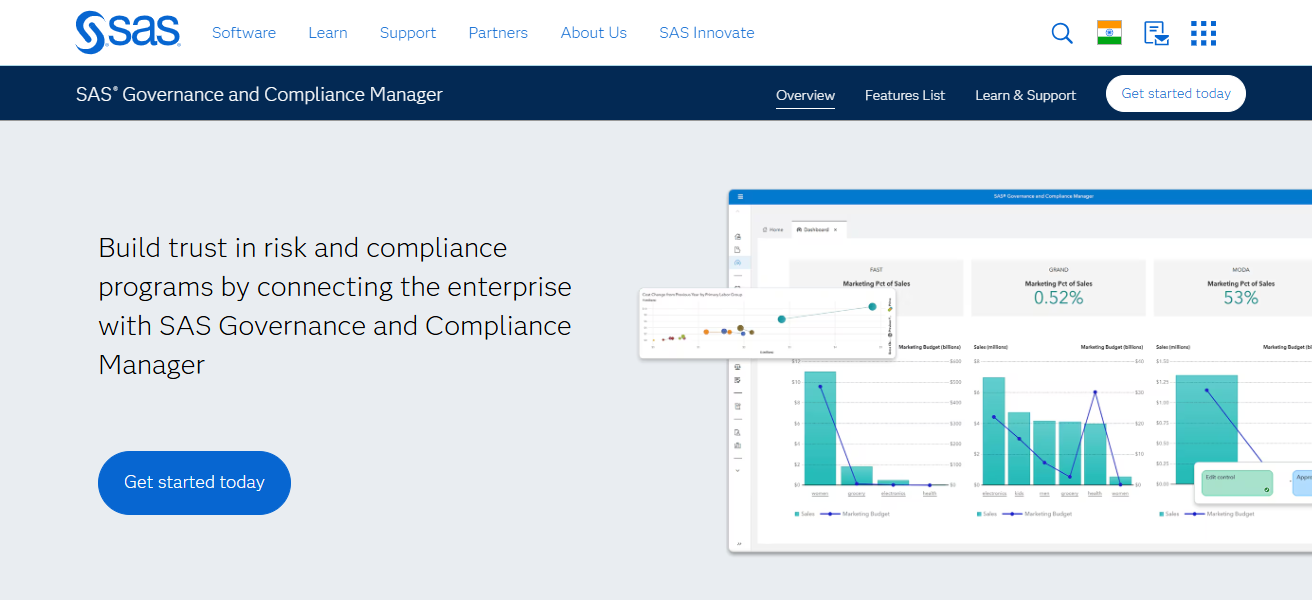
Their analytics technology helps predicting the consequences of regulations and aids in better management of company resources. Aside from the audit trails, scenario analysis, and reporting features provided by SAS, there is transparency and accountability.
With its data-centered strategies, compliance teams are able to respond to new regulations more efficiently, reduce penalties, and keep regulatory alignment consistent across business divisions.
SAS Regulatory Compliance Features
- Advanced Analytics & Modeling: Predictive analytics help assess and forecast regulatory impact along with emerging compliance challenges.
- Enterprise Level Data Integration: Provides a complete view of regulatory risk by merging multiple datasets.
- Automated Reporting: Compliance reports are automatically created using customizable templates for internal or external audit reviews.
- Audit Trail & Traceability: Records every change and action taken for transparency and compliance proof.
| Pros | Cons |
|---|---|
| Powerful analytics and predictive modeling. | Steeper learning curve for compliance teams. |
| Aggregates data from multiple sources. | Setup and maintenance are resource intensive. |
| Strong reporting and audit trails. | Higher price point for full feature set. |
| Identifies compliance gaps proactively. | Less intuitive UI for non‑analysts. |
| Scales well for enterprise risk needs. | Requires training to maximize use. |
4. Microsoft Purview
Microsoft Purview provides organizations with a means to understand data governance and compliance monitoring for organizations to understand data governance and compliance monitoring to track adherence to data protection.
It employs AI to review sensitive data and evaluate compliance risks by scanning both structured and unstructured data across cloud and on-prem systems.
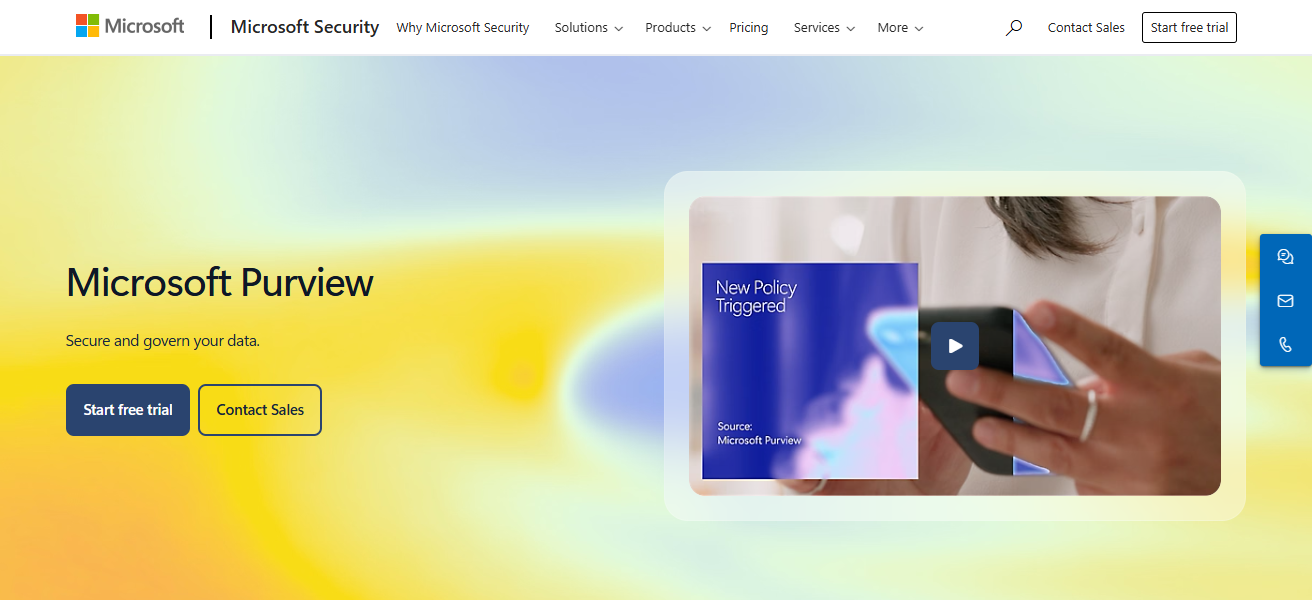
real-time monitoring, automated workflows, and risk score alerts will present compliance gaps and violations in the most risk.
templated global legal and compliance standards (i.e., GDPR, HIPAA, etc.) are integrated within the software. Microsoft 365 integration provides seamless oversight for documents, emails, and collaborative tools.
With minimal manual efforts, compliance teams can assess and communicate the status to auditors the governance gaps and track compliance with the help of Purview’s dashboards.
Microsoft Purview Features
- Data Classification & Sensitivity Scanning: Automatically discovers and tags sensitive information across various environments (cloud, on‑prem, hybrid).
- Compliance Templates: Preconfigured templates for GDPR, HIPAA, and other financial regulations help implement frameworks quickly.
- Unified Compliance Dashboard: Risk insights, Alerts, and Compliance posture overview in a centralized location.
- Seamless Microsoft Integration: Seamless with Microsoft 365, Azure, and other Microsoft products providing cohesive governance.
| Pros | Cons |
|---|---|
| Excellent data governance and compliance. | Best features tied to Microsoft ecosystem. |
| Automated scanning of sensitive data. | Setup can be technical and detailed. |
| Built‑in templates for common regulations. | Some alerts may be too generic. |
| Integrates with M365 and Azure data. | Cost scales with data volume. |
| Strong audit and reporting tools. | Not focused solely on regulatory text. |
5. Centraleyes
Centraleyes is a governance, risk, and compliance platform that streamlines the process of regulatory monitoring and compliance.
Using automation and AI, the platform updates and assesses the risk exposure and compliance obligations of an organization. Centraleyes offers a single dashboard solution for tracking and monitoring regulatory changes across responsibilities and tasks.
Using machine learning, it emphasizes the most important changes so that compliance teams tackle the most significant issues. The platform assists with audit prep, reporting, and streamlining compliance workflows.
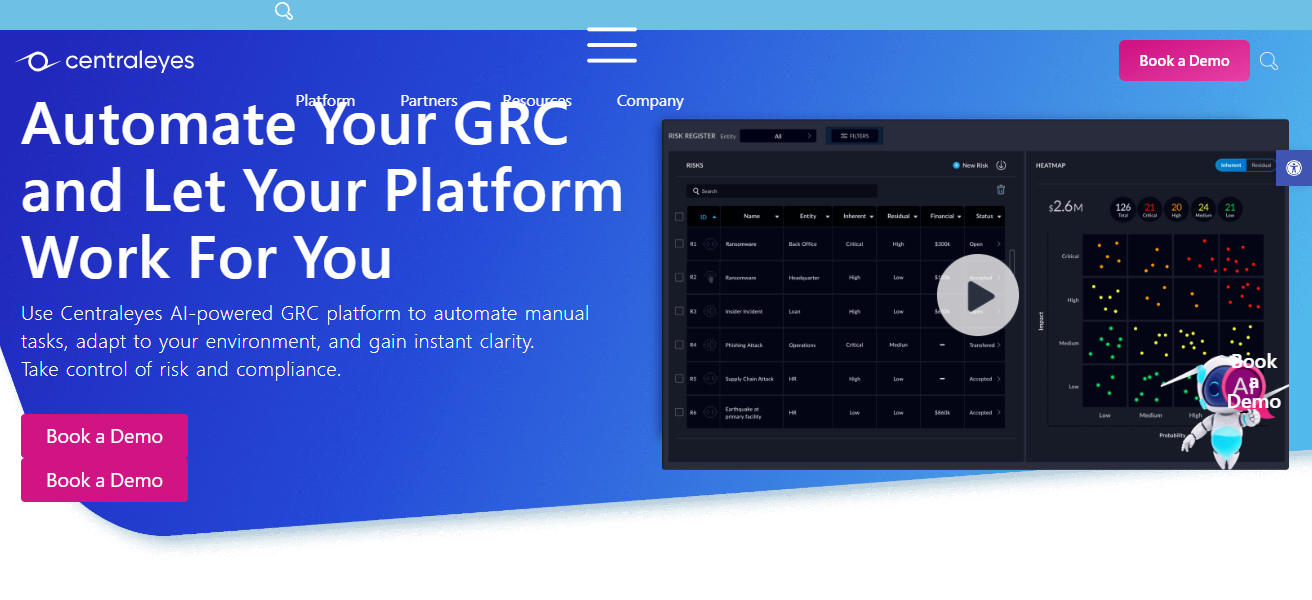
For multi-national companies, Centraleyes helps to manage cross border regulatory risks, reduce operational silos, and lowers the risk of bad regulatory outcomes.
Centraleyes helps to manage complex compliance challenges and improves regulatory oversight for all stakeholders from a single platform.
Centraleyes Features
- Centralized Risk & Compliance Hub: Single dashboard for all risk metrics and regulatory obligations.
- AI Driven Prioritization: With smart ranking and filtering, teams are guided to focus on significant regulatory shifts.
- Automated Compliance Workflows: Tracks tasks, assignments, and deadlines to streamline follow-up and closure of tasks.
| Pros | Cons |
|---|---|
| Centralized risk and compliance dashboard. | Smaller user community than bigger vendors. |
| Prioritizes updates by risk level. | May lack deep industry‑specific content. |
| Good workflow and task assignment. | UI can feel complex initially. |
| Encourages cross‑team collaboration. | Customization options vary by plan. |
| Helps prepare for audits. | Some advanced analytics limited. |
6. Thomson Reuters Regulatory Intelligence
Thomson Reuters Regulatory Intelligence is an artificial intelligence-driven global regulatory content aggregator with real time global regulations alerts and analyses.
It helps compliance teams assess the effects of legal, guidances, and industry practice changes on their operations and workflows.
The system uses AI to automate the classification of regulatory changes and updates by relevance, jurisdiction, and risk. It also provides users with compliance progress tracking, reporting, and task management features.
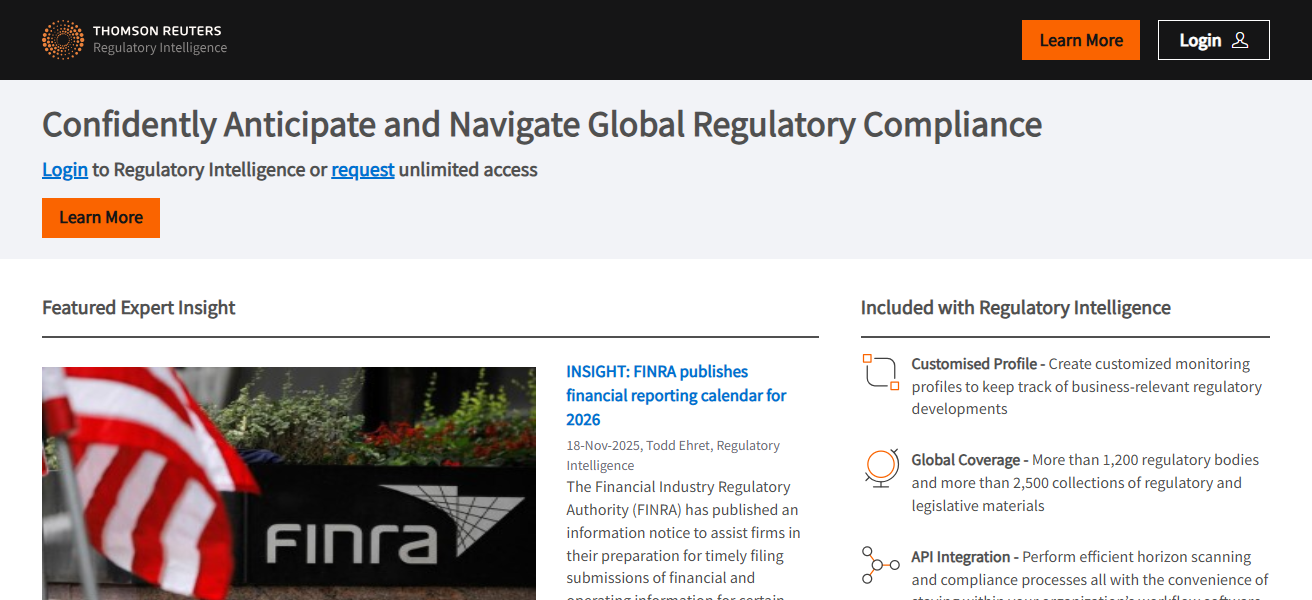
With the ability to provide regulatory analytics, Thomson Reuters Regulatory Intelligence helps organizations make analytics driven strategic decisions to achieve compliance before regulatory changes occur.
Their predictive analytics and extensive regulatory analytics database help organizations save time and improve the quality of their compliance assessments.
Thomson Reuters Regulatory Intelligence Features
- Global Regulatory Content Database: Extensive documentation on international laws, guidance, and regulations.
- AI‑Driven Categorization: Machine Learning (ML) tools to organize and tag updates by relevance, jurisdiction, and risk.
- Task & Workflow Tracking: Facilitation of assignment, tracking, and documentation of regulatory updates by teams.
- Historical Change Comparison: Analysis of the context and impact of regulations by comparing prior iterations.
| Pros | Cons |
|---|---|
| Extensive global regulatory database. | Can be expensive for smaller firms. |
| Categorizes by risk, jurisdiction, and topic. | Volume of updates may overwhelm teams. |
| Workflow and task tracking included. | Search can be less intuitive for new users. |
| Strong credibility and content depth. | Custom reporting needs training. |
| Regular update frequency. | May require filtering to reduce noise. |
7. Regology
Regology is a Regulatory monitoring platform that has integrated AI and machine learning in monitoring and analyzing the global regulatory environment and its potential impact.
It offers automated monitoring of regulatory updates from government agencies, regulatory authorities, and trade and industry publications.
The AI engine categorizes rules, details changes, and offers suggestions for compliance teams. Other features of Regology include workflow automation, risk scoring, and the delegation of tasks to responsible workstreams.
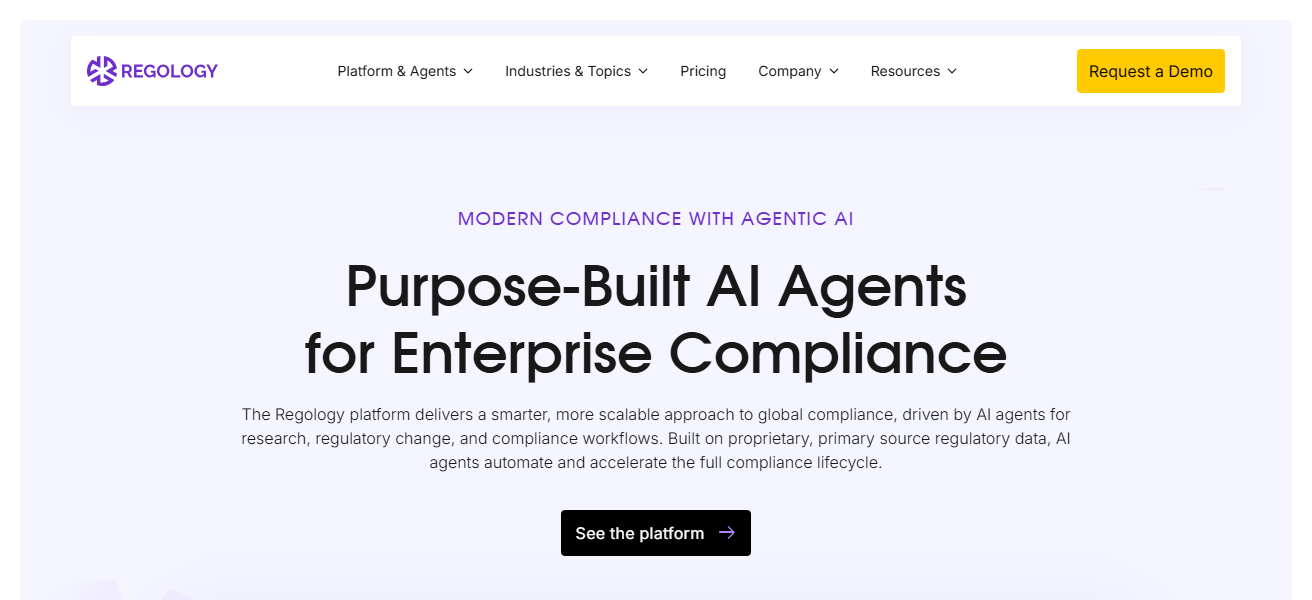
The softwawre user-friendly features include filtering by jurisdiction, industry, and type of reguation to alleviate the compliance tracking burden.
Users of Regology experience prompt notifications, low compliance checking burden, and optimised reporting while maintaining operational flexibility and reporting in compliance to the regulatory updates in the various jurisdictions.
Regology Features
- Automated Regulatory Aggregation: Collects data from websites of regulators and regulatory authorities, and legal publications.
- Smart Classification: AI detects changes and organizes them by issues, jurisdiction, and business impact.
- Customizable Alerts: Notifications for regulatory changes affecting a client organization are customizable.
- Actionable Insights & Tasks: Regulatory updates are transformed into tasks with action items, deadlines, and responsibilities.
| Pros | Cons |
|---|---|
| AI classifies and highlights regulatory differences. | Coverage isn’t as broad as legacy providers. |
| Actionable insights with alerts. | Some users find filtering tricky. |
| Workflow automation for compliance tasks. | Limited advanced analytics beyond tracking. |
| Customizable regulatory taxonomy. | Integration needs planning. |
| Helps reduce manual search time. | Learning curve to maximize tagging. |
8. Ascent RegTech
Ascent RegTech uses artificial intelligence to reduce complexities in regulatory compliance and streamline integration of obligations into an organization’s diverse operations.
It adapts to new regulatory changes and automatically updates relevant obligations, translating them into actionable business unit tasks. The AI-powered engine detects changes, analyzes impacts, and risk assesses and prioritizes relevant tasks.
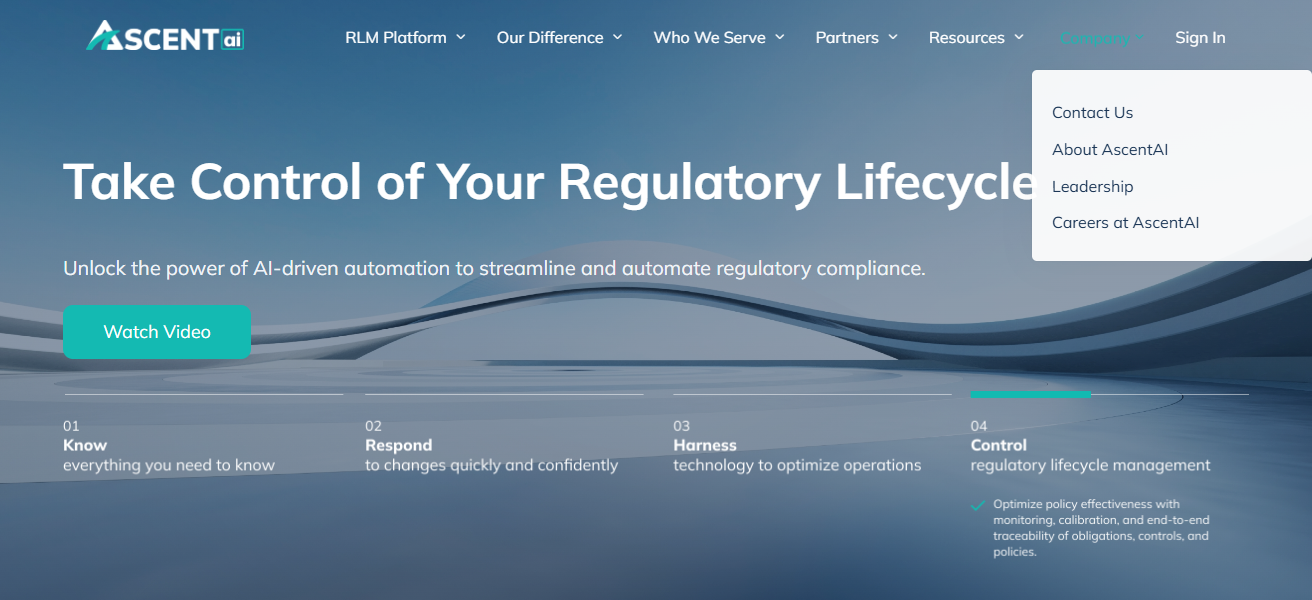
It provides audit trails, accountability, progress tracking, and transparency through reporting dashboards.
With workflow integration, compliance teams assign and manage tasks to streamline the process and minimize potential oversight.
By automating the process, Ascent provides active compliance, reducing penalties and allowing businesses to quickly adjust to new changes in regulation.
Ascent RegTech Features
- Regulation to Obligation Mapping: New regulatory language is linked to specific organizational obligations automatically.
- Risk Prioritization: Relevant and risk-related obligations are assigned by AI for prioritization to guide teams’ focus.
- Detailed Audit Trails: For the purpose of accountability and verification, changes, actions, and status of completion are monitored and recorded.
| Pros | Cons |
|---|---|
| Automatically maps obligations to operations. | Best features geared toward finance/legal. |
| Prioritizes tasks by relevance and risk. | Setup requires alignment with internal processes. |
| Detailed audit trails and dashboards. | Pricing may be high for small firms. |
| Good workflow accountability features. | May need tuning for unique regulations. |
| Keeps compliance up‑to‑date. | Some analytics require human validation. |
9. Clausematch
Clausematch is an AI-powered tool for policy management and regulatory compliance. Clausematch integrates policy creation, review, and approval with monitoring changes in regulations.
Clausematch employs AI for the analysis of recent regulations, identifies the policies that lose compliance, and recommends the respective updates. The platform offers features such as version control, team compliance collaboration, and automated processes to help with compliance.
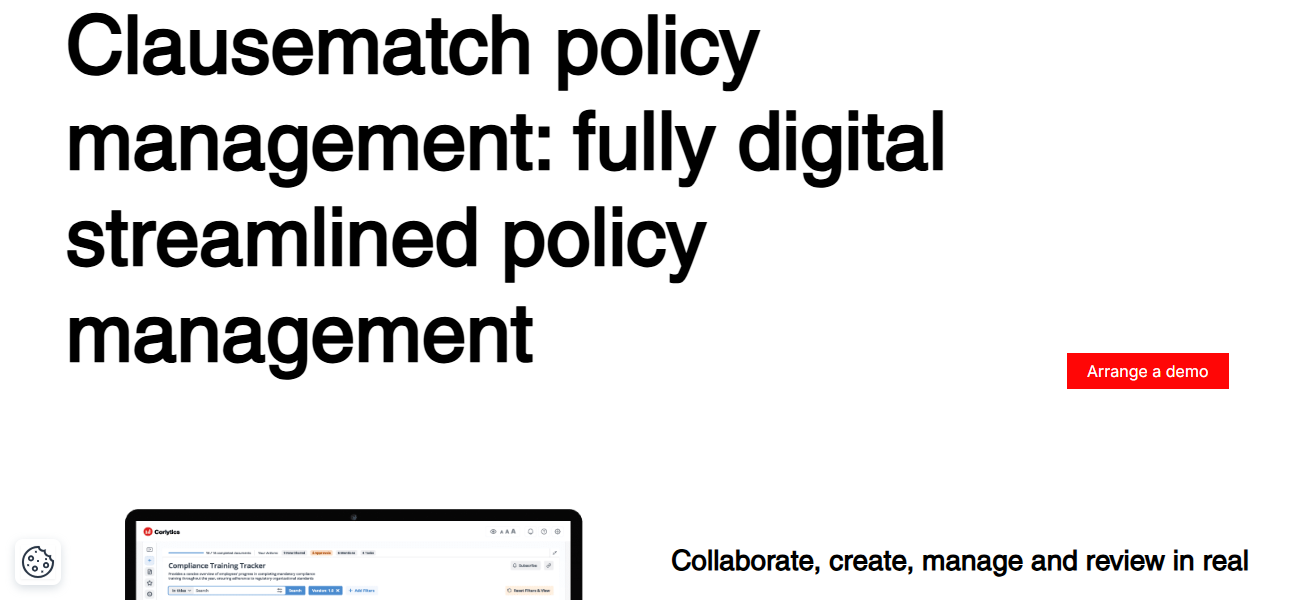
The platform also manages the compliance acknowledgment of employees, updating policies to lessen the risk of non-compliance.
Compliance teams get insight through reports and dashboards that document the steps of an audit. Clausematch helps financial institutions streamline regulatory compliance, reduce administrative tasks, and standardize policies across divisions.
Clausematch Features
- Policy Lifecycle Management: Streamlines processes for the creation, review, approval, and storage of compliance policies.
- Regulation‑Driven Policy Updates: When policies change due to updated regulation, the AI will review and recommend the necessary changes.
- Version Control & Accountability: History of compliance is maintained by tracking of versions, approvals, and employee records.
- Collaboration & Workflow Tools: Integrated workflows provide team editing, reviewing, and signing with audit logs.
| Pros | Cons |
|---|---|
| Strong policy lifecycle management. | Primarily focused on policy vs regulation. |
| Automated policy updates based on regulations. | May overlap with existing GRC tools. |
| Version control and document collaboration. | Notification noise if not configured well. |
| Audit trail of acknowledgments. | Best for larger policy portfolios. |
| Helps ensure consistent internal compliance. | Less suited for raw regulatory monitoring. |
10. Quantifind
Quantifind is an AI-based tool for regulatory compliance, risk assessment, and anti-financial crime operational activities.
Machine learning is applied to detect problematic activities, compliance breaches, and newly established regulations by analyzing both structured and unstructured data from numerous sources.
Quantifind assists teams by offering actionable insights, risk scores, and alert prioritization. With Quantifind, compliance teams can efficiently identify breaches and monitor trends using the company’s multiple dashboard visualization tools.
By using Quantifind, organizations can reduce operational risk and potential fines, improve the effectiveness and efficiency of compliance and regulatory workflows, and improve their internal processes.
Quantifind Features
- AI-Powered Risk Intelligence: Uses analytics to identify potential occurrences, suspicious behavior, and compliance gaps.
- Structured and Unstructured Data Coverage: Provides analysis of emails, documents, logs, and external sources for risk indicators.
- Risk Scoring & Prioritization: Provides scores to help teams place focus on the most critical items.
- Visual Insight Dashboards: Provides graphs and charts for compliance teams to quickly identify trends and hotspots.
| Pros | Cons |
|---|---|
| Powerful risk scoring and analytics. | Analytical results need expert review. |
| Detects suspicious patterns and compliance gaps. | May be too advanced for basic tasks. |
| Handles structured and unstructured data. | Setup requires data integration expertise. |
| Visual dashboards and alerts. | Cost can be high for smaller orgs. |
| Good for AML and regulatory risk contexts. | Not exclusively a regulatory text tracker. |
How To Choose Best AI Tools for Regulatory Monitoring
Regulatory Coverage Make certain that the tool analyzes the jurisdictions and regulatory authorities that are most critical to your organization (local, national, international).
Real-Time Alerts & Updates Check for systems that provide real-time or almost real-time alerts, ensuring you never overlook important changes.
AI Accuracy & NLP Capability Strong Natural language processing (NLP) allows the tool to capture and analyze complex legal language and identify significant changes.
Customization & Filtering Select tools that allow you to filter alerts by industry, type of regulation, business segment, or risk to reduce unnecessary alerts.
Workflow & Task Automation Tools that assign compliance responsibilities, close date tracking, and issue alerts to enhance the efficiency of your team.
Integration with Existing Systems Optimal tools are those that work seamlessly with your available technology (GRC systems, document management, data systems).
Cocnsluion
In conclusion, AI-driven regulatory monitoring tools are vital for organizations to remain compliant for the rapidly evolving regulatory landscape.
For instance, tools like Compliance.ai, IBM Watson Compliance, and Thomson Reuters automate monitoring and tracking, manage workflow and risk prioritization, and stream saves time and reduce penalties.
When selecting a tool, factors such as coverage, AI functionality, integration, scalability, and reporting should be considered to provide a better and more active compliance management assurance.
FAQ
AI tools for regulatory monitoring automatically track and analyze regulatory updates to help organizations stay compliant.
AI speeds up monitoring, reduces manual work, detects key changes, and prioritizes risks more efficiently than humans.
Finance, healthcare, insurance, legal, and multinational enterprises dealing with complex regulations benefit the most.
Yes, many tools like Compliance.ai, Thomson Reuters, and Regology cover multiple countries and jurisdictions.