In this article, I will discuss the Best AI Tools for Treasury forecasting and how these tools assist finance teams in enhancing cash flow visibility, forecasting accuracy, and liquidity planning.
- Key Points & Best AI Tools for Treasury Forecasting
- 10 Best AI Tools for Treasury Forecasting
- 1. Kyriba
- 2. Trovata
- 3. Hazelcast
- 4. Nilus Treasury AI
- 5. J.P. Morgan Treasury AI
- 6. GTreasury
- 7. FIS Treasury & Risk Manager
- 8. Coupa Treasury
- 9. SAP Treasury Management
- 10. Eoxs Treasury AI
- How We Choose Best AI Tools for Treasury Forecasting
- Conclusion
- FAQ
These AI tools combine advanced analytics, automation, and real-time data integration to decrease manual efforts, handle financial risk, and facilitate smarter data-driven treasury decisions.
Key Points & Best AI Tools for Treasury Forecasting
| AI Tool | Key Point |
|---|---|
| Kyriba | Real-time cash visibility and predictive liquidity forecasting. |
| Trovata | Automated cash reporting with AI-driven scenario planning. |
| Hazelcast | Streaming analytics for treasury risk and liquidity management. |
| Nilus Treasury AI | Bank connectivity plus machine learning for forecasting accuracy. |
| J.P. Morgan Treasury AI | Cash flow forecasting with advanced precision and strategic insights. |
| GTreasury | Integrated risk management and AI-powered liquidity optimization. |
| FIS Treasury & Risk Manager | AI-enhanced forecasting with strong compliance and reporting features. |
| Coupa Treasury | Spend management integration with predictive treasury analytics. |
| SAP Treasury Management | ERP integration and AI-driven cash forecasting. |
| Eoxs Treasury AI | Automation of routine tasks and predictive trend analysis |
10 Best AI Tools for Treasury Forecasting
1. Kyriba
Kyriba is a fully integrated cloud-based treasury and liquidity management platform catering to large enterprises for forecasting, cash visibility, risk, and payments.
The company incorporates AI into its cash forecasting models, allowing finance teams to create predictive cash forecasts using historical data and real-time variables, enhancing the accuracy of liquidity planning.

AI is additionally used for automation, reporting, banking, and custom integrations, allowing CFOs and treasurers to eliminate manual processes and gain visibility into their future cash balances and risk exposures.
The company also solves working capital, compliance, and fraud management challenges on a global scale.
Features Kyriba
- Real-time overview of cash available in all accounts worldwide.
- AI liquidity forecasts for the short term and long term.
- Worldwide bank connections with hundreds of financial institutions.
- Risk management for foreign currency, interest rate, and commodity risks.
- Treasury ERP integrations for streamlined treasury operations.
| Pros | Cons |
|---|---|
| Real-time cash visibility across global accounts | Implementation can be complex and time-consuming |
| Predictive liquidity forecasting powered by AI | Higher cost structure for smaller firms |
| Strong integration with banks and ERPs | Requires training for treasury teams |
2. Trovata
Trovata is a treasury management platform that specializes in real-time cash visibility, automated reporting, and machine learning forecast reporting.
The platform connects to the banking API’s to aggregate and normalize cash data spread across accounts and institutions, eliminating manual data collection and creating a single source of truth.
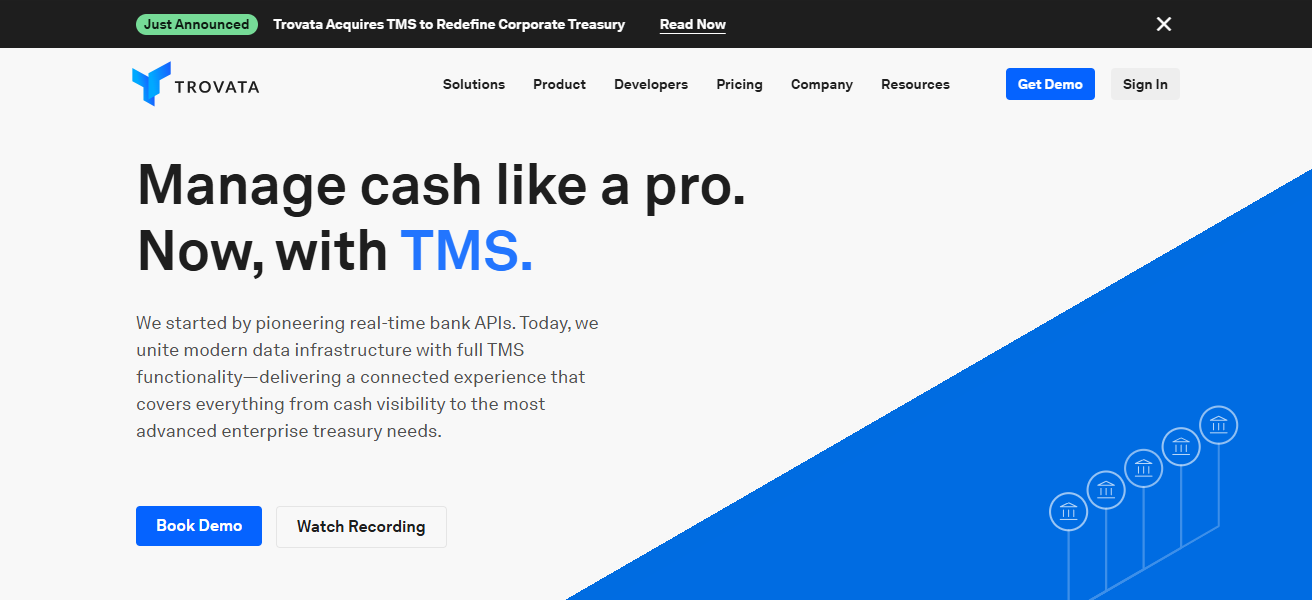
Trovata’s machine learning models generate predictive cash flow forecasts and scenario planning analysis by evaluating historical cash inflows and outflows to allow treasury teams to adjust business assumptions.
The system also provides advanced tagging and forecast variables to help organizations customize their forecasts to specific business situations, thereby reducing risk and the manual workload.
Features Trovata
- AI cash visibility through automated cash reporting and dashboards.
- Forecasting scenarios for treasury scenario planning.
- Rapidly deployable cloud-native platform.
- Real-time data through bank API connections.
- Treasury users interface designed for ease of use.
| Pros | Cons |
|---|---|
| Automated cash reporting with AI-driven insights | Limited customization compared to larger platforms |
| Scenario planning for treasury forecasting | Best suited for mid-sized firms, may lack enterprise depth |
| Easy cloud-native deployment | Relatively new player in treasury tech |
3. Hazelcast
Although Hazelcast is not a treasury system, it is still a high-performance, in-memory data platform that a number of financial institutions use to power real-time analytics.
Hazelcast can be used in treasury contexts in cash forecasting and assists in processing and integrating data quickly and seamlessly across disparate systems (ERP, banking, market feeds)
so that AI and machine learning models run in a time-efficient manner. Organizations that require real-time, continuous liquidity visibility and rapid liquidity forecasting derive considerable use from its real-time event processing.
Hazelcast provides treasury teams, in scenario analysis, with the most recent data points to keep the AI of their forecasting models active.
Features Hazelcast
- Real-time insights for treasury through a streaming analytics engine.
- Flexible construction of architecture for varying data sizes.
- Forecasting predictively through embedded machine learning.
- Treasury risk alerts through event-driven processing.
- Deployment of choice on-premise or on the cloud.
| Pros | Cons |
|---|---|
| Streaming analytics for real-time treasury risk | Requires technical expertise to set up |
| Handles large-scale data flows efficiently | Less treasury-specific, more general analytics |
| Strong scalability for enterprise use | May need integration partners for treasury functions |
4. Nilus Treasury AI
Nilus is an AI-driven treasury management ecosystem that aims to automate cash management, forecasting, and reconciliation on a single platform.
Nilus uses an AI to classify each transaction, identify cash movements through history, and improve forecasts using automated variance analysis and machine learning.
By integrating with banks, ERPs, and payment processors, Nilus gives clients real-time recommendations and insights on liquidity.
With the platform, treasury teams can reallocate time toward higher-order priorities such as focusing on strategy as the company’s “analyst agent” automates report generation and outlier identification.
By learning from actual behavior, Nilus forecasting models enable proactive cash, collections and liquidity planning through balanced forecasting.
Features Nilus Treasury AI
- Improved accuracy of forecasts through machine learning.
- Automated data ingestion from bank connections.
- Automated treasury for repetitive activities.
- Forecasting cash flows specific for treasury.
- Affordable simplicity of interface for smaller organizations.
| Pros | Cons |
|---|---|
| Machine learning forecasting improves accuracy | Still emerging, limited global adoption |
| Bank connectivity for seamless data | May lack advanced ERP integration |
| Focused on treasury automation | Smaller ecosystem compared to big player |
5. J.P. Morgan Treasury AI
J.P. Morgan’s AI treasury solutions reflect the company’s unique expertise in incorporating machine learning and data analytics into cash flow and scenario forecasting and data integration.
By integrating data from ERPs, market data, and internal systems, predictive AI models capture correlations and patterns forecasting models would otherwise overlook, improving forecasting accuracy and adaptability.
The bank’s AI tools also facilitate the predictive integration of data in real time, supporting treasury staff in forecasting and managing cash positions to streamline liquidity access.
Furthermore, the AI-powered stress testing and what if simulations help treasury managers optimize planning and risk management, as they enable assessing cash position impacts from volatility and disruptions in the economy and supply chains.
Features J.P. Morgan Treasury AI
- Expertise in finance for better accuracy in forecasting.
- Understanding liquidity for actionable insights.
- Access to J.P. Morgan banking services.
- Find flow anomalies using AI.
- Security and compliance at the enterprise level.
| Pros | Cons |
|---|---|
| Advanced precision forecasting | Restricted to J.P. Morgan clients |
| Strong strategic insights for liquidity | Less flexible for multi-bank setups |
| Backed by global financial expertise | May be costly for smaller firms |
6. GTreasury
GTreasury is a modular treasury management system that combines fundamental cash, liquidity, risk, and debt functions with smart automation.
The system is not purely AI, however, it does allow for better cash forecasting via automated data collection, data normalization, and generation of real time reports that power cross analytics. GTreasury helps treasury teams see and run scenarios for a given future cash position.
The system is easily tailored which leads to quick implementations and ability to scale. This allows organizations to easily begin with a forecasting module and later add on payments, netting, and risk management modules.
Forecasting and decision making will be enhanced through the strategic contributions of treasury via GTreasury’s integrations with banks and ERPs.
Features GTreasury
- Risk management and forecasting.
- AI-powered liquidity optimization.
- Global treasury and multiple bank connections.
- Treasury teams can have dashboards that are customizable.
- Compliance for the strong regulations.
| Pros | Cons |
|---|---|
| Integrated risk management with forecasting | Interface can feel complex |
| Liquidity optimization powered by AI | Higher implementation costs |
| Strong multi-bank connectivity | May require dedicated IT support |
7. FIS Treasury & Risk Manager
FIS Treasury & Risk Management (or FIS Quantum/Integrity) is an industry-spanning treasury system that integrates the management of cash, cash flow forecasting, risk management, and compliance.
It uses embedded AI and machine learning to spot anomalies, improve liquidity forecasting, and automate treasury activities.
These functionalities enable organizations to inspect their cash positions and liquidity risk on a real-time basis and model scenarios to mitigate risk.
The platform’s versatility and configurability are MPC’S INNOVATION STAKE are key. The Insights are foundational for helping organizations managing risk effectively
As the scale of their operations becomes more complex. AI-based recommendations and analytics improve liquidity management and strategic treasury management.
Features FIS Treasury & Risk Manager
- $AI forecasting and liquidity management.
- Robust reporting with compliance support.
- Risk management for IV and Interest.
- Large organizations with enterprise scale.
- ERP integration and payment system.
| Pros | Cons |
|---|---|
| AI-enhanced forecasting with compliance features | Can be expensive for mid-market firms |
| Robust reporting and risk management | Complex onboarding process |
| Trusted by large enterprises | May be overkill for smaller treasuries |
8. Coupa Treasury
Coupa performs treasuries functions across spend, procurement, and accounts payable to develop an integrated perspective of cash and liquidity.
Coupa’s AI-enabled analytics enhance models for forecasting and transparency by utilizing real time data from approved invoices, purchase orders, and payments.
By interlinking procurement and treasury data, organizations gain insights earlier in the process around cash outflows and working capital needs.
Coupa’s automation of treasury functions to complete manual tasks improves liquidity forecasting and optimizes the use of cash. This approach adds to cross-functional visibility to assist enterprise-wide planning.
Features Coupa Treasury
- Treasury forecasting integrated with spend management.
- Cash flow prediction with predictive analytics.
- Scalability with cloud-based.
- Finance and procurement systems integrated.
- Treasury visibility with dashboards that are user-friendly.
| Pros | Cons |
|---|---|
| Spend management integration with treasury | Focused more on procurement + spend than pure treasury |
| Predictive analytics for cash flow | May lack depth in risk management |
| Cloud-based, easy to scale | Requires Coupa ecosystem adoption |
9. SAP Treasury Management
SAP’s Treasury Management module gives customers in the SAP ecosystem the ability to manage cash liquidity and cash flow while automating saving the treasury management unit’s workforce.
Building on the SAP AI ecosystem, the module analytics and real time treasury management position.
Treasury management also automates payments, invests, and gains compliance for activities that companies and customers like to retain full control over to manage complex enterprises.
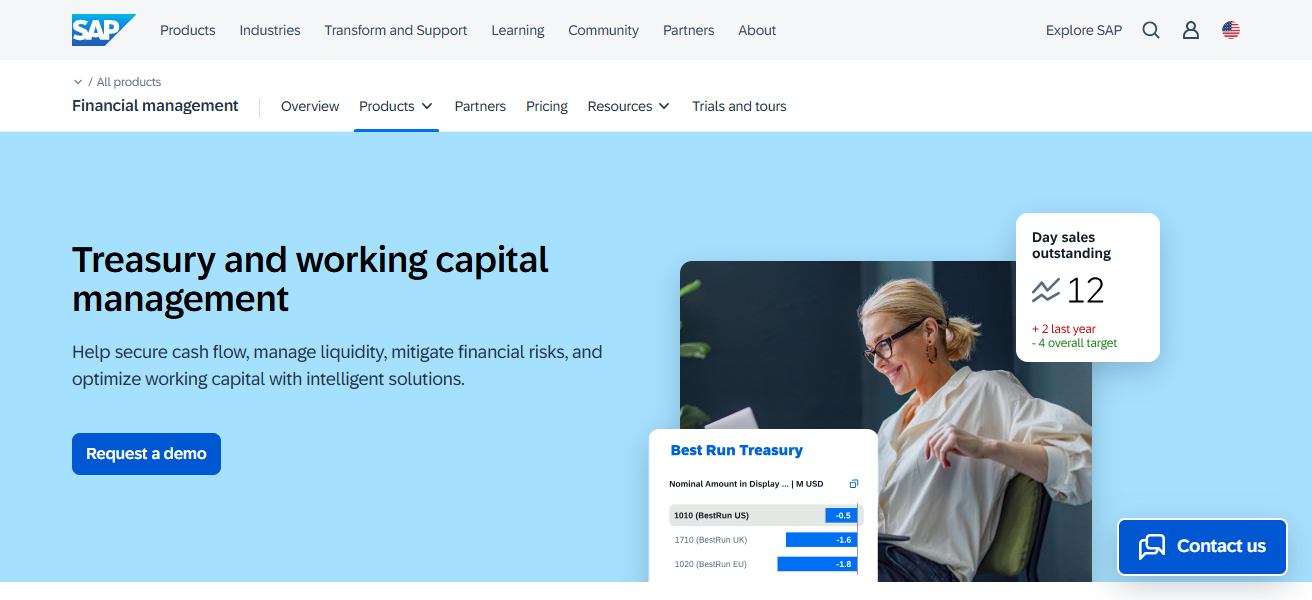
SAP also enables real time forecasting analytics using a combination of financial ERP and market data.
SAP helps enterprises in complex treasury position automate, reduce manual workload, and add financial resilience and risk management.
Features SAP Treasury Management
- ERP integration in the SAP ecosystem.
- Cash forecasting using AI for treasury teams.
- Global adoption with support for enterprise.
- Risk Management for IV and liquidity.
- Audit and compliance extensive.
| Pros | Cons |
|---|---|
| ERP integration with SAP ecosystem | Best suited for SAP-heavy organizations |
| AI-driven cash forecasting | High implementation costs |
| Strong global adoption | Can be rigid compared to niche tools |
10. Eoxs Treasury AI
Eoxs Treasury AI relates to new AI options in treasury that include real-time data processing, predictive analytics, and intelligent automation to enhance forecasting and liquidity management.
The documentation for certain products may be less centralized, but in this category, it is common to utilize machine learning to identify patterns in historical cash flow data, consolidation of multiple data sources (bank feeds, ERP, market data), and conduct scenario analysis.

These tools assist treasury teams in overcoming the use of static spreadsheets, moving to dynamic and constantly updated forecasts that respond to internal and external shifts.
The consolidation of data and the use of prediction tools in Eoxs platforms in complex markets help improve forecasting accuracy and assist strategic planning.
Features Eoxs Treasury AI
- Treasury tasks to automate.
- Cash flow prediction with trend analysis.
- AI-focused design treasury forecasting.
- Very Flexible, This is a Cloud-Native Deployment.
- This is a Simple Interface for Quick Adoption.
| Pros | Cons |
|---|---|
| Automation of routine tasks | Still new and evolving |
| Predictive trend analysis | Smaller market presence |
| Focused on AI-first treasury solutions | May lack enterprise-grade features |
How We Choose Best AI Tools for Treasury Forecasting
- Forecasting Accuracy – Data-driven machine learning and predictive analytics for forecasting accuracy.
- Visibility of Cash – Up-to-date cash visibility in all your bank accounts, entities and currencies.
- Forecasting Integration – Integrated seamlessly with your ERP, banks and financial systems to provide accurate forecasting.
- Efficiency and Automation – We prefer systems that automate data gathering, reconciliation and reporting to reduce the manual work effort.
- Treasury Scenarios & Stress Testing – To help a treasurer plan for uncertainty.
- Treasury Operations – Should support complex treasury activities and scale with the growth of the business.
- User Interface Reporting – Dashboards and reports tailored to user profiles.
- Treasury Security – High level security and regulatory compliance are essential for treasury systems.
Conclusion
In Conclusion Best AI tools for treasury forecasting help finance teams gain accurate snapshots of cash in real time and get automated insights.
Using AI analytics, scenario modeling, and system integrations, these platforms minimize manual work, and improve forecasting accuracy.
Overall, with the right tools, organizations are empowered with proactive risk management, enhanced decision-making, and a more adaptive treasury management coped with a sturdy data analytics.
FAQ
They use artificial intelligence and machine learning to predict future cash flows and liquidity needs.
AI analyzes historical data, patterns, and real-time inputs to generate more precise forecasts.
Yes, solutions exist for startups, mid-sized firms, and large enterprises.
Most leading tools support seamless ERP, bank, and API integrations.
Yes, they automate data collection, reconciliation, and reporting tasks.