This article will focus on the Best B2B Lending Platforms for Businesses looking for trustworthy digital lenders who assist in working capital access.
These platforms help MSMEs owing to their rapid approval processes, flexible repayment terms, and credit scoring based on analytics.
These features make them suitable for modern businesses in need of financing. They are also able to offer alternatives to traditional banking.
Key Poinst & Best B2B Lending Platforms For Businesses
| Platform | Key Point |
|---|---|
| FlexiLoans | AI-powered digital lending for SMEs |
| Save Solutions | IT-enabled correspondent banking services |
| Lendingkart | Quick unsecured loans for MSMEs |
| Indifi | Sector-specific financing solutions |
| SMEcorner | Collateral-free loans for small businesses |
| Capital Float | Flexible credit lines for enterprises |
| NeoGrowth | Revenue-based financing for retailers |
| Faircent | Peer-to-peer lending marketplace |
| Kissht | Instant credit with digital KYC |
| RupeeCircle | Community-driven lending for SMEs |
10 Best B2B Lending Platforms For Businesses
1. FlexiLoans
FlexiLoans is a B2B lending platform that uses advanced technology to facilitate rapid digital business loans for Micro, Small, and Medium Enterprises (MSMEs), with no collateral required. They focus on digital applications, underwriting, and disbursement.
Instead of evaluating a business’s credit only on traditional scores, FlexiLoans looks at alternative, underserved small business data
Such as point of sale (POS) transactions e-commerce, and goods and services tax (GST) information, allowing businesses to access capital more quickly.
The company’s co-lending solution, through which APIs (Application Programming Interfaces) link funding from banks and Non-Banking Financial Companies (NBFCs), provides a low investment operational model with quick funding and more approvals.
FlexiLoans has funded billions of rupees and is still growing its network of partners across various industries.
FlexiLoans Features
- Quick Digital Onboarding: Entirely online applications with instant eligibility checks greatly reduce processing times.
- Alternative Data Underwriting: Evaluates thin-file businesses credit with GST, bank, and transactional data.
- Co-Lending Network: Expands lending capacity and product offerings through partnerships with NBFCs and banks.
- Seasonal Flexi Repayment: Repayment plans are tailored to seasonal business cash flow and sales cycles.
| Pros | Cons |
|---|---|
| Quick loan approval with digital onboarding and minimal paperwork tailored for MSMEs. | Interest rates can be higher than traditional banks due to unsecured lending risk. |
| Uses alternative data (GST, POS, bank transactions) to assess creditworthiness, helping thin-file businesses. | May require strong digital documentation which some traditional businesses struggle to provide. |
| Offers co-lending with banks/NBFCs, increasing loan availability. | Customer support response times can vary based on volume. |
| Flexible repayment options aligned with cash flow cycles. | Not ideal for large capital-intensive loans (> ₹1–2 crore). |
2. Save Solutions
Save Solutions, which is often branded as SaveLoan Solutions, is a business finance platform that provides custom lending solutions, including working capital loans, invoice financing, and receivables funding to small and medium enterprises. ‘
Its financing plans, in addition to branded financial advisory services, are more unique than competitors since they are based on individual business cash flows. This personalized service helps manage business liquidity and match loan payments with revenue.
Save Solutions also demonstrates strong sectoral expertise in manufacturing, services, and distribution industries and offers flexible payment terms with competitive pricing.
Save Solutions Features
- Customized Financial Advising: Offers tailored lending support and guidance per business cash flow.
- Receivables Monetization: Working capital gaps are addressed through funding on receivables and invoices.
- Revenue-Based Custom Loan Structuring: Payment plans that are not bank template driven, but rather tied to actual revenue cycles.
- Targeted Small Business Lending: Designed for unserved segments of MSMEs across industries for a holistic approach.
| Pros | Cons |
|---|---|
| Focus on personalized financing advice alongside lending helps businesses plan better. | Smaller scale than major fintech lenders, which may limit loan volumes. |
| Flexible structured payment plans based on actual cash flow. | Not widely recognized, so businesses may hesitate to trust new fintech. |
| Offers working capital and receivables funding suited for liquidity gaps. | Digital process may lack automation depth seen in larger competitors. |
| Tailored products for specific industry needs. | Limited physical branch presence for in-person support. |
3. Lendingkart
Lendingkart has established itself as one of India’s largest digital lenders for SMEs, having dispursed over $1 billion across more than 130,000 businesses since starting operations.
Through partnerships with over 130,000 small and medium businesses (SMEs), it provides proprietary AI financial services using Cred8.
It’s AI evaluates a myriad of data points, bank statements, and business operational performance to offer businesses credit and funding approvals within 72 hours.
It’s technology facilitates credit access for those businesses in Tier 2 and Tier 3 cities with little to no business credit history.
Additionally, through products offered by Lendingkart such as Xlr8 SaaS, API integrations, and channel partner tools, broader distribution and optimized customer acquisition for partners and lenders is facilitated.
Lendingkart Features
- Proprietary Hybrid Algorithms: Smarter lending with improved accuracy through transactional data and alternative credit scoring.
- Instant Disbursal: Once documentation is complete, turnaround times of under 72 hours are expected.
- Strong Partner Ecosystem: Collaborates with SaaS, POS, and fintech partners for greater expansion.
- Working Capital Solutions: Provides operationally driven short-term loans and lines of credit.
| Pros | Cons |
|---|---|
| Fast approval and disbursal, often within a few days. | Traditional credit score still influences pricing. |
| AI-based underwriting evaluates large data points beyond credit history. | Interest rates can be higher due to unsecured risk pricing. |
| Strong distribution network and partner integrations. | May have stricter eligibility criteria for newer businesses. |
| Dedicated tools for partners and channel agents to expand reach. | Charges processing fees that add to loan cost. |
4. Indifi
Indifi has carved a niche for itself by extending tailored credit solutions to specific industries like travel, retail, hospitality, healthcare, and logistics.
Instead of offering one-size-fits-all lending solutions, Indifi builds products by integrating partnership platforms (like e-commerce and travel aggregators) to underwrite real-time transactional data and adjust lending to suit sectoral cash flow cycles and revenue models.
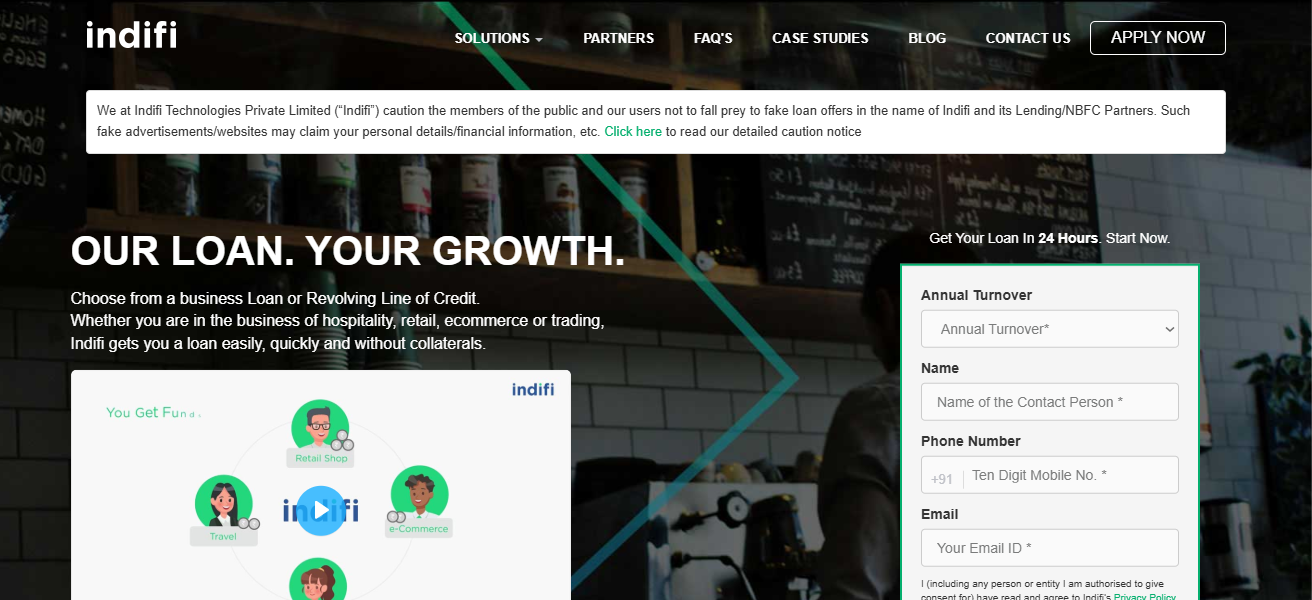
This strategy reduces the emphasis on traditional credit score metrics and enables lending on critical seasonality and revenue fluctuations.
Indifi also partners with banks/NBFCs for co-lending, to provide a greater lower capital flow to SMEs who are victims of the blind spot of mainstream lenders.
Indifi Features
- Sector-Specific Products: Develops financing solutions for each sector, including healthcare, travel, retail, and logistics.
- Real-Time Transaction Data: Incorporates live sales data and platform analytics for loan underwriting and pricing.
- Embedded Credit: Provides financing options at checkout for marketplaces and platform businesses.
- Flexible Tenures: Industry-specific loan tenure options related to revenue cycles.
| Pros | Cons |
|---|---|
| Industry-specific lending products designed around sector revenue behavior. | Limited penetration outside major business hubs. |
| Uses real-time platform/transaction data for smarter underwriting. | Certain sectors (e.g., agriculture) may not be fully supported. |
| Partnerships with marketplaces help SMBs get embedded credit. | Loan amounts may be capped compared to large institutional lenders. |
| Helps businesses with seasonality and cyclical cash flow patterns. | Underwriting tech may require connected platforms (e.g., ecommerce) to work best. |
5. SMEcorner
SMEcorner focuses on unsecured business and working capital loans for micro, small, and medium enterprises.
SMEcorner implements a hybrid underwriting model where some parts of the process are automated while others are carried out by employees.
This model allows SMEcorner to assist businesses that have little to no formal credit histories. SMEcorner is also able to offer loans in a matter of days

And typically, its loans are for amounts ranging from a couple of lakhs to several crores and it is able to do this with very little required documentation.
SMEcorner’s collateralized co-lending arrangements and detailed loan portfolios assist in the management of their portfolio risk.
This is necessary due to the clientele that SMEcorner services, which include under-served segments, traditional retail shops, and service SMEs across India.
SMEcorner Features
- Unsecured Loan Options: Provides credit to micro and small enterprises without collateral.
- Human + Tech Underwriting: Responsible loan deployment via automation and human underwriting.
- Minimal Documentation: Ideal for businesses without formal paperwork.
- Pan-India Reach: Targets small enterprises in rural and semi-urban areas.
| Pros | Cons |
|---|---|
| Specializes in unsecured loans for small and micro enterprises. | Loan approval timelines may be slower than fully automated lenders. |
| Minimal documentation requirements compared to banks. | Less technology depth than some fintech giants. |
| Human-augmented underwriting balances tech and touch. | Interest rates can vary widely across profiles. |
| Focused on underbanked regions and traditional businesses. | Smaller credit limits for high-growth companies. |
6. Capital Float
Capital Float is a digital lending platform providing SMEs and online sellers with working capital loans, supply chain financing, and merchant financing.
Its product mix includes BNPL (Buy Now Pay Later) for merchants, inventory staged financing, and term loans with varying repayment options.
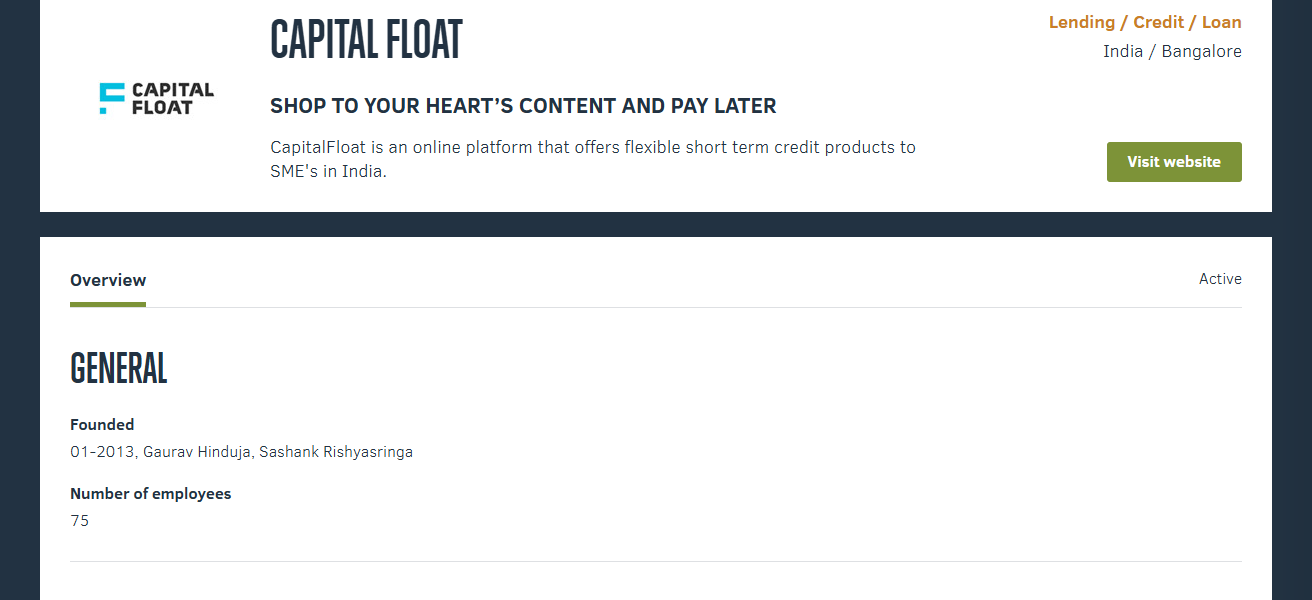
Capital Float bolsters its credit analytics by conducting transaction-based data analysis in collaboration with marketplace and POS system partners.
The platform’s rapid lending and flexible financing solutions assist companies in streamlining cash cycles and operational scaling without extensive banking delays.
Capital Float Features
- Product Diversity: Provides supply chain financing, working capital loans, and merchant BNPL.
- Integrated Data Analytics: Uses credit risk assessment data from POS and marketplace integration.
- Flexible Repayment: Customize repayment terms based on the business cash inflows.
- Partnership-Driven Distribution: Collaborates with platforms and partners to finance embedded workflows.
| Pros | Cons |
|---|---|
| Wide product suite including supply chain financing and merchant BNPL. | Complex product options may overwhelm new borrowers. |
| Integrates with POS and marketplaces to assess performance data. | Higher interest for unsecured products. |
| Flexible repayment aligned to sales cycles and business receipts. | Some products are available only via platform partners. |
| Well-established brand with strong fintech ecosystem presence. | Eligibility can be strict for very small enterprises. |
7. NeoGrowth
NeoGrowth specializes in providing unsecured business loans to retailers and offline businesses. Utilizing digital transaction data (like card swipes and payment terminal data), NeoGrowth underwrites credit risk.
NeoGrowth’s strength lies in embedding merchant revenue data into credit models. This enhances cash flow and repayment capability assessments without having to secure significant collateral.
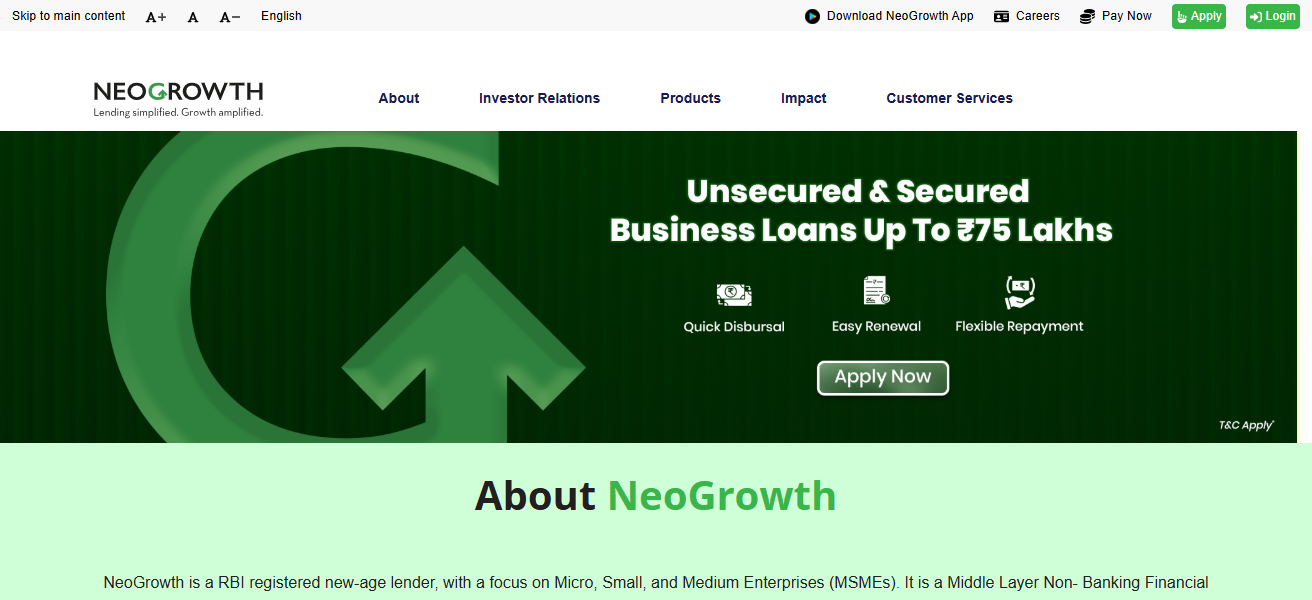
This feature is particularly advantageous to small retailers and service providers whose growth is heavily reliant on daily sales. NeoGrowth also offers flexible repayments that align with business performance.
NeoGrowth Features
- Merchant Revenue-Oriented Underwriting: Loans based on historical transactions at a card terminal and digital transaction history.
- Retail-Focused Loans: Lending business centered on small credit for retailers and service businesses.
- Performance-Linked Repayments: Repayment plans based on daily transactions usually help manage cash flow better.
- No Collateral Required: Offers unsecured loans based on authentic transaction data.
| Pros | Cons |
|---|---|
| Uses merchant transaction data (card swipes, terminals) for credit decisions. | Requires digital payment history, making it less helpful for cash-only businesses. |
| Tailored for retail and brick-and-mortar operations. | Loan sizes may not fit large growth projects. |
| Flexible, performance-linked repayment options. | Limited product diversification beyond core unsecured loans. |
| Helps businesses with digital payment adoption. | May not be competitive for highly rated credit profiles. |
8. Faircent
Faircent was the first P2P lending platform in India to get RBI registration. They connect businesses and individual borrowers with both retail and institutional lenders.
Faircent is different from the regular NBFC lenders. On their platform, borrowers can set the terms and pick their lenders which can help them get a loan at better rates.
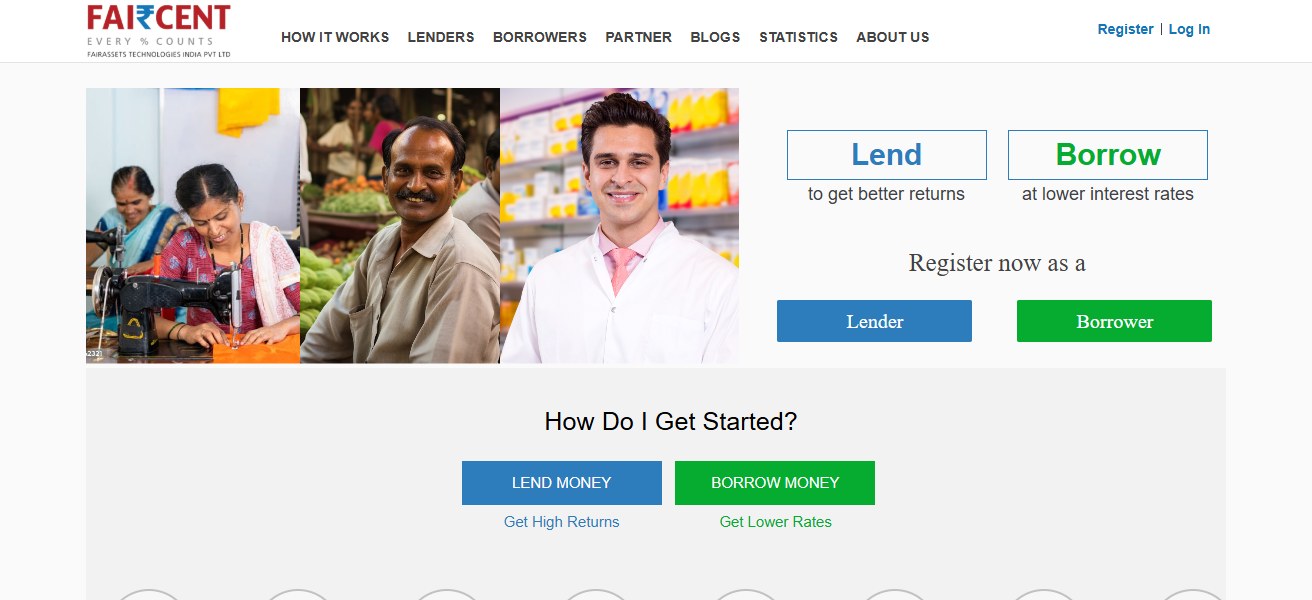
Investors can spread their investments across different borrowers and get better returns than most investing options and provide a higher risk.
Faircent helps businesses get capital by providing them with a funding source outside of traditional lenders, which is especially helpful for short-term funding needs or for filling liquidity gaps.
Faircent Features
- Peer-to-Peer Marketplace: Provides a platform for businesses to interact with individual and institutional lenders.
- Transparent Loan Terms: Borrowers have the ability to evaluate and select among competing offers for loans.
- Investor Diversification: Loan providers can mitigate risk by lending to a number of different business loans.
- Competitive Pricing Potential: Offers loans at prices determined by the market rather than a fixed price by a lender.
| Pros | Cons |
|---|---|
| Peer-to-peer model connects borrowers directly with lenders. | Returns and pricing depend heavily on investor risk appetite. |
| Potentially competitive interest rates versus traditional NBFCs. | Less institutional capital depth than bank-linked lenders. |
| Transparency on lender options and terms. | Loan amounts and terms can be restricted compared to large fintechs. |
| Option for investors to diversify across business loans. | Requires careful borrower risk evaluation by users. |
9. Kissht
Kissht is a financial technology company specializing in digital lending, providing fast unsecured loans to micro, small, and medium enterprises (MSMEs) and self-employed business owners, focusing on instant approval and easy documentation.
Kissht provides loans up to several hundred thousand rupees (lakhs) with flexible repayment plans and also offers secured loans, such as loans against property, for larger amounts.
Unlike most of its competitors, Kissht offers a unique and fully digital mobile experience, giving small business owners credit access on their smartphones with minimal documentation and high speed, allowing them to avoid traditional banking.
Kissht Features
- Mobile-First Experience: Accessibility of business loans on a smartphone with fewer paperwork requirements.
- Unsecured Micro-Loans: Designed for small business owners and self-employed persons.
- Flexible Repayment Plans: Cash flow cycles of SMEs drive the design of some plans.
- Fast Decisions: Expedited processes for urgent working capital requirements.
| Pros | Cons |
|---|---|
| Quick, mobile-first application process with minimal paperwork. | Smaller loan sizes focus mainly on short-term working capital. |
| Unsecured lending suited for micro and self-employed businesses. | Fewer tailored B2B products than larger B2B fintechs. |
| Flexible repayment options designed for microbusiness cash flows. | Interest rates can be higher for unsecured risk profiles. |
| Straightforward digital experience and user interface. | Limited offline support for traditional SMEs. |
10. RupeeCircle
RupeeCircle is a new P2P lending platform that is licensed as an NBFC-P2P and links borrowers (small businesses and entrepreneurs) with investors.
Its marketplace model focuses on the use of technology to offer credit with minimal documentation and quicker loan turnaround times.
From an investment perspective, it provides an opportunity to earn positive risk-return margins which creates a sustainable ecosystem.
To further aid the liquidity of MSMEs, RupeeCircle has expanded its offerings to include business finance solutions such as invoice discounting.
Additionally, the platform has integrated UPI/NEFT/IMPS wallets to enhance transactional ease and optimal working capital access for businesses.
RupeeCircle Features
- P2P Lending Model: Marketplace that enables business borrowers to obtain funds from individual lenders.
- Invoice & Discounting finance: Provides products to assist with the liquidating of receivables.
- Simplified Application: A digital approach with less documentation.
- Integrated Payments: Facilitates seamless payments and money transfer to increase liquidity.
| Pros | Cons |
|---|---|
| P2P marketplace allows direct interaction between borrowers and investors. | Matching with investors can take time versus instant disbursal. |
| Offers alternate financing like invoice discounting for SMEs. | Platform scale may be smaller than major digital lenders. |
| Simplified, less-paperwork process for quick working capital. | Risk assessment quality varies with available data. |
| Integrates payment mechanisms for smooth cashflow management. | Suitable mainly for smaller to mid-range loan needs. |
How To Choose Best B2B Lending Platforms For Businesses
Assess Your Loan Needs: Determine how much you plan to borrow, what you need the loan for, and how long you need it for.
Check Criteria: Make sure the business meets turnover, business age, and documentation requirements before getting to the approvals. It will be smoother.
Compare Costs: What will it ultimately cost you to borrow the money, i. e. interest, processing, and other fees.
Review Flexibility: Some repayments will mean no more than a x-month loan and will lose repayments.
Speed: Some repayments will mean no more than a x-month loan and will lose repayments.
Missing Data: If you are super thin-file or a new business, you may leverage data differently.
Quality: If you don’t believe it, support should be sufficient to help you with payment and dispute.
Control: It also useful to look for a line of credit, but need to control working capital, invoice financing and so on.
Integrated tech: Aside systems, some platforms are also integrated with other systems for e-commerce or POS.
Score: Finally, don’t forget to look for a final set of metrics such as reputation, review, and score of trust.
Conclusion
To sum up, optimal B2B lending platforms for businesses provide rapid funding, adaptive repayment options, and credit assessment through data analytics.
These platforms assist MSMEs in overcoming the constraints of conventional banking by offering easily obtainable adjustable working capital, customized loan offerings, and the ease of digital banking.
The selection of an appropriate platform depends on the size of the business, the cash flow requirements, and the goals for sustained business growth.
FAQ
It provides business loans to companies using digital, data-driven lending models.
MSMEs, startups, traders, and service-based businesses meeting eligibility criteria.
Yes, they usually offer quicker approvals and faster fund disbursal.
Most platforms offer unsecured loans, depending on business profile.
Rates depend on credit score, cash flow, business age, and risk assessment.