This article is about the top Banking-As-a-Service (BaaS) Providers that help businesses embed financial services.
- Key Ponts & Best Banking-As-a-Service (BaaS) Providers
- 10 Best Banking-As-a-Service (BaaS) Providers
- 1. Solaris
- Solaris
- 2. Railsbank (now Railsr)
- Railsr (previously Railsbank)
- 3. Treezor
- Treezor
- 4. ClearBank
- ClearBank
- 5. Bankable
- Bankable (Bnkbl)
- 6. Marqeta
- Marqeta
- 7. Unit
- Unit
- 8. Synapse
- Synapse
- 9. Treasury Prime
- Treasury Prime
- 10. Fidor Bank
- Fidor Bank Features
- How To Choose Best Banking-As-a-Service (BaaS) Providers
- Cocnsluion
- FAQ
BaaS allows companies to offer services like digital accounts, payments, cards, and other banking solutions without having to construct a bank.
In today’s fintech-driven world, choosing the right provider is important for scalability, compliance, and customer experience.
Key Ponts & Best Banking-As-a-Service (BaaS) Providers
| Provider | Key Point |
|---|---|
| Solaris | Strong European presence with full banking license |
| Railsbank (now Railsr) | Flexible API-driven platform for embedded finance |
| Treezor | Specializes in payment solutions and card issuing |
| ClearBank | Focus on clearing and real-time payments infrastructure |
| Bankable | Modular platform enabling digital banking solutions |
| Marqeta | Global leader in card issuing and payment processing |
| Unit | US-based provider simplifying fintech product launches |
| Synapse | Comprehensive suite covering payments, lending, and deposits |
| Treasury Prime | Strong API-first approach with US bank partnerships |
| Fidor Bank | Pioneer in digital banking with customizable solutions |
10 Best Banking-As-a-Service (BaaS) Providers
1. Solaris
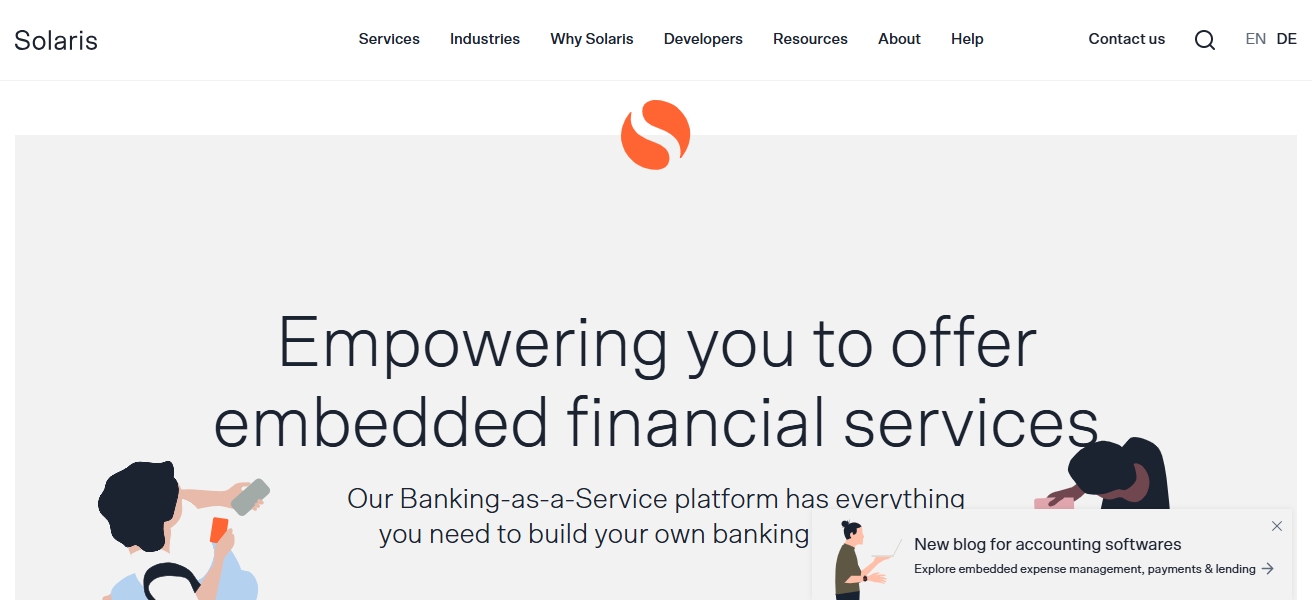
Solaris is a prominent BaaS (Banking as a Service) company based in Berlin, Germany, and has a complete banking license and cloud-based banking infrastructure, allowing clients to integrate services such as digital banking, payments, and card issuance into their existing products.
With its B2B API, clients can quickly and efficiently launch financial services in their products, such as IBAN accounts
SEPA payment services, debit and credit cards, and various compliance functions, without the need to develop complicated systems.
As a fully licensed and regulated banking institution, Solaris handles all the banking regulatory requirements, including AML and KYC, deposit insurance, and other banking-related services
So its clients can concentrate on enhancing their services and innovation. Solaris services 30 countries in the European Economic Area and is a key server for numerous Fintech companies.
Solaris
- API modularity ensuring digital services embedding, card issuing, and payment flows as part of banking solutions.
- The entire European banking license allowing for the provision of services (i.e., deposits, loans (BNPL included), and SEPA transers) without the partners having to get their own licenses.
- Cross-border service provision across EU markets, including local IBAN issuance, multi-currency, and embedded cross-border compliance.
- API compliance & onboarding (KYC/AML) tools, and identity verification and regulatory reporting, all embedde
| Pros | Cons |
|---|---|
| Full European banking licence allows true banking services (accounts, cards, payments). | Can be complex for very early-stage startups without compliance experience. |
| Strong regulatory compliance (KYC/AML, deposit insurance). | Primarily focused on Europe, limited global reach. |
| Modular API ecosystem supports many fintech products. | Pricing can be higher for smaller partners. |
| Proven track record with many established fintechs. | Setup and integration may take longer depending on requirements. |
2. Railsbank (now Railsr)
Railsr provides businesses around the world with the capacity to integrate banking services, payment systems, credit, digital wallets, and card services all through one simplified unified API.
They work on a global scale with partnerships across Europe, Asia, and North America and provide services including digital account support, interledger transfers, multi-currency wallets, and compliance.
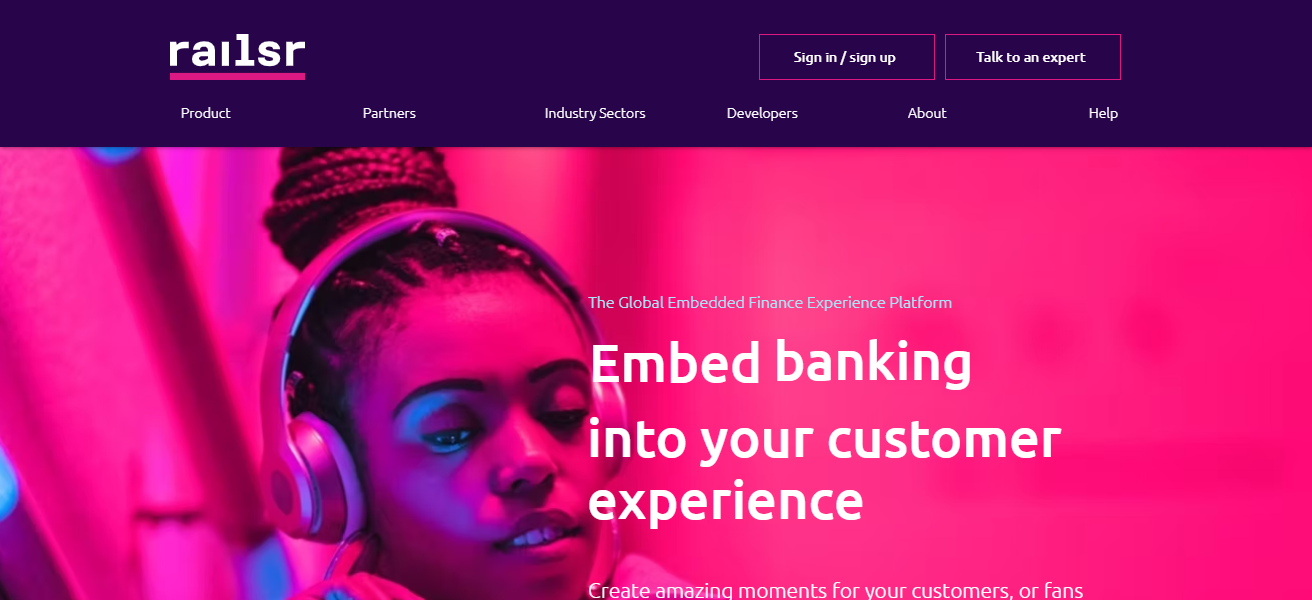
Railsr operates a single-contract model, allowing management of complex banking structures to be removed from clients, enabling branded financial partnerships to be offered through enterprises
from startups to enterprise level, across all verticals including retail and travel. With Railsr, complex banking structures become a thing of the past.
Railsr (previously Railsbank)
- Consolidated APIs for embedding finance solutions with accounts, wallets, cards, payments, and FX APIs all in one stack.
- Global presence & multi-currency offerings to support businesses in multiple geographies and provide extensive payment schemes.
- Inbuilt Compliance and risk management offering integrated in the ecosystem including payment safeguarding, fraud monitoring, and AML.
- Credit and card solutions including virtual, prepaid, and debit cards, and integrated credit option.
| Pros | Cons |
|---|---|
| Global coverage across Europe, Asia, and U.S. markets. | Some advanced features may require additional bank partners. |
| Unified API supports accounts, cards, wallets, and credit. | Documentation can be complex for beginners. |
| One-contract model simplifies partnerships. | Pricing structures may be opaque for some services. |
| Flexible for enterprises and startups alike. | Compliance obligations still fall partly on partners. |
3. Treezor
Treezor, a BaaS provider from France, has backing from Société Générale, and gives white-label banking and payment solutions throughout Europe.
Having an EMI and e-money license, Treezor’s platform allows businesses to provide IBAN accounts, handle SEPA and SWIFT payments, and begin programs for prepaid and virtual cards.
It also has KYC/AML compliance and payment processing services, which makes it a good fit for digital banks and fintechs.
Treezor’s commitment to compliance and technical guidance helps partners navigate regulatory complexity, while motor banking embedded finance into their offerings.
Treezor
- API powered technical core for embedded banking that includes accounts, payments and card issuance.
- Regulatory Licence (EMI) from the French authorities, enabling partners to utilize the e-money framework.
- Payment Processing including SEPA, direct debits, and e-wallets.
- Operational & compliance support from in-house experts to assist partners in launching and scaling their services.
| Pros | Cons |
|---|---|
| Licensed under French regulations, strong compliance. | Available mainly to European companies. |
| Offers accounts (IBAN), cards, SEPA/SWIFT payments. | Less customizable than developer-centric pure-API platforms. |
| Backed by a large banking group (Société Générale). | Not focused on non-bank financial services like lending. |
| Good onboarding support for regulated fintechs. | Fewer global rails outside SEPA. |
4. ClearBank
ClearBank is a a BaaS provider and clearing bank based in the UK that offers real time payment and account infrastructures to fintechs, banks, and corporations via APIs.
Partnered with the UK’s payment schemes, and licensed banking platforms, partnered FSCS protected banking accounts and embedded banking services, and direct clearing rail access, banking services are offered.
Integration of core banking services via the cloud APIs is seamless, and operational complexity is decreased while improving time to market.
Focused on state of the art bank services, scalable, and secure, and with the regulatory requirements, on BaaS services that are robust without the need to build a bank, BaaS pillars are provided.
ClearBank
- UK Clearing Bank Infrastructure offering direct access to real-time payment and clearing systems.
- API-first embedded banking services for accounts, payments, and settlements for fintechs and corporates.
- Real-time clearing and settlement for faster payment rails and balance reconciliation.
- Support for digital products — enabling partners to rapidly launch embedded accounts and other banking features through APIs.
| Pros | Cons |
|---|---|
| Direct access to UK clearing and settlement systems. | UK-centric focus limits use outside the UK. |
| True clearing bank (not a fintech-only provider). | Less emphasis on card issuing features. |
| Accounts with FSCS protection through partners. | Not ideal for companies seeking multi-region support. |
| API-driven real-time payments and accounts. | Onboarding can be stringent. |
5. Bankable
Bankable (trading as Bnkbl) is a BaaS provider based in London which offers modular banking solutions including account management, card (both virtual and physical) issuance, wallets, and payments.
Using a BaaS model, users can embed digital accounts, payments, and instant settlements into their customer experience.
Bankable differentiates itself by focusing on transactional use cases (including volume-driven) and merging modern banking with digital solutions.
Strategic partnerships and acquisitions are a big part of their growth plan, allowing them to expand embedded finance. This offers their partners an effective and economical way to scale and manage financial solutions.
Bankable (Bnkbl)
- Modular API platform for card issuing, digital accounts, wallets, and payment functionality.
- Flexible Program Management tools for virtual/physical card issuance and transaction control.
- High Volume Use Cases Design, servicing enterprises and fintechs with scalable infrastructure.
- Strong European Footprint along with regulatory compliance support in select markets.
| Pros | Cons |
|---|---|
| Strong modular APIs for cards, accounts, wallets. | Documentation quality varies by region/use case. |
| Supports virtual + physical card issuance. | Not as widely adopted as some global competitors. |
| Good scalability for high-volume transactions. | Pricing can be high for smaller volumes. |
| Enterprise-ready for large companies and banks. | Some advanced services need custom contracts. |
6. Marqeta
Marqeta is an internationally recognized provider of payment processing and card-issuing solutions, along with payment system processing infrastructure.
Marqeta provides businesses with the ability to create customized card programs through their APIs, including virtual, debit, and credit card options.
While often linked with card issuing products, the breadth of Marqeta’s BaaS (Banking as a Service) solutions
When paired with their banking partners, also includes bank account functionalities, real-time payments, and embedded payments.
Square, Klarna, and other leading Fintech’s utilize Marqeta. Some distinguishing features of Marqeta’s platform include functionality to support JIT (just-in-time) funding and fraud filters.
Marqeta is distinguished when it comes to global access, scalability, and developer and enterprise support.
Marqeta
- Purchased card processing APIs with modern card issuing capabilities for virtual, debit, and credit cards, plus dynamic controls.
- Embedded finance components for cards, accounts, and money movement that are scalable.
- Developer-targeted platforms like RESTful APIs, SDKs, and sandbox environments for rapid go-live.
- Program & risk management features like tokenization, fraud detection, and spend controls.
| Pros | Cons |
|---|---|
| Industry-leading card issuing + payment controls. | Most powerful for card products; not a full bank replacement. |
| Advanced features like JIT funding and real-time controls. | Needs bank partners for core banking services. |
| Excellent developer tools and documentation. | Pricing for small projects can be expensive. |
| Global footprint with multi-currency support. | More complex to integrate non-card services. |
7. Unit
Unit provides a U.S.-focused Banking as a Service (BaaS) platform that enables companies and startups to easily and quickly offer banking and lending products with a lower engineering barrier.
Its APIs provide digital accounts, ACH (automated clearing house) payments, debit card issuance, and compliance features, as well as developer dashboards and sandboxes to streamline the development process.
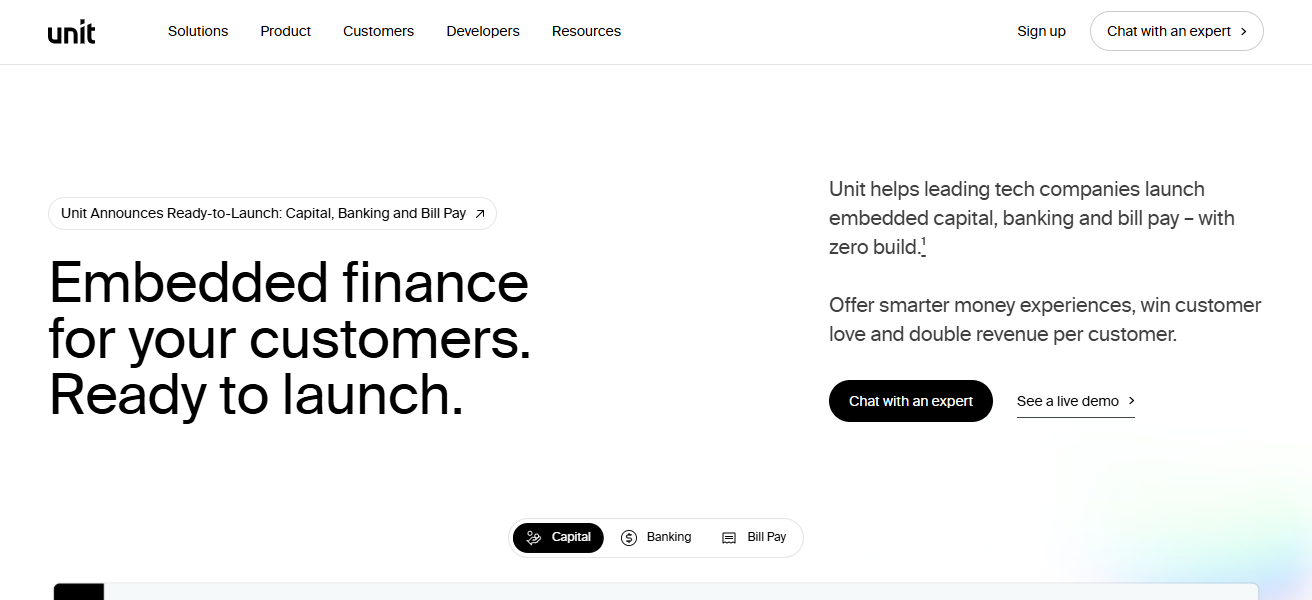
Thanks to the Unit sponsor bank, compliance and U.S. regulatory hurdles are simplified. This allows partners to offer embedded banking solutions within their apps without having to build their own banking infrastructure.
Because of the quality developer experience and readily available modules, Unit has become a leading BaaS provider for fintech companies and SaaS businesses that want to quickly and easily add a financial services component.
Unit
- Complete BaaS toolkit such as accounts, card issuance, ACH payments, and basic lending primitives.
- Embedded workflows for compliance so partners manage regulations in less time. (Fintech Review)
- Operational dashboards for KYC exceptions, disputes, and settings to avoid engineering tickets.
- Sandbox and SDK to boost the speed of product development and lessen time to market.
| Pros | Cons |
|---|---|
| Strong U.S.-focused BaaS with payments, accounts, cards. | Mainly focused on the U.S. market. |
| Great sandbox + developer experience. | Some regulatory and compliance features still limited to U.S. rails. |
| Built-in compliance workflows lower regulatory burden. | Not ideal for non-U.S. companies. |
| Fast time-to-market for startups and fintechs. | Smaller network of global partner banks. |
8. Synapse
Synapse Financial Technologies Inc. was a once-reputable BaaS provider trusted in helping fintechs offer embedded banking services (accounts, payments, debit cards) through APIs.
Its downfall in 2024 highlighted the risks in the BaaS ecosystem, emphasizing the need for tighter financial controls and regulatory scrutiny.
Before the company shut down, Synapse was funded by prominent investors and was able to link hundreds of fintechs to banking services, without the need for a regulatory license.
This company is often used in examples of partner due diligence and risk management in embedded finance.
Synapse
- API-based banking infrastructure for accounts, cards, and payments.
- White-label banking products for POs, including checking, savings, and debit cards.
- Compliance and regulatory tooling to assist partners in addressing legal requirements as they execute their plans.
- Customization capabilities allows partners to modify financial solutions for particular audiences.
| Pros | Cons |
|---|---|
| Historically offered accounts, payments, cards via APIs. | Bankruptcy highlighted business model and control issues. |
| Strong early developer community. | Closed operations create risks for continuity. |
| Previously quick onboarding. | Lost trust from many partners. |
| Good U.S. regulatory support historically. | Now not recommended as a BaaS partner due to shutdown. |
9. Treasury Prime
Treasury Prime is a U.S. embedded banking and BaaS platform. It connects fintechs and enterprise partners to regulated banks via modern API.
It allows partners to embed banking features, payments, and risk and compliance management into their apps while managing core banking integrations and risk.
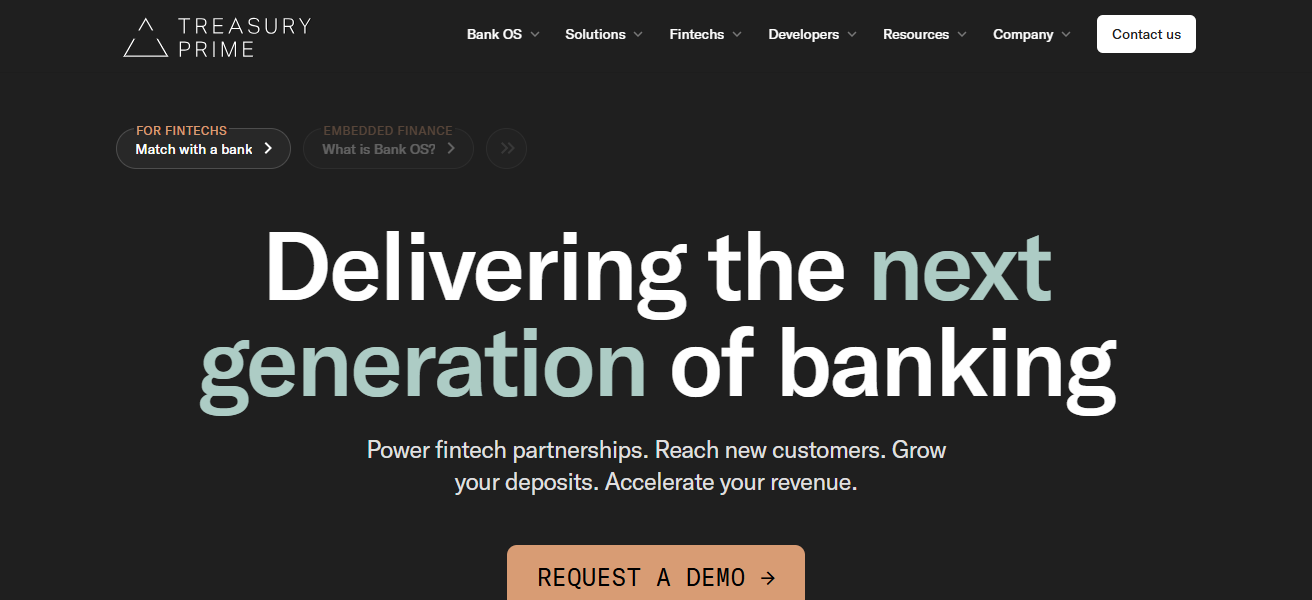
Treasury Prime’s platform is designed to be flexible and scalable to support rapid fintech product development and deployment.
Treasury Prime is an active BaaS industry community member and advocates for the industry’s best practices. It continues to expand its services to assist banks and fintechs in innovating within a regulated environment.
Treasury Prime
- Bank-grade API that allows fintechs to connect with regulated banks for embedded accounts and transactions.
- Embedded compliance and risk management.
- Card issuing support through fintech partners like Marqeta.
- Quick onboarding for developers allowing partners to iterate and expedite product launches.
| Pros | Cons |
|---|---|
| Strong U.S. BaaS with flexible API platform. | U.S. focus means limited international availability. |
| Helps handle compliance through sponsor banks. | Some advanced financial services require extra integrations. |
| Well-built developer experience and support. | Not as many global rails as some competitors. |
| Good for fintechs wanting embedded accounts & payments. | Pricing can be opaque for complex use cases. |
10. Fidor Bank
Fidor Bank is a German digital bank that has been providing BaaS and digital banking services for some time.
It focuses on community-centric digital banking and middleware services that enable banks, fintechs, and other companies to offer financial products to customers.

Digital account management, online payment services, client engagement suites, and cloud-native infrastructure are some of Fidor’s specializations.
Fidor is highly valued by its partners for providing adaptable and innovative digital banking solutions as its competitors may have a wider global reach but are not as experienced in the digital banking technological space.
Fidor Bank Features
- Digital banking as a service, with APIs for embedded banking and collaborative products.
- Partners can integrate accounts and payments through the open API ecosystem. ([LinkedIn][4])
- Innovative online banking and fintech customer-centric offerings. ([Dataintelo][13])
- Fusion of modern APIs with traditional banking digital services. ([Dataintelo][13])
| Pros | Cons |
|---|---|
| Established digital bank with BaaS and middleware offerings. | Smaller global footprint than other BaaS providers. |
| Good for digital-first banking and community models. | Core banking services may be less modern than pure API platforms. |
| Strong experience in EU markets. | Fewer plug-and-play modules than newer fintech-centric BaaS. |
| Deep banking expertise from traditional operations. | Not as developer-centric as cloud-native platforms. |
How To Choose Best Banking-As-a-Service (BaaS) Providers
- Regulatory Compliance: Check if the Provider is Fully Licensed, KYC, AML, and Regulatory Reporting are ascribed to.
- APIs & Integration: Check if there are APIs. Make sure the provided APIs are easily integrable, well documented, and simple to use.
- Services Offered: Check their offerings. Determine if they provide the services you need (accounts, cards, payments, wallets, lending, etc).
- Geographic Coverage: Make sure the Provider is in all your target regions and is compliant with the payment rails you need.
- Scalability & Reliability: Check if the Provider will be able to meet your growing transaction expectations and volumes.
- Pricing & Flexibility: Check the Provider’s modularity, fees, and business size compliance to see what is best for you.
- Security & Risk Management: Analyze the Provider’s fraud, encryption, and operational (shift left) security.
- Support & Onboarding: Proper support and onboarding are important so your Provider gets you set up properly in a timely manner.
Cocnsluion
In closing, selecting a Banking-As-a-Service (BaaS) provider is critical for businesses wanting to embed financial services seamlessly. The optimal providers furnish flexible, secure, and compliant solutions for account, payments, and card services.
Assessing attributes, API functionality, regional coverage, and customer service enables businesses to drive banking solutions and optimize growth in the highly competitive fintech environment.
FAQ
BaaS allows businesses to offer banking services like accounts, payments, and cards via APIs without becoming a licensed bank.
They handle compliance, infrastructure, and payments, letting businesses focus on customer experience.
Yes, top providers operate under banking or e-money licenses and comply with KYC/AML rules.
Accounts, card issuing, wallets, payments, lending, and analytics tools.