In this article, we will go over the Best Bitcoin Staking Protocols, so you can find out how to get potential rewards from your Bitcoin holdings. We’ll explore the best platforms like the Babylon Protocol, Solv Protocol, Core DAO
Lombard and others, discussing their key features, supported assets, anticipated yields, minimum investment, reward schemes, security and liquidity choices to guide you toward making well-informed decisions.
How We Choose The Best Bitcoin Staking Protocols of 2023
- Security & Audits: Security measures, smart contract audits & custody mechanisms reviewed.
- Expected APY/Yield: Estimated potential yields and sustainability of rewards without assuming yields are guaranteed.
- Supported assets: Verified BTC, STX, liquid Bitcoin tokens and other eligible assets.
- Minimum Investment: Evaluated the entry thresholds and ease of access for various investors.
- Rewards System : Reviewed reward tokens, distribution processes, compounding options.
- Liquidity & Lock-up: evaluated withdrawal flexibility, unbonding periods and redemption terms.
- Supported Networks: Investigated compatibility with blockchains and cross-chain integrations.
- User Experience: Reviewed wallet compatibility, ease of staking and overall feel.
- Availability & Reputation: Viewed regional eligibility, platform reliability, and ecosystem adoption.
Key Points &Best Bitcoin Staking Protocols In 2026
| Best Bitcoin Staking Protocols | Explanation |
|---|---|
| Babylon Protocol | Enables Bitcoin holders to stake BTC securely and support proof-of-stake blockchain security. |
| Solv Protocol | Offers Bitcoin-based staking products designed to generate yields through decentralized finance strategies. |
| Stacks Bitcoin Staking | Lets STX holders earn Bitcoin rewards through Stacks’ consensus mechanism called Stacking. |
| Core DAO | Enables Bitcoin holders to participate in BTC staking and earn potential CORE rewards. |
| Lombard | Provides LBTC, a liquid Bitcoin token designed to earn staking-related Bitcoin DeFi opportunities. |
| Acre | Offers Bitcoin staking solutions designed to provide BTC yield while maintaining liquidity. |
| StackingDAO | Enables STX holders to liquid-stack tokens and access potential Bitcoin-denominated rewards. |
| Endur | Provides liquid staking solutions within the Cosmos ecosystem, including assets linked to Bitcoin-related strategies. |
| Kraken | Offers eligible users crypto staking and rewards products, depending on asset and region. |
| Binance Earn | Provides crypto earning products, including eligible staking options with flexible or locked subscription terms. |
10 Best Bitcoin Staking Protocols In 2026
1. Babylon Protocol
Holders can stake native BTC without bridging or wrapping it, securing proof-of-stake networks through self-custodial Bitcoin timelock scripts on Babylon. Supported assets: native BTC Supported Networks: Bitcoin mainnet, securing connected PoS chains and Babylon Genesis. Rewards System: stakers earn BABY tokens and other rewards from the chains they secure. Expected APY/Yield: Varies and generally mid single digits or lower.
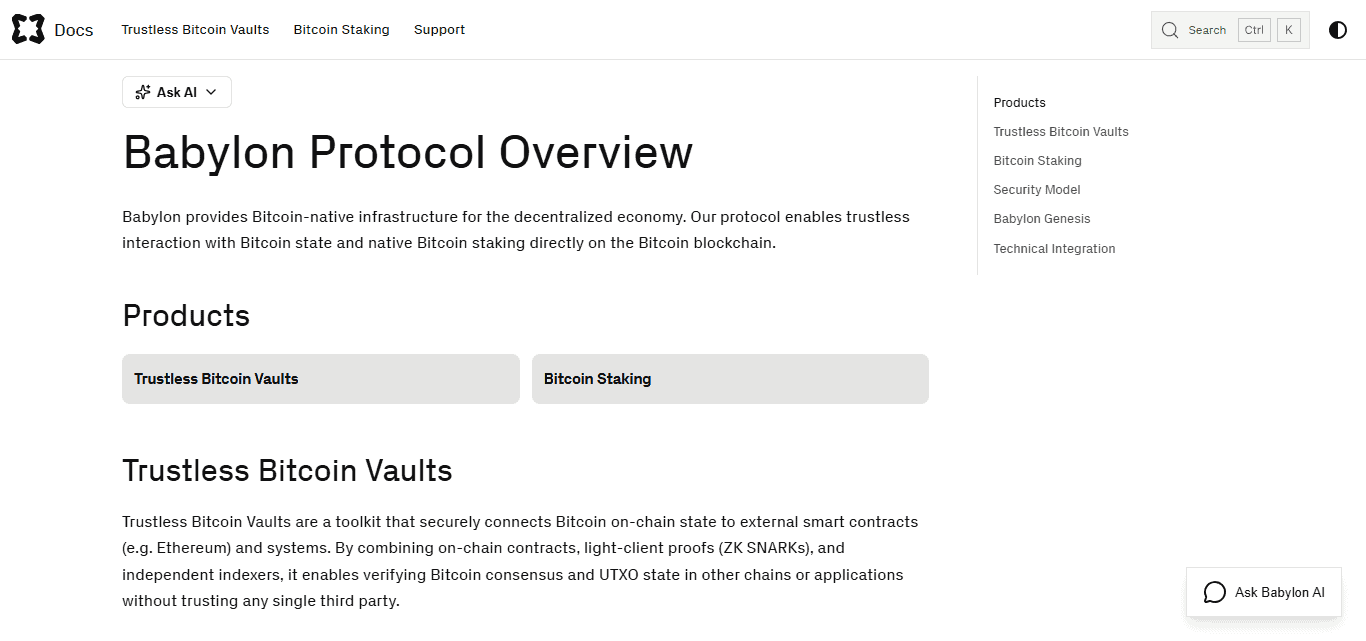
Minimum Staking Amount / Minimum Deposit: ~0.005 BTC per deposit. Lock-up Period (Liquidity): funds are locked for the chosen timelock then there’s a ~7 day unbonding period. Availability: available globally via self-custody wallets, however some front-ends may restrict access by region.
Babylon Protocol
| Feature | Explanation |
|---|---|
| Native Bitcoin Staking | Allows BTC holders to stake native Bitcoin without conventional bridging. |
| Bitcoin Security | Helps secure supported proof-of-stake networks using Bitcoin-backed economic security. |
| Self-Custody | Designed to let users retain control of their Bitcoin during staking. |
| Trust-Minimized Design | Uses cryptographic mechanisms to reduce reliance on centralized intermediaries. |
2. Solv Protocol
Solv converts BTC into liquid tokens that generate yield, primarily SolvBTC and SolvBTC.BBN, which is connected to Babylon. Supported Assets: BTC, WBTC and other wrapped BTC Supported Networks: Bitcoin, Ethereum, BNB Chain, Arbitrum, Solana and others.

Rewards System: Staking yield + protocol points + incentive tokens DeFi uses for the liquid token. Expected APY/Yield: Variable, usually 1%-5% depending on strategy. Minimum Staking Amount / Minimum Investment: No fixed minimum, except network fees. Lock-up Period (Liquidity) : Token is tradable so exit is fast, but direct redemption can take few days. Availability: worldwide with some regional front-end limitations.
Solv Protocol
| Feature | Explanation |
|---|---|
| Liquid Bitcoin Assets | Provides SolvBTC, a Bitcoin-backed token for supported DeFi applications. |
| Yield Opportunities | Offers access to different Bitcoin-focused yield strategies and vaults. |
| Multi-Chain Access | Connects supported Bitcoin representations with multiple blockchain ecosystems. |
| DeFi Integration | Enables eligible assets to participate in supported decentralized finance applications. |
3. Stacks Bitcoin Staking
Stacks uses Proof of Transfer where users “stack” STX and get real BTC rewards. Supported assets: STX (sBTC supports the broader Bitcoin DeFi ecosystem) Supported Networks: Stacks Bitcoin-supported. Rewards System: BTC paid out approximately every 2 weeks to solo stackers or pool participants. Expected APY/Yield: ~5% – 10% paid in BTC and based on participation.
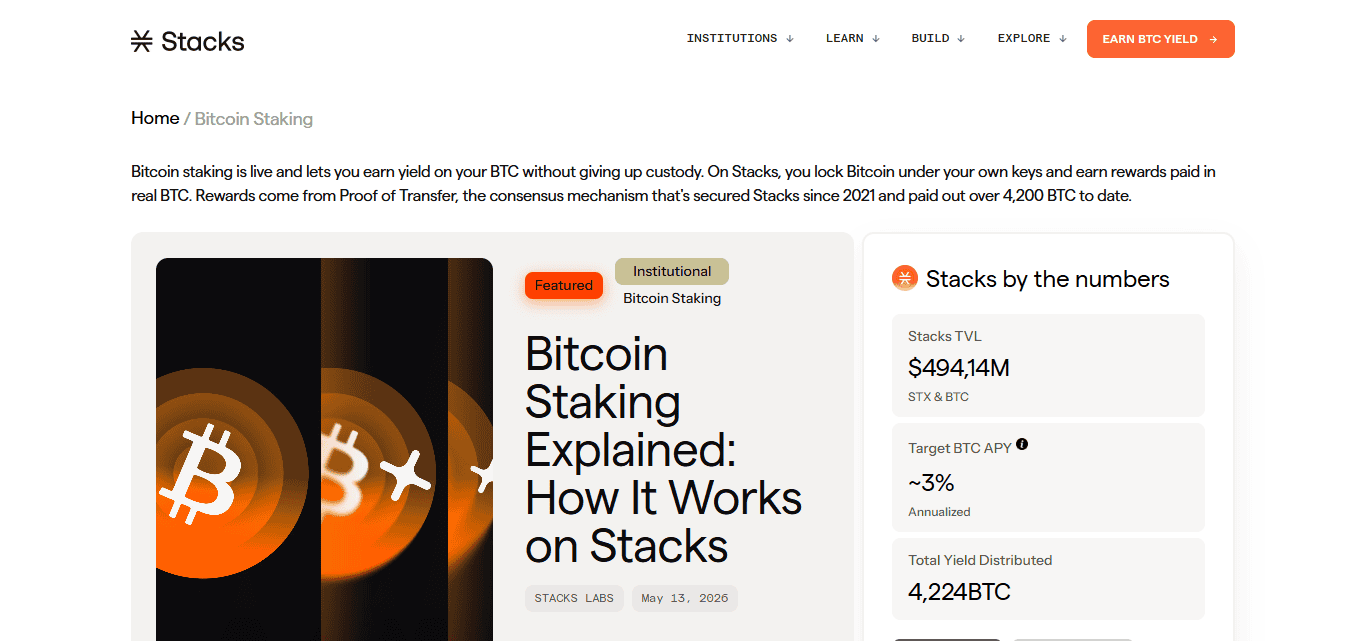
Minimum Staking Amount / Minimum Investment: solo stacking requires a dynamic threshold of tens of thousands of STX, while pools accept very small amounts. Lock-up Period (Liquidity) Locked for 1-12 cycles, about 2 weeks to 6 months. Availability: global in Stacks wallets and pools.
Stacks Bitcoin Stacking
| Feature | Explanation |
|---|---|
| Bitcoin Rewards | Eligible STX holders can receive BTC rewards through the Stacks consensus mechanism. |
| Proof of Transfer | Uses Bitcoin as part of its Proof of Transfer consensus design. |
| Network Participation | Stacking helps support the Stacks network’s consensus and security. |
| Pooled Stacking | Eligible users can participate through supported stacking pools with lower entry requirements. |
4. Core DAO
Core DAO uses Satoshi Plus consensus, combining Bitcoin hash power with non-custodial BTC staking. Supported Assets: BTC (also CORE and liquid tokens like stCORE) Supported Networks: Bitcoin and core chain, using timelock scripts.
Rewards System: CORE tokens per round staked, delegated to validators. Expected APY/Yield: Usually 5%-10% depending on CORE price and total staked.

Minimum Staking Amount / Minimum Investment: no fixed protocol minimum, so small amounts are feasible after fees. Lock-up Period (Liquidity) : set by the user’s timelock, your funds stay in your own wallet and can’t be withdrawn early. Available globally on the Core staking dashboard.
Core DAO
| Feature | Explanation |
|---|---|
| BTC Staking | Enables Bitcoin holders to stake BTC through supported staking mechanisms. |
| CORE Rewards | Participants may receive CORE tokens as staking rewards. |
| Bitcoin Compatibility | Connects Bitcoin staking with the Core blockchain ecosystem. |
| Non-Custodial Design | Supports staking mechanisms designed to preserve user control over BTC. |
5. Lombard
Lombard issues LBTC, a liquid staking token backed by staked BTC via Babylon. Supported Assets: BTC and WBTC (converted to LBTC). Supported Networks Ethereum, Base, BNB Chain, Solana, Sui and more chains. Rewards System: staking yield is earned on LBTC, points and partner incentives for DeFi utilization.
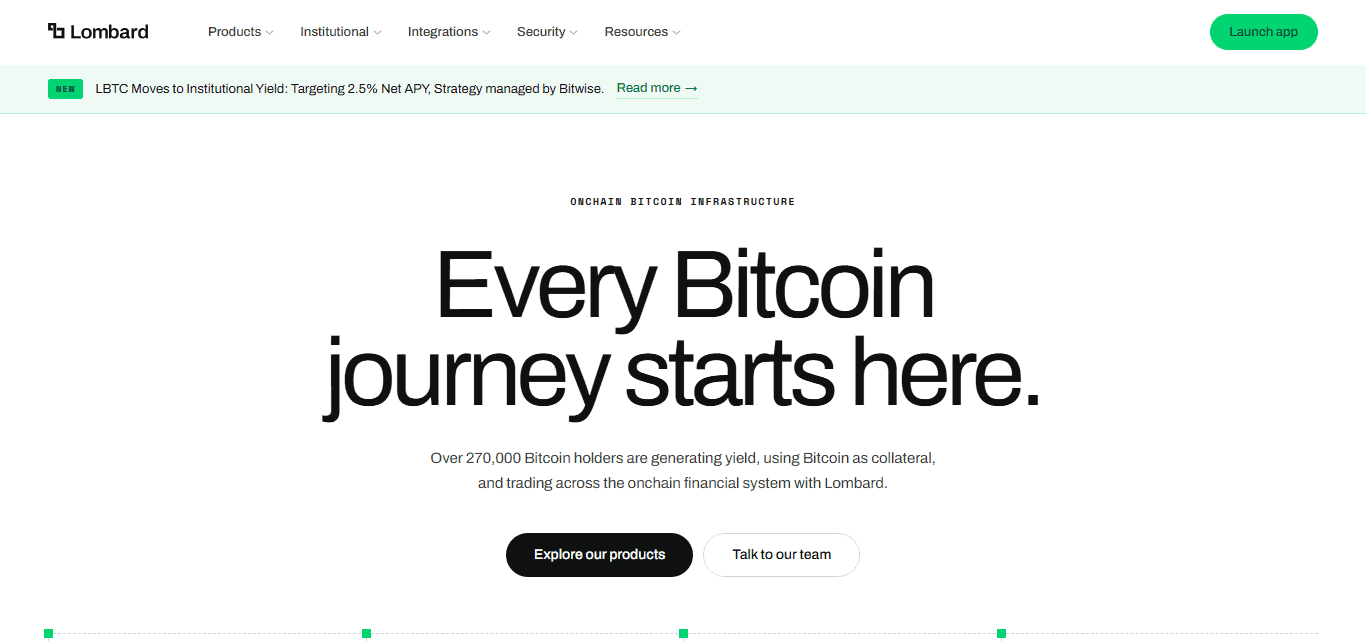
Expected APY/Yield: low base yield (~1%) + additional yield from lending or liquidity strategies. Minimum Staking Amount / Minimum Investment: No minimum, just gas and fees. Lock-up Period (Liquidity): No. LBTC can be traded and used as collateral; takes longer to redeem back to BTC. Availability: global (some jurisdictions restricted).
Lombard
| Feature | Explanation |
|---|---|
| Liquid Bitcoin | Issues LBTC, a liquid Bitcoin token designed for DeFi use. |
| Yield Generation | Provides access to Bitcoin-focused yield strategies, depending on the product. |
| DeFi Composability | Allows eligible LBTC to be used across supported decentralized finance applications. |
| Cross-Chain Utility | Supports access to multiple blockchain ecosystems, subject to current integrations. |
6. Acre
Acre is a Bitcoin yield platform built on Thesis’s infrastructure with simple deposit vaults. Assets Supported: tBTC and WBTC, BTC deposits routed through their interface. Supported Networks: Ethereum & Mezo network. Rewards System: returns on strategies under management + extra points or incentives.

Expected APY/Yield: fluctuating and low. Generally low to mid single digits. Minimum Staking Amount / Minimum Investment: There was a small minimum, about 0.005 BTC used. Lock-up Period (Liquidity): Withdrawals are flexible, though processing may take a short period. Available worldwide, although some parts of the world may have limited availability or phased rollouts.
Acre
| Feature | Explanation |
|---|---|
| Bitcoin Yield | Provides Bitcoin-focused strategies designed to generate potential BTC returns. |
| Automated Strategies | Uses supported investment strategies to manage deposited assets. |
| Compounding Potential | Eligible returns may be reinvested to increase Bitcoin holdings over time. |
| DeFi Integration | Connects Bitcoin-related assets with supported decentralized finance opportunities. |
7. StackingDAO
StackingDAO is the #1 liquid stacking protocol on Stacks, providing STX holders stSTX. Assets Supported STX. Supported Networks: Stacks Rewards System: Rewards compound and stack automatically into stSTX value, with some strategies adding yield linked to BTC. Expected APY/Yield: ~5%-10% depending on your participation in the network.

Minimum Staking Amount / Minimum Investment: very low, so you can start with a small amount of STX. Lock-up Period (Liquidity): no lock-up on stSTX, can be swapped and used in DeFi; unstacking through the protocol follows Stacks cycles are about 1–2 weeks. Availability: Globally accessible via Stacks wallets, including Leather and Xverse.
StackingDAO
| Feature | Explanation |
|---|---|
| Liquid Stacking | Provides liquid tokens that represent eligible staked assets. |
| BTC Rewards | Offers Bitcoin-related reward opportunities through supported products. |
| STX Stacking | Enables eligible STX holders to access stacking rewards. |
| DeFi Flexibility | Liquid tokens can offer access to additional supported DeFi applications. |
8.Endur
Endur is a Bitcoin asset liquid staking protocol on Starknet . Supported Assets: wrapped BTC like WBTC, tBTC, LBTC, solvBTC which turns into xWBTC, xtBTC and so forth. Networks Supported: StarkNet Rewards System: Yield accrual in liquid token value, potential STRK incentives. Expected APY/Yield: varies, typically 1%-5%.

Minimum Staking Amount / Minimum Investment: no strict minimum, small deposits allowed except for fees. Lock-up Period (Liquidity): no lock-up on the liquid token, which can be used in Starknet DeFi; direct unstaking may be subject to a short queue. Availability: worldwide through Starknet wallets such as Argent and Braavos.
Endur
| Feature | Explanation |
|---|---|
| Liquid Staking | Provides liquid staking solutions for eligible supported assets. |
| Bitcoin Asset Support | Supports selected Bitcoin representations, subject to current integrations. |
| Reward Compounding | Certain strategies may reinvest rewards into the underlying asset. |
| Starknet Integration | Connects supported staking products with the Starknet ecosystem. |
9. Kraken
Kraken is a centralized exchange and offers staking and rewards on several assets, BTC options depend on the region. Supported Assets: BTC, and many more. Supported Networks: internal custody of the exchange, with deposits through Bitcoin and other chains. Rewards System: opt-in rewards are paid out regularly with a commission taken by Kraken. Expected APY/Yield: Typically low for BTC, often below 1%-2%.

Minimum Staking Amount / Minimum Investment: very small usually a few dollars Lock-up Period (Liquidity): Flexible opt-in rewards allow for quick withdrawal, but bonded staking may need to be unbonded. Availability: varies by country and some areas have restrictions, for example parts of the US.
Kraken
| Feature | Explanation |
|---|---|
| Accessible Staking | Offers supported staking products through an established cryptocurrency exchange interface. |
| Bitcoin Staking Access | Eligible customers may access Babylon-powered Bitcoin staking where available. |
| Reward Tracking | Provides account-based tools to monitor eligible staking rewards. |
| Platform Support | Combines staking access with exchange services and customer support. |
10. Binance Earn
Binance Earn is the exchange’s suite of products for earning on idle crypto, including Simple Earn. Supported Assets: BTC and a wide range of other cryptocurrencies. Supported Networks The exchange’s custody with deposits via Bitcoin and other networks. Rewards System: Daily interest, flexible and locked options, and occasional bonus tiers.
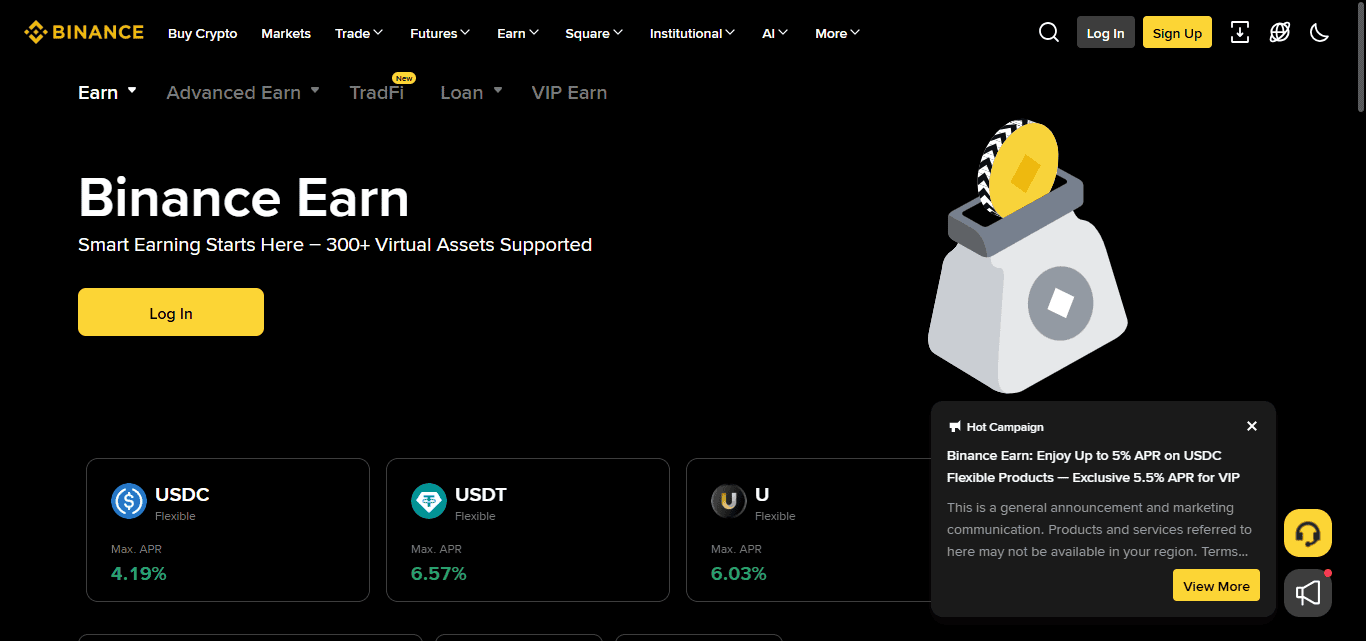
Expected APY/Yield: flexible BTC is usually under 1%, locked terms a bit higher. Minimum Staking Amount / Minimum Investment: very low, usually around 0.001 BTC or less. Lock-Up Period (Liquidity) Flexible products can be redeemed anytime, locked terms 30-120 days. Availability: worldwide (except for restricted areas), US uses Binance.US with different products.
Binance Earn
| Feature | Explanation |
|---|---|
| Multiple Earn Products | Offers different earning products with varying terms and reward structures. |
| Flexible Options | Eligible flexible products may allow withdrawals without a fixed commitment period. |
| Locked Products | Certain products offer fixed subscription periods with specific redemption conditions. |
| Simple Management | Provides an integrated interface for subscribing to and tracking eligible crypto earning products. |
Conclusion
To summarize : Selecting the Best Bitcoin Staking Protocols depends on your investment goals, preferred assets, security requirements and liquidity needs. Platforms like Babylon, Solv, Core DAO, Lombard and StackingDAO are offering different staking and Bitcoin yield opportunities.
Check APY, minimum investment, lock-up periods, fees and withdrawal terms before you invest. Always research the risks involved and remember that staking rewards are not guaranteed.
FAQ
Can you stake native Bitcoin?
Yes, selected protocols support native BTC staking without conventional bridging.
How much can Bitcoin staking earn?
Yields vary by protocol, market conditions, and staking strategy.
Is Bitcoin staking safe?
No platform is risk-free; smart contract, liquidity, and market risks remain.
What is the minimum staking amount?
Minimum requirements depend on the platform and selected product.