This article examines the Best Blockchain-Based Financial Tools for Non-Crypto Investors as for the platforms that bring the benefits of blockchain but do not require working in digital currencies.
- Key Points & Best Blockchain-Based Finance Tools for Non-Crypto Investors
- 10 Best Blockchain-Based Finance Tools for Non-Crypto Investors
- 1. IBM Blockchain
- 2. Hyperledger Fabric
- 3. R3 Corda
- 4. Quorum by ConsenSys
- 5. RippleNet
- 6. Stellar Network
- 7. Avalanche Enterprise Solutions
- 8. Ethereum Enterprise Alliance
- 9. Digital Asset DAML
- 10. Chainlink Oracles
- Conclsuion
- FAQ
These tools allow organizations to improve the security, transparency, and efficiency with which they manage payments, compliance, and data.
They fit perfectly with users of conventional finance systems who are searching for robust, dependable, and scalable blockchain systems.
Key Points & Best Blockchain-Based Finance Tools for Non-Crypto Investors
| Tool | Key Point |
|---|---|
| IBM Blockchain | Enterprise-grade trust: Used in banking and supply chain finance for secure transactions |
| Hyperledger Fabric | Permissioned networks: Ideal for corporate finance, enabling private and scalable solutions |
| R3 Corda | Financial institutions focus: Built for banks, insurance, and trade finance with legal contract integration |
| Quorum by ConsenSys | Privacy-first blockchain: Designed for enterprises needing confidential financial transactions |
| RippleNet | Cross-border payments: Enables fast, low-cost international money transfers without crypto exposure |
| Stellar Network | Tokenized assets: Supports digital representations of fiat currencies for remittances and microfinance |
| Avalanche Enterprise Solutions | High-speed settlement: Used for tokenized securities and real-world asset management |
| Ethereum Enterprise Alliance | Smart contracts for finance: Enables automation in loan agreements, supply chain finance, and insurance |
| Digital Asset DAML | Contract modeling: Focused on financial agreements, reducing paperwork and reconciliation costs |
| Chainlink Oracles | Trusted data feeds: Connects financial systems to real-world data for accurate settlement |
10 Best Blockchain-Based Finance Tools for Non-Crypto Investors
1. IBM Blockchain
IBM Blockchain is an enterprise-grade distributed ledger platform aimed at streamlining and securing financial workflows of non-crypto trading businesses.
Companies can create cost-effective and trustable systems that provide transparency and auditability while preventing tampering for payments, finance in supply chains, clearing, compliance, and data shuffling.
The platform specializes in permissioned networks, allowing firms to manage participants and data visibility. They can lock in governance systems to fraudulently abuse smart contracts.
Integrated fraud, streamlined controls, and better fraud operational efficiency. The support, and scalability, is optimum for enterprise and traditional finance users, are in the first steps of exploring blockchain capabilities.
| Feature | Description |
|---|---|
| Permissioned Network | Ensures controlled access for enterprise users. |
| Smart Contracts | Automates financial workflows securely. |
| Governance Tools | Built-in controls for monitoring, access, and compliance. |
| Enterprise Integration | Works seamlessly with existing IT and ERP systems. |
| High Security | Tamper-proof, auditable transactions. |
| Scalable Architecture | Supports large institutions and complex workloads. |
| Supply Chain & Finance Support | Ideal for payments, KYC, and data verification. |
| Fraud Reduction | Transparent ledgers reduce manipulation and errors. |
2. Hyperledger Fabric
Hyperledger Fabric is categorized as a modular permissioned blockchain developed for businesses, blockchain, and linux foundation.
It allows blockchain to be utilized by non-crypto investors and enterprises for automation, integrity and compliance.
Fabric is used in banking, trade finance, and insurance and other industries. Customers are able to implement smart contracts as chaincode to automate actions to improve manual reconciliation.
It provides an enhanced and high-performing financial class applications that are customizable. This allows businesses to be built on Fabric as it is scalable to pluggable consensus with individualized regulatory management to have their privacy and compliance in place.
| Feature | Description |
|---|---|
| Modular Architecture | Customizable components for enterprise needs. |
| Permissioned Blockchain | Strong privacy and restricted data visibility. |
| Channel-Based Data Sharing | Allows confidential transactions between specific members. |
| Chaincode Smart Contracts | Automates processes with secure logic. |
| Pluggable Consensus | Choose consensus method for performance or security. |
| Identity Management | Strong authentication through Membership Service Providers (MSPs). |
| High Scalability | Supports heavy enterprise workloads. |
| Compliance-Friendly | Suitable for finance and regulated industries. |
3. R3 Corda
R3 Corda is a distributed ledger system designed for financial institutions that require a network for secure, transparent, and compliant data sharing without the need for sharing cryptocurrency.
Corda is more like a shared database rather than a blockchain, so only some participants in the network can see the data in each transaction.
This selective data visibility allows Corda to service a multitude of applications such as trade finance, syndicated lending, settlements, digital identity, and regulatory reporting.

Corda’s smart contracts provide outcomes that are enforceable by law and compliant to financial regulations.
Corda is widely used by banks, insurers, and exchanges due to its ability to enhance workflow, decrease risks from other financial counterparties, and improve operational effectiveness.
Corda Enterprise provides additional mission critical support with enhanced security, additional system scalability, and constant availability.
| Feature | Description |
|---|---|
| Not a Traditional Blockchain | Uses point-to-point data sharing for privacy. |
| Legal Smart Contracts | Enforceable contract logic aligned with regulations. |
| High Privacy Controls | Only authorized parties see transaction data. |
| Financial-Grade Architecture | Built specifically for banks and financial institutions. |
| Workflow Automation | Improves loan processing, settlements, and reporting. |
| Interoperability | Connects easily with existing finance systems. |
| Strong Security | Tamper-resistant ledger with audit trails. |
| Corda Enterprise | Provides 24/7 support and enterprise performance. |
4. Quorum by ConsenSys
ConsenSys created Quorum to support private and permissioned financial applications. Quorum is designed for companies that wish to reap the benefits of the blockchain technology while avoiding any exposure to cryptocurrency.
Quorum provides high speed transaction, encrypted messages, and high levels of privacy. Quorum’s architecture provides fast settlement ability along with trusted multiparty workflows along with the secure sharing of encrypted data with other trusted institutions.
Quorum’s smart contracts and KYC applications, payment systems, and other internal banking systems make Quorum ideal for companies for asset tokenization, document verification, supply chain finance, and interbank settlements.
| Feature | Description |
|---|---|
| Permissioned Ethereum Network | Private chain for enterprise financial use. |
| Encrypted Peer Messaging | Secure transaction communication. |
| High-Speed Performance | Designed for fast settlement and scaling. |
| Customizable Smart Contracts | Enterprise-grade contract logic. |
| Privacy Controls | Fine-grained control over data visibility. |
| Compatibility with Ethereum Tools | Works with MetaMask, Truffle, etc. |
| Integrates with Banking Systems | Ideal for KYC, payments, and compliance systems. |
| Governance & Access Controls | Suitable for multi-party financial workflows. |
5. RippleNet
Designed to help banks, payment processors, and other financial firms manage international transactions more quickly and cost-effectively, RippleNet is a blockchain-based global payment network. RippleNet does not require users to own cryptocurrencies.
Rather, the network utilizes financial fiat and real-time tracking capabilities to provide products and services to clients, including tracking ongoing payments, ensuring regulatory compliance, and offering messaging formats (standardized communication templates).
RippleNet helps customers to update their SWIFT-based systems. RippleNet is furthering the integration of global payments while ensuring the network remains secure (enterprise-grade) and compliant (with regulatory requirements).
| Feature | Description |
|---|---|
| Global Payment Network | Supports fast cross-border remittances. |
| Fiat-to-Fiat Settlement | No need for crypto holdings. |
| Real-Time Tracking | Instant visibility into transaction status. |
| Low-Cost Transfers | Reduces bank fees and delays. |
| Optional XRP Usage | ODL feature does not require crypto. |
| Strong Compliance Tools | AML, KYC, and regulatory reporting integration. |
| Enhanced Security | Uses a reliable digital ledger. |
| SWIFT Alternative | Modernizes outdated international payment systems. |
6. Stellar Network
With the advantage of its low-cost and fast payments, and transfers of tokenized assets, the Stellar Network has opened the doors to financial infrastructure on the blockchain.
Due to its enterprise tools, even non-crypto investors can use Stellar for remittances, micro-payments, and digital identity. Stellar’s consensus mechanism allows institutions to serve emerging markets, keeping their costs low.
These institutions, which have the ability to issue stablecoins, integrate cross-border payment rails, and connect to their banking API.
Stellar offers the ability to cross all financial and currency systems without friction. Stellar is open-source, meaning it can help organizations develop financial tools efficiently but without the volatility of a speculative crypto market.
| Feature | Description |
|---|---|
| Low Transaction Fees | Ideal for micro-payments and remittances. |
| Fast Confirmations | Near-instant settlement. |
| Asset Issuance | Supports stablecoins and tokenized assets. |
| Cross-Border Payment Rails | Suitable for global transactions. |
| Interoperability Focus | Connects different currencies and financial systems. |
| Open-Source Protocol | Transparent and community-driven. |
| Financial Inclusion Tools | Designed for emerging-market institutions. |
| Strong API Support | Easy integration for banks and fintechs. |
7. Avalanche Enterprise Solutions
Avalanche Enterprise Solutions specializes in providing super fast customizable blockchain networks to assist traditional financial institutions with modernizing their infrastructure without the need to interact with crypto markets.
Through Avalanche’s subnets, enterprises can acquire private, permissioned blockchains fitted to the unique needs of banking such as asset tokenization, settlements, compliance automation, and secure data exchange.
Avalanche’s consensus mechanism allows for high frictionless operational environments as it offers near instant finality for peak operational transactional volume.
Offering top of the line governance, interoperability, and compliance with data autonomy in financial institutions, Avalanche builds the ability to operate with lessened risk and downtime.
| Feature | Description |
|---|---|
| High-Speed Consensus | Sub-second transaction finality. |
| Custom Private Subnets | Build permissioned networks for finance. |
| Asset Tokenization | Ideal for securities and financial products. |
| Compliance Automation | Built-in rule enforcement and auditability. |
| Interoperability | Connects with external blockchains and systems. |
| Enterprise Governance | Advanced access and policy controls. |
| Scalable Architecture | Handles high-volume financial operations. |
| Low-Latency Settlement | Supports high-frequency transactional needs. |
8. Ethereum Enterprise Alliance
The Ethereum Enterprise Alliance (EEA) is the first Hub of International Business with a focus on the adoption of the Ethereum blockchain in the field of finance.
The EEA helps the adoption of private enterprise blockchains by designing Open Standards, Best Practices, and Development Frameworks.

The private blockchains have no need for public crypto assets. EEA incorporates enterprise databases for cross blockchains interoperability, adding value on the blockchain by increasing data visibility,
Eliminating the need for reconciliation, and decreasing overall costs on data processes. EEA provides and accelerates the integration of real-world blockchains for financial institutions.
| Feature | Description |
|---|---|
| Industry Consortium | Collaboration between enterprises using Ethereum. |
| Standards Development | Creates frameworks for enterprise adoption. |
| Enterprise Ethereum Specs | Defines requirements for private, scalable chains. |
| Interoperability | Connects enterprise blockchains seamlessly. |
| Research & Innovation | Supported by tech leaders and financial institutions. |
| Compliance Support | Helps organizations implement regulatory-friendly solutions. |
| Ecosystem Tools | Access to enterprise-grade Ethereum technologies. |
| Collaboration Network | Connects developers, businesses, and researchers. |
9. Digital Asset DAML
DAML (Digital Asset Modelling Language) is a kind of smart contract legal technology that supports the construction of credible, secure and viable cross platform financial applications.
Unlike systems tethered to one chain, DAML enables institutions to implement the same business logic on several ledgers, which is excellent for businesses trying to avoid crypto dependencies.
DAML streamlines advanced workflows such as post-trade processing, asset servicing, and ancillary regulatory reporting.
The platform’s privacy-first architecture ensures that sensitive financial data is shared with and only with the required stakeholders. The abstraction layer of DAML improves the responsiveness of systems for firms.
| Feature | Description |
|---|---|
| Cross-Ledger Smart Contracts | Deploy the same contract on multiple blockchains. |
| Privacy-First Architecture | Controls access to sensitive financial data. |
| Interoperable Logic | Works across Fabric, Corda, and more. |
| Simple Development | Reduces complexity for financial applications. |
| Workflow Automation | Supports settlement, clearing, and reporting. |
| Legal & Audit Friendly | Creates transparent, compliant records. |
| No Crypto Required | Built for enterprise financial systems. |
| Reduced Errors | Ensures consistent contract logic across platforms. |
10. Chainlink Oracles
Chainlink automates the provision of accurate and real-time functionality across various applications in finance using a decentralized network of blockchains and real-world, multi-source data.
There is no need for crypto integration since Chainlink helps enterprises automate settlement processes, monitor prices, verify identities, and execute contracts based on user-specified events.
Chainlink is used by financial institutions as a blockchain-integrated oracle for market data, regulatory information, and API compliance across decentralized networks.
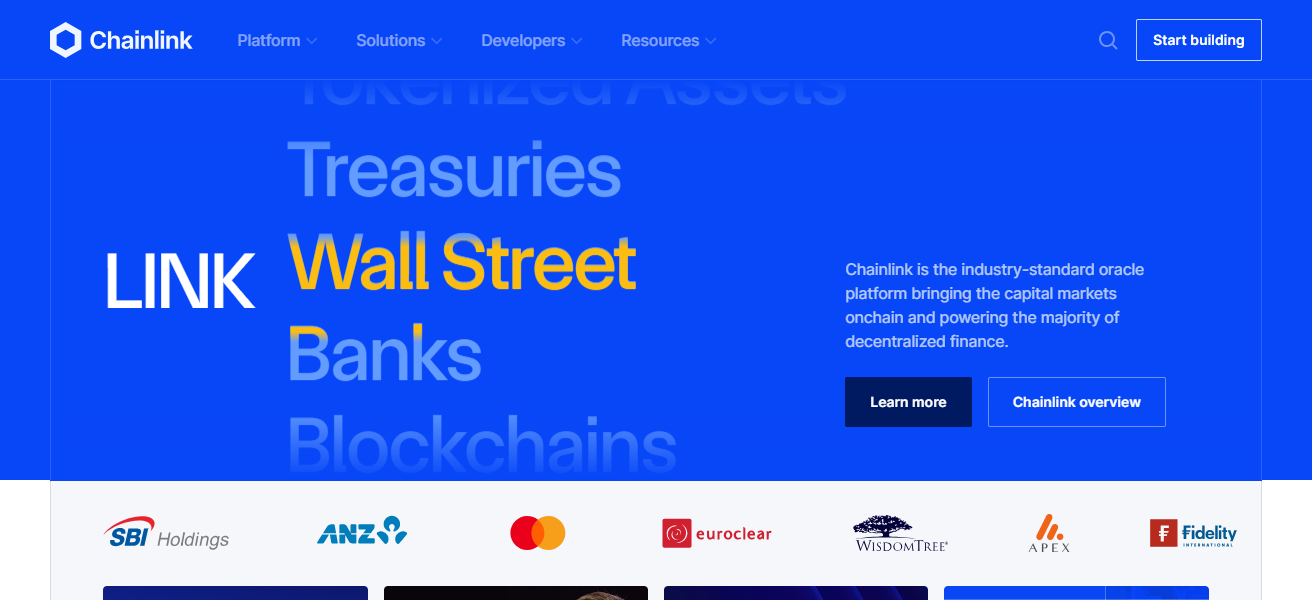
Chainlink protects the data with proof of work and offers backup systems for other oracles, increasing the confidence of all blockchains in advanced financial systems.
| Feature | Description |
|---|---|
| Real-World Data Feeds | Connects financial apps with external market data. |
| Decentralized Infrastructure | Reduces single-point failures. |
| Secure API Integration | Pulls data from banks, markets, and institutions. |
| Cryptographic Proofs | Ensures tamper-proof data delivery. |
| Compatible with All Blockchains | Works with public and private networks. |
| Smart Contract Automation | Enables event-triggered payments and workflows. |
| Compliance Data Access | Supports KYC, AML, and regulatory inputs. |
| High Reliability | Used by major enterprises for mission-critical systems. |
Conclsuion
To conclude The most effective blockchain-financed solutions available to non-crypto investors blockchain offer the potential for crypto-free investment protection and efficiency.
IBM Blockchain, Hyperledger Fabric, Corda, Quorum, RippleNet, and Chainlink offer enterprise solutions to modernize financial systems and mitigate operational risks through payments, compliance, process automation, and data integrity.
These solutions create trusted, scalable infrastructures designed for traditional organizations undergoing digital transformations.
FAQ
These are enterprise-focused platforms that use blockchain technology for security, transparency, and automation without requiring cryptocurrency use.
No. Most enterprise blockchains like Hyperledger Fabric, IBM Blockchain, and Corda operate without public tokens.
R3 Corda and Hyperledger Fabric are widely preferred due to strong privacy and regulatory alignment.
RippleNet and Stellar Network offer fast, low-cost international payment solutions.
Yes. Platforms like Quorum, Hyperledger Fabric, and Avalanche allow fully private, permissioned networks.