In this article, I will discuss the Best CoinPayments Alternatives in the USA for 2026. With the rise of cryptocurrency payments, US merchants need fast, secure, and cost-effective solutions.
- What Is CoinPayments?
- Key Points & Best CoinPayments Alternatives In The USA
- 10 Best CoinPayments Alternatives In The USA 2026
- 1. BTCPay Server
- 2. CoinGate
- 3. Plisio
- 4. NOWPayments
- 5. BitPay
- 6. PayPal Crypto Checkout
- 7. Stripe Crypto Integration
- 8. Square (Block) Payments
- 9. Crypto.com Pay
- 10. OpenNode
- Why Choose CoinPayments Alternatives In The USA
- Flexible Crypto Checkout Platforms Shaping the Future of US Commerce
- Conclusion
- FAQ
From self-hosted platforms like BTCPay Server to enterprise-ready gateways like BitPay and Stripe, these alternatives offer low fees, USD settlements, and seamless integrations to help businesses stay ahead in the evolving crypto payment landscape.
What Is CoinPayments?
CoinPayments facilitates companies’ acceptance of online cryptocurrency payments through its online portal.
They have been active since 2013 and accept over 2,000 cryptocurrencies, are able to do transactions in Bitcoin, Ethereum, Litecoin, and are able to do transactions through apps, and have multi-currency wallets, shopping cart plugins, and automatic currency converters. They are able to do automatic transactions in US currency.
They are one of the most prominent apps for online shopping and digital services. However, They also have platform fees, and require KYC compliance. CoinPayments brings ease and convenience to merchants of all sizes and in all industries as they are able to use cryptocurrency.
Key Points & Best CoinPayments Alternatives In The USA
- BTCPay Server – Open-source, self-hosted crypto payment gateway.
- CoinGate – Supports Bitcoin, Ethereum, and 70+ altcoins with merchant tools.
- Plisio – Easy integration for online stores, supports 150+ cryptocurrencies.
- NOWPayments – Non-custodial gateway with recurring billing and donation tools.
- BitPay – One of the oldest crypto payment processors, widely trusted in the USA.
- PayPal Crypto Checkout – Mainstream option allowing crypto payments directly via PayPal.
- Stripe Crypto Integration – Expanding into blockchain payments with strong developer tools.
- Square (Block) Payments – Jack Dorsey’s company offering Bitcoin-focused merchant solutions.
- Crypto.com Pay – Cashback rewards and easy merchant adoption.
- OpenNode – Lightning Network-powered Bitcoin payments for instant transactions.
10 Best CoinPayments Alternatives In The USA 2026
1. BTCPay Server
Widely considered to be among the very best alternatives to CoinPayments on the US market, BTCPay Server is the only fully self-hosted and open source option.
Because of this, BTCPay Server gives its customers, merchants, and users complete control over their payment infrastructure.
BTCPay Server also does not have to rely on third party processors at all, meaning there are no platform fees and no privacy concerns for users, customers or the businesses they are involved with.
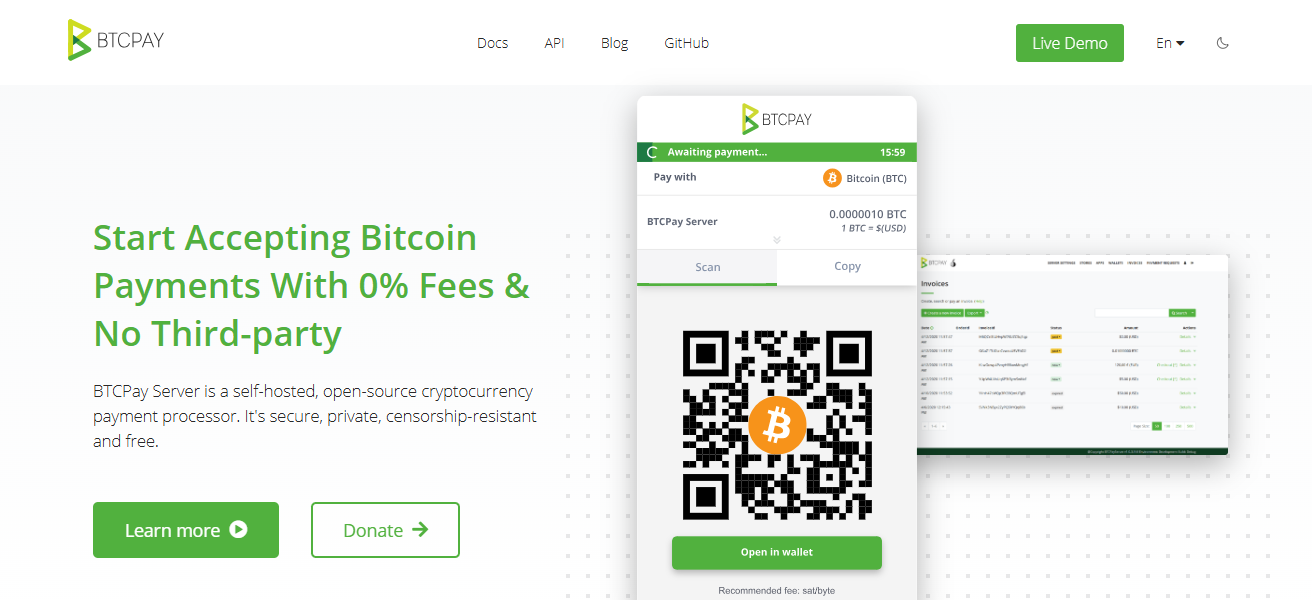
In addition, they experience rapid and more affordable transactions due to BTCPay Server’s integration of ilghtning Network supported settlements.
Tech-savvi United States merchants, looking for autonomy and maximal data security at lower costs, are best served by BTCPay Server’s reduced risk of censorship with their transparent fully decentralized code.
BTCPay Server – Pros & Cons
Pros
- Self-Hosting Control – Merchants operate their own server and control their private keys therefore are not dependent on anyone.
- No Platform Fees – Other than the blockchain network fees, there are no other processing fees taken by the platform.
- Privacy-Focused – No KYC requirements or data being shared with other parties therefore customer privacy is upheld.
- Lightning Network Enabled – Instant and low-fee Bitcoin payments are possible over the Lightning Network.
Cons
- Technical Setup Required – Knowledge on configurations server set up and ongoing maintenance is required and is something beginners may struggle with.
- No Customer Support Team – Support is provided on a volunteer basis and there are no help desks.
- Limited Fiat Integration – Direct payouts and bank settlements in USD is not available natively.
- DIY Compliance – Merchants are left to do taxes and other regulatory compliance on their own.
| Feature | Detailed Explanation |
|---|---|
| Self-Hosted Infrastructure | BTCPay Server is fully self-hosted, meaning merchants control their server, private keys, and payment flow without relying on third parties. |
| Zero Platform Fees | There are no processing or service fees charged by BTCPay; merchants only pay blockchain network fees. |
| Lightning Network Support | Supports Bitcoin Lightning payments, enabling instant transactions with extremely low fees. |
| Privacy & Censorship Resistance | No KYC, no account freezes, and no centralized control make it ideal for privacy-focused businesses. |
2. CoinGate
In the USA, CoinGate is a recommended alternative to CoinPayments due to its combination of crypto versatility and merchant-neutral fiat settlement options.
Unlike CoinPayments, CoinGate enables US companies to receive real-time payouts in USD or EUR while accepting over 70 different cryptocurrencies, lowering their market volatility risk.
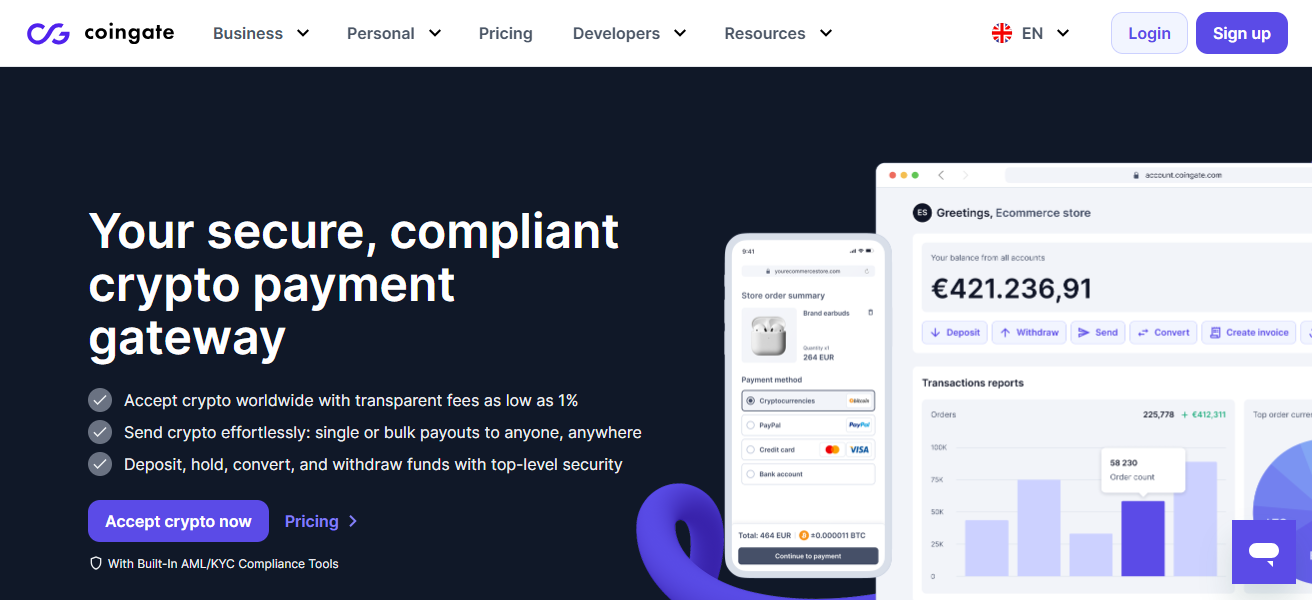
For online sellers, CoinGate’s best feature is quick deployment due to frictionless integration with top ecommerce applications like Shopify, WooCommerce, and Magento.
Additionally, CoinGate provides sellers with stability during price fluctuations by locking in volatile cryptocurrencies with the use of fixed-rate invoices at the point of sale. Considering these attributes, CoinGate is one of the most reputable options for US merchants.
CoinGate – Pros & Cons
Pros
- Broad Crypto Support – Over 70 cryptocurrencies can be accepted for payments.
- Fiat Payouts – Settlements can be made in USD or EUR allowing reach and mitigating risks associated with crypto volatility.
- Fixed Checkout Rates – Merchants can lock an exchange rate at payment, securing an exchange rate.
- Ecommerce Integration – Includes plugins for WooCommerce, Shopify, etc.
Cons
- Platform Fees – Payment processing fee can be higher than self-hosted options.
- KYC Requirements – Merchants need to pass identity KYC to unlock all features.
- Less Developer Customization – Compared to open-source solutions, more limited for deep bespoke customization.
- Dependency on Third Party – Centralized solution means downtime or policy changes can create friction for merchants.
| Feature | Detailed Explanation |
|---|---|
| Wide Cryptocurrency Support | Accepts 70+ cryptocurrencies, allowing merchants to reach diverse crypto users. |
| Fiat Payouts | Merchants can settle directly in USD or EUR, reducing volatility exposure. |
| Fixed Exchange Rates | Locks crypto prices during checkout to prevent losses from price swings. |
| Ecommerce Plugins | Native plugins for Shopify, WooCommerce, and Magento simplify integration. |
3. Plisio
In the US market, Plisio is one of the best CoinPayments competitors as a result of its simplicity, automation, and cost-efficient crypto processing tailored to the needs of online businesses.
While CoinPayments charges a 0.5% setup fee, Plisio has 0% setup fees with a flat processing fee of approximately 0.5% making it a better choice for small businesses and startups.
Their greatest feature is the automation of payment confirmations and the expiration of invoices, which allows for improvements in manual control tracking issues.

Plisio has instant API and plugin integrations for WooCommerce and WHMCS, and for the more popular cryptocurrencies like BTC, ETH, USDT, and LTC.
With the streamlined and developer-friendly processes, Plisio is great for US businesses that want consistency and efficiency.
Plisio – Pros & Cons
Pros
- Low Flat Fees – Predictable fees for payment processing around ~0.5%. Good for microbusinesses.
- Automated Payment Confirmation – Saves manual tracking and record-keeping.
- Invoice Tools – Provides invoice expiration and tracking for easier billing.
- Simple Integration – No-code automation via plugins and basic API.
Cons
- Fewer Cryptos Compared to Others – Smaller list of vying currencies.
- Limited Advanced Features – Less of an enterprise suite than larger processors like BitPay.
- No Direct USD Bank Settlements – Merchants need to do the conversion.
- Support Levels Vary – Responsiveness issues compared to larger payment providers.
| Feature | Detailed Explanation |
|---|---|
| Low Transaction Fees | Offers a flat, predictable fee structure suitable for startups and SMEs. |
| Automatic Payment Processing | Confirms blockchain payments automatically without manual verification. |
| Invoice & Billing Tools | Built-in invoice creation, expiration, and payment tracking improve efficiency. |
| Developer-Friendly API | Simple APIs and plugins for WHMCS and WooCommerce enable fast deployment. |
4. NOWPayments
NOWPayments is one of the best CoinPayments alternatives in the United States due to its wide selection of crypto payments and flexibility for merchants.
When it comes to crypto payments, it is one of the most flexible with over 300 + cryptocurrencies supported. This allows businesses to receive payments in not only the most popular cryptocurrencies, but the newly developed ones as well with no complicated configurations.
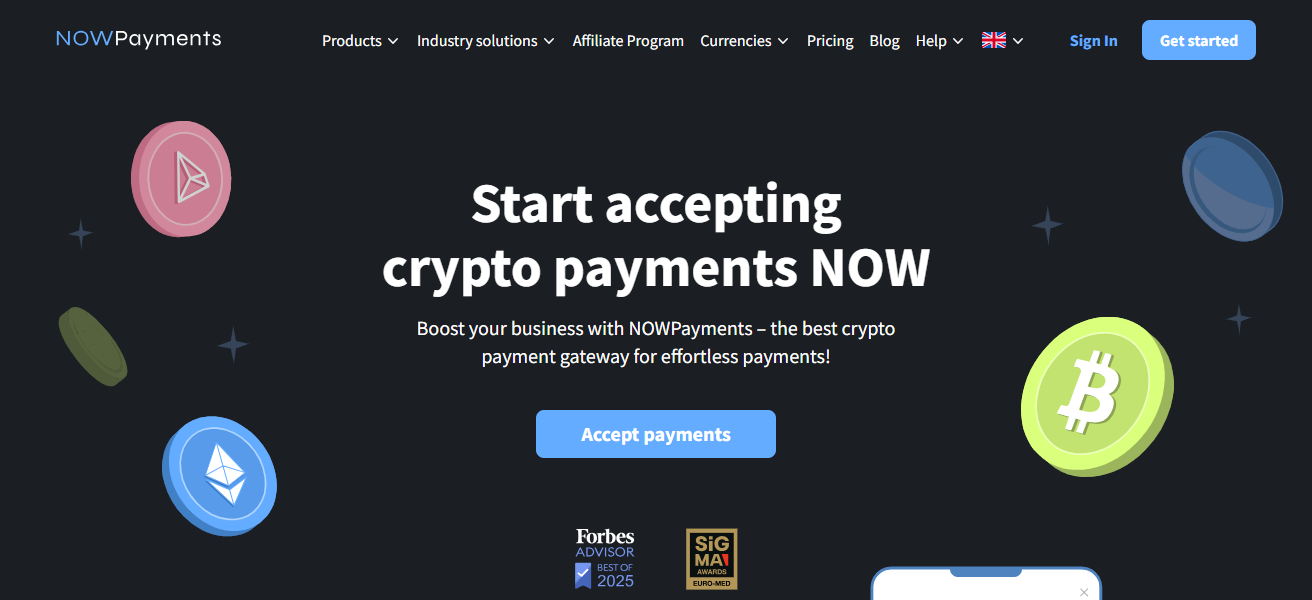
One of the most notable features is auto coin conversion, which allows merchants to receive payments in their desired coin, and is useful in managing volatility.
NOWPayments also offers custodial and self-custodial crypto payment solutions for users, which is great for crypto beginners and experts alike.
With easy integration for eCommerce sites and transparent fees starting from 0.5 %, it provides businesses in the United States with liquidity and flexibility.
NOWPayments – Pros & Cons
Pros
- Huge Crypto Selection – Supports well over 300 cryptocurrencies ensuring customers will find what they are looking for.
- Auto Conversion Feature – Automatically converts to a stable coin to minimize the chance of incurring volatility.
- Custodial & Noncustodial Options – Offers merchants flexibility when it comes to custody options.
- Transparent Fees – Pricing is competitive with no-nonsense fees.
Cons
- Fees Add Up for Small Transactions – Fee structure is not as favorable for micro- payments.
- KYC Onboarding – In the case of mandatory KYC, stronger KYC will be required for higher limit transactions.
- Less Focused on Fiat Settlement – Payout options will be less than the options you will find with other payment processors.
- API Complexity for Beginners – Other developers, especially ones with lesser experience, will be required to put in a fair deal of time to get acquainted with the more advanced features
| Feature | Detailed Explanation |
|---|---|
| Massive Crypto Coverage | Supports 300+ cryptocurrencies, including major and niche tokens. |
| Auto Coin Conversion | Automatically converts payments into a preferred coin or stable asset. |
| Custodial & Non-Custodial Options | Merchants can choose between managed wallets or direct wallet payments. |
| Transparent Fee Structure | Competitive fees with clear pricing and no hidden costs. |
5. BitPay
BitPay is also a trusted alternative to CoinPayments with strong regulatory alignment and reliability. Unlike CoinPayments, BitPay allows merchants to accept crypto and settle in USD to US bank accounts, making accounting and compliance easier.
It holds BTC, ETH, and several stablecoins with daily settlements and locked exchange rates at checkout to mitigate volatility risk.

One of the advantages is that it’s one of the oldest crypto payment processors established in 2011. Also, with the additional stability and security, BitPay is a great choice for US businesses.
BitPay – Pros & Cons
Pros
- USD Bank Settlement – Settles crypto to USD and transfers directly to a US bank account.
- Locked Exchange Rates – Checkout price is guaranteed to stay locked in, which may alleviate uncertainty.
- Enterprise Security & Compliance – Provides peace of mind with considered good security practices and compliance as well.
- Established Reputation – Has a long track record, regarded as trustworthy.
Cons
- Higher Fees than DIY – In certain cases, their fees may be higher when compared to self-hosted payment processors.
- Limited Support for Altcoins – This product primarily supports major coins and stablecoins and does have some smaller and more obscure coins.
- KYC Obligatory – The users that act as sellers have to go through verification.
- Potential for Delayed Settlements – The banks could take a while to process payments making funds unavailable for transactions.
| Feature | Detailed Explanation |
|---|---|
| Instant USD Settlement | Merchants receive USD instantly without holding crypto. |
| Massive User Base | Access to over 400 million PayPal users boosts checkout trust. |
| No Crypto Custody Required | Merchants never manage wallets or private keys. |
| Built-In Fraud Protection | Uses PayPal’s advanced fraud detection and compliance systems. |
6. PayPal Crypto Checkout
PayPal Crypto Checkout is a US alternative to CoinPayments which integrates the functionality of a crypto gateway and a traditional payment processor.
Unlike CoinPayments, PayPal enables US businesses to accept cryptocurrency and receive USD in real-time, elminating volatility and custody issues.

PayPal’s biggest advantage is its network of over 400 million active users which enhances checkout trust and conversion rates.
Customers transact with the cryptocurrency, while merchants never directly manage cryptocurrency. Armed with PayPal’s compliance and fraud protection,
Crypto Checkout is a low-risk and high-reach option for US businesses accepting cryptocurrency for the first time.
PayPal Crypto Checkout -Pros & Cons
Pros
- Uberization of PayPal’s User Base – PayPal users intotal are more than 400M.
- Immediate Payment Transfers – The payments are sent in USD and immediately to the seller.
- Zero Wallet Management – The sellers do not have to manage cryptocurrency wallets like worrying about private keys.
- Fraud Protection Included – There are chargebacks and transactions that are fraudulent and PayPal uses some of their tools to help decrease their occurrences.
Cons
- Deficient Choice in Cryptocurrencies – Paypal supports a few cryptocurrencies and that are not a popular choice.
- Increased Service Charges – Fees could be more expensive than other crypto transaction services and that is because of Paypal.
- Less Innovative Functions – There is no opportunity to utilize the Lightning Network.
| Feature | Detailed Explanation |
|---|---|
| Instant USD Settlement | Merchants receive USD instantly without holding crypto. |
| Massive User Base | Access to over 400 million PayPal users boosts checkout trust. |
| No Crypto Custody Required | Merchants never manage wallets or private keys. |
| Built-In Fraud Protection | Uses PayPal’s advanced fraud detection and compliance systems. |
7. Stripe Crypto Integration
The integration of Stripe Crypto is a great alternative to CoinPayments in the US since it incorporates cryptocurrency payments directly into one of the most reliable payment frameworks in the world.
Unlike CoinPayments, Stripe has a focus on cryptocurrencies and stablecoin payments, allowing United States merchants to easily accept cryptocurrencies while settling in USD, all through Stripe’s familiar dashboards and reporting tools.

Stripe’s unique advantage is their great developer support and generous APIs which millions of businesses around the world depend on.
Stripe’s systems, if already in use, cover the operational friction gap, providing fraud detection, compliance tools, and instant reconciliation.
By providing a single solution that integrates cryptocurrency payment, card payment, and bank payment systems, Stripe has achieved unparalleled flexibility and reliability for US businesses adopting crypto.
Stripe Crypto Integration –Pros & Cons
Pros
- Combined User Interface – The user can manage other digital payments at the same time.
- Support for Stablecoins – This service uses a stablecoins to avoid market volatility.
- Customization – There is a good documentation and strong APIs for making the integration customized.
- Built-In Compliance and Risk Management Tools– Stripe deals with fraud and tax reporting, etc.
Cons
- Not Much Native Crypto Support– Doesn’t have as many tokens as crypto-first processors.
- Could Be More Reasonable– Stripe’s service fees are higher than typical crypto processors.
- You Have To Create A Stripe Account– Have to comply with Stripe’s KYC and business regulations.
- Focuses On Fiat More– They still prioritize traditional processing over crypto.
| Feature | Detailed Explanation |
|---|---|
| Stablecoin Payments | Focuses on stablecoin-based transactions for reduced volatility. |
| Unified Payment Dashboard | Crypto and card payments are managed from one Stripe interface. |
| Advanced Developer APIs | Powerful APIs allow deep customization for large-scale platforms. |
| Strong Compliance Tools | Integrated risk, fraud, and reporting tools simplify regulation handling. |
8. Square (Block) Payments
Square (Block) Payments is an excellent alternative to CoinPayments in the USA due to its integration of cryptocurrency and advanced point-of-sale and merchant systems.
In contrast to CoinPayments, Square allows businesses to accept Bitcoin payments and automatically clears them to USD, alleviating tax and accounting headaches.

Square is the only provider with integration to the 3+ million Square POS terminals across the US, helping both online and in-store merchants integrate crypto with other payments.
Square retains the enterprise security and instantaneous reporting, with the responsiveness of tools to the Bitcoin strategy of Block, making Square ideal for US merchants wanting to add crypto to their offerings, with a minimal hit to operational complexity.
Square (Block) Payments Pros & Cons
Pros
- Supports Both– Unified POS and (digital) payments for hybrid business models.
- Fast USD conversion– Crypto is converted into USD for easier bookkeeping.
- Square Analytics– Unified sales reports across payment methods.
- Business Tool Familiarity– Works with widely used tools in the Square ecosystem.
Cons
- Not Much Native Crypto Support– Very bitcoin-centric with limited tokens.
- Fees Are Not the Best– Overall fee structure is created with convenience in mind.
- You Have To Abide By Square Policies– Merchant agreements and holds are subject to Square’s terms.
- Less Innovative– Not as rich in features with blockchain tools as focused innovators.
| Feature | Detailed Explanation |
|---|---|
| POS & Online Integration | Works seamlessly across online stores and physical POS systems. |
| Instant USD Conversion | Converts crypto-related payments into USD immediately. |
| Unified Sales Reporting | Combines crypto and traditional sales into one analytics dashboard. |
| Backed by Block Ecosystem | Supported by Block’s Bitcoin-focused financial infrastructure. |
9. Crypto.com Pay
Crypto.com Pay is a CoinPayments alternative in the USA since it links cryptocurrency transactions to a large consumer ecosystem.
Unlike CoinPayments, it connects merchants to over 80 million users of the Crypto.com app, boosting payment acceptance beyond traditional checkout avenues.
It offers features such as crypto-to-fiat conversion in seconds with merchants choosing how they want to get paid – in particular digital currencies or in American dollars.

Crypto.com Pay supports multiple digital currencies with lower transaction costs for CRO settled. Having a worldwide regulated, secure system makes it a first choice for American companies wanting to transact in cryptocurrency.
Crypto.com Pay – Pros and Cons
Pros
- Large Crypto Ecosystem – Merchants can access millions of users on their Crypto.com application.
- Flexible Settlements – Payments can be made using cryptocurrency or US dollars.
- Token Based Fee Benefits – Fee discounts are available when using CRO cryptocurrency on the platform.
- Security and Regulation – Supported by a global platform and adherence to legal frameworks.
Cons
- KYC Required – To access the full suite of features, merchant verification is required.
- Less Focus on Fiat Tools – Direct bank withdrawals aren’t a priority for the platform.
- Crypto Volatility Exposure – There are risks involved in cryptocurrency, especially when the settlement methods are crypto.
- Support Variability – There may be delays in response times due to a high volume of requests.
| Feature | Detailed Explanation |
|---|---|
| Large Consumer Network | Connects merchants to 80+ million Crypto.com users. |
| Flexible Settlement Options | Merchants can receive payouts in crypto or USD. |
| Token-Based Fee Benefits | Reduced fees when settling using CRO tokens. |
| Secure Global Platform | Enterprise-grade security with regulated operations. |
10. OpenNode
Bitcoin payments with robust support for the Lightning Network makes OpenNode unique, and it is a powerful alternative to CoinPayments in the USA.
OpenNode lets users accept payments in Bitcoin and experience Lightning Network’s near-instant settlement with very small fees.
OpenNode’s settlement is flexible with Bitcoin and USD (USD is payable to a US bank account) and is able to mitigate the volatility.
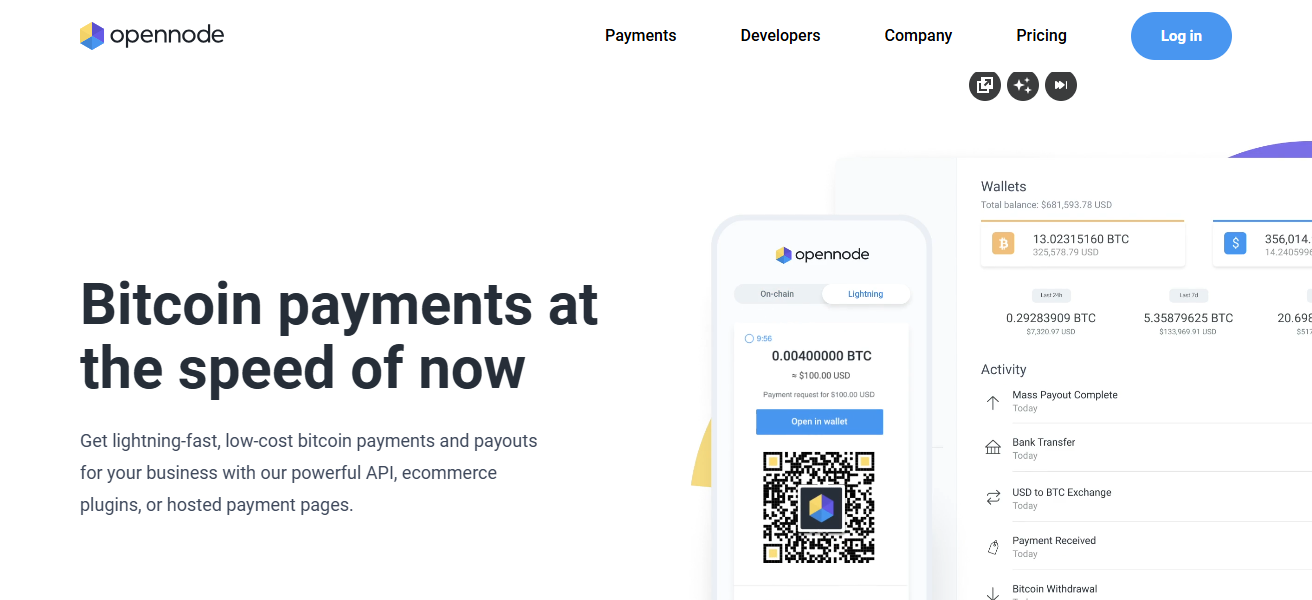
OpenNode is heavily relied on by enterprises for their top-tier APIs, payment tracking, and compliance tools.
This Bitcoin-focused innovation and speed makes OpenNode a top choice for merchants in the US that are in need of a fast and affordable way to transact with cryptocurrencies.
OpenNode – Pros & Cons
Pros:
- Transactions Using Bitcoin Lightning Network – Users can send and receive Bitcoin transactions with ease.
- Choice of Currency – Merchants have the option to choose the currency in which they receive their payments.
- Enterprise-Grade API – A strong set of features to assist large businesses in automating their processes.
- Affordability – Compared to on-chain fees, Lightning fees are less costly.
Cons:
- BTC-Only Focus – OpenNode does not support a variety of other cryptocurrencies.
- Requires Wallet Setup – Merchants need to have a basic understanding of how to manage crypto wallets.
- Light Custodial Options Only – Noncustodial setups require more initial configuration.
- Limited Fiat Features – Compared to card processors, they don’t offer fiat banking at a deeper level.
| Feature | Detailed Explanation |
|---|---|
| Bitcoin & Lightning Focus | Optimized for Bitcoin with instant Lightning payments. |
| Ultra-Low Transaction Fees | Lightning fees are often fractions of a cent. |
| USD & BTC Settlements | Merchants can choose between crypto or bank payouts. |
| Enterprise APIs & Tools | Real-time tracking, analytics, and scalable payment infrastructure. |
Why Choose CoinPayments Alternatives In The USA
- Lower Fees & Better Rates – Savings can be in higher revenue as more alternatives have lower processing fees or no platform fees at all.
- USD Settlement Options – Payouts to US bank accounts eliminates volatility risk and simplifies accounting on your end.
- Broader Crypto Support – Alternatives support all tokens, some more stablecoins, and all customers to pay regardless of the coin they have.
- Faster Transactions – Networks like Lightning Network and optimized rails on other networks significantly lower confirmation times.
- Stronger Compliance – Platforms focusing on the US market are voluntary compliant on KYC, tax reporting, and fraud protection; the complete reporting chain is integrated.
- Improved Integration – Simple plugins and APIs are available to help with ecommerce or POS systems.
- Greater Control & Security – Self-hosted options like BTCPay are those where you have complete control of the keys and all other data.
- Better User Experience – Conversions and trust are higher when checkout flows are familiar like PayPal or Stripe.
Flexible Crypto Checkout Platforms Shaping the Future of US Commerce
- Multi-Crypto Acceptance: Customers can use Bitcoin and altcoins as these modern payment systems accept both.
- Instant USD Settlement: Since merchants receive payments in USD, they do not have to deal with volatility and complexity in their accounting.
- Fast Transactions: The use of stablecoins and the Lightning Network allows for a near-instant checkout experience.
- Seamless Integrations: Crypto payments can be easily integrated with ecommerce stores and apps, and POS systems using simple plugins and APIs.
- Regulatory-Ready Design: Built-in KYC and tax reporting, along with anti-fraud measures, ease compliance with US regulations.
- Lower Processing Costs: Below-card-network fees enhance margins for merchants.
- Enhanced Customer Trust: The familiar checkouts of trusted platforms increase customer conversion.
- Scalable Infrastructure: The system is designed to accommodate higher transaction volumes as crypto use in the US increases.
Conclusion
To conclude, US merchants wanting reliable, safe, and affordable crypto payment solutions have plenty of alternatives to CoinPayments. Platforms like BTCPay Server, BitPay, NOWPayments, and PayPal Crypto Checkout provide quicker transaction speeds
Support a wider selection of cryptocurrencies, and guarantee reliable USD settlements. By picking appropriate alternatives, merchants could minimize costs, gain customer confidence, and in 2026 adapt to changes in customer payment preferences.
FAQ
Plisio, NOWPayments, and CoinGate for easy setup and low fees.
BitPay, Stripe, and Square for compliance, analytics, and bank settlement.
Yes, BTCPay Server is fully self-hosted.
Yes, most platforms support BTC, ETH, USDT, and more.
Yes, BitPay, CoinGate, Stripe, Square, and PayPal support direct USD settlement.