In this article we will discuss the best continuous security validation platforms that assist organizations in proactively assessing and improving their cybersecurity defendable posture.
- Key Points & Best Continuous Security Validation Platforms
- 10 Best Continuous Security Validation Platforms
- 1. AttackIQ
- 2. Cymulate
- 3. SafeBreach
- 4. XM Cyber
- 5. Verodin (FireEye Mandiant)
- 6. Picus Security
- 7. Randori
- 8. ThreatCare
- 9. Mandiant Security Validation
- 10. Horizon3.ai
- How We Choose Best Continuous Security Validation Platforms
- Cocnlsuion
- FAQ
The platforms help businesses defend their cybersecurity posture by simulating real-world attack scenarios to highlight where security measures are weak, and help ensure that measures in place are working against continuously evolving threats.
Key Points & Best Continuous Security Validation Platforms
| Platform | Key Point |
|---|---|
| AttackIQ | MITRE ATT&CK–aligned breach simulations for proactive defense testing |
| Cymulate | Comprehensive attack surface coverage including email, web gateway, endpoint, and cloud |
| SafeBreach | Extensive library of hacker playbooks to simulate real-world attack scenarios |
| XM Cyber | Continuous exposure management with attack path mapping across hybrid environments |
| Verodin (FireEye Mandiant) | Security instrumentation platform that validates controls and measures ROI |
| Picus Security | Automated threat emulation with actionable mitigation insights |
| Randori | Adversary emulation combined with attack surface management |
| ThreatCare | Agentless breach simulations for quick deployment and validation |
| Mandiant Security Validation | Continuous control validation integrated with threat intelligence |
| Horizon3.ai | NodeZero autonomous pentesting for scalable, continuous security validation |
10 Best Continuous Security Validation Platforms
1. AttackIQ
AttackIQ is at the forefront of a distinct sector within the cyber security industry. AttackIQ was the first company to defend in real time against adversaries based on the Attack Mitigation and Surveillance (MITRE) ATT&CK framework.
This approach enables real time verification of cyber security company controls and mitigations at the endpoint (EDR), perimeter (firewalls) and abstraction (SIEM) levels.
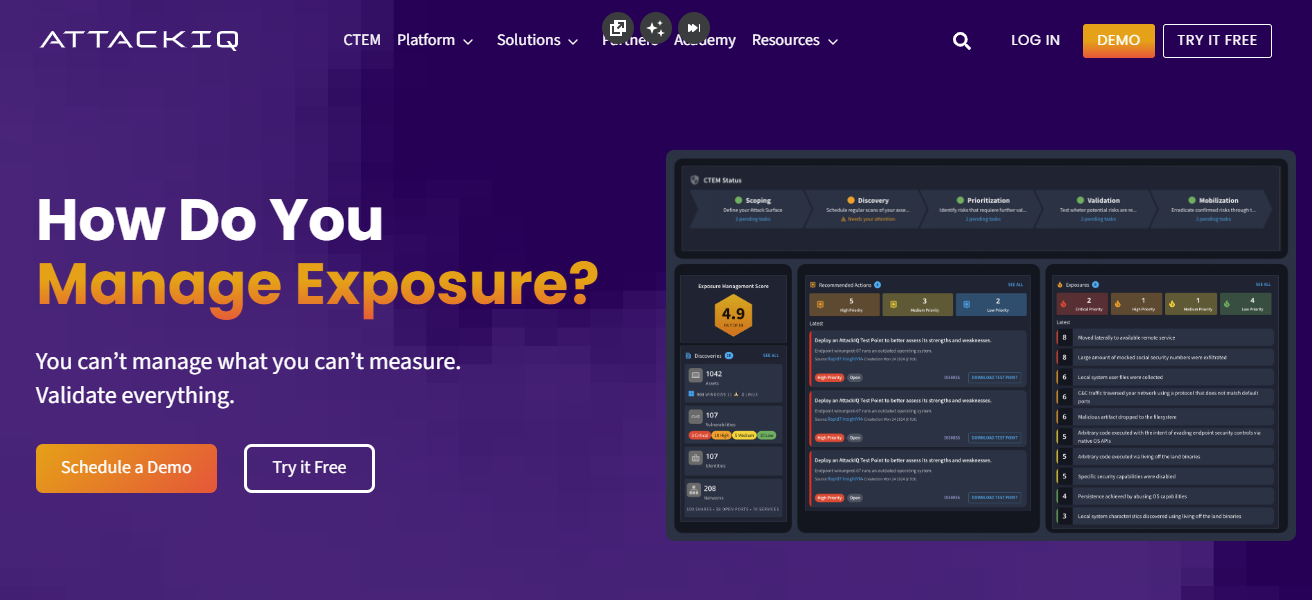
AttackIQ’s automated workflows and risk prioritization analytics empower cyber defense teams to work on security gaps based on risk and impact.
AttackIQ streamlining of security technology integration along with sophisticated reporting enable cyber defense leadership to improve controls continuously and defend security investments in the organization.
Features Attackiq
MITRE ATT&CK Alignment – Emulates adversary tactics and techniques mapped to MITRE ATT&CK as MITRE ATT&CK provides a standardized approach to adversary emulation.
Automated Security Control Validation – Validation of security control effectiveness and thoroughness is automated for continuous checking of security control detection, obstruction, and response goals.
Data-Driven Insights – Comprehensiveness of reporting on security configuration misalignments, security drift, and security economic ROI.
| Pros | Cons |
|---|---|
| Uses MITRE ATT&CK-aligned adversary emulation to test security controls. | Can be complex to set up for smaller teams without dedicated security engineers. |
| Strong automation and risk prioritization help focus remediation efforts. | Higher cost compared to simpler simulation tools. |
| Integrates with SIEM/SOAR tools to enhance correlation and response. | Requires ongoing tuning to reflect evolving environments. |
| Comprehensive reporting supports executive dashboards and compliance. | May feel heavy for organisations just starting with validation. |
2. Cymulate
Cymulate has continuous security validation by performing automated breach and attack simulations across multiple environments – network, cloud, web and endpoints.
It has a large library of pre-created scenarios, updated every day, to measure the effectiveness of security controls, identify deficiencies, and offer solutions to fix them.
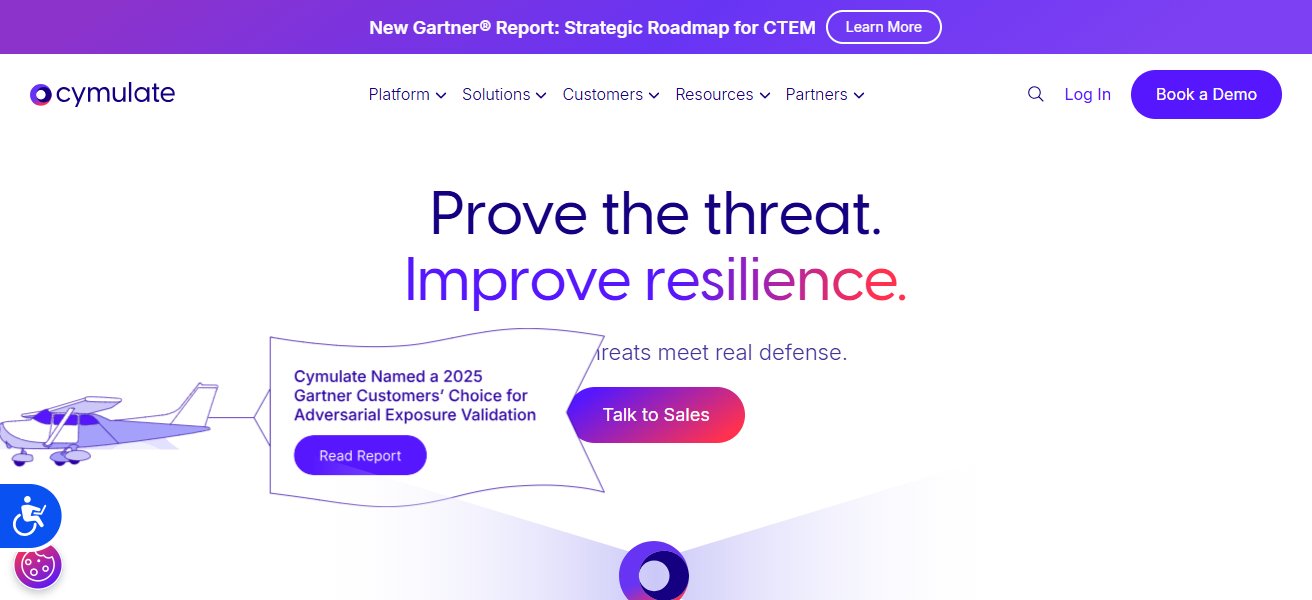
Cymulate assesses security posture over time, measuring drift and offering evidence for compliance/audit purposes.
The solution’s production-safe execution and integration with top-tier SIEM, SOAR and ticketing tools makes it ideal for mature and developing security teams in need of continuous validation.
Features Cymulate
Attack Surface Coverage – Emulates attacks on multiple surfaces of the attack vector, including email, web, end user, and cloud.
Continuous Threat Validation – Automates exposure testing of vulnerabilities to minimize attack surface and exposure.
Detection Engineering – Assisting fine tuning of detection and response technologies in SIEM, EDR, and XDR on faster detection.
Red Team Synchronization – Eases the augmentation of offensive security testing by providing production-safe virtual attack platforms.
| Pros | Cons |
|---|---|
| Fast “production-safe” breach simulation across network, email, endpoint, and cloud. | Less deep offensive automation compared to full red-team platforms. |
| Easy to get started with pre-built templates and frequent updates. | Can generate alerts that require careful interpretation. |
| Strong visibility into security posture over time. | Licensing cost may be high for broad module usage. |
| Integrates with SIEM/SOAR for automated workflows. | Some complex scenarios may require expert input. |
3. SafeBreach
SafeBreach is the first company to simulate breaches and attacks through a continuous simulation of the techniques used by real hackers.
This process helps to validate security controls and eliminates vulnerabilities before real attackers can exploit them.
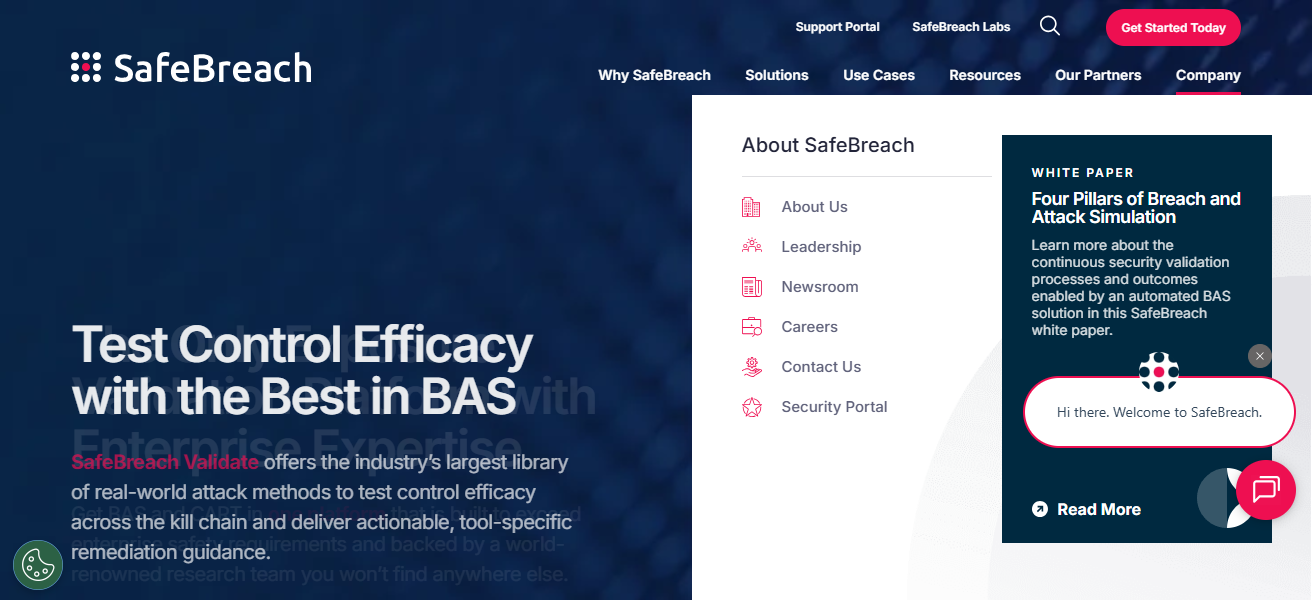
SafeBreach automatically executes integrated attack simulations against cloud, endpoint, and email security controls to help organizations understand the entire attack surface and the potential attack pathways through the kill chain.
SafeBreach also helps teams validate the workflows of detection engineering and incident response by supplying contextualized data about the simulated attacks, which strengthens the defensive posture.
Features Safebreach
Extensive Hacker Playbook Library – Emulates adversaries of the virtual world to the extent of thousands of attack scenarios and real world attack penetration testing.
Security Control Validation – Validation of attacks on individual and orchestration of multiple security control tools to unconceal misconfigurations.
Dynamic Risk Visibility – Provides real-time data to of risks exposure to visualize paths of attack and the relative risk vector.
Actionable Mitigation Guidance – Provides clear recommendations to prioritize response and mitigation to attacks.
| Pros | Cons |
|---|---|
| Pioneer in BAS with mature library of attack scenarios. | Platform complexity may require more onboarding/training. |
| Provides full-chain attack simulations to uncover control gaps. | Enterprise-scale pricing may not suit smaller orgs. |
| Helps fine-tune detection engineering and incident response. | Management of simulation output may require skilled staff. |
| Strong reporting and analytics. | Some endpoint behaviours may need deeper contextual data. |
4. XM Cyber
XM Cyber focuses on Continuous Exposure Management (CEM), a proactive approach that focuses on the continuous identification of vulnerabilities, attack paths, and exploitable attack surfaces in hybrid environments.
XM Cyber’s platform simulates attacker movement across systems, correlates external and internal exposures, and assists security teams in prioritizing remediations based on true business risk.
Instead of basic vulnerability scanning, XM Cyber performs automated risk validation of security controls and configuration drift, determining whether fixes are working and eliminating false positives.
The continuous risk-focused perspectives assists in decision-making and diminishes the gap between discovering a threat and mitigating it.
Features XM Cyber
Continuous Exposure Management – Prioritize engagements using graph-based analysis to manage exposures.
Attack Path Mapping – Identify exploitable paths by showing the interconnections of the vulnerabilities.
Hybrid Environment Coverage – Combines discovery of the external attack surface with internal validation.
False Positive Reduction – Cross verifies external threats with internal assets to filter out noise.
| Pros | Cons |
|---|---|
| Focus on continuous exposure management and real attack path modelling. | May produce large volumes of findings needing prioritisation. |
| Correlates external and internal exposure data well. | Onboarding can be involved, especially for hybrid environments. |
| Supports hybrid cloud and on-prem infrastructure. | Requires integration with vulnerability/data sources for full value. |
| Helps reduce false positives by validating exposures. | May overlap with other risk management tools if already deployed. |
5. Verodin (FireEye Mandiant)
Verodin is a component of Mandiant Security Validation. It aims to evaluate a company’s existing security controls to check whether they are able to withstand an attack from a real-world adversary.
It helps organizations determine whether their security systems are able to mitigate high sophistication, targeted, adversary attacks using tools and processes aligned with MITRE ATT&CK, frontline threat intelligence and test adversary attacks.

It provides drift detection and alerts when security controls regress for continuous monitoring and environmental enhancement.
Mandiant’s incident response threat and research is incident response and threat research is a significant component of strong realism to attack simulation ability of the platform.
Features Verodin (FireEye Mandiant)
Security Instrumentation Platform – Measures and confirms control effectiveness over time.
MITRE ATT&CK Mapping – Synchronizes testing against tactics and frameworks deployed by the adversary.
Environmental Drift Detection – Issues notifications when there are security regressions over time.
ROI Measurement – Assures organizational leaders of the security investment benefits.
| Pros | Cons |
|---|---|
| Backed by Mandiant threat intelligence for realistic validation. | Can be resource-intensive to maintain continuous validation. |
| Strong MITRE ATT&CK coverage for credible attack emulation. | Licensing and enterprise focus may limit accessibility. |
| Identifies control degradation over time. | Setup and tuning require security engineering expertise. |
| Helps validate that remediation measures actually work. | Reporting can be dense for non-technical stakeholders. |
6. Picus Security
Piccus Security offers automated attack simulations to evaluate security control effectiveness in on-premise, cloud, and hybrid environments.
The platform regularly pulls from a large expanding threat library to help organizations evaluate how well their defenses identify and mitigate.
Picus also providers actionable, vendor-aligned mitigation recommendations and reporting to help organizations fine tune their tech stack.
Picus also provides risk quantification and attack pathway prioritization to help CISOs manage with the addition of new AI and exposure validation feature.
Features Picus Security
Automated Threat Emulation – Continuously and automatically emulates real-life cyberattacks across the entire kill chain.
Actionable Insights – Quickly addresses security gaps by providing steps to close them.
SOC Optimization – Assists SOC teams to enhance productivity and clear the remediation backlog.
Flexible Deployment – Completely adaptable to the needs of the enterprise and fully continuous.
| Pros | Cons |
|---|---|
| Large and regularly updated threat library. | Some advanced scenarios may not be as customizable. |
| Actionable, vendor-specific remediation guidance. | May require dedicated effort to integrate into workflows. |
| Continuous validation across hybrid environments. | Smaller footprint compared with full red team platforms. |
| Quantifies risk and prioritises fixes effectively. | Pricing can rise when adding multiple modules. |
7. Randori
Randori provides automated attack surface management as well as continuous automated red teaming that allows organizations to analyze and improve their defenses against real-world attackers.
Randori’s automated Attack Platform allows defenders to see how real attackers might exploit their vulnerabilities by moving through various stages of an attack — from reconnaissance to lateral movement — to simulate various advanced attack techniques.
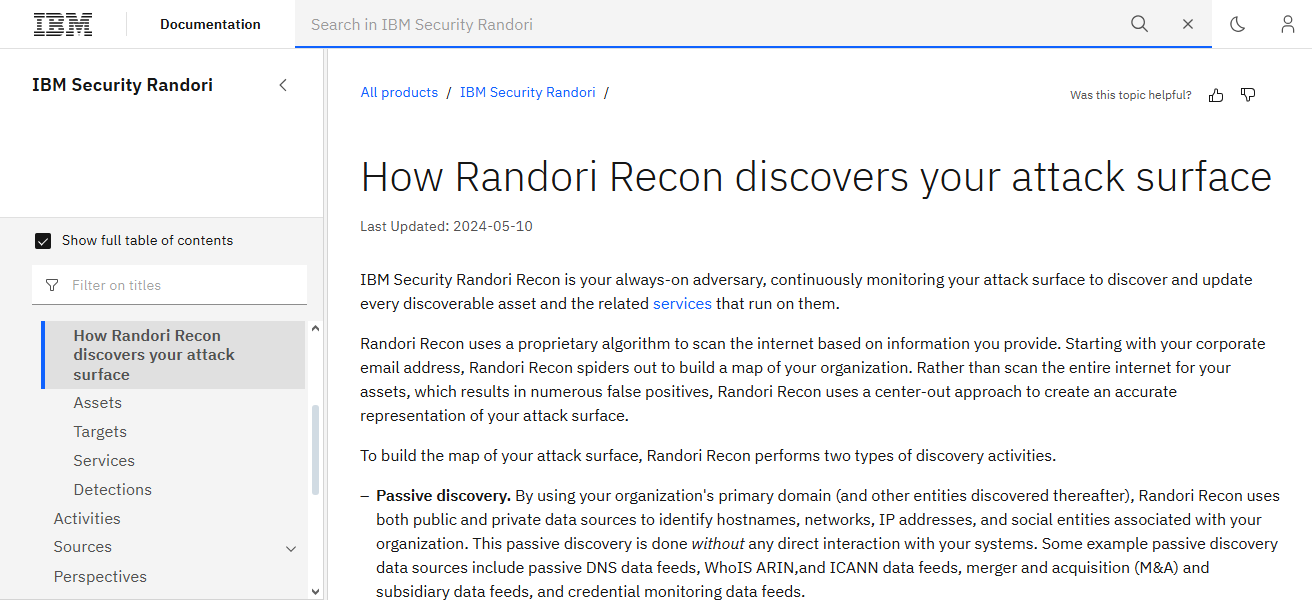
Randori’s Recon module continuously surveys an organization’s attack surface and prioritizes findings by potential impact and their likelihood of being exploited.
By integrating automation for offensive security and ongoing surveillance, Randori makes it possible to continuously, proactively, and at scale assess the security posture and validate the controls in place.
Features Randori
Attack Surface Management (ASM) – Finds and tracks external assets in real-time.
Automated Red Teaming – Evaluates the defences by mimicking attacker’s behavior and scales the testing.
Risk-Based Prioritization – Detects the vulnerabilities that are most likely to be exploited.
Unified Offensive Security Platform – This is where ASM joins with an adversary emulation to form a holistic validation.
| Pros | Cons |
|---|---|
| Strong continuous automated red-teaming capabilities. | Attack surface discovery may highlight a lot of low-priority findings. |
| Recon component continuously profiles exposures. | Requires security maturity to act on results effectively. |
| Good for organisations wanting real offensive insights. | May overlap with penetration testing services. |
| Provides prioritised exposure risk insights. | Some features can be overwhelming for beginners. |
8. ThreatCare
ThreatCare provides breach and attack simulation and adversarial emulation capabilities to help organizations assess and advance the effectiveness of their security programs.
While individual continuous validation functionalities depend on the implementation, ThreatCare tools allow organizations to conduct realistic cyber risk assessments and simulate cyber threats in order to assess detection, prevention, and response capabilities.

These simulations help security teams assess their gaps in response and improve their operational workflows to better respond to threats.
Features ThreatCare
Agentless Breach Simulations – There is no need for deployments with endpoint agents.
Production-Safe Testing – Defense validation happens with no interruption to live system processes.
Continuous Security Validation – Assessments are automated to uncover open gaps and overlaps.
Policy and Control Optimization – Targets and augments gaps in configuration and existing defense regimes.
| Pros | Cons |
|---|---|
| Realistic breach and attack simulations. | Not as widely adopted, so integrations may be limited. |
| Helps exercise detection and response playbooks. | Feature set can be less mature than larger BAS competitors. |
| Useful for internal security program assessments. | Depth of automation may vary by deployment. |
| Supports continuous and scenario-based testing. | Smaller community and ecosystem compared to bigger brands. |
9. Mandiant Security Validation
Mandiant Security Validation (formerly Verodin) offers continuous automation for testing security controls using automated adversary emulation based on intelligence and real attack behavior.
It verifies if tools like EDR, firewalls and SIEM can actually defend against real threats and notifies teams if controls degrade over time.

The platform pulls in threat intelligence gained from Mandiant incident response engagements, mapping tests to MITRE ATT&CK for relevance and accuracy.
Continuous validation helps organisations defend against current threats and align security posture to adversary movements.
Features Mandiant Security Validation
Frontline Threat Intelligence – Acquired target insights through real-world incident response collaboration.
Automated Attack Simulations – Defense systems are constantly tested with attacks from new and upcoming threats.
Environmental Drift Analysis – Control misconfigurations regression and gap analysis.
Framework Integration – Consolidates with other frameworks from MITRE ATT&CK and NIST.
| Pros | Cons |
|---|---|
| Leverages Mandiant’s threat intelligence for high-quality emulations. | Higher cost for enterprise-grade features. |
| Continuously validates controls and maps to MITRE ATT&CK. | Advanced setup may require expert support. |
| Detects control degradation and drift. | Can surface significant output requiring triage. |
| Supports executive reporting and compliance readiness. | Not as lightweight for small teams. |
10. Horizon3.ai
The NodeZero® platform of Horizon3.ai specializes in automated penetration testing and ongoing security evaluation, enabling companies to identify, remediate, and verify exploitable weaknesses at scale.
NodeZero conducts internal, external, and cloud penetration tests and assumes remediation in order of occurrence based on actual attack paths and business risk.
Horizon3.ai empowers organizations to assess security posture, ascertain whether remediation efforts are effective, and identify new risks on a continuous basis by enabling automated testing at a frequency that far exceeds the conventional yearly pentest.
Over time, its method combines traditional offensive testing and continuous validation to create a broad spectrum of security improvements.
Features Horizon3.ai (NodeZero)
Autonomous Pentesting – Conducts large scale automated penetration tests across varied environments.
Vulnerability Management Hub – Empowers your team to close and validate gaps in the system.
Customizable Attack Configurations – Tailors pentesting that suits the needs of your organization.
Continuous Scheduling – Automates tests for iterative validation.
| Pros | Cons |
|---|---|
| Automated penetration testing (NodeZero) for continuous assessment. | Focused more on penetration-style testing than pure validation. |
| Prioritises vulnerabilities based on real attack paths and impact. | May produce findings that require manual validation. |
| Frequent automated tests deliver continuous insights. | Cloud/on-premise coverage may vary by agent deployment. |
| Useful for teams that want offensive insight + validation. | Requires security expertise to interpret advanced outputs. |
How We Choose Best Continuous Security Validation Platforms
- Threat-informed testing – We verify that the platform can model attacks based on the MITRE ATT&CK framework combined with specific threat intelligence. Then, we examine how real-world attacks are simulated.
- Continuous & automated validation – We prefer tools that automate testing, rather than those that do manual or one-off tests.
- Attack Path & Exposure Validation – We examine platforms based on how quickly and accurately they expose attack paths and validate real-world risks versus risks that are merely theoretical.
- Remediation Guidance – Optimal platforms provide detailed, actionable steps in a recommended plan that security teams can implement quickly.
- Integration & scalability: We select tools based on their capabilities to complement current security technologies (SIEM, SOAR, EDR) and their scalability on public cloud, on-premises, and hybrid architectures.
Cocnlsuion
To summarize, the top self-security validation platforms assist entities in staying one step ahead of cyber threats by continually assessing and validating their cyber defense capabilities.
In doing so, these platforms empower cyber defense teams with risk assessments, up-to-date risk visibility, and frontline attack emulation, enabling teams to strengthen their cyber defense, reduce their exposure, and achieve long-term cyber defense sustainability.
FAQ
A platform that continuously tests and verifies the effectiveness of security controls by simulating real cyberattacks to identify gaps and weaknesses.
Because security threats evolve rapidly, and static testing (like annual pentests) may miss new vulnerabilities or control degradation over time.
Penetration testing is periodic and manual, while continuous validation is automated, ongoing, and integrated into daily security operations.
Most use MITRE ATT&CK or similar threat modelling frameworks to map simulated attacks to real adversary behaviors.
Security operations, SOC teams, risk management, compliance, and incident response teams benefit by improving detection, prevention, and response.