
In this article, we will go over the Best Crypto Community Sybil Detection Tools that help Web3 projects detect fake accounts, duplicate wallets, bots, and fraudulent participants.
We will also look into their main features, human verification methods, blockchain compatibility, community protection capabilities, and practical use cases to help crypto projects choose the most suitable solutions to prevent Sybil attacks and ensure fair participation.
Key Points & Best Crypto Community Sybil Detection Tools
| Tool | Explanation |
|---|---|
| Trusta Labs | Identifies Sybil accounts using on-chain analytics, behavioral patterns, and reputation scoring. |
| Human Passport | Verifies unique human identities through decentralized credentials and community-backed verification methods. |
| Artemis AI | Analyzes blockchain activity to detect suspicious wallets, coordinated behaviors, and Sybil networks. |
| ShieldLabs | Helps communities identify fraudulent participants through advanced Sybil detection and risk analysis. |
| Chainalysis | Tracks blockchain transactions to uncover suspicious wallets, illicit activities, and coordinated networks. |
| TRM Labs | Uses blockchain intelligence to identify risky wallets, fraud patterns, and suspicious connections. |
| Galxe | Supports community verification through credential checks, campaign analytics, and Sybil-resistant participation. |
| zkMe | Provides privacy-preserving identity verification to help prevent duplicate and fraudulent accounts. |
| Privado ID | Enables decentralized identity verification using verifiable credentials and privacy-focused authentication technology. |
| World ID | Verifies unique human users through proof-of-personhood technology without revealing personal identity information. |
10 Best Crypto Community Sybil Detection Tools in 2026
1. Trusta Labs
At Trusta Labs, we focus on blockchain identity, reputation analysis, and suspicious wallet activities in Web3 ecosystems. The primary focus is the detection of Sybil accounts through AI-based behavioral analysis, wallet connection and on-chain activity patterns.
It uses identity and reputation signals to help distinguish human users from automated or fraudulent users for human verification. Community protection includes the discovery of coordinated wallet networks,
The prevention of fake participation and the improvement of fairness in airdrops, campaigns and community rewards. It is compatible with multiple blockchain ecosystems, supporting networks like Ethereum, BNB Chain, Polygon and other supported environments.
Trusta Labs Best For
- Airdrop campaigns against Sybil farming.
- DAOs are identifying coordinated wallet networks.
- Communities assess wallet reputation and user authenticity.
- Web3 projects flagging suspicious wallet activity
Trusta Labs Use Case
| Use Case | Explanation |
|---|---|
| Sybil and bot detection | Uses AI and graph analysis to flag fake wallets farming airdrops. |
| On-chain reputation scoring | Gives wallets a “MEDIA Score” based on activity, engagement and trust. |
| Fair airdrop distribution | Projects filter out farmers and reward real users. |
| Identity attestations | Issues on-chain attestations and credentials that other apps can reuse. |
2. Human Passport
Human Passport (formerly Gitcoin Passport) is a decentralized identity verification and Sybil resistance solution for Web3 communities. The main purpose is to determine if the wallet addresses are real people or potentially fraudulent participants.
Human verification includes identity credentials, social accounts, blockchain activity, biometrics and zero-knowledge verification options. Its community protection features help mitigate fake accounts, duplicate participation, airdrop farming and manipulated DAO voting.
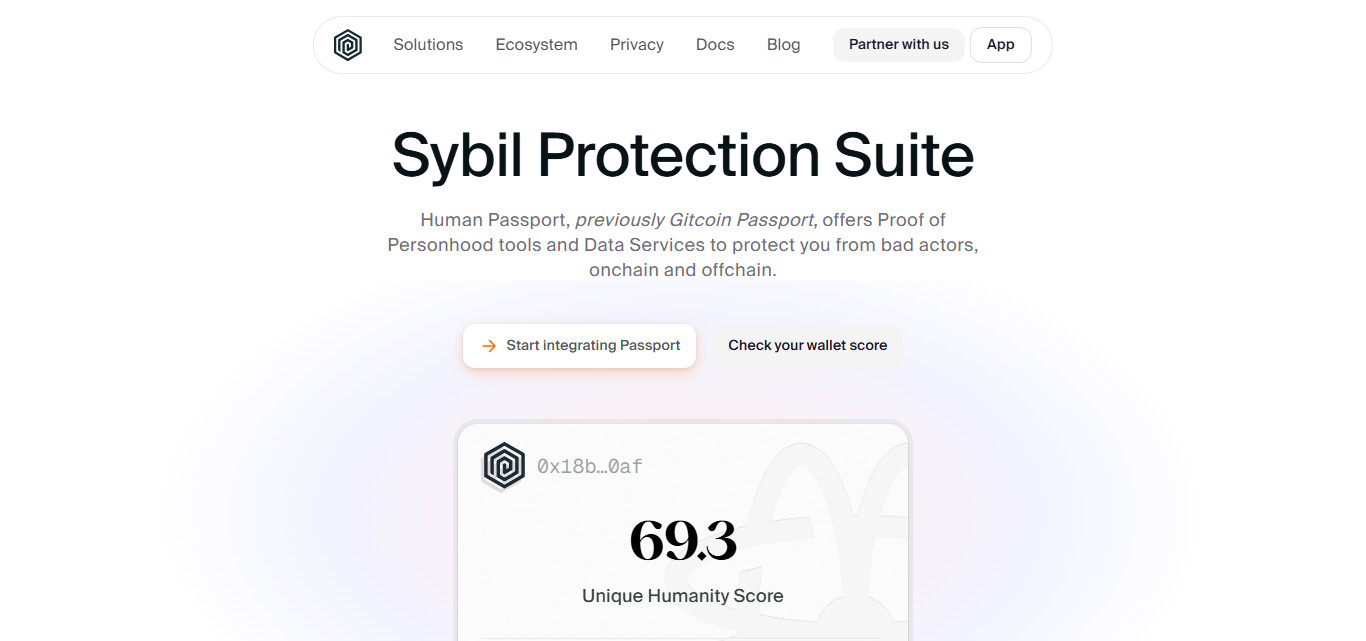
Reputation scores and machine-learning models can be used by developers to evaluate participants before giving them access or handing out rewards. The blockchain compatibility depends on the feature of verification, including Ethereum, Base, Optimism, Avalanche, Stellar, Sui and several EVM ecosystems.
Human Passport Best For
- Airdrop campaigns checking actual users.
- DAOs to avoid double voting and fake identities.
- Web3 communities assessing human trustworthiness.
- Projects that implement decentralized identification verification.
Human Passport (formerly Gitcoin Passport) Use Case
| Use Case | Explanation |
|---|---|
| Sybil-resistant grants | Protects quadratic funding rounds from fake accounts. |
| Humanity scoring | Aggregates “Stamps” (social, biometric, on-chain) into one score. |
| Airdrop and rewards gating | Only wallets above a score threshold can claim. |
| Fair governance voting | Helps ensure one person has one meaningful vote in DAOs. |
3. Artemis AI
Also listed is Artemis AI, a blockchain analytics option to understand wallet activity and identify unusual participation patterns. Primary Function: Possible role in Sybil research is to analyze wallet behavior, transaction activity, and ecosystem-level participation to identify suspicious patterns.
Human verification: blockchain analytics can’t verify that a wallet belongs to a unique human, so further identity verification may be needed. Community Protection: Trustworthy wallet intelligence can enable projects to analyze suspicious behavior and identify possible reward farming or organized participation.
Blockchain Compatibility Compatibility is dependent on the particular Artemis product and the available network datasets. Teams should evaluate their current Sybil-detection capabilities before they adopt it as a dedicated solution.
Artemis.ai Best For
- Projects tracking Web3 blockchain activity.
- Analysts detecting abnormal transaction patterns.
- Wallet activity trackers and ecosystem progress trackers.
- Projects studying on-chain participation and suspicious activity.
Artemis AI Use Case
| Use Case | Explanation |
|---|---|
| AI-driven data analytics | Turns raw on-chain and market data into usable insights. |
| Wallet and user behavior analysis | Segments users and tracks activity patterns. |
| Risk and anomaly detection | Flags suspicious or unusual activity automatically. |
| Decision support | Gives teams and investors research-ready dashboards and signals. |
4. ShieldLabs
ShieldLabs provides technology designed to detect Sybil attacks and multi-accounting in crypto applications. Main Purpose: It identifies multiple wallets from a single person by device intelligence, browser fingerprints, network information, suspicious behavior of visitors.
Human Verification: It is not government ID or biometric scans, but technical signals to detect returning users and connect suspicious accounts. Community Protection: It prevents projects from airdrop farming

fake registrations, reward manipulation and fraudulent participation in pre-distributions. Blockchain Compatibility: It works mostly at the website, device, and wallet-connection level instead of the individual blockchain network level for its detection.
ShieldLabs Best For
- Airdrop projects that stop farming multiple accounts.
- Web3 platforms that identify suspicious registrations.
- Communities identify repeat users and fraudulent participation.
- Projects protecting token distributions and campaign awards.
ShieldLabs Use Case
| Use Case | Explanation |
|---|---|
| Wallet and transaction protection | Warns users about malicious contracts and scams. |
| Identity and trust verification | Confirms users or counterparties are legitimate. |
| Fraud and phishing prevention | Detects fake sites, address poisoning and drainers. |
| Security tooling for projects | Helps apps add risk checks to their own flows. |
5. Chainalysis
Chainalysis is a blockchain intelligence platform that helps organizations investigate suspicious cryptocurrency transactions and risky wallet networks. Primary Function: Examines blockchain transactions, wallet relations, fund flows and entity links to identify possible fraudulent activities.
Human Verification Chainalysis does not offer direct proof-of-personhood verification, but employs intelligence and wallet attribution to investigate suspicious entities. Community Protection: Crypto projects can use its analytical tools to identify scam related wallets, trace suspicious fund transfers and enhance security monitoring.
Blockchain Compatibility: Its blockchain intelligence platform supports 29 blockchain networks, providing extensive transaction visibility across various crypto ecosystems.
Chainalysis Best For
- Crypto exchanges probing suspicious wallet activity.
- Blockchain companies tracking illicit transactions.
- Security teams watching connected wallet networks.
- Companies investigating crypto risks.
Chainalysis Use Case
| Use Case | Explanation |
|---|---|
| Transaction monitoring (KYT) | Exchanges screen deposits and withdrawals for risk in real time. |
| Sanctions and AML compliance | Detects exposure to sanctioned or illicit addresses. |
| Criminal investigations | Law enforcement traces funds across wallets with tools like Reactor. |
| Government asset recovery | Agencies track and seize proceeds of crypto crime. |
6. TRM Labs
TRM Labs provides blockchain intelligence and risk monitoring solutions to identify suspicious cryptocurrency addresses and financial activity. Main Purpose: The platform analyzes wallet transactions, address clusters, asset movements and behavioral patterns to spot potential financial threats.
Human Verification: TRM Labs does not directly verify unique human identities but provides wallet attribution and risk intelligence to support investigations into suspicious participants. Community Protection Projects can scan high risk wallets, investigate scam links, track suspicious transactions and reinforce their security processes.
Blockchain Compatibility: TRM provides transaction intelligence for 65+ chains and risk screening for 184+ blockchains depending on the product.
TRM Labs
- Web3 projects screening high risk wallet addresses.
- Security teams are watching out for suspicious blockchain transactions.
- Crypto companies investigate scams, financial risks.
- Organizations exploring wallet connections and transaction risks.
TRM Labs Use Case
| Use Case | Explanation |
|---|---|
| Blockchain intelligence | Traces funds across many chains and entities. |
| Risk and compliance screening | Scores wallets and transactions for AML and sanctions risk. |
| Fraud and scam tracing | Follows hacks, ransomware and scam proceeds. |
| Public-sector investigations | Helps tax, police and regulatory bodies build cases. |
7. Galxe
Galxe offers Web3 community engagement, identity credentials and campaign verification features to help projects increase participant authenticity. The core purpose is to leverage its Galxe Score and Sybil Prevention to assess on-chain activity and user credibility within community initiatives.
Human Verification: Galxe Passport provides identity verification capabilities and humanity scoring allows projects to evaluate if participants demonstrate authentic human behavior. Community Protection Its verification features help reduce bot participation, fake accounts, duplicate campaign entries and fraudulent reward farming.
Campaign security requirements will drive different verification needs for projects. Blockchain Compatibility: Galxe is compatible with multiple Web3 ecosystems via its wallet connections, credentials and integrations; availability of specific network depends on the selected campaign and feature.
Galxe (Galxe) Best For
- Community campaigns for Web3 projects.
- Airdrop organizers cutting bots.
- DAOs to verify campaign participants and credentials.
- Communities giving out rewards for verified actions.
Galxe Use Case
| Use Case | Explanation |
|---|---|
| Community quests and campaigns | Projects run tasks and reward users with tokens, NFTs or points. |
| Credential network | Issues verifiable credentials for on-chain and off-chain achievements. |
| Galxe Passport and Score | Provides a reusable identity and reputation layer. |
| Loyalty and user growth | Brands build engagement and track users across ecosystems. |
8. zkMe
zkMe is a decentralized identity verification protocol that leverages zero-knowledge technology to safeguard user privacy across Web3 applications. Primary Function: Its primary function is to verify user credentials and establish trusted digital identities without revealing personal information.
Human Verification : It offers privacy-preserving identity verification, proof-of-personhood verification, and reusable credentials to assist in distinguishing real participants. Community Protection Projects may utilize its verification infrastructure to prevent duplicate identities, fraudulent registrations
Sybil attacks and unauthorized campaign participation. Blockchain Compatible: zkMe supports over 30 blockchain networks including Ethereum, Solana, Aptos, BNB Chain, Polygon, Arbitrum, and Optimism.
zkMe Best For
- Web3 apps that use privacy-preserving identity verification.
- Airdrop campaigns to avoid duplicate user registration.
- DAOs verifying unique participants without revealing personal data
– Projects requiring zero-knowledge identity credentials.
zkMe Use Case
| Use Case | Explanation |
|---|---|
| Zero-knowledge KYC (zkKYC) | Users prove they passed KYC without exposing personal data. |
| DeFi and RWA compliance | Protocols meet regulations while keeping users private. |
| Selective proofs | Proves age, residency or accreditation only when needed. |
| Reusable credentials | Issues KYC-linked credentials usable across multiple apps. |
9. Privado ID
Privado ID (formerly Polygon ID) offers decentralized identity infrastructure with verifiable credentials and zero-knowledge proofs. Primary Function: Apps can issue, manage and verify digital identity credentials without requiring users to share unnecessary personal information.
Human Verification Credentials can be used for Identity Verification, Proof-of-Personhood, KYC and privacy-preserving authentication. Community Protection: Projects may utilize Sybil-resistant participation rules with unique identity credentials and cryptographic nullifiers to ensure that the same person does not perform restricted actions multiple times.
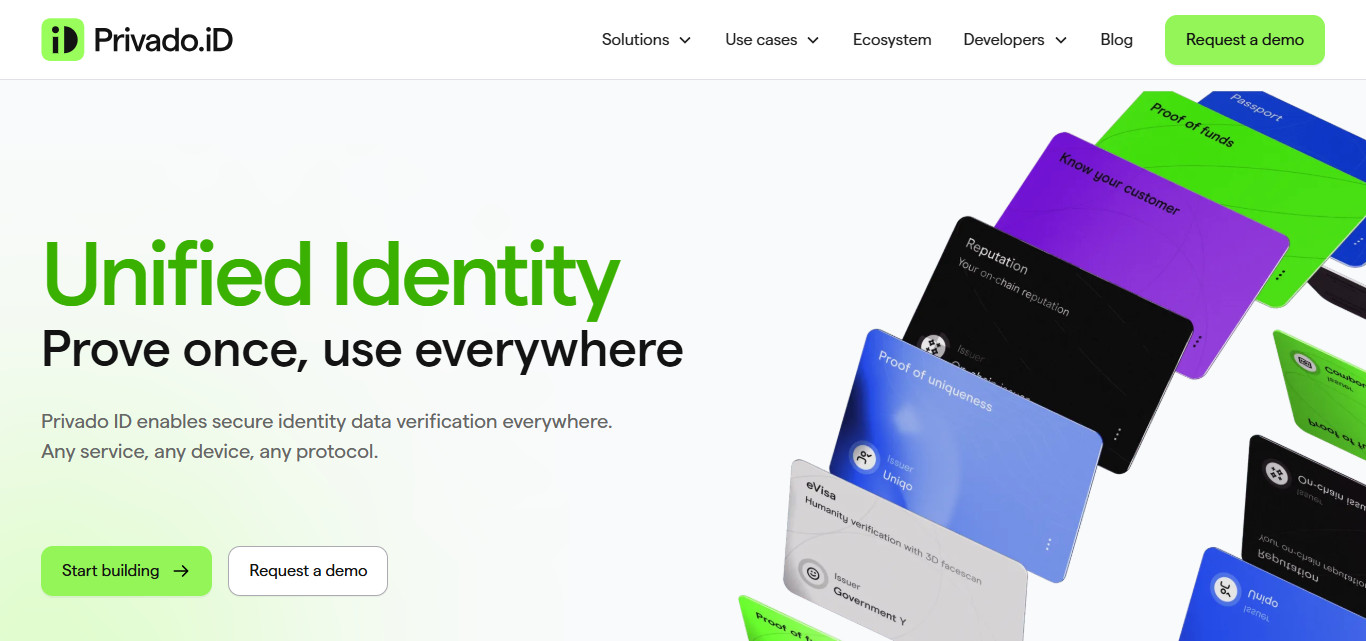
Blockchain Compatibility: Privado ID supports on-chain and off-chain verification, and is integrated with blockchains such as Polygon and its developing identity infrastructure.
Privado ID Best For
- Web3 apps that build decentralized identity systems.
- DAOs that leverage privacy preserving membership verification.
- Communities stopping multiple registrations through identity credentials.
- Projects that require verifiable credentials and zero knowledge proofs.
Privado ID (formerly Polygon ID) Use Case
| Use Case | Explanation |
|---|---|
| Self-sovereign identity | Users hold their own verifiable credentials in their wallet. |
| Private verification | Zero-knowledge proofs confirm claims without revealing raw data. |
| On-chain access control | Smart contracts gate actions based on verified credentials. |
| Enterprise and government credentials | Issuers such as institutions can create and verify ID-style credentials. |
10. World ID
World ID is a decentralized proof of personhood solution aimed at creating unique human identities across digital platforms. Primary Function: It enables Web3 applications to confirm that participants are real, unique humans and not automated bots or duplicate accounts.
Human Verification: Its Proof of Human system uses Orb-based verification and privacy-preserving cryptography to verify human uniqueness without revealing personal identity information to applications.

Community Protection Projects may use World ID to reduce Sybil attacks, prevent multiple reward claims, limit fake registrations, and enable fair community participation. Blockchain Compatibility: World ID is compatible with Web3 applications through its identity protocol and developer tools, including World Chain and supported application integrations.
World ID Best For
- Airdrop campaigns that confirm unique human participants.
- Web3 communities prohibiting participation by automated bots.
- DAOs that support fair and unique voting.
- Applications that require proof-of-personhood verification.
World ID Use Case
| Use Case | Explanation |
|---|---|
| Proof of personhood | Iris-based verification shows a user is a unique human. |
| Anonymous login | Users sign in to apps using zero-knowledge proofs, without sharing identity. |
| Bot and Sybil prevention | Protects airdrops, polls, social apps and marketplaces from fake accounts. |
| Fair distribution and voting | Supports one-person-one-share rewards, governance and token distributions. |
How we select the best crypto community sybil detection tools
- Detection Accuracy: Detects fake accounts, duplicate wallets, bots and coordinated Sybil networks.
- Human Verification: There are Proof of personhood, decentralized identity and unique user verification techniques.
- Wallet Analysis: Ability to analyze wallet relationships, transaction histories and suspicious on-chain activities.
- Community Protection: How effective is it in preventing airdrop farming, fake sign-ups, reward manipulation and fraudulent participation.
- Blockchain Compatibility: Works with various blockchain networks such as Ethereum, Solana, Polygon, and other Web3 ecosystems.
- Real-Time Monitoring: Track suspicious wallet activity to rapidly detect potential Sybil threats.
- Scalability: Ability to support large communities, multiple wallets and high volume campaigns.
Conclusion
Conclusion Best Crypto Community Sybil Detection Tools for Web3 Projects Web3 projects can protect their communities from fake accounts, bots, duplicate wallets, and fraudulent activity. Tools such as Trusta Labs, Human Passport, Galxe, zkMe, and World ID are taking a different approach to identity verification and Sybil resistance.
Projects can guaranty fair participation and more reliable Web3 ecosystems by evaluating detection accuracy, human verification, blockchain compatibility, privacy, and community protection.
FAQ
Why are Sybil Detection Tools important?
They prevent fraudulent participation, airdrop farming, reward manipulation, and unfair community engagement.
Which are the Best Crypto Community Sybil Detection Tools?
Popular options include Trusta Labs, Human Passport, ShieldLabs, Galxe, zkMe, Privado ID, and World ID.
How do Sybil Detection Tools identify fake accounts?
They analyze wallet relationships, transaction histories, behavioral patterns, device signals, and identity credentials.
Can Sybil Detection Tools protect crypto airdrops?
Yes, they help identify suspicious participants, reduce duplicate claims, and improve fair reward distribution.