This article will discuss the best crypto transaction relayer networks that transfer assets and messages across blockchains fast, safe, and cheap. I’ll walk you through Across Protocol, Relay, deBridge, LayerZero, Stargate, Hyperlane, Wormhole
LI.FI, Jumper Exchange, and Bungee, and tell you exactly which chains they support, how much they cost, how quickly they do their transfers, what they’re best at, and their best use cases so you can choose with confidence.
How We Pick the Best Crypto Transaction Relayer Networks
Security and History: We look at audits, the design of the verifier or guardian, past exploits, and how the team responded.
Transfer speed: We like chains that can transfer value cross-chain in a few minutes to seconds.
Fees and Costs: We assess the protocol fees, the relayer fees and the gas to make sure we are getting affordable and clear pricing.
Supported Chains: We examine the range of blockchains that are supported, such as EVM, Solana and Bitcoin networks.
Liquidity and Volume: We like networks with deep liquidity, high transaction volume, and low slippage.
Ease of Use: We look at how easy it is for users and developers to use the interface, API and SDK.
Decentralization and Reliability: We believe in permissionless design, uptime and consistent delivery without failed or stuck transfers.
Adoption and Ecosystem Support: We look at wallet and dapp integration, community trust, and developer tools.
Key Points & Best Crypto Transaction Relayer Networks
| Network | Explanation |
|---|---|
| Across Protocol | Fast intent-based bridging where relayers front user liquidity and get repaid later. |
| Relay (Relay.link) | Instant cross-chain payments and swaps through solver relayers with very low fees. |
| deBridge Liquidity Network | Cross-chain swaps and messaging using validators and market makers for fast settlement. |
| LayerZero (V2) | Omnichain messaging protocol where independent verifiers and relayers confirm cross-chain transactions securely. |
| Stargate Finance | Unified liquidity pools on LayerZero enabling native asset transfers across many chains. |
| Hyperlane | Permissionless interoperability layer letting any chain deploy custom security modules and relayers. |
| Wormhole | Guardian-validated messaging network connecting dozens of blockchains for token bridging and apps. |
| LI.FI | Bridge and DEX aggregator finding optimal cross-chain routes across many relayer networks. |
| Jumper Exchange | Beginner-friendly interface powered by LI.FI for easy asset swapping and cross-chain bridging. |
| Bungee (Socket) | Aggregator comparing bridge routes using Socket infrastructure for fast, cheap cross-chain transfers. |
10 Best Crypto Transaction Relayer Networks In 2026
1. Across Protocol
Across Protocol is an intent-based bridge where relayers front funds on the destination chain immediately and are paid back later from a shared liquidity pool, secured by UMA’s optimistic oracle. It supports around 20 networks including Ethereum, Arbitrum, Optimism, Base, Polygon, Linea, zkSync, Scroll, Blast and Unichain with Solana support added more recently.

Most transfers are made in a few seconds to about two minutes depending on the route. Fees are a relayer fee, an LP fee and destination gas, usually a small fraction of one percent. best for quick cheap 2nd layer transfers
Between Protocols Key Advantages
- Relayers fund instantly so users get assets in seconds.
- Fees remain low, especially on Layer 2 routes like Base and Arbitrum.
- UMA’s optimistic oracle delivers robust, battle-tested security for transfers.
- Shared liquidity pool. Keeps your capital efficient and reduces slippage.
Across Protocol Best Use Case
| Best Use Case | Explanation |
|---|---|
| Cross-Chain Transfers | Move crypto assets between supported blockchain networks. |
| DeFi Integration | Connect decentralized finance applications across different chains. |
| Token Swapping | Facilitate token swaps between supported blockchain ecosystems. |
| Multi-Chain Applications | Help developers build applications that operate across multiple networks. |
2. Relay (Relay.link)
Relay is a solver-based cross-chain payment and swap network where independent relayers immediately fulfill user requests and settle with the protocol later. The protocol is compatible with more than 80 chains, including Ethereum, Base, Arbitrum, Optimism, Polygon, BNB Chain, Avalanche, Solana, and Bitcoin, spanning both EVM and non-EVM ecosystems.
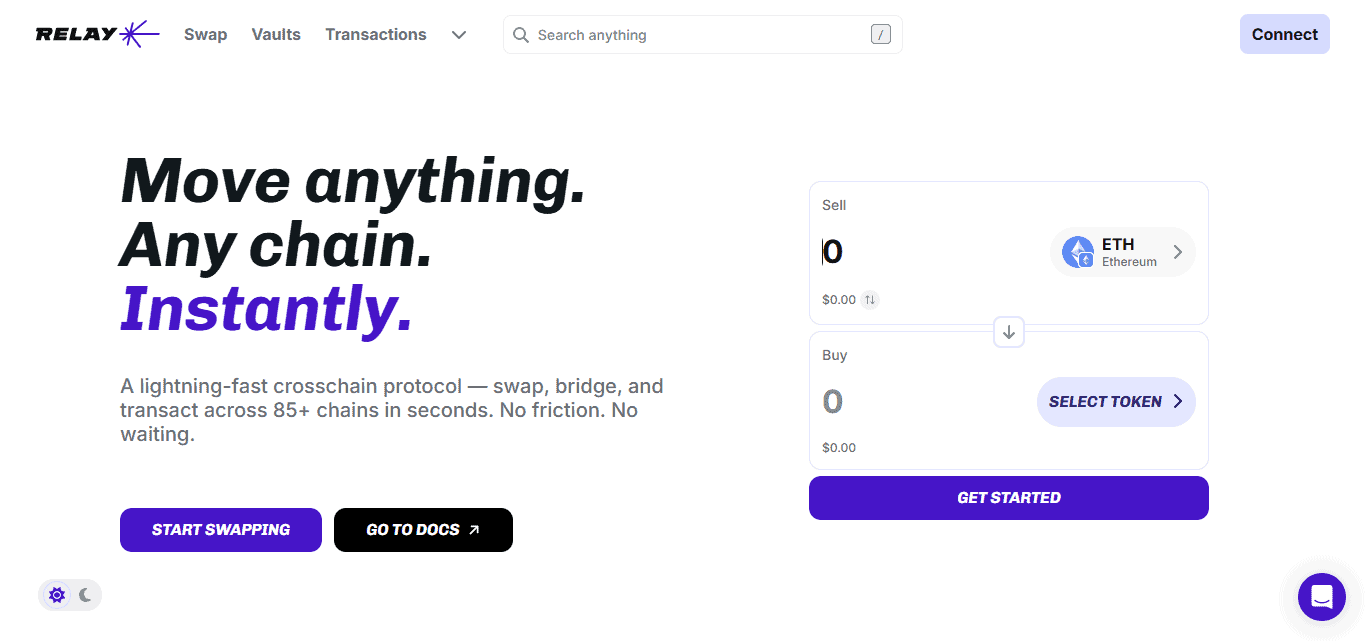
Transfers generally are completed in about two to five seconds, among the fastest in the industry. Fees are low, typically a small percentage plus destination gas, and vary with route and size. Wallets and dApps can integrate Relay through its API, making it a great choice for instant checkout and seamless multichain onboarding.
Relay (Relay.link) Key Advantages
- Some of the fastest transfers were done in between two and five seconds.
- It supports over 80 chains, including EVM, Solana and Bitcoin.
- The simple API enables dApps and wallets to quickly integrate instant payments.
- It’s great for checkout and everyday payments with its low fees.
Relay (Relay.link) Best Use Case
| Best Use Case | Explanation |
|---|---|
| Fast Cross-Chain Transfers | Transfer assets between supported blockchains with a focus on speed. |
| Low-Cost Transactions | Help users access efficient cross-chain transaction routes. |
| Stablecoin Transfers | Support moving stablecoins between compatible blockchain networks. |
| User-Friendly Bridging | Simplify cross-chain transfers for everyday crypto users and applications. |
3. deBridge Liquidity Network
deBridge is a cross-chain liquidity and messaging network that allows market makers (or takers) to fill orders and independent validators to secure message passing. It supports about 25+ networks including Ethereum, Solana, BNB Chain, Arbitrum, Base, Polygon, Avalanche, and Optimism, so its Solana connectivity is especially valuable.

Transfers are typically completed in seconds to a couple of minutes with its DLN order system. Fees are a fixed protocol fee, a small percentage taker fee and gas costs. It’s popular with traders and developers who want deep liquidity, strong Solana-EVM routes and fast settlement with minimal slippage.
deBridge Liquidity Network Key Advantages
- Strong Solana to EVM routes with deep liquidity and low slippage.
- Settlement is still quick as market makers fill orders directly.
- Independent validators provide an additional layer of security for messages.
- Allows cross-chain swaps and messaging on one platform.
deBridge Liquidity Network Best Use Case
| Best Use Case | Explanation |
|---|---|
| Cross-Chain Token Swaps | Exchange tokens across different blockchain networks. |
| Liquidity Routing | Connect liquidity sources to facilitate efficient transactions. |
| DeFi Applications | Enable decentralized applications to perform cross-chain operations. |
| Secure Asset Transfers | Facilitate cross-chain transfers using its messaging and settlement infrastructure. |
4. LayerZero (V2)
LayerZero V2 is an omnichain messaging protocol where messages are confirmed by configurable Decentralized Verifier Networks and delivered by executors on the destination chain. It connects 100+ chains including Ethereum, BNB Chain, Arbitrum, Optimism, Base, Polygon, Avalanche, Aptos and Solana, and powers many token and app launches.

Delivery is typically one to three minutes, depending on source chain finality and verifier settings chosen. Fees are source gas plus verifier and executor fees, generally a few cents to a few dollars. Developers use it to create omnichain tokens, bridges and apps with tailored security configurations.
LayerZero (V2) Key Advantages
- Connects 100+ blockchains; widest omnichain reach.
- Configurable decentralized verifier networks give per-application custom security.
- Developers are able to create omnichain tokens and apps with one standard.
- When you adopt a large ecosystem, you get good tooling and community support.
LayerZero (V2) Best Use Case
| Best Use Case | Explanation |
|---|---|
| Omnichain Applications | Build applications that communicate across multiple blockchain networks. |
| Cross-Chain Messaging | Send messages and instructions between supported blockchains. |
| Omnichain Tokens | Support token designs that operate across multiple chains. |
| DeFi Interoperability | Connect decentralized finance protocols through cross-chain messaging. |
5. Stargate Finance
Stargate is a liquidity transport protocol on LayerZero that utilizes shared liquidity pools to move native assets across chains without wrapped tokens. It supports around 30 to 60 chains like Ethereum, Arbitrum, Optimism, Base, Polygon, BNB Chain, Avalanche, Linea, and Mantle, with its pools and routes still growing.

Transfers typically take one to three minutes, and its faster Bus and Taxi modes sacrifice speed for cost. The fees are a mix of a small protocol %, LayerZero messaging fee, and gas. It’s perfect for users seeking instant guarantyd finality, native stablecoin transfers, and liquidity providers who earn yield and STG rewards.
Stargate Finance (Stargate Finance) Key Advantages
- Native assets move through unified liquidity pools without wrapped tokens.
- Instant finality guaranties zero risk of failed or stuck transfers.
- Robust native stablecoin transfers of USDC & USDT.
- Liquidity providers accrue yield and STG rewards.
Stargate Finance Best Use Case
| Best Use Case | Explanation |
|---|---|
| Stablecoin Transfers | Move supported stablecoins between different blockchain networks. |
| Cross-Chain Swaps | Exchange supported assets across connected chains. |
| Unified Liquidity | Access shared liquidity pools for cross-chain transactions. |
| DeFi Integration | Integrate cross-chain liquidity into decentralized finance applications. |
6. Hyperlane
Hyperlane is a permissionless interoperability layer where any blockchain can deploy messaging contracts and choose custom Interchain Security Modules for verification. It supports more than 100 chains including Ethereum, Arbitrum, Optimism, Base, Polygon, BNB Chain, Avalanche, Solana and Cosmos-based networks. New chains can be added by anyone without approval.

The delivery time of a message is usually between a few seconds and several minutes, depending on the chosen security model and finality. Fees are mostly interchain gas payments to relayers + normal transaction costs, typically cents to a few dollars. Developers like it for sovereign rollups, app-chains and warp routes that ferry tokens between ecosystems.
Hyperlane Key Advantages
- Permissionless design lets anyone add a new chain without approval.
- Custom Interchain Security Modules give developers flexible verification choices.
- Supports 100+ chains, including EVM, Solana, and Cosmos networks.
- Ideal for app-chains, rollups, and warp route token transfers.
Hyperlane Best Use Case
| Best Use Case | Explanation |
|---|---|
| Cross-Chain Messaging | Send information and messages between different blockchain networks. |
| Interoperable Applications | Build applications that communicate across multiple chains. |
| Custom Blockchain Integration | Connect custom and application-specific blockchain networks. |
| Cross-Chain Token Transfers | Enable token movement using its interoperability infrastructure. |
7. Wormhole
Wormhole is a cross-chain messaging protocol secured by a network of Guardian nodes that sign verified messages to enable token transfers and data passing between ecosystems. It supports 30+ chains, including Ethereum, Solana, Sui, Aptos, BNB Chain, Avalanche, Arbitrum, Optimism, Base, Polygon.

Standard transfers take ~15 seconds to a few minutes, and faster-than-finality options reduce wait times. Fees include source gas, relayer fees, and sometimes a small protocol fee – usually cents to a few dollars. It was hacked badly in 2022 but recovered. It is widely used for Solana-EVM transfers and its Native Token Transfers framework.
Wormhole (WH) Key Advantages
- Guardian network secures messaging on 30+ major blockchains.
- Great Solana to EVM connectivity with high volume of transfers.
- Native Token Transfers framework means that the tokens are still owned and controlled.
- Proven resilience, fully recovered from its 2022 exploit.
Wormhole Best Use Case
| Best Use Case | Explanation |
|---|---|
| Cross-Chain Communication | Exchange messages and data between supported blockchain networks. |
| Multichain Token Transfers | Transfer supported digital assets across connected chains. |
| DeFi Interoperability | Connect decentralized finance applications across blockchain ecosystems. |
| Automated Message Delivery | Use relayer infrastructure to deliver verified cross-chain messages. |
8. LI.FI
LI.FI is a bridge and DEX aggregator that scans multiple bridges, relayers and exchanges to find the best cross-chain path for each transaction. It supports 60+ chains including Ethereum, Solana, Arbitrum, Optimism, Base, Polygon, BNB Chain, Avalanche, zkSync and Bitcoin, in addition to access to 20+ bridges and 30+ DEXs.

Speed depends on the route selected, usually seconds to a few minutes. LI.FI also charges a small integrator fee, typically around 0.25 percent or less, in addition to bridge and gas fees. Its API and SDK are used by wallets, dApps and developers to provide seamless multichain swaps.
Li.FI. Key Advantages
- Aggregates 20+ bridges and 30+ DEXes to find the cheapest route
- Users automatically receive better prices and higher success rates.
- API and SDK make multichain integration easy for developers
- Supports 60+ chains including Solana and Bitcoin.
LI.FI Best Use Case
| Best Use Case | Explanation |
|---|---|
| Bridge Aggregation | Compare and access multiple cross-chain bridge providers. |
| Cross-Chain Swapping | Swap digital assets between different blockchain networks. |
| Smart Route Optimization | Find suitable transaction routes based on available providers and execution conditions. |
| Developer Integration | Integrate cross-chain swaps and bridging functionality into wallets and decentralized applications. |
9. Jumper Exchange
Jumper Exchange is a LI-powered swap and bridge interface built for the consumer.FI routing engine, targeted at regular users not developers. It supports the same wide range of 60+ chains including Ethereum, Solana, Arbitrum, Optimism, Base, Polygon, BNB Chain, Avalanche and zkSync, and routes through many bridges and DEXs.

Transfer time depends on the route and is usually between a few seconds and about five minutes. The fees are bridge fees, network gas and a small service fee and the quote is clearly shown before you confirm. Good for beginners looking for cheap, simple cross-chain swaps with route comparison, gamified quests and no technical setup.
Jumper Swap Key Advantages
- No technical knowledge needed to swap or bridge. Beginner-friendly UI.
- LI.FI powered so the routes and rates stay competitive.
- Fees and time are clearly displayed before you click confirm.
- Cross-chain usage is more fun with gamified quests and rewards.
Jumper Exchange Best Use Case
| Best Use Case | Explanation |
|---|---|
| Easy Crypto Bridging | Help users transfer crypto assets between supported blockchain networks. |
| Cross-Chain Token Swaps | Exchange tokens without manually completing multiple bridging steps. |
| Route Comparison | Access different available routes through its LI.FI-powered infrastructure. |
| Retail DeFi Access | Provide a user-friendly interface for everyday users exploring multichain DeFi. |
10. Bungee (Socket)
Bungee is a cross-chain swap and bridge aggregator on Socket’s infrastructure, comparing routes across many bridges and an auction-based solver system. It supports 15 to 30+ chains such as Ethereum, Arbitrum, Optimism, Base, Polygon, BNB Chain, Avalanche, Linea, and zkSync.
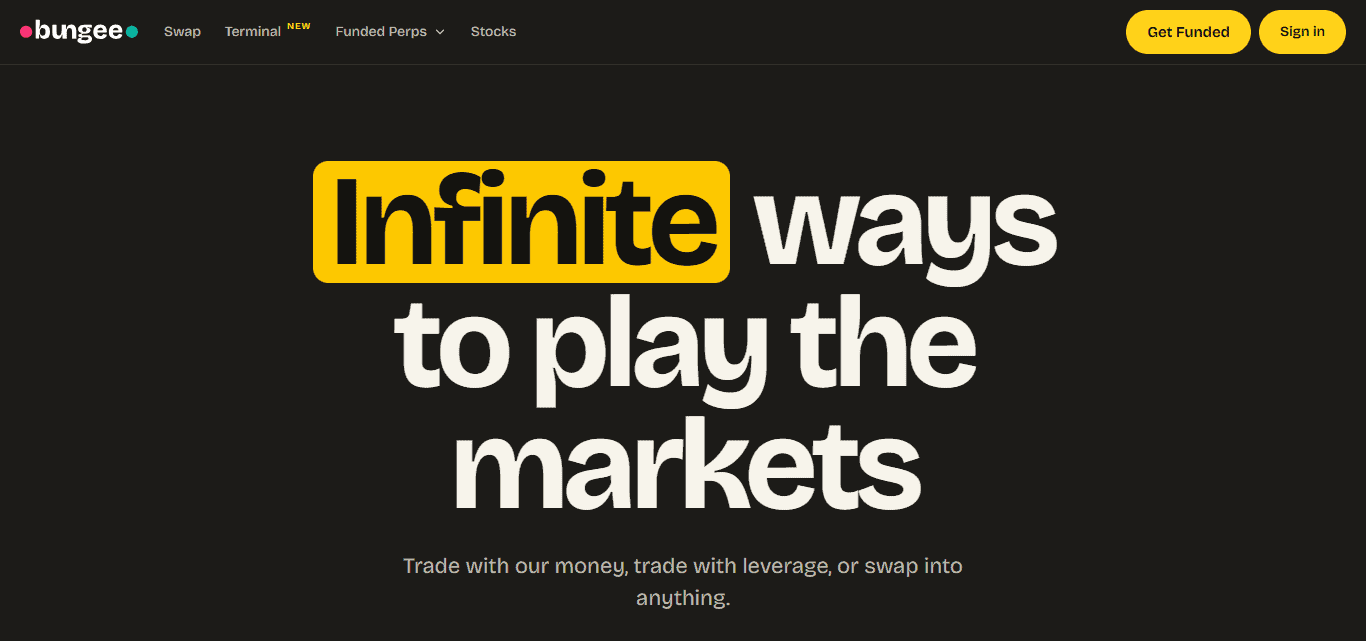
Depending on the bridge or solver picked, transfers usually wrap up in seconds to a few minutes. Fees include bridge charges + gas + small service fee. There is a gas-refuel feature giving your destination wallet starting gas. It’s great for users who want competitive quotes, easy native-gas top-ups and a clean interface to do regular multichain trading.
Bungie (Soket) Key Advantages
- Compares many bridges and solvers to provide competitive quotes.
- Gas refuel feature starts your destination wallet off with some gas.
- Auction based solver system for better speed and pricing.
- Regular multichain traders and everyday users will enjoy the clean interface.
Bungee (Socket) Best Use Case
| Best Use Case | Explanation |
|---|---|
| Cross-Chain Asset Transfers | Move supported tokens between different blockchain networks. |
| Bridge Aggregation | Access multiple bridge providers through a unified routing interface. |
| Optimized Transaction Routing | Compare available routes to identify suitable transfer options. |
| DeFi Application Integration | Help wallets and decentralized applications add cross-chain transaction functionality. |
Conclusion
Conclusion The Best Crypto Transaction Relayer Networks – Which One to Choose Relay and Across are quick and inexpensive. deBridge and Wormhole are good for Solana connectivity.
LayerZero and Hyperlane are ideal for developers building omnichain apps, while Stargate is ideal for native stablecoins. LI.FI, Jumper and Bungee make route comparison easy. Always check the security, fees, supported chains, and speed before bridging any assets.
FAQ
What is a crypto transaction relayer network?
It delivers assets or messages between blockchains by relayers, solvers, or validators.
Which relayer network is the fastest?
Relay and Across usually finish transfers within a few seconds to two minutes.
Which network supports the most blockchains?
LayerZero and Hyperlane connect over 100 chains, while Relay supports roughly 80.
Are crypto relayer networks safe to use?
Most are audited, but past exploits show you should always verify security.