This article will review the Best Crypto Wallet APIs for Fintech Apps, allowing wallet integration, security, and real-time market data enhancements.
- Key Poinst & Best Crypto Wallet APIs for Fintech Apps
- 10 Best Crypto Wallet APIs For Fintech Apps
- 1. Zerion API
- 2. CoinGecko API
- 3. CoinMarketCap API
- 4. CryptoCompare API
- 5. Alchemy API
- 6. Moralis API
- 7. Chainalysis API
- 8. BlockCypher API
- 9. BitPay API
- 10. Kraken API
- How We Choose Best Crypto Wallets For High-Value Cold-Warm Storage
- Cocnlsuion
- FAQ
These APIs provide the building blocks to create advanced fintech apps with multi-chain capabilities, portfolio tracking, transaction monitoring, and payment processing, enabling developers to create a premium crypto experience.
Key Poinst & Best Crypto Wallet APIs for Fintech Apps
| API | Key Point |
|---|---|
| Zerion API | Portfolio-ready data integration |
| CoinGecko API | Comprehensive crypto market data |
| CoinMarketCap API | Global price and market insights |
| CryptoCompare API | Historical and real-time analytics |
| Alchemy API | Scalable blockchain infrastructure |
| Moralis API | Web3 wallet and NFT support |
| Chainalysis API | Compliance and transaction monitoring |
| BlockCypher API | Multi-chain wallet operations |
| BitPay API | Crypto payments and merchant tools |
| Kraken API | Exchange-grade trading and wallet data |
10 Best Crypto Wallet APIs For Fintech Apps
1. Zerion API
Zerion API helps fintech applications get data related to decentralized finance (DeFi). It helps with Ethereum and other EVM compatible networks with real-time tracking of portfolios, balances, and transaction histories.
Thanks to its effortless integration, apps can provide users with information regarding investments in DeFi, NFTs, and yield farming.
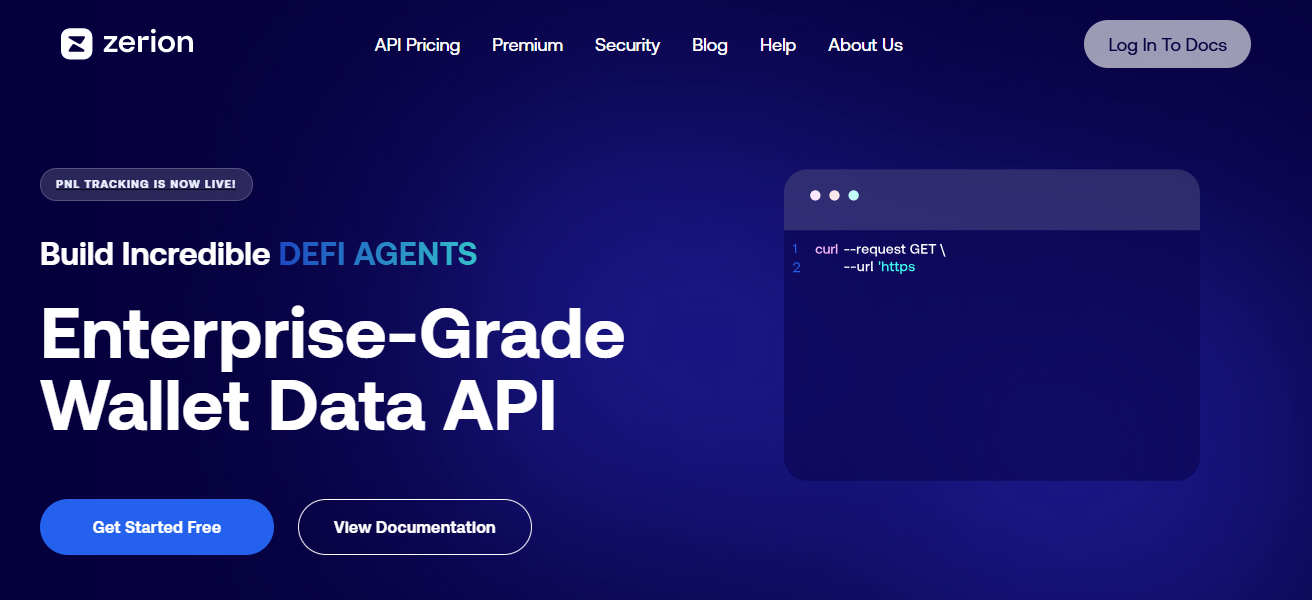
For apps that want to help users see all their digital assets and DeFi activities in one place, Zerion API is perfect because it aggregates data across multiple blockchains.
Zerion API Features
- Tracking of DeFi Portfolio. This functions by aggregating token balances, yield farming, as well as NFTs that are held in separate Ethereum wallets.
- Support of Multi-Chain. This supports Ethereum and EVM compatible networks in order to provide broader insights of DeFi.
- History of Transactions. In this, a comprehensive history of the transactions of deposits, withdrawals, swaps and of any other activity that is done on the chain is provided.
- Analytics in Real Time. This provides an update of the portfolio worth and the performance of the assets to the respective Financial Technology Dashboards.
| Pros | Cons |
|---|---|
| Supports multi-chain DeFi portfolio tracking. | Limited to Ethereum and EVM-compatible networks mostly. |
| Real-time token balances and transaction history. | Fewer features for traditional exchange trading. |
| Aggregates NFTs and yield farming data in one view. | Advanced analytics may require deeper integration. |
| Simplifies wallet integration for fintech apps. | Smaller community and ecosystem compared to larger APIs. |
2. CoinGecko API
Fintech applications can integrate CoinGecko API to get cryptocurrency market data as it’s one of the most popular APIs.
It’s great for getting current and historical data, market cap, and trading data for thousands of cryptocurrencies.
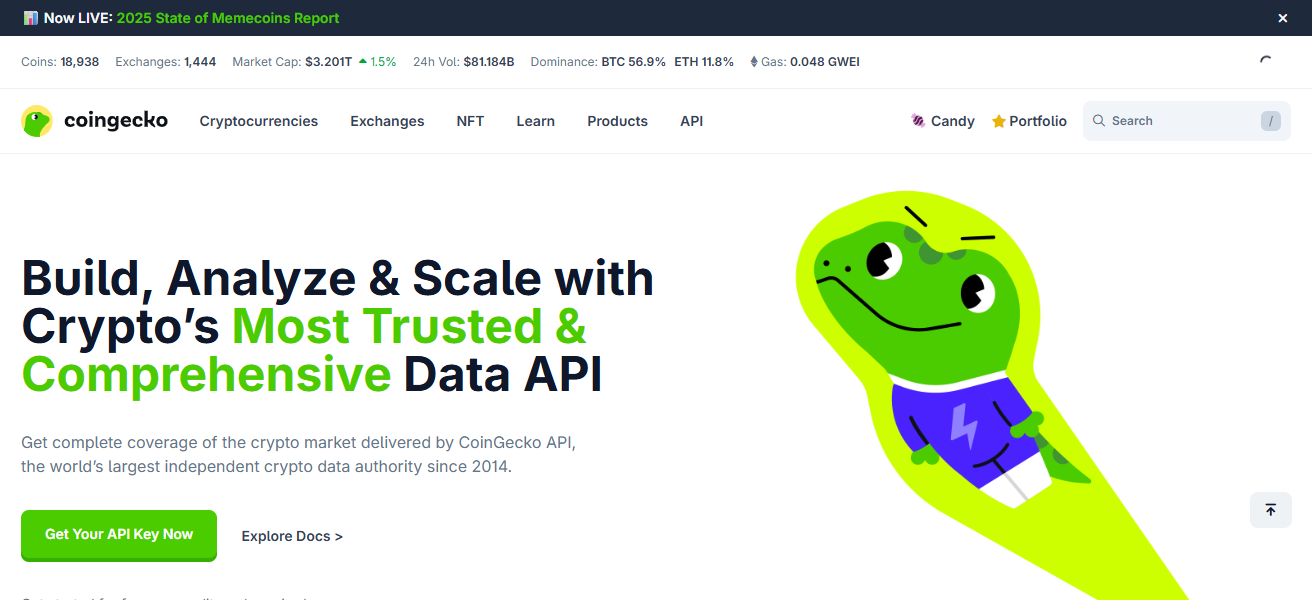
They’ve integrated live pricing, crypto news, and portfolio tracking features. The API is compatible with many coins and exchanges
Which is especially useful for creating price comparison applications, alerts, and analytics dashboards. Users get valuable market data and your app is more engaging as a result.
CoinGecko API Features
- Inside Market Data. This API has real time prices, trading volumes as well as market capitalization of thousands of cryptocurrencies.
- Data that is Historical. People use this for tracking of portfolios and analytics as this API has access to the trends of markets and prices, charts and history.
- Data of Different Exchanges. This has coverage of different exchanges which aids in analytics and insights of arbitrage.
- Coverage of Globally. This is used for Fintech Apps that have multiple assets as it has a wide variety of coins and tokens.
| Pros | Cons |
|---|---|
| Provides real-time pricing for thousands of cryptocurrencies. | Limited direct wallet management features. |
| Free tier available with extensive coin coverage. | Rate limits in free tier may affect high-volume apps. |
| Supports historical data and exchange comparisons. | Some advanced data features require paid tiers. |
| Easy integration for portfolio tracking apps. | Does not provide trading or transaction execution. |
3. CoinMarketCap API
CoinMarketCap API provides comprehensive information regarding the prices, market cap, volume, and circulating supply of different cryptocurrencies.
For fintech apps requiring reliable and extensive market information, this API is perfect. This API also includes exchange listings, historical graphs, and metadata for many different tokens.
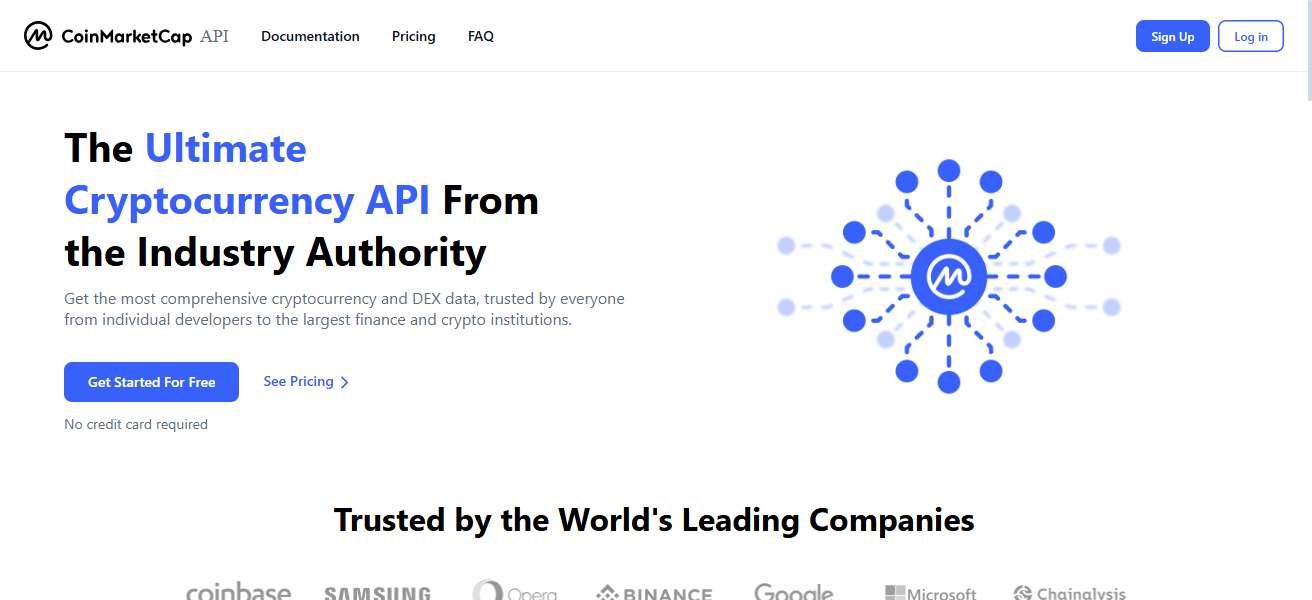
Developers can incorporate price alerts, live tracking, and portfolio analytics into their applications.
Due to the extensive data coverage and constant updates, the CoinMarketCap API provides users with accurate and reliable insights, facilitating trading and investment decisions.
CoinMarketCap API Features
- Market Metrics in a Comprehensive Manner. This has market cap, volume and circulating supply for different tokens.
- Data that is Historical and Trending. This is available for trading and portfolio analytics.
- Integration of Exchange. This provides details of trading pairs and their respective cryptocurrencies for different exchanges.
- Metadata & Token Info: Provides user dashboards with token descriptions, logos, and related links.
| Pros | Cons |
|---|---|
| Offers detailed market metrics like market cap and volume. | Premium subscription needed for full features. |
| Supports historical data and metadata for tokens. | Mainly focused on market data, not wallet management. |
| Reliable and widely used in fintech applications. | Limited support for DeFi and NFT data. |
| Easy to integrate with alerts, portfolio apps, and dashboards. | Free tier has restricted calls per month. |
4. CryptoCompare API
CryptoCompare API provides several data points relating to the cryptocurrency market, as well as trading and historical data. It can be used to analyze prices in real-time, as well as access order books and portfolio analytics.
It can be used in fintech applications to visualize live charts, compare the performance of several different assets and/or execute trading algorithms. It is also suited for in-depth analytics for cryptocurrency, as the API provides data related to social media sentiment and cryptocurrency mining.
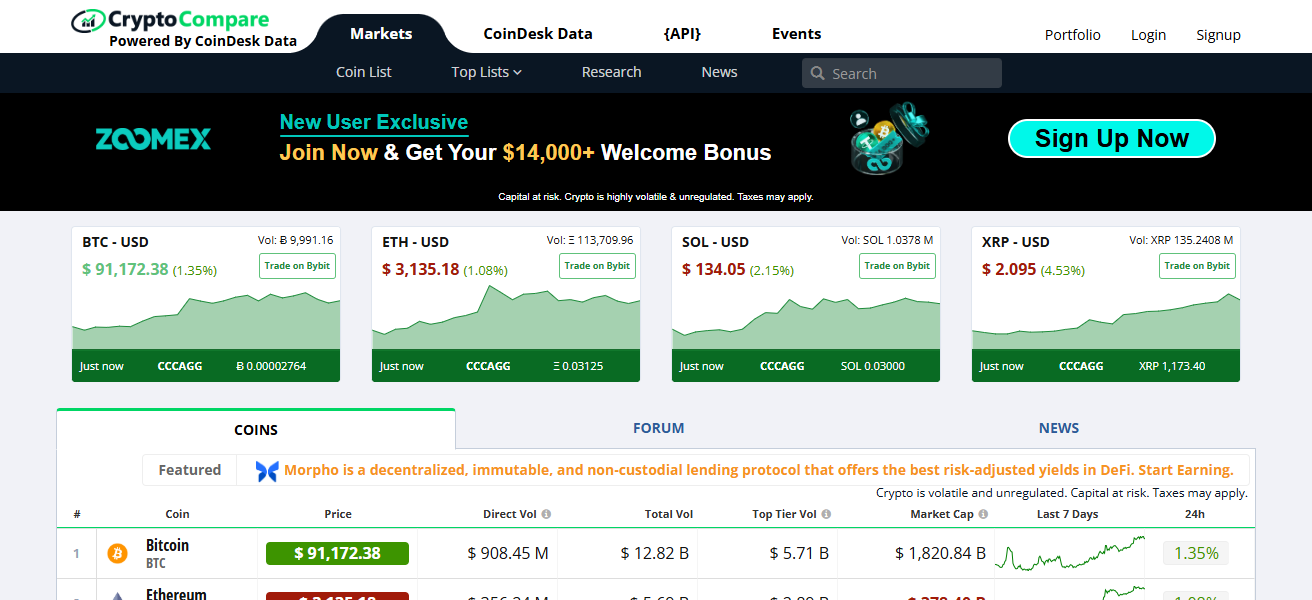
The API can be used for applications on different platforms, and therefore can be integrated into desktop, web, and mobile applications.
This way, application users are able to utilize tools to analyze and monitor cryptocurrencies, track their holdings, and optimize their strategies.
CryptoCompare API Features
- Real-Time Pricing: Updates users with most recent prices of cryptocurrencies over multiple platforms.
- Trading Data & Charts: Provides information on order books, comparative trading history, and additional trading metrics.
- Market & Social Analytics: Provides empirical data on social influence, mining statistics, and market trends.
- Multi-Platform Support: Applicable on mobile, web, or desktop fintech applications.
| Pros | Cons |
|---|---|
| Provides real-time prices, trading data, and historical charts. | Some endpoints are complex and may require extensive parsing. |
| Includes social sentiment and mining data. | Free tier has limited access to advanced analytics. |
| Multi-platform support for web, mobile, and desktop. | Primarily market-focused, not wallet creation. |
| Suitable for trading analytics and portfolio apps. | Data refresh rates can vary for certain coins. |
5. Alchemy API
Alchemy API helps apps communicate with Ethereum and other chains seamlessly. It focuses on providing smart contract execution and blockchain event access alongside performant node data.
Alchemy can be used by Finttech apps for wallet management, token transfers, NFTs, and monitoring blockchain in real time.
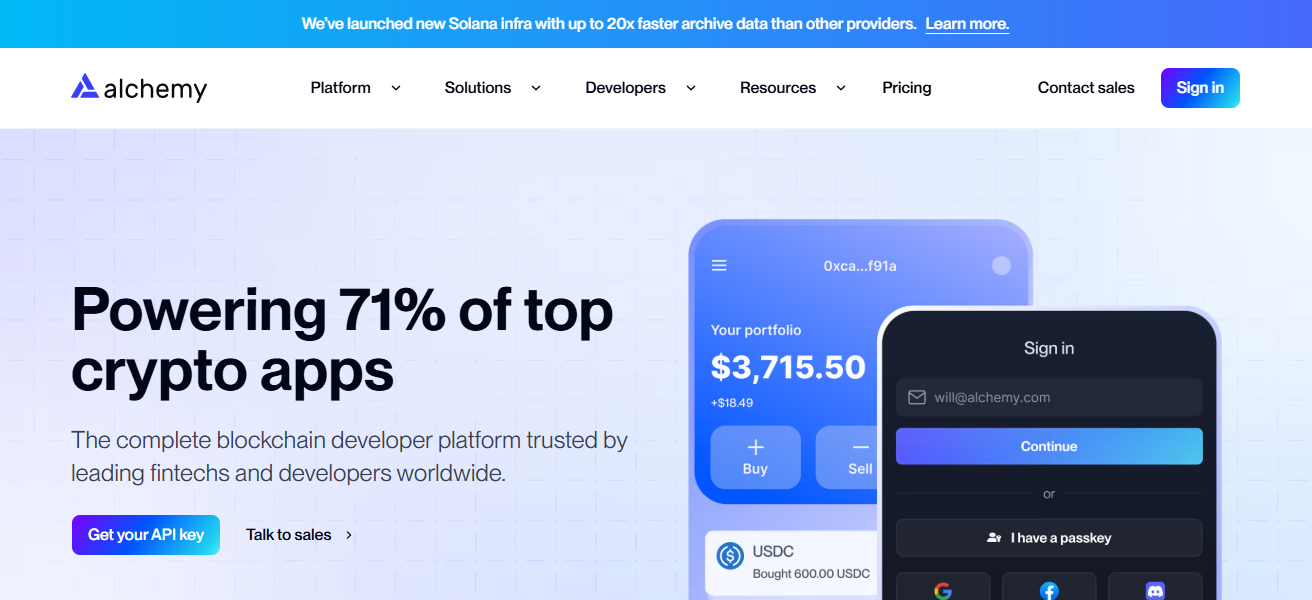
It is scalable and reliable which makes it good for trading platforms, DeFi dashboards, and other crypto wallets. Developers appreciate the detailed SDKs and analytics that assist with building robust blockchain integrations.
Alchemy API Features
- Blockchain Node Access: Highly optimized API for Ethereum and EVM-compatible blockchain technology.
- Smart Contract Interaction: Allows apps with wallets to perform cryptocurrency transfers and interact with smart contracts.
- Real-Time Event Monitoring: Monitors blockchain transfers, smart contract interactions, and NFT related activities.
- Scalable Infrastructure: Handles trade and DeFi app requests with optimum speed and volume.
| Pros | Cons |
|---|---|
| High-performance access to Ethereum and other chains. | Limited coverage of non-EVM blockchains. |
| Supports smart contract interaction and NFT management. | May be overkill for simple crypto wallets. |
| Scalable and reliable infrastructure. | Free tier has usage limitations for high-volume apps. |
| Provides real-time blockchain event monitoring. | Requires some blockchain development expertise. |
6. Moralis API
Moralis API integrates various tools into a single platform, allowing developers to create Web3 applications in a matter of minutes.
Moralis offers real-time data for every existing blockchain, as well as tools for user authentication and NFT management.
Fintech applications can utilize Moralis to track users’ wallets, monitor transactions, and retrieve historical data regarding tokens across various blockchains.
Moralis lessens complexities in backend development, allowing developers to prioritize the user interface and experience.
Furthermore, Moralis enhances applications, such as cryptocurrency wallets, trading platforms, and portfolio management tools, by supporting interactive features like transaction pings and cryptocurrency price notifications.
Moralis API Features
- Multi-Chain Support: Operates on Ethereum, Binance Smart Chain, and Polygon among other networks.
- Wallet & Transaction Tracking: Users’ balances, transaction history, and token characteristics are provided.
- NFT Management: Users can view NFT associated metadata, ownership, and transfer history.
- Push Notifications: Users receive alerts for transactions, token activities, and shifts in market prices.
| Pros | Cons |
|---|---|
| End-to-end Web3 platform, fast to implement. | Free tier is limited in requests per month. |
| Real-time wallet balances and transaction tracking. | Primarily focused on blockchain, less on traditional trading. |
| Multi-chain support and NFT management. | Some features require paid subscription. |
| Push notifications for transactions and price alerts. | Backend complexity may increase for large apps. |
7. Chainalysis API
Chainalysis API specializes in blockchain compliance and fraud detection. It enables fintech applications to monitor suspicious activities, investigate funds, and evaluate risks tied to a transaction.
Fintech applications can execute AML/KYC processes to remain compliant with regulations using risk score assessments and wallet surveillance.
Chainalysis offers the crypto flow analysis and fraud detection tools in order to make payment systems more safe.
With this API, users can feel confident that their transactions are safe. Developers can also manage fraud and meet financial compliance safely, at a global level, in a more effective manner.
Chainalysis API Features
- Compliance & Risk Management: Risk and transaction scoring, and AML/KYC verification.
- Wallet Monitoring: Fraud and illicit transaction prevention through monitoring suspicious wallet activity.
- Transaction Tracing: Fintech apps can ensure regulatory compliance by tracing cryptocurrency flows.
- Integration for Security: Assists apps in building secure and compliant systems for crypto payments or trading.
| Pros | Cons |
|---|---|
| Strong compliance and anti-fraud monitoring. | Expensive for small fintech startups. |
| Risk scoring and wallet monitoring for AML/KYC. | Focused on compliance, less useful for portfolio features. |
| Traces cryptocurrency flows for security. | Limited real-time price or trading data. |
| Helps fintech apps stay regulatory-compliant. | Requires technical expertise to integrate effectively. |
8. BlockCypher API
BlockCypher APIs enable the creation of various blockchain fintech apps as it offers bitcoin, ethereum, and litecoin blockchain infrastructure services.
The APIs allow the creation of wallets and monitoring addresses, as well as broadcasting transactions.
The APIs provide webhook notifications, which allow fintech apps to integrate crypto send/receive functionalities, hierarchically deterministic wallets, and transaction confirmation tracking.
The APIs are particularly useful for providing developer-oriented, multi-chain blockchain wallets and payment solutions because they do not require the overhead of running complete blockchain nodes.
BlockCypher API Features
- Multi-Blockchain Support: Compatible with Bitcoin, Ethereum, Litecoin, Dogecoin, and testnets.
- Wallet Creation: Creation of standard and hierarchical deterministic (HD) wallets.
- Transaction Handling: Broadcast, confirm, and track transactions. Webhook notifications are available.
- Developer-Friendly: Easy to implement, lightweight, and simple for fintech app integration.
| Pros | Cons |
|---|---|
| Multi-chain support: Bitcoin, Ethereum, Litecoin, etc. | Limited advanced analytics compared to market data APIs. |
| Wallet creation and transaction broadcasting. | Webhooks and event monitoring can be tricky to scale. |
| Developer-friendly and lightweight. | May not handle high-frequency trading efficiently. |
| Supports address monitoring and confirmations. | Not optimized for DeFi or NFT management. |
9. BitPay API
The BitPay API offers invoicing and processing services. It enables fintech applications to accept and integrate payments in Bitcoin, Ethereum, and stablecoins.
Additional services include invoice creation, merchant settlements in crypto or fiat, and real-time crypto-to-fiat exchange rates.
BitPay’s crypto payment confirmation and wallet services provide additional security and payment verification.
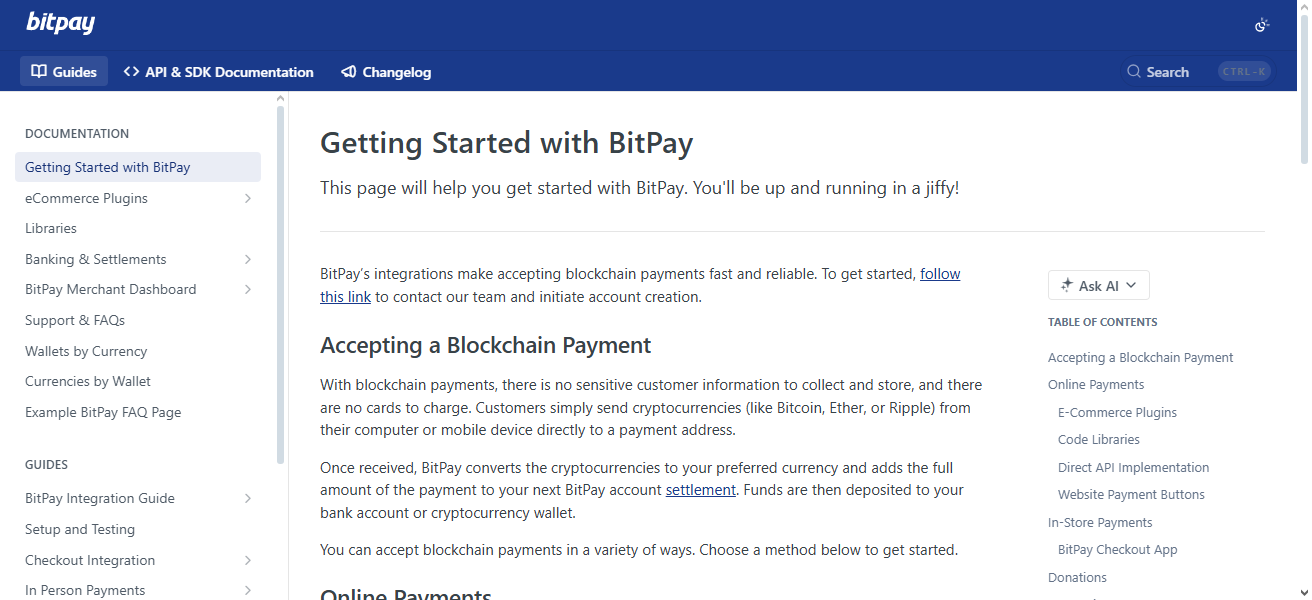
Their infrastructure reliability makes them a great choice for applications offering e-commerce, payments, or remittance services for businesses.
Developers are provided with ample SDKs and documentation which supports faster integrations and a better overall experience for users to securely transact with cryptocurrencies.
BitPay API Features
- Crypto Payment Processing: In-app and e-commerce payments accepting Bitcoin, Ethereum, and stablecoins.
- Invoice Generation: Invoices for payments in crypto and fiat with conversion options.
- Merchant Settlement: Payments settlement in crypto or fiat for flexible cash flow management.
- Secure Transactions: Offers Fintech apps payment channels that are secure and verified.
| Pros | Cons |
|---|---|
| Enables crypto payments and invoicing in fiat or crypto. | Focused on payments, less on portfolio tracking. |
| Supports multiple coins including stablecoins. | Limited access to multi-chain wallet management. |
| Secure and reliable infrastructure for transactions. | Fees may apply for merchant settlements. |
| Easy integration for fintech payment apps. | Not suitable for advanced trading features. |
10. Kraken API
Integrating with the Kraken API allows access to one of the biggest crypto exchanges in the world. It can be used to manage accounts, trade, and obtain market data. Fintech applications can integrate the API to retrieve prices, trade, and manage portfolios.
The API covers spot, futures, and margin trading. It also provides order history and wallet balance information. The Kraken API is also great for apps aimed at active traders due to its robust security and high liquidity.
It provides real-time data and trading capabilities, which allows fintech platforms to offer advanced investment features and a streamlined experience for cryptocurrency trading.
Kraken API Features
- Trading Integration: Integration of spot, futures, and margin trading on the Kraken exchange.
- Market Data Access: Access to real-time feeds, order books, and trading volume for crypto assets.
- Account & Wallet Management: Retrieve information on balances, order history, and trade executions.
- High Security & Liquidity: Offers secure and liquid trading alternatives appropriate for fintech applications focused on traders.
| Pros | Cons |
|---|---|
| Provides trading, market data, and account management. | Mainly focused on Kraken exchange, not multi-exchange coverage. |
| Supports spot, futures, and margin trading. | Requires users to have Kraken accounts. |
| Real-time prices and order execution. | Integration complexity is higher for beginners. |
| Suitable for fintech apps targeting active traders. | Limited NFT or DeFi tracking features. |
How We Choose Best Crypto Wallets For High-Value Cold-Warm Storage
- Security First: Consider wallets that provide multi-signature functionality that is hardware-encrypted and key-stored.
- Cold vs Warm Storage: Use cold wallets for offline storage. Use warm wallets for secure trading access.
- Reputation/Audits: Look for wallets that have a good reputation and audit their security regularly.
- Backup & Recovery: Look for a good disaster recovery plan and a really good backup method.
- Multi-Currency Support: Wallets that support the storage of multiple cryptocurrencies and tokens should be selected.
- User Control: Choose non-custodial wallets that provide full control to the user over their keys.
- Integration: Look for wallets with open APIs for integration with enterprise systems.
- Transaction Monitoring: Use warm wallets with alerts and tracking for high-value transactions.
- Legal Compliance: Use wallets, especially for businesses, that comply with the laws of your jurisdiction.
- Scalability: Wallets that can handle high-value transactions without compromising on security should be prioritized.
Cocnlsuion
In cocnlsuion Selecting the most suitable crypto wallet API plays a crucial role in developing fintech applications that are secure, efficient, and easy to use.
System APIs such as Zerion, CoinGecko, and Alchemy provide real-time data, support for multiple chains, and easy integration with wallets.
Using these APIs, developers can improve experience on individual and business crypto apps by refining portfolio management, payment processing, and DeFi services.
FAQ
A crypto wallet API allows apps to interact with wallets, track balances, and execute transactions.
It simplifies integration, enhances security, and provides real-time crypto data for users.
Yes, most offer encryption, multi-signature support, and compliance features for secure handling.
Yes, most APIs support major coins, tokens, and even NFTs across multiple blockchains.
Yes, they track deposits, withdrawals, and swaps for portfolio and analytics purposes.