This article will cover the Best Crypto Wallets for Embedded Finance Platforms and how fintech apps seamlessly incorporate blockchain technologies.
- Key Points & Best Crypto Wallets for Embedded Finance Platforms
- 10 Best Crypto Wallets for Embedded Finance Platforms
- 1. Para
- 2. Alchemy Smart Wallets
- 3. Blockradar
- 4. Openfort
- 5. Bitzaro
- 6. Dynamic Wallets
- 7. Privy
- 8. Magic
- 9. Web3Auth
- 10. Sequence
- How To Choose Best Crypto Wallets for Embedded Finance Platforms
- Conclusion
- FAQ
These wallets provide secure management of assets, transactions across multiple chains, and a simple onboarding process.
They offer account abstraction, smart contract functionality, developer APIs, and more. Selecting the best wallet is crucial to developing embedded finance solutions that are scalable and efficient.
Key Points & Best Crypto Wallets for Embedded Finance Platforms
- Alchemy Smart Wallets: Secure, developer-friendly wallets enabling seamless embedded finance integrations with customizable smart contract capabilities.
- Blockradar: Real-time monitoring wallet offering fraud detection, compliance tools, and embedded finance transaction transparency.
- Openfort: Simplifies embedded finance with programmable wallets, ensuring scalability, automation, and user-friendly crypto management.
- Bitzaro: Multi-chain wallet designed for embedded finance, supporting instant transfers, token swaps, and secure custody.
- Dynamic Wallets: Adaptive wallets providing embedded finance platforms with flexible APIs, scalability, and strong authentication protocols.
- Privy: Privacy-focused wallet enabling secure embedded finance onboarding, identity management, and encrypted transaction handling.
- Magic: Passwordless wallet solution offering embedded finance platforms frictionless user authentication and seamless crypto access.
- Web3Auth: Authentication-driven wallet simplifying embedded finance with social logins, enterprise-grade security, and decentralized identity.
- Sequence: Developer-centric wallet supporting embedded finance with multi-chain compatibility, APIs, and streamlined user experience.
10 Best Crypto Wallets for Embedded Finance Platforms
1. Para
Embedded crypto wallets such as Para provide finance platforms with the ability to build non-custodial wallet infrastructures directly into their platforms with no separate downloads or seed phrase worries.
Para supports multi-chain transactions, social or Web2 logins, and gas-sponsored signing. Advanced security features combine Distributed MPC and passkeys to give users full control of their keys.
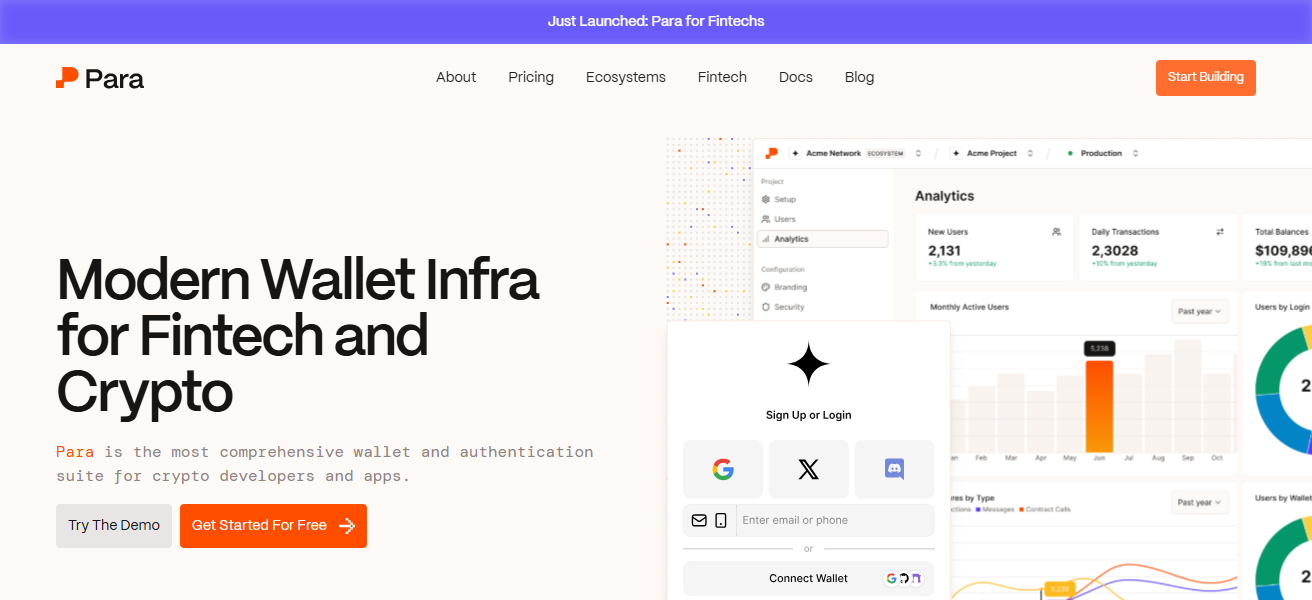
With APIs for on and off ramps, movement of money, and policy controls, Para empowers fintechs to integrate seamless crypto functionalities across EVM, Solana, and Cosmos with scalable crypto experiences.
Para Features
- Eliminates the need for seed phrases, making onboarding frictionless.
- Users can log in with Google, Apple, or other social accounts.
- Passkey support ensures strong authentication without complex passwords.
- Ideal for embedded finance apps where speed and simplicity matter.
| Pros | Cons |
|---|---|
| Easy SDK integration for embedded finance platforms | May require development effort for advanced customization |
| Multi‑chain support for seamless asset management | Some features may be complex for non‑developers |
| Social and Web2 login options simplify onboarding | Platform dependency for backend services |
| Strong security with distributed key management | Limited brand recognition compared to legacy wallets |
| Supports gas abstraction and seamless UX | Advanced analytics or reporting tools may be limited |
2. Alchemy Smart Wallets
Alchemy Smart Wallets are made to integrate with decentralized applications, which makes them suitable for embedded finance solutions.
They support transaction batching, gasless transactions, and account abstraction, which streamline the onboarding process and improve transaction efficiency.
These embedded wallets add value to platforms by allowing users to manage their assets with minimal blockchain expertise.
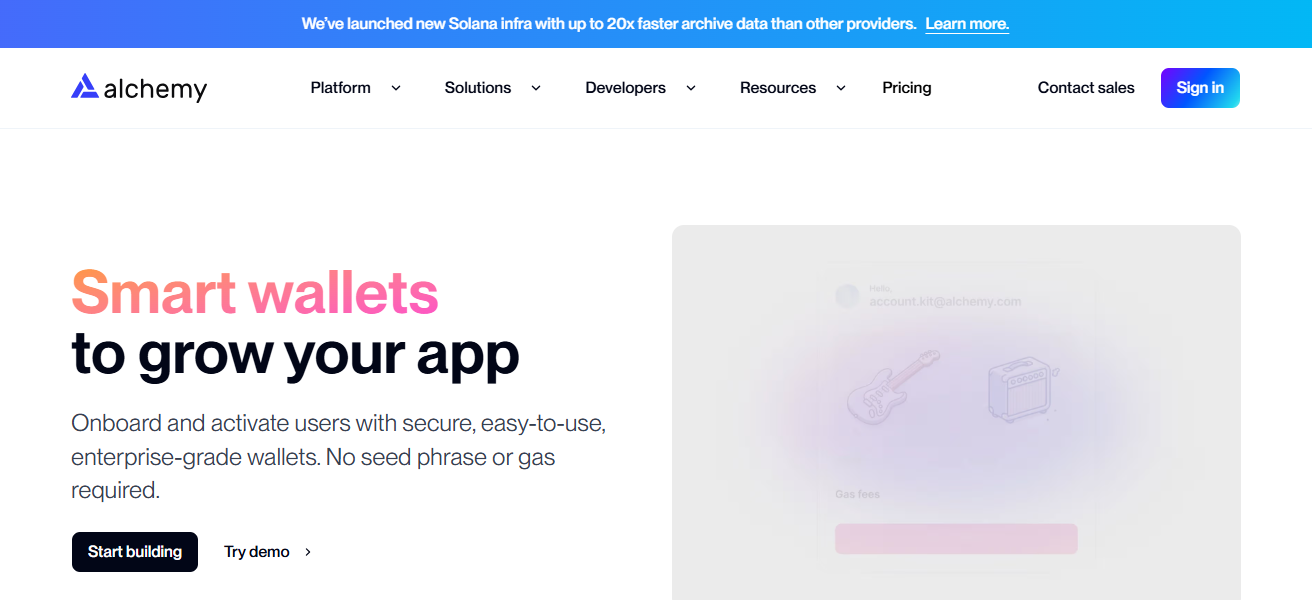
The wallets also support multisig and have key recovery features for added peace of mind. With this reliable API, platforms can scale seamlessly and offer users a smooth, safe, and intuitive crypto experience.
Alchemy Smart Wallets Features
- Account Abstraction: User onboarding is even easier because users can interact with wallets without managing private keys.
- Transaction Batching: Consolidates transactions into one and saves users money on gas fees.
- Developer-Friendly APIs: Embedded finance services can be quickly integrated into web and mobile applications.
- Robust Security: User assets are protected with multisig, key recovery, and encrypted storage.
| Pros | Cons |
|---|---|
| Seamless integration with DApps and embedded finance platforms | May require developer knowledge for advanced features |
| Transaction batching and gas optimization | Slightly higher dependency on Alchemy’s infrastructure |
| Account abstraction simplifies user onboarding | Limited support for non-EVM blockchains |
| Robust security with multisig and key recovery | Customization may require additional coding |
3. Blockradar
Blockradar is a crypto wallet designed for embedded finance. It has features such as blockchain tracking and transaction monitoring that can be customized.
Users of Blockradar can view their balance and transaction history because of its fintech app transparency. Users can do cross-chain transactions without leaving the app.
There is security through encrypted storage and customizable permissions that let platforms manage users. Blockradar has a modular API that makes it easy to integrate into web and mobile apps.
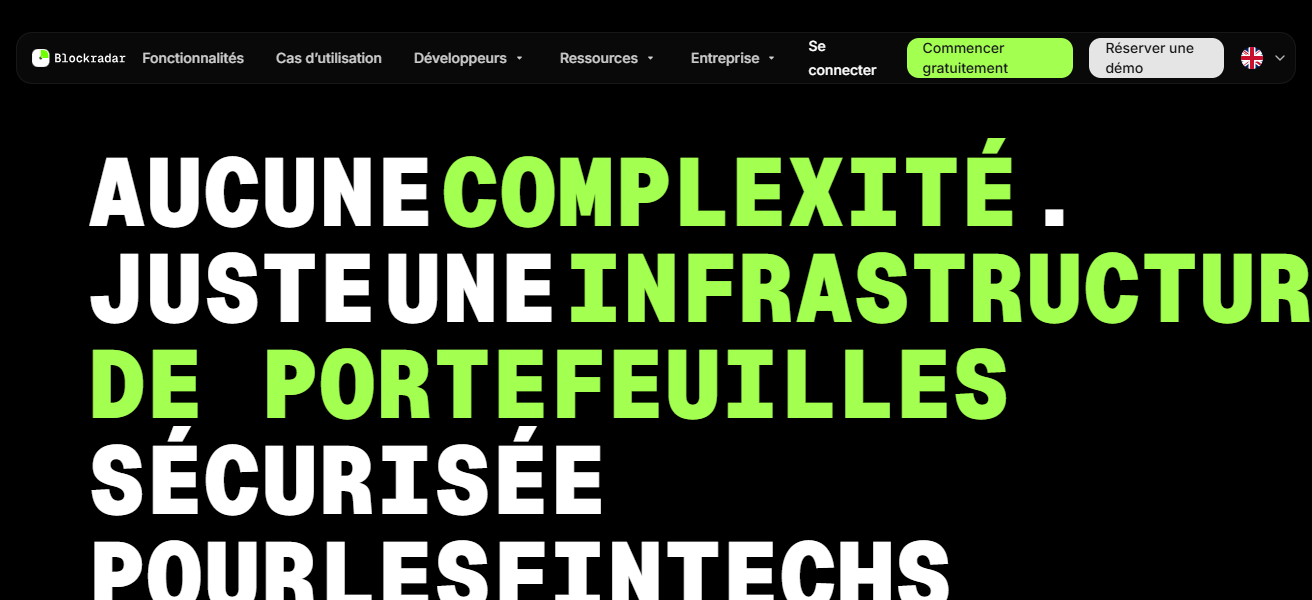
For companies that want to integrate wallet functionality with reporting and analytics and want to scale, Blockradar is a trusted partner.
Blockradar Features
- Real-time Blockchain Analytics: Platforms receive transaction monitoring and reporting.
- Multi-Chain Support: Users can track and manage assets on different blockchains.
- Customizable Permissions: Platforms can manage user access and permissions for better control.
- Modular API: Analytics and wallets functions can be integrated easily into existing applications.
| Pros | Cons |
|---|---|
| Real-time blockchain analytics and transaction monitoring | Limited mainstream adoption |
| Multi-chain support for cross-chain transactions | May have a steeper learning curve for beginners |
| Modular API for easy embedding | Analytics features may be unnecessary for simple apps |
| Strong security and permission controls | Limited design flexibility in UI |
4. Openfort
Openfort provides flexible wallet solutions for platforms integrating blockchain asset wallets into their services.
It assists account abstraction and lets users operate without the friction of private keys. It is ideal for mass adoption.
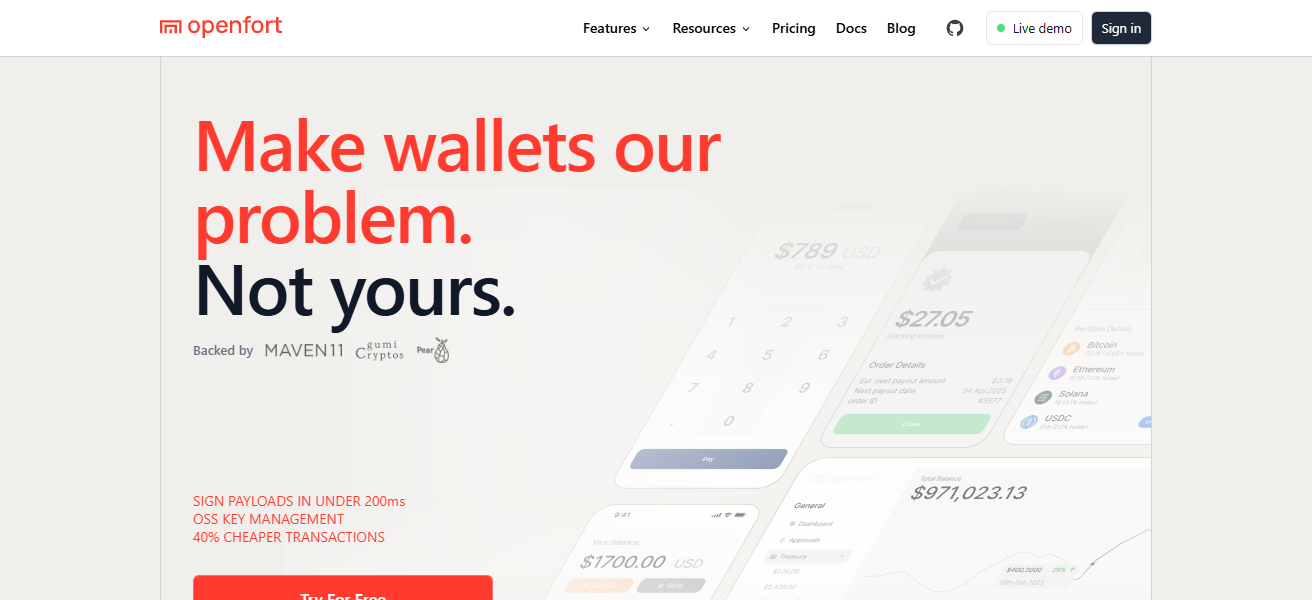
Platforms can offer modular wallets and role-based access to fit their business model. Openfort’s security includes multi-layer authentication, key recovery, and validated transaction proofing.
Its developer-friendly APIs provide seamless integration into web and mobile applications. Embedded finance platforms can use Openfort to provide a simple, secure, and user-friendly way to manage crypto.
Openfort Features
- Flexible Wallet Architecture: Embedded finance is best with account abstraction, and is user’s preferred wallet.
- Account Abstraction: Users can perform transactions without private keys.
- High Security: User funds are protected with sophisticated key management and multi-layered authentication.
- Developer-Friendly SDKs: Wallet functions can be embedded into web and mobile applications easily.
| Pros | Cons |
|---|---|
| Flexible wallet architecture for embedded finance | Focused mostly on EVM chains |
| Supports account abstraction for frictionless transactions | Some advanced features need developer setup |
| High security with multi-layer authentication | May be overkill for small platforms |
| Developer-friendly APIs for web and mobile apps | Limited analytics or monitoring tools |
5. Bitzaro
Bitzaro specializes in customizable wallets with an emphasis on embedded finance and decentralized apps. It is multi-chain compatible and allows users to manage diverse crypto assets through one platform.
Bitzaro prioritizes security with features like encrypted key storage, 2FA, and optional multisig. Its APIs integrate easily with mobile and web apps, incorporating automation for payment routing and smart contract interaction.
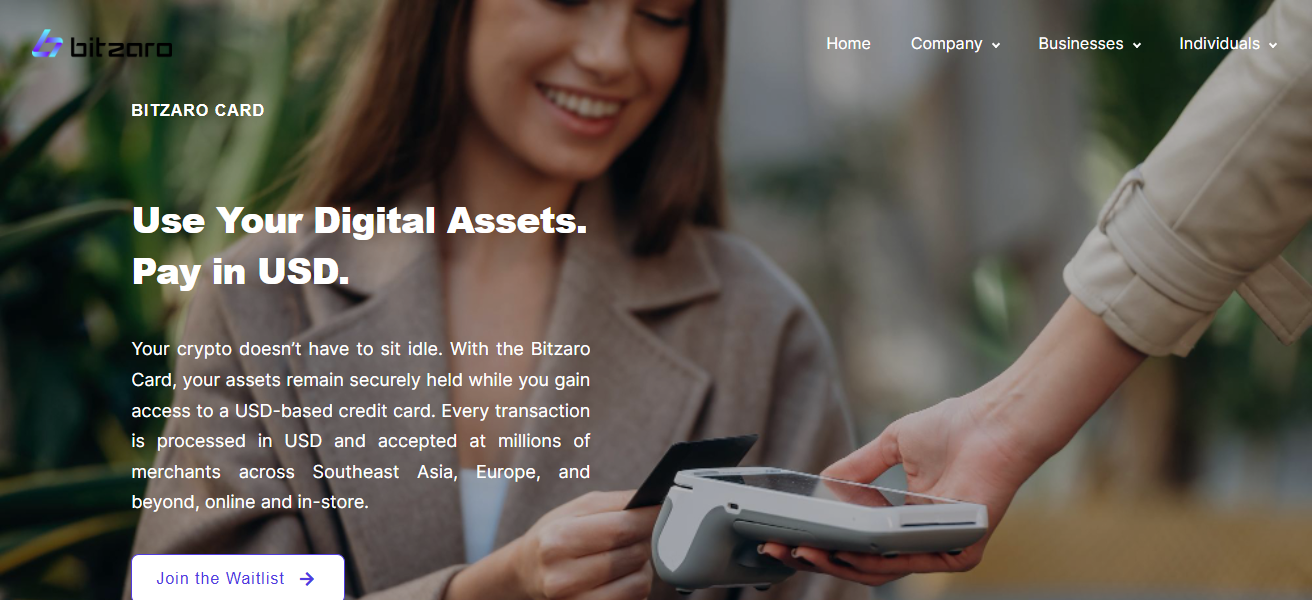
Bitzaro is focused on user experience, with simple interfaces and streamlined onboarding. This is ideal for platforms wanting to offer crypto services without burdening users with complicated technology.
Bitzaro Features
- Multi-Chain Wallet: Offers support for a variety of cryptocurrencies within one application.
- Smart Contract Integration: Empowers platforms to facilitate automated payments and DeFi engagements.
- Enhanced Security: Encrypted key custody, 2FA, and optional multisig arrangements.
- User-Friendly Interface: Eases crypto management, particularly for users without a technical background.
| Pros | Cons |
|---|---|
| Multi-chain wallet with single interface | Less known in mainstream adoption |
| Advanced security with encrypted keys and 2FA | UI customization can be complex |
| Automated payment routing and smart contract support | Requires development resources for full integration |
| Intuitive interface for end users | Some features may not scale for large platforms |
6. Dynamic Wallets
Dynamic Wallets stand out in embedded finance because of their programmable wallets that respond to specific platform requirements. They are flexible because of account abstraction.
Developers can tailor wallets to allow users to execute transactions without needing to understand the blockchain.
Developers can also customize wallets to improve operational efficiency with automatic gas payments, transaction batching, and smart contract interactions.
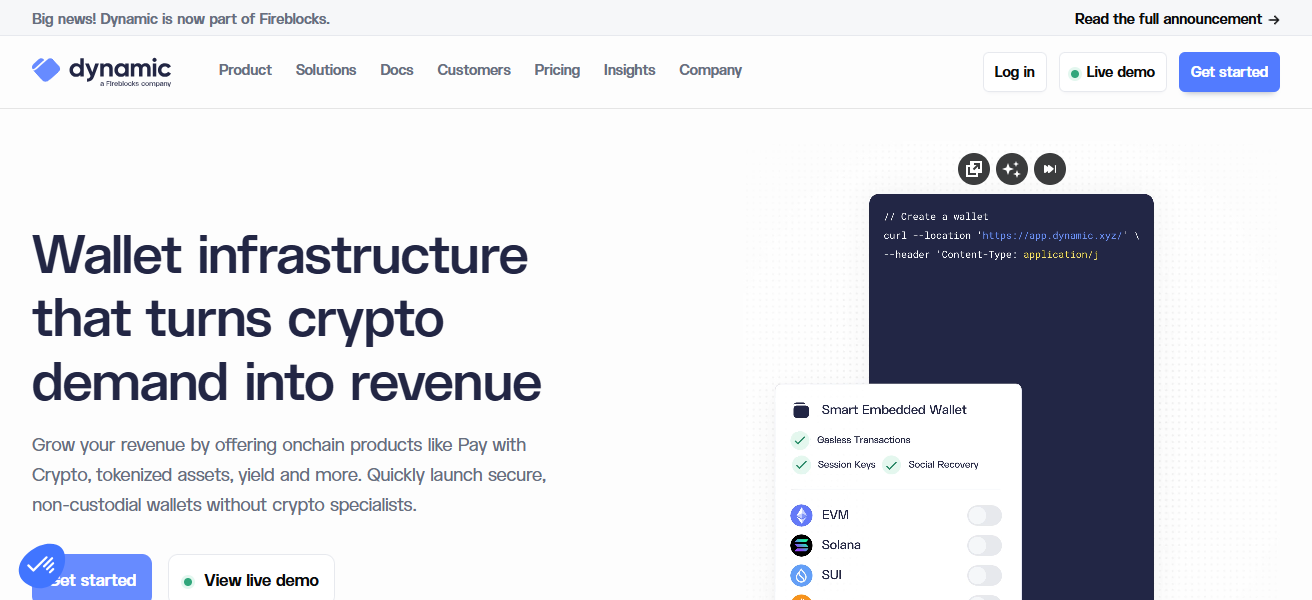
Security features include flexible key recovery, encrypted key management, and audit trails that are compliant with regulatory requirements.
Dynamic Wallets APIs and SDKs simplify the embedding process for existing mobile or web applications.
For businesses that want to provide embedded crypto features in their applications, Dynamic Wallets provide scalable, flexible, and safe solutions that users can engage with easily.
Dynamic Wallets Features
- Programmable Wallets: Customizable for gas savings, batching transactions, and smart contracts.
- Account Abstraction: Provides a seamless transactional experience without the burdens of private key management.
- Compliance-Ready Logs:** Preserves audit logs suitable for regulatory-compliant environments.
- Modular APIs: Simple integrations into web and mobile applications.
| Pros | Cons |
|---|---|
| Programmable wallets with account abstraction | May require technical expertise to configure |
| Supports transaction batching and gas optimization | Limited brand recognition |
| Secure with key recovery and compliance-ready logs | Integration may be complex for small teams |
| Modular APIs for web and mobile platforms | Advanced features may be underused by simple apps |
7. Privy
Privy prioritizes user-friendliness and security, making blockchain access easier for embedded finance applications.
Users can onboard via email or social logins, eliminating the need for a crypto wallet, and Privy interfaces with many blockchains while offering customizable recovery options.
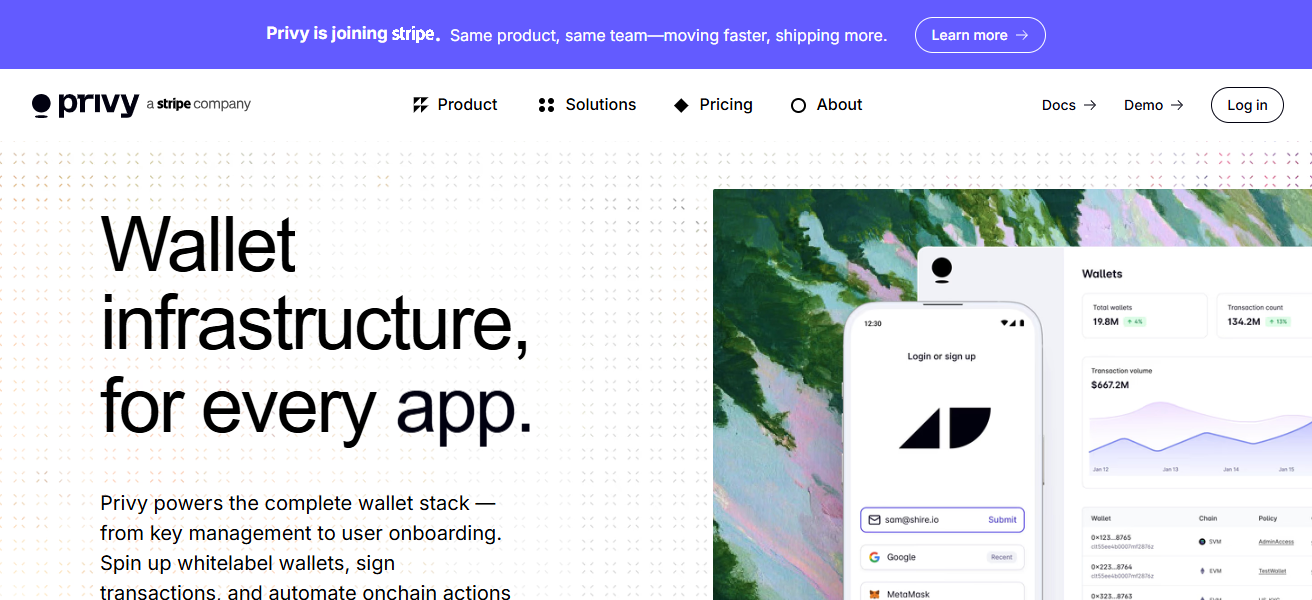
Developers can use Privy’s APIs to incorporate wallet functionalities into their web and mobile applications, including payments, token control, and DeFi management. Privy’s focus on security and usability allows advanced crypto capabilities.
Privy Features
- Social/Login Onboarding: The option for users to sign up using their email or social accounts simplifies the onboarding process.
- Multi-Chain Support: Allows the management of crypto assets across several blockchains.
- Key Recovery Options: Users are safeguarded against losing access to their funds.
- Developer APIs: Wallet capabilities are embedded into applications with little resistance.
| Pros | Cons |
|---|---|
| User-friendly onboarding with social/email logins | Limited blockchain ecosystem support compared to others |
| Secure key management and recovery options | Some advanced DeFi features may be missing |
| Multi-chain support | May not support very large enterprise-scale operations |
| Easy API integration for embedded platforms | Fewer customization options for wallet UI |
8. Magic
Magic is designed to make embedded finance and web3 applications passwordless wallets. Private key management is eliminated by using social logins, email, or OAuth for user onboarding.
Magic is flexible for fintech applications as it covers smart contract interactions, token storage, and even cross-chain transactions. Loss of safety is covered by advanced key recovery, cryptography and phishing.
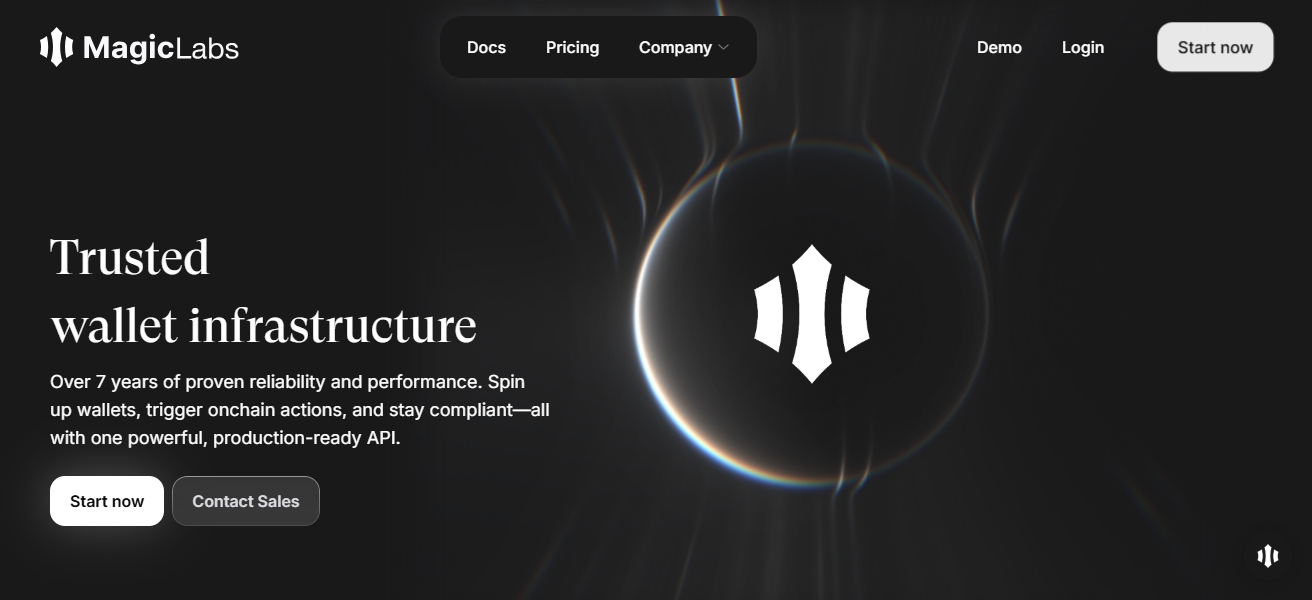
It’s easy to integrate into web and mobile applications through its SDK and API. Magic empowers web3 applications to be user friendly and safe so that embedded blockchain services can be adopted faster.
Magic Features
- Passwordless Login: Frictionless onboarding is facilitated by social or email logins.
- Cross-Chain Support: Provides the ability to store and transfer tokens across various blockchains.
- Secure Key Management: User funds are protected with advanced cryptography.
- Finance-related Embedded SDKs: quick integrations into mobile and web solutions for embedded finance.
| Pros | Cons |
|---|---|
| Passwordless and social login onboarding | Focused mainly on Web2/Web3 hybrid apps |
| Supports smart contracts and cross-chain transactions | May require developer effort for custom logic |
| Advanced cryptography and key recovery | Limited analytics or reporting tools |
| SDKs for easy web and mobile integration | Less suitable for highly regulated finance apps |
9. Web3Auth
Web3Auth offers a decentralized wallet solution without keys, designed specifically for embedded finance platforms. Users can login with Google, Apple, or social accounts, removing barriers to crypto access.
It operates on multiple blockchains and tokens, and efficiently manages keys using distributed cryptographic systems and threshold crypto. Developers can integrate wallet capabilities using their SDKs for in-app payments, DeFi, and NFTs.
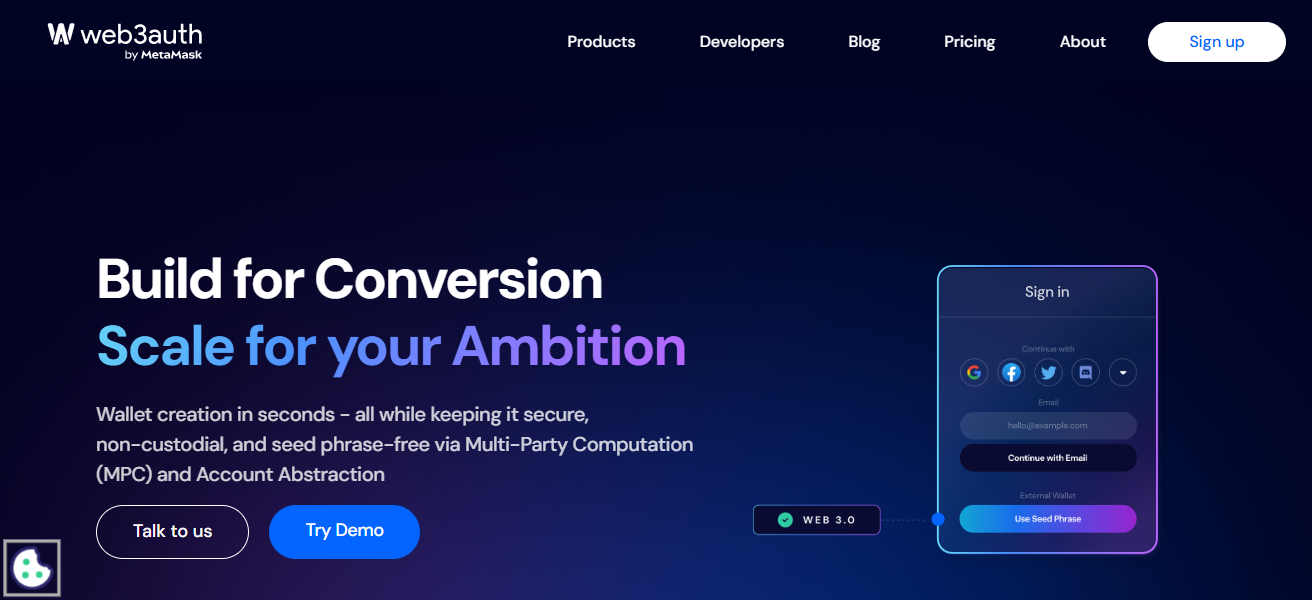
Usability and security are central to their service, making it ideal for platforms that are converting users from traditional finance to web3. It gives users a familiar experience while decentralized ownership of their assets.
Web3Auth Features
- Keyless Login: users access with common credentials like Google or Apple account.
- Multi-Chain & Token Support: supports numerous blockchain and assets.
- Decentralized Key Custodians: Robust cryptography and distributed threshold secret management.
- Easy Integration SDKs: integrates with payment, DeFi, or NFT functionalities.
| Pros | Cons |
|---|---|
| Keyless login with familiar Web2 credentials | Advanced blockchain features require additional setup |
| Supports multiple chains and tokens | Limited custom UI out-of-the-box |
| Strong security with distributed key management | Some integration features are EVM-focused |
| Developer-friendly SDKs for embedded finance | May not cover niche blockchain protocols |
10. Sequence
Sequence provides a smart contract-based wallet solution that simplifies embedded finance integration. It supports account abstraction, multisig approvals, and batch transactions, optimizing gas costs and operational efficiency.
Developers can embed Sequence into web and mobile platforms via its SDK, enabling seamless management of multiple assets and blockchain interactions. Security is strengthened with social recovery mechanisms and cryptographic protections.
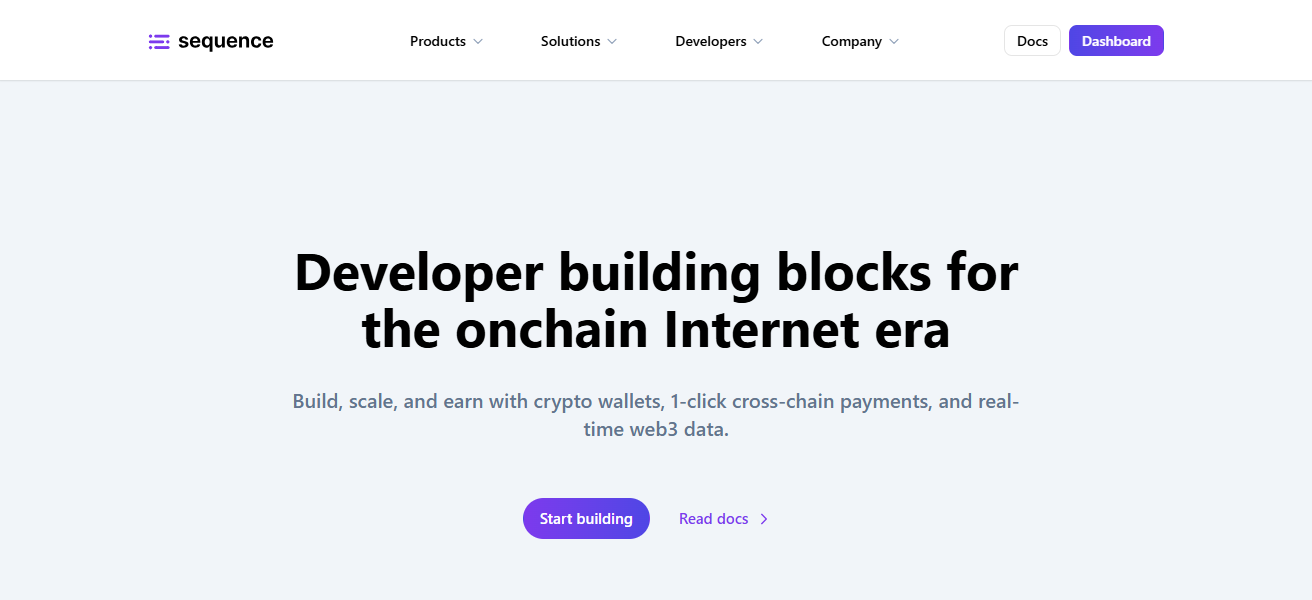
Sequence also offers modular features for governance, payments, and token management, making it highly versatile.
Platforms can leverage Sequence to provide users a secure, intuitive, and fully decentralized crypto experience, combining flexibility, usability, and advanced blockchain functionalities.
Sequence Features
- Smart Contract Wallet: offers additional functionalities like multisig and governance.
- Transaction Batching & Gas Optimization: improves efficiency and reduces costs.
- Social Recovery: gives users peace of mind that they will not lose keys or access.
- Modular Integration: SDKs offer seamless integration of wallet, token, and governance functionalities into apps.
| Pros | Cons |
|---|---|
| Smart contract-based wallet with multisig support | More suitable for EVM chains |
| Supports batch transactions and gas optimization | Can be complex for non-technical teams |
| Social recovery and cryptographic protections | Fewer third-party integrations compared to others |
| Modular features for governance, payments, and tokens | Learning curve for developers is moderate |
How To Choose Best Crypto Wallets for Embedded Finance Platforms
- Security First – Double check wallets can keep user funds secured through encrypted key storage, multisig, and recovery tools.
- Integration Ease – Partnerships are best with wallets that offer simple to use, developer oriented APIs and SDKs.
- Multi-Chain Support – Cross-chain compatibility lets users diversify and manage an entire ecosystem of assets.
- User Experience – Wallets must make onboarding easy by offering social logins, email logins, or passwordless logins.
- Transaction Efficiency – Batching, gas optimizations, and smart contracts keep user costs low.
- Scalability – Built to manage growing numbers of users and transactions seamlessly.
- Customizability – Your platform can use a dedicated wallet with a custom UI, special permissions, and unique features.
- Regulatory Compliance – Features that assist with audit requirements and regulatory compliance come standard.
- Recovery Options – Users of social recovery or keyless recovery don’t have to worry about a loss of access to their funds.
- Platform Support – Be sure the wallet can operate across the web, mobile, and hybrid embedded apps of your choice.
Conclusion
Final remarks From the point of view of embedded finance, picking the right crypto wallets is important, as it directly influences how safe, seamless, and scalable user journeys will be.
Alchemy, Blockradar, Openfort, Bitzaro, Dynamic Wallets, Privy, Magic, Web3Auth, and Sequence support multiple chains and flexible accounts, and are easy to integrate.
Focusing on the simplicity of transactions enhances the embedded crypto services and increases adoption alongside the trust of users.
FAQ
A wallet integrated directly into apps to manage crypto without separate downloads.
They simplify crypto access, improve user experience, and enable seamless transactions.
Alchemy, Blockradar, Openfort, Bitzaro, Dynamic Wallets, Privy, Magic, Web3Auth, Sequence.
They use encrypted key storage, multisig, social recovery, and advanced cryptography.