In this article, I would like to focus on the Best Crypto Wallets for Internal Compliance Teams. The right crypto wallet can help institutions secure and protect managed digital assets to meet the needed compliance.
- Key Points & Best Crypto Wallets for Internal Compliance Teams
- 10 Best Crypto Wallets for Internal Compliance Teams
- 1. Fireblocks
- 2. Ledger Enterprise
- 3. BitGo
- 4. Coinbase Custody
- 5. Metaco Harmonize
- 6. Anchorage Digital
- 7. Copper
- 8. Kraken Institutional Wallet
- 9. ChainUp Custody
- 10. Gemini Custody
- How To Choose Best Crypto Wallets for Internal Compliance Teams
- Cocnsluion
- FAQ
With features like audit-ready reporting and top-tier security, these crypto wallets help compliance teams implement governance, risk oversight, and the safe and efficient crypto custody throughout the organization’s processes.
Key Points & Best Crypto Wallets for Internal Compliance Teams
| Wallet | Key Point |
|---|---|
| Fireblocks | Institutional-grade security with multi-party computation (MPC) |
| Ledger Enterprise | Hardware-based cold storage with enterprise compliance controls |
| BitGo | Multi-signature approvals and SOC 2 Type II certification |
| Coinbase Custody | Regulated custodian with insurance coverage for digital assets |
| Metaco Harmonize | Policy-based governance and integration with core banking systems |
| Anchorage Digital | Federally chartered crypto bank offering compliance-first custody |
| Copper | ClearLoop technology for off-exchange settlement and compliance monitoring |
| Kraken Institutional Wallet | Advanced reporting tools and regulatory-grade audit trails |
| ChainUp Custody | Supports DeFi, NFTs, and staking with compliance dashboards |
| Gemini Custody | Licensed trust company with SOC 1 & SOC 2 compliance |
10 Best Crypto Wallets for Internal Compliance Teams
1. Fireblocks
Fireblocks is a digital asset operations platform. Built on secure Multi-Party Computation (MPC), Fireblocks is fully enterprise grade and allows teams to manage, transfer, and store crypto without ever having to expose any private keys.
Fireblocks is integrated with sophisticated compliance automation, as well as with an operational risk mitigation policy control and institutional transfer network.
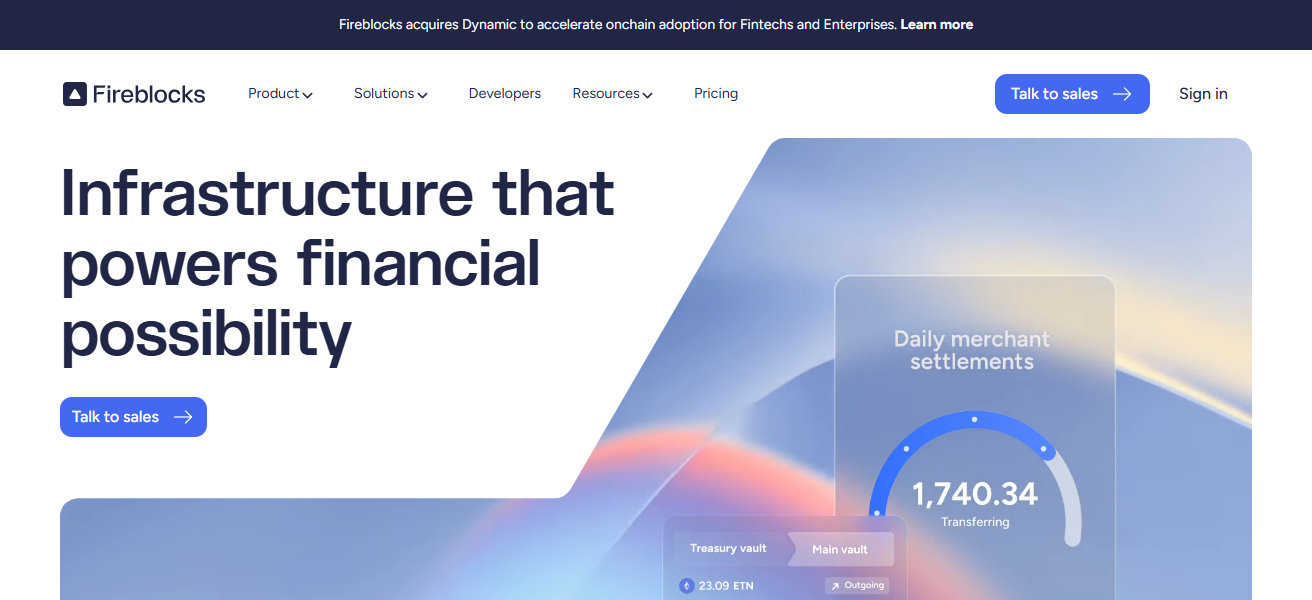
Fireblocks streamlines and instantaneously settles a broad array of digital assets. This helps internal compliance teams facilitate and automate governance
Integrate anti-money laundering (AML), know your transaction (KYT) compliance, and safely access decentralized finance (DeFi) to carry out trading and treasury operations.
Fireblocks Features
- MPC Key Management: Secures the private keys with the use of multi-party computation, eliminating single points of failure and exposure.
- Automation of Compliance: Built-in workflows and policy controls assist in the streamlining of the internal rules and regulatory controls.
- Network of Institutions: With proprietary risk-transfer protocols, the crypto network allows for instantaneous off-exchange transfers.
- Integrations and APIs: APIs and programmable tools for custom compliance, reporting, and automation
| Pros | Cons |
|---|---|
| MPC key management reduces private key exposure | Can be expensive for smaller teams |
| Strong compliance & policy controls | Some advanced features require custom setup |
| APIs for automation and governance workflows | Learning curve for non-technical users |
| Institutional transfer network increases operational efficiency | Dependent on platform uptime for critical operations |
2. Ledger Enterprise
Ledger Enterprise integrates the cutting-edge security of Ledger’s hardware technology with an institutional custody solution focused on hardware wallets and HSMs (Hardware Security Modules) for private key protection.
It includes internal compliance rights management and customizable team roles and policy enforcement. Ledger Enterprise optimizes compliance with the audit trail and storage practices of the offline Ledger.
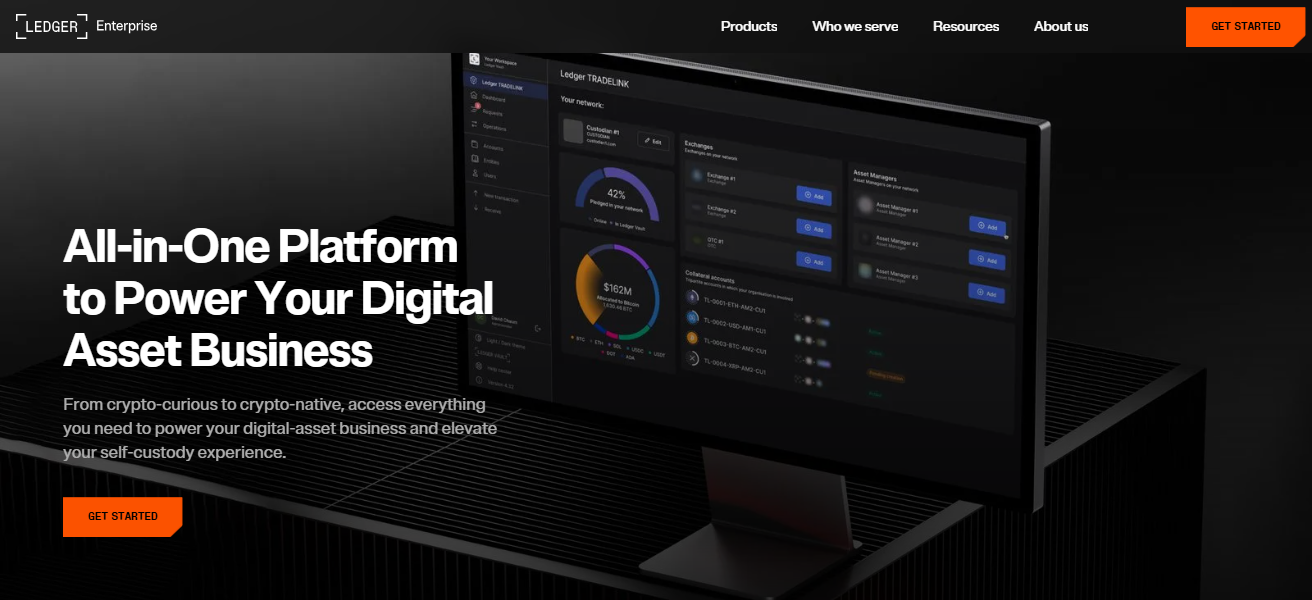
It assists compliance personnel in implementing the duty segregation, multi-layered access, and traceability enforcement essential for regulatory reporting and reducing insider threats.
Ledger Enterprise Features
- Hardware Security: Private keys secured with dedicated and engineered hardware.
- Role-Based Access: Internal segregation of duties is supported via fine-grained permissions for the teams.
- Audit Logging: Compliance and internal reporting can be facilitated with comprehensive activity logs.
- Offline Protection: The risk of online attacks is reduced with cold storage foundations.
| Pros | Cons |
|---|---|
| Hardware-secure private key protection | Heavily reliant on physical devices |
| Strong role-based access controls | Limited advanced compliance analytics |
| Good audit trails for internal reviews | Less integrated for active trading workflows |
| Fits teams focused on offline security | Not ideal for high-frequency institutional workflows |
3. BitGo
BitGo provides an integrated service combining security and custody for digital assets. Funds, enterprises, and exchanges use BitGo for digital asset custody and security.
They integrate multi-signature wallets with custodial and self-custody wallet options, customizable policies, and insurance coverage.
They support governance, compliance, and internal policy controls with limited authorization, risk monitoring, and operational transparency.
BitGo’s services are backed by licenses and certifications that support the risk policies of institutions and meet regulatory and audit standards.
BitGo Features
- Custody with Multi-Signatures: Transactions require more than one signature, thus improving security.
- Custody Flexibility: Institutions can choose between self custody and full service managed custody.
- Custody Insurance: Protection of custodians’ breaches is also available under separate agreement.
- Controls of Governance: Withdrawal policies, limits, and permissions for roles within teams are configurable.
| Pros | Cons |
|---|---|
| Multi-signature security model | Fee structure can be complex |
| Flexible custody models (self & custodian) | High costs for full enterprise features |
| Good policy and governance controls | UI may feel dated for some users |
| Insurance coverage available | Onboarding can take time |
4. Coinbase Custody
Based in New York and regulated by the NYDFS, Coinbase Custody has the required institutional licenses and provides the necessary compliance controls, including cold-storage segregation and compliance across the board.
Coinbase Custody has also built institutional frameworks for governance, custodial-asset insurance, and custodial-asset insurance, and integrates with staking, reporting, and other institutional services.
Coinbase Custody supports the internal compliance team with the necessary access controls, audit trails, and compliance-mapping features that help with the regulatory risk/ compliance/ policy alignment.
Coinbase Custody Features
- Custodian Regulation: The custodian is regulated mainly for compliance purpose since it has to comply with institutional requirements.
- Secure Off-Site Cold Storage: Assets stored offline, protected by insurance and security.
- Regulatory Reporting: Audit trail reporting that is friendly to compliance.
- Integrated Staking and Services: Staking and some custodial-embedded enterprise services.
| Pros | Cons |
|---|---|
| Regulated and compliant custody framework | Can be restrictive in asset support |
| Strong audit logging and segregation | Not tailored for all institutional workflows |
| Deep enterprise support | Less flexibility for custom integrations |
| Insurance on held assets | Higher fees for smaller portfolios |
5. Metaco Harmonize
Metaco Harmonize is designed for large-scale financial institutions. It provides digital assets custody and orchestration for big banks.
Harmonize provides custody, trading, tokenization, and compliant custody-agnostic DeFi operations.
It allows internal compliance to blend secure custody with adaptable workflows, policy control, and counter risk management across diverse assets.
Harmonize’s trading, custody, and settlement integrations maintain governance, auditability, and alignment to regulations across complex institutional frameworks.
Metaco Harmonize Features
- Orchestration Platform: Custody, trading, tokenization, and DeFi access are combined in one solution.
- Bank-Grade Compliance: Designed for the financial services sector with advanced compliance governance.
- Asset Agnostic: Allows diverse tokens in a streamlined process.
- Enterprise Integration: Direct connections with back-office and risk management applications.
| Pros | Cons |
|---|---|
| Bank-grade custody and orchestration | Requires significant integration work |
| Supports broad asset types | Higher implementation cost |
| Unified compliant workflows | Complexity can slow initial deployment |
| Designed for large financial institutions | Overkill for smaller teams |
6. Anchorage Digital
Anchorage Digital offers secure custody, governance controls, and compliance services as a qualified custodian and federally chartered crypto bank.
They combine regulated custody with staking, trading, and governance, all backed with advanced security and hardware protections.
Anchorage mitigates compliance concerns with oversight and reporting, assisting internal teams with policy enforcement, risk controls, and compliance while managing gaps in jurisdiction and internal digital asset policies.
Anchorage Digital Features
- Qualified Custodian: Custodian with a federal charter and supervision shielded by an institutional layer.
- On-Chain Staking and Governance: Compliant with custodial restrictions, Anchorage supports governance and staking.
- Hardware-Backed Security: Proprietary blend of state-of-the-art hardware and security software.
- Transparent Auditing: Compliance features access and activity logging, along with built-in reporting.
| Pros | Cons |
|---|---|
| Regulated custodian with strong governance | Limited flexibility for custom protocols |
| Integrated compliance features | Onboarding process can be stringent |
| Supports staking and advanced services | Higher minimum requirements |
| Hardware-level security protections | Not ideal for all asset classes |
7. Copper
Copper provides institutional custody and settlement services focusing on secure off-exchange settlement (ClearLoop) and collateral management for active trading.
Its systems are built for automated compliance, including role-based access, whitelisting, and audit trails, which enables internal teams to implement strong governance controls.
With a primary focus on hedge funds and trading desks, Copper achieves an effective balance between settlement and security
While supplying the governance components needed for risk frameworks, regulatory reporting, and intra-institutional asset movement oversight.
Copper Features
- ClearLoop Settlement: Copper’s own settlement solution for minimal transfer time and security.
- MPC Key Security: Advanced security for the protection of cryptographic keys.
- Treasury and Collateral Tools: Available for trading processes requiring an integrated custodial layer.
- Custom Controls: Compliance controls through permissions and policy enforcement by roles.
| Pros | Cons |
|---|---|
| Efficient settlement (ClearLoop) | Can be expensive for less active teams |
| Good risk controls and access policies | Limited ecosystem compared to some peers |
| Strong audit trails | Best suited for trading / hedge scenarios |
| MPC key security | May require training to maximize tools |
8. Kraken Institutional Wallet
Kraken Custody provides institutional-grade services with protection tiers, including custody bordering on the custodial services of a bank, bank chartered with MPC/HSM, and additional safeguards aligned with institutional controls.
The service also offers Kraken Prime liquidity with Athena and Kraken Custody integrated staking. Kraken Prime Athena stakers also receive Kraken Custody.
Legally separate Kraken entities assist in fulfilling internal and external compliance, including the segregation of assets, audit trails, and the custody alignment of internal risk and external compliance frameworks.
Kraken Institutional Wallet Features
- Qualified Custody: Regulated custodial services for the institutional client.
- Multi-Layer Protection: Key protection through HSM and MPC.
- Governance Capabilities: Custom access controls and roles for different teams.
- Integrated Services: Links to trading, staking, and liquidity services.
| Pros | Cons |
|---|---|
| Regulated custody with strong controls | Asset support can lag top competitors |
| Multi-layer security features | Less mature compliance integrations |
| Clear governance and role permissions | More focused on traditional trading workflows |
| Tight integration with institutional services | Fees may vary by service |
9. ChainUp Custody
ChainUp Custody designs a solution for institutions that balances critical custody operational compliance, MPC security, and compliance geographically separated custody solutions to satisfy custody operational, regulatory, and security concerns.
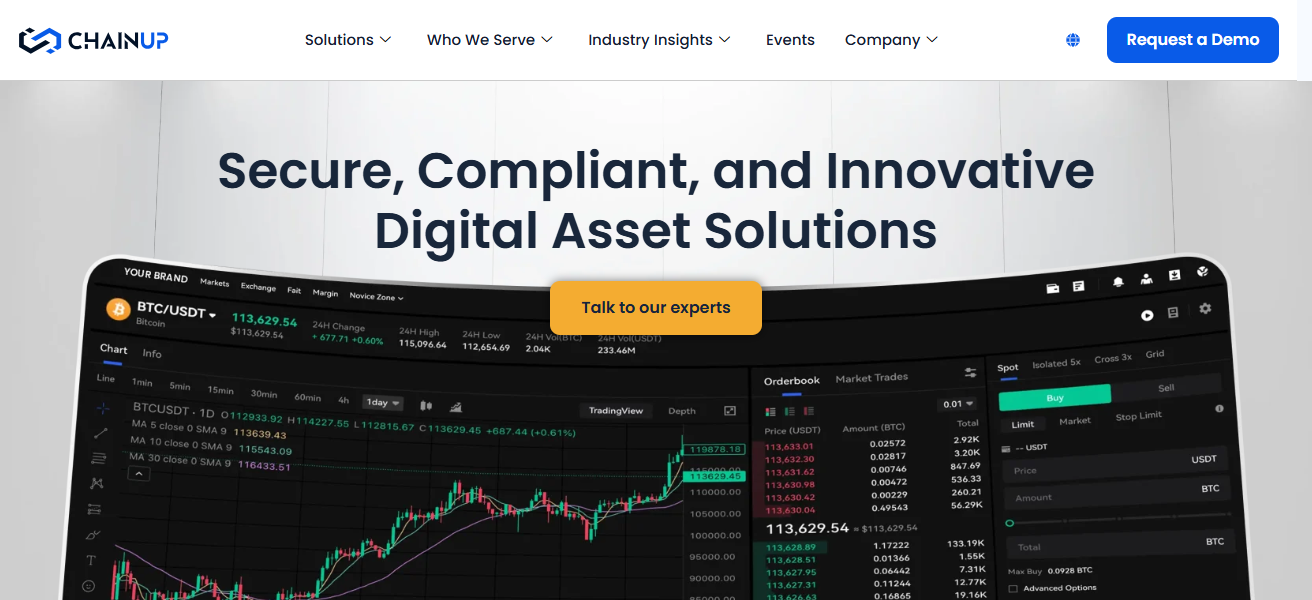
It provides enterprise-grade access control, internal regulatory risk management compliance, and operational scaling support for the AML/KYT insurability.
ChainUp focuses integrating custody functionalities with the operational standards of traditional finance to aid institutional teams in implementing robust governance, auditing, and secured wallets for compliant institutional crypto custody.
ChainUp Custody Features
- Enterprise Compliance: Regulatory expectations controls are built in.
- MPC & Geo-Distributed Storage: Cryptographically secured key protection in different regions.
- AML/KYT Tools: Transaction monitoring and anti-money laundering tools.
- Scalable Architecture: For expanding institutional operations.
| Pros | Cons |
|---|---|
| Enterprise-grade compliance controls | Platform feature set can vary by region |
| MPC & geographic distribution | Less known in Western markets |
| AML/KYT support | Support responsiveness varies |
| Designed for institutional governance | Integration can be complex |
10. Gemini Custody
Gemini Custody integrates cold storage with insurance and compliance safeguards for institutional customers, and is managed under the New York trust law framework.
It is structured to uphold separation of assets, thorough reporting, and enhanced control which makes it suitable for compliance officers seeking organized supervision.
Gemini Custody’s strength in audits, regulatory alignment, and being part of the Gemini ecosystem enables institutions to satisfy their internal risk policy, reporting, and regulatory pressure.
Gemini Custody Features
- Regulatory Alignment: Compliance under the trust laws.
- Cold Storage with Insurance: Offline protection and coverage for insured assets.
- Rich Reporting: Compliance dashboards and audit logs.
- Ecosystem Integration: Trading, staking, and enterprise workflows.
| Pros | Cons |
|---|---|
| Strong regulatory alignment | Higher fees for smaller clients |
| Cold storage with insurance | Asset support may not be as broad |
| Detailed reporting and audit logs | Focused primarily on Gemini ecosystem |
| Well structured compliance workflows | Less customizable for niche requirements |
How To Choose Best Crypto Wallets for Internal Compliance Teams
Regulatory Compliance: Assess if the wallet has the pertinent custody licenses, and other local and international compliance regulations met.
Security Measures in Place: Assess if the wallet has any security measures in place such as MNC, HSM, or multi-signature.
Access Controls: Check if the wallet has any role-based permissions or separation of duties.
Auditability: Evaluate if the wallet has detailed and reportable logs.
Insurance Coverage: Assess if the wallet has any custody solutions.
Customer Support: Evaluate if the wallet has the needed customer support.
Integration & APIs: Assess if the wallet integrates with other compliance apps and internal processes.
Operational Efficiency: Evaluate if the wallet has a settlement network, automated processes or policies, and batch transfers.
Flexibility and Scalability: Assess if the wallet has the needed compliance and operational flexibility.
Cocnsluion
In cocnsluion Selecting appropriate crypto wallets for internal compliance teams is critical for managing digital assets securely and within regulations.
With focus on high security, reporting that is ready for audits, control by roles, and compliance with regulations, organizations can safeguard their assets and enhance their processes.
Fireblocks, Ledger Enterprise, and BitGo are examples of crypto wallets that allow teams to preserve governance, reduce risk, and crypto management within the institution.
FAQ
It’s a secure digital wallet designed for institutions with governance, audit, and regulatory controls.
They ensure secure asset management, enforce internal policies, and meet regulatory requirements.
Top options include Fireblocks, Ledger Enterprise, BitGo, Coinbase Custody, and Anchorage Digital.
Through multi-signature, MPC, HSM, and cold storage protections.
Yes, most offer APIs for reporting, automation, and workflow integration.