
This article will highlight notable features in the Best Crypto Wallets With Custom Approval Workflows that offer wallet security, flexibility, and enterprise-grade governance.
- Key Points & Best Crypto Wallets With Custom Approval Workflows
- 10 Best Crypto Wallets With Custom Approval Workflows
- 1. Zengo
- 2. Uphold
- 3. MPCVault
- 4. Coinbase Wallet
- 5. Ledger Enterprise
- 6. Safeheron
- 7. Fireblocks
- 8. BitGo
- 9. Copper
- 10. Anchorage Digital
- How To Choose Best Crypto Wallets with Custom Approval Workflows
- FAQ
- Cocnlsuion
With these wallets, companies and teams can impose multi-approver, role-based, and transaction control policies that are audit-friendly.
This guide is meant to assist you in crypto management and highlight the top wallets, whether you are managing substantial assets or team approvals.
Key Points & Best Crypto Wallets With Custom Approval Workflows
| Wallet | Key Point |
|---|---|
| Zengo | MPC-based non-custodial security |
| Uphold | Centralized custody with compliance features |
| MPCVault | Multisig + MPC, no single key risk |
| Coinbase Wallet | Enterprise-grade approval policies |
| Ledger Enterprise | Hardware-backed governance controls |
| Safeheron | 3-of-3 MPC with third-party audit |
| Fireblocks | Custom transaction approval workflows |
| BitGo | Multisig treasury management |
| Copper | ClearLoop custody with flexible approvals |
| Anchorage Digital | Institutional-grade workflow automation |
10 Best Crypto Wallets With Custom Approval Workflows
1. Zengo
Zengo’s business-oriented MPC wallet has been designed for secure crypto custody for institutions and comes with flexible multi-approver workflows and role-based governance.
Zengo, unlike traditional seed-phrase wallets, uses Multi-Party Computation (MPC) to eliminate Single Points of Failure (SPOFs) and secure the assets via distributed key shares.
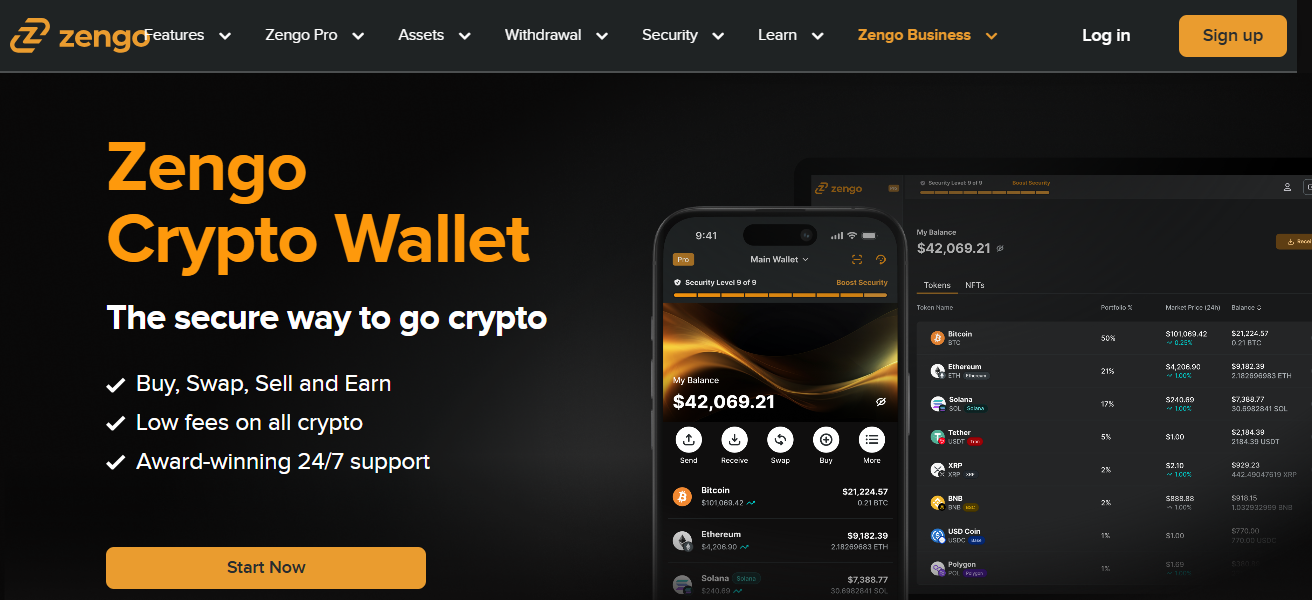
Companies can create roles such as Admin, Approver, Controller, and Viewer, and define the approval thresholds to match their internal policies, for example, requiring two or more approvers for large value transfers.
This multi-tiered structure helps to minimize operational risks, automate compliance, and create audit trails.
Zengo’s tailored enterprise solution focuses on distributed accountability, collaborative automation, and simplified governance, all without the disclosure of private keys.
Zengo Features
- MPC Security Model — With no requirement for seed phrases, key authority is split across several different entities, minimizing the risk of single point failures.
- Role-Based Approvals — Set role configurations for Admin, Approver, and Controller with adjustable signature thresholds for transaction and governance granularity.
- Policies & Workflows — Creates internal frameworks that enforce the need for several approvals for the execution of a difficult and high-value strategy.
- Audit & Compliance — Supplies the necessary scalable and audit-friendly governance for compliance and accountability approval governance records.
| Pros | Cons |
|---|---|
| Uses MPC (no single private key) for strong security | Custom workflows may require onboarding and training |
| Supports role‑based approval policies (multiple approvers) | Not as widely adopted as some legacy enterprise solutions |
| Eliminates seed phrases to reduce risk of loss | Advanced features may cost more for business plans |
| Easy for teams to enforce governance rules | Less deep DeFi integration than some wallets |
| Transparent audit trails for compliance | Workflow flexibility still improving compared to full enterprise suites |
2. Uphold
Uphold functions mostly as a custodian wallet and trading service. It allows customers to purchase, store, send, and receive several different cryptocurrencies and fiat currencies using a single interface.
It is known for being easy to use and for having a wide depth of product offering, however, most large-scale enterprises lack features such as approval workflows tied to MPC or multi-signature governance structures systems.
The robust positions hybrid custodian models with self-custody options like the Uphold Vault and the self-custody integration enterprise APIs for automating payment flows.
Though he is well-positioned as an investor and payment services provider, the detailed multi-user approval features are lacking compared to institutional custody solutions.
Uphold Features
- Wallet & Exchange — Integrates wallet, trading, and payment functionalities into a single platform.
- API Feature — Users are able to automate payments and seamlessly workflow Uphold with third-party systems.
- *Multi-asset — Users can manage a variety of cryptocurrencies and fiat currencies from a single platform.
- Basic Governance Controls — Although approval-workflow is more of an absence, administrative control is granted through account permission and API logic for basic business use.
| Pros | Cons |
|---|---|
| Simple interface for users of all levels | Not natively focused on custom multi‑approver workflows |
| Supports a wide range of assets including fiat | Limited governance controls without external tooling |
| Built‑in trading, wallet, and payments in one | Custodial aspects reduce true self‑custody control |
| Useful APIs for automating some business flows | Approval policies depend on API logic, not platform native |
| Good for hybrid corporate use cases | Not ideal for high‑assurance enterprise governance |
3. MPCVault
MPCVault is a non-custodial MPC wallet that is focused on teamwork. It allows hierarchies and policies.
Built for multi-chain and multi-asset transactions, it allows organizations to create a different vaults, each having custom transaction policies that can be tailored for different volume thresholds, roles, and position of members.
Users can even control who can be an initiator, reviewer, or signer of a transaction, and can even batch tasks like payroll or mass payments with approvals at different levels.
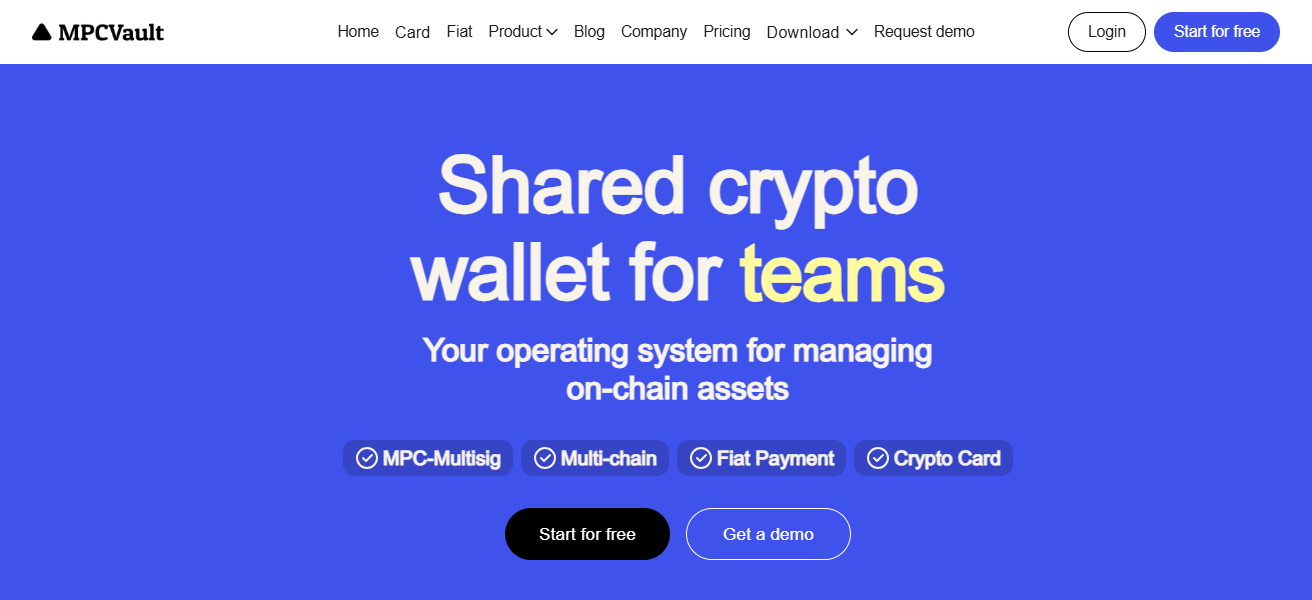
MPCVault also allows organizations to download bank- statement-like histories and CSV files for reconciliation.
Because the private keys are never fully generated, the vault is reinforced by its MPC architecture, while the approval policies ensure that governance workflows are in place for different business requirements.
MPCVault Features
- Multi‑Party Computation (MPC) — Cryptographic key shares are distributed among parties, ensuring that no complete keys are revealed.
- Custom Approval Policies — Define distinct policies, including role-based hierarchies, spend thresholds, multi-signer requirements, and other custom parameters per vault.
- Multi‑Asset Support — Enables governance workflows across different crypto assets and multiple blockchains.
- Enterprise‑Ready Interface — Offers teams audit logs, enterprise-grade access controls, and CSV file export functionality.
| Pros | Cons |
|---|---|
| MPC‑based with no single key to compromise | Onboarding may be complex for non‑technical teams |
| Detailed custom approval workflows per vault | May require subscription for advanced features |
| Multiple roles and governance levels | Less broad ecosystem integration than major exchanges |
| Good for batch payouts and payroll use cases | Smaller community and documentation pool |
| Strong audit and compliance audit records | Learning curve for governance rule definitions |
4. Coinbase Wallet
Custom approval workflows are supported by Coinbase’s institutional offerings (including Prime and Onchain Wallet) via a proprietary policy engine, allowing firms to specify their transaction authorization and execution processes.
Customers can set consensus rules and approver demands based on individual portfolios, allowing them to customize workflows for various risk profiles or activities such as DeFi trading versus holding for the long term.
With policy conditions that are customizable, such as the quantity of approvers, specific wallets, and trusted addresses, teams are able to control separation of duties and governance.
The Coinbase solution resembles a traditional corporate policy framework while providing an audit trail and accommodating more sophisticated institutional crypto activities.
Coinbase Wallet (via Coinbase Prime) Features
- Built‑In Policy Engine — Institutions can set policies and approve workflows as per institutional risk guidelines and business policies.
- Seamless Coinbase Ecosystem — Fully integrated with Coinbase Prime, offering seamless trading, custody, and compliance services.
- Role‑Based Authorization — Set multi-approvers, conditional workflows, and trust lists per wallet or asset class.
- Compliance & Reporting Tools — Provides reporting, governance dashboards, and transaction history oversight for institutions.
| Pros | Cons |
|---|---|
| Well‑established policy engine for approval controls | Requires use of Coinbase institutional accounts |
| Integrates with broader Coinbase ecosystem | Custodial aspects if not using self‑custody layers |
| Good for organizations already on Coinbase Prime | Fees may be higher than pure self‑custody options |
| Flexible autorization rules by asset or threshold | Less configurable than some dedicated MPC platforms |
| Strong compliance and reporting tools | Not fully open‑ended for every governance scenario |
5. Ledger Enterprise
Ledger Enterprise (usually called Ledger Vault) offers self-custody secured by hardware and sophisticated governance controls tailored for corporations and institutions.
It allows for multi-step approval processes in which admins specify the required number of approvers, set transaction control and whitelisting or limiting rules before anything is sent.
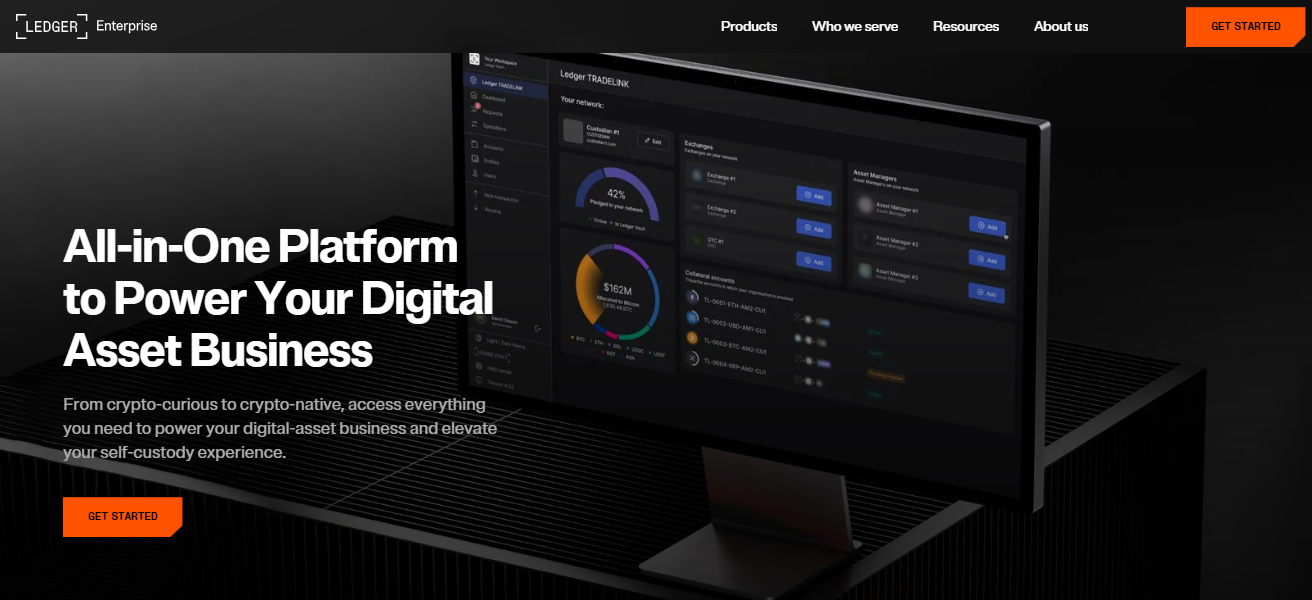
Admin rules and approval criteria can be customized across accounts and groups, making certain that significant transactions can only be processed after several approvals.
With Ledger’s policy engine and workspace management tools, teams can create and customize workflows that suit institutional governance paradigms, and combine the security of cold storage with the operational flexibility.
Ledger Enterprise (Ledger Vault) Features
- Hardware-Backed Security — Employs Ledger’s safe hardware to keep the keys and apply enterprise governance policies for added security.
- Custom Workflow Rules — Establish rules for multiple approvals, whitelists, and transactional restrictions per group or asset.* Cold Storage & Hot Wallets — Provides support for both cold and hot custody workflows with separate approval control for each type.
- Admin & Policy Management — Consolidated admin dashboards for the management of collective approvals, role assignments, and audit logging.
| Pros | Cons |
|---|---|
| Hardware‑backed security with strong custody | Setup for enterprise governance can be complex |
| Supports policy‑driven workflows and multiple approvers | Requires Ledger Enterprise plan (costly) |
| Excellent for cold storage and secure approvals | Best features geared toward large institutions |
| Admin tools for whitelists and limits | Smaller teams may not need full enterprise scale |
| Good audit logs and compliance capabilities | Integration with DeFi less native than some MPC tools |
6. Safeheron
Safeheron is an enterprise-grade self-custody platform powered by MPC and Secure Enclave technologies, along with policy engines for customized workflows for access and approvals.
Safeheron is complaint with industry regulations and offers flexible governance controls over the transactions, allowing institutions to manage their assets across an array of devices and nodes.
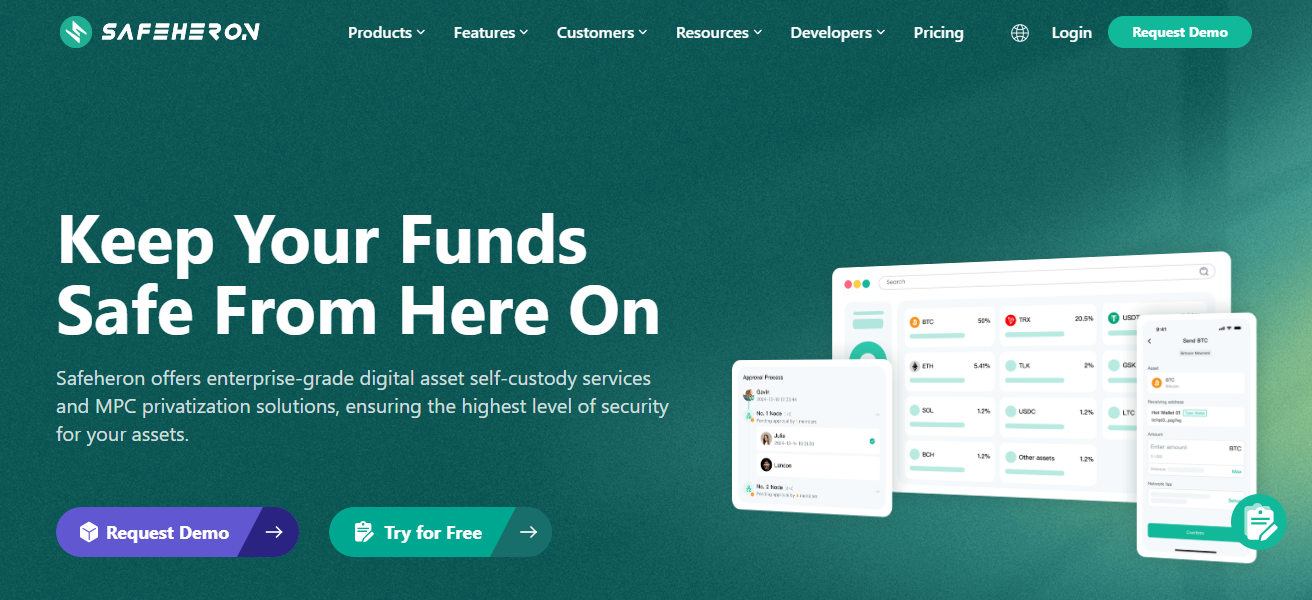
Policy control allows the administrator to set specific rules and conditions for the number of signatories required and the specific contracts or events that need to take place for the approvals.
With Safeheron’s proprietary, fully auditable, and transparent workflows, large institutions that require policy control, strong governance, and flexible access approvals, can benefit from their self-custody the control of the centralized keys.
Safeheron Features
- MPC + Enclave Security — Secure enclaves and multi-party key sharing are used together to safeguard against unauthorized access to keys.
- Flexible Approval Workflows — Set governance policies for approvers, transactional limits, and other policy parameters.
- Institutional Interface — Provides features for enterprises such as role-based access, audit trail management, and dashboards for reporting.
- Cross-Platform Compatibility — Functions on various devices and protected nodes for seamless cross-participant signing.
| Pros | Cons |
|---|---|
| Enterprise focus with MPC + enclave security | Might be overwhelming for small teams |
| Custom workflows and governance engine | Adoption smaller than some competitors |
| Audit logs and compliance ready | Requires structured setup and policy design |
| No single key means fewer attack vectors | Less consumer‑oriented tooling |
| Multi‑device and node signing options | Documentation can be technical |
7. Fireblocks
Fireblocks is an industry-leading institutional MPC wallet and digital asset platform integrating digital asset wallet, treasury, and secure blockchian workflow management with key management and programmable transaction controls.
Fireblocks’ MPC-CMP architecture removes single points of failure. Enterprises can set workflow policies around maker/checker, transaction thresholds, and govern rules pre-execution.
Fireblocks supports diverse and broad asset types, treasury system integrations, and customized automation and API extensions to elasticate approval workflows.
This is particularly beneficial to institutional clients such as hedge funds, custodians, and trading desks that operate high volumes and require sophisticated, scalable governance and oversight.
Fireblocks Features
- Institutional MPC Infrastructure — Handles secure multi-party keys and eliminates the need for central private keys.
- Custom Governance Policies — Enables adaptable policies such as maker/checker logic, workflows, and limits for enterprises.
- Broad Asset & DeFi Support — Provides multiple blockchain support, DeFi services, and institutional offerings.
- APIs & Automation — Offers customizable workflows, integrations, and automated systems through API.
| Pros | Cons |
|---|---|
| Institutional grade MPC with governance policies | Pricing may be high for smaller businesses |
| Maker/checker and limit controls built in | Enterprise focus may be overkill for individuals |
| Broad asset and ecosystem support | Onboarding and integration effort needed |
| Good APIs for workflow automation | Some features locked behind tiered plans |
| Trusted by large institutions and exchanges | Not pure self‑custody (managed MPC) |
8. BitGo
BitGo provides institutional custody integrated with multisig, policy-based security, and customizable approval workflows.
Organizations can set up threshold signatures, meaning that a particular group of keyholders must authorize a transaction before it goes through.
BitGo’s wallets are globally used for regulated custody, integrating hardware and cold storage with policies such as whitelists, velocity restrictions, and role-based control.
The threshold system is akin to multi-sig governance, minimizing the risk of a single actor and providing a robust separation of duties.
Insurance and compliance support are also offered on the platform, making workflow governance appropriate for funds, custodians, and enterprises.
BitGo Features
- Multi-Signature & Threshold Controls — Upon the fulfillment of a set number of signatures, the transaction is completed.
- Policy Engine — Match internal controls to approval thresholds, velocity limits, and address whitelists.
- Insurance & Compliance — Optional insurance and tools for regulatory reporting are available with institutional features.
- Hybrid Custody Options — Integrated governance workflows with both hot wallets and cold storage.
| Pros | Cons |
|---|---|
| Strong multisig and policy controls | Complex governance setup for novices |
| Insurance options and enterprise focus | Costs can be above market for enterprise plans |
| Role‑based thresholds for approvals | Not as fluid for DeFi interactions |
| Good compliance and audit capabilities | Some APIs require engineering support |
| Established player in institutional custody | Less flexible than blockchain‑agnostic MPC |
9. Copper
Copper’s custody solution implements a multi-party security model with a multi-signature scheme (e.g., 2-of-3) for transaction signing, creating built-in approval workflows.
In this structure, control is distributed among the client, Copper, and a third party. Therefore, transactions cannot be processed without prior necessary approvals.
Due to this design, the model provides a quasi-extended sanction regime for the U.S.-based hedge funds, exchanges, and market-making firms in conjunction with the compliance governance frameworks, as it focuses on crypto-assets and institutional clients.
Copper Features
- MPC Quorum Model — Implements multi‑party key control and with a quorum model (e.g., 2 of 3) for approval of transactions.
- Institutional Custody Focus — Tailored to hedge funds, exchanges, and regulated entities with secure workflows.
- Separation of Duties — Enhanced security through distributing signing authority between client and third-party nodes.
- Asset & Chain Support — Custody across primary blockchains with governance solutions.
| Pros | Cons |
|---|---|
| Secure MPC with quorum signatures | Limited public info on deep custom workflows |
| Separation of duties across parties | Best suited to institutional clients |
| Reduces single‑party signing risk | Might not expose granular policy engines |
| Supports broad asset classes | Requires corporate onboarding |
| Good for regulated custody use cases | Not ideal for simple self‑custody individuals |
10. Anchorage Digital
Anchorage Digital stands out as an institutional custody service provider that offers custody services and trading and staking services for digital assets.
Anchorage Digital’s custody services are integrated with trading and staking services with secure, regulated, and governance compliant digital asset custody services, trading, and staking.
Anchorage’s services are designed for institutional clients with an emphasis on provides custody services integrated with trading and staking services with secure, regulated, and governance compliant custodial services.
Anchorage has U.S. banking charter uniform design for enterprise clients. Anchorage’s digital asset custody services are integrated with trading and staking services with safe, regulated, and governance compliant digital asset custody services and trading and staking services.
Anchorage Digital Features
- Regulated Institutional Custody — Within a regulated environment, provides governance workflows for enterprises.
- Multi‑Party Controls — Built operational controls within custody and asset functions for compliance.
- Treasury & Staking Support — In addition to custody, offers oversight for staking and treasury services.
- Enterprise Integrations — Focused on enterprise infrastructure, compliance and operational reporting tools.
| Pros | Cons |
|---|---|
| Regulated institutional custody framework | Approval workflows tied to enterprise onboarding |
| Emphasis on compliance and governance | Not self‑custody if fully managed |
| Strong security and insurance mechanisms | Limited public customization details |
| Enterprise integrations for treasury & staking | Best for larger organizations |
| Multi‑party controls inherent to infrastructure | Not suited for casual users |
How To Choose Best Crypto Wallets with Custom Approval Workflows
Security Model – Choose wallets with MPC or multi-sig to avoid compromise with a single key.
Approval Flexibility – Custom approval via multi-controllers and role-based access should be possible with the wallet.
Asset Support – Verify whether it accommodates all the types of crypto required by your business.
Enterprise Features – Identify the presence of compliance, governance, and reporting audit logs tools.
Integration Options – Assess API access and workflow automation for treasury or corporate integration.
User Roles – Clearly defined roles for admin, approver, controller, and viewer should be present.
Ease of Use – Simple interfaces that enable approval management are preferred.
Cost & Plans – Pricing of enterprise features and customization of workflows should be evaluated.
Reputation & Reliability – Well-established providers with high institutional adoption minimize operational risks.
Regulatory Compliance – Confirm the wallet complies with local regulations, KYC, and AML.
FAQ
A wallet that allows multiple approvers and role-based permissions for secure transactions.
To reduce risk, enforce governance, and maintain compliance in multi-user environments.
Yes, MPC distributes key control, eliminating single points of failure.
Some wallets support individuals, but most are optimized for teams or enterprises.
Cocnlsuion
In cocnlsuion Assessing crypto wallets with custom approval workflows is necessary to optimize asset management with compliance and security.
For teams, businesses, or institutions, Zengo, Ledger Enterprise, and Fireblocks support multi-approver policies, role-based access, and audit-ready controls.
Tailoring crypto governance and security to your organization’s needs lets you manage crypto operations more confidently.