This article will outline crypto wallets that are tailored for use by firms, companies, and teams that handle digital currencies. I will focus on crypto wallets with role-based permissions.
- Key Poinst & Best Crypto Wallets With Role-Based Permissions
- 10 Best Crypto Wallets With Role-Based Permissions
- 1. MetaMask Institutional
- 2. Ledger Enterprise
- 3. Fireblocks
- 4. Coinbase Custody
- 5. Gnosis Safe
- 6. BitGo
- 7. Zengo Business
- 8. Copper Custody
- 9. Anchorage Digital
- 10. Trezor Suite (Enterprise)
- How To Choose Best Crypto Wallets with Role-Based Permissions
- Conclusion
- FAQ
These wallets help organizations improve governance, reduce risk, and manage crypto assets by defining each user’s access to the organizations funds and incorporating approval processes and access security controls.
Key Poinst & Best Crypto Wallets With Role-Based Permissions
| Wallet | Key Point |
|---|---|
| MetaMask Institutional | Role-based access for teams with enterprise-grade compliance tools. |
| Ledger Enterprise | Hardware-backed multi-user permissions for secure corporate treasury management. |
| Fireblocks | Granular role assignment across trading desks, custodians, and auditors. |
| Coinbase Custody | Institutional-grade wallet with configurable approval workflows. |
| Gnosis Safe | Multi-signature smart contract wallet enabling flexible role delegation. |
| BitGo | Policy-based permissions with customizable spending limits and approvals. |
| Zengo Business | MPC-based wallet offering shared controls and team governance. |
| Copper Custody | Clear segregation of duties with role-based transaction authorization. |
| Anchorage Digital | Regulated custody solution with layered role permissions for institutions. |
| Trezor Suite (Enterprise) | Hardware wallet with team access and permissioned transaction signing. |
10 Best Crypto Wallets With Role-Based Permissions
1. MetaMask Institutional
MetaMask Institutional (MMI) enhances the well-known MetaMask interface as it is catered to teams and organizations. MMI offers multi-custody and governance controls that integrate with enterprise workflows.
MMI works with custodial tech, such as MPC and HSM partners, to comply with institutional key management policies.
MMI provides the ability to build structured hierarchies, apply assignable names to accounts, and manage portfolios across the EVM and Solana ecosystems.
Enterprises can use MMI for access to integrated managed portfolios and customizable permissions. This combination provides managed governance/ risk controls for institutional DeFi.
MetaMask Institutional Features
- Team Roles & Permissions: Users can be assigned different levels of permissions to see, sign, or authorize a transaction.
- Multi-Custody Integration: MetaMask collaborates with different custody solutions, including MPC and hardware, so organizations can select their preferred secure key storage.
- Unified Interface: Institutional clients benefit from a single integrated dashboard for analytics and cross-chain account portfolio visibility.
- DeFi & DApp Access: Access to decentralized apps (DeFi and NFT, GameFi) with enterprise-ready controls.
| Pros | Cons |
|---|---|
| Familiar interface for teams already using MetaMask | Higher costs compared to retail version |
| Supports multi-chain integrations | Complex setup for smaller organizations |
| Compliance and reporting tools for institutions | Requires custodial integrations for full functionality |
2. Ledger Enterprise
Ledger Enterprise brings Ledger’s hardware security to the risk enterprise context by combining cold-storage protection with flexible policies and access controls.
Ledger Enterprise is built for businesses needing cold security with governance. It gives admins the ability to control who can see, initiate, and approve transactions, backed by secure key management and physical device authentication.
With hardware keys kept offline and policy-based approvals, Ledger Enterprise ensures institutional-grade security with operational workflows for corporate treasury and long-term asset storage.
Ledger Enterprise Features
- Hardware Key Security: Ledger Enterprise customers benefit from the security of offline hardware keys that protect private keys from online attacks and hacks.
- Policy-Based Approval: Approval policies can be set by enterprises so that role-modulated multiple approvals are required.
- Cold Storage Emphasis: Focuses on the offline (cold) storage of assets, which are safe and ideal for treasury holdings.
- Integration Flexibility: Compatible with governance software and enterprise systems for workflow.
| Pros | Cons |
|---|---|
| Hardware-level security with Secure Element chip | Permissions can be tricky to configure |
| Certified by cybersecurity agencies | Premium pricing for enterprise clients |
| Multi-user governance for treasury management | Limited DeFi integrations compared to software wallets |
3. Fireblocks
Fireblocks is one of the primary custody and wallet platforms for institutions utilizing the secure, split-key MPC (Multi-Party Computation) technology, removing single points of failure, while providing customizable, policy-based workflows.
Enterprises create policies for multiple users, automate approvals for certain transactions, and set governance control integrations with trading desks and DeFi workflows, all within the same policy.
Fireblocks also provides a secure transfer network with API (Application Programming Interface) for scalable and operational flexibility, ideal for firms that require a combination of centralized governance and active management of their assets.
Its sophisticated policy engine and permissioning system ensure that actions are executed in accordance with the organizational policies and only by the approved users.
Fireblocks Features
- MPC Security Model: The Multi-Party Computation model eliminates the need for single private keys and their associated risks.
- Advanced Policy Engine: Policy frameworks with role-based permissions, automated approvals, and transaction caps.
- Institutional APIs: Seamless connectivity to trading platforms, proprietary systems, and DeFi solutions.
- Secure Transfer Network: Encrypted network for the movement of assets among custodians and exchanges.
| Pros | Cons |
|---|---|
| MPC technology ensures strong security | Premium pricing for institutions |
| Flexible transaction management | Best suited for large enterprises, less ideal for small teams |
| Excellent customer support | Integration process can be complex |
4. Coinbase Custody
Coinbase Custody provides segregated cold storage, compliance features, and deep integration with Coinbase’s other institutional offerings.
As a licensed institutional custody service under the NYDFS, Coinbase Custody provides segregated cold storage, compliance features, and integration with Coinbase’s broader institutional offers.
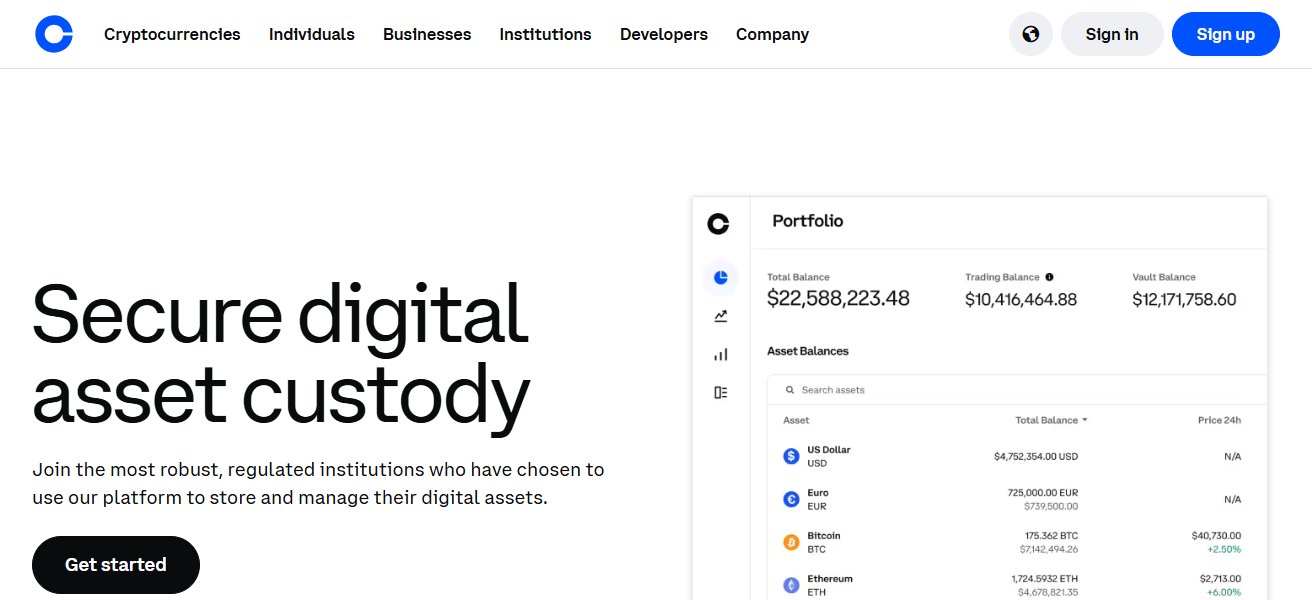
While primarily a custody service, Coinbase Custody offers access management services, and the Coinbase Prime permission model enables an organization to assign a role to each user that defines the custodian’s control over the actions that can be performed at the entity or portfolio level.
This structure allows organizations to implement monitoring and activity oversight, which makes Coinbase Custody a suitable option for traditional institutional clients who want to govern their digital assets in a compliant, secure manner.
Coinbase Custody Features
- Regulated Custodial Storage: Custody under the supervision of NYDFS with separate cold storage.
- Team Access Controls: Assignment of roles for viewers, traders, approvers, and admins.
- Compliance & Reporting: Features for reporting to assist with audits and institutional compliance.
- Prime Integration: Integrated with Coinbase Prime for trading, settlement, and asset management.
| Pros | Cons |
|---|---|
| Regulated and trusted by institutions | High fees compared to competitors |
| Supports 240+ cryptocurrencies | Limited staking options |
| Insurance coverage and approval workflows | Transparency issues with hidden charges |
5. Gnosis Safe
Gnosis Safe (now just Safe) is a multisignature wallet based on smart contracts which facilitates flexible control and governance through the multisig feature (requiring a configurable M-of-N signer consensus to execute transactions).
Teams can set M-of-N signer configurations, and through the role modules, control permissions to specific addresses.
While ‘admin’ and ‘viewer’ aren’t traditional role designations, the multisig framework provided by Safe keeps full control distributed among the signers, which is perfect for DAOs, treasuries, and other organizations that need operational control by a consensus.
Gnosis Safe Features
- Multisignature Governance: Configure an M-of-N signature requirement for transaction approval by multiple actors.
- Modular Permissions: Customize roles and automate processes by attaching modules.
- EVM Chain Support: Operates on Ethereum and all compatible chains for extensive market reach.
- Transparent On-Chain Control: Activities are permanently and immutably recorded on-chain, providing auditability and decentralization.
| Pros | Cons |
|---|---|
| Battle-tested multi-signature smart contract wallet | No hierarchy among signers |
| Supports multiple networks and dapps | Can be complex for beginners |
| Widely used by DAOs | Gas fees can be high on Ethereum |
6. BitGo
BitGo provides enterprise-grade wallet infrastructure that includes strong role-based access control and policy management tools.
Using the admin console, companies can create differentiated roles (e.g., enterprise admin, wallet admin, spender, viewer, auditor), adjust permissions based on team structures, and implement spend approval workflows.
With detailed governance and auditing, BitGo’s system mitigates risks and enhances control for every user action.
When paired with additional policy control and multi-sig features, BitGo serves enterprise customers well who need detailed access control alongside secure custody and compliance.
BitGo Features
- Role-Based Admin Console: Create and assign roles such as spender, auditor, and admin with defined permissions.
- Multisig + Policy Engine: Integrates multisignature requirements along with configurable policies for approval workflows.
- Audit & Compliance Tools: Compliance and audit features, such as activity logging, for regulatory reporting and internal audits.
- Multi-Chain Support: Operate and control assets on multiple chains from a unified interface.
| Pros | Cons |
|---|---|
| Strong multi-signature security | Interface less user-friendly |
| Insurance coverage for assets | Limited DeFi integrations |
| Affordable pricing for institutions | Setup can be complex |
7. Zengo Business
Zengo Business is an MPC-based wallet solution that focuses on treasury management and multi-user governance.
It removes seed-phrase risks employing sophisticated distributed key generation and provides Role-Based Approvals (RBA).
These roles are Admin, Approver, Controller, and Viewer, and they determine and structure transaction access and control initiation, approval, or mere visibility to other users.
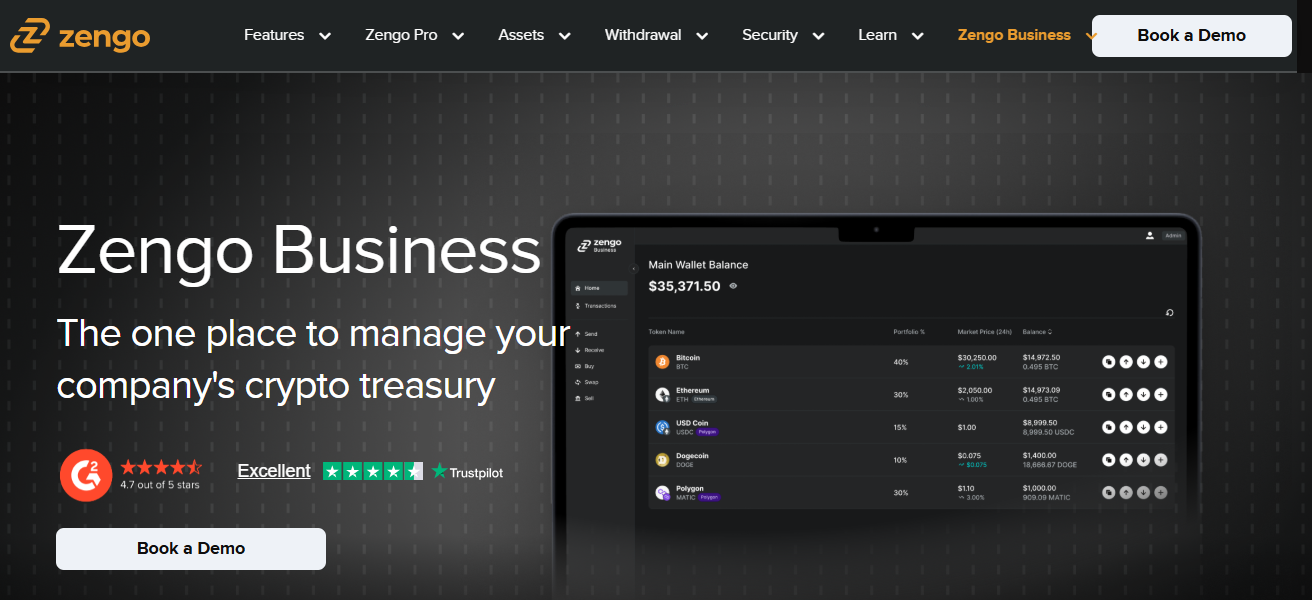
These features are layered on compliance workflows with transaction and approval audit trails, configurable transaction limits, and address whitelisting.
With Zengo’s MPC security, fine-grained access control, and user-friendly design, businesses can rest easy.
Zengo Business Features
- MPC Security Without Seed Phrases: No phrases required; private keys are divided using MPC technology.
- Business Roles: Admin, Approver, Controller, and Viewer for tiered access.
- Audit Trails & Limits: Monitor activity history and impose limits to minimize exposure.
- User-Friendly Interface: Simple dashboards tailored for users with limited crypto knowledge.
| Pros | Cons |
|---|---|
| MPC-based wallet with no seed phrase | Limited advanced institutional features |
| Strong security and ease of use | Not widely adopted by enterprises |
| Supports DeFi and Web3 integrations | Customer support less robust |
8. Copper Custody
Copper offers custody and settlement systems for institutions, combining secure wallets and enterprise governance features.
While role designations may be absent from promotional materials, Copper’s suite of services is tailored to institutional customers.
Fostered by configurable custody, audit trails, and settlement network integrations, operational and counterparty risks are diminished.
Such features serve asset managers, hedge funds, and trading entities, who demand solid governance and custodial confidence paired with extensive market access.
Copper Custody Features
- Institutional Protocol Support: Custody of assets along with access to trading and settlement ecosystems.
- Policy-Driven Workflows: Determine who can trigger, approve, or observe actions with governance parameters.
- Secure Asset Storage: Custody graded for enterprises plus solid architecture and redundancy.
- Audit Logging: Comprehensive records of actions taken by users for oversight and compliance.
| Pros | Cons |
|---|---|
| Off-exchange settlement reduces counterparty risk | Premium pricing for institutional clients |
| MPC wallet system for secure custody | Complex setup for smaller firms |
| Connectivity to multiple exchanges | Limited retail accessibility |
9. Anchorage Digital
Anchorage Digital is federally chartered as an institutional crypto custodian and offers a highly customizable secure custody platform.
It provides organizational governance workflows and multi-signatory control custody solutions. Its infrastructure enables institutions to specify control over assets, integrate governance with biometric, hardware, and policy approvals, and automate approvals based on internal role structures.
Given Anchorage’s standing in the industry, coupled with its enterprise focus, it is an ideal option for institutional organizations seeking integrated custody, trading, staking, and settlement services along with compliant and regulatory focused control over custodial assets.
Anchorage Digital Features
- Federally Chartered Custody: Custody services regulated and based in the U.S. with a focus on compliance.
- Custom Authorization Models: Create multi-party approval workflows and processes based on organizational structure.
- Integrated Services: Staking, trading, and settlement are combined with custody.
- Advanced Security Layers: Protection with hardware, biometrics, and access policies.
| Pros | Cons |
|---|---|
| Regulated U.S. custodian with strong compliance | Best suited for institutions, not retail |
| Multi-signature authentication and cold storage | High fees compared to competitors |
| Integrated enterprise solutions | Limited DeFi integrations |
10. Trezor Suite (Enterprise)
Trezor Suite Enterprise integrates with Trezor’s hardware wallet ecosystem for business applications and provides additional business functionalities for key custody with admin control.
While Trezor’s offline key security is one of their main strengths, business applications typically integrate key security with defined processes, often with multisig solutions (for example, Gnosis Safe) for collaborative control.
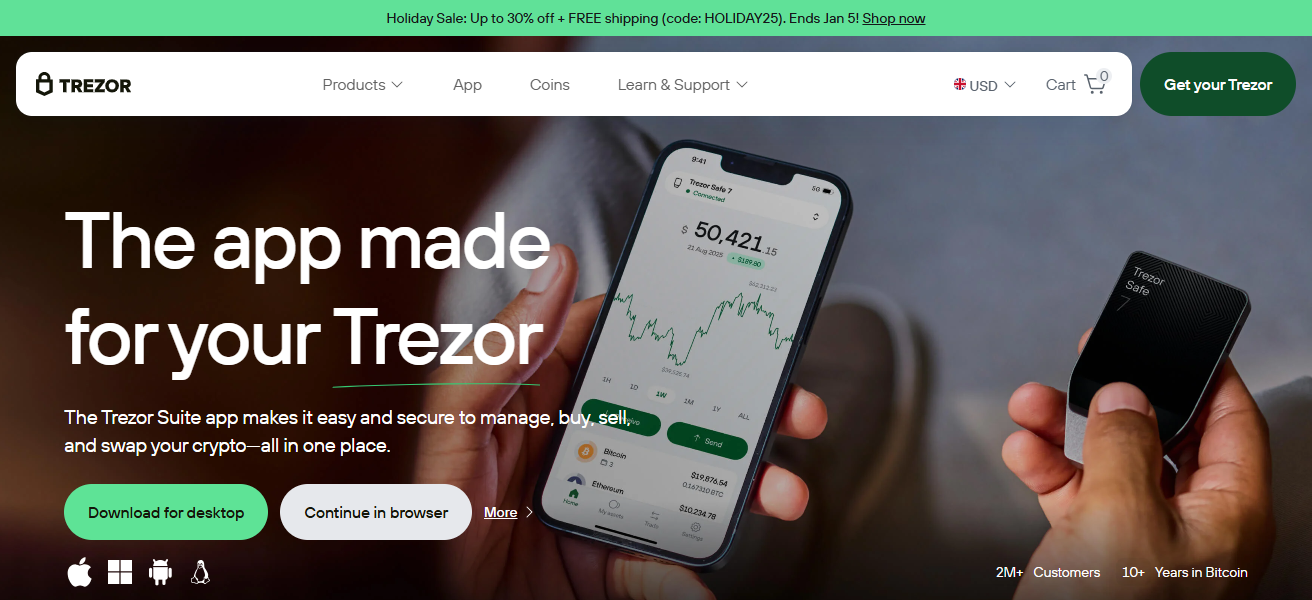
Here, Trezor hardware keys are integrated into a role-based signing threshold structure which provides excellent physical security and good operational security between team members.
This is ideal for scenarios where organizational access control includes hardware-protected signatures.
Trezor Suite (Enterprise) Features
- Hardware Key Protection: Private keys are kept securely and offline on Trezor devices.
- Multisig Compatibility: Functions seamlessly with multisig systems (like Gnosis Safe) for role-based permissions.
- Enterprise Integration: Can be integrated with enterprise workflows utilizing policy tools.
- Proven Reliability: Trustworthy due to Trezor’s historical consistency in hardware crypto security.
| Pros | Cons |
|---|---|
| Industry-leading hardware security | Premium models are expensive |
| Open-source firmware for transparency | No native staking or NFT support |
| Supports thousands of coins and tokens | Requires technical knowledge of seed phrases |
How To Choose Best Crypto Wallets with Role-Based Permissions
Role Granularity: Select wallets that allow roles like admin, approver, and viewer to safeguard against unauthorized access and operational mistakes.
Security Model: Choose wallets with MPC, multisig, or hardware to mitigate risks that come with single key failures.
Approval Workflows: The wallet should allow for governance with adjustable transactional approval steps and signing thresholds.
Audit Logs: Choose wallets with logs of activities for transparency, accountability, and compliance to the audit trail.
Custody Flexibility: Choose self-custodial wallets or self-custodial wallets with compliance and control custodial wallets.
Multi-Chain Support: Confirm the wallet has the capability to manage multiple blockchains and tokens.
Compliance Readiness: For institutional users, wallets that carry KYC, AML, and compliance regulations are most valuable.
Integration Options: For automated workflows in trading, accounting, and DeFi, integrable APIs are preferred.
User Experience: A clear, well-designed dashboard can decrease the time to onboard users and lower the chance of errors.
Cost Scalability: Consider the costs associated with scaling, transactions, and pricing to align with future organizational growth.
Conclusion
To sum up, selecting optimal crypto wallets with role-based access is critical for organizations wanting to manage their assets securely, efficiently, and within the compliance framework.
With features such as access by multiple users, approval workflows, and audit trails, these wallets mitigate risks and enhance team operational efficiency.
For enterprises, DAOs, and SMEs, the right wallet choice is critical to ensuring the governance and security of digital assets.
FAQ
Wallets that allow multiple users with assigned roles to control access and approvals securely.
They enforce governance, reduce risks, and ensure proper transaction approvals within teams.
MetaMask Institutional, Fireblocks, BitGo, Gnosis Safe, Zengo Business, and Ledger Enterprise.
Yes, most use multisig, MPC, or hardware-based security for high-level protection.
Many support multi-chain assets, including Ethereum, Solana, Bitcoin, and other popular tokens.