This article will cover The Best Data Catalog Platforms which assist with data management, discovery, governance, and more. This software provides many tools such as metadata management, data lineage tracking, data discovery and governance.
When utilized, companies have the ability to upgrade their data quality and make compliant and collaborative improvements to their data driven decisions.
Key Pointys & Best Data Catalog Platforms
| Best Data Catalog Platforms | Explanation |
|---|---|
| Collibra | Provides enterprise data governance, discovery, lineage, and collaboration capabilities for organizations. |
| Alation | Enables data discovery, governance, stewardship, and analytics collaboration across teams. |
| Microsoft Purview | Offers unified data cataloging, compliance tracking, and metadata management solutions. |
| Atlan | Simplifies modern data discovery, collaboration, governance, and workflow automation. |
| Informatica Intelligent Data Management Cloud | Delivers metadata management, data quality, governance, and enterprise intelligence features. |
| IBM Knowledge Catalog | Supports data discovery, classification, governance, and trusted data management. |
| Oracle Enterprise Data Catalog | Helps organizations manage metadata, discovery, and enterprise data assets. |
| Google Cloud Dataplex | Provides intelligent data discovery, governance, and analytics management across clouds. |
| AWS Glue Data Catalog | Creates centralized metadata repositories for analytics and data processing workloads. |
| DataHub | Offers open-source metadata management, discovery, lineage, and governance features. |
10 Best Data Catalog Platforms
1. Collibra
Collibra is a top data catalog platform for large companies. It improves data governance and management. It centralizes data assets, helping teams understand data ownership and data quality and how data is used. Catalog platforms like Collibra also provide advanced data lineage. It provides a centralized view of data.
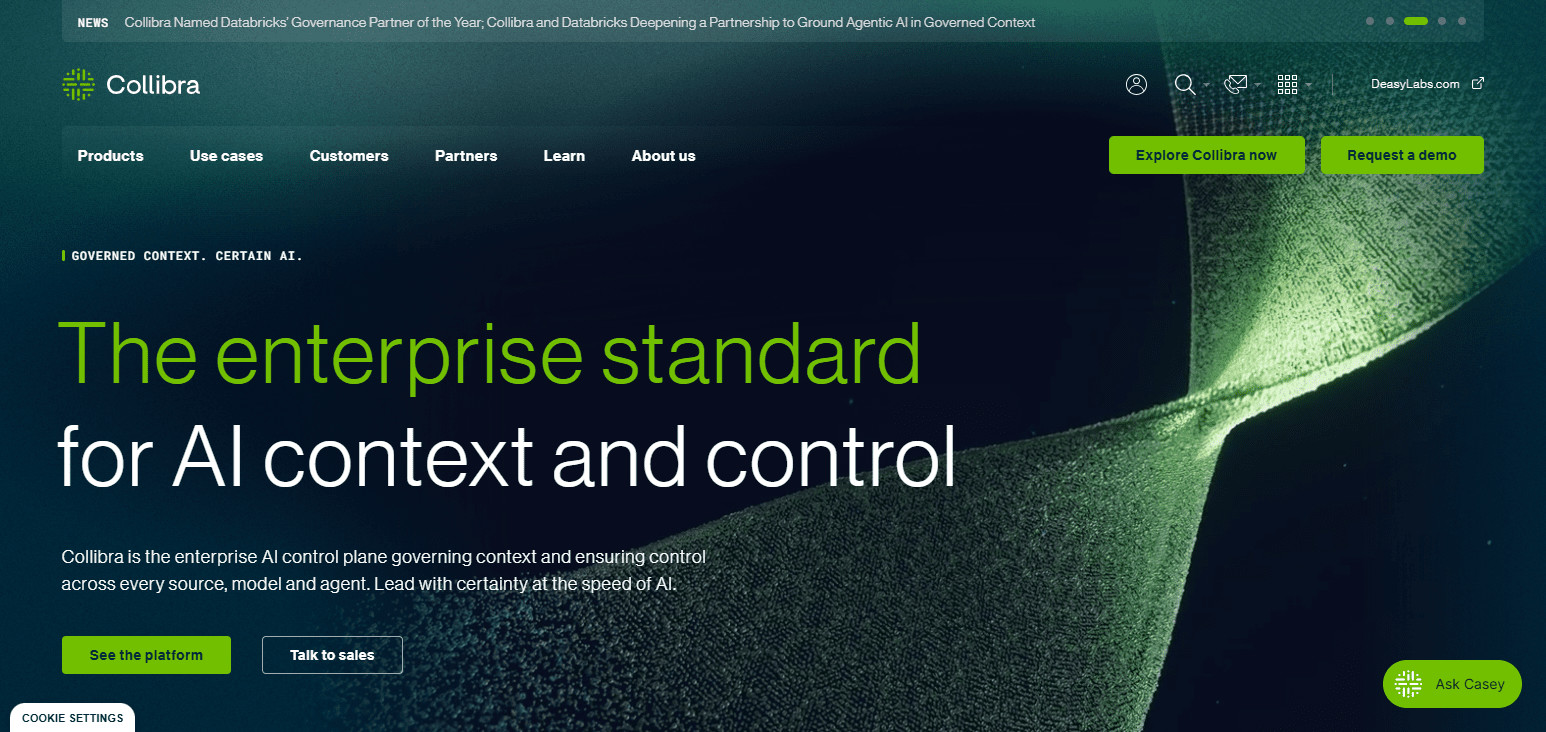
It brings data teams, business users, and data governance users together to bring the most accurate, trusted data. The automation functionality of Collibra helps companies maintain compliance and make better decisions, and it helps companies gain the most from their enterprise data.
Collibra Features
- Data Governance: Establishes frameworks to manage enterprise data policies.
- Data Discovery: Users can identify datasets in disparate locations and sources.
- Data Lineage: Shows how data flows, transforms, and relates to other data.
- Metadata Management: Assists structuring metadata to aid comprehension of available data.
- Collaboration Tools: Promotes partnership of business users and data experts.
| Pros | Cons |
|---|---|
| Provides strong enterprise-level data governance and compliance management. | Higher pricing may not suit small businesses or startups. |
| Offers advanced data lineage tracking across complex systems. | Requires proper training for new users and administrators. |
| Improves collaboration between business and technical teams. | Implementation can be time-consuming for large organizations. |
| Supports centralized metadata management effectively. | Some advanced features need additional configuration efforts. |
| Helps maintain trusted and high-quality data assets. | User interface may feel complex for beginners. |
2. Alation
Alation is one of the best data catalog platforms that empowers users with the tools to improve data discovery, collaboration, and analytics.
Alation builds an intelligent data catalog that brings business data closer to its users. Alation combines data cataloging, metadata management, and data governance to help companies keep trustworthy data.

Alation helps teams bring data documentation/description and encourages teams to communicate knowledge about the data and helps teams improve data governance.
Alation is one of the best data catalog platforms when a company wants to improve business collaboration and analytics, data-driven decisions, and data management.
Alation Features
- Intelligent Search: Search functions that yield relevant results for users.
- Data Stewardship: Teams can manage the ownership and documentation of data.
- Analytics Collaboration: Bridging the gap between analysts and business users.
- Metadata Cataloging: Detailed descriptors for enterprise data collections.
- Data Governance: Implementation of secure and reliable data policies.
| Pros | Cons |
|---|---|
| Provides powerful search capabilities for finding business data. | Premium pricing can be expensive for smaller organizations. |
| Improves collaboration between analysts and data teams. | Requires continuous maintenance for accurate metadata. |
| Offers strong data stewardship and governance features. | Initial setup may require technical expertise. |
| Supports multiple data sources and integrations. | Some users report limited customization options. |
| Enhances data literacy across enterprise teams. | Advanced analytics features may need additional tools. |
3. Microsoft Purview
Microsoft Purview offers unified data governance designed to simplify data management in the cloud, on-premises, and in hybrid environments. Microsoft Purview offers automated data discovery, classification, compliance, and metadata management.
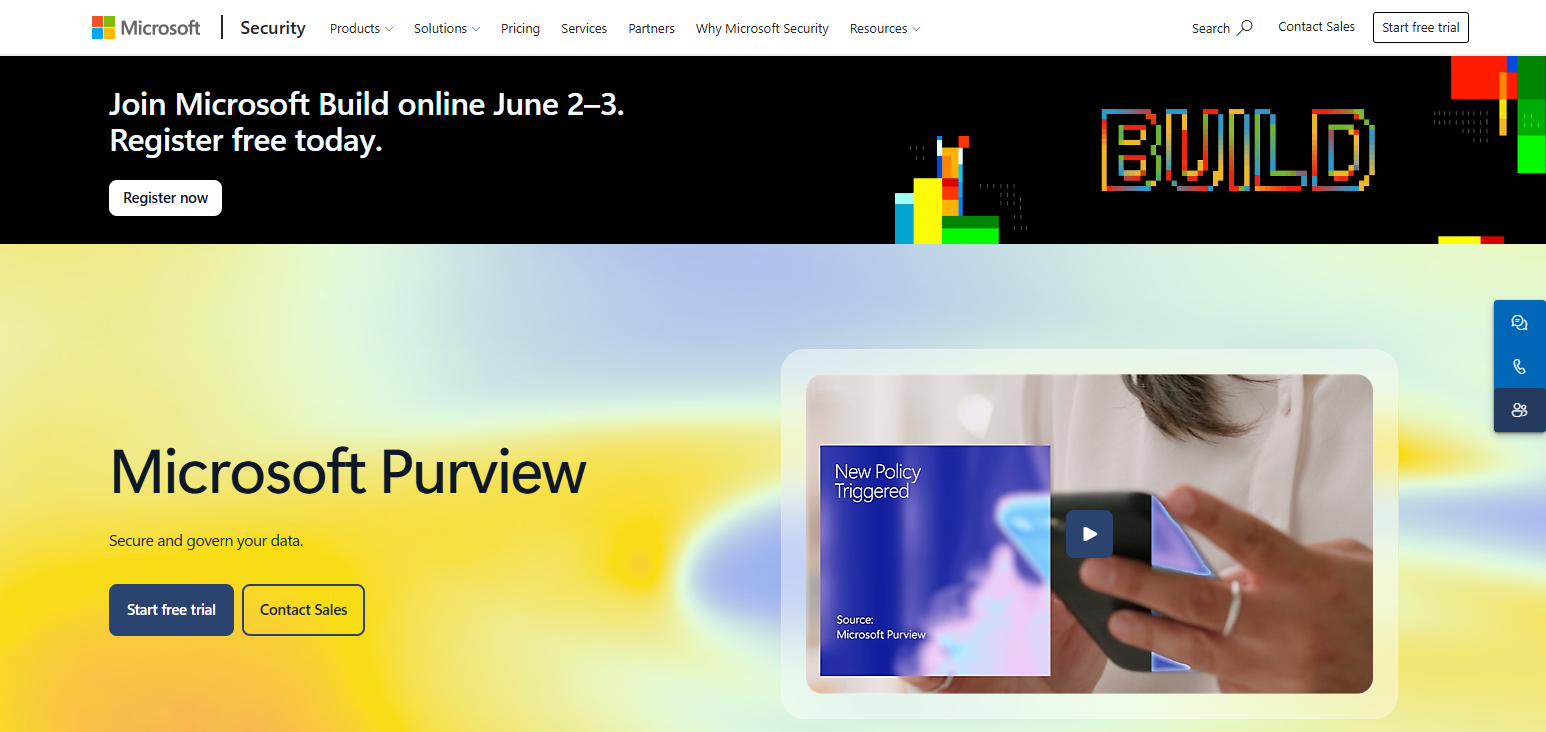
As one of the Best Data Catalog Platforms, Microsoft Purview allows organizations to build a comprehensive data map and gain insights into their data resources.
Microsoft Purview integrates both Microsoft offerings and a variety of third-party data sources. This allows organizations to sustain compliance, build a trust framework of data, and secure data used for both analytics and reporting.
Microsoft Purview Features
- Automated Discovery: Data is discovered and logged automatically by the system.
- Data Classification: Sensitive data can be organized based on level of risk.
- Compliance Tracking: Assists in compliant data practices.
- Metadata Management: Data description and data source mapping is available.
- Data Mapping: Datasets can be related visually to other datasets.
| Pros | Cons |
|---|---|
| Provides unified data governance across cloud environments. | Best suited for organizations using Microsoft ecosystems. |
| Offers automated data discovery and classification features. | Pricing structure can become complex at scale. |
| Supports compliance monitoring and security management. | Requires technical knowledge for complete implementation. |
| Integrates well with Microsoft Azure services. | Some features have learning curve challenges. |
| Helps manage large enterprise data environments efficiently. | Limited functionality outside Microsoft integrations. |
4. Atlan
Atlan’s modern data catalog enables data teams to promote governance and simplify data discovery and collaborative efforts. Users can search through the data, find and track datasets and their relationships, and visualize data ownership.
As one of the Best Data Catalog Platforms, Atlan incorporates automation into the design to promote collaboration between data analysts and engineers, and business users. Additionally, Atlan incorporates data lineage, metadata management, and integration with a vast majority of data tools.
Atlan embraces and improves data culture by breaking down silos. This allows departments to discover and understand data, and promotes effective use of data across the entire organization.
Atlan Features
- Modern Data Discovery: Simplifies search and comprehension of organizational data.
- Workflow Automation: Automated tedious governance and documentation.
- Data Lineage: Shows the data’s interrelations and business process.
- Team Collaboration: Promotes communication of data teams.
- Integration Support: Easily connects to modern data platforms and tools.
| Pros | Cons |
|---|---|
| Provides modern and user-friendly data catalog experience. | May not support very complex legacy systems easily. |
| Simplifies data discovery and collaboration workflows. | Pricing can be high for growing teams. |
| Offers automated metadata and lineage management. | Requires integration setup with existing platforms. |
| Supports modern data stack technologies effectively. | Advanced governance features may need customization. |
| Improves communication between technical and business users. | Limited offline capabilities compared with traditional tools. |
5. Informatica Intelligent Data Management Cloud
Informatica Intelligent Data Management Cloud combines several data management capabilities and features advanced strengths in metadata management, data quality, and governance. The platform helps enterprises manage data irrespective of its source.
Best Data Catalog Platforms such as Informatica improve understanding of data and aid operations by assembling relevant insights using AI.
The platform ensures information is reliable by managing data lineage and classification, as well as providing compliance. Informatica is used by enterprises to build the logical data foundation required for analytics, artificial intelligence, and informed decisions, even in the most complex of environments.
Informatica Intelligent Data Management Cloud Features
- AI-Powered Insights: Employs advanced AI for informed data management.
- Data Quality Management: Enhances the reliability of data used in business.
- Metadata Intelligence: Offers extensive insights into corporate data.
- Data Governance: Manages access to data and upholds compliance.
- Enterprise Integration: Links disparate data systems in enterprises.
| Pros | Cons |
|---|---|
| Provides powerful enterprise data management capabilities. | Higher cost compared with lightweight catalog solutions. |
| Uses AI-driven insights for better data operations. | Implementation requires experienced technical teams. |
| Offers strong data quality and governance features. | Interface can be complex for beginners. |
| Supports multiple enterprise data environments. | Requires significant configuration and customization. |
| Improves compliance and data reliability. | Licensing structure may be difficult to understand. |
6. IBM Knowledge Catalog
IBM Knowledge Catalog combines data governance and cataloging capabilities to help organizations discover, classify, and manage their data assets. It offers solutions for the management of metadata, the monitoring of data quality, and the enforcement of policies.
Best Data Catalog Platforms such as IBM Knowledge Catalog create trusted data ecosystems for organizations by improving the governance and management of data.

The platform endorses AI and analytics by ensuring that users have access to quality data that is properly managed. IBM Knowledge Catalog is an appropriate solution for large organizations as it offers advanced capabilities for governance and the management of security and compliance.
IBM Knowledge Catalog Features
- Data Classification: Automates the identification and classification of sensitive data.
- Policy Management: Implements governance policies for data access.
- Trusted Data Access: Ensures datasets for analytics and AI are founded on trust.
- Metadata Management: Records all data-related activities.
- Data Quality Monitoring: Evaluates the fidelity of data.
| Pros | Cons |
|---|---|
| Provides strong governance and data classification tools. | Requires IBM ecosystem knowledge for better usage. |
| Supports AI and analytics data management. | Setup process can be complicated for organizations. |
| Improves data security and policy enforcement. | Higher investment compared with open-source alternatives. |
| Offers reliable metadata management capabilities. | User interface may require improvement. |
| Helps enterprises maintain trusted data environments. | Some features require additional IBM services. |
7. Oracle Enterprise Data Catalog
Oracle Enterprise Data Catalog is a metadata management tool that allows companies to locate their data assets and understand the data available to their business. The software allows users to map data relationships and discover insights.
Automated metadata harvesting, search functions, and data discovery are all functions included in products such as Oracle Enterprise Data Catalog that are included in the Best Data Catalog Platforms.

The product provides governance support by integrating with Oracle databases and other enterprise applications. Used by companies to strengthen their data, the product also supports compliance and the development of analytics and intelligence initiatives.
Oracle Enterprise Data Catalog Features
- Metadata Harvesting: Automates the harvesting of metadata from all enterprise data.
- Data Search: Simplifies the identification of useful data.
- Asset Management: Facilitates the management of data assets.
- Data Relationship Mapping: Maps associations between data and applications.
- Governance Support: Sustain secure and compliant data environments.
| Pros | Cons |
|---|---|
| Provides effective metadata harvesting capabilities. | Mainly optimized for Oracle-based environments. |
| Helps discover and manage enterprise data assets. | Can be expensive for smaller companies. |
| Supports strong data relationship mapping features. | Requires Oracle expertise for deployment. |
| Improves data visibility across business systems. | Limited flexibility compared with newer platforms. |
| Provides enterprise-grade governance support. | Implementation may require longer deployment time. |
8. Google Cloud Dataplex
Google Cloud Dataplex is a data management and governance platform for cross cloud data which organizes and analyzes data via centralized governance. Cataloging data in compliance with governance policies is a key function of the Best Data Catalog Platforms such as Google Cloud Dataplex.

Automation of metadata management and data quality are functions of this platform. Dataplex is used by companies to construct secure data lakes and governance frameworks so that employees can use verified enterprise data to discover insights more readily.
Google Cloud Dataplex Features
- Data Discovery: Simplifies the identification and access of cloud data.
- Data Governance: Focused control of data in disparate environments.
- Data Quality Monitoring: Assures the integrity and administration of data.
- Analytics Integration: Native integration with Google Cloud analytics.
- Data Lake Management: Effective management of large data stores.
| Pros | Cons |
|---|---|
| Provides scalable cloud-based data management capabilities. | Best experience requires Google Cloud ecosystem usage. |
| Offers centralized governance for distributed data. | Learning curve for new cloud users. |
| Integrates smoothly with Google analytics services. | Limited features outside Google Cloud environments. |
| Supports large-scale data lake management. | Pricing can increase with large data workloads. |
| Improves data discovery and quality monitoring. | Requires cloud expertise for advanced configuration. |
9. AWS Glue Data Catalog
AWS Glue Data Catalog provides businesses with a central repository for their metadata. It reduces the burden of managing metadata for analytics workloads by automatically capturing and storing metadata for many different sources.

Metadata is now more accessible for analysis. Platforms like AWS Glue Data Catalog that appear in the Best Data Catalog Platforms list provide support for data processing and governance and integration with AWS analytics services.
This platform is highly used in cloud infrastructure for data lake management, machine learning, and analytics that deal with data of large volumes and of varied velocity.
AWS Glue Data Catalog Features
- Metadata Repository: Analytics and processing metadata storage.
- Automatic Crawling: Finds new data sources and refreshes catalogs with minimal effort.
- Data Lake Support: Assists in constructing and maintaining flexible data lakes.
- Analytics Compatibility: Integrates with analytics and data science on AWS.
- Schema Storage: Keeps a catalog of structured information for datasets.
| Pros | Cons |
|---|---|
| Provides automatic metadata discovery and management. | Mostly designed for AWS-based environments. |
| Integrates well with AWS analytics services. | Requires AWS knowledge for efficient usage. |
| Supports scalable data lake architectures. | Complex pricing model for beginners. |
| Offers serverless catalog management capabilities. | Limited governance features compared with dedicated platforms. |
| Helps manage large datasets efficiently. | Advanced customization may require coding skills. |
10. DataHub
DataHub is an open-source data catalog and metadata management system offered by the Best Data Catalog Platforms list for data-centric organizations. It is effective for the discovery of data sets, tracking data lineage, and managing data ownership. Platforms like DataHub also offer a vast range of flexibility and integrations to other data technologies.

DataHub enables organizations to design a framework of searchable data assets that reflects data governance and provides a foundation of documented data services for analytics and decision support. Collaboration on data is at the core of what DataHub provides.
DataHub Features
- Flexibility: As a customizable open-source platform, it accommodates diverse needs.
- Metadata Storage: Captures, organizes, and maintains both technical and business metadata.
- Data Lineage: Visualizes the full journey of data across different systems.
- Efficient Search: Quickly locates datasets throughout the enterprise.
- Wide-Range Integrations: Built for compatibility with numerous data systems and frameworks.
| Pros | Cons |
|---|---|
| Provides flexible open-source data catalog capabilities. | Requires technical expertise for deployment and management. |
| Supports extensive customization options. | Maintenance responsibility remains with organizations. |
| Offers strong metadata and lineage tracking. | Enterprise support may require additional services. |
| Integrates with many modern data technologies. | User experience may need technical configuration. |
| Helps organizations build transparent data ecosystems. | Initial setup can be complex for beginners. |
Conclusion
In Conclusion, The Best Data Catalog Platforms allow organizations to utilize their data governance strategies to the fullest. Data Catalog Platforms help increase data quality, aid in collaboration, and provide a clear path for regulated governance.
Metadata and lineage help data catalog platforms meet their goals. Depending on functional/business requirements, the catalog platforms help meet integration needs, scalability, and regulated governance.
The data catalog platforms of today are definitely a step forward and help organizations make the right decisions based on data.
FAQ
Why do businesses use Data Catalog Platforms?
Businesses use data catalog platforms to improve data visibility, maintain quality, enhance collaboration, and make faster data-driven decisions.
What features should a Data Catalog Platform have?
Important features include metadata management, data discovery, data lineage, governance, compliance tracking, search, and integration support.
Which is the best enterprise Data Catalog Platform?
Platforms like Collibra, Alation, Microsoft Purview, and Informatica are popular choices for enterprise-level data governance and management.
How does a Data Catalog improve data governance?
A data catalog improves governance by tracking data ownership, policies, quality standards, and access controls across organizations.