
This article explores the digital identity solutions best suited to allowing users access to cross-border financial services. I focus on systems that are secure, rapid, and compliant.
With the financial services sector going global, identity verification tools are increasingly needed to prevent financial fraud, meet KYC/AML obligations, and to improve the experience of users. I examine the most relevant systems to enable reliable and instant global access.
Key Points & Best Digital Identity Solutions For International Financial Access
| Digital Identity Solution | Key Point |
|---|---|
| Trulioo | Global identity verification across 195+ countries with strong compliance support. |
| Onfido | AI-powered document and biometric checks for seamless onboarding and fraud prevention. |
| Jumio | Real-time ID verification using biometrics and machine learning for financial institutions. |
| IDnow | Video-based and automated identity verification trusted by European banks and fintechs. |
| Socure | Predictive analytics to reduce fraud and improve approval rates in cross-border finance. |
| Veriff | AI-driven identity verification with multilingual support for global financial access. |
| Mitek Systems | Digital identity and mobile capture solutions widely used in banking and payments. |
| Shufti Pro | KYC/AML compliance with biometric verification across 230+ countries and territories. |
| Authenteq | Blockchain-based identity verification enabling secure and decentralized financial access. |
| iDenfy | Affordable identity verification with fraud detection and compliance automation. |
10 Best Digital Identity Solutions For International Financial Access
1. Trulioo
Trulioo is one of the most developed platforms in the world of digital identification verification, helping financial institutions handle compliance and onboarding complications encountered in cross-border transactions.
The firm connects to hundreds of databases in real time, including government files, credit reports, and telecom records, maintaining connections to over 100 countries.
Trulioo’s GlobalGateway product streamlines multi-market KYC and AML compliance while decreasing fraud through the company’s proprietary AI-driven risk assessments.
The platform offers document verification, biometric authentication, business verification, and proof of address, allowing it to serve banks, fintechs, crypto providers, and payment companies. The company’s API is also particularly easy to integrate.
| Pros | Cons |
|---|---|
| Global coverage across 100+ countries with extensive data sources. | Pricing can be expensive for startups and small businesses. |
| Strong compliance with KYC/AML regulations worldwide. | Integration may require technical expertise for full customisation. |
| Supports multiple verification types including KYB, biometrics, and address verification. | Document verification speed can vary depending on region. |
| Highly scalable API suitable for large enterprises and financial institutions. | Limited offline verification support in certain developing regions. |
2. Onfido
Onfido performs AI-based identity verification through biometric facial recognition and document verification.
Companies in financial services are able to verify customers worldwide if they provide ID documents and complete a quick selfie liveness test.
Identity verification in real-time relies on machine learning to identify document alterations and attempts to spoof real identities.

Banks, digital lenders, trading platforms and providers of remittance services are compliant, and because of its coverage and workflows, Onfido has become a leading provider.
Automated onboarding flows facilitate user experience and service frictionless fraud detection. Onfido satisfies international regulatory compliance.
| Pros | Cons |
|---|---|
| AI-powered facial biometrics with strong liveness detection. | Occasional false rejections for low-quality camera inputs. |
| Smooth user onboarding with fast, automated workflows. | Manual review delays may occur during peak times. |
| Excellent for global identity checks with wide document support. | Costs increase with advanced features and add-ons. |
| Strong fraud detection for tampered or synthetic IDs. | Some users report friction for cross-border document types. |
3. Jumio
Jumio is a leader in biometric identity verification and eKYC solutions, enabling global financial access.
Jumio uses a range of technology, including AI, machine learning, and 3D liveness detection to facilitate secure onboarding through document verification, facial biometrics, and risk scoring.
Jumio’s KYX Platform includes continuous monitoring, AML screening, and transaction risk assessment solutions, making it especiallyfits financial institutions with a presence across several countries.
Jumio verifies more than 10,000 types of ID across 200 countries and territories. Its workflows are fully automated, reducing costs and increasing fraud prevention.
Jumio technology arms banks and fintechs with the capacity to onboard customers in a fast, compliant, and scalable manner.
| Pros | Cons |
|---|---|
| 200+ country coverage with thousands of supported ID types. | Higher pricing compared to many competitors. |
| Industry-leading biometric and 3D liveness detection. | Integration can feel complex for new businesses. |
| Fully automated workflow that reduces operational workload. | Strict verification rules may cause false declines. |
| KYX platform supports AML screening and risk scoring. | Requires strong internet connection for smooth verification. |
4. IDnow
IDnow is one of the most advanced entities in the EU and worldwide offering fully compliant (eIDAS, AMLD) fully automated video and document verification, electronic signatures, and secure biometric liveness verification.
They provide secure document verification, fraud detection, and liveness verification using sophisticated AI and Expert document verification teams.
They serve clients in banking, insurance, fintech, and mobility and have enabled clients to operate in new worldwide markets.
Their regulatory innovative identity verification wallet technology. IDnow has secure instant onboarding.
| Pros | Cons |
|---|---|
| Offers both automated and expert-assisted video verification. | Video verification may increase onboarding time. |
| Highly compliant with EU regulations like eIDAS and AMLD. | Strong EU focus; global coverage is improving but still limited. |
| Suitable for banks, insurance, and regulated sectors. | Can be costlier for small companies or startups. |
| Includes e-signatures and identity wallet capabilities. | Process can feel rigid due to strict regulatory adherence. |
5. Socure
When it comes to verifying identities and fraud protection, especially in the financial and fintech sectors, Socure has developed the most sophisticated and global solutions.
Predictive analytics and AI, combined with cross-industry data consortium intelligence, allow Socure to perform highly accurate identity verification in real-time.
International finance, and especially the U.S, has been experiencing a sharp rise in fraud with the creation of synthetic identities, and Socure is aware of this and focuses on it.
The company provides a full suite of continuous fraud detection and verification solutions: fraud verification, cross checking documents, biometrics, KYC and AML, and ongoing monitoring.
The fraud prevention solutions are industry-leading in the rate of automatic approvals, enabling institutions to significantly reduce fraud risk and customer onboarding friction.
With exceptional accuracy and scalability, Socure has been the go to fraud prevention solutions provider for banks, digital wallets, crypto services, and remittance companies.
| Pros | Cons |
|---|---|
| Exceptional accuracy in detecting synthetic identities. | More focused on U.S. and North America than global markets. |
| High auto-approval rates reduce onboarding drop-offs. | Requires large data volumes for optimal performance. |
| Uses predictive analytics and AI for fraud prevention. | Pricing may not suit small or early-stage fintechs. |
| Strong in KYC, AML, and continuous monitoring. | Setup and integration can take longer for complex enterprises. |
6. Veriff
Veriff is a digital identity verification service with the world\’s most comprehensive user base and advanced fraud protection capabilities.
Leveraging AI document verification, facial biometrics, and device fingerprint authentication, Veriff is able to validate customers in real time in over 190 countries.
Veriff s system can detect counterfeit documents, deepfake videos, and spoofing using advanced video analytics.
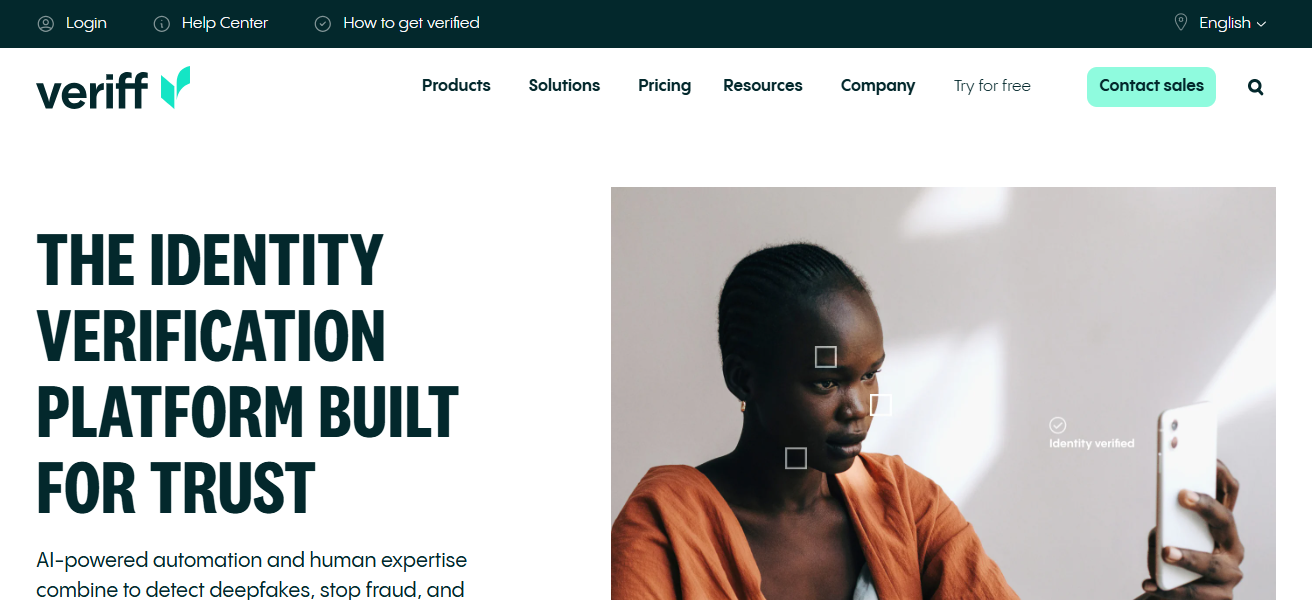
Veriff services banking, gaming, mobility, and crypto service industries. With modifiable workflows, it provides seamless onboarding with KYC and AML requirements.
The platform includes analytics compliance and fraud trend reporting tools. Veriff helps companies to gain new markets by using fraud protection tools.
| Pros | Cons |
|---|---|
| Verifies users in 190+ countries with multi-layered fraud checks. | Pricing is not transparent and can be higher for advanced use cases. |
| Strong deepfake and spoof detection using video analysis. | Verification accuracy can drop with poor lighting or low-quality cameras. |
| Supports gaming, mobility, fintech, and crypto sectors. | Some users report slower reviews during heavy traffic. |
| Customizable KYC workflows for global compliance. | Limited offline or documentless verification methods. |
7. Mitek Systems
Mitek Systems digitized the identity verification process and captured the technology of mobile check capture. They use AI, computer verification, and biometric information for global authentication.
Mitek has advanced verification features that analyzes documents for authenticity and detects forgeries. Advanced Mitek features, such as liveness verification and facial matching, provide comprehensive protection for financial fraud.
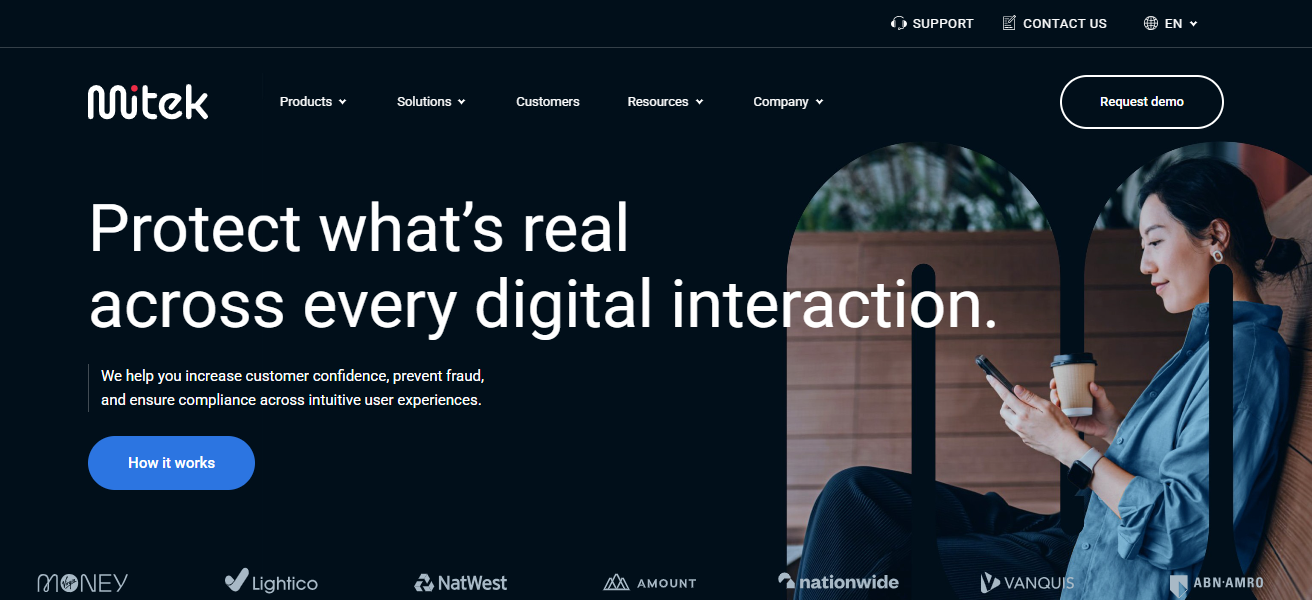
Mitek is the popular choice of numerous global banks, lenders, and compliant fintech companies offering international onboarding services.
Mitek has a special array of orchestration tools to enhance the customer onboarding process, resulting in a reduction of manual customer reviews.
Mitek is a global leader because of its numerous financial services and its rich history in the marketplace.
| Pros | Cons |
|---|---|
| Strong document verification using computer vision and AI. | User experience may feel less modern compared to newer competitors. |
| Trusted by major banks and financial institutions. | Global coverage is good but not as extensive as top leaders. |
| Excellent fraud detection, including tampering and forgery checks. | Setup can be more technical for smaller teams. |
| Mobile check capture and biometrics improve onboarding. | Minimum contract requirements may not fit small companies. |
8. Shufti Pro
Shufti Pro has the greatest global reach for providing identity document verification and is able to authenticate over 10,000 different documents issued in more than 240 countries and territories.
The verification technology in use is AI and machine learning focused and highly accurate in verifying the elements of ID documents, biometrics, facial images, address documents as well as contact numbers.
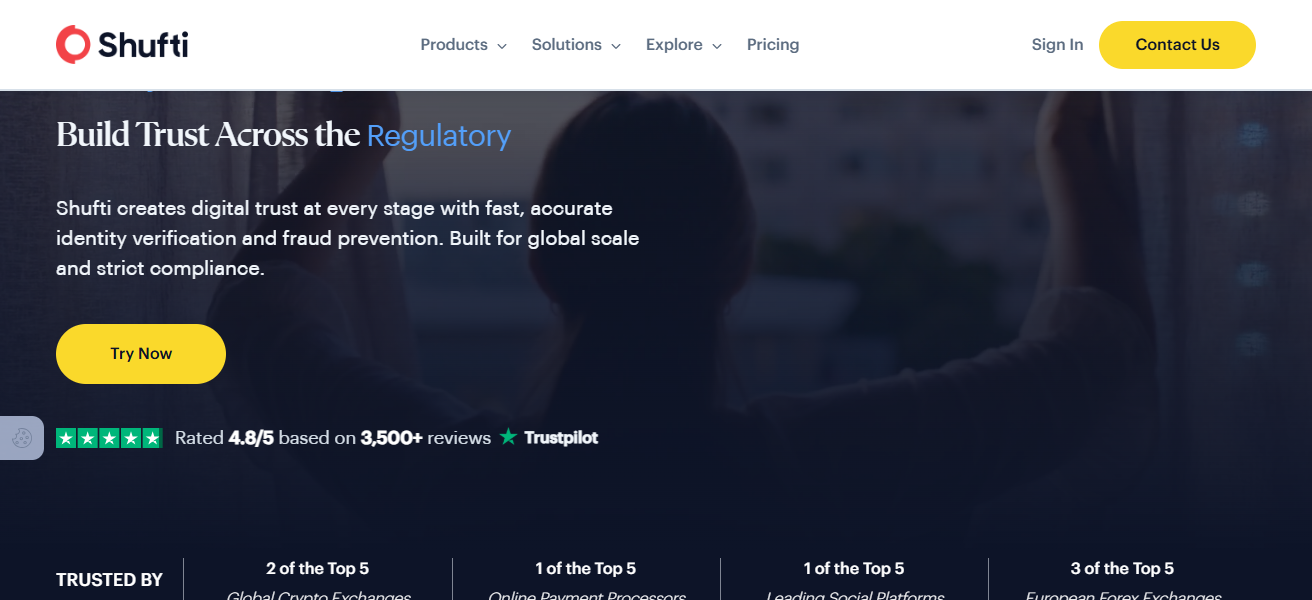
International banks and payment providers, as well as crypto exchanges, and corporations focused on scalable business applications for KYC and anti-money laundering, have come to popularize the use of Shufti Pro.
Their offering includes electronic KYC, Know Your Business, video verification, and sanction search as well. The system is able to provide almost real-time document verification and is highly customizable in its use and support for multiple languages.
The combination of Shufti Pro’s global reach and more than one option for connecting to its services set a very high standard for access to financial services worldwide.
| Pros | Cons |
|---|---|
| Extremely wide coverage—240+ countries and territories. | Automation accuracy can vary for rare or low-quality documents. |
| Supports 10,000+ document types with high-speed verification. | Some users report false positives in AML screening. |
| Offers eKYC, KYB, video KYC, and sanctions checks. | Customer support response time may occasionally lag. |
| Cost-effective with multilingual capabilities. | Requires stable internet for smooth biometric verification. |
9. Authenteq
Authenteq is a company that seeks to automate identity verification in a way that is first and foremost secure.
Providing customers with the tools necessary to authenticate and secure their identity documents is streamlined to a matter of seconds using a digital ID verification platform.
Users are easily able to digitally verify their identity through document verification and biometric recognition and in turn are issued a digitally authentic ID verified.
With authenteq customers will be able to satisfy the requirements of kyc without storing sensitive documents.
Designed for the financial technology industry and online platforms that require rapid and secure document verification.
Authenteq’s decentralized systems ensures that users fraudulently posing as customers are able to access the features of the service. Our focus is on supporting financial technology businesses to provide services internationally.
| Pros | Cons |
|---|---|
| Blockchain-backed identity verification enhances privacy. | Smaller global footprint compared to major competitors. |
| Self-sovereign identity model gives users control. | Not widely adopted across traditional banking institutions. |
| Fast biometric verification completed in seconds. | Limited document type support compared to larger vendors. |
| Reduces data storage risk for businesses due to decentralized IDs. | Integration options are more specialized and less flexible. |
10. iDenfy
iDenfy is a company that offers fully on board digital identity verification services for the financial sector.
Providing banks and other financial institutions with accurate ID verification in seconds is made possible through the use of biometric recognition and document verification of the users ID.
Real time verification with Transaction monitoring and iDenfy’s other services and tools such as fraud analysis offering a complete compliance verification service.
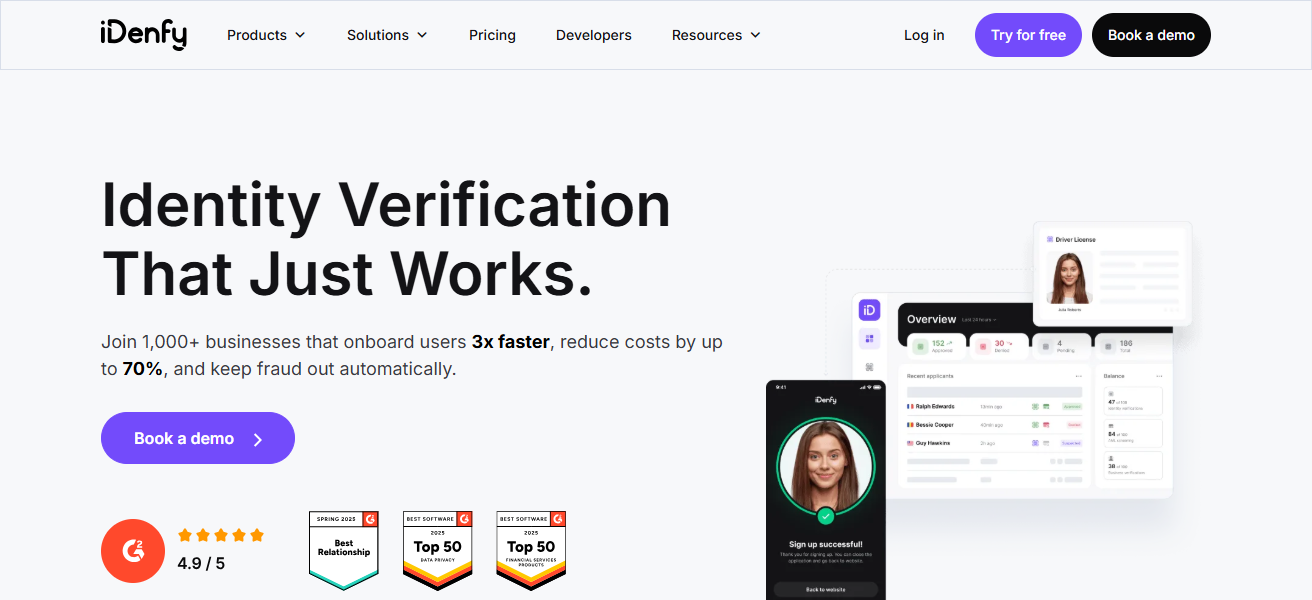
With the ability to service the entire globe using a variety of ID’s allows iDenfy to service a large number of customers.
With the use of a 24/7 anomaly verification service and a high degree of freedom with pricing, iDenfy is able to ensure compliance within the financial industry.
| Pros | Cons |
|---|---|
| Affordable pricing with strong global ID coverage. | Manual review may extend onboarding time in rare cases. |
| Provides real-time verification with biometric facial checks. | Interface is functional but less polished than premium solutions. |
| Includes AML tools, fraud analytics, and transaction monitoring. | Some advanced features require higher-tier plans. |
| 24/7 human review team ensures high accuracy. | Less brand recognition than major global competitors. |
Cocnlsuion
In cocnlsuion The best digital identity solutions for international financial access combine global coverage, advanced biometrics, AI-driven fraud detection, and strong regulatory compliance.
Platforms like Trulioo, Onfido, Jumio, and others help financial institutions onboard users securely across borders.
Their scalability, accuracy, and automation reduce risk, simplify KYC processes, and enable businesses to expand globally with confidence while maintaining seamless user experiences.
FAQ
They are technologies that verify user identities online using biometrics, documents, and databases to prevent fraud and enable secure onboarding.
They ensure compliance with global KYC/AML regulations and allow financial institutions to onboard users from different countries securely.
Trulioo, Jumio, Shufti Pro, and Veriff provide some of the widest international verification coverage.
Socure is highly recognized for its advanced synthetic identity detection capabilities.
Yes, most leading tools like Onfido, Jumio, and iDenfy support facial recognition and liveness checks.