
In this article, I discuss emerging digital loan management systems and how they are changing the way lenders process loans. These systems automate the entire loan lifecycle, from origination and credit assessments to servicing and collections, helping banks
NBFCs, and fintechs boost operational efficiencies, minimize mistakes, maintain compliance, and provide fast and seamless experiences to borrowers in the digital financial ecosystem.
Key Points & Best Digital Loan Management Systems
| Loan Management System | Key Point |
|---|---|
| Roopya LMS | Comprehensive features with strong compliance support |
| M2P Fintech LMS | Scalable solution for co-lending and EV financing |
| LoanPro | Cloud-native platform with advanced automation |
| TurnKey Lender | AI-powered decisioning and loan lifecycle automation |
| Finflux | Affordable SaaS model with microfinance support |
| Temenos Infinity | Enterprise-grade LMS with global compliance |
| nCino | Bank-focused LMS with Salesforce integration |
| CloudBankin | Quick deployment and strong customer experience tools |
| Oradian | Specialized for emerging markets and rural lending |
| FIS Loan Management | Robust servicing and collections management |
10 Best Digital Loan Management Systems
1. Roopya LMS
Roopya LMS is a cutting-edge cloud native digital lending platform which automates the full loan lifecycle for banks, NBFCs, and fintech lenders.
It merges AI-powered decisioning and risk scoring with no-code configuration tools, enabling business users to create and edit loan products without assistance from IT.
Speed is a primary focus for Roopya. Once onboarded, lenders can start servicing their products in a matter of days rather than the months typical of the industry.
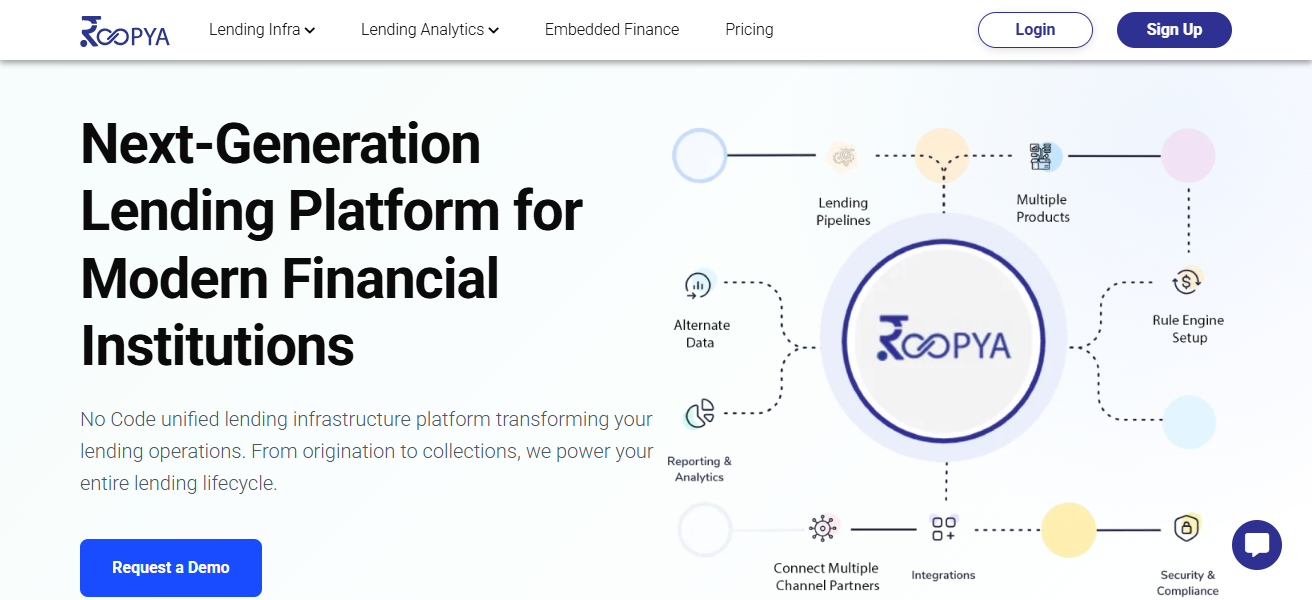
Also, with smart automation, Roopya cuts down on manual errors, improving operational efficiency.
Integrated in a single platform is the automation of origination, underwriting, servicing, collections, and analytics to help lenders scale compliantly and cost efficiently.
Roopya LMS Features
- Cloud-native architecture: Delivers increased scalability and high availability with minimal infrastructure.
- No-code configuration: Empowers business users to create and change loan products without needing IT.
- AI driven decisioning: With credit scoring and automated risk analytics, decisioning speed is increased while errors are decreased.
- End-to-end automation: Consolidates origination, underwriting, servicing, collections, and analytics in a single platform.
| Pros | Cons |
|---|---|
| Cloud-native with fast deployment, allowing lenders to go live in days. | May require initial setup training for non-technical staff. |
| No-code configuration enables quick product modifications. | Limited global presence compared to larger LMS providers. |
| AI-driven decisioning reduces manual errors and improves risk assessment. | Smaller ecosystem of integrations than enterprise LMS platforms. |
| Comprehensive lifecycle management: origination, underwriting, servicing, collections, analytics. | Pricing may be less competitive for smaller lenders. |
| Supports regulatory compliance across multiple jurisdictions. | Advanced AI features might require ongoing optimization. |
2. M2P Fintech LMS
M2P Fintech’s LMS, frequently referred to as Finflux, provides a tailored, loan management software solution with an API-first, flexible lending, and loan against mutual funds and other securities resources.
The software accommodates flexible management and precise lending complex loan products through dynamic interest rate adjustments, real-time credit limit changes, automated collateral and credit risk management, and co-applicant risk management.
This LMS software allows for rapid deployment and scalability and helps lenders streamline their operational management, adjustable repayment, and overdraft management, and compliance with regulatory management (e.g., RBI, SEBI).
Additionally, their full-stack API integrations lessen the need for manual work, increase operational efficiency, and enhance the vertical and horizontal variety of products offered within multiple asset classes.
M2P Fintech LMS Features
- API-first platform: Enables integration with fintech stacks, third-party data providers, and partnered solutions.
- Flexible product configuration: Complex products such as mutual fund-backed loans and co-lending are supported.
- Dynamic risk management: Real-time credit limit adjustments and automation of collateral checks are provided.
- Regulatory compliance: Various compliance frameworks and audit trails are addressed.
| Pros | Cons |
|---|---|
| API-first platform allows easy integration with other systems. | Advanced features may be overwhelming for small teams. |
| Supports complex loan products like mutual fund-backed loans. | Heavily reliant on internet connectivity for full functionality. |
| Dynamic interest and credit limit management improve flexibility. | Customization for niche workflows may need technical support. |
| Regulatory compliance with RBI and SEBI standards. | Some features may require paid add-ons. |
| Scalable architecture suitable for fintechs and NBFCs. | Reporting dashboards can be complex for beginners. |
3. LoanPro
The loan management system from LoanPro is an API-first and adjustable system that integrates origination, servicing, payment, and collection management into a single system. It is built in the cloud, making it scalable and supporting virtually any credit program.
This ranges from line-of-credit and installment products to credit card offerings. It also offers customers extensive data visibility and workflow automation.
LoanPro provides lenders with the tools to improve automation and operational efficiency and to expeditiously introduce new products.
Because of its extensive automation, advanced reporting, and integrations with over 100 data providers, it is unmatched for lenders wanting a modern and adaptive LMS.
LoanPro Features
- Highly configurable workflows: Custom rules for varying loan types and operational processes are supported.
- Deep integrations: Fusing over 100 data partners for identity, credit, payments, and verification.
- Comprehensive servicing: Accounting, payments, collections, rescheduling, and reporting origination are included.
- Cloud-based and scalable: Great for any sized lender with flexible and secure infrastructure.
| Pros | Cons |
|---|---|
| Highly configurable and scalable for various loan types. | Complexity can require onboarding support for new users. |
| API integrations with 100+ data partners for seamless automation. | May be overkill for very small lenders with simple products. |
| Centralized loan origination, servicing, payments, and collections. | Some advanced automation features need setup assistance. |
| Deep data visibility and workflow automation. | Licensing costs could be higher for small-scale lenders. |
| Rapid product launch capabilities with cloud-native infrastructure. | Limited offline support for field operations. |
4. TurnKey Lender
Turnkey lender offers streamlined automation solutions that cover the entire gamut of the lending process from origination and underwriting to serv icing, collections, and reporting.
Using advanced AI, it helps clients build adaptive credit products in a way that they can easily customize loan workflows and risk models with a low code approach.
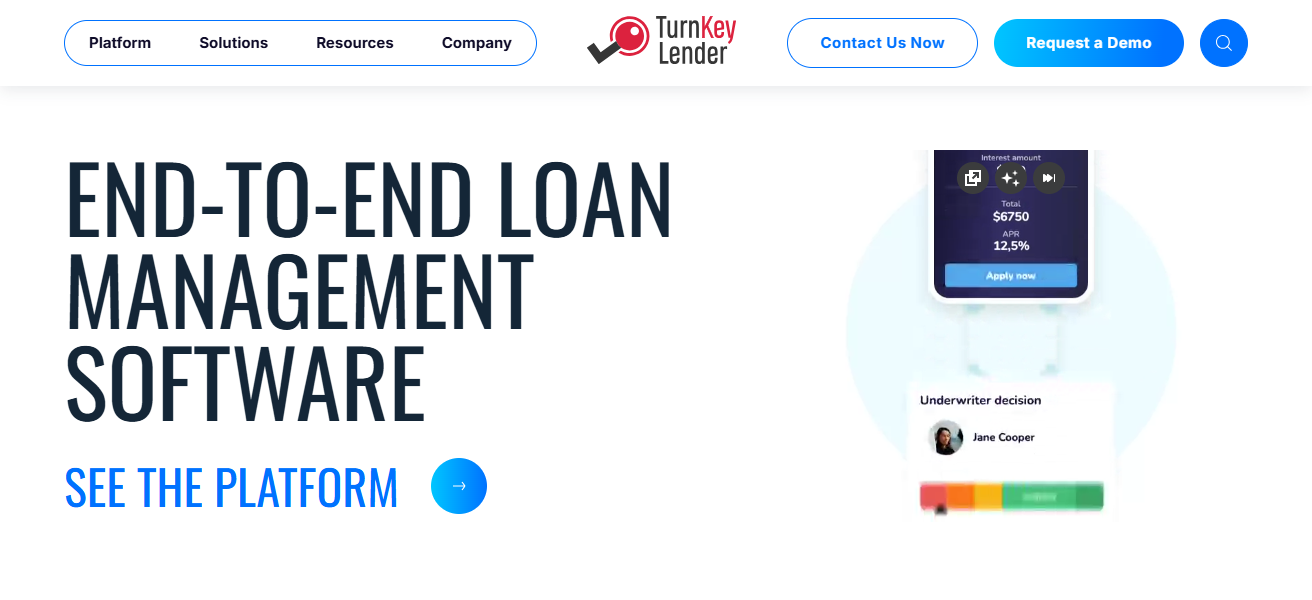
Its automation solutions cover the entire lending life cycle, from digital onboarding, and document management, to real time analytics and reporting.
Its clients enjoy reduced operational costs and pnl improvement. Turnkey Lender’s reporting and automation tools are especially helpful in managing intricate loan portfolios.
TurnKey Lender Features
- AI-powered decision engine: Improves credit evaluation and underwriting precision.
- Full-lifecycle automation: Automates onboarding, servicing, collections, and compliance.
- Configurable product builder: Create tailored loan products with low technical coding requirements.
- Real-time analytics & reporting: Provides dashboards for portfolio performance and risk evaluation.
| Pros | Cons |
|---|---|
| End-to-end loan automation from origination to collections. | Can be expensive for smaller lenders. |
| AI-powered decision engine improves credit risk assessment. | Requires training to leverage advanced AI workflows fully. |
| Configurable credit product builder supports diverse loan types. | Initial configuration can be time-consuming. |
| Real-time analytics and reporting improve operational insights. | Custom integrations may require developer support. |
| Flexible deployment suitable for banks, NBFCs, and fintechs. | Might be heavy for very small institutions with simple portfolios. |
5. Finflux
Finflux is a responsive and adaptable loan management systems that helps lenders to fully digitize and automate their loan servicing processes end-to-end.
It provides users with the ability to track (DPD) delinquent loans (and) NPAs, repayment flexibility, loan restructuring, and integrated reports that help with operational smoothness.

Finflux manages to make automation, operational seamlessness, error-reduction, regulatory compliance, and quick time-to-market all possible at the same time.
Both tech and FinServ diverse institutional barriers become non-existent as custom processes, appropriate settings, and live operational monitors through all loan stages improve productivity.
Lenders, Fintechs, Banks, Micro-Finance, NBFCs, and even more diverse lenders enjoy operational excellence with Finflux.
Finflux Features
- Flexible payment options: EMI, bullet, decreasing balance, and tailored repayment schedules.
- Delinquency & NPA tracking: Oversees aged debts and automates subsequent actions.
- Custom workflows: Facilitates unique processes from origination to portfolio management.
- Insightful reporting: Provides real-time analytics and reports for regulatory compliance
| Pros | Cons |
|---|---|
| Flexible repayment schemes and loan restructuring options. | May require technical expertise for advanced configuration. |
| Robust NPA and delinquency tracking for risk management. | Integration with legacy systems can be complex. |
| Real-time insights across loan lifecycle improve decision-making. | Smaller global footprint compared to enterprise LMS. |
| Supports diverse financial institutions: banks, NBFCs, microfinance, fintechs. | Advanced analytics may require training. |
| Scalable architecture enables rapid growth and product launch. | Some features may be subscription-based with extra cost. |
6. Temenos Infinity
Temenos Infinity is integrated into the Temenos digital banking suite and provides end-to-end lifecycle support for lending and account servicing.
With the help of Temenos digital banking suite, banks can automate and maintain compliance with the evolving regulations for origination, decisions, and approvals for collections management.

Temenos’s platform boasts tailored data-driven decisioning and analytics for individual institutions, incorporating data and risk management to improve operational efficiency and customer experience.
The Infinity ecosystem fosters deep integration with core banking systems for ultimate customizability, ensuring financial institutions of all sizes can deliver fully compliant loan journeys tailored to requirements in retail and corporate lending.
Temenos Infinity Features
- End-to-end loan lifecycle: Digital origination, credit decision, approval, and servicing.
- Data-driven analytics: Embedded analytics for risk assessment and customer behavior.
- Core banking integration: Smoothly integrates with existing core systems for streamlined operations.
- Customer experience: Aimed for tailored, omnichannel and personal interactions with borrowers.
| Pros | Cons |
|---|---|
| End-to-end lifecycle support for retail and corporate lending. | Higher cost may deter smaller lenders. |
| Data-driven decisioning and analytics enhance risk management. | Complexity may require specialized IT support. |
| Deep customization and integration with core banking systems. | Implementation timelines may be longer for large institutions. |
| Supports regulatory compliance and personalized borrower journeys. | May be more suited for banks than fintech startups. |
| Scalable platform for diverse lending needs. | Advanced modules can be expensive to license. |
7. nCino
The nCino platform is a global lending and banking system designed to streamline and simplify the front to back loan processes.
The platform runs on the cloud and a centralized banking system. The system generates a complete and integrated view of client/customer data and process
flows to support and enhance the efficiency of front end tasks such as onboarding and loan servicing; as well as backend processes.
NCino decreases the volume of repetitive tasks that need to be completed, and supports (in manual vs automated) the analytics decision, regulatory risk compliance, and improves customers/potential customers.
The system is designed for a wide range of lending products including commercial and consumer loans. The platform is best suited for mid-large sized banks and credit unions.
nCino Features
- Unified platform: Combines CRM, loan origination, and servicing into one platform.
- Automation of manual tasks: Less mistakes and faster customer onboarding and approvals.
- Embedded analytics: Built-in analytics and data visualization tools for reporting and portfolio management.
- Scalable cloud infrastructure: Growth support with secure and flexible cloud deployment options.
| Pros | Cons |
|---|---|
| Centralizes front-to-back loan processes for efficiency. | Best suited for mid-to-large banks; small lenders may find it complex. |
| Integrated CRM for enhanced customer data and workflow management. | Requires dedicated IT support for full configuration. |
| Automates manual tasks and optimizes compliance. | Implementation can be lengthy. |
| Supports commercial, consumer, and corporate lending. | High licensing cost for smaller institutions. |
| Open API ecosystem for integration and scalability. | Some advanced analytics features may need expert usage. |
8. CloudBankin
CloudBankin’s LMS is a comprehensive scalable solution for lenders that supports the entire loan lifecycle from onboarding and underwriting, throughout disbursement, repayment, and even NPA tracking.
Built on a fully configurable and cloud-native architecture, the platform’s embedded loan management tools allow for flexible interest calculation, varied repayment structures and schedules, customized EMI plans, loan rescheduling, and co-lending options.
With sophisticated operational analytics, automated operational alerts, compliance audit trails, and comprehensive reporting, CloudBankin enables lenders to enhance efficiency and satisfaction.
The platform’s architecture ensures seamless scalability, coupled with low-code capabilities for lenders to quickly and transparently introduce new loan products, while keeping tight control over servicing loans and managing the portfolio.
Oradian Features
- Core banking + LMS: Integrated loan management and complete core banking functionality.
- Real time data access: Loan portfolio and operations insights in real time.
- Modular architecture: Allows lenders to select and purchase only the modules they need.
- RESTful API support: Simplifies the integration of external analytics and payment tools.
| Pros | Cons |
|---|---|
| Digitizes end-to-end loan lifecycle, including NPA tracking. | May need customization for very specific workflows. |
| Highly configurable system with flexible interest calculations. | Limited international adoption outside select regions. |
| Supports EMI structures, co-lending, and loan rescheduling. | Advanced reporting may require training. |
| Low-code platform allows rapid product launches. | Integration with legacy systems may take effort. |
| Automated alerts, audit trails, and compliance support. | Full features may require higher subscription tiers. |
9. Oradian
Lenders in expansive and evolving markets can make use of Oradian’s cloud-based core banking and loan management systems. Its LMS digitizes workflows and Maintain process optimization and lessen the manual work. Employees can work better when data is available in real-time.
Oradian’s system captures and retains all information about a loan and process approvals. Customers can optimize and automate manual processes.

The modular design and RESTful APIs provide seamless integration with third-party systems. This gives lenders greater flexibility and the ability to scale their systems and configure workflows to their individual needs.
Oradian Features
- Core banking + LMS: Integrated loan management and complete core banking functionality.
- Real time data access: Loan portfolio and operations insights in real time.
- Modular architecture: Allows lenders to select and purchase only the modules they need.
- RESTful API support: Simplifies the integration of external analytics and payment tools.
| Pros | Cons |
|---|---|
| Cloud-based LMS designed for emerging markets and dynamic environments. | Might lack some advanced features of enterprise LMS. |
| Automates workflows from onboarding to collections. | May need internet access for real-time functionality. |
| Real-time data accessibility improves decision-making. | Smaller ecosystem of integrations compared to global players. |
| Modular architecture allows scalable and flexible deployments. | Some analytics features may be less sophisticated. |
| RESTful API support for easy integration with other systems. | Training required to maximize workflow automation. |
10. FIS Loan Management
FIS (Fidelity National Information Services) provides a variety of enterprise-level lending management and servicing technologies, particularly the mortgage and commercial lending markets
That automate and consolidate the management of loans and processes including risk assessment, default management, and compliance reporting.
Its solutions support the entire loan life cycle, spanning origination, servicing, payment processing, and investor reporting across the mortgage and commercial lending markets.
FIS’s platforms cater to large financial institutions that demand high-volume processing with operational efficiencies, deep automation, customizable workflows, and integrated risk analytics.
FIS also creates digital lending solutions for SMBs as well as cloud-native SaaS loan management systems designed to help lenders scale and streamline operations across various loan products.
FIS Loan Management Features
- Enterprise grade performance: Designed for high-volume lending, especially commercial and mortgage.
- Risk & compliance automation: Automated reporting for audits, defaults, and regulatory compliance.
- Full servicing suite: Origination, servicing, payment processing, and investor reporting.
- Customizable workflows: Incorporation of advanced rule-based systems and organizational business logi
| Pros | Cons |
|---|---|
| Enterprise-grade solution ideal for mortgage and commercial lending. | Expensive, mostly suitable for large banks and lenders. |
| Automates risk management, default handling, and compliance reporting. | Complex setup may require IT consulting. |
| Supports full loan lifecycle: origination, servicing, and reporting. | Less suitable for microfinance or small fintechs. |
| High-volume operational efficiency with customizable workflows. | Deployment and onboarding timelines can be long. |
| Cloud-native SaaS options available for scalable digital lending. | Smaller lenders may not fully utilize all features. |
Conclusion
To sum up, top Digital Loan Management Systems optimize the lending cycle from origination to collections while managing compliance, risk, and other potential issues.
Systems such as Roopya, M2P Fintech, and LoanPro help banks, NBFCs, fintechs optimize scalability, automation, and other cutting-edge analytics to improve operational efficiency, speed up approvals, and provide a superior experience to borrowers in the digital lending arena.
FAQ
LMS platforms streamline operations, reduce manual errors, ensure compliance, enhance risk management, boost scalability, and deliver faster loan processing for borrowers and institutions alike.
Banks, NBFCs, fintech lenders, credit unions, microfinance institutions, and any financial organization that offers loans or credit products.
Core features include digital origination, credit decisioning, flexible product configuration, automated servicing, risk scoring, collections, analytics, and compliance reporting.
Cloud LMS offers scalability, reduced IT costs, faster deployment, remote access, automatic updates, and improved data security.
By offering digital applications, faster approvals, real‑time status updates, flexible repayment options, and simplified communication throughout the loan lifecycle.