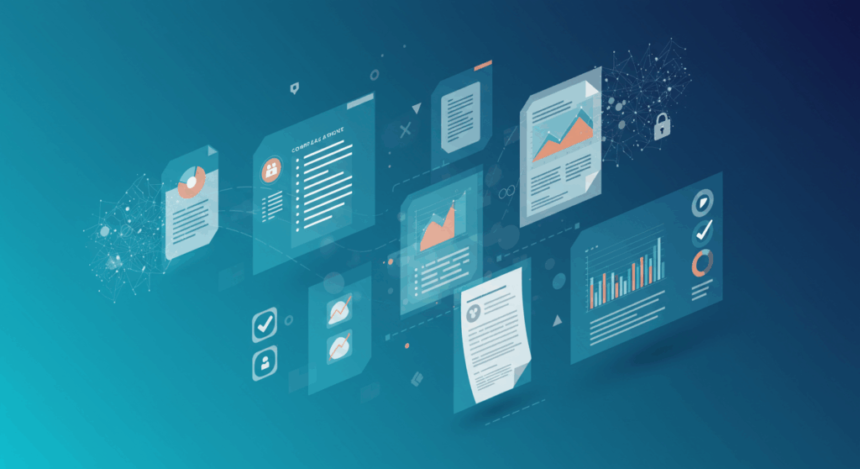
I’m going to write about the Best Digital Trust Management Platforms. This will help organizations achieve compliance, data privacy, and risk management.
Automation of audits, security control monitoring, and vendor and internal risk management help companies to establish compliance to customer trust.
Regulatory compliance and operational security is essential in today’s digital world, which makes choosing the right platform very important.
Key Points & Best Digital Trust Management Platforms
| Platform | Key Point |
|---|---|
| Drata | Automates governance, risk, and compliance with continuous monitoring |
| Sift | AI-powered fraud detection across customer journeys |
| OneTrust | Comprehensive privacy, ethics, and compliance management |
| TrustArc | GDPR and global privacy compliance automation |
| Vanta | Streamlined SOC 2 and ISO 27001 audit readiness |
| Securiti | Data governance with AI-driven privacy intelligence |
| LogicGate | Risk cloud platform for enterprise resilience |
| CyberGRX | Third-party cyber risk exchange and assessment |
| Convercent by OneTrust | Ethics and compliance reporting with whistleblower protection |
| Hyperproof | Collaboration-focused compliance operations management |
10 Best Digital Trust Management Platforms
1. Drata
Drata automates governance, risk, and compliance (GRC) workflows by continuously monitoring security controls and gathering evidence for standards such as SOC 2, ISO 27001 and HIPAA.
Its AI-native platform leverages real-time control testing, prioritization of risks, and a centralized Trust Center that helps teams show compliance to auditors and customers.
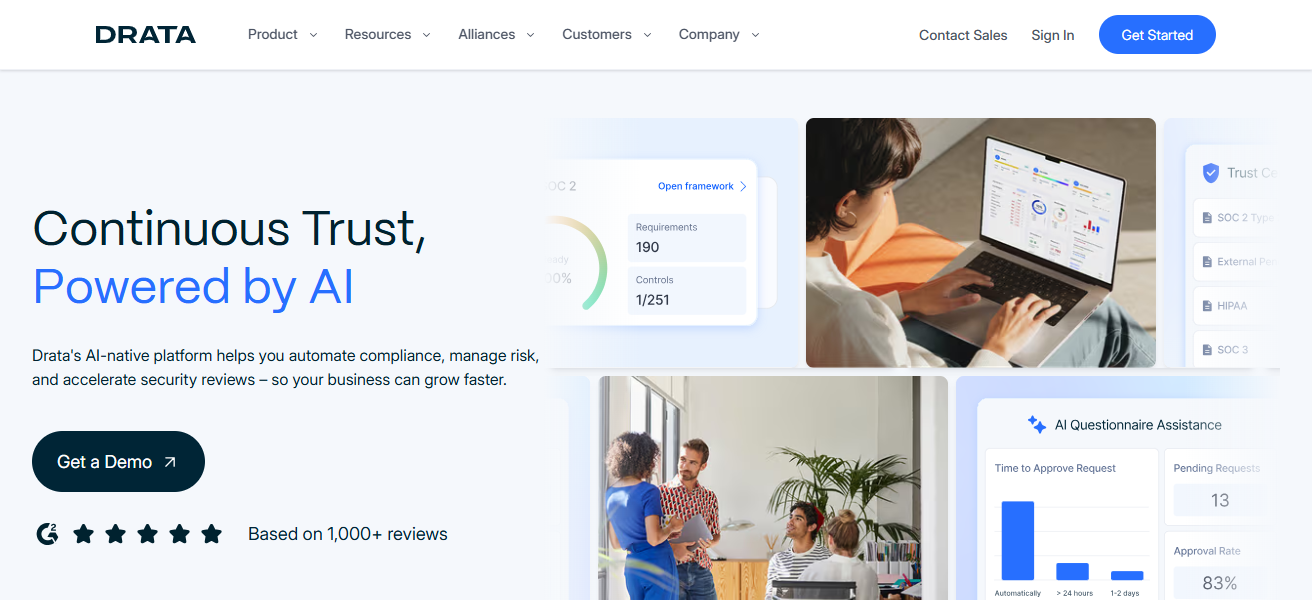
Drata converts traditionally manual audit tasks into automated processes, saving time and improving audit readiness.
These processes enable teams to gain visibility into the automated audit processes and their risk posture.
Features Drata
Automated Compliance Monitoring System: Drata automatically monitors and accumulates evidence of your security posture across systems to ensure ongoing compliance with SOC 2 and ISO 27001 and other standards.
Control Library: Provides pre-mapped controls to the most commonly used frameworks for easier and less manual configuration.
Real-Time Compliance Visualization: Provides a visualization of the compliance posture and indicates which areas require remediation.
Exportable Evidence Collection for Audit Support: Answer third-party audits more quickly by auto-generating evidence of compliance for audits.
| Pros | Cons |
|---|---|
| Automates continuous compliance monitoring and evidence collection for frameworks like SOC 2, ISO 27001 and HIPAA, saving audit time and effort | Pricing may be high for smaller teams, and value can vary with organizational size. |
| Integrates with many cloud and identity tools, enabling real‑time compliance visibility and reducing manual processes | Automation focus can limit advanced business process features beyond compliance tasks. |
| Audit‑ready reporting, control libraries, and issue tracking help maintain posture and share trust externally. | Some features may require configuration or learning to align with complex workflows |
2. Sift
Sift aids in the recognition and mitigation of digital fraud and abuse through the use of artificial intelligence to observe and analyze user interactions and transacts in real time.
Sift fosters trust by being able to recognize deviations and prevent fraudulent account creation, payment fraud, and abuse of promotion before they become operationally damaging.
Sift’s adaptive risk scoring enables the protection of customers and revenue by not hindering the movement of authentic customers, making it a vital tool in employed by corporations fully integrated with their digital services for safe and scalable fraud management.
Features Sift
Fraud Detection Engine: Sift uses a machine-learning strategy to monitor activity and identify abuse (e.g., abusive accounts, chargebacks) and other fraudulent behavior in real-time.
Dynamic Risk Scoring: Provides adaptive trust scores to users and transactions, enabling more informed risk management.
Custom Rule Builder: Allows teams to generate tailored rules that automatically flag and/or block users.
Commerce and Payments Integration: Sift for Risk Management incorporates eCommerce, payments, and identity systems to mitigate risk.
| Pros | Cons |
|---|---|
| Strong real‑time fraud and abuse detection with ML‑driven risk scores and customizable rules, improving trust and reducing losses | Implementation and setup can be complex, requiring expertise to tune rules and workflows. |
| Intuitive dashboards and detailed documentation make it easier for teams to monitor patterns and adjust prevention strategies. | Some users report false positives and occasional lost data during export or reporting tasks. |
| Integrates well with payment and fraud ecosystems to support business‑specific trust decisions. | Cost and licensing structure may be a barrier for smaller or lean teams. |
3. OneTrust
OneTrust is a privacy, security, and governance platform that assists organizations in building trust in their data practices and staying compliant with international data protection laws.
It helps with data mapping, vendor risk assessments, consent management, compliance reporting, and it also supports several risk and security management frameworks.
The modular nature of OneTrust allows organizations to build upon it as necessary, providing regulatory insights to simplify compliance and improve operational visibility while automating the workflows of the processes.
Features OneTrust
Privacy Management Suite: Consolidates data mapping, consent, and policy management with privacy compliance policies to ensure the privacy of your data.
Risk & Vendor Assessment Tools: Assessing third-party risk and tracking compliance by a third party is the Risk & Vendor Assessment Tools function.
Governance Frameworks: Governance Frameworks support the compliance standards and regulations including the GDPR, CCPA, and other industry specifications.
Cross-Module Dashboard & Reporting: Providing integrated dashboards in reporting is the Cross-Module Dashboard & Reporting function.
| Pros | Cons |
|---|---|
| Comprehensive trust platform covering privacy, risk, compliance, and governance with broad regulatory support. | Can be resource‑intensive to implement and maintain due to its complexity and breadth. |
| Centralized dashboards, data mapping, vendor risk tools, and policy management improve program visibility. | Learning curve is steep and UI may feel overwhelming for new users without dedicated training |
| Flexible modular suite allows organizations to scale and tailor governance programs. | May lack advanced AI automation features for some compliance workflows compared to specialized tools. |
4. TrustArc
TrustArc helps organizations strengthen their data governance by navigating data privacy complexities and global regulations compliance.
With TrustArc’s all-in-one solution, organizations automate data mapping, risk assessment, cookie consent, and other privacy workflow tasks. TrustArc enhances these tools with predictive artificial intelligence data and regulatory insight.
Rather than compliance being a multi-step manual workflow, organizations use TrustArc’s tools to construct their compliance program as a strategic asset, thereby enhancing stakeholder trust.
Features TrustArc
Privacy Risk Assessment: Assessing the risk of privacy from the flow of data and risk of compliance of the organization is conducted by assessing Privacy Risk Assessment.
Consent & Preference Management: User consent and preference management is a function of the digital interface.
Regulatory Intelligence: Regulatory Intelligence provides information and a revision of the privacy regulations and laws that continuously changes.
Data Inventory & Mapping: Mapping where personal data is stored and the data can assist to conduct risk management and compliance.
| Pros | Cons |
|---|---|
| Strong privacy compliance support with consent management, data inventory, and PIA/DPIA tools. | User experience can be complex with a steep learning curve for some workflows. |
| Proactive regulatory coverage and a large resource inventory support evolving legal requirements. | Pricing plans lack transparency and may be less flexible for smaller businesses |
| Good choice for global businesses needing structured privacy risk assessment | Integration breadth may be limited compared to some competitors. |
5. Vanta
Vanta has created a trust management platform that helps automate security and compliance monitoring. That automates security and compliance monitoring allows companies to continously show readiness for frameworks like SOC 2 and ISO 27001.
Vanta centralizes security posture visiblity, cuts down on manual evidence collection, and helps collect evidence to monitor and track risks across systems and vendors.
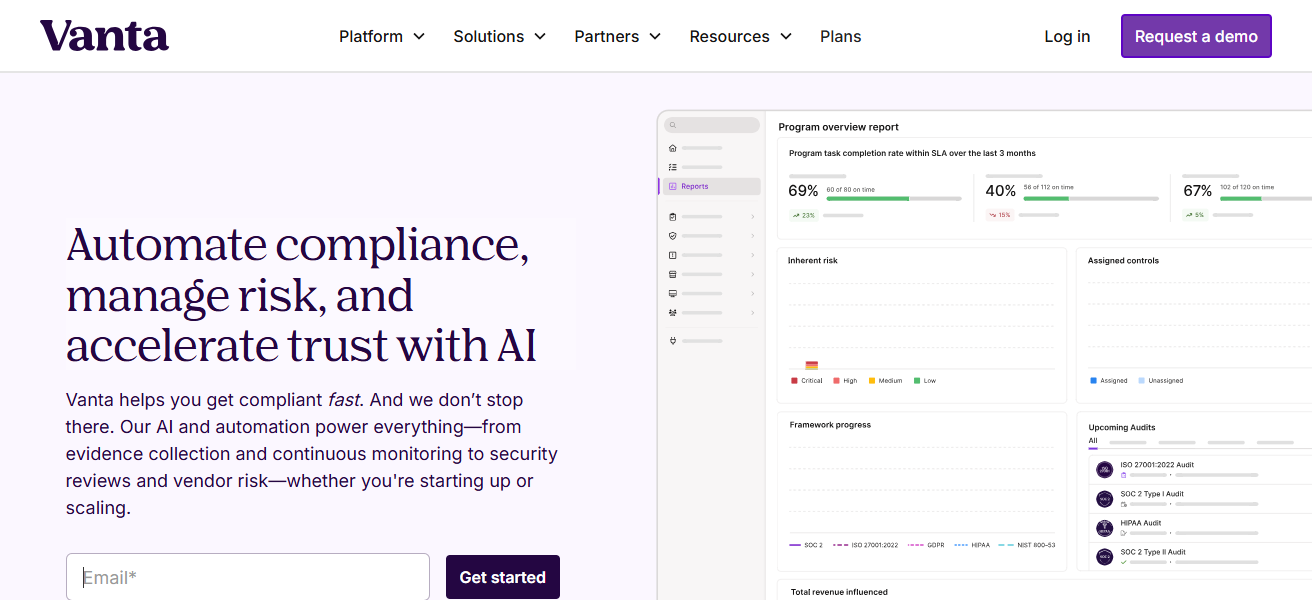
Vanta helps companies move compliance processes to a place where they can spend a lot less time on issues, and more reliability focus on audits and customer trust initiatives. Vanta’s evidice collection helps prepare audits and accomplish compliance more efficiently.
Features Vanta
Continuous Security Monitoring: Monitoring the systems and policies continuously to identify lack of behavioral compliance.
Automated Evidence Collection: Evidence in the form of data, so logs and acts, is collected automatically without manual tracking intervention for audit purposes.
Multi-Framework Support: Supporting frameworks covering SOC 2, ISO 27001, HIPAA, PCI, among others.
Risk & Issue Tracking: Security gaps are identified and track by Risk & Issue Tracking providing specific and actionable remediative workflows.
| Pros | Cons |
|---|---|
| Automated compliance checks, real‑time monitoring, and reporting simplify audit readiness across many frameworks. | Pricing and licensing can be expensive and unclear for smaller organizations. |
| Intuitive UI with broad integrations and a trust center enhances visibility across teams. | Some integrations and customization options may lack depth. |
| Strong user experience and streamlined compliance processes increase operational efficiency. | Limited customization for complex, enterprise‑specific use cases |
6. Securiti
Securiti’s Data Command Center integrates the multifaceted realms of data security, data governance, data privacy, and data compliance, enabling the confident utilization of data and AI
Across hybrid multicloud infrastructures, and providing the ability to foster data democracy and AI across enterprise environments.
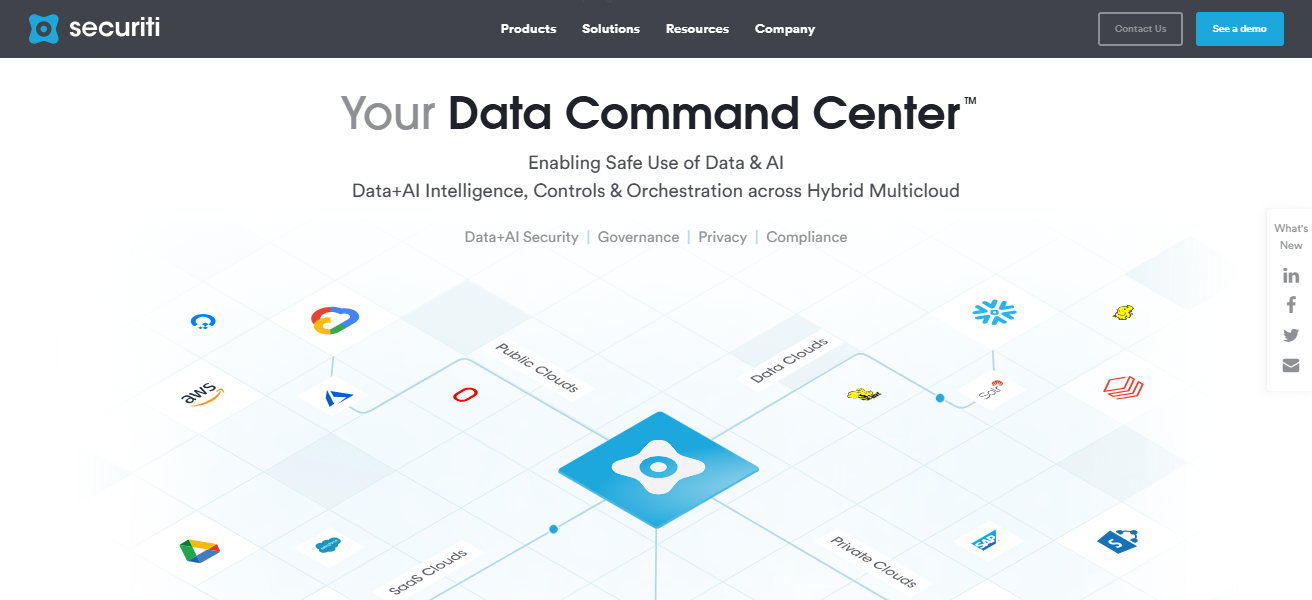
Data Command Center also enhances the ability to discover, classify, govern accesses, automate compliance, and provide AI governance to help enterprises maintain the scale of protecting sensitive data.
Organizations can determine least-privilege access, automate privacy and operational compliance, and maintain safety and compliance
Features Securiti
Data Discovery & Classification: Labeling and separating sensitive data in the cloud, on-premise, and SaaS environments.2. Access Governance – Automates review and enforcement of least privilege access policies.
Privacy Automation – Handles DSARs and assists in privacy compliance and consent management at scale.
AI Powered Insights – Identifies enhancements to data risk scoring and governance recommendations through machine learning.
| Pros | Cons |
|---|---|
| AI‑driven data governance, privacy automation, and risk scoring help reduce manual compliance tasks. | Can be perceived as complex with a learning curve for some users. |
| Good integration and feature breadth support compliance, access governance, and risk monitoring | Some reviewers report limitations in certain advanced features and data management challenges. |
| Helpful customer support and functionality to manage data protection tasks | Implementation may be challenging without experienced staff. |
7. LogicGate
LogicGate’s Risk Cloud represents the completeGRC with the ability to streamline the identification, assessment, and mitigation of risk and the organization’s ability to visualize and respond to threats.
LogicGate provides automation of work flows, risk data integration, and aids in the visualization of threats through dashboards in the fields of cyber security, compliance, and enterprise risk.
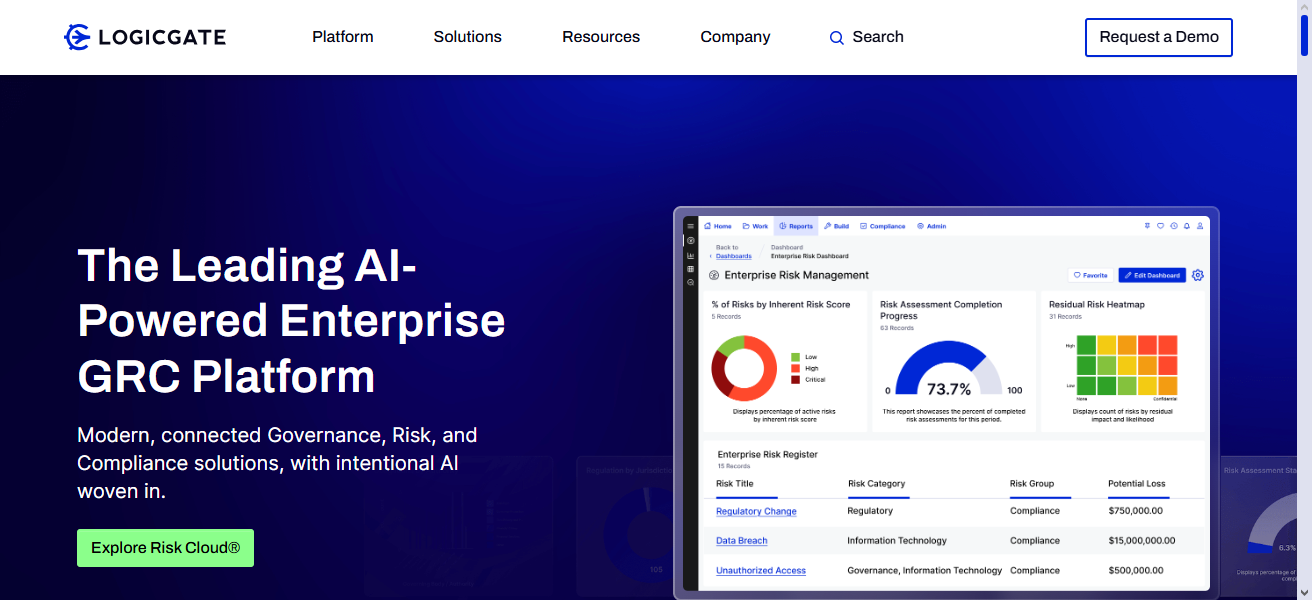
LogicGate is valuable to both technical and non technical stakeholders to enhance governance and operational resilience.
Features LogicGate
Custom Risk Workflows – File a workflow that meets specific requirements in governance using a drag and drop configurator.
Risk & Control Libraries – Advanced risk programs templates allow users to bypass some of the advanced initiatives.
Real Time Dashboards – Risk exposures, mitigations, and compliance statuses can be monitored in one location.
Integration Hub – Moves risk data to external systems for analysis.
| Pros | Cons |
|---|---|
| Highly customizable GRC workflows and no‑code risk models adaptable to unique business needs. | Initial configuration and learning curve can be significant, particularly for new users. |
| Supports enterprise‑level risk, audit, and third‑party management with real‑time reporting. | Flexibility can lead to over‑customization and ongoing maintenance. |
| Strong integration ecosystem and customer support enhance usability and adoption. | Advanced analytics and reporting sometimes require additional configuration or tools. |
8. CyberGRX
CyberGRX, through its global cyber risk exchange, focuses on third-party cyber risk management by providing standardized risk data and advanced analytical capabilities.
It assists organizations in assessing, monitoring, and dynamically prioritizing vendor security risk through predictive insights and extensive datasets of vendor evaluations.
CyberGRX allows organizations to minimize manual vendor risk efforts, strengthen collaboration across systems, and enhance vendor risk visibility, which is crucial due to the increasing interdependence on external partners and supply chains.
Features CyberGRX
3rd Party Risk Exchange – Assessment duplication is diminished through the combined cyber risk dataset from multiple enterprises.
Standardized Assessments – Structured questionnaires allow for consistent benchmarking of vendors.
Actionable Analytics – Insights based on vendor performance and threats to support risk prioritization.
Centralized Vendor Profiles – Vendor risk and status can be viewed in one location for streamlined decision making.
| Pros | Cons |
|---|---|
| Focused on third‑party risk intelligence with shared assessment data to improve vendor security visibility | Specialized scope may require complementing tools for broader internal risk or compliance needs. |
| Streamlines third‑party assessments, reducing manual questionnaires and vendor burden. | Detailed comparison coverage suggests the need for additional features |
9. Convercent by OneTrust
Convercent equips companies with compliance and ethics software that incorporates the trust management component by assisting firms in establishing and sustaining an ethical culture and supervision of compliance-related risks.
The software provides whistleblower management, policy management, disclosure management, training management, and analytical management and has ancillary third-party risk management extensions in the OneTrust privacy and governance ecosystem.
Convercent provides information on organizational risk and behavioral transparency ensuring ethical conduct and compliance, supporting business practitioners with tools to conduct ethical oversight.
Features Convercent by OneTrust
Ethics & Compliance Case Management – Management of compliance and whistleblower reports is tracked.
Policy & Training Tools – Facilitates policy distribution and completion tracking for mandated training.
Disclosure & Conflict Tools – Provides an automated mechanism for employees to disclose gifts and conflicts of interest in line with the policy.
Integration with Governance Tools – Provided with OneTrust for all the additional compliance and privacy governance.
| Pros | Cons |
|---|---|
| Strong focus on ethics, compliance programs, policy management, and case reporting. | Not a full GRC suite — best used within the broader OneTrust ecosystem. |
| Helps drive organizational ethical culture and manage disclosures/training effectively | Limited standalone advanced governance/risk analytics without OneTrust integration. |
10. Hyperproof
Hyperproof is an artificial-intelligence-activated GRC system that helps teams optimize compliance processes, manage risks, and create automation control mapping and evidence management systems that foster organizational trust.
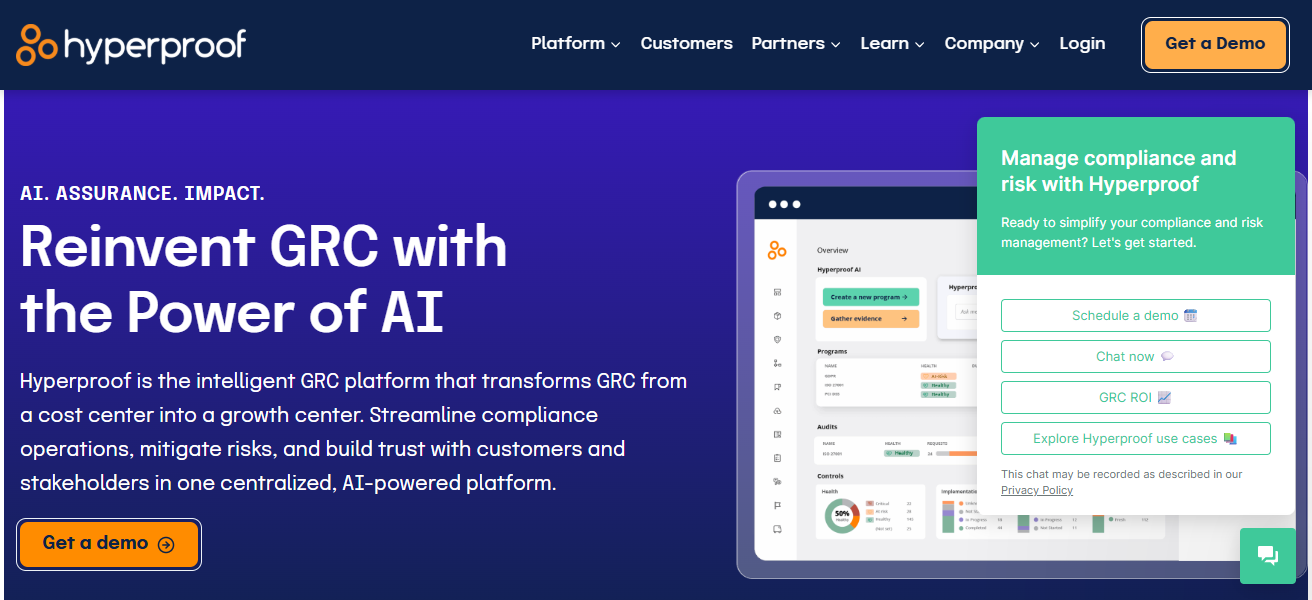
It centralizes where policies, risks, audits, and vendor assessments live in one platform to eliminate duplicate efforts and give stakeholders visibility.
Hyperproof’s continuous monitoring and reporting helps to convert manual compliance processes into efficient, auditable workflows, which helps accelerate audits and improve communication between the risk, security, and business teams.
Features Hyperproof
Evidence & Control Tracking – Single source of the truth for the evidence of compliance control.
Automated Alerts & Monitoring – Identifies issues or evidence gaps that should be addressed.
Framework Support Library – Preformatted document to support compliance with SOC 2, PCI, ISO, GDP, and others.
Collaboration Workflows – Provides inter-team task allocation and progress tracking for effective collaboration to support audit readiness.
| Pros | Cons |
|---|---|
| Centralizes compliance evidence, control mapping, and continuous monitoring across multiple frameworks | Setup complexity can be high for teams unfamiliar with structured compliance platforms |
| Good collaboration features and integrations help coordinate tasks across teams | Some users report limited advanced enterprise‑level features compared to larger GRC suites. |
| Scalable for regulated startups and growing businesses seeking audit readiness automation. | May lack deep automation tools found in larger compliance ecosystems. |
How To Choose Best Digital Trust Management Platforms
Understanding of Goals Select what is most important to you: compliance automation, privacy governance, fraud protection, or vendor risk.
Frameworks Confirm that the Platform is able to meet Standard(s): SOC 2, ISO 27001, GDPR, etc.
Automation Look for less manual work through automated monitoring, evidence collection, and automatic reporting.
Interoperability Ensure that the Platform can connect to your existing systems (cloud applications, identity and security tools).
Growth Look for a service that can adapt to your organization and your requirements.
Vendor Risk and Privacy Tools Relevant if you engage in third party risk or privacy data regulation.
User Friendliness Look for intuitive User Interfaces, availability of training, and good vendor support.
Cocnlsuion
To sum up, the finest Digital Trust Management Platforms are invaluable in automating compliance processes, improving data privacy, and effectively mitigating risk.
Selecting these platforms allows businesses to simplify audit processes, improve security and privacy control over internal and vendor systems, and maintain enduring trust relationships with their clients.
Choosing these solutions guarantees compliance with regulations and protects the organization’s investment in ongoing digital adaptability.
FAQ
A system that helps organizations manage compliance, privacy, risk, security controls, and trust programs across digital operations.
To automate audits, reduce manual compliance work, strengthen data governance, and build customer trust.
Common frameworks include SOC 2, ISO 27001, HIPAA, GDPR, CCPA, and industry‑specific standards.
Automation, real‑time monitoring, integration support, reporting dashboards, vendor risk, and privacy tools.
Yes — many offer scalable plans, but choose based on budget, feature needs, and complexity.