This article focuses on the Best Digital Twin Platforms for Enterprise Operations, looking at how these tools assist businesses in building virtual replicas of their physical assets, processes, and systems.
- Key Points & Best Digital Twin Platforms For Enterprise Operations
- 10 Best Digital Twin Platforms For Enterprise Operations
- 1. NVIDIA Omniverse
- 2. Microsoft Azure Digital Twins
- 3. Siemens Teamcenter
- 4. IBM Digital Twin Exchange
- 5. PTC ThingWorx
- 6. Dassault Systèmes 3DEXPERIENCE
- 7. Ansys Twin Builder
- 8. Oracle IoT Cloud
- 9. SAP Digital Twin
- 10. Altair SmartWorks
- How To Choose Best Digital Twin Platforms for Enterprise Operations
- Conclusion
- FAQ
By providing real-time monitoring, predictive insights, and optimization of workflows, digital twin platforms empower organizations to enhance operational efficiency, decrease downtime, and drive complex businesses with actionable insights.
Key Points & Best Digital Twin Platforms For Enterprise Operations
| Platform | Key Point |
|---|---|
| NVIDIA Omniverse | High-fidelity simulation for industrial metaverse |
| Microsoft Azure Digital Twins | Scalable IoT integration with enterprise cloud |
| Siemens Teamcenter | Comprehensive lifecycle management |
| IBM Digital Twin Exchange | Marketplace for reusable digital assets |
| PTC ThingWorx | Strong IoT and AR capabilities |
| Dassault Systèmes 3DEXPERIENCE | Advanced product design and simulation |
| Ansys Twin Builder | Physics-based modeling and predictive analytics |
| Oracle IoT Cloud | Enterprise-grade IoT data management |
| SAP Digital Twin | Integration with ERP and supply chain |
| Altair SmartWorks | AI-driven optimization and analytics |
10 Best Digital Twin Platforms For Enterprise Operations
1. NVIDIA Omniverse
NVIDIA Omniverse is a collaboration and simulation platform that helps businesses construct intricate and digitally precise replicas of systems, factories, and environments.
Omniverse connects disparate engineering, CAD, and simulation tools based on the OpenUSD standard and brings the data into a single 3D virtual world, improving collaboration and decision-making across teams.
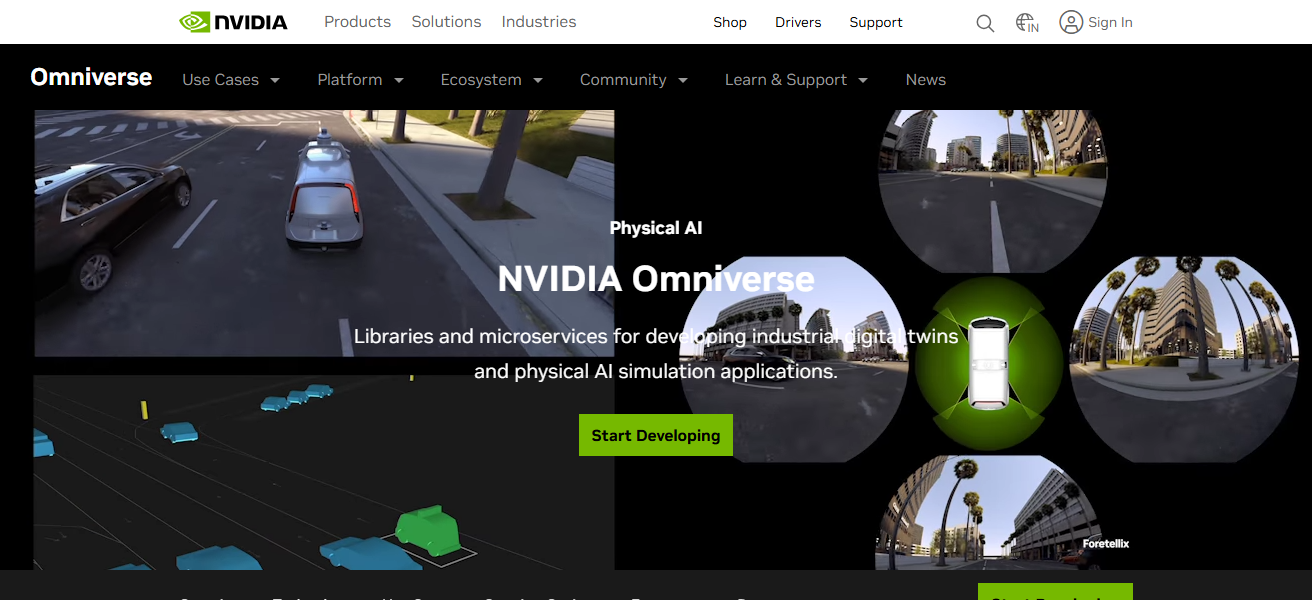
Omniverse’s AI-enhanced insights and GPU-accelerated rendering support advanced scenario planning, predictive analytics, and the optimization of operations and product designs.
NVIDIA Omniverse Features
- Collaborative Platform: Rapid photorealistic real-time rendering for engineering, operations, and virtual validation. Empowers designers, engineers, and end-users in real time to review and modify designs.
- High-fidelity 3D Simulation: Rapid photorealistic real-time rendering for engineering, operations, and virtual validation.
- AI-Driven Insights: Leverages integrated AI for optimization, pattern recognition, and predictive simulation.
- Interoperability: Uses open standards to bridge the gaps between CAD, simulation, and systems data across multiple sources.
| Pros | Cons |
|---|---|
| Excellent real-time 3D simulation and visualization with high fidelity. | Requires significant GPU and hardware resources. |
| Strong support for collaborative engineering workflows. | Steeper learning curve for non-3D/graphics users. |
| Connects many design/engineering tools into a unified digital twin. | Can be expensive for smaller enterprises. |
| Scales well for complex simulation scenarios. | Integration with non-NVIDIA ecosystems may need custom work. |
2. Microsoft Azure Digital Twins
Microsoft Azure Digital Twins is a cloud-based service that enables users to build live digital representations of physical spaces, including buildings, factories, and complete supply chains.
Azure Digital Twins employs graph-based modeling, which breaks down real-time data from IoT devices and business systems into manageable components to aid intelligent data analytics and scenario simulations.
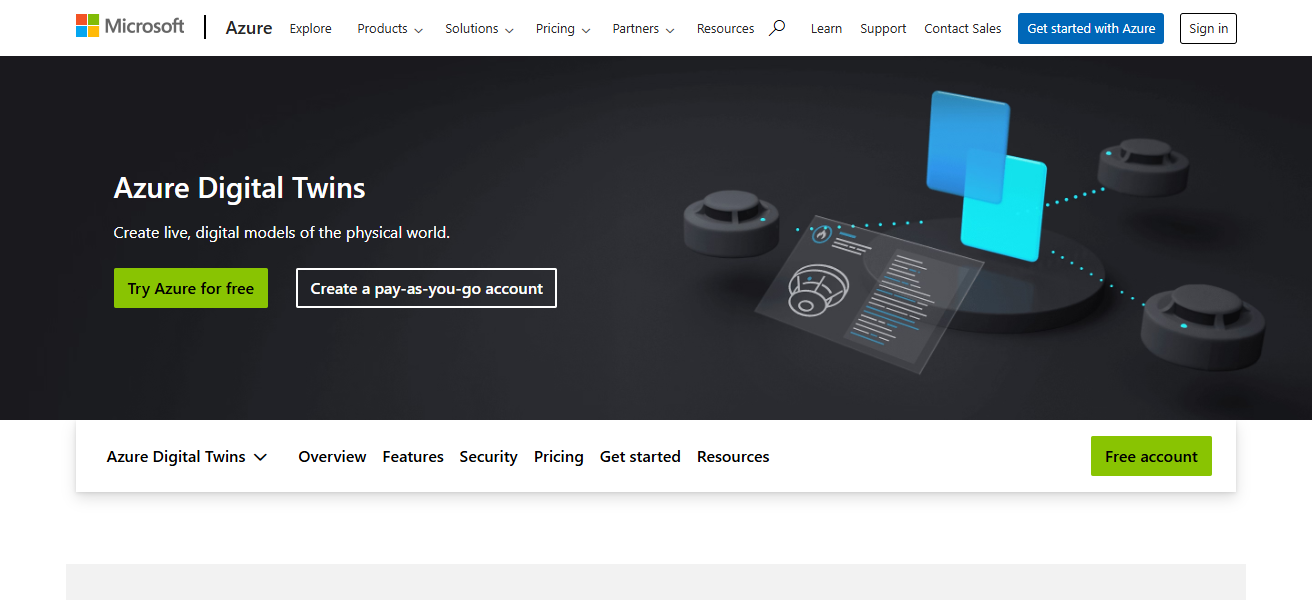
Digital Twins is a valuable asset to Microsoft Azure because, in addition to Digital Twins, Microsoft Azure Cloud offers AI, analytics, and cloud services.
That means Digital Twins customers can safely scale their twin solutions and make better decisions through optimized data that combines historical and current states.
Microsoft Azure Digital Twins Features
- Graph-based Modeling: Models assets, spaces, and relationships by creating digital models and outlines of them.
- Real-time IoT Integration: Stream and ingest real-time live data, ensuring the operational status of the system.
- Scalable Cloud Architecture: Azure’s powerful Global Cloud and AI services, combined with advanced analytics, allow for enterprise-level scalability.
- Security & Governance: Enterprise-grade security, identity protection, and compliance features are built in.
| Pros | Cons |
|---|---|
| Cloud-native with scalable infrastructure. | Dependence on Azure ecosystem for full capabilities. |
| Flexible graph-based modeling for real-world systems. | Potentially high costs at large IoT scale. |
| Integrates easily with Azure analytics and AI tools. | Requires cloud skills and Azure platform knowledge. |
| Strong security and enterprise support. | Not always ideal for on-premises only use cases. |
3. Siemens Teamcenter
Siemens Teamcenter integrates product lifecycle management processers with digital twin construction for design, manufacturing, and service.
It meshes operational and IoT data with engineering data (CAD models, simulation results, and BOMs) to create context for digital twin models.
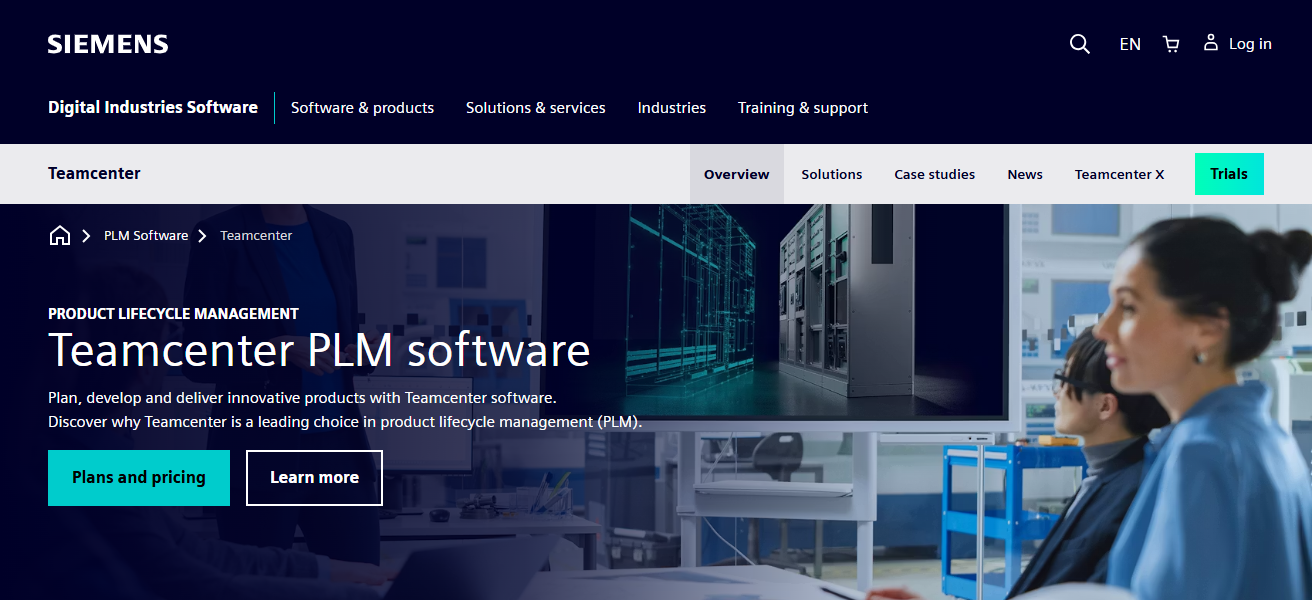
This context empowers teams to refine design, simulate performance, and optimize processes prior to physical release.
Teamcenter meshes simulation tools and operational data to help enterprises decrease errors, improve product quality, and accelerate time to market.
Siemens Teamcenter Features
- Integrated PLM Backbone: Engineering, design, and manufacturing data are consolidated into a single integrated platform.
- Lifecycle Synchronization: Synchronization across multiple platforms for product planning, simulation, and production.
- Collaboration in Engineering: Cross-disciplines in design intelligence, enabling engineering across various domains.
- Change/Version Control: In-depth impact analysis and revision control of complex products throughout different steps of the process.
| Pros | Cons |
|---|---|
| Deep integration with CAD/PLM and engineering data. | Can be complex and heavyweight to implement. |
| Good for end-to-end product lifecycle twin use. | High implementation and customization costs. |
| Supports global engineering and collaboration. | Requires training for effective use. |
| Strong manufacturing and design workflows. | Less focused on real-time OT/IoT data ingestion out-of-box. |
4. IBM Digital Twin Exchange
IBM Digital Twin Exchange integrates with IBM’s larger digital twin ecosystem and serves as a marketplace and integration center for twin services and content.
It enables manufacturing and asset management businesses to purchase and sell digital twin models, maintenance strategies, and customizable asset data that integrates with IBM Maximo and other enterprise applications.
This boosts the speed of twin deployments through the reuse of validated models and enhances collaboration across engineering, operations, and maintenance teams for lifecycle optimization and predictive analytics.
IBM Digital Twin Exchange Features
- Model Marketplace: Marketplace to trade and collaborate validated twin models across teams.
- Standardized Components: Speeds up deployments by encouraging the reuse of templates and model elements.
- Lifecycle Integration: Links twin models to maintenance and operations.
- Collaboration Hub: Enables shared twin assets across different divisions.
| Pros | Cons |
|---|---|
| Central hub for reusable twin models. | Not a full twin modeling engine by itself. |
| Facilitates collaboration and standardized models. | Best value when connected to broader IBM stack. |
| Improves lifecycle insights and maintenance planning. | May need integration expertise. |
| Helps reduce duplication of effort across teams. | Smaller partner ecosystem vs other platforms. |
5. PTC ThingWorx
PTC ThingWorx is an example of an industrial IoT and digital twin platform that links physical devices and sensors with their digital counterparts.
Users can see, track, and analyze how an asset performs with real-time updates. This platform also supports predictive maintenance, operational anomaly detection, and optimization.
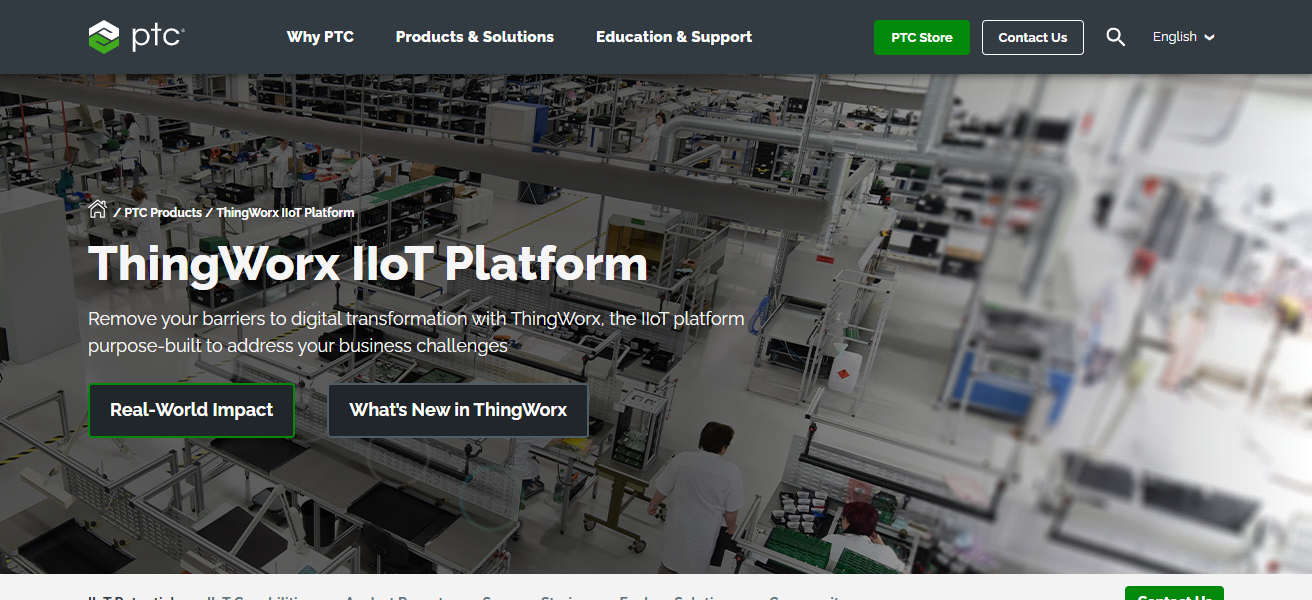
Thingworx also provides preconfigured apps and IoT tools to accelerate twin deployments and assistance for businesses to glean information from complicated data streams.
Its adaptable structure can fit any industry because it supports cloud, on-prem, or hybrid deployments.
PTC ThingWorx Features
- Industrial IoT Connectivity: Integrates sensors, machines, and controllers into digital twins.
- Built-in Analytics: Dashboard, insights, and real-time monitoring detect issues and analyze performance.
- Low-Code App Builder: Offers tools to quickly build tailored apps based on IoT or twins with minimal coding.
- Edge & Cloud Support: Comprehensive support for edge gateways and cloud deployments.
| Pros | Cons |
|---|---|
| Strong industrial IoT and real-time asset connectivity. | UI and platform can feel complex for new users. |
| Built-in analytics and dashboards. | Licensing costs can grow with scale. |
| Rapid application development for twin use cases. | Custom integration work may be needed. |
| Good ecosystem for manufacturers. | Requires IoT knowledge for best use. |
6. Dassault Systèmes 3DEXPERIENCE
The 3DEXPERIENCE Platform by Dassault Systemes builds a fully integrated cloud environment where enterprise digital twins can be created alongside 3D models, simulations, and lifecycle data.
It fosters collaboration across and within engineering, manufacturing, and service teams to plan and design processes and products.
The platform aids in functional virtual prototyping and performance optimization while dynamically updating and syncing with data from real-world systems and processes.
With the combination of digital twin and PLM capabilities, 3DEXPERIENCE aids businesses in developing products and improving innovation and product value while decreasing costs.
Dassault Systèmes 3DEXPERIENCE Features
- Unified Engineering Platform: Integrates CAD, simulation, PLM, and operational data into a single platform.
- Virtual Prototyping: Testing and refining designs is possible before physical construction.
- Cross-Functional Collaboration: Integration with design, manufacturing, and service functions.
- Simulation-Driven Design: Complex behaviors and advanced physics incorporated into design.
| Pros | Cons |
|---|---|
| Comprehensive digital twin and PLM platform. | Can be expensive for broad enterprise adoption. |
| Excellent for cross-functional engineering collaboration. | Steep learning curve for full suite. |
| Strong simulation and design integration. | Heavy deployment requirements. |
| Supports complex product lifecycle scenarios. | Needs dedicated support resources. |
7. Ansys Twin Builder
Ansys Twin Builder is an example of simulation-driven digital twin solutions designed specifically for engineer-centric twin models.
The software enables users to create, evaluate, and implement advanced digital twins through a combination of hybrid analytics and simulation based on physics.
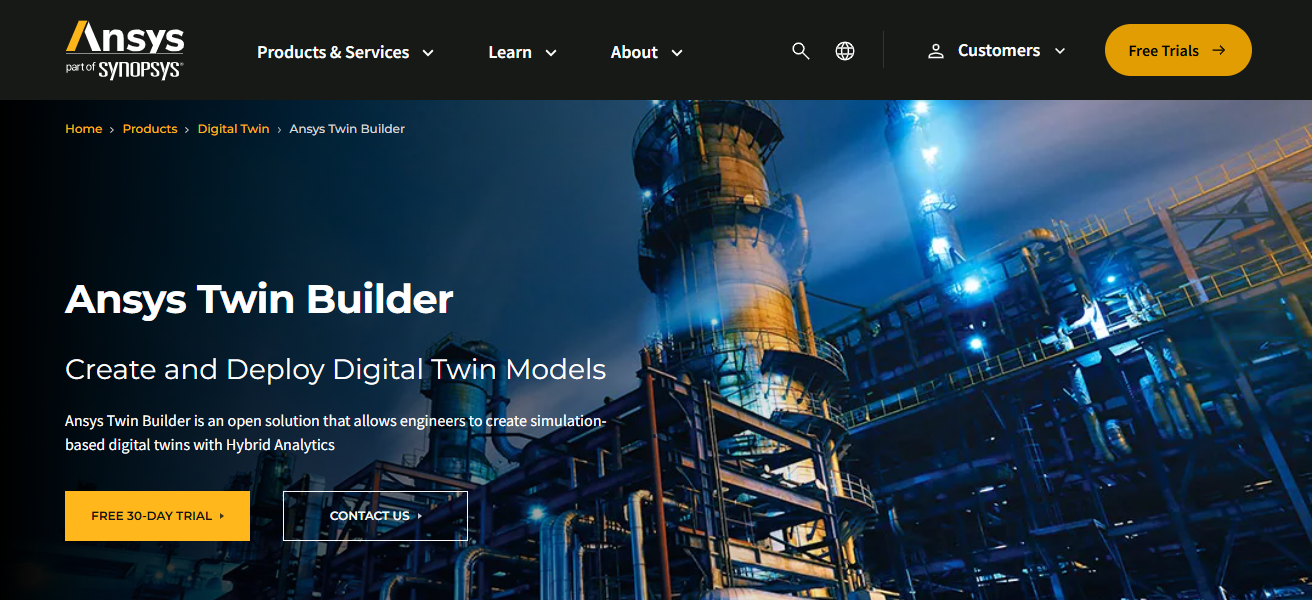
The software supports models of different domains and integrated IIoT (Industrial Internet of Things) tools for predictive maintenance, system optimization, and lifecycle management (ILM) enhancement.
Enterprises use Twin Builder to mimic the behavior of actual assets, virtually perform “what-if” analyses, and link twin models to operational systems for real-time monitoring and control.
Ansys Twin Builder Features
- Physics-Based Simulation: Uses digital twin behavior and multiphysics to create model simulations.
- Hybrid Model Support: Integrates data-driven and physics-based models.
- Deployment Options: Twin models have the ability to operate locally, in the cloud, or integrated into other systems.
- Predictive Scenarios: Ability to perform extensive “what-if” analyses to assess likely future conditions and potential failures.
| Pros | Cons |
|---|---|
| Best-in-class simulation-driven twin accuracy. | Primarily focused on engineering simulation. |
| Supports physics-based and hybrid models. | Less suited for general business process twins. |
| Strong predictive and what-if scenario testing. | Integration with IoT and data streams may require work. |
| Good for mission-critical performance modeling. | Specialized skill set needed for modeling. |
8. Oracle IoT Cloud
Oracle IoT Cloud offers the ability for enterprises to visualize and manage digital twins of real-world assets and systems.
With the integration of device telemetry and enterprise back-end systems, such as ERP and supply chain, predictive maintenance, operational visibility, and lifecycle analysis are possible.
Configurable alerts, analytic models, and simulations are among the elements of this framework, which assists businesses in identifying performance trends and predicting failures.
By incorporating IoT data and business context, Oracle’s digital twin tools enhance asset performance, minimize downtime, and optimize supply chain processes.
Oracle IoT Cloud Features
- Enterprise Integration: Merges twin information with ERP, SCM, and other business process interfaces.
- Real-Time Monitoring: Ongoing observation of status, utilization, and performance of assets.
- Alerts & Rules Engine: Automation of events and rules for decision support and proactive actions.
- Scalable Infrastructure: Cloud capabilities for worldwide and extensive device fleet support.
| Pros | Cons |
|---|---|
| Tight integration with enterprise apps (ERP, SCM). | Stronger focus on business context than 3D simulation. |
| Real-time analytics and alerts. | Oracle licensing and stack complexity. |
| Good for operations and asset tracking. | May need other tools for advanced twin modeling. |
| Scales to global enterprise use. | Cloud expertise required. |
9. SAP Digital Twin
SAP Digital Twin technologies integrate digital twin ideas with enterprise resource planning and asset management systems, incorporating digital representation, operational IoT data, and business process data synchronization.
SAP allows live visibility across its cloud services into products, assets, and processes and integrates with predictive maintenance, engineering insights, and analytics for manufacturing.
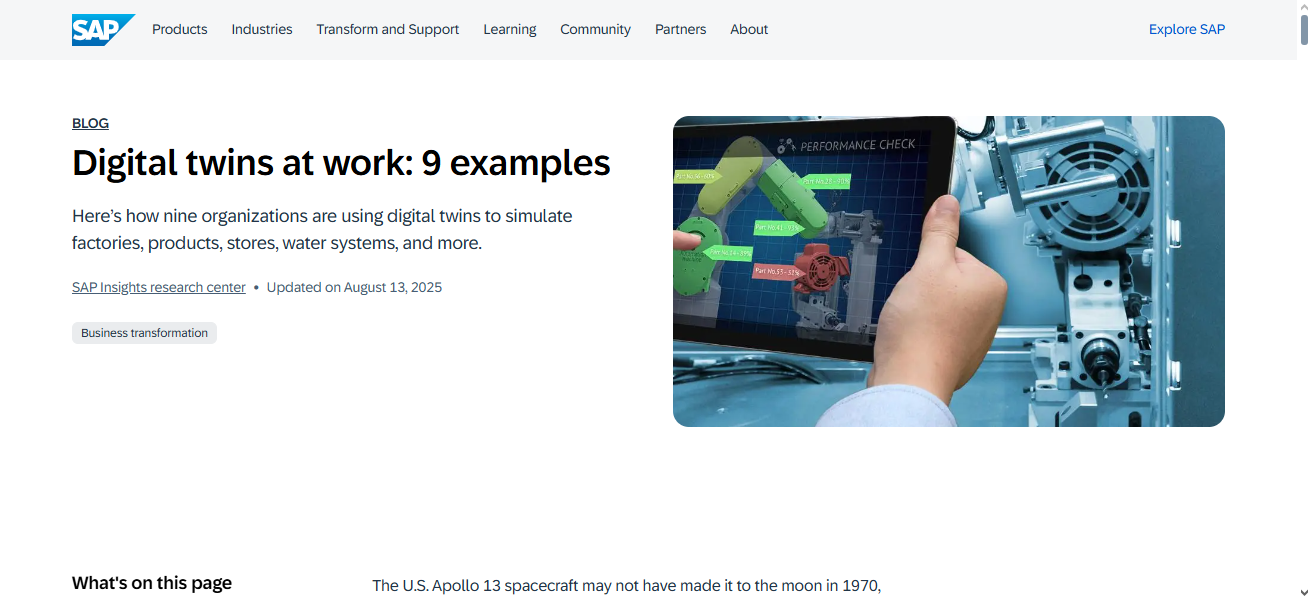
These integrations help firms improve decision-making, anticipate service requirements, and optimize maintenance schedules.
SAP’s twin strategy further fosters cooperative digital twin networks across supply chains and business ecosystems.
SAP Digital Twin Features
- Business Process Integration: Embeds twin information into enterprise processes and planning.
- Operational Visibility: Dashboards that integrate IoT, asset, and transaction information.
- Maintenance Optimization: Predicts and recommends actions for scheduled maintenance based on operational data.
- Integrated Enterprise Suite: Close integration with SAP ERP, supply chain, and analytic systems.
| Pros | Cons |
|---|---|
| Embedded with SAP ERP and asset management. | Best performance when within SAP ecosystem. |
| Real-time operational visibility and maintenance insights. | Not a full 3D modeling platform. |
| Strong business process alignment. | Setup and configuration can be complex. |
| Good for enterprise planning and operations. | May need partners for advanced IoT integration. |
10. Altair SmartWorks
Altair SmartWorks is an advanced, adaptable IoT and analytics platform that fosters digital twin creation by processing live sensor data and utilizing analytics to foresee potential downtimes and operational disruptions.
It integrates data, machine learning, and visualization to assist companies in monitoring assets, analyzing performance patterns, and gaining insights to improve reliability and efficiency.
The architecture’s flexibility and vendor neutrality enable quick twin deployment and scaling across industrial systems, especially when forecasting, optimization, and proactive maintenance are critical.
Altair SmartWorks Features
- IoT Data Management: Unified approach to assimilating and standardizing multiple feeds from sensors.
- Advanced Analytics & ML: Construction of predictive models and application of machine learning for forecasting failures.
- Dashboard & Visualization Tools: Interfaces for non-technical users to analyze data and monitor significant events.
- Open Architecture: Freedom to be integrated with other systems from multiple vendors.
| Pros | Cons |
|---|---|
| Flexible IoT ingest and advanced analytics. | Twin modeling is not as mature as specialized tools. |
| Vendor-agnostic and scalable. | Smaller market presence than larger vendors. |
| Predictive maintenance and forecasting tools. | May require integrations with other systems. |
| Good visualization and trend analysis. | Requires data science know-how. |
How To Choose Best Digital Twin Platforms for Enterprise Operations
State Your Business Objectives: Define what digital twins are required for (predictive maintenance, optimization of production, asset performance, or lifecycle support).
Data Integration Ability: The platform should be capable of integration with your IoT devices, ERP/PLM systems, and operational databases.
Potential and Performance: Opt for the highest performing systems that assist your scaling (growth) needs, ranging from pilot projects to enterprise-wide deployment.
Fit within the Vertical Industry: Choose the platform that best aligns with your needs in terms of manufacturing, energy, automotive, or smart facilities, as s/he will be able to give the best out-of-the-box support.
Modeling and Simulation: You must balance your need for fidelity and predictability with the physics-based versus data-driven modeling choices.
On-Prem vs Cloud: You need to stay with your policies regarding data, determining your need for onsite deployment or peak cloud scalability.
Security and Privacy: Assure yourself of the access controls, data, and systems security within the compliance across all regulatory and industry standards.
Conclusion
In summary, the Best Digital Twin Platforms for Enterprise Operations allow companies to optimize, monitor, and visualize processes and assets in real time.
These platforms, incorporating state-of-the-art simulation, predictive analytics, and IoT, improve operational efficiency, facilitate proactive decision-making, and minimize downtime.
Selecting a platform tailored to your needs guarantees scalable and secure operations for the enterprise of the future.
FAQ
A digital twin platform creates a virtual replica of physical assets, processes, or systems for monitoring and optimization.
To improve efficiency, predict failures, reduce downtime, and optimize operations.
Manufacturing, energy, automotive, logistics, smart buildings, and healthcare.
They can be both, depending on platform capabilities and enterprise needs.
Yes, most platforms connect real-time IoT data to virtual models.