This article will cover enterprise-grade e-commerce platforms that enable businesses to scale, streamline, and optimize complex operations and shopping experiences.
- Key Points & Best E-Commerce Platforms For Enterprises
- 10 Best E-Commerce Platforms For Enterprises
- 1. Shopify Plus
- 2. Magento Commerce (Adobe Commerce)
- 3. BigCommerce Enterprise
- 4. Salesforce Commerce Cloud
- 5. SAP Commerce Cloud
- 6. Oracle Commerce
- 7. WooCommerce Enterprise (WordPress)
- 8. Commercetools
- 9. VTEX
- 10. Elastic Path
- How To Choose Best E-Commerce Platforms For Enterprises
- Cocnlsuion
- FAQ
For high-volume traffic, multi-channel selling, and sophisticated personalization, platform selection is critical.
We will analyze leading enterprise e-commerce platforms, their differentiating capabilities, and what makes them best suited for enterprise e-commerce.
Key Points & Best E-Commerce Platforms For Enterprises
| Platform | Key Point |
|---|---|
| Shopify Plus | Scales easily for high-volume sales |
| Magento Commerce (Adobe Commerce) | Highly customizable with open-source flexibility |
| BigCommerce Enterprise | Strong multi-channel selling integrations |
| Salesforce Commerce Cloud | AI-driven personalization features |
| SAP Commerce Cloud | Robust B2B and B2C capabilities |
| Oracle Commerce | Enterprise-grade security and compliance |
| WooCommerce Enterprise (WordPress) | Flexible plugin ecosystem for extensions |
| Commercetools | API-first headless commerce architecture |
| VTEX | Built-in marketplace and collaboration tools |
| Elastic Path | Composable commerce for modular deployments |
10 Best E-Commerce Platforms For Enterprises
1. Shopify Plus
Shopify Plus has a fully scalable infrastructure making it able to support over 7,000 merchants worldwide. It offers seamless, intuitive drag-and-drop design, multi-channel integrations, and automated workflows through Shopify Flow.
Shopify Plus provides 99.99% uptime and cloud-based architecture that can manage millions of transactions at a time. With custom checkouts and advanced APIs, enterprises can create unique shopping experiences.
Shopify Plus has rapid deployment and global scaling which is why brands like Heinz and Red Bull choose it. It is perfect for companies that need speed, flexibility, and strong analytics.
Shopify Plus Features
- Uptime & scalability: Supports millions of transactions. 99.99% uptime.
- Multichannel sales: Supports integrations with marketplaces, social, POS, and mobile.
- Checkout customizations & API integrations: Supports custom enterprise operational models and complex integrations.
- Workflow & automation tools: Shopify Flow automates order, inventory and promotional actions.
| Pros | Cons |
|---|---|
| Scalable cloud-based infrastructure with 99.99% uptime. | Higher cost compared to standard Shopify plans. |
| Intuitive drag-and-drop interface and customizable checkout. | Limited flexibility for extremely complex customizations. |
| Multi-channel integration (social, marketplaces, POS). | Some advanced features require third-party apps. |
| Automated workflows with Shopify Flow. | SaaS-based, so control over backend is limited. |
| Trusted by global brands like Heinz and Red Bull. | Transaction fees if not using Shopify Payments. |
2. Magento Commerce (Adobe Commerce)
Magento Commerce, integrated with Adobe Experience Cloud, serves more than 250,000 merchants globally. It combines open-source flexibility with enterprise-grade architecture and extensive third-party modules.
Cloud hosting provides optimal performance and PCI DSS compliant security. His extensive B2B capabilities, coupled with AI-driven personalization and intelligent inventory management, empower merchants to optimize their business processes.
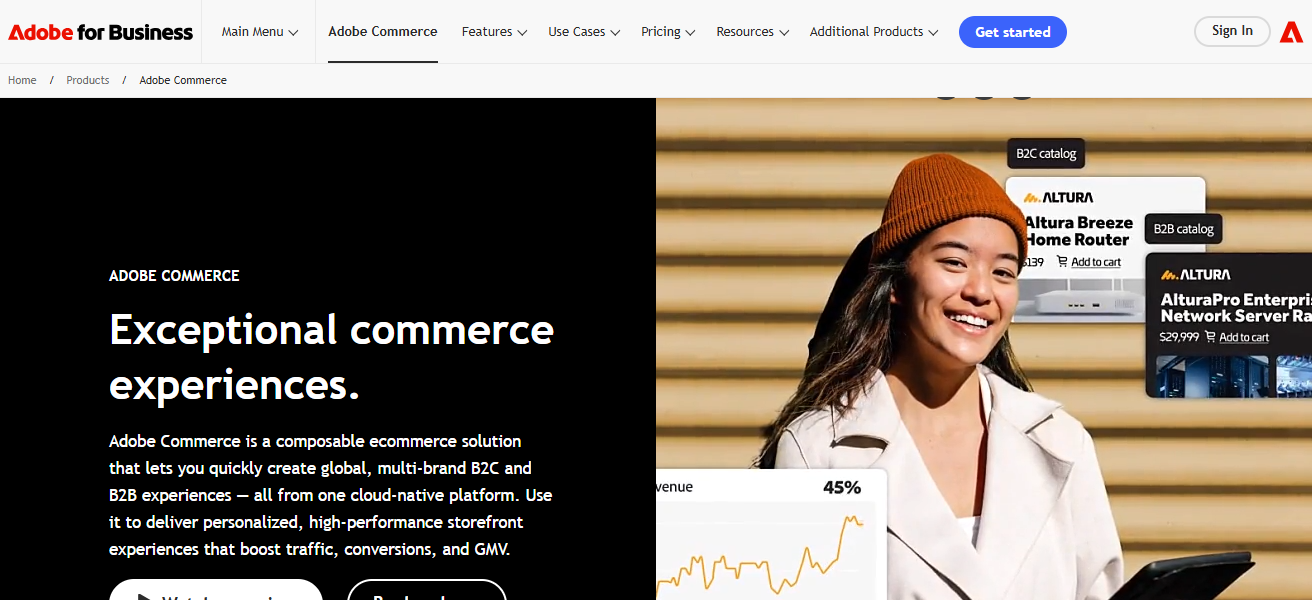
With multi-country, multi-lingual, and multi-currency functionalities, Magento supports complex digital storefronts and extensive product catalogs. This flexibility is harnessed by enterprises like Nike and Canon.
Magento Commerce (Adobe Commerce) Features
- Open source customization: Custom architecture for complex enterprise requirements.
- B2B & B2C functions: Advanced pricing and customer segmentation, B2B multi-store functionality.
- AI-driven personalization: Recommendations, promotions, and tailored content for individual users.
- Global order and inventory management: Supports complex multi-location and cross-border shipping.
| Pros | Cons |
|---|---|
| Enterprise-grade flexibility with open-source architecture. | Requires technical expertise to manage and customize. |
| Extensive extensions and integrations available. | Higher hosting and maintenance costs for large-scale deployment. |
| AI-driven personalization and advanced inventory management. | Complexity can slow implementation time. |
| Supports multi-store, multi-language, multi-currency setups. | Resource-intensive for high-traffic sites. |
| Trusted by brands like Nike and Canon. | Customization may require professional developers. |
3. BigCommerce Enterprise
BigCommerce Enterprise suits rapidly growing companies that require flexibility and dependability. It has an uptime of 99.99% and can accommodate more than $500 million in online sales per store every year.
Limited B2B tools are customer segmentation, personalized pricing, and advanced shipping rules. Thanks to API-first construction and 600+ integrations, businesses can link with all ERPs, CRMs, and marketing tools.
Skullcandy and Toyota are examples of brands that use BigCommerce Enterprise for omnichannel sales and international growth along with seamless integrations with Amazon and eBay.
BigCommerce Enterprise Features
- Annual sales support: Can support more than $500 million of sales annually per store.
- B2B functionality: Advanced pricing, shipping, quoting, and customer segmentation.
- API-centric frameworks: Best in class integrations with CRMs, ERPs, marketing automation tools, and marketplaces.
- Flexible Cloud System: 99.99% uptime with optimization for performance and reliability.
| Pros | Cons |
|---|---|
| Supports $500M+ annual sales per store. | Limited front-end customization compared to open-source platforms. |
| Native B2B tools (pricing, segmentation, shipping). | Some advanced integrations require API work. |
| API-first architecture with 600+ integrations. | Fewer themes than Shopify or WooCommerce. |
| High uptime (99.99%) and scalable infrastructure. | Custom checkout is less flexible than Shopify Plus. |
| Trusted by Toyota and Skullcandy. | Enterprise plan pricing may be high for small scaling teams. |
4. Salesforce Commerce Cloud
Salesforce Commerce Cloud is a fully integrated and native cloud solution for over 2,500 brands around the world.
It combines CRM, AI personalization with Einstein, and orders from any channel. It’s SaaS architecture is scalable and able to more than millions of concurrent shoppers.
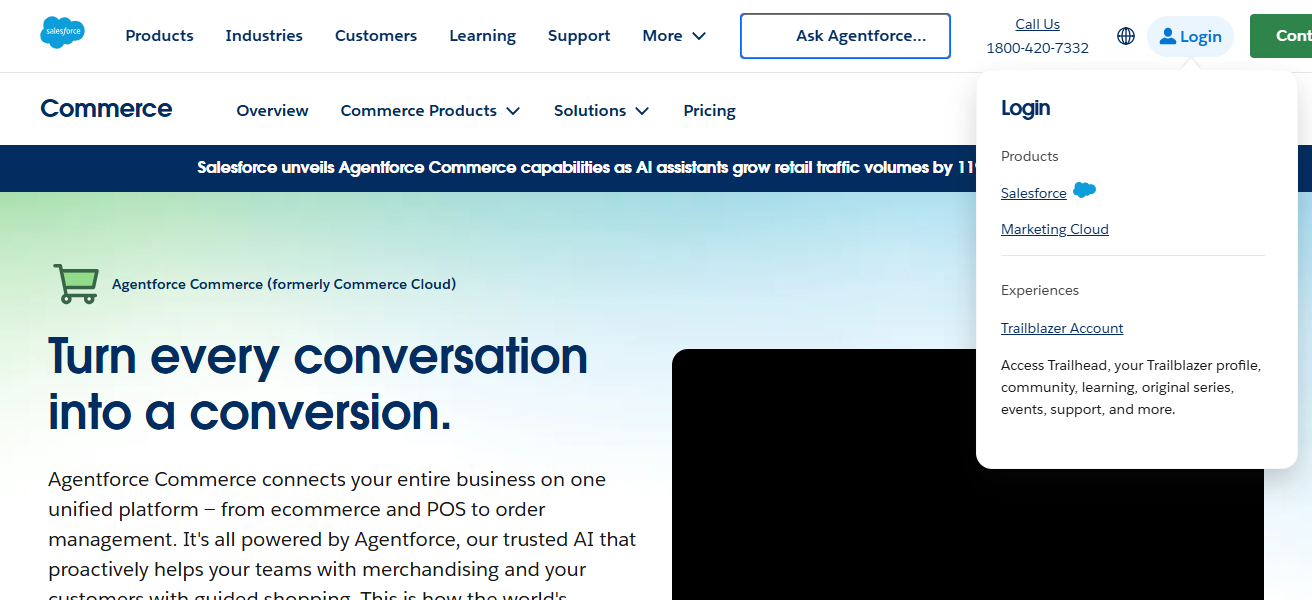
It also has predictive analytics and automation tools. Enterprises gain insights to customer behavior, inventory, and marketing in real time.
Adidas and Puma use Commerce Cloud to create integrated digital experiences with personalized product recommendations, loyalty tools, and social/ mobile commerce seamless across countries.
Salesforce Commerce Cloud Features
- Cloud native SaaS: High performance and millions of concurrent shoppers support.
- AI personalization via Einstein: Predicted customer behaviors for tailored recommendations.
- Omnichannel order management: Integrated mobile, web, in-store, and social commerce.
- Data-driven insights: Real-time analytics for marketing, inventory, and customer engagement.
| Pros | Cons |
|---|---|
| Cloud-native SaaS with high scalability. | Expensive, mainly suitable for large enterprises. |
| AI-driven personalization via Einstein. | Customization requires Salesforce developers. |
| Unified multi-channel order management. | Implementation can take months. |
| Predictive analytics and automation tools. | Limited flexibility compared to headless platforms. |
| Trusted by Adidas and Puma. | Pricing transparency can be low. |
5. SAP Commerce Cloud
SAP Commerce Cloud is the part of the SAP CX Suite designed for large B2B and B2C companies. It provides excellent management of product content, AI-driven personalization, and omnichannel order orchestration.
As an SAP partner, Bosch and La Mer have multi-site management, subscription commerce, and localized pricing.
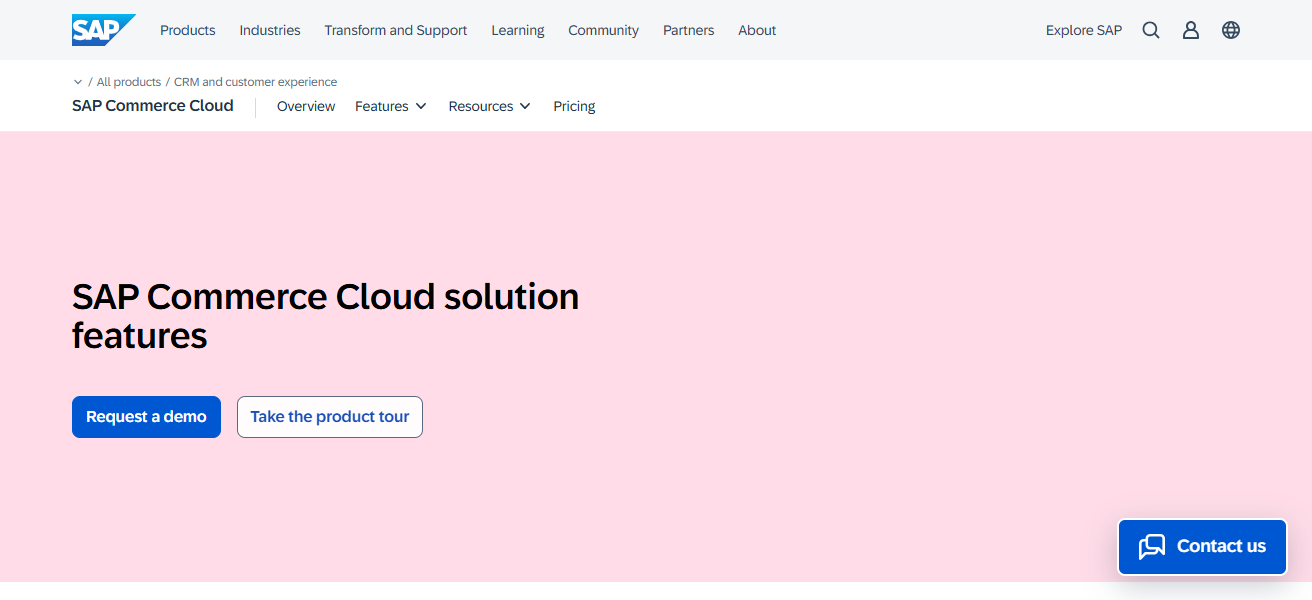
It is an excellent fit for enterprises needing strong operational integration and customer experience across multiple geographies and sales channels because of its scalability and security compliance. It is also a great fit for fast expanding brands.
SAP Commerce Cloud Features
- Integrated ERP & CRM: Native connectors for streamlined operations and supply chain systems.
- Omnichannel order orchestration: Covers B2B/B2C, subscriptions, and multi-site management.
- AI personalization & product content management: Personalizes experiences and catalog management.
- Scalability & compliance: Global operations and enterprise-grade security compliance.
| Pros | Cons |
|---|---|
| Deep ERP and CRM integration for complex enterprises. | High cost and long implementation time. |
| AI-driven personalization and omnichannel orchestration. | Requires skilled SAP developers. |
| Robust product content management. | Not ideal for small businesses. |
| Multi-site management with localized pricing. | SaaS flexibility is lower compared to headless platforms. |
| Trusted by Bosch and La Mer. | Ongoing maintenance can be expensive. |
6. Oracle Commerce
Oracle Commerce (Oracle CX Commerce) allows for fully tailored B2B and B2C commerce for businesses of any size. The platform offers AI-enhanced merchandising tools, real-time search, and product recommendations.
Businesses can rely on Oracle Commerce’s cloud-based infrastructure for worldwide scalability and the ability to manage peak traffic periods.
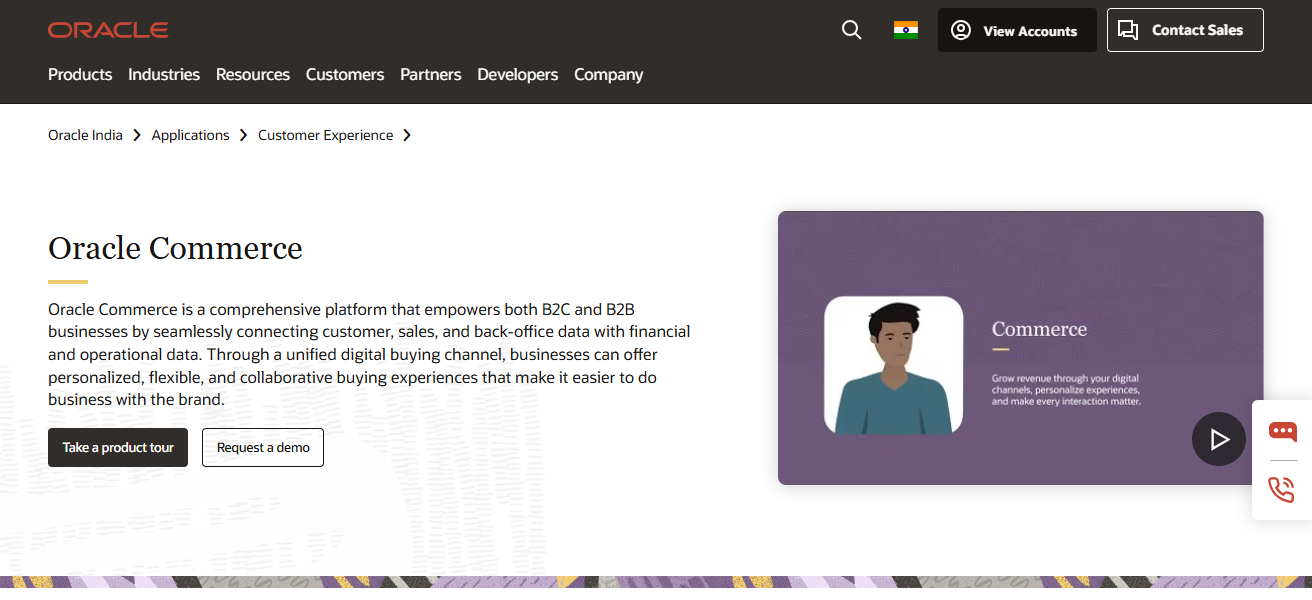
Real-time reporting coupled with Oracle’s seamless ERP, CRM, and marketing integrations provides further enterprise value.
Oracle Commerce is solidly positioned for large-scale businesses with complex business rules. Companies such as Staples and Lenovo leverage Oracle Commerce to manage a multitude of customer journeys, catalog complexities, and international commerce.
Oracle Commerce Features
- Enterprise-grade architecture: Manages complex operations for B2B and B2C.
- AI-powered search & recommendations: Enhances engagement and boosts conversions.
- ERP & CRM integration: Seamless with Oracle’s analytics and operations ecosystem.
- Global scalability: Supports multi-regional, multi-currency, and high-volume e-commerce.
| Pros | Cons |
|---|---|
| Enterprise-grade scalability for high-traffic sites. | Steep learning curve for new users. |
| AI-driven product recommendations and advanced search. | High total cost of ownership. |
| Seamless integration with Oracle ERP, CRM, marketing tools. | Implementation time is long for large catalogs. |
| Supports complex B2B and B2C operations. | Less community support than open-source alternatives. |
| Trusted by Staples and Lenovo. | Customization requires Oracle expertise. |
7. WooCommerce Enterprise (WordPress)
Based on the added excerpt which mentions WooCommerce Enterprise utilizing the WordPress other ecosystem, helping 5 million stores worldwide, with complete customization
Multi store management and including ERPs and CRM. Enterprises can also use WooCommerce for B2B pricing, advanced reporting, and subscription models.
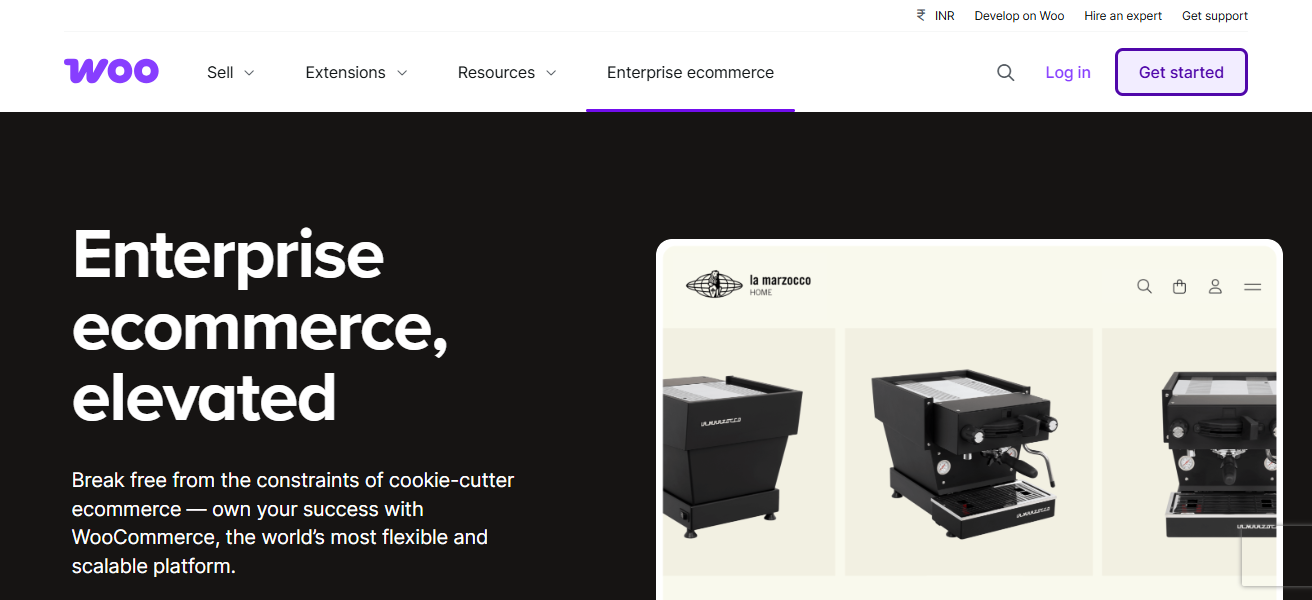
Managing cloud solutions provide scalable hosting for high traffic. Brands like Rip Curl and All blacks use WooCommerce Enterprise for the flexible storefront and content driven commerce.
It’s the Builders, customization, and content management ecosystem which WooCommerce Enterprise deserves to have for the scalable and content driven marketing.
WooCommerce Enterprise (WordPress) Features
- Complete customization: Utilizes the WordPress ecosystem for comprehensive design and functionality control.
- B2B and subscription support: Includes custom pricing, memberships, and recurring billing.
- Scalable hosting solutions: Managed cloud hosting for high-traffic enterprise sites.
- Vast plugin ecosystem: Simplifies integrations for marketing, analytics, ERP, and CRM.
| Pros | Cons |
|---|---|
| Complete customization through WordPress ecosystem. | Requires technical maintenance and security management. |
| Multi-store support and B2B pricing capabilities. | Hosting scalability depends on chosen infrastructure. |
| Supports subscriptions and advanced reporting. | Plugins may conflict or require frequent updates. |
| Vast plugin ecosystem for marketing, analytics, and ERP integration. | Security and performance depend on third-party hosting. |
| Trusted by Rip Curl and All Blacks. | High traffic may require expensive managed hosting. |
8. Commercetools
Commercetools is a headless and API-first platform specializing in enterprise-level flexibility and innovation.
It is built on a microservices architecture enabling rapid commerce experience iterations across web, mobile, and Internet of Things (IoT) devices.
Furthermore, Commercetools supports a variety of languages and currencies, as well as sophisticated pricing models.
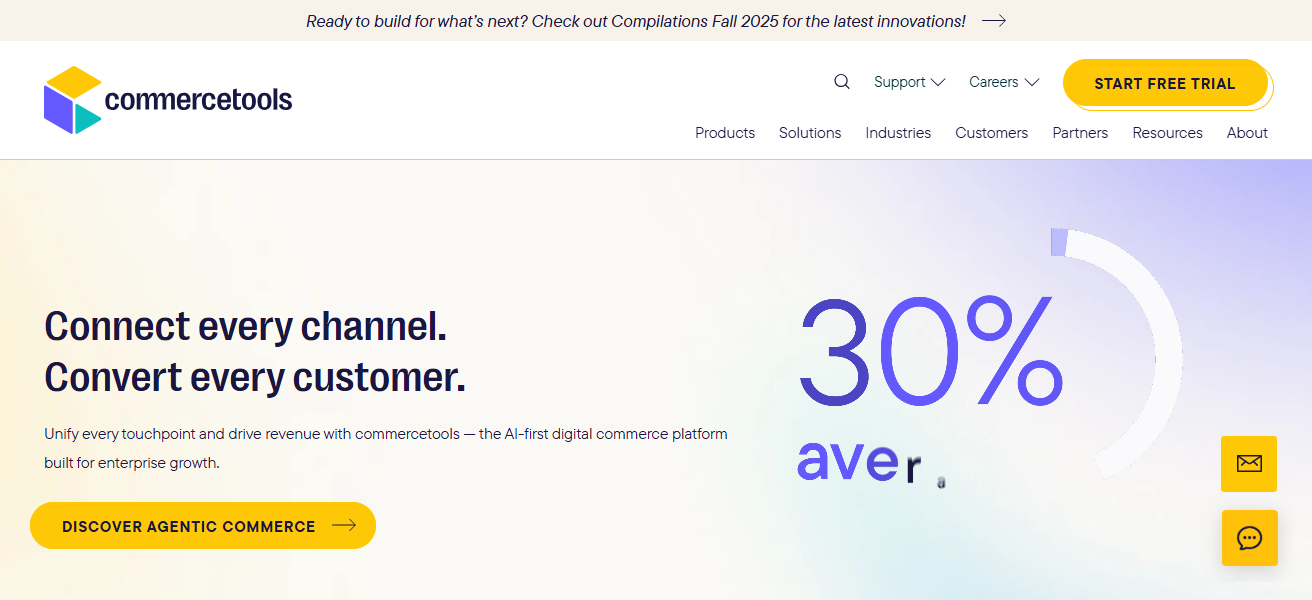
It is relied upon for dynamic omnichannel commerce by brands such as Audi and Bang & Olufsen. The platform’s cloud-native architecture promotes uptime and scalability by separating front-end and back-end systems.
This approach empowers enterprises to efficiently execute customized strategies for digital commerce.
Commercetools Features
- Headless, API-first Architecture: Both front and back ends can be separated, providing flexibility.
- Microservices Based: Rapid updates and iterations without affecting the entire system.
- Support for Multiple Languages and Currencies: Ideal for global companies with complicated catalogs.
- Omnichannel Personalization: Seamless and consistent experiences across web, mobile, and IoT.
| Pros | Cons |
|---|---|
| Headless, API-first architecture enables flexibility. | Requires developers for front-end implementation. |
| Microservices architecture allows fast iterations. | Initial setup can be complex. |
| Multi-language, multi-currency, and complex pricing support. | Less out-of-the-box features compared to SaaS platforms. |
| Cloud-native for high scalability and uptime. | Ongoing developer resources required for updates. |
| Trusted by Audi and Bang & Olufsen. | Smaller community support compared to Magento or WooCommerce. |
9. VTEX
VTEX provides a cloud-based headless commerce and marketplace management system. VTEX supports a wide variety of commerce models (B2B, B2C, and hybrids) and has over 2,500 customers in 40 countries.
VTEX is used by companies like Whirlpool and Nestle to integrate complex catalog management, omnichannel catalog management, and marketplace acceleration.
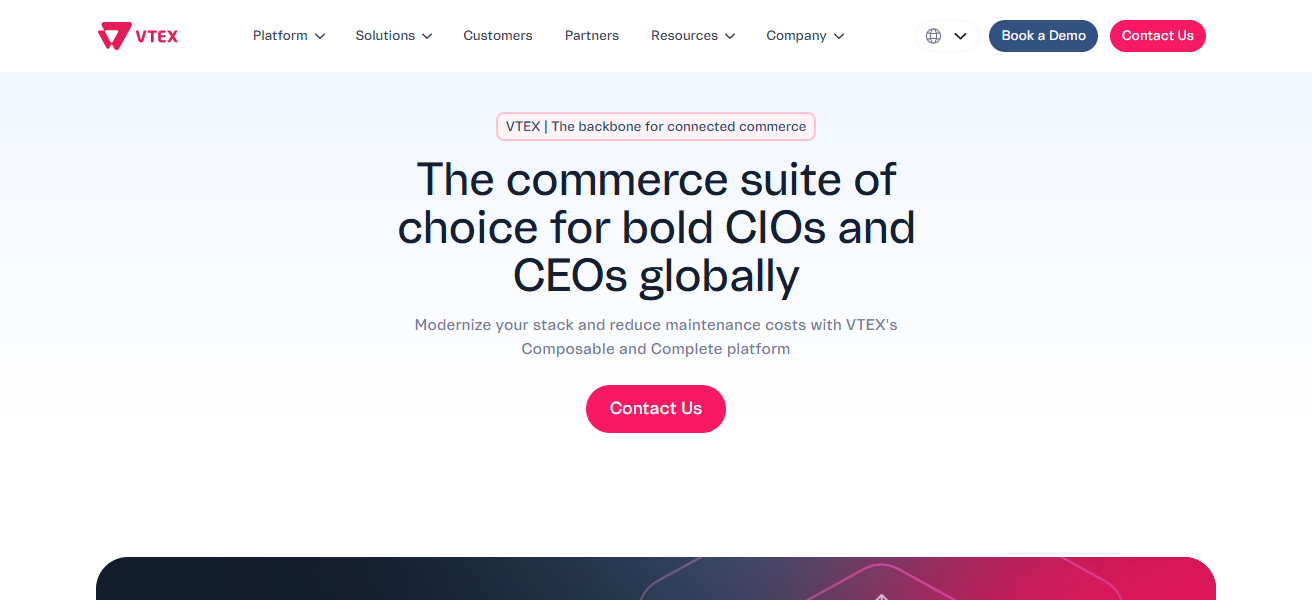
Using VTEX’s integrated OMS, AI-driven recommendations, and marketplace management, your catalog management to marketplace acceleration omnichannel capabilities are advanced.
VTEX’s (no code/lower code) marketplace management system provides flexibility to rapidly changing technological needs of enterprises while maintaining high levels of scalability, reliability, and seamless interoperability with third parties.
VTEX Features
- Integrated Marketplace Management: Combines marketplace and e-commerce store in one platform.
- Support for B2B, B2C, and Hybrid: Adaptable to different models of businesses.
- Customization via No-Code or Low-Code: Fast experimentations and updates can be done without large dev workloads.
- AI-Driven Recommendations and Order Management System (OMS): Enhances order fulfillment and customer experience.
| Pros | Cons |
|---|---|
| Headless commerce with integrated marketplace capabilities. | Limited third-party extensions compared to open-source options. |
| Supports B2B, B2C, and hybrid commerce. | Learning curve for “no code/low code” customization. |
| AI-driven recommendations and integrated OMS. | Smaller community for troubleshooting. |
| Powers 2,500+ brands in 40 countries. | Custom features may require professional implementation. |
| Enables fast time-to-market and omnichannel integration. | Pricing can be complex for mid-size enterprises. |
10. Elastic Path
Elastic Path focuses on headless commerce for enterprise customers requiring high flexibility and complex integrations.
With an API-first approach, Elastic Path empowers enterprises to deliver customized experiences across digital touchpoints, including IoT, mobile applications, and point of sale (POS) systems.
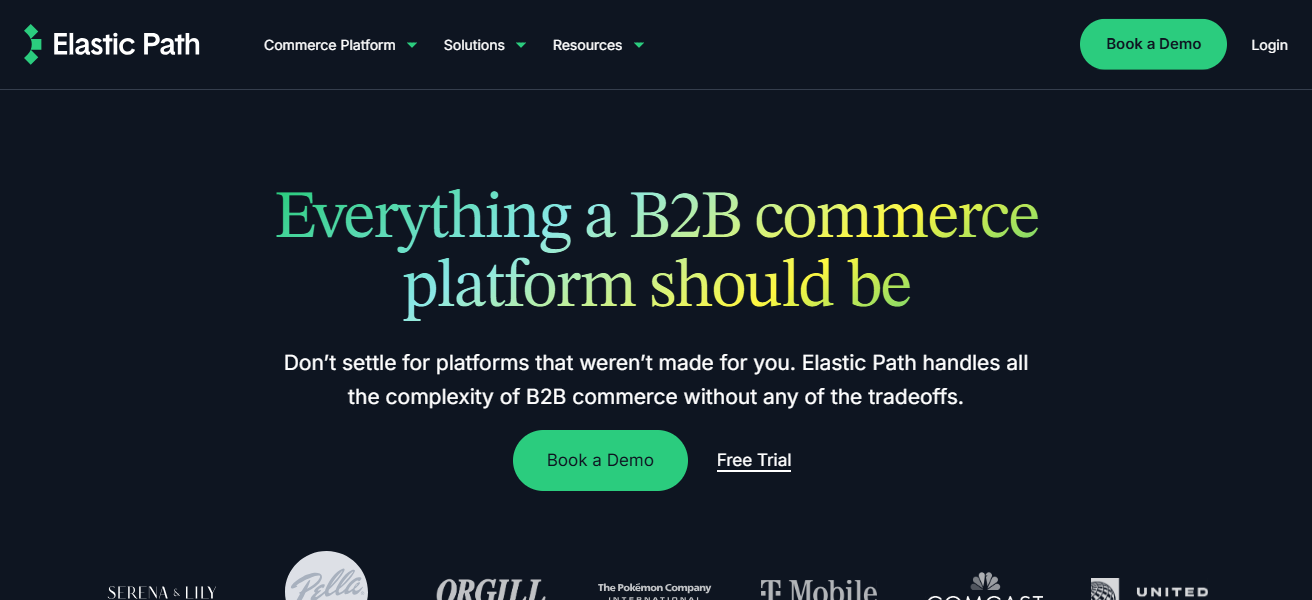
Enterprises can accurately configure subscriptions, bundles, and B2B processes. Elastic Path is used by brands like Sony and Siemens for composable commerce, fronting the innovation cycle by decoupling the commerce front end from the back end.
Its cloud-native SaaS solution is optimized for scalability, performance, and security, providing an ideal solution for large organizations that have varied product offerings and customers across the globe.
Elastic Path Features
- Composable and Headless Commerce: Enables customized experiences for enterprises on each part of their digital ecosystem.
- Support for Multiple Channels: Crosss IoT, mobile applications, POS, and web storefronts.
- Sophisticated B2B Processes: Subscriptions, bundles, pricing rules, and order management.
- Cloud-Native and Scalable: Provides optimal security and performance for enterprises.
| Pros | Cons |
|---|---|
| Headless, API-first for ultimate flexibility. | Requires heavy development expertise. |
| Supports IoT, mobile apps, POS, and complex B2B workflows. | Higher cost due to composable architecture. |
| Cloud-native SaaS ensures scalability and security. | Not ideal for small or mid-size businesses. |
| Allows rapid front-end experimentation and composable commerce. | Implementation can take longer compared to SaaS solutions. |
| Trusted by Sony and Siemens. | Limited out-of-the-box functionalities; relies on integrations. |
How To Choose Best E-Commerce Platforms For Enterprises
Business Model Suitability – Pick a platform that supports your focus (B2B, B2C, D2C, a marketplace, or a hybrid) to align with pricing, catalog rules, and customer flows.
Scalability – Ensure that it supports anticipated traffic, extreme seasonal spikes, and global growth without performance issues.
Customization & Flexibility – Opt for platforms that offer unlimited tailoring for individual storefronts, diverse checkout paths, and bespoke integrations as needed.
Integration Ecosystem – Be warned for available connectors or APIs for enterprise resource planning (ERP), customer relationship management (CRM), and other automation marketing, Product Information Management (PIM), logistics, tax, and payments.
Omnichannel Support – Select platforms that integrate web, social, mobile, point of sale (POS), and marketplaces for a seamless shopping experience.
Total Cost of Ownership (TCO) – Consider costs for licensing, hosting and maintenance, and also implementation, development, and third-party additions.
Headless / API-First Options – If you prefer flexibility in quickly iterating UI/UX, focus on headless commerce platforms.
Security & Compliance – Validate the presence of protective measures against data loss, as well as PCI DSS compliance, and enterprise-level security.
Analytics & Personalization – Look for platforms that leverage built-in artificial intelligence (AI) and customer data for personalization to enhance retention and conversions.
Vendor Support & Community – Opt for vendors with solid enterprise-level support, a robust documentation offering, and an extensive developer community.
Cocnlsuion
In cocnsluion Selecting an appropriate e-commerce platform can help in business operational scaling, customer satisfaction, and business growth on a global level.
Shopify Plus, Magento Commerce, and Salesforce Commerce Cloud are examples of platforms with unique and specific B2B and B2C great complexity.
Assessing features and prospective growth and business integration can help and enterprise find a solution with great optimiztion, versatile flexibility and sustainable success.
FAQ
Shopify Plus is an enterprise-grade, cloud-based platform that supports high-volume sales, multi-channel integration, and automated workflows for global brands.
Magento Commerce is a flexible, open-source platform offering B2B/B2C support, multi-store management, AI personalization, and advanced inventory controls.
BigCommerce Enterprise is a scalable SaaS platform designed for high-volume sales with built-in B2B tools, API integrations, and omnichannel capabilities.
Salesforce Commerce Cloud is a cloud-native solution with AI-driven personalization, unified order management, and predictive analytics for multi-channel enterprises.
WooCommerce Enterprise is a customizable, WordPress-based solution supporting multi-store setups, subscriptions, B2B pricing, and content-driven commerce.