
Best Embedded Finance Solutions for Platforms are changing the way digital companies offer integrated financial services.
In this article, I will focus on Best Embedded Finance Solutions for Platforms and examine how they assist platforms in embedding payment services, banking, loans, and other financial
Products and services into their ecosystems to enhance user experience, scalability, and revenue, all without the need to develop a complicated financial system from the ground up.
Key Points & Best Embedded Finance Solutions For Platforms
| Provider | Key Point |
|---|---|
| Stripe | Powerful APIs for payments and financial services |
| PayPal | Global reach with seamless merchant integration |
| Square | Strong POS ecosystem and lending options |
| Plaid | Data connectivity enabling open banking |
| Adyen | Unified commerce with multi-channel payments |
| Marqeta | Card issuing and modern payment infrastructure |
| Railsr | Banking-as-a-service with modular APIs |
| Solaris | European BaaS leader with compliance focus |
| Unit | Fast integration for banking and lending |
| Mambu | Cloud-native core banking platform |
10 Best Embedded Finance Solutions for Platforms
1. Stripe
Stripe is one of the biggest embedded finance platforms. It allows companies to manage online payments.
Stripe’s services include simple payments, integrated services for marketplace automation, fraud protection through Radar, billing, and subscriptions.
Developers can easily integrate financial services into apps using Stripe’s developer-friendly APIs. Instead of building infrastructure from the ground up, Developers can integrate financial functionality from Stripe.
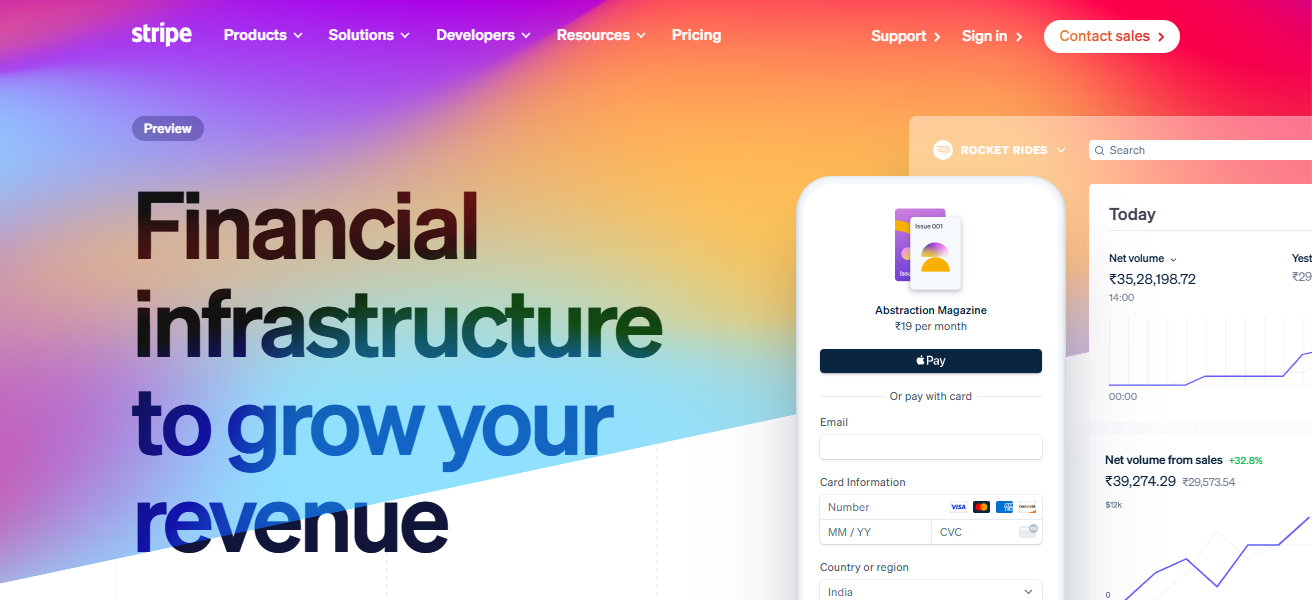
With Stripe, platforms can onboard sellers, divide payments, and manage currency exchange, all from the same account.
Platforms can also keep transactions compliant and secure, while scaling financially, due to Stripe’s comprehensive documentation, global coverage, and built-in compliance.
Stripe Features
- Global Payments & Checkout: Processes payments from multiple cards as well as digital wallets, local payment methods, and supports multiple currencies.
- Stripe Connect: Facilitates marketplace and platform payment distributions as well as split payment flows and custom payment flows.
- Billing & Subscriptions: Automates the processes of billing, invoicing, and capturing revenue for recurring payments.
- Fraud & Risk Tools: Stripe Radar employs machine learning to aid in the identification of possible fraud, as well as tools to aid in the resolution of payment disputes.
| Pros | Cons |
|---|---|
| Highly developer-friendly APIs with excellent documentation. | Can become expensive at scale with addons like Radar, Connect, Billing. |
| Supports global payments, subscriptions, marketplace payouts. | Advanced features require technical resources to implement. |
| Built-in fraud detection and reporting tools. | Limited banking products beyond payments (no direct lending). |
| Handles multi-currency and international compliance complexity. | Chargeback fees and disputes can be challenging for new users. |
| Scales from startups to enterprise. | Dependent on internet connectivity and tech stack stability. |
2. PayPal
PayPal is a well-known and trusted embedded finance provider for safe and international online payments.
Platforms using PayPal get immediate customer recognition, several payment options (credit and debit cards, account balances, and local alternative payment methods), and automated fraud protection.
PayPal for Marketplaces lets platforms capture payments and partition funds to sellers, automate payouts, and handle chargebacks.

Since PayPal has a large customer base, many platforms’ conversion rates improve when PayPal is offered at checkout.
Moreover, PayPal’s digital wallets and offered financing allow platforms to integrate lending and credit at checkout, improving customer experience and increasing sales.
PayPal Features
- Digital Wallet & Payments: Offers a digital wallet with a single-click payment option to enhance transactional security and protect buyers.
- PayPal Commerce Platform: Marketplace ecosystem with seller onboarding and distribution of funds.
- Multi-Channel Support: Platforms for accepting payments via the web, mobile apps, and physical stores.
- Fraud Prevention: Integrated risk management and tools for managing disputes to ensure transaction safety.
| Pros | Cons |
|---|---|
| Globally recognized brand trusted by customers. | Higher transaction fees vs some alternatives. |
| Supports wallets, seller payouts, and buyer protection. | Less flexible APIs compared to Stripe/Adyen. |
| Quick setup and familiar UX improves conversions. | Dispute resolution can favor buyers, affecting sellers. |
| Works in many countries and local payment methods. | Limited embedded banking features beyond payments. |
| Good fraud prevention & risk tools. | Account holds and freezes can disrupt cash flow. |
3. Square
Square offers tools for online and offline commerce, including embedded payment and financial suites for POS system integration, payment processing, mobile payments, and online checkout.

Platforms can embed invoicing, payroll, analytics, and business banking in their ecosystem, providing small merchants with comprehensive financial services.
Square’s developer APIs help platforms customize payment workflows and automate financial processes.
Square Features
- Omni-Channel Payments: Facilitates seamless payments via a single platform for physical stores, the web, and mobile applications.
- POS & Hardware: Card readers and point of sale (POS) systems that are fully integrated.
- Business Tools: Systems for invoicing and payroll management, along with tools for managing employees and business analytics.
- Banking Features: Embedded checking accounts for business and lending features for merchants.
| Pros | Cons |
|---|---|
| All-in-one commerce suite (POS + online + invoicing). | Transaction rates can be higher for small volumes. |
| Excellent for local businesses and omnichannel sales. | Embedded finance focus is narrower than fintech-centric providers. |
| Easy setup with intuitive tools and dashboard. | Less robust for global marketplaces with cross-border needs. |
| Includes payroll, business banking features. | Advanced APIs slightly less mature than Stripe’s. |
| Strong hardware ecosystem for in-person payments. | Not ideal for complex financial products like lending. |
4. Plaid
Plaid specializes in bank connectivity and data aggregation, allowing users to link their bank accounts and authenticate with their bank, check balances, and see transaction histories.
This functionality is important for embedded finance, which includes services like funding accounts, assessing risk, making loans, and verifying financial information in real time.
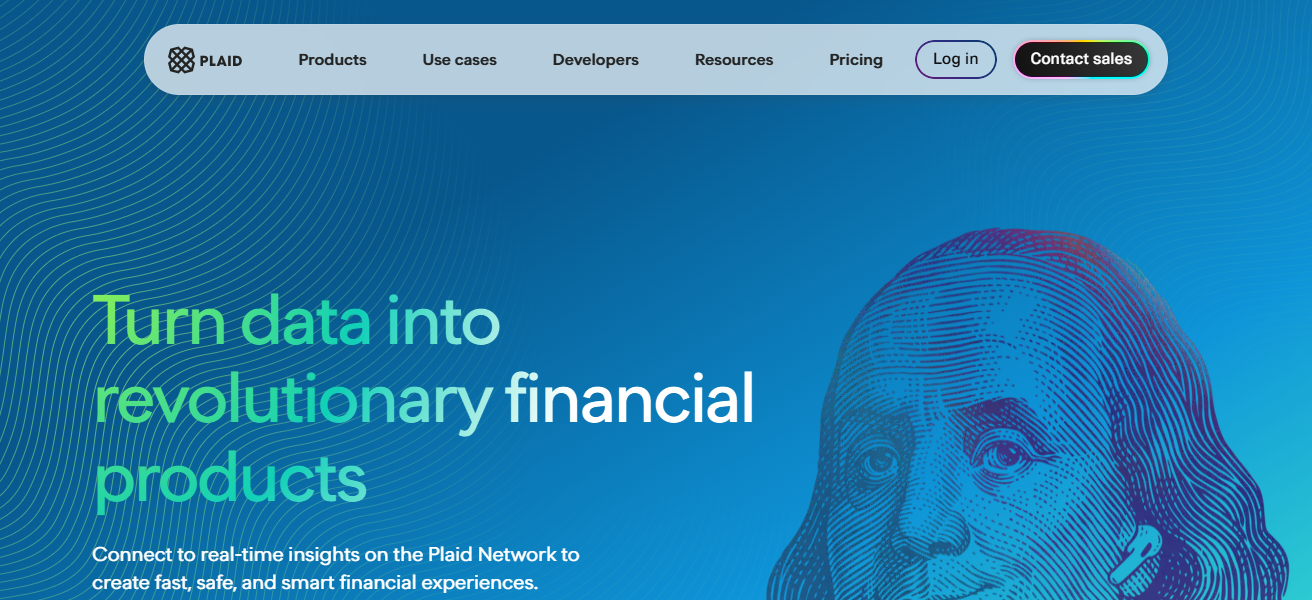
With thousands of banks and financial institutions, users can interact with simplified APIs. For users with embedded payments, wallets, and lending or budgeting features
Plaid provides reliable access to financial data while prioritizing security and compliance. This is why it is one of the top aggregators with extensive developer tools, making it an ideal option for financial applications needing real-time banking data.
Plaid Features
- Bank Connectivity: Provides a secure method for users to authenticate their accounts and access data from linked bank accounts.
- Real-Time Financial Data: Provides access to account balances and transaction details, as well as account analytics and insights.
- Identity Verification: Confirms ownership and minimizing the possible occurrence of fraudulent activities.
- Funding & Underwriting Support: Assists platforms in fund confirmation and risk assessment.
| Pros | Cons |
|---|---|
| Best-in-class bank account connectivity and data access. | Limited direct payment processing capabilities. |
| Speeds up verification, funding, and underwriting workflows. | Coverage varies by region and bank support. |
| Supports balance checks, transaction history, identity. | Requires integration with other financial APIs for full stack. |
| Robust security and compliance standards. | Costs scale with volume and product usage. |
| Enables better risk and fraud insights. | Less useful outside banking data use cases. |
5. Adyen
Adyen is a payments processor that helps platforms execute payments across different channels and regions. It provides omni-channel payment processing via cards, mobile wallets, local payment methods, and billing.
Adyen’s single and unified platform combines processing, risk management, and acquiring, which simplifies reconciliation and reduces costs.
Embedded features such as split payments by marketplaces, pricing in multiple currencies, and fraud management protection are advantages for platforms.
Adyen helps to understand payment outcomes and customer behavior through real-time data and analytics.
Adyen is trusted by large, global companies and is best for platforms that want to expand internationally and provide their customers frictionless checkout.
Adyen Features
- Unified Global Payments: A single system that supports cards, digital wallets, and local currency payments.
- Omni-Channel Integration: Compatible with web, mobile, and in-store channels.
- Risk Management: Integrated fraud detection and risk scoring.
- Data & Analytics: Centralized reporting provides real-time analytics.
| Pros | Cons |
|---|---|
| Unified global payments platform with one contract. | Minimum monthly volume requirements for some plans. |
| Supports cards, wallets, local methods across regions. | Implementation can be complex for smaller teams. |
| Strong fraud management and analytics tools. | Pricing not transparent by default. |
| Multi-currency support and optimization tools. | Platform features focused on payments vs full banking. |
| Enterprise-grade scalability and uptime. | Not ideal for startups with low initial volume. |
6. Marqeta
Modern card processing and issuing platform Marqeta assists customers in integrating unique payment card programs into their offerings.
Marqeta allows users to create virtual, physical, and tokenized cards using its APIs, with customizable spend controls and authorizations in real time.
Without constructing card infrastructure, other platforms can provide spend, incentive, on-the-spot funding, or branded partner cards.
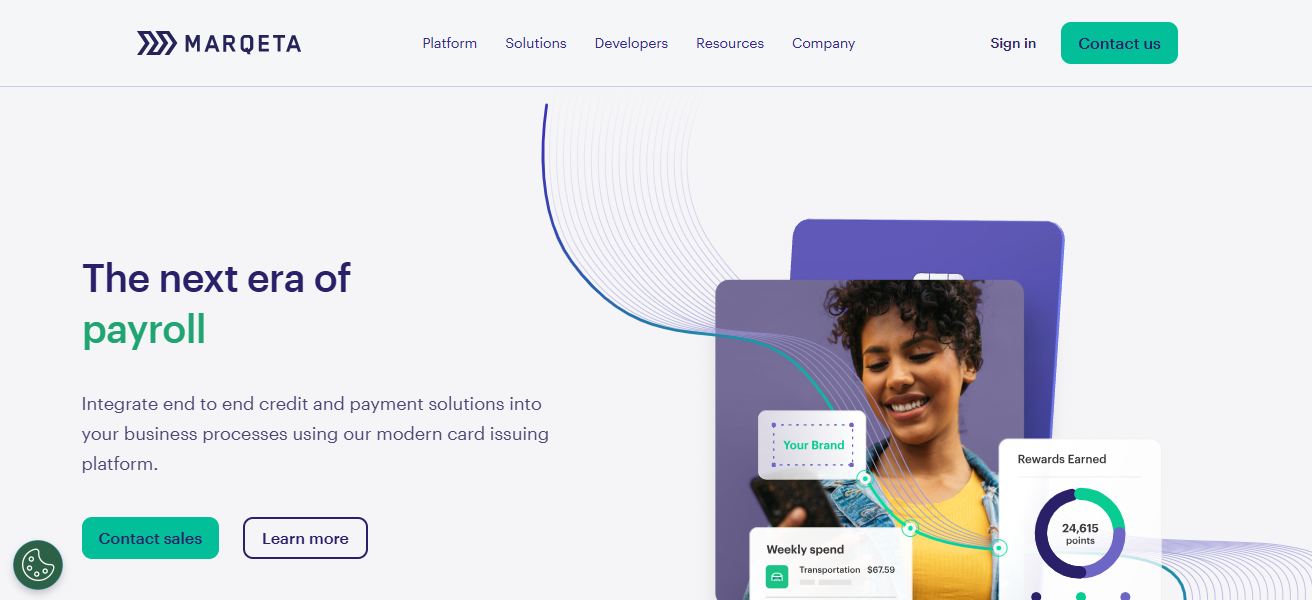
Marqeta’s Gig economy payments, fraud spend management, and integrated wallets business features are customizable to customers’ business requirements on fund control and distribution.
Customers are able to enrich their offerings and increase monetization with Marqeta’s advanced dynamic provisioning and fraud management options.
Innovative financial solutions are offered by Marqeta’s customers using Marqeta’s flexible fraud management options.
Marqeta Features
- Card Issuing: Create physical and digital cards using an API.
- Programmable Controls: Specify custom spending controls and real-time authorizations.
- Tokenization & Security: Safeguards card information within digital ecosystems.
- On-Demand Funding: Immediate funding for pay-as-you-go disbursement resetting.
| Pros | Cons |
|---|---|
| Modern card issuing and processing APIs. | Must integrate partners for full banking services. |
| Highly configurable virtual/physical cards. | Complex for teams without card program experience. |
| Real-time funding controls and authorizations. | Pricing tied to card volumes can be high for low use. |
| Great for corporate/expense and embedded wallet use cases. | Not a one-stop solution for payments + accounts. |
| Strong fraud controls and tokenization support. | Partner-dependent for compliance licensing. |
7. Railsr
Railsr banks API solution (previously known as Railsbank), allows businesses to integrate banking, payments, cards, and compliance into their platforms.
APIs by Railsr allows businesses to create accounts, issue cards, facilitate money transfers, and provide loans or savings products.
They address complex and costly regulatory issues, compliance, licensing, and risk management.
It allows businesses to pick and customize services from their API modules to meet the needs of their target consumers (including KYC, wallets, and foreign exchange services).
It is therefore ideal for platforms that need to embed advanced financial services without becoming fully licensed banks.
Railsr Features
- All-in-One Finance APIs: Comprehensive accounts, cards, wallets, payments, and lending solutions.
- Regulatory Support: Incorporates KYC, AML, and compliance mechanisms.
- Modular Architecture: Choose and combine only the desired functionalities for better integration.
- End-to-End Embedded Banking: Comprehensive banking solution for fintech platforms.
| Pros | Cons |
|---|---|
| Full embedded finance stack (accounts, cards, compliance). | Less widely adopted, smaller ecosystem than Stripe. |
| Handles KYC/AML, licensing complexity. | Regional coverage varies; check local support. |
| Modular, pick-and-choose financial building blocks. | Requires careful planning to avoid feature overload. |
| Speeds up product launch without building infrastructure. | Pricing can be opaque or tiered. |
| Supports wallets, lending, payments, cards in one. | Developer resources can be inconsistent. |
8. Solaris
Solaris is a banking platform with embedded banking and financial services, such as IBAN accounts, card issuing, lending, and compliance services through APIs.
It serves as a licensed banking partner and outsourcing regulatory compliance so that platforms can provide real banking products.
Solaris is a good embeded banking solution for fintechs, marketplaces, and neobanks as it supports digital wallets, deposit accounts, and payment processing.
Its infrastructure offers a quick and easy customization for a range of financial services including savings and installment payment features.
Combining technology and regulatory compliance, Solaris assist platforms in executing their embedded finance initiatives and providing end users with reliable and compliant financial services.
Solaris Features
- Banking as a Service: Licensed banking partner for customer accounts and deposit services.
- Card Issuing & Processing: Support for both physical and digital cards.
- Compliance & Risk: KYC/AML integration and regulatory coverage.
- Savings & Lending: Integrated lending and savings functionalities.
| Pros | Cons |
|---|---|
| Banking partner with regulated financial products. | Not focused on broad payment processing. |
| Embedded accounts, cards, and compliance built-in. | May have longer onboarding due to regulation. |
| Suitable for fintechs and digital banks. | API maturity varies by region. |
| Strong KYC/AML and risk tooling included. | Less global reach than Stripe/Adyen. |
| Helps platforms offer deposit and lending features. | May need additional partners for full stack. |
9. Unit
Unit enables businesses to integrate banking services like accounts, cards, payments, and loans into their apps.
Unit has a diversified product catalog that has digital wallet APIs, ACH and wire transfer APIs, card issuance APIs, KYC/AML APIs, and lending workflow APIs.
Unit enables businesses to quickly and easily offer financial services without the need to construct backend systems or deal with complicated banking regulations.
Additionally, Unit has a “plug-and-play” philosophy, which allows businesses to use only the services they need. This modularity results in quicker development cycles and lower costs.
Unit allows clients to concentrate on their primary value proposition by providing secure fintech solutions that have been optimized for scalability.
Unit Features
- Modular Banking Services: APIs for accounts, transfers, cards, and payments.
- Compliance Tools: Automated KYC/AML with user onboarding.
- Lending Infrastructure: Credit, underwriting, and adaptive loan product support.
- Wallet & Transfer Support: Digital wallets with ACH and wire transfers.
| Pros | Cons |
|---|---|
| Modular embedded banking (accounts, cards, payments). | Not a payment processor—needs partners for payments. |
| Quick to launch financial products with APIs. | Feature expansion tied to regulatory scope. |
| Built-in KYC/AML and compliance support. | May require tech resources for customization. |
| Supports ACH, cards, transfers, and lending flows. | Emerging platform—smaller ecosystem. |
| Good for fintech-first platforms. | Integration costs scale with modules used. |
10. Mambu
Mambu is a cloud-native banking engine that is aimed at streamlining the creation of digital financial products.
Mambu doesn’t directly offer payments, but allows users to embed APIs for banking services such as loans, deposits, savings, and other banking services.
Mambu is highly configurable and can support unique combinations of business logic, pricing, and product customization, making it great for emerging fintech companies that need to move swiftly.
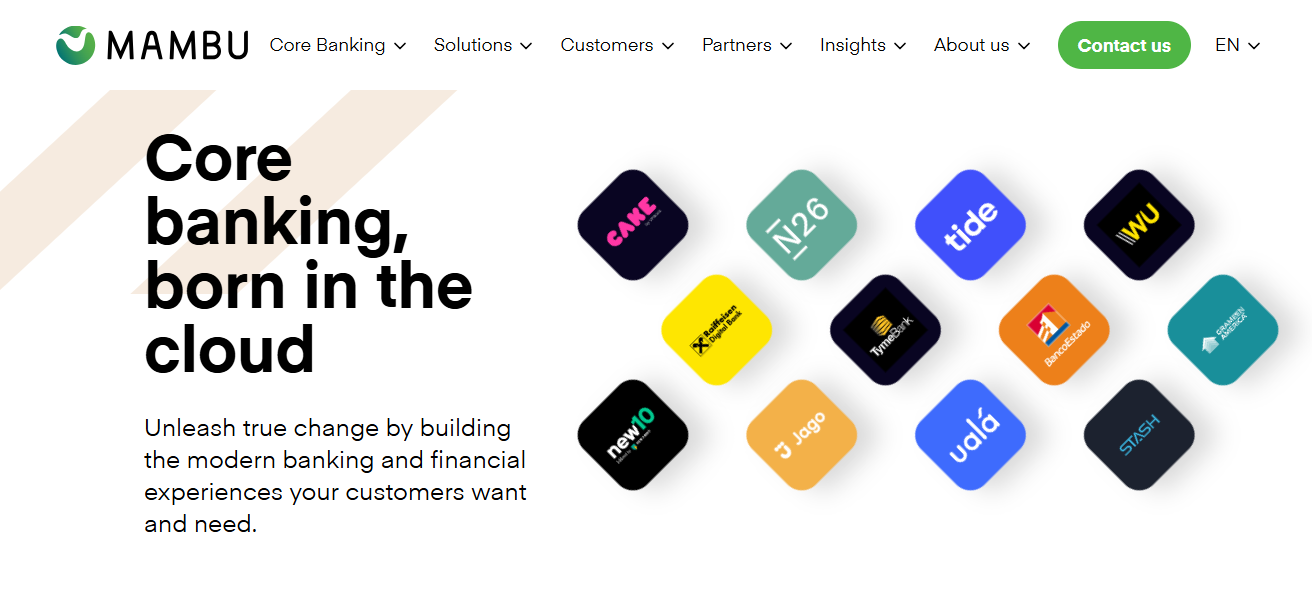
Mambu’s users can launch digital banking products, lending marketplaces, or savings products without having to use legacy banking systems.
Mambu’s cloud-native banking systems are highly scalable and promote the use of third-party systems for payments, compliance, and analytics. Customers choose Mambu often because of their ability to cope with legacy banking systems.
Mambu Features
- Cloud-Native Banking Engine: Digital banking products core platform.
- Lending & Deposits: Loans, savings, and deposit accounts creation support.
- Composable Architecture: Seamless integration with third-party fintech solutions.
- Product Configurability: Tailored business logic, pricing, and rules for products.
| Pros | Cons |
|---|---|
| Flexible, cloud-native banking engine. | Not a payment processor—partners needed for payments. |
| Excellent for loans, deposits, savings products. | Requires integration with external payment/card providers. |
| Highly configurable and composable. | More complex than single-purpose APIs. |
| Scales well for digital banks and finance apps. | Setup and customization demand robust engineering. |
| Integrates with fintech ecosystem tools. | Not ideal for simple payments-only platforms. |
How To Choose Best Embedded Finance Solutions For Platforms
- Necessary Financial Features: Determine the services required: payments, cards, lending, wallets, or banking services.
- Choice of Provider: Select the vendor with the most extensive resources to assist with API integration.
- Capacity for Growth: Determine whether the platform will continue to operate effectively after significant user and transaction growth.
- Regulatory and Compliance Support: A platform that reduces the operational and legal risks must offer KYC and AML.
- Global Reach: Identify the countries, currencies, and domestic payment solutions for which the platform will provide access.
- Fraud Prevention & Security: Use platforms that provide adequate transaction monitoring, encryption, and fraud detection.
- Pricing and Cost Structure: Assess the transaction costs, onboarding fees, and other costs that will affect the solution’s profitability.
- Levels of Customization: Use solutions that enable different customization levels, including branded user journeys and financial product design.
Conclusion
In closing, the Best Embedded Finance Solutions for Platforms help businesses provide integrated financial experiences within their ecosystems.
Solutions that combine payment processing, banking, lending, and compliance tools boost user engagement, streamline business processes, and create new monetization opportunities.
The right embedded finance solution enables platforms to decouple the intricacy of their infrastructure to improve competitiveness and maintain rapid growth in a digital economy focused on finance.
FAQ
They allow platforms to offer payments, banking, lending, and financial services within their own products.
They improve user experience, increase engagement, and create new revenue streams for platforms.
Marketplaces, SaaS platforms, fintech apps, eCommerce platforms, and gig economy platforms benefit the most.
Payments, digital wallets, card issuing, banking accounts, lending, and money transfers can be embedded.