In this article, we’re going to focus on the Best Embedded Insurance APIs for Fintech Apps, and how these platforms allow for effortless integration of insurance into digital financial services.
- Key Points & Best Embedded Insurance APIs For Fintech Apps
- 10 Best Embedded Insurance APIs For Fintech Apps
- 1. Boost Insurance Platform
- 2. Bigfix Merchant
- 3. Cover Genius
- 4. Trov API
- 5. Qover
- 6. Zopper Embedded Insurance
- 7. BIMA
- 8. Instanda
- 9. Singlife API
- 10. Demex API
- How To Choose The Best Embedded Insurance APIs for Fintech Apps
- Conclsuion
- FAQ
Embedded insurance APIs enable fintech companies to provide users with contextual insurance coverage, improving the overall experience, opening new revenue opportunities, and reducing compliance complexities. This makes insurance an integral part of today’s fintech ecosystem.
Key Points & Best Embedded Insurance APIs For Fintech Apps
| API Provider | Key Point |
|---|---|
| Boost Insurance Platform | Full-stack digital insurance infrastructure enabling fintechs to launch products quickly |
| Bigfix Merchant | Retail-focused embedded protection for warranties and device insurance |
| Cover Genius | Global embedded insurance distribution with localized compliance and claims handling |
| Trov API | On-demand microinsurance for items, travel, and mobility |
| Qover | Pan-European embedded insurance orchestration with modular APIs |
| Zopper Embedded Insurance | Banking and retail integration for seamless customer journeys |
| BIMA | Mobile-first insurance API targeting emerging markets |
| Instanda | No-code insurance product builder with API-first deployment |
| Singlife API | Digital life and health insurance integration for fintech partners |
| Demex API | Climate risk insurance embedded for financial and retail platforms |
10 Best Embedded Insurance APIs For Fintech Apps
1. Boost Insurance Platform
Boost empowers FinTech and digital companies to offer personalized and customizable insurance policies to their customers via embedded insurance offered as a service.
Boost’s customers can self-design insurance policies through a white-label portal. Boost’s customers can offer insurance without investing additional capital to obtain an insurance license to offer their own branded insurance policies.
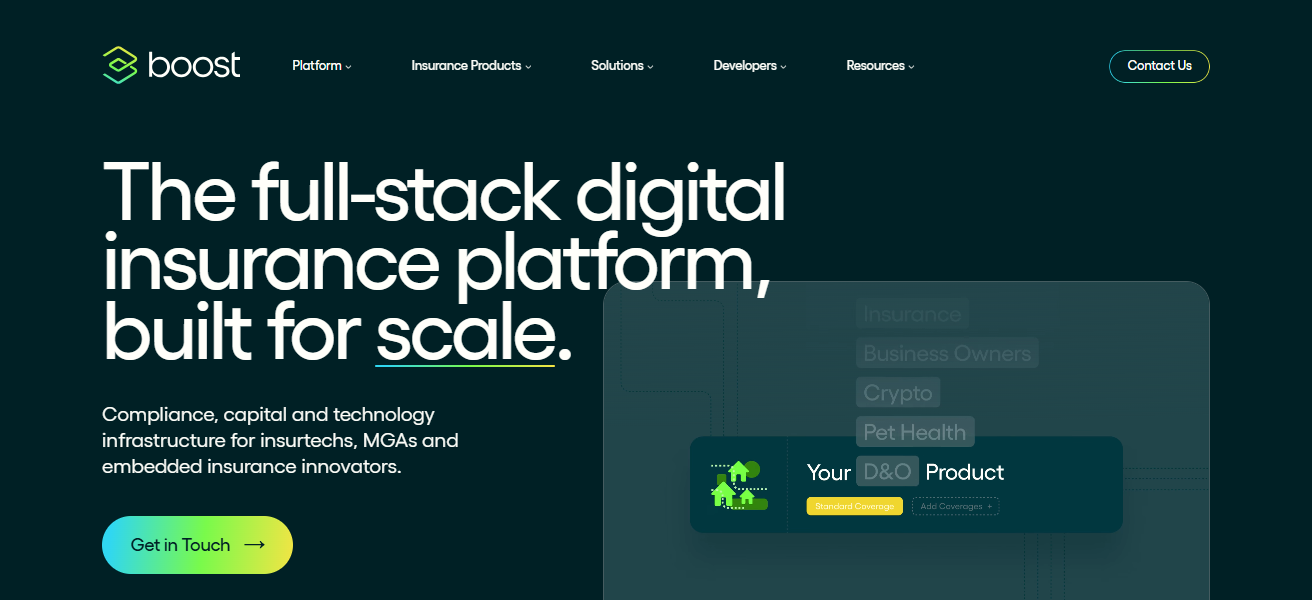
Boost’s policy management and purchase workflows are embedded in customers’ applications to provide a seamless digital experience for customers to engage and manage their insurance policies improving brand loyalty.
Boost’s reinsurance and operational partners allow Boost’s platform to grow without any additional investment to handle insurance operational back-end.
Features Boost Insurance Platform
API-First Integration: Boost carries out REST API integration seamlessly, allowing for the inclusion of insurance products into the fintech apps without having to worry about complicated codes and structures.
Customizable Policies: Fintech apps have the flexibility to personalize the coverage, pricing, and user interface to align with the brand and the clientele.
White-Label Support: Users are able to purchase insurance from the app without any branding, hence the term white-label.
Scalable Architecture: Designed for the digital economy, Boost Insurance Platform issues and manages a high number of policies at the same time.
| Pros | Cons |
|---|---|
| Easy and fast integration with API-driven architecture. | May require additional compliance support in certain regions. |
| Customizable insurance offerings under your brand. | Pricing and revenue-share models may vary by partner. |
| Scales well for fintech growth and multiple products. | Limited direct consumer analytics compared to some competitors. |
| Reduces backend insurance operational work. | Dependent on Boost’s insurance partners for underwriting. |
2. Bigfix Merchant
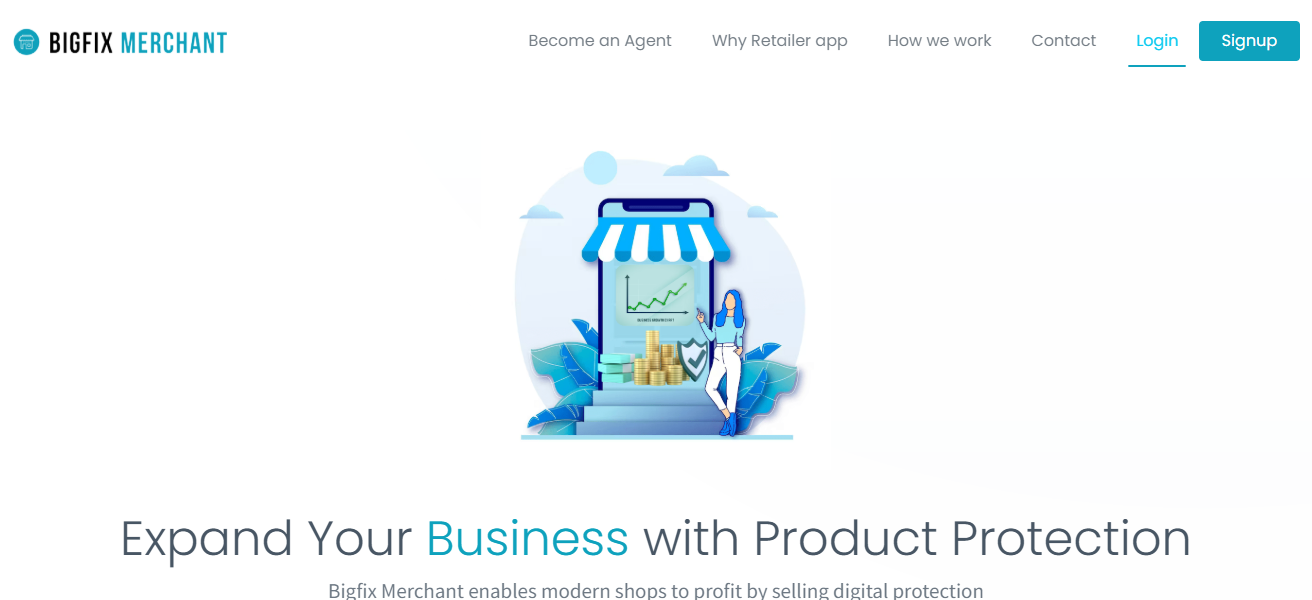
Bigfix Merchant draws on Bigfix’s technology ecosystem focused on protection and extended warranty coverage on devices to link retailers, insurers and consumers via API.
While Bigfix is the marquee name in after-sales care, his Merchant APIs embed Warranty and Protection Plan sell offers in Point-of-Sale (POS) systems, allowing device fintech and ecommerce platforms to offer device insurance or coverage plans at checkout.
The APIs streamline and automate claims, registrations, real- time tracking and warranty fulfilment, increasing conversions and lowering friction in the enablement.
Bigfix’s integrated service network and multilingual capacity further support the deployment of embedded insurance in consumer electronics and appliances.
Features Bigfix Merchant
Device Protection Focus: APIs focusing on warranties and device insurance at checkout or after purchase are offered.
Claims Automation: Automation of registering, tracking, and solving claim issues for customers and partners.
Partner Network Connectivity: Unifying backend systems for retailers, insurers, and service providers.
Real-Time Plan Enrollment: Depression on purchasing flows significantly increases enrollment and user conversion.
| Pros | Cons |
|---|---|
| Great for device protection & warranties at point of sale. | Not a full general insurance stack (focus on electronics). |
| Automates claims processing and servicing. | Limited product variety compared to broader insurtech APIs. |
| Strong partner network with retailers and insurers. | Less ideal for life or health insurance embeds. |
| Improves conversions during checkout. | Not as flexible for global fintech use cases. |
3. Cover Genius
Cover Genius is an insurtech company that works with digital platforms around the world to provide insurance with their API so that customers can receive protection at the moment of their transaction.
E-commerce, travel, fintech, logistics, and marketplace partners can offer tailored insurance via Cover Genius’ embedded API, including product warranties, shipping protection, travel insurance, and liability coverage.
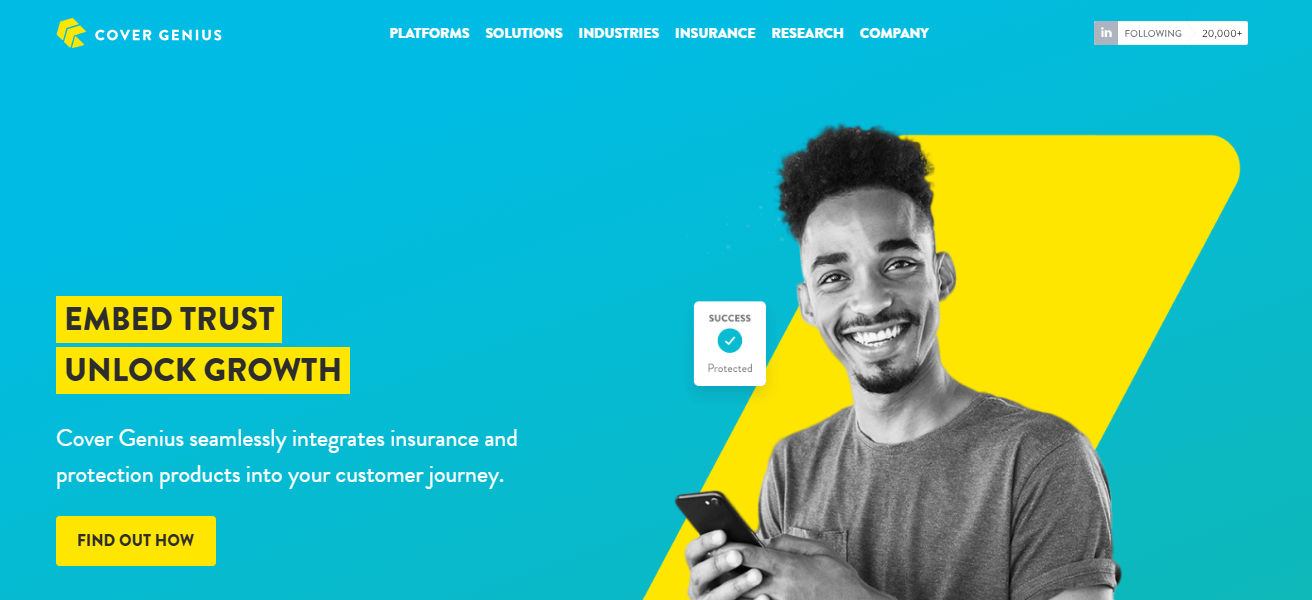
Cover Genius’ API does pricing and underwriting and issues policies and processes claims in different countries and in different currencies
Creating ease of use for customers and opening new revenue streams for partners. Businesses can enhance attach rates and customer confidence by using Cover Genius’ API.
Features Cover Genius
Global Insurance Delivery: Delivery coverage for multiple insurance products across numerous markets with great flexibility on currencies and countries.
Full Lifecycle API: Complete with a single full API, it lays out the steps of quoting, underwriting, creating policies, and resolving claims for insurance.
Cross-Industry Products: Integration of insurance into travel, shipping, products, rentals, and liability is included.
Dynamic Pricing & Underwriting: Real time calculations based on customer situation and their risk assessmen
| Pros | Cons |
|---|---|
| Global API that handles pricing, policy & claims. | More complex setup for highly customized workflows. |
| Supports many industries (travel, product, liability). | May have higher integration costs for small fintechs. |
| Multi-currency and country support. | Underwriting rules can be rigid for niche use cases. |
| Good documentation and developer support. | Some advanced features require deeper API expertise. |
4. Trov API
Insurance can be seamlessly integrated into digital applications offered by The Travelers Companies due to Trov’s embedded insurance. Trov’s platform, designed for on-demand and item-specific insurance, allows easy insurance distribution to digital brands.
Trov’s extensive vetting automated quoting, underwriting, and claims processing enables insurance to be sold with frictionless ease as digitized Trov integrated protected fintech offerings.
Trov’s API allows User Interaction and Unique Customized Protection Coverage Digital experiences and modernible offerings. Trov’s API enables Corporates to launch Protection offerings quickly and Fintech to capture a new stream of recurring revenues.
Features Trov API
On-Demand Coverage: Customers can activate insurance towards a particular item or for a particular time.
Seamless Digital Workflow: No offline paperwork is required for quotes and for issuance and claims automation.
Lightweight API: Clear documentation and simple endpoints total to a quick adoption by developers.
Modern Product Types: Excellent for rental, gig-economy, or usage insurance types.
| Pros | Cons |
|---|---|
| Modern, developer-friendly API. | Now part of a larger insurer, limiting stand-alone flexibility. |
| Allows on-demand & item-level coverage. | Smaller range of products compared to full stacks. |
| Handles quoting, issuance & claims automation. | Not as widely adopted as some incumbents. |
| Designed for digital partner integrations. | Can be costlier for low-volume usage. |
5. Qover
Qover offers embedded insurance orchestration solutions, providing customers with a fully integrated API suite that addresses the entire insurance value chain: underwriting, policy issuance, claims, and reports.
Qover’s APIs are built with flexibility and configurability in mind, which allows seamless integration and gives customers complete control of the UI, while automating the payments, documentation, and compliance workflows in the background.
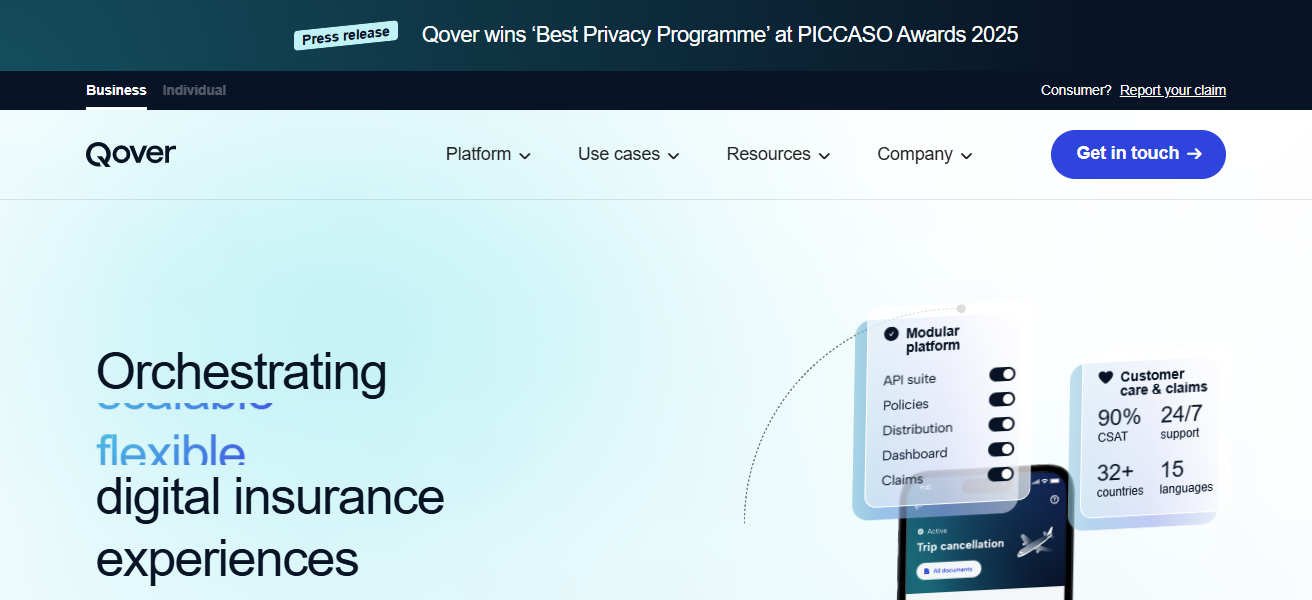
Qover has the capability to embed insurance solutions worldwide, including accident, travel, mobility, and purchase protection.
With tailored performance dashboards and automated processes, Qover removes operational friction for customers to scale their insured fintech offerings.
Features Qover
End-to-End Insurance Management: Complete insurance API capabilities from policies to claims.
Configurable Product Templates: Various insurances can be created by Fintechs without complex coding.
Multi-Partner Orchestration: One unified layer allows integration with multiple insurers.
Analytics & Reporting: Tools for dashboards to gain insights on sales, claims, and overall performance.
| Pros | Cons |
|---|---|
| End-to-end insurance lifecycle support. | Requires careful configuration to match product logic. |
| Flexible and configurable across products & markets. | Advanced analytics may need third-party tools. |
| Good automation of backend operations. | SMEs might need support for integration. |
| Dashboard and reporting included. | API complexity increases with custom products. |
6. Zopper Embedded Insurance
Zopper has built an integrated embedded insurance API infrastructure designed to be the first to connect banks, fintechs, retailers, digital brands, and ecosystem partners to multiple insurers, in India’s insurance market.
Zopper’s API solutions normalise insurer data and automate quoting, issuance and policy management. With low engineering overhead, Zopper allows partners to embed multiple covers (e.g. health, life, general) insurance within their apps and services.
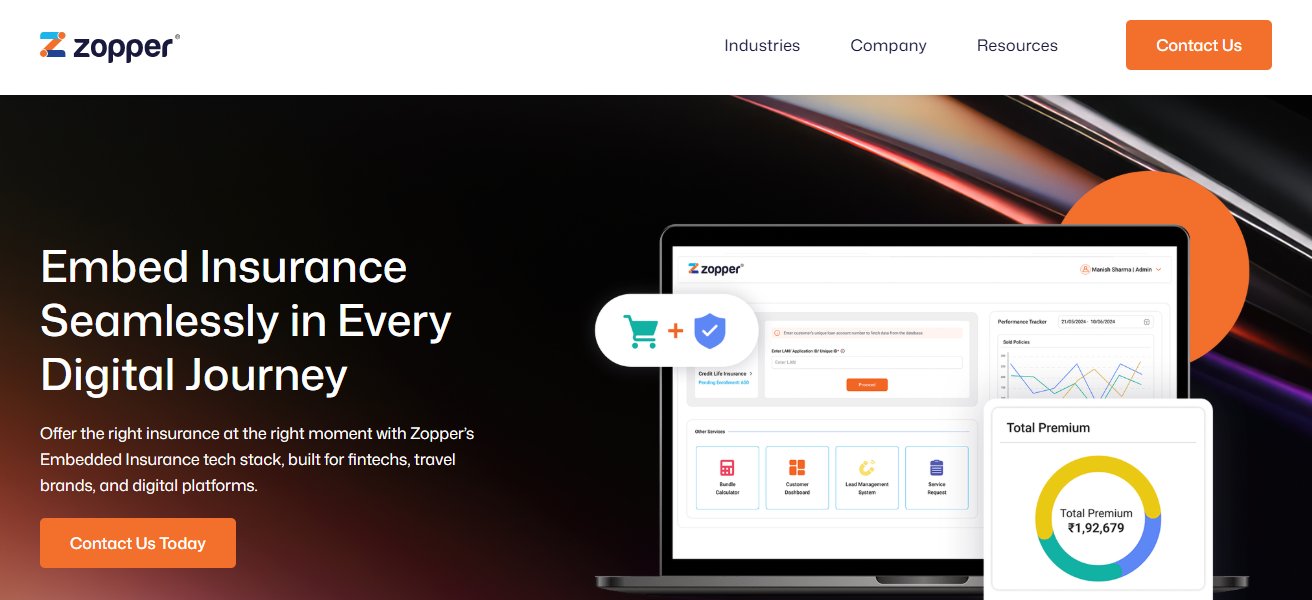
Zopper supports rapid distribution with low operational overhead, making claims tracking easier. India’s embedded insurance market allows Zopper to partner with some of the largest banks, and marketplace and retail players.
Features Zopper Embedded Insurance
Multi-Insurer Connectivity: One API can connect to several insurance partners in India.
Policy Normalization: Diverse processes across insurers are unified into a single API.
Automated Workflow: Issuance, documentation, renewals, and quoting are all automated.
Omnichannel Distribution: Can be used across partner ecosystems, retail POS, web, and apps.
| Pros | Cons |
|---|---|
| Strong in Indian market, connecting many insurers. | Less global footprint outside South Asia. |
| Normalizes APIs across multiple insurers. | Feature depth can vary by insurer partner. |
| Good for retail, fintech & banking partners. | Claims evolution depends on insurer capabilities. |
| Reduces operational overhead. | Not as specialized for parametric products. |
7. BIMA
BIMA is an insurtech company that utilizes technology to reach those who are currently underserved with life and health insurance products and seeks to provide this insurance digitally.
Although BIMA is not always talked about in the same context as other tech-focused insurtech companies due to the fact they also distribute digitally and integrate mobile wallets and partner applications, they still protect products right when they are needed.
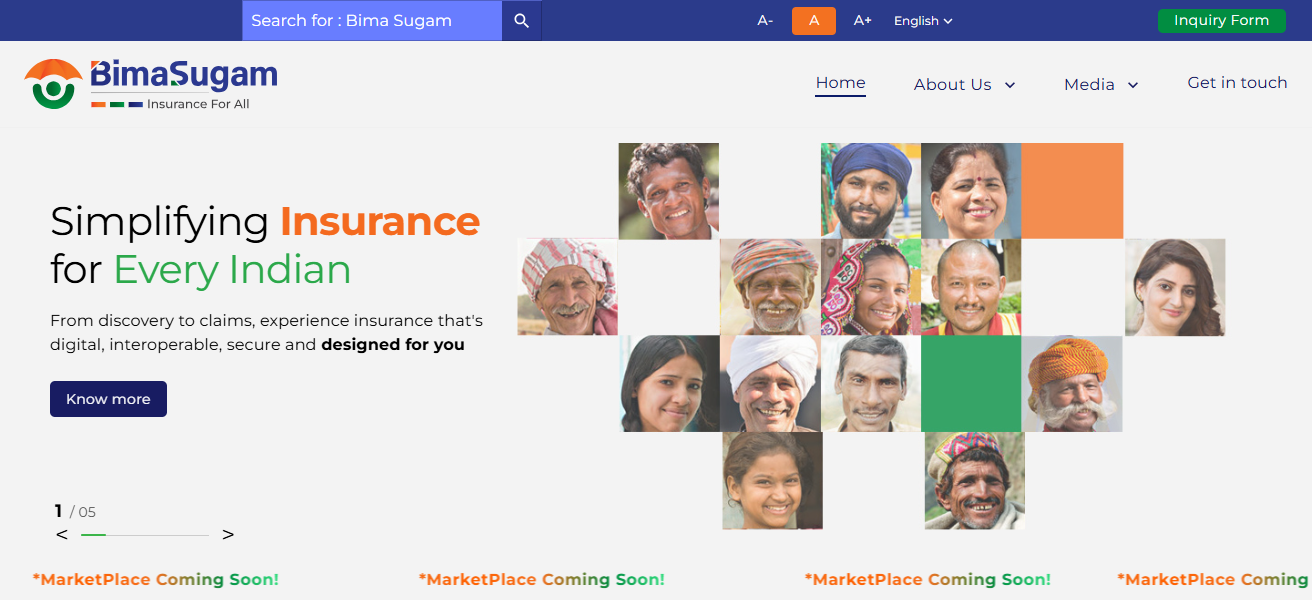
BIMA’s technology is also to insure customers who are oftentimes not convenient. Protection products in insurance are often customers who can not access. This makes BIMA an attractive partner to fintech companies who care about economic inclusion.
Features BIMA
Mobile-First Distribution: Targeted towards mobile use in developing countries.
Accessible Coverage: Micro-insurance, and health and life insurance for unserved populations.
Light Digital Onboarding: The new customers are getting onboarded with more ease, having a simplified process.
Partner-Driven Integration: Partnerships with a multitude of fintech wallets and apps.
| Pros | Cons |
|---|---|
| Focus on underserved markets and inclusion. | API ecosystem not as mature as tech-first peers. |
| Simplifies access to life & health insurance. | Fewer product variations for advanced fintech needs. |
| Mobile-first customer experience. | Not as strong for non-health products. |
| Good for reach & financial inclusion. | Integration may need additional partners. |
8. Instanda
Instanda offers a seamless cloud-native, API-First Insurance Platform that helps distribute, create, and administer agile insurance products thanks to their no-code and API innovations that helps insurance and fintech partners develop and manage products quickly and without extensive developmental work.
Instanda provides embedded insurance experiences through their quotes and policy servicing fintech apps or, through their distribution channels, while ensuring adaptability and speed to market.
Instanda works to support their insurers and partners allow rapid product and workflow customization that directly helps to cut down implementation costs and directly helps acceleration in digital transformation.
Features Instanda
Cloud-Native Platform: Built entirely for deployment and scalability on the cloud.
API-First Product Creation: Allows fintechs to create and customize insurance products through APIs.
No-Code Tools: Builders for forms and drag-and-drop are lessened design effort.
Flexible Policy Admin: Fully-fledged back-office operations for policy servicing and amendments.
| Pros | Cons |
|---|---|
| Cloud-native and highly configurable. | May require more setup time initially. |
| No-code options accelerate product launches. | Smaller third-party ecosystem compared to big players. |
| Strong policy admin and lifecycle features. | Customization may need advanced planning. |
| Designed for insurers & partners equally. | Not optimized for specific vertical use cases only. |
9. Singlife API
The Singaporean digital financial services provider Singlife offers integrated embedded services including insurance and savings products that fit into lifestyle and financial services.
Singlife enhances customer engagement by integrating protection with rewards through third-party apps and loyalty/award programs.
This integration allows Fintech applications to tailor coverage on demand and embed insurance into diversified journeys, offering greater ease of access to insurance.
Singlife’s activities exemplify the leading edge of embedded finance, characterized by seamlessly including insurance within digital engagements.
Features Singlife API
Embedded Savings & Insurance: Protection is embedded within apps to promote and support saving.
Partner Integration: APIs designed for seamless third-party embed within fintech and lifestyle platforms.
Personalized Experiences: Targeted efforts are offered based on the profile and actions of the user.
Digital Lifecycle Support: Buying, servicing and renewing coverage are all API-enabled.
| Pros | Cons |
|---|---|
| Integrates insurance with lifestyle & rewards journeys. | More focused on savings + life products. |
| Enhances engagement with embedded value-adds. | Product suite may be narrower for traditional covers. |
| API-driven integration with partner platforms. | Best for markets where Singlife operates. |
| Can boost loyalty and retention. | Complex flows may need more implementation effort. |
10. Demex API
Embedded insurance solutions for digital experiences Desmex collaborates with. Protection products by Demex insures with parametric insurance.
Demex integrates complex insurances fitted with trigger events to enable instant cover and automated claims.
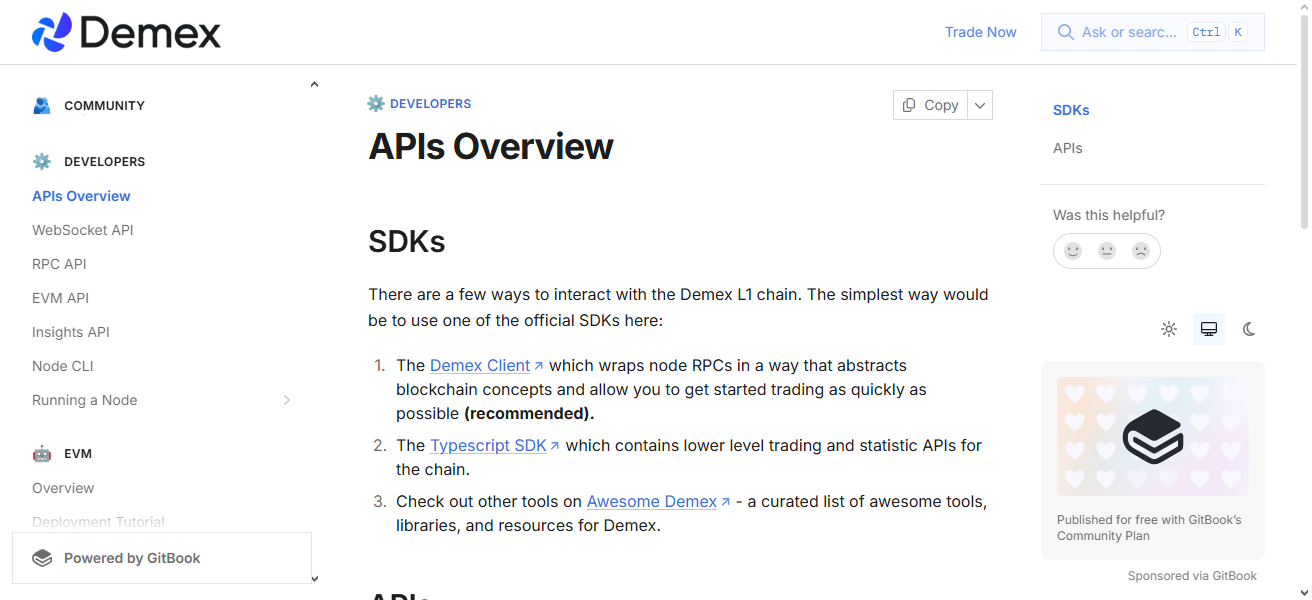
Fintechs are able to offer dynamic insurance solutions to customers because Demex makes complex insurances embedded.
Real-time sensors enable automated and seamless integration to apps to offer protection with the click of a button.
Features Demex API
Parametric Insurance Support: Enables automated payouts based on pre-established conditions (e.g. weather, data signals).
Data-Driven Risk Modeling: High reliance on data inputs for dynamic pricing and risk modeling.
Real-Time Coverage Events: No manual claims are needed as activation and payout are seamless.
IoT & Sensor Integration: Suited to scenarios where coverage conditions are driven by real-time external data or sensors.
| Pros | Cons |
|---|---|
| Strong in data-driven & parametric insurance. | Not ideal if you need basic traditional products only. |
| Real-time triggers & automated payouts. | Parametric insurance is less familiar to some teams. |
| Innovative risk transfer offerings. | Integration requires strong data feeds. |
| Enables dynamic coverage experiences. | May not cover all standard insurance categories. |
How To Choose The Best Embedded Insurance APIs for Fintech Apps
Integration and Flexibility of API Select the API that streamlines the integration and will take the least time through a developer-friendly, and well-documented interface.
Coverable Insurance Products Depending on your target market, confirm the required insurance coverages that the platform can provide, whether it is Life, Health, Device, Travel, Parametric, Micro-insurance etc.
Geographic Restrictions and Regulatory Compliance Determine if your API is set up to cover your operational regions and if it is capable of handling compliance, licensing, and regulatory requirements in a preset arrangement.
Comprehensiveness of the Insurance Management Lifecycle Select APIs that can control and oversee the complete activities of an insurance ecosystem to avoid integration problems in the future.
Customizable Solutions Including White Labeling Look for solutions that offer branding, user interface modifications, and bespoke coverages that will align with the user in your application.
Conclsuion
To sum up, the best integrated insurance application programming interfaces enable fintech applications to provide smooth, integrated insurance within digital experiences.
These API systems create additional trust and retention by simplifying compliance and claims management.
Other factors to consider when parting with a platform are expected product changes, geographical footprint, the ability to grow, and the UX alignment with your fintech’s future.
FAQ
They allow fintech apps to offer insurance directly within their platform using API integration.
They create new revenue streams and improve customer experience without building insurance infrastructure.
Usually no, as the API provider manages licensing and compliance.
Life, health, device, travel, micro-insurance, and parametric insurance.
Most platforms offer developer-friendly REST APIs and documentation.