
This article will cover top embedded lending platforms that enable companies to integrate lending and credit services into their digital offerings.
These services make it possible to streamline lending operations, enhance customer service, and provide funding solutions that scale without the need to construct complicated banking systems.
Embedded lending solutions, using modern APIs and lending systems that are ready for regulatory compliance, allow both fintech and non-financial companies to provide safe, seamless, adaptable, and user-centered lending services.
Key Points & Best Embedded Lending Platforms
| Platform | Key Point |
|---|---|
| Plaid | API-driven integrations enabling seamless financial data access for lending decisions |
| Mambu | Cloud-native banking engine supporting flexible lending product creation |
| Railsr | Embedded finance toolkit offering lending, payments, and card issuance |
| Solaris | Regulated banking-as-a-service platform with lending and compliance support |
| Marqeta | Card issuing and lending APIs for credit and BNPL solutions |
| Unit | Plug-and-play lending infrastructure for fintechs and SaaS providers |
| Synctera | Banking partnerships enabling embedded lending with compliance guardrails |
| Bond | Unified API platform for embedded credit and loan products |
| FinBox | India-focused embedded lending with strong BNPL and credit scoring tools |
| BlueQuartz | Data-driven lending solutions with advanced analytics for embedded finance |
10 Best Embedded Lending Platforms
1. Plaid
Plaid is an industry-leading financial data connectivity platform that facilitates embedded finance products like lending, payments, and account verification by safely connecting apps to users’ financial accounts.
It does not directly issue loans, but offers crucial credit API infrastructure to fintechs and lenders for credit value assessments, income or balance verifications, and workflow approvals.
Plaid enables developers to construct integrated solutions for real time financial data access, providing frictionless credit decisions and contextual lending within non-financial applications.
| Pros | Cons |
|---|---|
| Provides secure financial data APIs that help fintechs assess creditworthiness, verify accounts, and power lending decisions. | Doesn’t directly originate or service loans — more a data layer than a full lending engine. |
| Trusted by many fintechs worldwide with strong integrations into banks and apps. | Pricing can be high for startups with limited usage budgets. |
| Fast access to user financial accounts improves underwriting and reduces friction in loan workflows. | Dependency on bank connections means occasional data retrieval limitations. |
2. Mambu
Mambu is a cloud-native, fully composable core banking solution commonly encountered in lending and embedded finance.
Mambu is a flexible platform that enables rapid product deployment whereby banks, fintechs, and digital businesses are able to seamlessly integrate via APIs to offer loans
Buy-now-pay-later (BNPL) products, credit to small and medium enterprises (SMEs), and a variety of other financial products.
Mambu’s modular lending engine is capable of managing and servicing a variety of products in accordance with client requirements
While its Software as a Service (SaaS) architecture also provides for real-time payment processing and regulatory compliance.
Mambu’s embedded infrastructure increases the speed to market of embedded credit solutions for third parties.
| Pros | Cons |
|---|---|
| Cloud-native core banking that supports configurable lending products (SME credit, term loans, BNPL, etc.). | Requires technical integration work and dedicated engineering resources. |
| Modular, API-driven architecture speeds time-to-market for embedded credit. | Not a plug-and-play lender — partners still need to manage risk/underwriting. |
| Scales across regions with strong compliance support. | Customization can increase costs and complexity. |
3. Railsr
Railsr (previously Railsbank) is an embedded finance service provider that offers unified APIs for banking, payments, cards, and credit services.
With its modular banking system, businesses are able to integrate financial functionalities, including lending and credit, into their applications without having to develop their own backend structures.
By streamlining the complexities of regulation, settlement, and compliance, Railsr enables its clients to offer white-label financial products such as loans, cards, and wallets.
This allows brands to monetize their offerings and increase customer engagement within the financial services ecosystem.
| Pros | Cons |
|---|---|
| All-in-one embedded finance infrastructure: cards, payments, and lending APIs. | Some markets limited due to regional licensing and provider partners. |
| Helps brands embed credit capabilities without building backend banking rails. | Abstraction layer can reduce visibility into underlying lending risk. |
| Reduces regulatory and settlement burdens for fintechs. | Pricing & compliance obligations vary by region. |
4. Solaris
Solaris (usually called Solarisbank in Europe) provides geared banking infrastructure, allowing businesses to integrate financial services like accounts, loans, and payments into their offerings.
It combines compliance, IBAN accounts, and modular APIs, providing a fully regulated environment for non-financial brands to issue embedded credit and digital banking services.
Managing local regulatory requirements, risk, and settlement, Solaris streamlines operational expansion across European markets and supports embedded loans and financing services within partner ecosystems.
| Pros | Cons |
|---|---|
| Regulated banking infrastructure that supports lending, accounts, and KYC under one platform. | Primarily focused on European markets, less global coverage. |
| Enables non-financial brands to embed credit and digital banking features inside apps. | Bank partnership limits flexibility compared to pure tech providers. |
| Simplifies compliance and regulatory challenges for credit products. | Setup and regulatory coordination can be slower than API-only providers. |
5. Marqeta
Marqeta processes payments and issues cards, and, through its APIs, supports embedded financial services, including Buy Now, Pay Later (BNPL) and flexible credit options.
Through its Marqeta Flex, BNPL loans can be embedded into checkout flows, enabling payment apps and digital wallets to provide flexible financing at the point-of-sale.
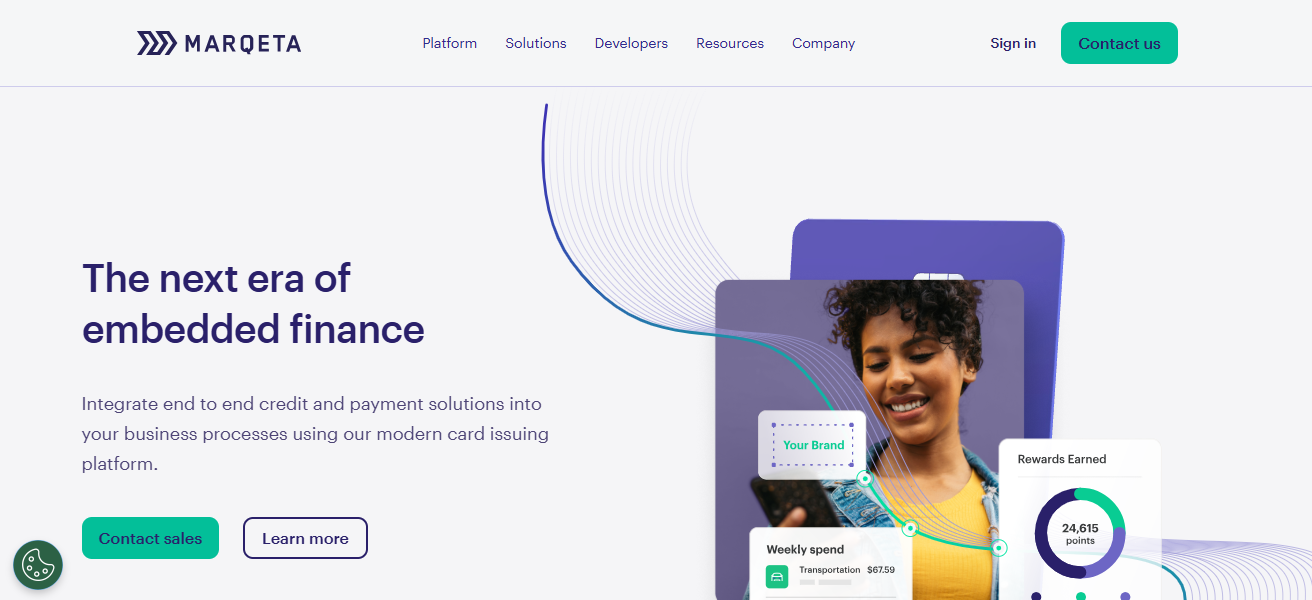
With a focus on embedded lending and credit-linked payment products, Marqeta’s infrastructure supports customization, real-time controls, and compliance.
| Pros | Cons |
|---|---|
| Leading card-issuance infrastructure with support for embedded BNPL & credit options. | Stronger in card payments than full lending engine features. |
| Real-time controls and customizable features for credit at checkout. | Not a complete lending stack alone — focused on payment and BNPL rails. |
| Scales with high transactional throughput for modern fintechs. | May require additional partners for underwriting or loan servicing. |
6. Unit
The US-based BaaS provider Unit offers a comprehensive toolkit to embed banking and lending features, including deposit accounts, card services, cash advance, and credit functionalities, for software companies and fintechs.
Apart from compliance, ledgering, and workflow APIs, it includes a one-stop financial services workflow that minimizes reliance on multiple vendors to improve time-to-market
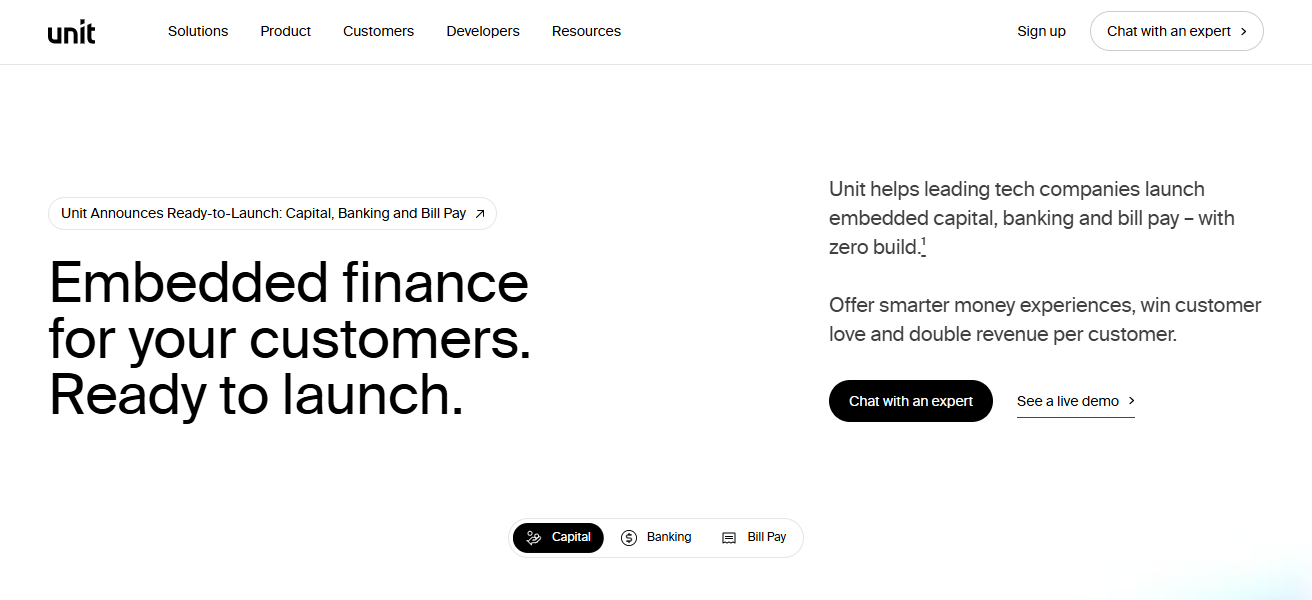
for embedded financial services, including cash advance and credit. With a developer-first strategy, Unit is able to assist companies in the rapid deployment of lending and credit services within their platforms.
| Pros | Cons |
|---|---|
| Comprehensive Banking-as-a-Service toolkit — deposits, cards, credit all in one. | Tends to be focused on US market; global availability is limited. |
| Built-in compliance and ledgering reduces integration overhead. | May be overpowered for smaller niche use cases without need for full banking stack. |
| Accelerates launch timelines for embedded financial products. | Requires partners to handle underwriting and risk models. |
7. Synctera
Synctera is a banking and payments platform that allows businesses to create and grow embedded banking and credit products through a unified set of APIs.
It simplifies embedding lending and card programs, banking features, and money movement to apps. It removes the operational burden of embedding products by streamlining risk and compliance processes.
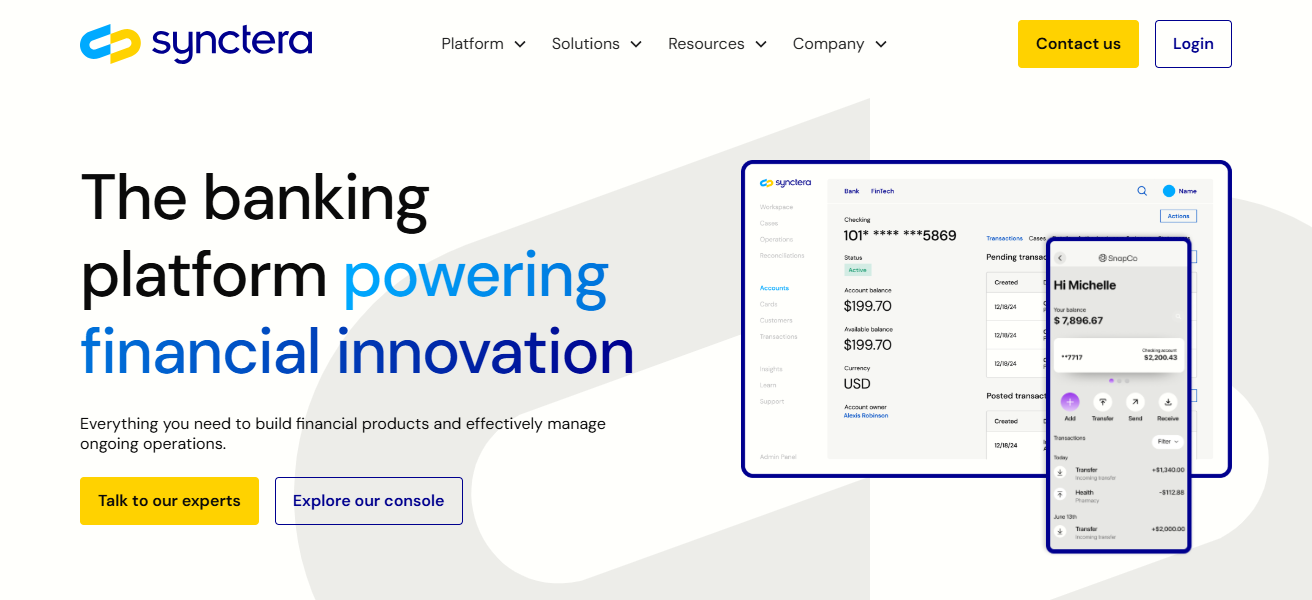
ThisOps control over embedded financial products, making it especially suitable for startups and scale-ups offering credit services.
| Pros | Cons |
|---|---|
| Single API platform connecting fintechs with sponsor banks for embedded credit and banking. | Focuses on program launch/operations rather than underwriting intelligence. |
| Handles compliance, KYC, and risk workflows with transparency. | May have minimum usage requirements or enterprise pricing. |
| Suitable for startups and scaleups needing embedded finance infrastructure. | Engineering resources still needed for custom products. |
8. Bond
Bond is a licensed enterprise-level embedded finance platform that enables businesses to embed card and lending solutions into their offerings via state-of-the-art APIs and SDKs.
Bond simplifies the complexities of bank partnership and regulatory processes for businesses to provide their customers with personalized financing options, credit builder cards, and other loan-linked features within weeks, instead of months.
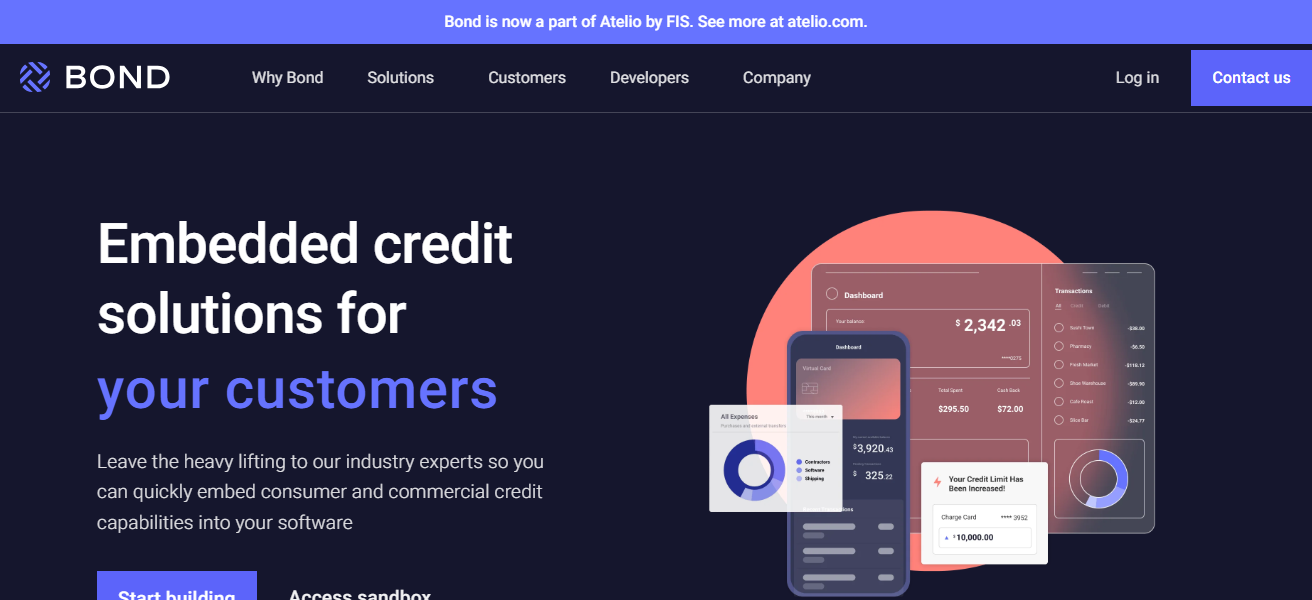
Bond’s unified infrastructure facilitates onboarding, KYC, and underwriting and other regulatory processes to launch virtual and physical credit and debit programs at a rapid pace.
| Pros | Cons |
|---|---|
| Unified embedded finance APIs for credit cards and lending capabilities. | As a BaaS integrator, actual lending terms depend on partner banks. |
| Handles onboarding, KYC, compliance, and program orchestration. | May need external data partners for deep credit analysis. |
| Helps launch personalized financing options quickly. | Some advanced features require custom implementation. |
9. FinBox
FinBox offers embedded credit and financial solutions that make it easy to integrate loan products, BNPL, term loans, and overdrafts into digital platforms.
With its ecosystem, lenders and digital platforms are connected via APIs and pre-built journeys, minimizing technical roadblocks and speeding up the go-to-market process.
Along with supporting instant data processing and real-time underwriting, FinBox helps partners manage the growth of their loan books profitably.
This helps businesses perform seamless lending and create new revenue opportunities through embedded finance.
| Pros | Cons |
|---|---|
| Focused on embedded credit products like BNPL, overdraft, and term loans via easy APIs. | Less coverage outside India (depending on partner networks). |
| Supports real-time underwriting and loan origination systems. | Loan portfolio risk and compliance still need partner management. |
| Pre-built journeys reduce development time. | Might need additional third-party tools for full compliance and scoring. |
10. BlueQuartz
Results from the BlueQuartz search show unrelated software development and materials analytics companies instead of an embedded finance or lending platform.
This means it probably isn’t a known fintech embedded lending provider. If you meant a different finance-related BlueQuartz company, please tell me.
However, the publicly indexed BlueQuartz Software, based on available data, does not provide embedded finance or lending services.
| Pros | Cons |
|---|---|
| No embedded finance / lending capability — BlueQuartz Software focuses on materials science/engineering tools. | Not applicable as a lending or embedded finance provider — does not offer financial APIs, lending engines, or banking services. |
| Useful software for materials data analytics in engineering contexts. | Not relevant for fintech or embedded lending use cases. |
| Serves engineering & research communities, not financial product builders. | If you meant a different “BlueQuartz” in fintech, please clarify. |
How To Choose Best Embedded Lending Platforms
API Flexibility — Looks at how lending features easily integrate into other apps with new API structures.
Compliance Support — Surveys the embedded KYC, AML, and lack of regulation for the operating areas.
Lending Capabilities — Looks at support for loan types, BNPL, credit line, and payment plans.
Scalability — Assesses the growth potential and how the platform manages many transactions and users.
Time to Market — Evaluates how fast businesses are able to offer embedded lending features.
Data & Underwriting — Looks at the availability of real-time data and credit assessment tools.
Customization — Assesses the ability to modify lending features, process, and customer experience.
Geographic Coverage — Outlines the country and currency availability for the embedded lending solution.
Security Standards — Verifies the protective measures against data breaches, encryption and fraud.
Cost Structure — Evaluates the clarity of costs, platform fees, and cost during the lifespan of the service.
Cocnlsuion
In cocnlsuion The high-quality embedded lending solutions allow companies to integrate fast, safe, and adaptable lending solutions into their digital platforms.
These platforms provide seamless APIs, lending compliances, and flexible lending infrastructures to ease developmental stress and quicken market entry.
For lending ecosystems to optimally evolve, companies must select embedded lending platforms that better customer experience, increase revenue, and sustain competitive advantage.
FAQ
They allow businesses to offer loans directly within their apps using APIs and financial infrastructure.
Fintechs, marketplaces, SaaS companies, and non-financial brands offering credit to customers.
Most provide infrastructure; lending is usually handled by partner banks or financial institutions.
Yes, they operate with built-in compliance, KYC, AML, and regulatory partnerships.