
In this article, we will review the Best Enterprise Search & Discovery Platforms which enable organizations to efficiently find, access, and use information across disparate data sources.
- Key Points & Best Enterprise Search & Discovery Platforms
- 10 Best Enterprise Search & Discovery Platforms
- 1. Elastic Enterprise Search
- 2. Microsoft SharePoint Syntex
- 3. Coveo
- 4. Lucidworks Fusion
- 5. Amazon Kendra
- 6. IBM Watson Discovery
- 7. Algolia
- 8. Google Cloud Search
- 9. Sinequa
- 10. BA Insight
- How We Choose Best Enterprise Search & Discovery Platforms
- Cocnlsuion
- FAQ
As digital content proliferates, choosing the right platform becomes critical to improving productivity, optimizing decisions, and relevant outcomes. I will discuss the key features, and advantages and review some of the best options available today.
Key Points & Best Enterprise Search & Discovery Platforms
| Platform | Key Point |
|---|---|
| Elastic Enterprise Search | Scalable open-source search engine with strong indexing and analytics capabilities |
| Microsoft SharePoint Syntex | AI-powered content discovery integrated with Microsoft 365 ecosystem |
| Coveo | Personalized search experiences using AI and machine learning |
| Lucidworks Fusion | Advanced AI-driven insights with strong scalability for enterprises |
| Amazon Kendra | Natural language search optimized for enterprise knowledge bases |
| IBM Watson Discovery | Cognitive search capabilities with NLP and AI integration |
| Algolia | Fast and developer-friendly search with strong API support |
| Google Cloud Search | Seamless integration with Google Workspace for enterprise collaboration |
| Sinequa | AI-powered enterprise search with strong multilingual support |
| BA Insight | Connectors for multiple data sources enabling unified enterprise search |
10 Best Enterprise Search & Discovery Platforms
1. Elastic Enterprise Search
Elastic Enterprise Search has the ability to seamlessly search multiple sites, applications, and workplace information. It harnesses the power of Elasticsearch to provide quick, relevant, and scalable search results.
Organizations can customize the relevancy of search results, control different sets of data, and analyze results to enhance the user experience.

It has simple dashboards and connectors for easy content integration from sites such as Salesforce, Google Drive, and Slack.
Elastic is suitable for enterprises that require strong real-time search and discovery capabilities as it also incorporates AI features such as natural language processing, autocomplete, and suggestions for content.
Features Elastic Enterprise Search
Real-Time Search & Indexing – Websites, applications and enterprise sources are indexed and searched in a matter of seconds.
Customizable Relevance – Search relevance is customizable, allowing users to fine-tune the ranking and prominence of critical results.
Connectors & Integrations – Prebuilt integrations with systems such as Salesforce, Google Drive and Slack are included.
Search Analytics Dashboard – Search and behavioral data to visualize and optimize user experience during each search.
| Pros | Cons |
|---|---|
| Fast, scalable search powered by Elasticsearch, excellent for large datasets. | May require technical expertise to tune and optimize relevance. |
| Real‑time indexing and strong analytics dashboards. | Costs can rise significantly at enterprise scale. |
| Connectors for many sources (Salesforce, Slack, Google Drive). | Self‑hosted setups need ops resources and monitoring. |
| Customizable relevance and search UI options. | Support costs higher for premium features. |
2. Microsoft SharePoint Syntex
Microsoft SharePoint Syntex is an application on Microsoft 365 that uses artificial intelligence to assist with content management and business searching.
It improves findability by identifying, labeling, and pulling metadata from files. Accessible from SharePoint document libraries, employees can conduct multi-team and multi-department searches with greater ability.
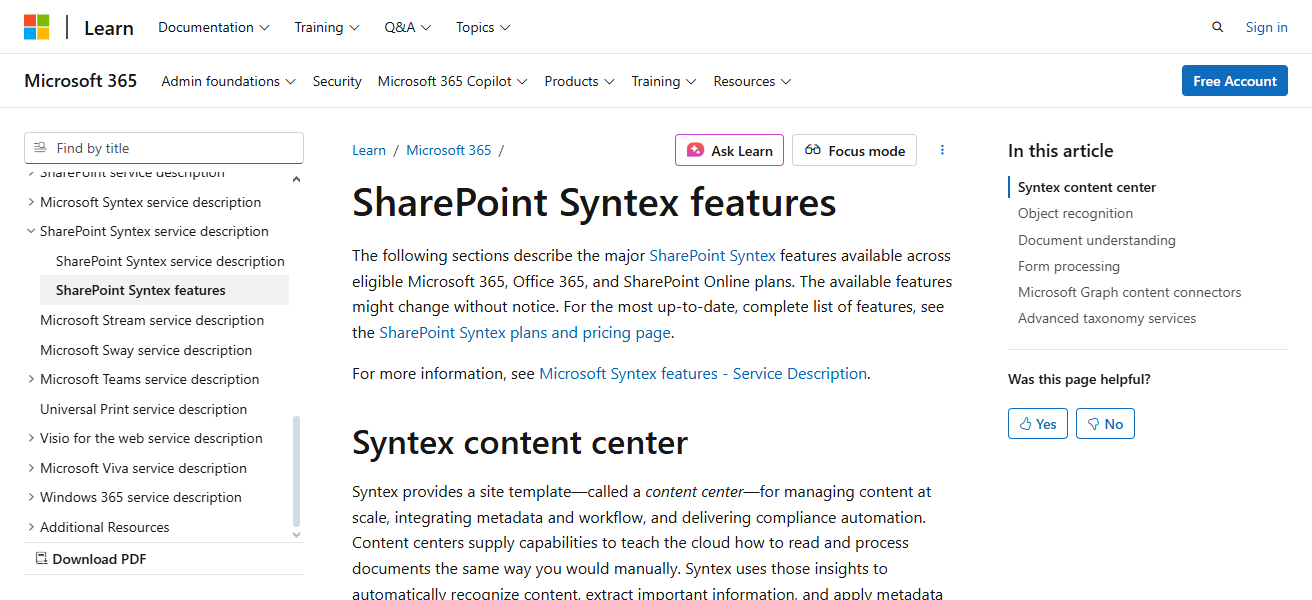
The system’s generative artificial intelligence improves optimization of Syntex systems to organizational learned structures providing greater document intelligence and compliance.
Syntex streamlines workflow processes by automating mundane tasks and facilitates document life cycle management.
Organizations get quicker information retrieval, greater collaboration, and enterprise data becomes more useful.
Features Microsoft SharePoint Syntex
AI Driven Content Classification – Automatically classifies content for improved search and governance using categorization AI model for documents.
Metadata Extraction – Extracts specific key pieces of content (terms, clauses) as search-abled content to improve document searches.
Deep Microsoft 365 Integration – Unified in Microsoft applications for coherent search with SharePoint, Teams and OneDrive.
Automated Workflows – Automation of tagging, compliance and content lifecycle processes, reduces the manual effort involved.
| Pros | Cons |
|---|---|
| Deep integration with Microsoft 365 and SharePoint. | Best value only within the Microsoft ecosystem. |
| AI‑driven document classification and metadata extraction. | Limited support for non‑Microsoft data sources. |
| Improves compliance and content lifecycle automation. | Custom model training has a learning curve. |
| Boosts discoverability across Teams and SharePoint. | Not ideal for complex external search needs. |
3. Coveo
Coveo is an AI-powered search and recommendation technology that helps companies enhance their productivity and customer experiences.
By bridging multiple content sources, like CRM, cloud applications, and websites, Coveo provides contextually-relevant results.
Coveo increases engagement and efficiency by personalizing search results through their machine learning technology. Coveo optimizes their results through analytics that track user interactions.
Other features include predictive recommendations, advanced relevance tuning, and support for natural language queries.
For companies that want to improve further operational efficiencies through intelligent, data-driven search and discovery, Coveo helps drive effective decision making.
Features Coveo
AI Personalization – Search results that are customized to individual users.
Unified Search Across Sources – Combination of data from a customer relationship management (CRM) system, cloud applications, and knowledge portals and websites.
Machine Learning Relevance – Learning from usage to improve and optimize the search from the system.
Advanced Analytics: Patterns user searches and makes results and decision-making more efficient.
| Pros | Cons |
|---|---|
| Strong AI‑powered personalization and recommendations. | Can be expensive for smaller deployments. |
| Connects to many enterprise data sources. | Setup and relevance tuning require specialist skills. |
| Advanced analytics for search optimization. | Complexity increases with advanced features. |
| Improves engagement with predictive search. | Some integration overhead for custom systems. |
4. Lucidworks Fusion
Lucidworks Fusion serves as an AI-response search platform deriving its base from Apache Solr and focusing upon machine learning and higher level analytics.
With Fusion, companies can customize their search results as it helps companies understand their user’s search behaviors and utilizes predictive relevance models.
Fusion makes it possible to index content from both formatted and non-formatted data, enabling it to process data across mulitple, real-time streams.
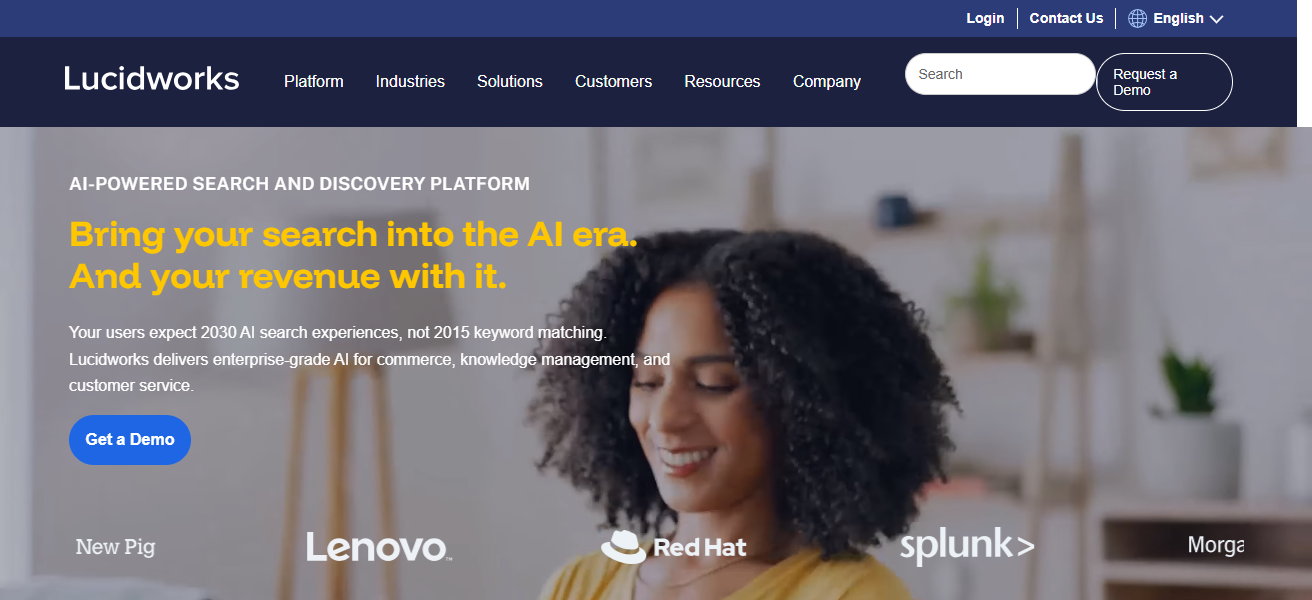
Fusion employs numerous innovative features like NLP, signal processing, and recommendation enging, resulting in improving user’s operational efficency and providing actionable intel.
Fusion excels in cases where businesses require complex search, analytics and discovery to be done on an enterprise level.
Features Lucidworks Fusion
AI-Powered Search Relevance: Contextual, personalized search results are achieved using machine learning.
Signal & Query Processing: Improves relevance of results over time through user interaction.
Support for Mixed Data Types: One search platform for both structured and unstructured data.
Analytics & Insights: Search configuration and performance are improved through provided dashboards and metrics.
| Pros | Cons |
|---|---|
| Built‑in machine learning for personalized relevance. | High implementation complexity for custom use. |
| Handles structured and unstructured content. | Requires knowledge of Solr to maximize potential. |
| Real‑time indexing and signal processing. | Can be costly at large scales. |
| Extensive analytics and AI tools. | Longer deployment timelines for enterprise use. |
5. Amazon Kendra
Amazon Kendra is a cloud-based smart enterprise search service, which, using machine learning, can answer questions from untapped data. Kendra connects to cloud and local data sources, such as SharePoint, Salesforce, and S3.
Kendra helps users improve their productivity by understanding open-ended, everyday language questions and providing direct answers, as opposed to just responding with links and directing users to search results.
Users can improve their productivity by using Kendra not just to answer simple questions, but also to provide detailed context, which helps them to zone in on crucial information.
Features Amazon Kendra
Natural Language Understanding: Answers questions, e.g. ‘Where’s the Q4 report?’, precisely rather than just linking to it.
Secure Data Connectors: Integration of data from SharePoint, S3, Salesforce, and other databases.
Relevance Tuning: Different user groups or departments can be given different result tuning configurations.
Fully Managed Service: Infrastructure, scaling, and maintenance are managed by AWS.
| Pros | Cons |
|---|---|
| Natural language understanding returns direct answers. | Costs can grow with query and data volume. |
| Fully managed AWS service (low ops burden). | Less algorithm control versus self‑hosted systems. |
| Built‑in connectors for common data sources. | Best fit if you’re already on AWS. |
| Automatic relevance tuning and analytics. | Limited customization outside AWS ecosystem. |
6. IBM Watson Discovery
IBM Watson Discovery is an AI-based search and content analysis platform that helps businesses understand complex data.
Watson Discovery pulls information from various unstructured data sources like documents, web pages, and databases.
It understands natural language and uses machine learning and AI to discover patterns, trends, and relationships.
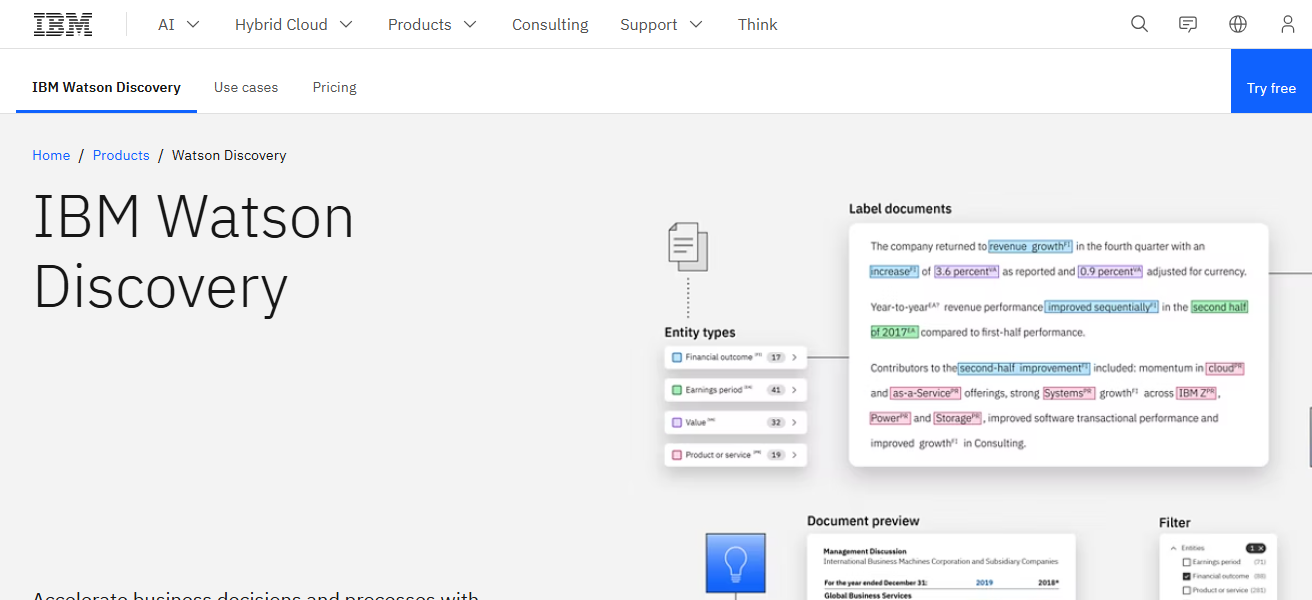
Businesses are able to create their own search applications, chatbots, and analytics dashboards to help them streamline their decision-making processes and improve their operational efficiencies.
Watson Discovery offers businesses advanced cognitive search capabilities and helps them uncover elusive information within their large amounts of data. Organizations are able to process information much faster.
Features IBM Watson Discovery
Advanced NLP: Key entities and insights are pulled out of unstructured text using natural language processing.
Cognitive Search Capabilities: Content’s context, sentiment, and relationships are understood.
Custom Query & Training: Search models can be tailored to specific phrases and use cases.
Insight Extraction & Dashboards: Large document sets can be used to find trends, patterns, and other actionable information.
| Pros | Cons |
|---|---|
| Strong NLP and cognitive search capabilities. | Steeper learning curve for AI features. |
| Excellent for unstructured data insights. | Pricing can be complex to predict. |
| Can uncover hidden patterns and relationships. | Setup for advanced use can be time‑intensive. |
| Good for building cognitive search apps or chatbots. | Integration complexity with legacy sources. |
7. Algolia
Algolia is a fully managed search API service optimized for fast and relevant searching across different websites and applications, competitor products, etc.
It provides searching, real-time index updates, search typo imprecision tolerance, and AI search differentiation.
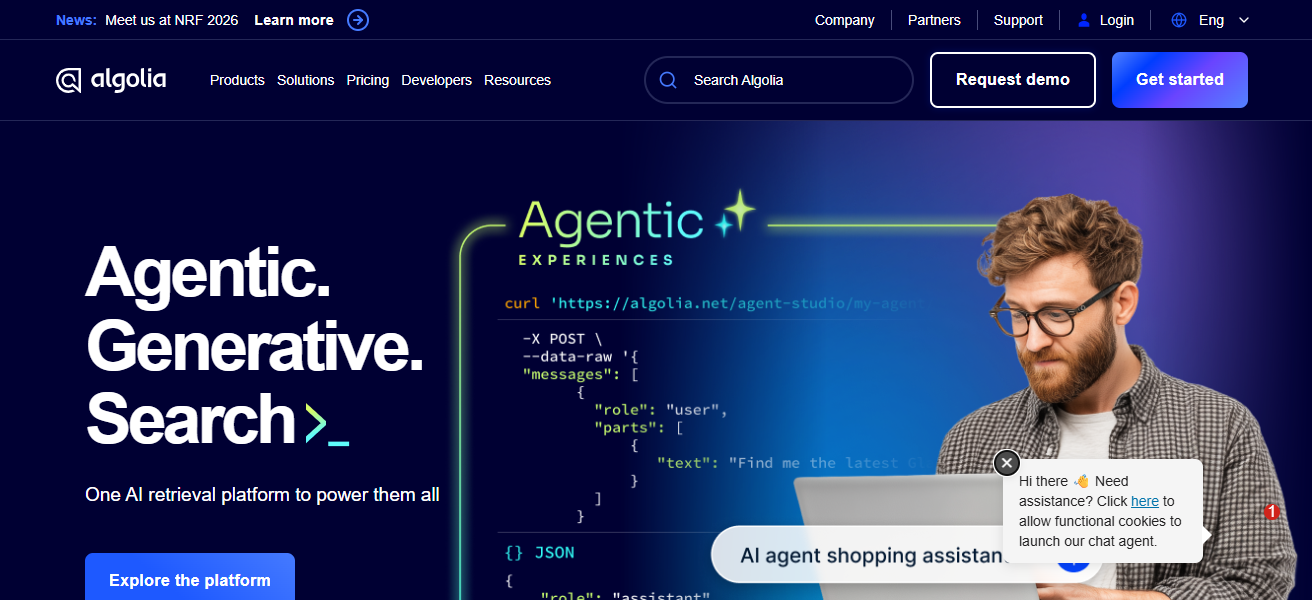
Algolia removes barriers to users finding specific content and offers both structured and unstructured data via a faceted search that is fully customizable, driving user engagement and Conversion Rate Optimization (CRO) demands.
Algolia has powerful search performance analytics and search relevance optimization and is one of the strongest search-discovery platforms for enterprise users.
Features Algolia
Fast, Instant Search. Search response times are blazing fast thanks to real-time indexing.
Typo-Tolerance & Relevance. Handles misspellings automatically and ranks results based on relevance.
Developer-Friendly APIs. Integrating Algolia with web and mobile applications is easy with our provided SDKs.
Faceted & Filtered Search. Users are empowered to fine-tune search results with a selection of filters and categories.
| Pros | Cons |
|---|---|
| Extremely fast, typo‑tolerant search responses. | Focused mainly on digital experiences, not deep enterprise insight. |
| Developer‑friendly APIs and SDKs. | Costs tied to query volume and indexing usage. |
| Great for websites and apps requiring instant results. | Less suited for complex content analytics. |
| Faceted search and personalization support. | Limited built‑in content intelligence. |
8. Google Cloud Search
Google Cloud Search is a model that connects and utilizes Google Workspace and other third-party applications and tools to provide enterprise-level cloud search solutions.
In search and retrieval from Google Cloud Search integrated tools, it provides actionable insights, natural queries, and contextual search using advanced Google AI technologies.
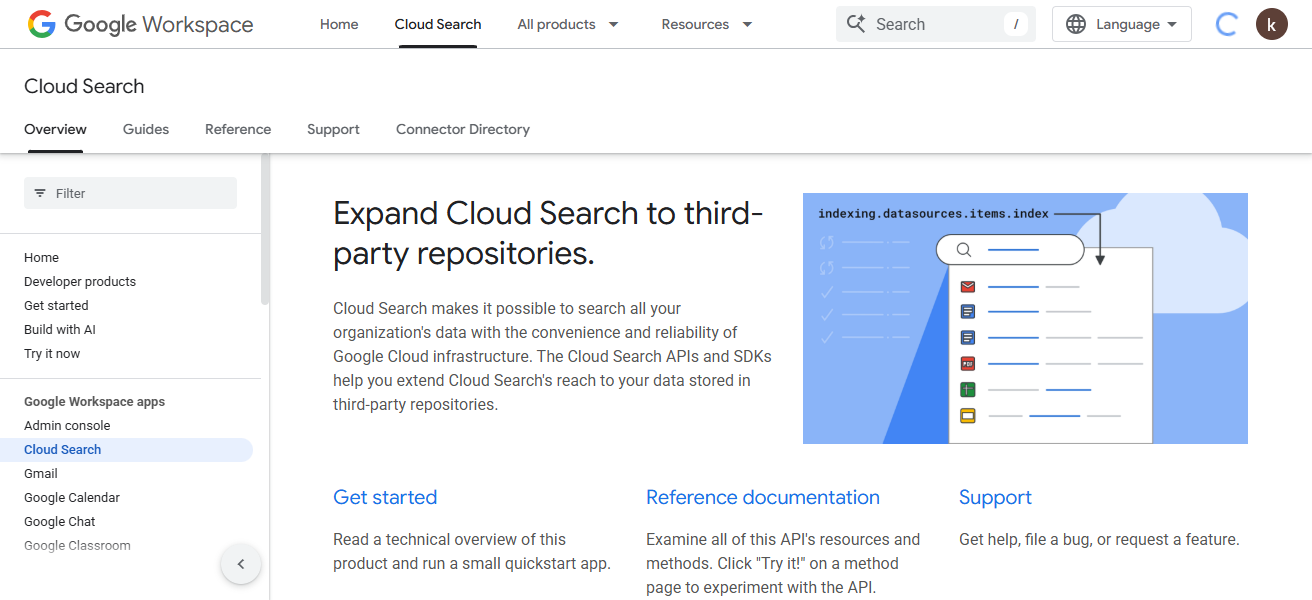
Google Cloud Search is focused on advanced security and protection of sensitive data. Google Cloud Search provides enterprise collaboration tools by breaking down data silos for rapid data retrieval.
It enhances enterprise productivity and user search and data retrieval by providing AI suggestions and indexing structured and unstructured data.
Features Google Cloud Search
Unified Workspace Search. Search Gmail, Drive, Docs, Sheets, and other Google Workspace tools from a single point.
Natural Language Queries. Users search the way they speak. e.g. “Find budget file from Raj.”
Security & Access Control. Google Workspace permissions are automatically respected for secure access to information.
AI-Powered Suggestions. Relevant content is predicted and results are suggested to the user as they type.
| Pros | Cons |
|---|---|
| Seamless integration with Google Workspace. | Best value within the Google ecosystem. |
| Natural language queries and smart suggestions. | Fewer third‑party connectors than other platforms. |
| Strong security and access controls. | Advanced customization is limited. |
| Unified search across Gmail, Drive, Docs, and more. | Pricing tied to Workspace licensing. |
9. Sinequa
Sinequa focuses on information intelligence with an analytics platform and NLP based search capabilities. Semantic search capabilities with relevance, NLP, and machine learning to understand user intent.
Then analytics capabilities with automated dashboards, knowledge graphs, and content classification.
Operational and regulatory efficiency with rapid access and sense making of complex datasets. Best fit for large enterprises with advanced search and discovery.
Features Sinequa
Semantic Search Engine. Crosses structured and unstructured data to understand meaning and context.
Machine Learning & NLP. Relevant insights are surfaced by processing advanced language.
Knowledge Graphs. For deeper discovery, contextual relationships between concepts are built.
Enterprise-Scale Connectivity. Large repositories and complex data architectures are supported.
| Pros | Cons |
|---|---|
| Enterprise‑grade semantic search with NLP. | Requires specialist skills for setup and tuning. |
| Connects structured and unstructured data sources. | Higher total cost of ownership for smaller teams. |
| Knowledge graphs and advanced analytics. | Longer implementation timelines. |
| Good for compliance, risk, and complex discovery. | Complexity may exceed needs for basic search use. |
10. BA Insight
BA Insight enriches enterprise search by using artificial intelligence and machine learning which integrates with other technologies for seamless and secure search throughout the enterprise.
It augments Microsoft SharePoint, Microsoft Office 365 and other enterprise applications, helping users access and search both the cloud and on-premises content.

BA Insight’s features include search relevance tuning, analytics, and performance visualization. It enriches access to more enterprise data sources with its connectors, further enhancing knowledge discovery and collaboration.
By providing seamless enterprise integration of AI search, BA Insight enables enterprises to fully utilize their content, minimize information silos, and increase employee productivity.
Features BA Insight
Connector Ecosystem. Integration with SharePoint, Office 365, and other enterprise platforms is smooth and easy.
AI‑Driven Relevance Tuning. Search quality is improved with contextual relevance models for relevance.
Unified Search Experience: Consolidates cloud-based and local content into one search interface.
Analytics & Reporting: Monitors user actions and improves the search settings.
| Pros | Cons |
|---|---|
| Enhances search across SharePoint, Office 365, and other systems. | Best suited to Microsoft‑centric environments. |
| AI‑driven relevance tuning and analytics. | Cost increases with connector use. |
| Broad connector support for many enterprise sources. | Feature set depends on underlying engines like SharePoint. |
| Improves unified search across on‑prem and cloud. | Not as strong standalone without Microsoft stack. |
How We Choose Best Enterprise Search & Discovery Platforms
Compatibility with Current Systems: The solution must integrate well with your CRM, intranet, cloud apps, databases, and document repositories.
AI & Search Result Relevance: Consider the ones with natural language processing (NLP), machine learning, and personalization.
Performace & Scalability: Large amounts of structured and unstructured data must be processed by the solution. Real-time indexing and quick search response times are necessary.
Security & Standards: Check if the system retains necessary access controls, encryption, and compliance (e.g. GDPR) oriented systems.
User & Admin Tool Configuration Ease: Look for user-friendly search interfaces for search end-users. Admin tools for tuning search relevance, capturing data analytics, and performance monitoring.
Cocnlsuion
In conclusion, choosing the right Enterprise Search & Discovery Platform is critical for optimizing auser productivity and auser gaining the most out of one`s data. Elastic, Coveo, and Amazon Kendra have AI’s, integration of systems, and good analytics.
The assess features, scalability and the level of security for a business auser seamless to level features auser refined auser must decision in a competitive world to data driven one.
FAQ
A software solution that enables organizations to search, discover, and access information across internal and external data sources.
It improves productivity, reduces time spent looking for information, and helps make data-driven decisions.
Elastic Enterprise Search, Microsoft SharePoint Syntex, Coveo, Lucidworks Fusion, Amazon Kendra, IBM Watson Discovery, Algolia, Google Cloud Search, Sinequa, BA Insight.
They understand user intent, provide relevant results, enable natural language queries, and offer personalized search experiences.
Yes, most platforms support hybrid environments with connectors for both cloud services and on-prem repositories.