The values will empower the decentralized organizations with Visibility, Flexibility, and Safe Governance.
Aragon, and Juicebox empowers organizations with Voting, Treasury Management, and Legal Compliance.
These platforms will support enterprises with sustained and cohesive development in decentralized networks.
Such innovations fuel Decentralized Autonomous Organizations with Flexibility, Visibility, and Safe Governance.
Key Points & Best Enterprise Token Governance Platforms For DAOs
| Platform | Key Point |
|---|---|
| Aragon | Modular governance framework with customizable voting and treasury management |
| DAOstack | Holographic consensus model enabling scalable decision-making |
| Colony | Reputation-based governance aligning voting power with contributions |
| Snapshot | Gasless off-chain voting widely adopted by DAOs for efficiency |
| Tally | On-chain governance dashboard for transparency and proposal tracking |
| Boardroom | Multi-DAO governance aggregator simplifying participation across protocols |
| Gnosis Safe | Secure multisig treasury management integrated with DAO governance |
| Orca Protocol | Pod-based governance enabling flexible sub-groups and delegation |
| Syndicate | Investment DAO tooling for collective capital deployment |
| Juicebox | Funding and treasury platform supporting community-driven projects |
10 Best Enterprise Token Governance Platforms For DAOs
1. Aragon
Aragon lays claim to being the first ever framework, enabling users to develop Decentralized Autonomous Organizations (DAOs) with customizable governance functions.
These functions work for proposing systems, vote tracking, treasury control, resolving disputes. Aragon’s modular DAOs architecture went on to let enterprises customize governance functionality to a variety of industries, resulting in great extensibility and growth.
During the course of adoption, Aragon became recognized within the “Best Enterprise Token Governance Platforms For DAOs” and gained the ability to provide legal entity wrappers and enterprise grade security.
All enterprises that participated gained the benefits of the open source and modifying base governance models the systems provided.
| Pros | Cons |
|---|---|
| Highly modular and customizable governance | Complexity may overwhelm new users |
| Strong developer community and open-source | Requires technical expertise for setup |
| Legal entity integration available | Limited user-friendly interfaces compared to rivals |
2. DAOstack
Also built on the Ethereum blockchain, DAOstack introduced a new governance model that allows hierarchical modular governance to function.
This enables proposals for governance structures to be made throughout the community giving full modular flexibility.
Proposals may integrate a new governance model and DAO within the community which functions through recognition within the reputation system to leverage resources, manage collaboration, and build on user activity reputation.
DAOstack even structures the community through a holographic model to ensure smooth and collaborative functions. Finally, DAOstack is recognized as one of the Best Enterprise Token Governance Platforms For DAO and has gained models for resource governance.
The features of Alchemy, DAOstack’s Alchemy interface, allow even those without technical knowledge to easily create proposals and vote, making governance accessible to all. With thousands of stakeholders, enterprises need to pay attention to DAOstack’s focus on scalability.
| Pros | Cons |
|---|---|
| Scalable holographic consensus model | Still experimental in large-scale use |
| Alchemy interface simplifies governance | Limited adoption compared to Snapshot |
| Encourages inclusive participation | Reputation system can be gamed |
3. Colony
Colony’s approach to governance based on reputation, rather than solely on tokens, enables a more balanced and fair approach to voting. This way, value-creating decisions can be made for the DAO.
Within the scope of a decentralized organization, Colony provides a complete solution through the automation of payroll, tasks, and dispute resolution.

The effort-based governance approach, based on reputation, aligns with accountability and sustainability exceptionally well in daows.
Parte of the Best Enterprise Token Governance Platforms For DAOs* due to the way the platform automates the governance process to eliminate passive activity through token speculation, making the platform more effective.
| Pros | Cons |
|---|---|
| Reputation-based governance ensures fairness | Reputation metrics can be complex |
| Automates payroll and task management | Limited integrations compared to rivals |
| Encourages active participation | Slower adoption among enterprises |
4. Snapshot
The process of DAO governance has completely changed with the implementation of gasless, off-chain voting through Snapshot.
This encourages more participation and allows communities to vote without the drawbacks of blockchain transactions.
Enterprises use Snapshot for its ease and adaptations made with many technological protocols. It has become a cornerstone among the Best Enterprise Token Governance Platforms For DAOs*, allowing effective governance without losing the ability to scale.

Snapshot offers various voting methods, such as quadratic and weighted voting, and this versatility increases organizational governance flexibility.
The use of Snap Shot in DeFi and NFT ecosystems served as a proof of concept. For enterprises, Snap Shot is a low-cost and simple way to involve stakeholders in governance.
| Pros | Cons |
|---|---|
| Gasless voting increases participation | Off-chain voting may reduce security |
| Supports multiple voting strategies | Relies on external execution of results |
| Widely adopted across DAOs | Limited treasury management features |
5. Tally
Tally offers a complete governance dashboard on-chain, facilitating transparency and accountability on DAOs. Tally records proposals and votes, and tracks various governance metrics in real-time.
Tally is highly regarded as one of the Best Enterprise Token Governance Platforms For DAOs as it reconciles the highly technical governance process with the interface simplicity.
Tally is able to provide verifiable and immutable governance outcomes by directly integrating with smart contracts on Ethereum. With Tally’s analytics, organizations can track participation and understand governance behavior.
Tally’s transparency is a key element that enterprises seek to provide their stakeholders to trust their governance frameworks.
| Pros | Cons |
|---|---|
| Real-time governance tracking | Limited to Ethereum ecosystem |
| Strong analytics and transparency | Less flexible voting strategies |
| User-friendly dashboard | Smaller adoption compared to Snapshot |
6. Boardroom
Boardroom is a governance aggregator, enabling participation in multiple DAOs from one interface.
This is especially helpful for enterprises that govern multiple protocols, as it simplifies the governance process. By streamlining governance activities, Boardroom eliminates redundancies and increases productivity.

Cross-DAO insights and participation tools facilitate enterprise’s governance collaboration within ecosystems, allowing stakeholders to participate without governance fatigue.
As an enterprise wrapper, Boardroom’s focus on interoperability and deep user experience are competitive advantages. These qualities also make Boardroom an asset for organizations dealing with governance in several decentralized communities at once.
| Pros | Cons |
|---|---|
| Aggregates governance across DAOs | Still evolving in features |
| Simplifies participation for enterprises | Limited treasury management |
| Strong interoperability focus | Smaller user base compared to Snapshot |
7. Gnosis Safe
The industry-standard multisig treasury management, Gnosis Safe, is a must-have for all DAOs and enterprises that wish to keep funds secure since it requires multiple approvals per transaction.
Gnosis Safe also contributes to ecosystem governance by interconnecting with governance tools, ensuring that any on-chain transaction gets sanctioned by the community.

Gnosis safe’s treasury management, embedded within the Best Enterprise Token Governance Platforms For DAOs, is necessary since the treasury is at the heart of any organization.
Gnosis Safe is trusted by enterprises for its security and sophisticated control attributes and its ability to interoperate with Hyper DeFi.
Gnosis Safe balances governance and treasury, allowing enterprises to keep trust and accountability within decentralized ecosystems.
| Pros | Cons |
|---|---|
| Industry-standard treasury security | Focused mainly on treasury, not voting |
| Multisig ensures accountability | Requires multiple signers, slowing decisions |
| Integrates with DeFi protocols | Limited governance features beyond treasury |
8. Orca Protocol
Orca Protocol’s pod-based governance allows DAOs to form highly flexible sub-structures for delegation and specialization. This setup provides enterprises with the ability to distribute unity-keeping responsibilities to smaller teams.
Thanks to its innovative strategies, Orca is differentiated to be the Best Enterprise Token Governance Platforms For DAOs which is due to its modular governance that closely aligns with the complexity of an organization.

Pods that are designed to handle specific tasks, budgets, or initiatives ensure that responsibility and accountability are maintained. Companies are able to decentralize control and responsibilities without supervision.
Orca designed the system to cultivate collaborative governance. Organizations desiring to optimize governance with autonomy find its adjustable and collaborative nature appealing.
| Pros | Cons |
|---|---|
| Pod-based governance enables flexibility | Still relatively new and experimental |
| Decentralizes responsibilities effectively | Limited adoption compared to larger platforms |
| Scalable and adaptable | Requires careful pod coordination |
9. Syndicate
Syndicate is an expert in investment DAO tooling, enabling the collective and collaborative pooling of community capital. It is enterprise ready due to the automation of compliance, reporting, and fund management.
Syndicate garnered recognition as one of the Best Enterprise Token Governance Platforms For DAOs because of its seamless governance within a decentralized framework. Enterprise clients of Syndicate establish venture DAOs, community funds, and angel investment groups.

Syndicate guarantees legal compliance empowering organizations to sustain decentralized practices within the boundaries of regulation.
Syndicate is designed to foster collaborative and innovative capital deployment through the democratization of investment opportunities.
| Pros | Cons |
|---|---|
| Tailored for investment DAOs | Narrow focus on investment use cases |
| Automates compliance and reporting | Limited general governance features |
| Enterprise-ready with legal frameworks | Smaller ecosystem compared to Aragon |
10. Juicebox
Juicebox is a treasury and funding solution for community-first initiatives. It provides DAOs with the tools for transparent fund raising and for the management of treasuries under programmable constraints.
Juicebox systems are one of the Best Enterprise Token Governance Platforms For DAOs, with the flexibility to support anything from open-source ventures to enterprise-level projects.
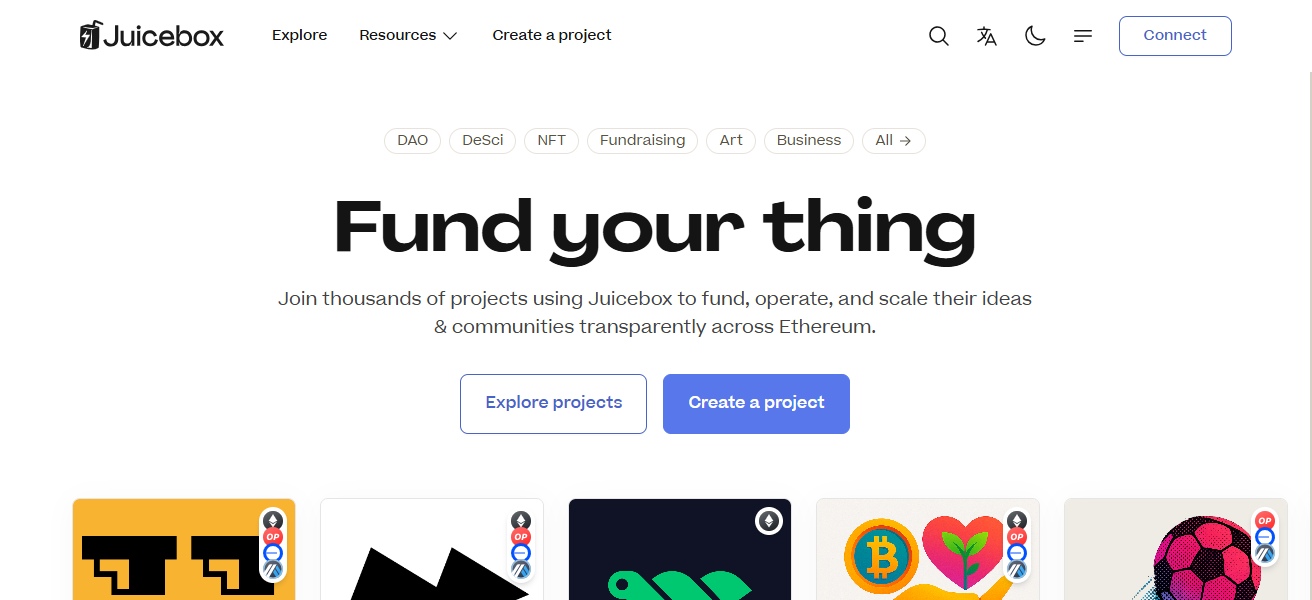
Thanks to its Ethereum integration, there is transparency as well as retention of immutability within the ecosystem.
The administrative funding functions within Juicebox allow enterprises to keep governance aligned with frictionless funding
So that efforts and resources are deployed to what is prioritized by the community. Within the systems, projects are balanced with ongoing governance to ongoing and decentralized accountability.
| Pros | Cons |
|---|---|
| Transparent fundraising and treasury | Limited beyond funding use cases |
| Programmable treasury rules | Requires Ethereum integration |
| Supports community-driven projects | Smaller enterprise adoption compared to Snapshot |
Cocnlsuion
To summarize the above findings, the best enterprise token governance solutions for DAOs offer organizations the ability to make decisions in a scalable, transparent, and secure manner.
Aragon, DAOstack, Colony, Snapshot, Tally, Boardroom, Gnosis Safe, Orca Protocol, Syndicate, and Juicebox offer a valuable balance between innovation and responsibility.
They allow companies to handle their treasury, voting, and governance in a manner that sustains crypto-economies based on trust and collaborative ecosystems.
FAQ
They are tools that help decentralized organizations manage voting, treasury, and decision-making securely
Enterprises adopt them to ensure transparency, scalability, and accountability in decentralized governance.
Aragon, DAOstack, Colony, Snapshot, Tally, Boardroom, Gnosis Safe, Orca Protocol, Syndicate, and Juicebox.
Snapshot enables gasless off-chain voting, making participation cheaper and more accessible.
Colony uses reputation-based governance, rewarding contributors rather than just token holders.