In this article, I will mention the best Financial Close Automation Software and how these tools assist companies in simplifying their month-end and year-end closing procedures.
Closing software lowers manual mistakes and provides modern finance teams with faster, more accurate financial insights by automating reconciliations, journal entries, and reporting. Software also improves compliance.
Key Points & Best Financial Close Automation Software
| Software | Key Point |
|---|---|
| Redwood Record to Report | End-to-end automation for financial close, reducing manual effort and errors |
| Joiin | Cloud-based consolidation tool ideal for multi-entity reporting |
| DOKKA | AI-powered document processing for faster reconciliations and close cycles |
| Planful | Integrated FP&A platform combining close automation with planning and forecasting |
| BlackLine | Industry leader in account reconciliation and compliance automation |
| Vena | Excel-native interface with strong workflow and reporting capabilities |
| Aico | Continuous accounting approach for real-time financial close |
| SolveXia | Process automation platform with strong audit trail and compliance features |
| FloQast | Collaboration-focused close management with checklist tracking |
| Adra by Trintech | Mid-market solution offering reconciliation, compliance, and workflow automation |
10 Best Financial Close Automation Software
1. Redwood Record to Report
Autumn’s Record to Report automation system changes the traditional financial close by automating up to 90% of tasks in the record to report (R2R) cycle, such as reconciliations, journal entries, intercompany processes, and close checklists.
Real-time data orchestration and approvals, eliminating manual effort and reducing risk, are achieved through deep ERP integrations, especially with SAP. The system’s implementation and finance systems coverage increase the accuracy of month-end closes.
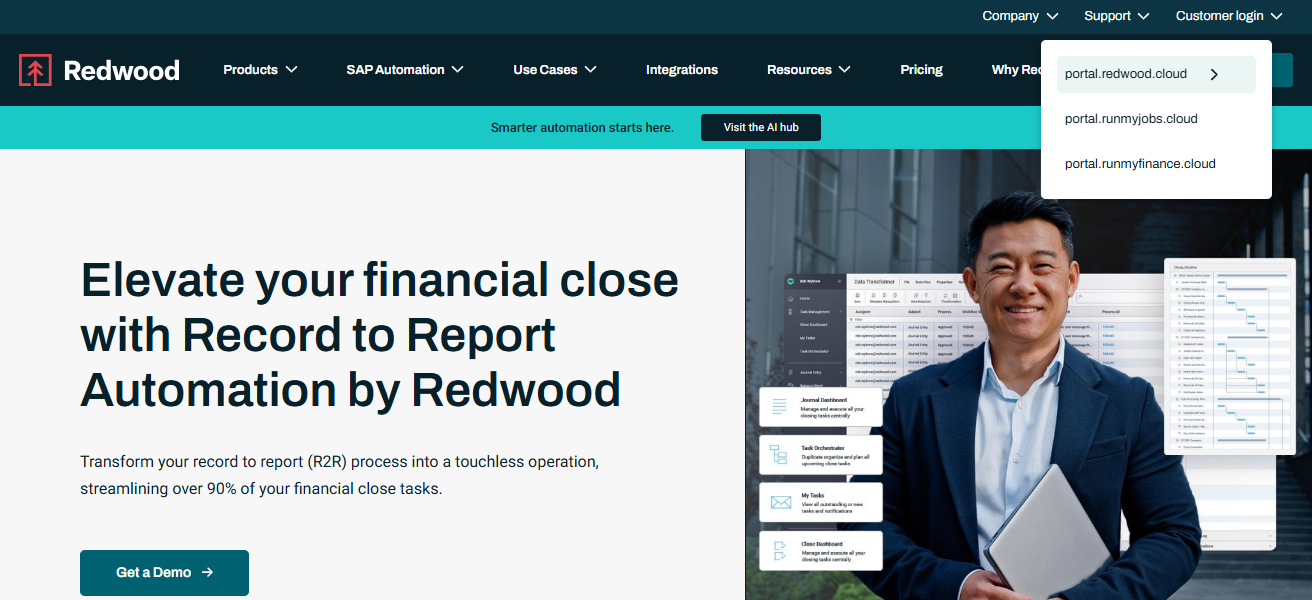
Furthermore, finance executives have visibility into the progress and compliance of the close through centralized dashboards and automated workflows.
Features Redwood Record to Report
Touchless Finance Close – Automates more than 90% of financial close tasks such as reconciliations, journal entries, and intercompany processing, and frees teams from manual work.
Deep ERP Integration – Works effortlessly with leading ERPs, such as SAP, to retrieve live data, orchestrate approvals, and maintain system accuracy.
Comprehensive Task Coverage – Manages complex R2R activities, such as accruals, provisions, and intercompany eliminations on one platform.
Flexible Deployment & Controls –Includes cloud and on–premises options with features for audit trails and compliance monitoring.
| Pros | Cons |
|---|---|
| End-to-end automation across the close cycle | May be complex to implement for smaller teams |
| Scalable for enterprises with high transaction volumes | Higher cost compared to mid-market tools |
| Strong audit and compliance features | Requires training and onboarding for full |
2. Joiin
Joiin is a financial reporting and consolidation tool in the cloud that automates the previously manual, spreadsheet-driven tasks associated with the multi-entity close and reporting process.
It connects in real-time to Xero, QuickBooks, and Sage accounting software and spreadsheets to consolidate financial information, and generate accurate reports at the group level in multiple currencies.
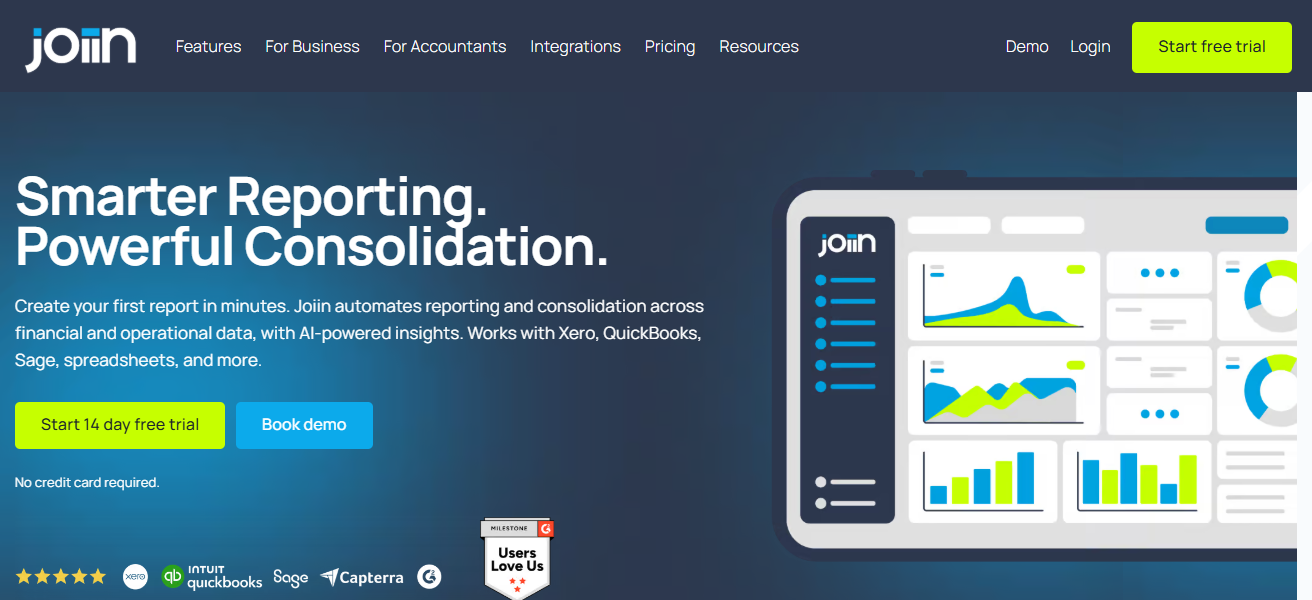
With dashboards that quickly reveal trends and anomalies, and AI insights, the tool eliminates hour of tedious consolidation effort.
Joiin is the best tool for accountants and finance professionals who deal with multiple entities and need to manage consolidated reports for their clients. It automates and reports business process workflows.
Features Joiin
Automated Consolidation – Extracts financial data from Xero, QuickBooks, Sage, spreadsheets, and more to streamline the automation of group consolidation.
Real–Time Reporting Dashboards – Offers always current dashboards and insights that assist teams in rapidly understanding performance across different entities.
Multi–Entity & Multi–Currency Support – Manages consolidation and reporting within and across various currencies, along with intercompany eliminations.
AI–Powered Insights – Leverages smart analytics to recognize patterns and surface anomalies, transforming unprocessed data into actionable information.
| Pros | Cons |
|---|---|
| Cloud-based consolidation for multi-entity reporting | Limited advanced automation compared to enterprise tools |
| Easy to use with intuitive dashboards | Best suited for SMEs, not large enterprises |
| Affordable pricing | May lack deep compliance features |
3. DOKKA
DOKKA provides automation services that accelerate the financial closing process by completing data extraction, seamless workflow automation, and automated reconciliations across the accounts payable and closing functions.
It alleviates tedious, repetitive tasks such as transaction matching and invoice data capture by employing data classification, data extraction, and intelligent processing of data from disparate financial sources.
It provides finance departments with real-time status of the closing process and significant reductions in manual workloads.
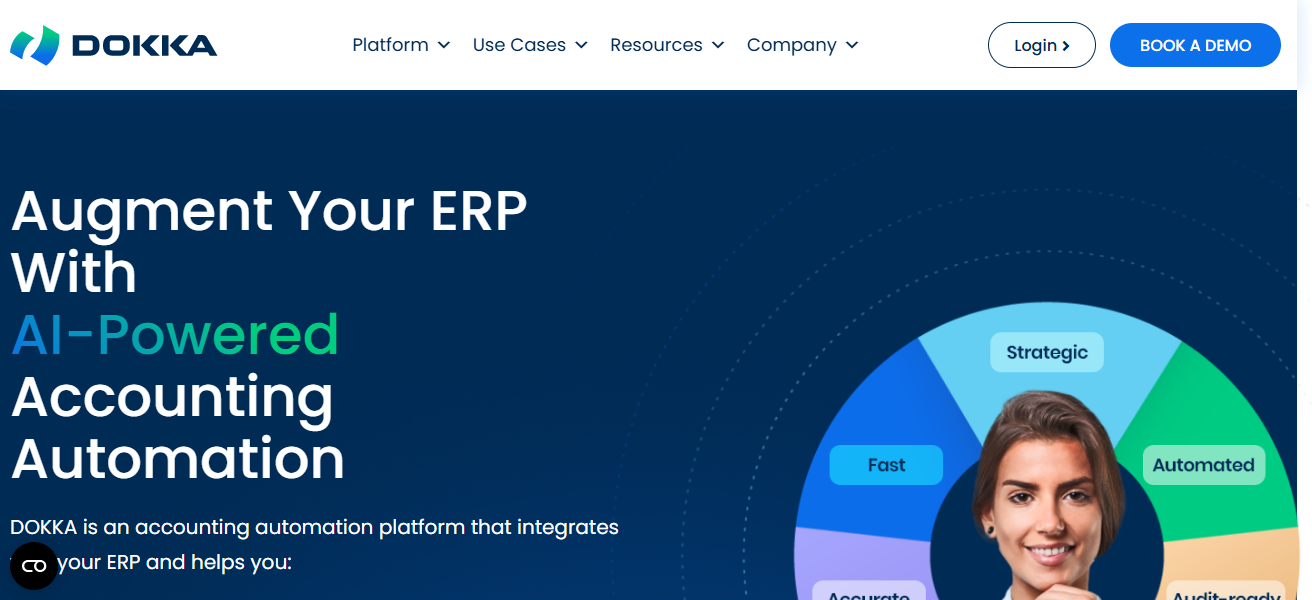
DOKKA allows real time standardization and process improvement of the closing process leveraging their automation technology and userfriendly interfaces, especially in the case of mid-market firms.
Features DOKKA
Automated Reconciliations & Journal Entries – With DOKKA you will remove the manual steps of reconciliation and journal entries, and as tasks get automated, journal entries and reconciliations disappe
Real-Time Anomaly Detection – Real time discrepancy detection as data enters the system.
ERP & Accounting Integrations – Integrations with existing finance systems, so close activities performed are based on true and verifiable source data.
Customizable Automation Workflows – Automation workflows to defmany steps and rules to accommodate to specific teams for tailoring rules to their closing workflows.
| Pros | Cons |
|---|---|
| AI-powered document processing speeds reconciliations | Focused mainly on document automation, not full close |
| Reduces manual data entry | May require integration with other systems |
| Improves accuracy with machine learning | Less robust for complex consolidations |
4. Planful
Planful is an all-in-one financial performance solution enabling users to budget, forecast, and close financial periods faster than ever, all while improving the efficiency of the financial close.
By automating account reconciliations and close tasks, teams can allocate their time to high-level strategic analysis rather than maintaining the tedious manual entry that is so critical to preventing errors.
The software improves the speed and accuracy of period-end reporting with centralized task workflows and real-time reporting.

Planful’s artificial intelligence assists users with reporting by identifying and correcting anomalies, expediting approvals, and reducing reporting risk.
The solution is purpose-built to be scalable and provides finance teams with a single system to manage the close, plan reporting, and monitor performance to meet the ever-evolving demands of the business.
Features Planful
End-to-End Close Automation – Automating the entire month-end process and closing activities ranging from reconciliations to journal entries and closations.
Built-In Audit Trails & Controls – Transparency custom log and control close activities to enforce compliance and traceability.
Multi-View Reporting – Drill down traceability across GAAP, IFRS, or management views.
Scalability for Growth – No process slowdown from growing with added entities, reorganizations, or acquisitions.
| Pros | Cons |
|---|---|
| Combines close automation with FP&A | Can be expensive for smaller firms |
| Strong forecasting and planning integration | Implementation may take longer |
| Cloud-native and scalable | Requires dedicated finance team to maximize value |
5. BlackLine
BlackLine is an industry leader when it comes to financial reconciliation and consolidation services. Their system is capable of automating every stage of the closing cycle.
Activities like reconciliations, transactions, entry journaling, and consolidation reporting are managed automatically.
Rather than using multiple cloud platforms requiring spreadsheets and susceptible to human error, workflows and data from multiple systems are concentrated into one blackline central platform.
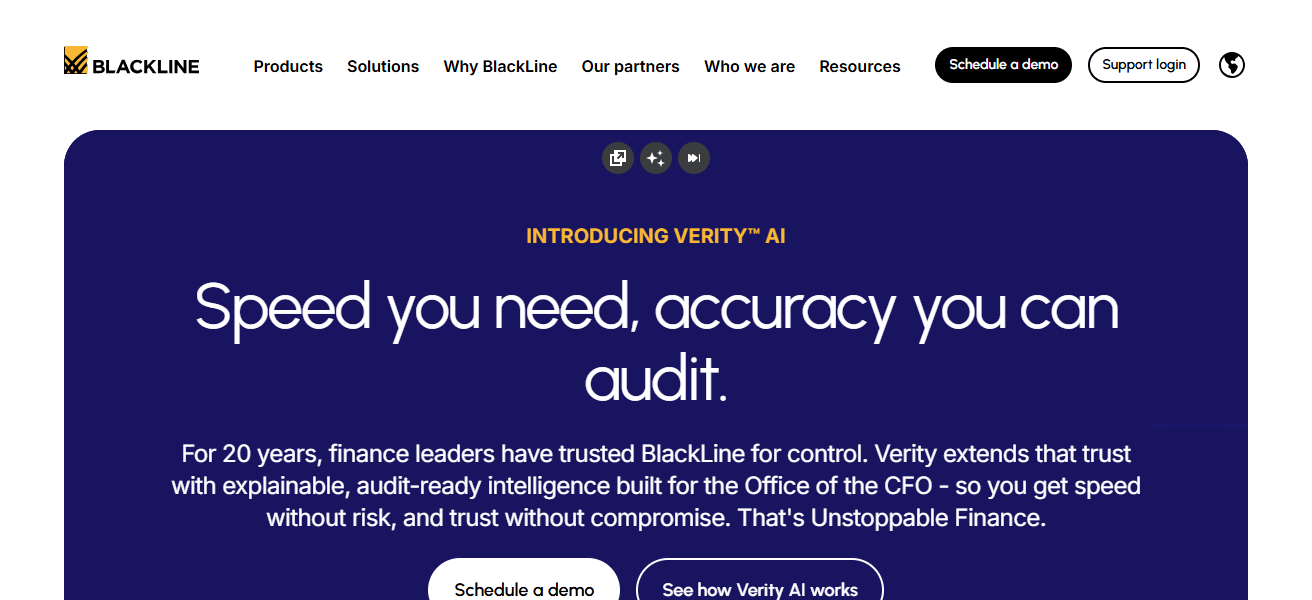
With the Verity AI layer, automation is taken even further with features like intelligent matching, anomaly detection, and predictive insights.
Closing activities are monitored with built-in compliance controls, audit trails, and task management systems, giving real-time visibility, hence, making blackline an almost mandatory solution for enterprises dealing with complex multi-entities.
Features BlackLine
Unified Close Platform – Built on one platform.
AI-Driven Insights (Verity) – Match transactions and surface purpose explanations for varying AI balance fluctuations.
Real-Time Visibility & Dashboards – Dashboards and reporting offer close status to teams and display bottlene.
Comprehensive Compliance Controls – Built-in controls and audit trails help enforce governance and accuracy.
| Pros | Cons |
|---|---|
| Industry leader in reconciliation and compliance | Premium pricing |
| Strong workflow automation | May be overkill for SMEs |
| Trusted by large enterprises | Complex setup and customization needed |
6. Vena
Vena offers users the ability to manage financial planning, reporting, and close management through an interface similar to Excel, but with the added benefits of workflow automation and data integration.
Vena helps teams reduce the amount of manual work through automation of account reconciliations, multi-entity consolidation, and other activities necessary for the financial close. Its centralized database and version control facilitate collaboration among users during the month-end activities.
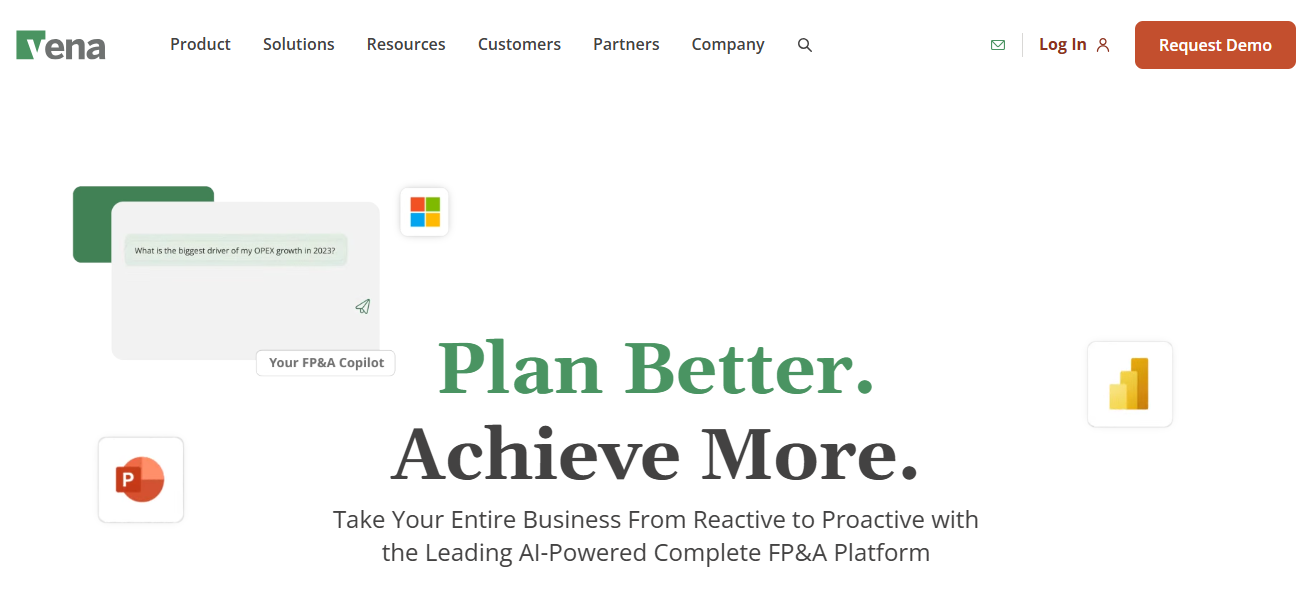
Despite the initial effort to configure and train users, many teams value Vena’s ability to customize workflows, provide flexibility, and provide excellent assistance with complicated reporting and closing processes across various finance environments.
Features Vena
Excel-Native Interface – Leverages familiar Excel workflows enhanced with centralized cloud automation and control.
Automated Consolidation – Handles intercompany eliminations, multi-currency, and consolidation tasks automatically.
Version Control & Auditability – Tracks changes and maintains full audit trails to improve data integrity and compliance.
Tax and Close Management – Supports complex tasks like tax provisioning and month-end checklists with automated workflows.
| Pros | Cons |
|---|---|
| Excel-native interface makes adoption easier | Heavy reliance on Excel familiarity |
| Strong workflow and reporting | May lack advanced AI automation |
| Good for mid-market companies | Can be less scalable for very large enterprises |
7. Aico
Aico is a close automation platform powered by artificial intelligence to help streamline close-related tasks such as reconciliations, posting journal entries, matching transactions, and intercompany invoicing.
Aico is built to integrate with ERPs such as SAP, Oracle, Microsoft Dynamics, and Aico provides real-time visibility into the closing process with intelligent automation to decrease error and cycle time.

Custom templates and dashboards allow teams to manage and uniform close tasks across the board. In high-volume or fast-paced environments, Aico provides compliance for finance leaders to have visibility and manage risk throughout the close process.
Features Aico
End-to-End Automation – Automates reconciliations, journal entries, and close workflows across departments.
Configurable Templates & Workflows – Lets teams set up close calendars and templates tailored to their process requirements.
ERP Integration Support – Connects to major ERP systems to pull and push accurate financial data.
Progress Monitoring Dashboards – Offers visual dashboards to track close completion and identify delays.
| Pros | Cons |
|---|---|
| Continuous accounting for real-time close | Less well-known compared to leaders like BlackLine |
| Strong automation of reconciliations | May require custom integration |
| Improves visibility and compliance | Smaller ecosystem of support |
8. SolveXia
SolveXia is an automation tool that requires no code to work and is intended to make the financial close process easier by automating the reporting, reconciliations, and data processing.
Finance teams are able to reduce more manual work and the chances of human error by using the easy drag and drop interface to create the automated workflows.

Audit trails and analytics during the close cycle are made transparent and compliant with the help of the integration with other data and ERP systems which keep financiial data current.
Flexibility and scalability of the tool allow for large teams to utilize automation with ease and without the need for complex programming.
Features Features SolveXia
No-Code Automation Builder – Finance teams can build workflow automation without coding expertise.
Workflow Orchestration – Automates the multi-step closing process from data ingestion to reconciliations and reporting.
Real-Time Monitoring and Logs – Monitors workflows and exceptions to speed up resolution.
Integration with Data Sources – Integrates ERP, accounting systems and other data stores to consolidate financial close data.
| Pros | Cons |
|---|---|
| Process automation with strong audit trail | May need technical expertise for setup |
| Flexible workflows | Not as widely adopted as BlackLine |
| Good for compliance-heavy industries | Limited FP&A integration |
9. FloQast
FloQast specializes in financial close management and automates workflows allowing teams to collaborate and close books faster.
FloQast integrates with accounting software and Excel to provide real-time visibility into progress and close task bottlenecks.
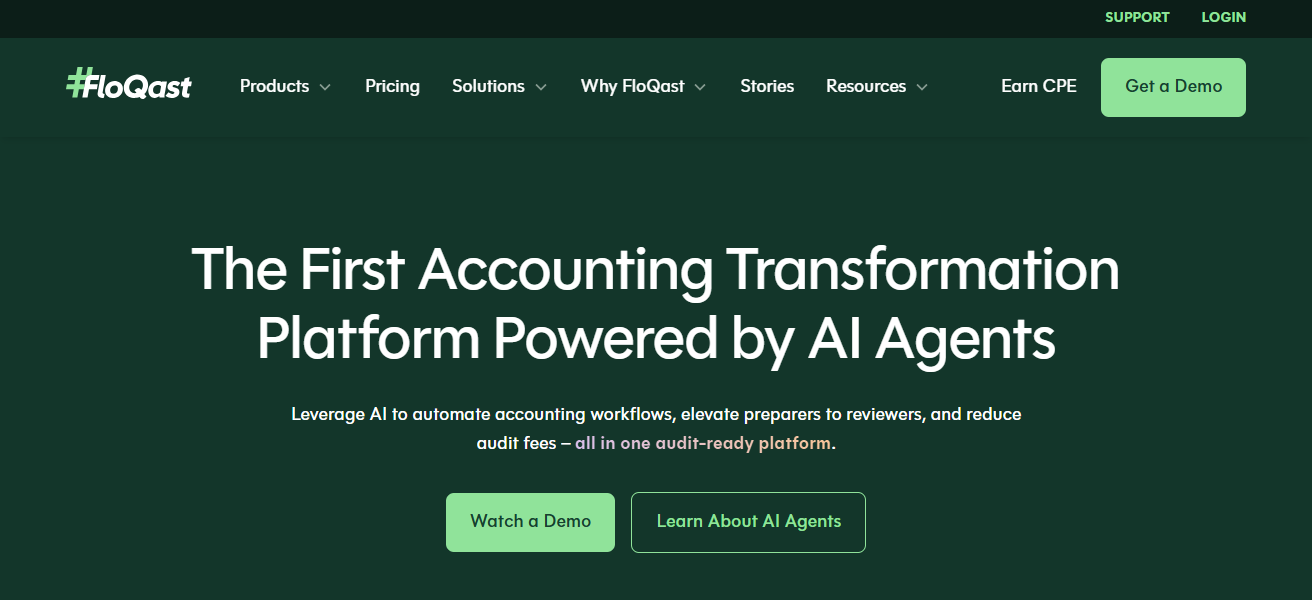
FloQast was founded by accountants to provide ease of use and fast adoption. FloQast helps teams use structured workflows and easy to use dashboards to keep teams aligned.
Teams can generate financials with less manual work every period due to audit automation with AI.
Features FloQast
Checklist-Driven Close Management – Breaks up the close tasks into checklists that steer the teams through each step of the period-end.
AI-Assisted Reconciliations – Auto-matches transactions and can create explanations and variance narratives.
Collaborative Work Environment – Streamlines team comments, task assignments, and issue resolution all to a single destination. ([get.floqast.com][10])
Integration with Existing Tools – Operates alongside accounting systems and spreadsheets to minimize manual data preparation.
| Pros | Cons |
|---|---|
| Collaboration-focused with checklist tracking | More suited for mid-market firms |
| Easy to use and implement | May lack deep automation |
| Strong team visibility | Not ideal for complex consolidations |
10. Adra by Trintech
Adra by Trintech is a financial close automation software that adapts close task management, journal entry automation, reconciliation, and reporting into a single solution.
It provides customizable, real-time analytics and finance teams to track period closes. With real-time data and analytics, finance teams can track period closes.
Adra integrates with various ERPs to eliminate manual errors and standardize data flows and workflows to minimize.

The software is designed for organizations that want to control the close faster, improve compliance, and prepare for audits.
Its flexibility allows finance teams to customize workflows to their business rules and reporting requirements.
Features Adra by Trintech
Automated Balance Sheet Reconciliation – Finds and reconciles inconsistencies with no manual handling.
Close Task Management – Monitors close tasks across teams to provide insight into the completed and remaining tasks.
ERP and Data Source Integration – Extracts data from ERPs and other systems to provide consistent finance data.
Audit Trails and Compliance – Detailed logs and controls assist with audit preparedness and regulatory compliance.
| Pros | Cons |
|---|---|
| Mid-market solution with reconciliation and compliance | Less robust for large enterprises |
| Affordable compared to BlackLine | May lack advanced AI features |
| Easy workflow automation | Smaller feature set than enterprise tools |
How To Choose Best Financial Close Automation Software
Define your requirements. Determine what financial close activities you are looking to automate, such as journal entry preparation, consolidation, reporting, or reconciliations. Consider whether you require intercompany, multi-currency, or multi-entity support.
ERP and other systems integration. Determine whether your existing ERP and accounting systems, business intelligence tools, and data sources are integrated with your finance automation solution. Automatic data synchronization in real time minimizes the need for manual uploads, and errors are less likely to occur.
Level of automation. Determine whether the solution offers complete automation, such as automated journal entry postings, reconciliations, and detection of anomalies, as well as automated health checks, rather than simple task lists. Automation that is based on artificial intelligence or other matching algorithms significantly reduces the need for manual work.
Ease of use. Consider whether the interface is user-friendly and whether the finance team can adopt the solution without undue delays. Integration with familiar tools, such as Excel, can also improve user onboarding.
Dashboards for real-time monitoring and reporting. Determine whether dashboards are available for monitoring the status of a financial close and reporting on the location of bottlenecks, as well as tracking the progress of a financial close. Improved audit readiness is more likely with features that allow for a more granular review of data.
Regulatory Compliance and Controls. Determine whether the solution has built-in features that support audit trail maintenance, version control, and separation of duties. Also confirm that the solution has built-in support for relevant accounting frameworks like GAAP and IFRS.
Conclusion
To summarize, the Best Financial Close Automation Software enables finance teams to close faster, make fewer manual errors, and remain compliant.
The solution enhances visibility and efficiency through the automation of reconciliations, journal entries, and reports.
The right choice of platform allows organizations to save time, improve accuracy, and facilitate scalable financial operations to match growing organizational complexity.
FAQ
It’s a tool that automates month-end and year-end close tasks like reconciliations, journal entries, and reporting.
To reduce manual effort, errors, and speed up the close cycle.
Finance teams, accountants, controllers, and CFOs.
Reconciliation, data matching, journal posting, and dashboards.
Yes — most connect with ERPs like SAP, Oracle, and NetSuite.