In this article, I will review the Best Financial Intelligence Platforms for Investors. As global markets become more intricate, the need for tools that assist investors in analyzing data, identifying patterns, and making decisions becomes more critical.
Financial Intelligence Platforms offer cutting-edge market data, research, and analysis, as well as portfolio management capabilities.
These services help investors manage their portfolios and stay competitive in a rapidly changing marketplace.
Key Points & Best Financial Intelligence Platforms for Investors
Bloomberg Terminal Provides unparalleled real-time market data, analytics, and news, empowering institutional investors with actionable insights.
Morningstar Direct Offers deep fund analysis, portfolio management tools, and independent ratings trusted by global asset managers worldwide.
Refinitiv Eikon Delivers comprehensive financial data, advanced charting, and AI-driven analytics for professional investors and traders.
PitchBook Specializes in private equity, venture capital, and M&A intelligence, helping investors uncover hidden growth opportunities.
Sentieo Combines financial data, document search, and AI-driven research tools for streamlined equity analysis and decision-making.
TradingView Popular among retail investors, offering interactive charts, social trading features, and customizable technical analysis tools.
Zacks Investment Research Provides stock rankings, earnings forecasts, and proprietary research models to guide investors toward profitable opportunities.
AlphaSense AI-powered search platform analyzing earnings calls, filings, and reports to deliver actionable market intelligence instantly.
FactSet Integrates financial data, analytics, and portfolio solutions, enabling investors to optimize strategies and manage risks effectively.
Koyfin User-friendly platform offering macroeconomic data, equity research, and visualization tools for independent investors worldwide.
10 Best Financial Intelligence Platforms for Investors
1. Bloomberg Terminal
Bloomberg offers services for valuations, news, analytics, evaluation integrations of services, execution, analytical tools, and real-time news analytics and services as a financial service provider.
It is a gold standard financial services provider as it focuses on real-time analytics and other services, and for professional analytics, and Institutional Investing as a service provider
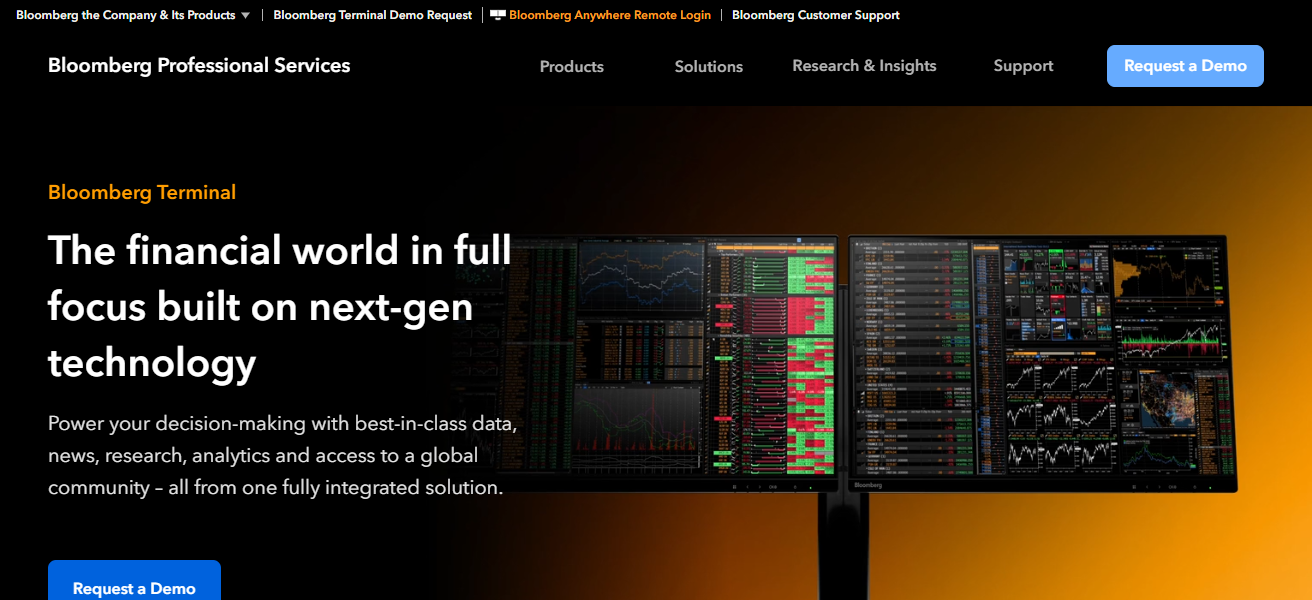
for equities analysis, and offers analysis for an entire spectrum for equities, cube and other equities.
Proprietary news and services include analysis, prices, analytics, services, etc. as well as historical analysis. Despite the high prices for services, there is a need for a transportation of services.
Bloomberg Terminal Features
- Real-Time Market Data: Provides streaming prices, order books, and market movements across global equities, fixed income, FX and commodities.
- Integrated News & Research: Provides integrated proprietary Bloomberg News, economic alerts, and integrated deep research reports.
- Analytics & Charting Tools: Provides a variety of dashboards with advanced features for both technical and fundamental analysis
- Communication & Collaboration: Provides built-in messaging and data sharing tools to support professional workflows.
| Pros | Cons |
|---|---|
| Provides real-time data across equities, fixed income, commodities, and FX. | Extremely high subscription cost, often prohibitive for smaller firms or individual investors. |
| Integrated news, research, and analytics in one platform. | Steep learning curve for beginners due to complex interface. |
| Customizable dashboards and alerts for market monitoring. | Requires powerful hardware and consistent internet connectivity. |
| Communication tools for professional networking and information sharing. | Primarily targeted at institutional users, less suitable for casual investors. |
| Reliable and widely trusted source with global coverage. | Subscription contracts are often annual and inflexible. |
2. Morningstar Direct
Morningstar Direct is a top-tier investment analysis platform offering independent research and performance data covering mutual funds, ETFs, and stocks.
It combines research, quant, and the data needed for comprehensive portfolio assessments and fundamental asset allocation.
Users also evaluate risk-adjusted returns and fund performance against their benchmarks to create tailored fund comparison reports for their clients.
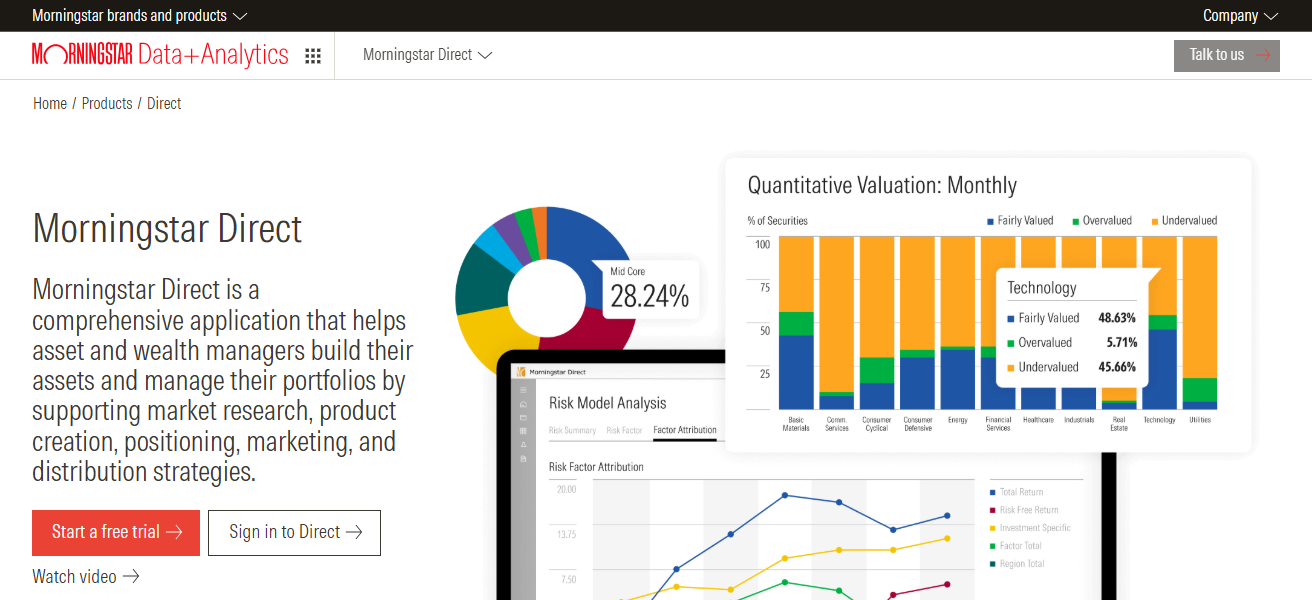
Morningstar ratings and their proprietary benchmarks assist in evaluating fund manager performance and diversification.
Lastly, good economic data and economic scenarios are integrated for analysis. It is especially useful for wealth managers and institutional analysts.
Morningstar Direct Features
- Fund & ETF Focused Data: Provides comprehensive performance metrics, risk analysis, and explained rankings for mutual funds and ETFs.
- Proprietary Ratings: Provides star ratings and Morningstar metrics to explain evaluation of investment quality and effectiveness of the manager.
- Portfolio Analytics: Provides asset allocation, benchmarking tools and reporting on performance of the portfolio.
- Custom Reporting: Provides the ability to create professional reports, customized for the client or the internal strategy.
| Pros | Cons |
|---|---|
| Strong fund and ETF analysis with star ratings and performance metrics. | Focused heavily on funds; less depth on individual equities or alternative assets. |
| Customizable reporting for portfolio and client presentations. | Expensive compared to retail-focused tools. |
| Supports portfolio construction, risk analysis, and asset allocation. | Interface can feel dated for tech-savvy users. |
| Provides independent research and proprietary metrics. | May not provide real-time intraday market data. |
| Ideal for wealth managers and institutional analysts. | Less suitable for active traders seeking high-frequency data. |
3. Refinitiv Eikon
Refinitiv Eikon, previously known as part of Thomson Reuters, is a real-time market data, analytics, and news service provider that spans global asset classes.
Eikon is built for institutional investors, analysts, and risk managers. Eikon offers features for tracking market trends, advanced charting, and fundamental and quantitative research.
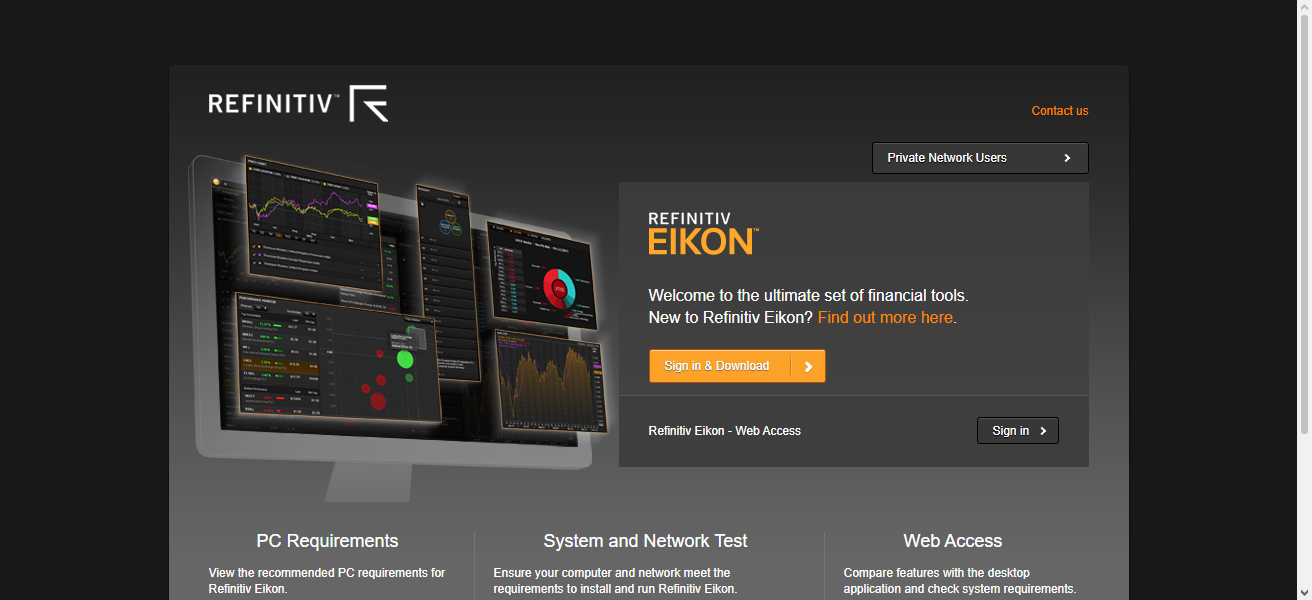
The platform is integrated with global regulatory filings, economic indicators, and news. Users can perform both micro and macro analyses with this platform.
The platform features customizable workspaces, collaboration, and flexible Excel integration, and is well known as an alternative to other premium financial terminals for companies that require extended data coverage.
Refinitiv Eikon Features
- Global Asset Coverage: Provides real-time prices and news for stocks, bonds, commodities, and FX across the globe.
- Advanced Analytics: Provides deep advanced charting, and both fundamental and quantitative modeling tools.
- Flexible Workspaces: Provides customized screens and layout for trading, analysis, and risk teams respectively.Unified News Sources News regulation filings, market commentary, and economies feeds updates.
| Pros | Cons |
|---|---|
| Real-time data, news, and analytics across global asset classes. | Costly subscription, similar to Bloomberg. |
| Advanced charting, modeling, and Excel integration. | Interface may feel overwhelming for beginners. |
| Extensive regulatory filings and economic data for deep analysis. | Some features may require add-ons or additional licenses. |
| Highly customizable workspaces for analysts and teams. | Primarily targets institutional users, limiting appeal for individuals. |
| Strong collaboration tools for professional teams. | Limited social or community features compared to TradingView. |
4. PitchBook
PitchBook is a premier financial intelligence platform for private capital markets like venture capital, private equity, and M&A transactions.
They provide comprehensive profiles, funding histories, valuations, deal details, and information on investors. PitchBook is critical for deal sourcing and competitive analytics.
Analysts, investment bankers, and corporate strategists rely on PitchBook for performance benchmarking, trend analytics, and investment opportunity analytics.
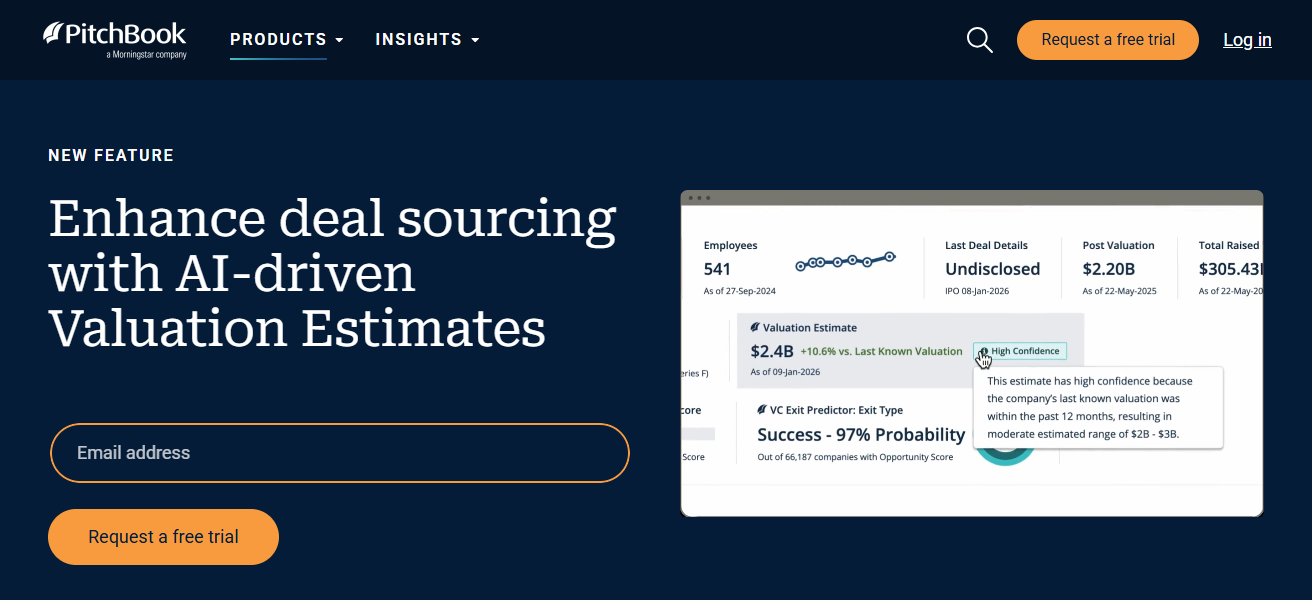
PitchBook has extensive search tools that allow investors to parse data by industry, geography, stage, and valuation. Investors can also take advantage of PitchBook’s extensive reporting capabilities.
Investors can create market maps, pitch books, and custom research reports for fundraising and due diligence.
PitchBook Features
- Private Market Intelligence: Comprehensive information on private equity, venture capital, mergers and acquisitions, and valuations.
- Company Profiles: Funding history, key executives, financial performance, and deal terms.
- Advanced Search & Filters: Narrow your search by industry, stage, geography, and various thresholds.
- Market Mapping & Reports: Tools to develop pitch books, market trend maps, and research documents.
| Pros | Cons |
|---|---|
| Deep coverage of private capital markets: VC, PE, and M&A deals. | Expensive; mostly suited for institutional or corporate users. |
| Provides company profiles, valuations, funding histories, and investor info. | Limited coverage of public markets and day-to-day trading data. |
| Advanced search and filtering for deal sourcing and trend analysis. | Learning curve for new users due to depth of information. |
| Reporting tools for pitch books and market mapping. | Focused on private markets; may not replace general equity research platforms. |
| Essential for corporate strategists and deal professionals. | Not designed for high-frequency trading or real-time market execution. |
5. Sentieo
Sentieo integrates multiple tools, such as document search capabilities, analytical tools, and modeling tools to assist investment professionals with their research.
Sentieo uses natural language search to assist users in finding information relating to research notes, financial filings, transcripts, news sources, and more.
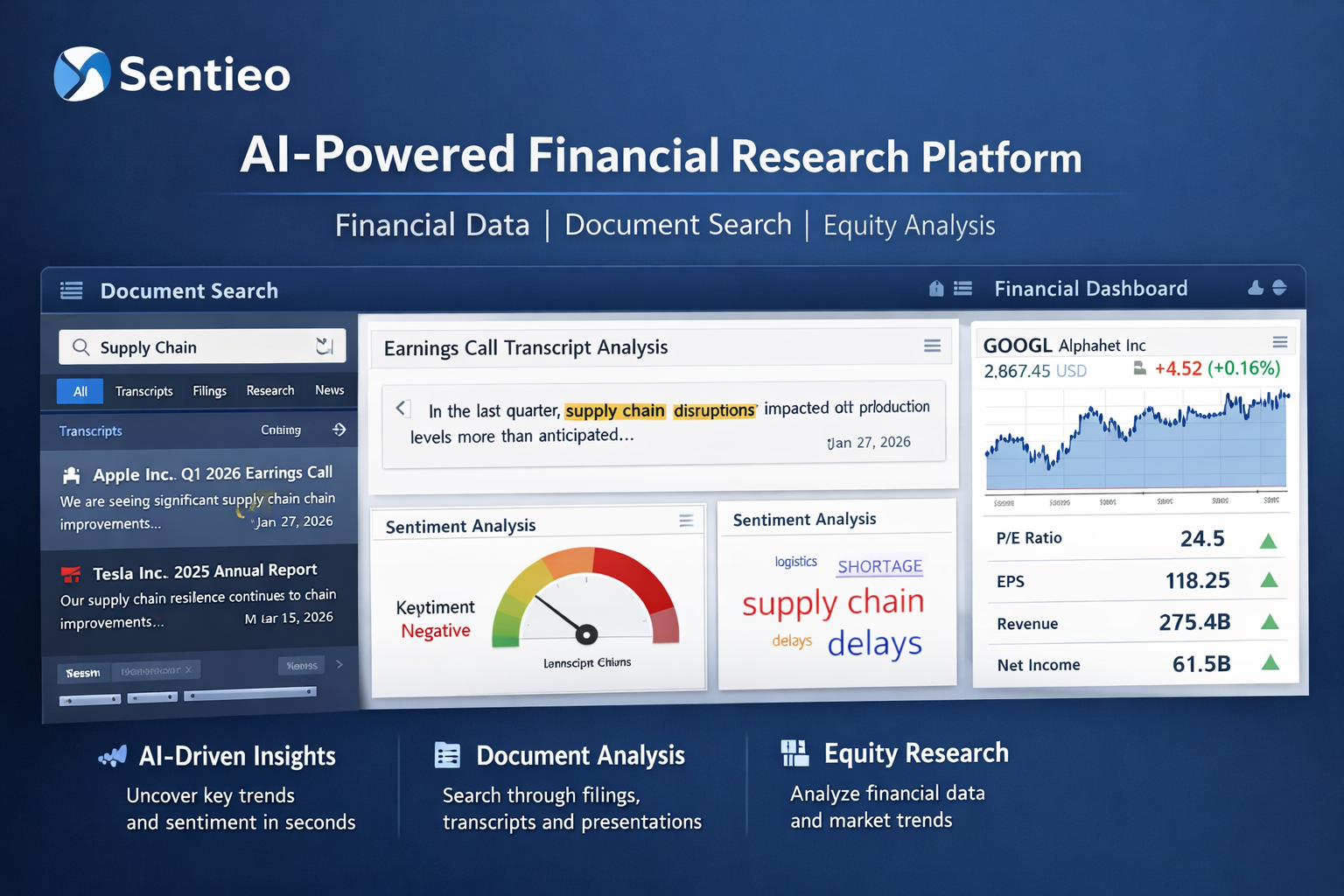
The analytical suite helps clients customize data visualizations and financial models. The sentiment analysis and alternative data set tools assist users in trend analysis and idea generation.
Equity analysts and portfolio managers are users of Sentieo and thus are able to enhance research workflow, data collection time, and decision accuracy. Investors appreciate the combination of qualitative and quantitative tools.
Sentieo Features
- Smart Document Search: Search using natural language to locate filings, earnings call transcripts, and research notes.
- Data Visualization: Create your own visuals and dashboards to aid your investment analysis.
- Integrated Modeling Tools: Construct financial models directly on the platform.
- Collaboration Features: Research teams can have shared annotations and notes, as well as team workflows.
| Pros | Cons |
|---|---|
| Combines document search, data analytics, and modeling in one platform. | Can be expensive for small teams or individual investors. |
| Natural language search for filings, transcripts, research, and news. | Alternative data and sentiment analysis features may require training. |
| Analytics tools allow custom visualizations and collaboration. | Interface can be complex for beginners. |
| Supports idea generation with quantitative and qualitative insights. | Less community-driven content compared to social trading platforms. |
| Reduces research time and improves workflow efficiency. | Primarily suited for equity research rather than day trading. |
6. TradingView
TradingView is a charting and social trading ecosystem popular among both professional and retail investors.
The platform’s powerful tools and simple user interface allow for extensive technical analysis and customization for charting, along with a variety of indicators and rich drawing capabilities for stock, forex, crypto, and commodity trading.
Investors can collaboratively develop and share trading strategies, follow community trading ideas, and setup price movement or indicator triggered events to help execute trades.

Being cloud-based means investors can access their accounts on any compatible device, and TradingView even allows for live trading with select broker integrations.
While the free tier is good enough to attract casual swing traders, the advanced premium features available to active traders, including, real-time data, trading strategy alerts, and up to 16 chart frameworks, are well worth the subscription cost.
TradingView Features
- Interactive Charts: Exceptional charting tools with overlays and a variety of drawing tools and indicators.
- Social Community: Share your ideas, along with public scripts and engage in strategy discussions with a global circle of traders.
- Cross‑Asset Coverage: Find analyses and charts on stocks, cryptocurrencies, forex, futures, and more.
- Alerts & Notifications: Stay active in trading by setting price indicators and establishing custom alerts.
| Pros | Cons |
|---|---|
| Powerful charting, technical analysis, and drawing tools. | Real-time data may require paid subscription for premium exchanges. |
| Community-driven platform with idea sharing and strategy publishing. | Limited fundamental analysis compared to Bloomberg or FactSet. |
| Cloud-based access across devices and brokers integration for live trading. | Free version has restrictions on alerts, indicators, and chart layouts. |
| Alerts and automated notifications for price and indicator events. | Social features can be distracting for some professional users. |
| Intuitive interface suitable for both beginners and advanced traders. | Less comprehensive coverage of institutional research. |
7. Zacks Investment Research
Zacks Investment Research is a well-known stock market research firm based on earnings estimation and fundamental analysis.
Their proprietary Zacks Rank system classifies stocks based on revisions and surprises in earnings and therefore assists investors in finding stocks with a high chance of outperforming.
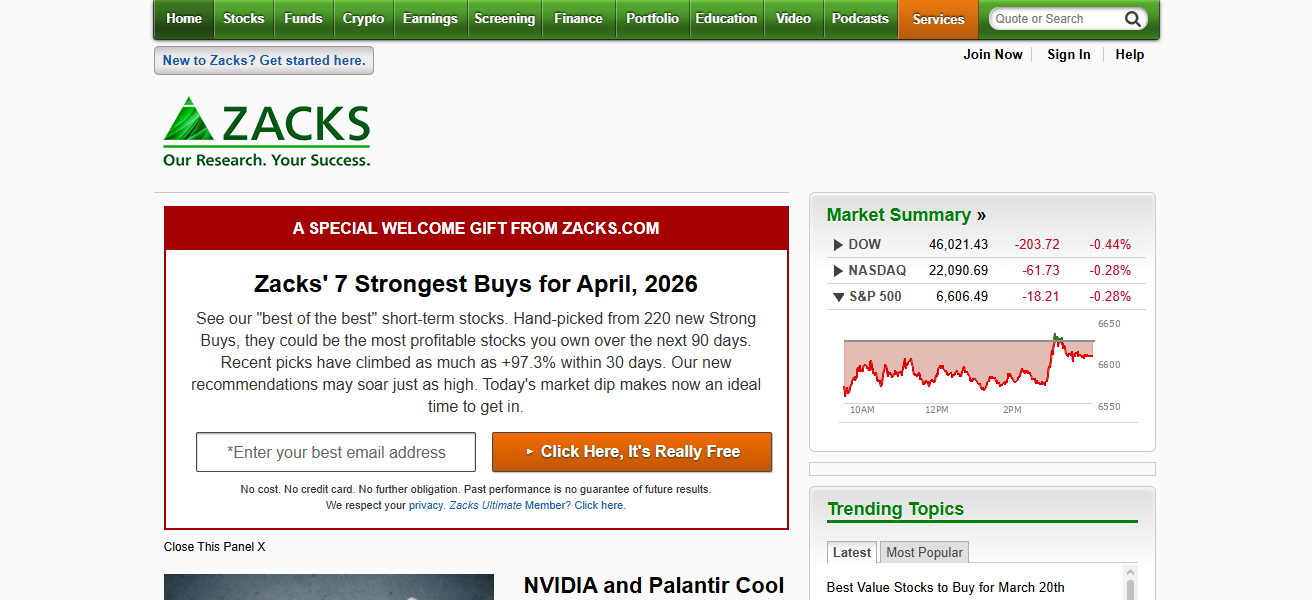
Zacks supports both individual investors and institutional investors through a combination of proprietary editorial and quantitative models.
Zacks assists investors in formulating strategies and establishing and tracking portfolios using models with a strong emphasis on earnings.
Zacks Investment Research Features
- Screening Tools: Screening for growth, value, momentum, dividends, and valuation.
- Research Reports: Analyst research based on earnings and fundamental analysis.
- Portfolio Tools: Portfolio tracking, performance monitoring, and trigger alert settings.
- Zacks Rank System: Unique ranking system based on earnings estimates and surprises.
| Pros | Cons |
|---|---|
| Proprietary Zacks Rank system helps identify potential outperformers. | Focused mainly on U.S. equities; limited global coverage. |
| Provides research reports, screening tools, and valuation metrics. | Less suitable for real-time intraday traders. |
| Quantitative and qualitative analysis combined for portfolio building. | May not cover alternative investments or private markets. |
| Supports dividend and income-focused investment decisions. | Interface and reporting tools can feel outdated. |
| Valuable for both retail and professional investors with earnings-driven strategies. | Free content is limited; full access requires subscription. |
8. AlphaSense
AlphaSense is an AI-based search and market intelligence platform that helps investment professionals find relevant information faster.
It uses natural language processing to analyze different documents such as financial filings, studies, transcripts, and news, and provides relevant data using semantic search.
From the investment perspective and the market’s corporate strategist perspective, AlphaSense helps stay ahead of the market, understand competition, and helps in final decision while using information.
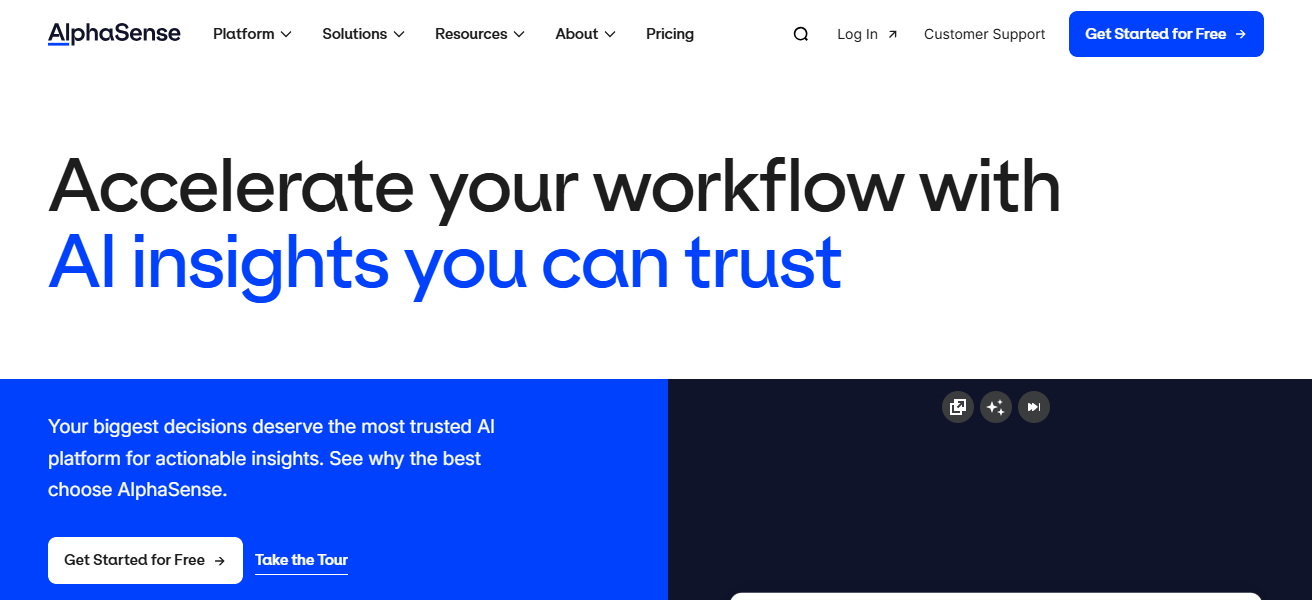
When there is a change in the sentiment of the information or there are important metrics, the information is provided to the user.
Also the user has the option to analyze the information. In hard and complicated information places, AlphaSense helps save time using AI technology.
AlphaSense Features
- AI-Search: Semantic search across filings, transcripts, earnings calls, and research.
- Sentiment and Trend Analysis: NLP to detect language and company messaging shifts.
- Alerts and Briefs: Automated updates on keyword activity and document revisions.
- Export and Integration: Data can be exported to Excel or BI for additional modeling or analysis.
| Pros | Cons |
|---|---|
| AI-powered search for filings, transcripts, and regulatory content. | Subscription costs can be high for smaller firms. |
| Semantic search reduces time spent on research. | Interface may require a learning period for effective use. |
| Alerts notify users of significant changes or trends. | Primarily research-focused; not a trading platform. |
| Supports portfolio managers, analysts, and corporate strategists. | Limited technical charting or execution features. |
| Helps extract actionable insights from large datasets quickly. | Focused on professional and institutional users, not casual investors. |
9. FactSet
Institutional Investors, asset managers, and researchers all benefit from FactSet’s wide range of financial data and analytics.
The platform provides real time market information, fundamental financial information, data on economic indicators, and analytic tools for researching equities, fixed income, and derivatives.
Also, users can customize content and workflows as FactSet is designed in a modular way. Users can then create their own models and reports as FactSet can also be integrated with Microsoft Office.
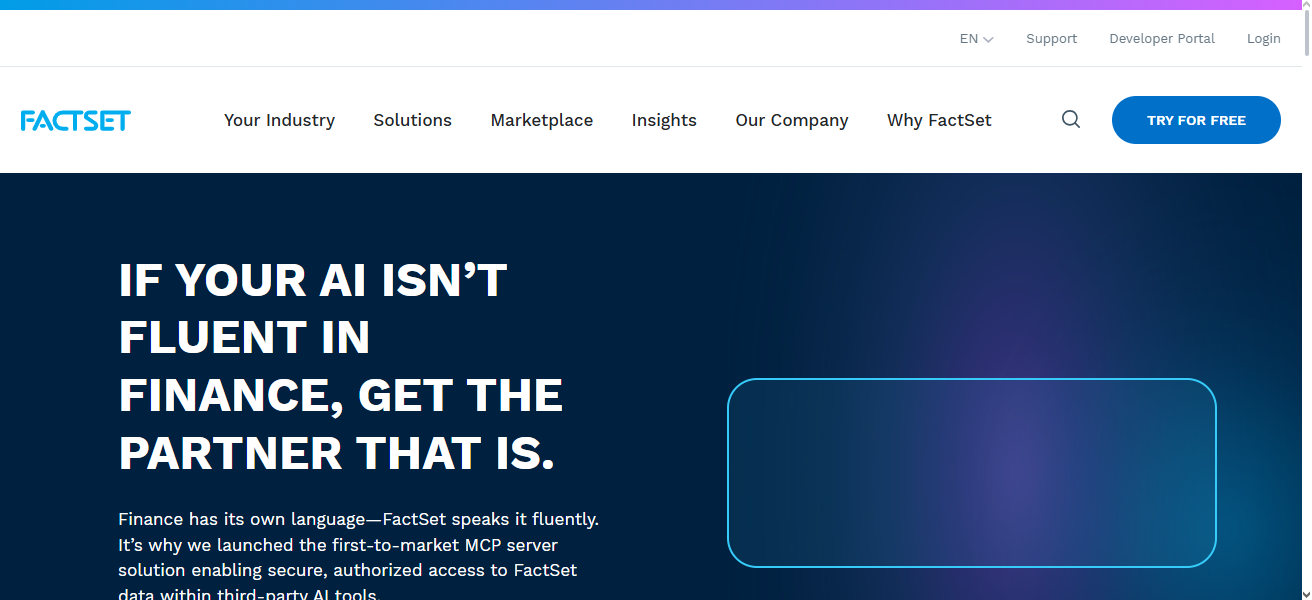
Portfolio performance measurement, risk analytics, and scenario analysis tools can also be found on FactSet.
FactSet contains global coverage and a multitude of content partners. This provides clients with support fundamental analysis, quantitative analysis, and client reporting.
FactSet Features
- Data Library: Compiles real-time market data, company fundamentals, and economic metrics data.
- Portfolio Analysis: Tools for performance measurement, risk modeling, and attribution.
- Microsoft Integration: Effortless workflow to Excel, Word, and PowerPoint.
- Modular Design: Equities, fixed income, derivatives, and alternatives tailored content.
| Pros | Cons |
|---|---|
| Comprehensive data and analytics for equities, fixed income, and derivatives. | High cost, primarily targeting institutional clients. |
| Real-time market data, economic indicators, and portfolio analytics. | Interface can feel complex for beginners. |
| Modular design allows customization for workflows and reporting. | Add-ons for specific markets or asset classes increase cost. |
| Integrated with Microsoft Office for custom modeling. | Less social or community features compared to TradingView. |
| Strong global coverage and multi-asset research capabilities. | May be overkill for individual investors with basic research needs. |
10. Koyfin
Koyfin is a new financial software company offering a user-friendly and cost-efficient solution to financial data visualization, data analytics, and financial market insights.
Features include interactive charting, dashboards, and data visualization for economic analytics, equities, ETFs, and fixed income. Koyfin helps both retail and institutional clients analyze, compare company performances, and track sectors and themes.
Users can create unique templates and customized dashboards to monitor assets with no coding requirements.
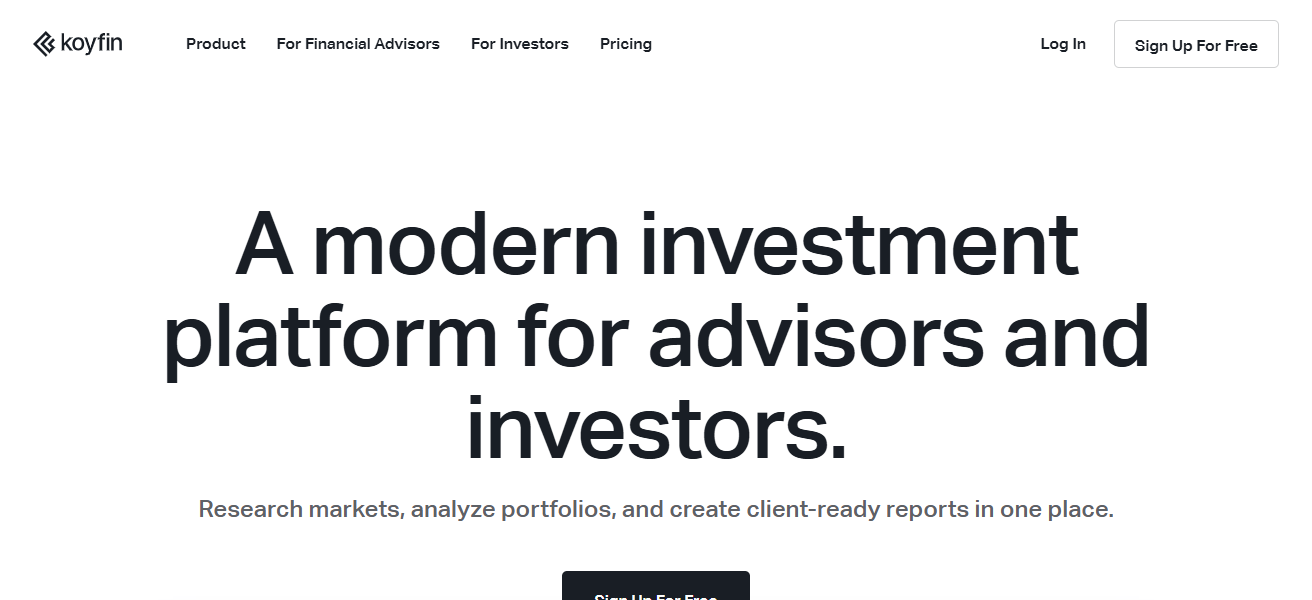
Koyfin also includes fundamental data, consensus estimates, and sentiment indicators useful for both long-term investments and tactical analytics.
Its strong data visualization features and reasonable pricing has resonated well with value conscious investors.
Koyfin Features
- Dashboards: Market performance and trends visualized in charts and heat maps.
- Fundamentals and Estimates: Company data, financial ratios, and consensus estimates.
- Templates: Create watchlists, dashboards, and comparison screens without coding.
- Macro and Sector Analysis: Economic data and sector analysis for top-down investing.
| Pros | Cons |
|---|---|
| Affordable platform with interactive charts, dashboards, and analytics. | Less coverage of private markets or specialized financial instruments. |
| Easy-to-use interface suitable for beginners and professionals. | Some advanced features limited to paid tiers. |
| Provides fundamental data, consensus estimates, and sentiment indicators. | Real-time market data may not be as robust as Bloomberg or Eikon. |
| Customizable templates and watchlists without coding. | Lacks extensive reporting or collaboration features for institutional teams. |
| Helps track sector, thematic, and macro trends effectively. | Primarily U.S.-focused data; international coverage limited. |
Conclsuion
To sum up, the Top Financial Intelligence Platforms for Investors provide both professional and retail investors with the necessary tools, including up-to -minute analytics and research, real-time data, and research technology, to increase the quality of their investment decisions.
From the extensive coverage of the Bloomberg Terminal to the simple charts of TradingView, every platform possesses individual merits.
Your objectives, spending plan, and experience level with financial markets will determine the best option.
FAQ
Institutional investors, analysts, portfolio managers, financial advisors, and individual investors.
Some (like TradingView and Koyfin) are beginner‑friendly, while others (like Bloomberg Terminal) require training.
Bloomberg Terminal and Refinitiv Eikon are known for the most comprehensive real‑time market coverage.
PitchBook excels in private equity, venture capital, and M&A intelligence.