
In this article, I will share the Best Financial Planning Tools for Europe-based Users. Financial planning tools assist businesses in enhancing performance through the automation of budgeting, forecasting, and reporting processes.
Europe has a variety of tools, from online applications to custom-built Excel modules, and can assist in the efficient management of a business’s finances, planning for growth in the future.
Key Points & Best Financial Planning Tools for Europeans
| Tool | Key Point |
|---|---|
| Limelight | Real-time data integration for accurate budgeting and forecasting |
| Anaplan | Cloud-native platform enabling enterprise-wide planning and scenario modeling |
| Vena Solutions | Excel-native interface with strong collaboration features |
| Workday Adaptive Planning | Scalable FP&A solution with predictive analytics |
| Oracle NetSuite Planning & Budgeting | Integrated ERP + planning for mid-to-large businesses |
| SAP Analytics Cloud | AI-driven insights and strong integration with SAP ecosystem |
| Jedox | Flexible modeling with strong support for European compliance needs |
| Prophix | Automation of reporting and financial consolidation |
| Planful | Continuous planning with strong collaboration workflows |
| Coefficient | No-code integration with 70+ business systems for SMEs |
10 Best Financial Planning Tools for Europeans
1. Limelight
Limelight is an all-in-one european financial planning tool that enables companies to enhance the efficiency of their budgeting, forecasting, and reporting functions.
By providing an easy-to-use platform that finance teams can use to work together, monitor KPIs and build sophisticated scenarios, Limelight improves collaboration and reporting.
Limelight’s integration with multiple data sources improves data accuracy and facilitates better decision making by filtering irrelevant data.
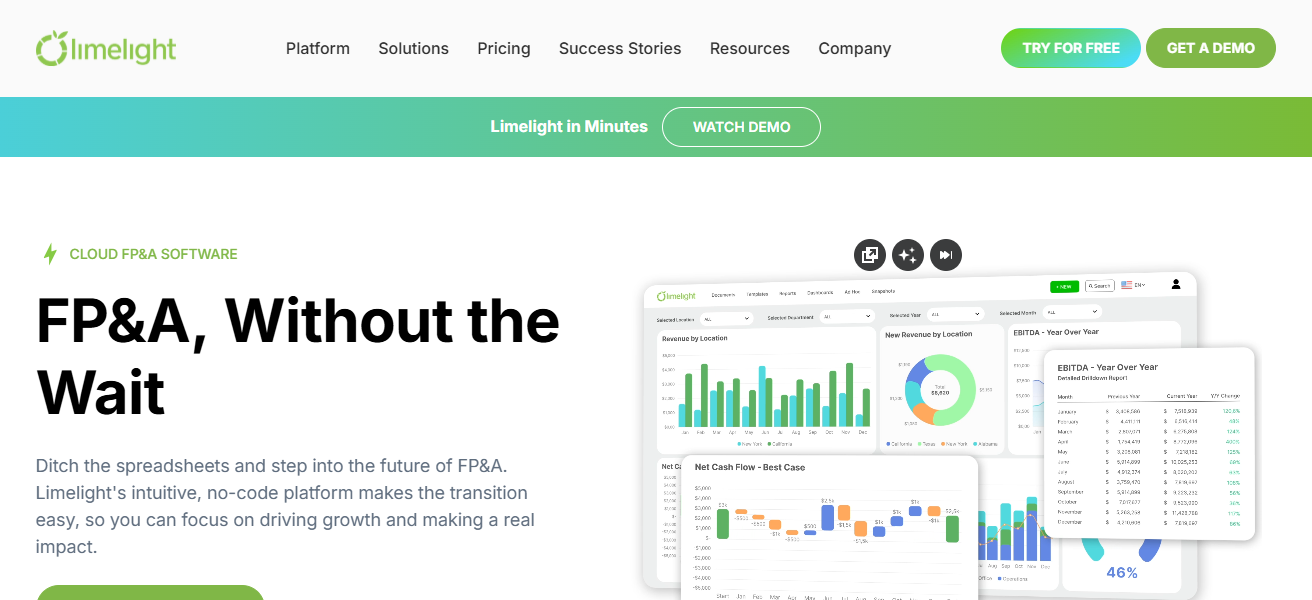
Limelight’s advanced analytics help organizations make data driven predictions and modify their response to trends.
Limelight is also designed to help organizations meet Europe’s financial reporting regulations and other compliance requirements.
For this reason, Limelight is an excellent financial planning tool for large and mid-sized companies.
| Pros | Cons |
|---|---|
| Intuitive interface that’s easy to adopt for finance teams. | Smaller brand awareness compared with legacy vendors. |
| Strong scenario planning and forecasting capabilities. | Limited partner ecosystem and community support. |
| Good collaboration tools for cross‑department planning. | Custom advanced configuration may require support. |
| Helps reduce manual errors and improves visibility. | Some advanced enterprise features may be missing. |
2. Anaplan
Anaplan is based on the cloud and offers scalable models and planning solutions for companies across Europe. It uses connected planning, allowing real-time collaboration of finance, operations, and sales teams.
The tool plays scenario planning and lets companies simulate multiple business outcomes for a better-informed decision.
It has a flexible modeling engine and users can build and modulate dashboards and reports, forecasts and plans based on the needs of the organization.
Anaplan has optimized integrations with ERP systems and other sources of data. It is one of the most flexible software with a user-friendly interface and is predictive. That is, it helps modern and large companies in financial planning.
| Pros | Cons |
|---|---|
| Highly scalable and great for complex enterprise planning. | Premium pricing; can be costly for smaller companies. |
| Real‑time collaboration and connected planning. | Steep learning curve for beginners. |
| Excellent scenario modeling and forecasting tools. | Implementation may require specialist support. |
| Integrates well with multiple enterprise systems. | Requires dedicated resources to manage. |
3. Vena Solutions
Vena Solutions incorporates the comforts of using Excel while also utilizing the FP&A services it also provides in the Vena Solutions business software.
Vena allows for European companies the ability to plan budgets, predictions, and reporting within Excel.
Vena allows for users to collaborate in different departments, create scenario analysis, and even generate automated reporting with in software regulatory reporting.
This software provides the users the ability to develop dashboards and have real-time reporting in a way that allows for faster, more effective decision making.
Companies will to optimize their financial reporting while using a simple software with active reporting will be satisfied.
| Pros | Cons |
|---|---|
| Uses familiar Excel interface for easy adoption. | Can feel limited for very complex models. |
| Centralized data reduces errors and duplication. | Heavily dependent on Excel skills. |
| Automation of budgeting and reporting saves time. | Requires configuration for advanced features. |
| Supports collaboration across teams. | Not as powerful as some enterprise‑only tools. |
4. Workday Adaptive Planning
Workday Adaptive Planning provides a solution to enterprise financial planning, budgeting, and forecasting in a cloud-native environment.
It focuses on real-time analytics and collaboration to assist European businesses in driving operational and financial alignment.
The application offers predictive analytics, scenario planning, and rolling forecasts, enabling finance teams to pivot to new market conditions.
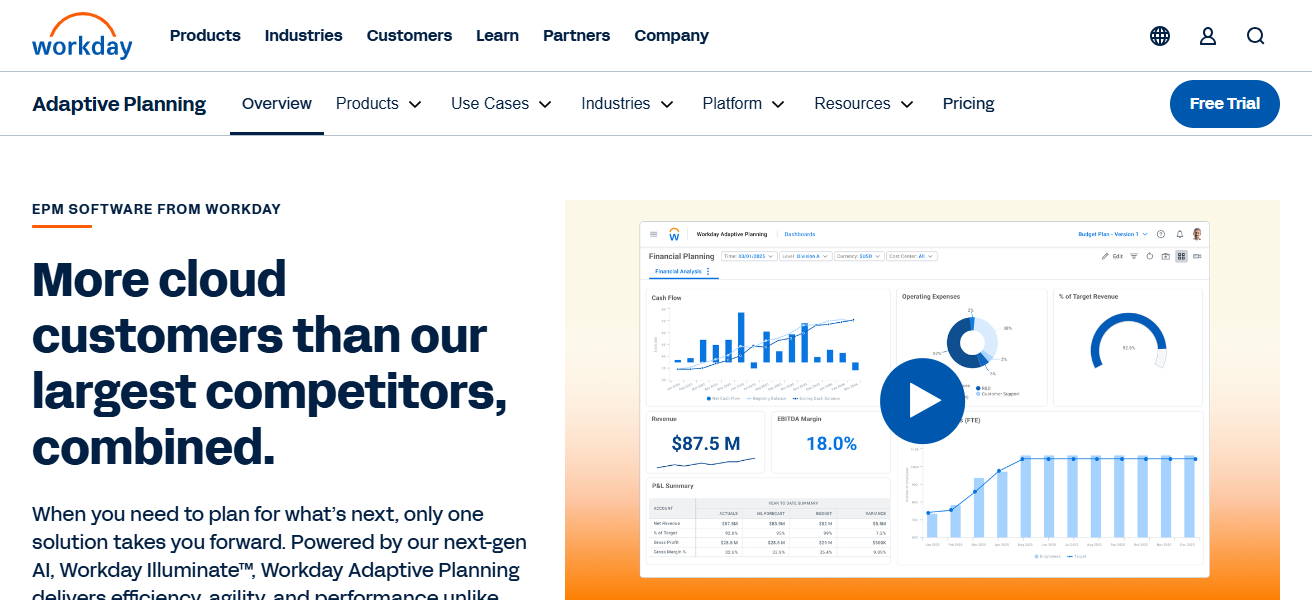
The intuitive dashboards and reporting tools improve visibility, allowing executives to monitor KPIs and make informed decisions.
Adaptive Planning offers seamless integration with Workday HCM and other ERP tools, enabling a complete and integrated view of business performance.
Its flexibility and adaptability make it a good fit for mid-market businesses and large multinational corporations who need agile financial planning.
| Pros | Cons |
|---|---|
| Cloud‑native with robust predictive analytics. | Higher cost, especially for full feature sets. |
| Real‑time forecasts and rolling planning features. | Setup and implementation can be lengthy. |
| Strong security and compliance frameworks. | Best value when paired with Workday HCM/ERP. |
| Good for both financial & workforce planning. | May require training for power users. |
5. Oracle NetSuite Planning & Budgeting
NetSuite Planning & Budgeting serves businesses across Europe and is a cloud-based solution that handles financial forecasting, reporting, and planning.
Planning and reporting are on the same platform in one system for increased accuracy and consistency.
It permits businesses to plan in advance and track their KPIs by utilizing the tools for scenario modeling, continuous forecasting, and proactive decision-making.
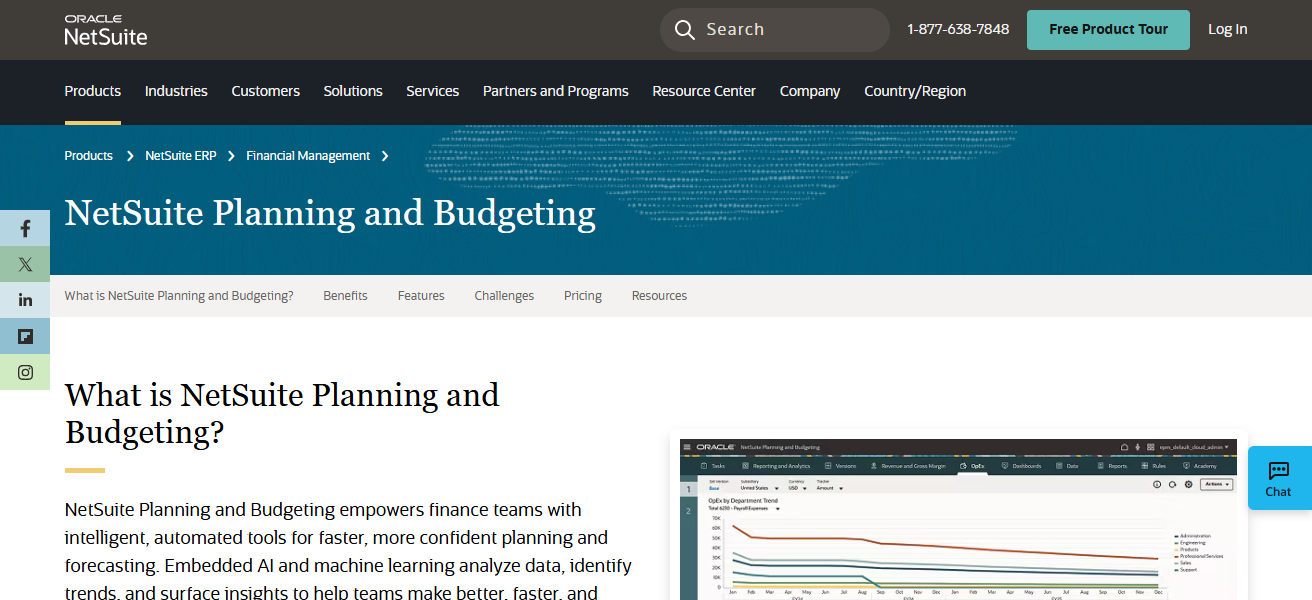
There are valuable executive and financial reporting tools. It is easy to implement the tool and the pre-built templates assist in that regard.
It has strong ERP integration allowing businesses to view their finances in real-time. NetSuite is a good choice for businesses looking for a comprehensive financial solution that can be implemented on a single platform.
| Pros | Con |
|---|---|
| Fully integrates with NetSuite ERP for end‑to‑end planning. | Can be expensive for smaller teams. |
| Real‑time data visibility and KPI tracking. | Complexity may require consulting help. |
| Strong scenario modeling and budgeting tools. | Not the most intuitive for first‑time users. |
| Flexible reporting for finance and operations. | Some customization needs technical support. |
6. SAP Analytics Cloud
SAP Analytics Cloud is a business intelligence (\BI), predictive analytics, and financial organization’s system with a cloud space.
Finance teams use SAP Analytics Cloud’s strong modeling and forecasting capabilities to customize and fine-tune applications.
Stakeholders analyze data dashboards where visualization and data trends are displayed in real-time. SAP Analytics Cloud connects with other SAP ERPs and databases to ensure accurate and consistent reports.
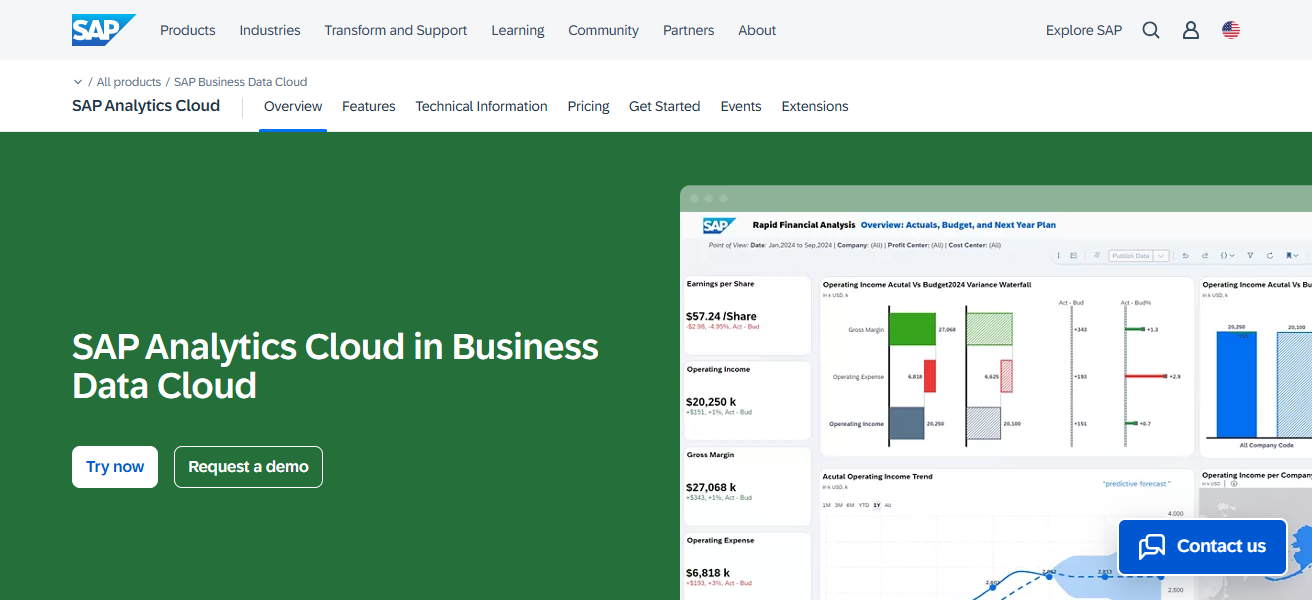
Organizations are able to predict future and current financial performance with its predictive analytic programs. Companies are able to better their financial performance, allocate resources efficiently, and minimize potential risks.
The tool is geared specifically toward large and mid-sized companies with a focus on an analytic and data driven financial approach.
| Pros | Cons |
|---|---|
| Combines analytics, planning & BI in one platform. | Generally requires strong IT support. |
| Powerful predictive analytics and visualizations. | Higher cost, especially in SAP environments. |
| Great for data‑driven decision‑making. | Best fit for organizations already in the SAP ecosystem. |
| Real‑time insights and dashboarding. | Steeper learning for new users. |
7. Jedox
Jedox is a leading cloud-based solutions offering financial planning and performance management services that help automate the budgeting, forecasting, and reporting processes of European companies.
It is popular in the European market as it connects and integrates with many ERP systems and meets Excel data frameworks used by many financial professionals.
It allows companies to make informed decisions at a quicker pace with its scenario planning, predictive analytics, real-time dashboards, and performance analytics.
Jedox also allows data collection in a unified manner from users across different departments of an organization, ensuring uniformity and data accuracy.
It also performs well across different currencies and is multilingual, making it suitable for European-based companies. It is flexible and user-friendly with strong analytics, making it an efficient tool for FP&A.
| Pros | Cons |
|---|---|
| Flexible cloud plus Excel workflow support. | Interface can feel less modern. |
| Rapid deployment and reasonable pricing. | Some complex models need training to build. |
| Multi‑currency and multi‑language support. | Integrations may need customization. |
| Good for both SMBs and enterprises. | Less enterprise brand visibility. |
8. Prophix
Prophix is an automated solution to corporate performance management to assist financial planning, budgeting, and reporting for businesses within Europe, and offers cloud-based services.
Repetitive, manual tasks are automated, and errors are reduced, allowing finance team members to spend time on strategic analyses.
Prophix enables companies to model scenarios, forecast finances, and analyze finances in order to make educated decisions.
Key performance indicators are available in real time on customizable dashboards, and to maintain data reliability, Prophix integrates with ERP and CRM systems.
Prophix fosters interdepartmental collaboration for organizations to improve their transparency, operational efficiency, and FP&A processes in finance.
| Pros | Cons |
|---|---|
| Strong automation for budgeting and forecasting. | UI is not as modern as competitors. |
| Improves accuracy by reducing manual work. | Integration quality can vary by system. |
| Good reporting and collaboration tools. | Some advanced analytics are limited. |
| Simplifies complex financial processes. | Learning curve for non‑technical users. |
9. Planful
Planful has introduced a cloud-native FP&A platform to help European firms simplify the complexities surrounding financial planning, forecasting, and reporting.
The platform eliminates inefficiencies and human errors growing from siloed processes, and serves companies a fully automated process in real time.
Executives can make accurate decisions from data collated in the forecasting modellers. The platform interfaces with ERP, CRM, and other financial suite products, ensuring no manual data entry is required, and data integrity is infinitely improved.

The efficiency gains from the process automation coupled with the diverse functionalities in the platform make Planful a competitive FP&A solution.
The growth and ease of use of the platform make Planful a leading FP&A solution, especially in the cloud native space.
| Pros | Cons |
|---|---|
| Designed for continuous planning cycles. | Some advanced features limited vs enterprise tools. |
| Real‑time dashboards and reporting. | Onboarding may take time for teams. |
| Scales with growing business needs. | Pricing can vary widely depending on modules. |
| Integrates with ERP & finance systems. | Some integrations may require setup. |
10. Coefficient
As of October 2023, the competitor of Coefficient, Precino, is an innovative financial planning tool that is helping European firms manage their spreadsheets and cloud data.
It connects Excel and Google Sheets with ERP, CRM, and accounting systems and updates them in real-time to reduce redundant processes.
Coefficient is best in class in budget, forecasting, and reporting, helping finance teams automate reoccurring processes and keeping the spreadsheet layout.
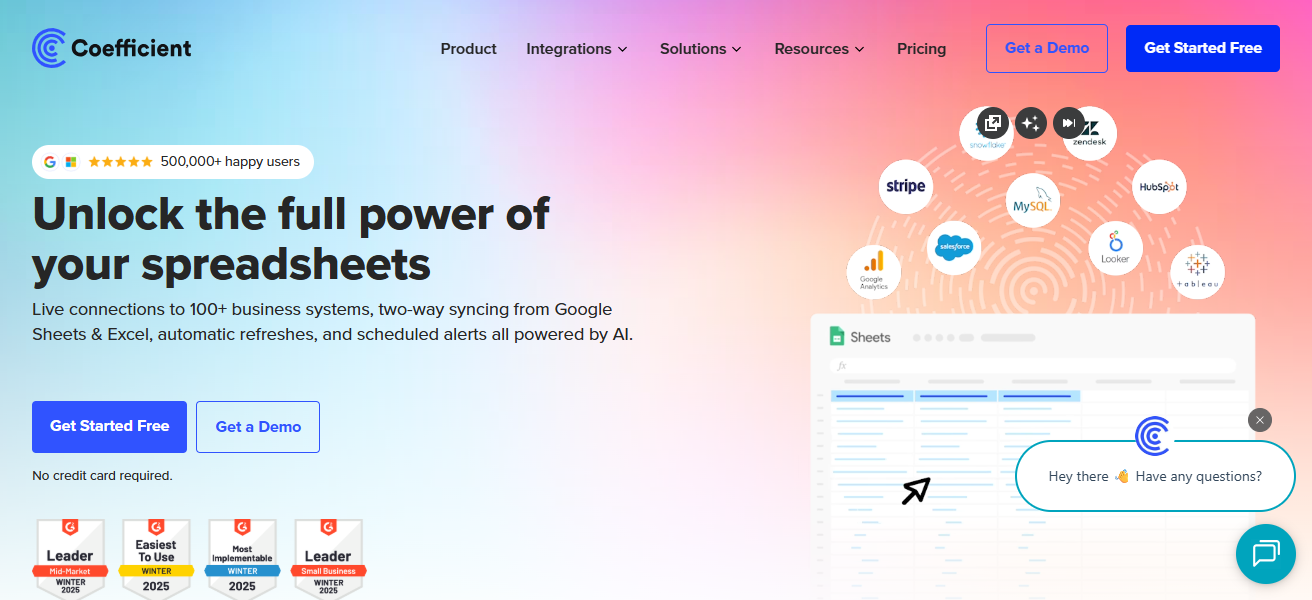
With customizable interfaces and lots of integration, Coefficient helps teams with collaborative planning and scenario planning, and tracking of different KPIs.
By helping teams improve their data flows, Coefficient helps make faster and better financial decisions. Coefficient is a great fit for more modern firms that are looking for spreadsheet-driven FP&A.
| Pros | Cons |
|---|---|
| Live data sync with Excel or Google Sheets. | Not a full standalone FP&A suite. |
| Reduces manual data imports & errors. | Scenario modeling is limited. |
| Simple and fast to adopt. | Best for lightweight planning, not deep modeling. |
| Great for spreadsheet‑centric teams. | Emerging tool; still maturing features. |
Conclusion
To sum up, the ideal financial planning tools for Europeans combine automation, teamwork, and real-time information.
Enterprise solutions like Anaplan, SAP Analytics Cloud, and Oracle NetSuite have high scalability and performance for complicated scenario planning
While Vena, Jedox, and Coefficient target mid-sized businesses with Excel-friendly-planning catered tools. Selection hinges on the organization’s size, degree of complexity, and integration requirements.
FAQ
They are software solutions that help businesses budget, forecast, analyze, and manage finances efficiently.
Anaplan, SAP Analytics Cloud, and Oracle NetSuite are ideal for complex, large-scale planning.
Yes, tools like Vena, Jedox, and Coefficient combine Excel familiarity with automation for mid-sized companies.
Most leading tools like Jedox, SAP Analytics Cloud, and Anaplan support multi-currency, multi-language, and European compliance.
Cloud solutions like Workday Adaptive Planning and Planful offer real-time access, scalability, and easier collaboration.