Modern banking institutions face significant problems from fraud and financial crime, which is why advanced security technology is crucial.
- Key Point & Best Fraud Detection Software for Banks
- 1. Featurespace ARIC
- Featurespace ARIC Risk Hub Features
- Featurespace ARIC Risk Hub
- 2. Feedzai
- Feedzai Features
- Feedzai
- 3. ComplyAdvantage
- ComplyAdvantage Features
- ComplyAdvantage
- 4. Quantexa
- Quantexa Features
- Quantexa
- 5. Guardian Analytics
- Guardian Analytics Features
- Guardian Analytics
- 6. InfrasoftTech FraudShield
- InfrasoftTech FraudShield Features
- InfrasoftTech FraudShield
- 7. Riskified
- Riskified Features
- Riskified
- 8. Shufti Pro
- Shufti Pro Features
- Shufti Pro
- 9. Kount (Equifax)
- Kount (Equifax) Features
- Kount (Equifax)
- 10. Palantir Foundry (fraud use cases)
- Palantir Foundry (Fraud Use Cases) Features
- Palantir Foundry (Fraud Use Cases)
- Conclusion
- FAQ
Using AI and real-time analytics, The Best Fraud Detection Software for Banks assists financial institutions in spotting questionable transactions, stopping cybercrime, and safeguarding client accounts. I’ll go over the Top Fraud Detection Software for Banks in this post, which helps organizations improve security and lower financial risk.
Key Point & Best Fraud Detection Software for Banks
| Platform | Key Points |
|---|---|
| Featurespace ARIC Risk Hub | Uses adaptive behavioral analytics and machine learning to detect fraud in real time. Widely used by banks and payment networks for card fraud and financial crime prevention. |
| Feedzai | AI-powered fraud prevention platform that analyzes transactions, devices, and user behavior to detect financial fraud across banking, payments, and e-commerce channels. |
| ComplyAdvantage | Provides AI-driven AML risk detection, sanctions screening, and transaction monitoring using real-time global financial crime intelligence data. |
| Quantexa | Specializes in contextual decision intelligence using entity resolution and network analytics to detect fraud, financial crime, and hidden risk relationships. |
| Guardian Analytics | Offers behavioral analytics and anomaly detection technology to protect banks and businesses from account takeover and payment fraud. |
| InfrasoftTech FraudShield | Provides fraud detection and risk management tools for banks with features like transaction monitoring, rule-based alerts, and AI-driven risk scoring. |
| Riskified | E-commerce fraud and chargeback protection platform that uses machine learning to approve legitimate transactions while preventing fraudulent purchases. |
| Shufti Pro | Identity verification and AML screening platform that offers KYC, document verification, biometric authentication, and fraud prevention services. |
| Kount (Equifax) | Digital fraud prevention solution that uses device intelligence, identity trust signals, and AI models to detect payment and account fraud. |
| Palantir Foundry (fraud use cases) | Data integration and analytics platform used by enterprises and governments to analyze large datasets and uncover fraud patterns, networks, and suspicious activities. |
1. Featurespace ARIC
Featurespace A sophisticated fraud and financial crime prevention tool created especially for banks and payment organizations is called ARIC Risk Hub. It tracks consumer transaction patterns and detects anomalous activity in real time using machine learning and adaptive behavioral analytics. The technology creates dynamic client behavior profiles and looks for irregularities that might point to fraud, account takeover, or scam activities.
Because it continuously learns from data and increases accuracy over time, it is frequently regarded as one of the Best Fraud Detection Software for Banks in the middle of the financial security ecosystem. Every year, the platform handles billions of events, assisting organizations in lowering false positives while safeguarding millions of customers globally.
Featurespace ARIC Risk Hub Features
- Adaptive Behavioral Analytics – Utilizes self-learning AI models that analyze customer behavior to identify the anomalies within the transactions.
- Real-Time Fraud Detection – Assesses incoming transactions, over a pre-determined time period, and assigns a risk score to mitigate further action on a transaction.
- Cross-Channel Monitoring – Identifies fraudulent behavior across cards, payments, engagements, and digital banking.
- Behavioral Profiling – Creates individual profiles to the customers to spot atypical behavior.
- Low False-Positive Alerts – Machine learning greatly improves fraud detection and alerts.
Featurespace ARIC Risk Hub
| Pros | Cons |
|---|---|
| Uses adaptive behavioral analytics to detect fraud in real time. | Implementation can be complex and requires technical expertise. |
| Very low false-positive rate compared to rule-based systems. | Enterprise pricing can be expensive for smaller institutions. |
| Highly scalable for banks processing millions of transactions. | Requires large datasets to achieve maximum accuracy. |
| Strong integration with banking and payment systems. | Focus mainly on financial services rather than multi-industry use. |
| AI models continuously learn and adapt to new fraud patterns. | Setup may require collaboration with vendor specialists. |
2. Feedzai
Banks, fintech firms, and payment processors all over the world use Feedzai, an AI-native financial crime prevention tool. In order to identify fraud in real time across digital banking channels, it examines vast amounts of transaction, device, and behavioral data. Customers’ unique risk profiles are created by Feedzai, which also keeps an eye on things like payments, account access, and onboarding.
Because it integrates identity verification, AML monitoring, and fraud detection into a single platform, it is considered one of the Best Fraud Detection Software for Banks in many enterprise banking settings. The system helps financial institutions more accurately identify money mule activity, account takeover attacks, and scams by processing billions of events each year.
Feedzai Features
- AI-Powered Fraud Detection – Machine learning models for use cases such as scam, payment fraud, and financial crime detection
- Real-Time Transaction Monitoring – Live banking payment monitoring and behavior detection.
- Digital Identity Creation – Forming trusted digital identity profiles prior to secure account opening and onboarding.
- Tools of Compliance to AML – Transaction monitoring, watchlist compliance, and automated compliance.
- Risk Scoring Engine – Uses behavior and transaction data to create risk scores.
Feedzai
| Pros | Cons |
|---|---|
| Advanced AI and machine learning for real-time fraud detection. | Enterprise-level pricing makes it costly for small companies. |
| Highly scalable for large banks and payment processors. | Implementation and configuration require skilled technical teams. |
| Combines fraud detection, AML, and risk management in one platform. | AI decision-making may be difficult for some teams to interpret. |
| Processes large transaction volumes with high speed. | Continuous model tuning and data management required. |
| Built-in investigation and case management workflows. | Setup and deployment can take significant time. |
3. ComplyAdvantage
With an emphasis on AML compliance, sanctions screening, and transaction monitoring, ComplyAdvantage offers financial crime risk detection technology. In order to identify high-risk businesses, suspicious transactions, and sanctioned individuals, the platform analyzes global financial crime data using artificial intelligence and machine learning.
The software helps banks reduce false alarms and laborious investigations by automating compliance procedures. Because it provides real-time risk intelligence and constantly updated financial crime datasets, it is widely regarded as one of the Best Fraud Detection Software for Banks in the middle of contemporary compliance architecture.
The platform assists financial institutions in bolstering regulatory compliance and safeguarding against fraud and money laundering by incorporating KYC, monitoring, and risk assessment capabilities.
ComplyAdvantage Features
- Real-Time AML Screening – Monitors customers with regards to sanctions and other global watchlists.
- AI-Informed Transaction Tracking – Uses machine learning to understand the potentially fraudulent behavior of customers and flag these transactions.
- Worldwide Financial Criminal Activity Database – Provides the most up-to-date intel to assist analysts in determining the level of risk involved.
- Customer Risk Assessment – Determines the degree of risk and crime tendency assigned to an individual.
- Automated Compliance Reporting – Provides assistance to financial institutions in developing custom tools that fit within the legal parameters of Anti-Money Laundering and compliance regulations.
ComplyAdvantage
| Pros | Cons |
|---|---|
| Strong AML compliance and sanctions screening tools. | Focus more on compliance than full fraud detection. |
| Easy API integration with banking systems. | Limited advanced fraud analytics compared to some competitors. |
| Continuously updated financial crime risk database. | Data enrichment capabilities may be limited. |
| Good option for startups and fintechs with compliance needs. | Some advanced features require paid enterprise plans. |
| Helps automate regulatory reporting and monitoring. | Not always ideal for high-volume fraud detection environments. |
4. Quantexa
Quantexa is a decision-intelligence platform that uses contextual data analysis to assist banks in identifying financial crime and fraud. The software creates a single view of consumers, transactions, and organizations by connecting data from various sources using entity resolution technology. It can find unusual activity patterns and hidden fraud networks by examining relationships between entities.
Because it allows investigators to comprehend the context behind transactions rather than studying them separately, it is frequently regarded as one of the Best Fraud Detection Software for Banks in major financial systems. In order to assist banks in identifying fraud rings, money laundering operations, and organized financial crime, the platform gives entities risk scores and offers visual network insights.
Quantexa Features
- Entity Resolution – Collates disparate datasets to gain a holistic view of the client.
- Graph and Network Analytics – Discovers and clarifies the relationships between criminals and the actors in the network.
- Contextual Decision Intelligence – Evaluates set of activities as a whole with relationships and behavioral patterns.
- Real-Time Risk Identification – Quickly identifies networks of crime and patterns of fraudulent activity.
- Visual Investigation – Network visualization is offered in some dashboard systems.
Quantexa
| Pros | Cons |
|---|---|
| Powerful entity-resolution technology for linking fragmented data. | Requires high-quality data integration to function effectively. |
| Excellent for detecting fraud networks and financial crime rings. | Implementation projects can be complex. |
| Provides strong contextual analytics and relationship insights. | Enterprise-level pricing may be expensive. |
| Visual investigation tools help analysts understand fraud patterns. | Requires skilled data teams for optimal use. |
| Widely used by banks for financial crime intelligence. | Initial deployment can take longer than simpler tools. |
5. Guardian Analytics
For financial organizations, Guardian Analytics specializes in anomaly detection technology and behavioral analytics. In order to identify account takeover attempts and payment fraud, the platform tracks digital banking activities, including login behavior, device information, and transaction trends. The technology can swiftly spot suspicious activity that deviates from typical behavior by creating behavioral profiles for every user.

Because it offers ongoing monitoring and risk scoring across online and mobile banking channels, it is often regarded as one of the Best Fraud Detection Software for Banks in contemporary cybersecurity frameworks for banks. The technology assists banks in lowering fraud losses, safeguarding client accounts, and increasing the precision of fraud alarms.
Guardian Analytics Features
- Behavioral Analytics – User behavior is monitored during online and mobile banking sessions.
- Account Takeover Recognition – Suspicious behavior during logins and unusual devices are identified.
- Transaction Risk Assessment – Risk is assigned to banking transactions.
- Real-Time Fraud Notification Banking activities that are deemed suspicious are reported to the bank in real time.
- Cross-Channel Fraud Protection – Fraud protection is included in mobile banking, online banking, and payment systems.
Guardian Analytics
| Pros | Cons |
|---|---|
| Strong behavioral analytics for detecting account takeover attacks. | Primarily focused on digital banking fraud. |
| Real-time monitoring of online and mobile banking transactions. | May require integration with additional tools for full AML coverage. |
| Helps reduce fraud losses through anomaly detection. | Implementation may require banking-specific configuration. |
| Provides continuous monitoring of customer behavior. | Smaller ecosystem compared to larger fraud platforms. |
| Improves security across digital banking channels. | Pricing information often not transparent. |
6. InfrasoftTech FraudShield
A banking fraud management tool called InfrasoftTech FraudShield is made to identify questionable financial transactions through various banking channels. The system tracks card transactions, digital banking activities, and payment activity using machine learning models and rule-based analytics. In order to promptly look into possible fraud instances, it gives banks access to risk scoring systems, case management tools, and real-time notifications.

Because it satisfies regulatory compliance requirements and connects smoothly with core banking platforms, it is frequently ranked among the Best Fraud Detection Software for Banks inside enterprise banking security systems. By enhancing operational effectiveness and reducing financial losses, FraudShield assists financial institutions in fortifying their fraud protection tactics.
InfrasoftTech FraudShield Features
- Multi-Channel Fraud Monitoring – Fraud can be detected at ATMs, cards, internet banking, and payment channels.
- Rule-Based & AI Detection – Merges the use of rules engines and machine learning.
- Real-Time Alerts System – Alerts at real-time flagged banking activity.
- Case Management Dashboard – Assists investigators in the tracking and managing of fraud cases.
- Regulatory Compliance Support – Compliance of AML and financial risk management is supported.
InfrasoftTech FraudShield
| Pros | Cons |
|---|---|
| Multi-channel fraud detection across ATM, card, and digital banking. | Less global recognition compared to larger fraud platforms. |
| Combines rule-based systems with machine learning models. | Advanced analytics features may be limited. |
| Real-time alert system for suspicious transactions. | May require customization for specific banking environments. |
| Built-in case management for fraud investigations. | Integration with legacy banking systems may take time. |
| Supports regulatory compliance for financial institutions. | Limited public documentation compared with major vendors. |
7. Riskified
Riskified is a machine learning-based fraud protection tool that is mainly intended for digital payment and e-commerce settings. To ascertain if an online purchase is authentic or fraudulent, the software examines behavioral cues, transaction data, and buying trends.
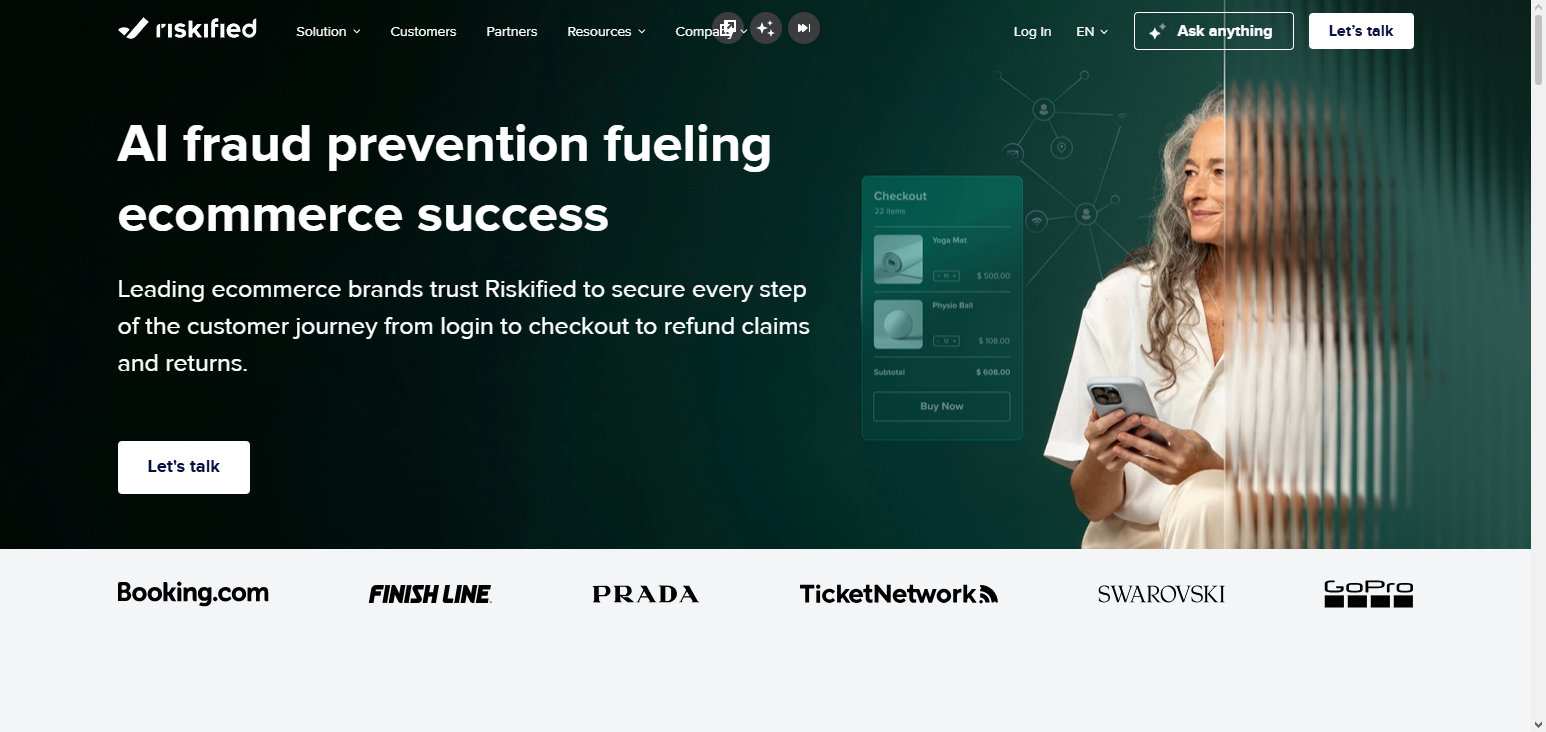
Riskified is able to allow genuine purchases while denying suspect ones through the use of sophisticated AI algorithms and international fraud intelligence networks.
Because it helps stop payment fraud and lower chargebacks, it is becoming more and more recognized as one of the Best Fraud Detection Software for Banks in various digital banking and payment ecosystems. By reducing pointless transaction declines and guaranteeing robust protection against fraudulent activity, the technology also enhances the client experience.
Riskified Features
- AI-Driven E-commerce Fraud Detection – Fraud in online transactions and chargebacks is detected.
- Global Merchant Network Intelligence – Fraud detection is enhanced through the use of global transaction data.
- Chargeback Protection – Protection of chargebacks due to fraud is guaranteed.
- Automated Transaction Approval – Machine learning is used to approve transactions.
- Fraud Pattern Analysis – Trends in fraud and patterns of suspicious purchases are detected.
Riskified
| Pros | Cons |
|---|---|
| Offers chargeback protection and fraud guarantee. | Mainly designed for e-commerce rather than traditional banking. |
| AI analyzes purchasing behavior and transaction patterns. | Merchants have limited control over final fraud decisions. |
| Real-time approval or rejection of online transactions. | Pricing depends on transaction volume and may be expensive. |
| Reduces false declines and improves revenue. | Not ideal for organizations that want full control over fraud rules. |
| Integrates with major e-commerce platforms. | Focus is mainly on online payment fraud. |
8. Shufti Pro
KYC, AML, and biometric verification are the main features of Shufti Pro, an identity verification and financial crime prevention software. It enables banks and other financial organizations to use real-time database checks, facial recognition, and document verification to confirm the identities of their clients.
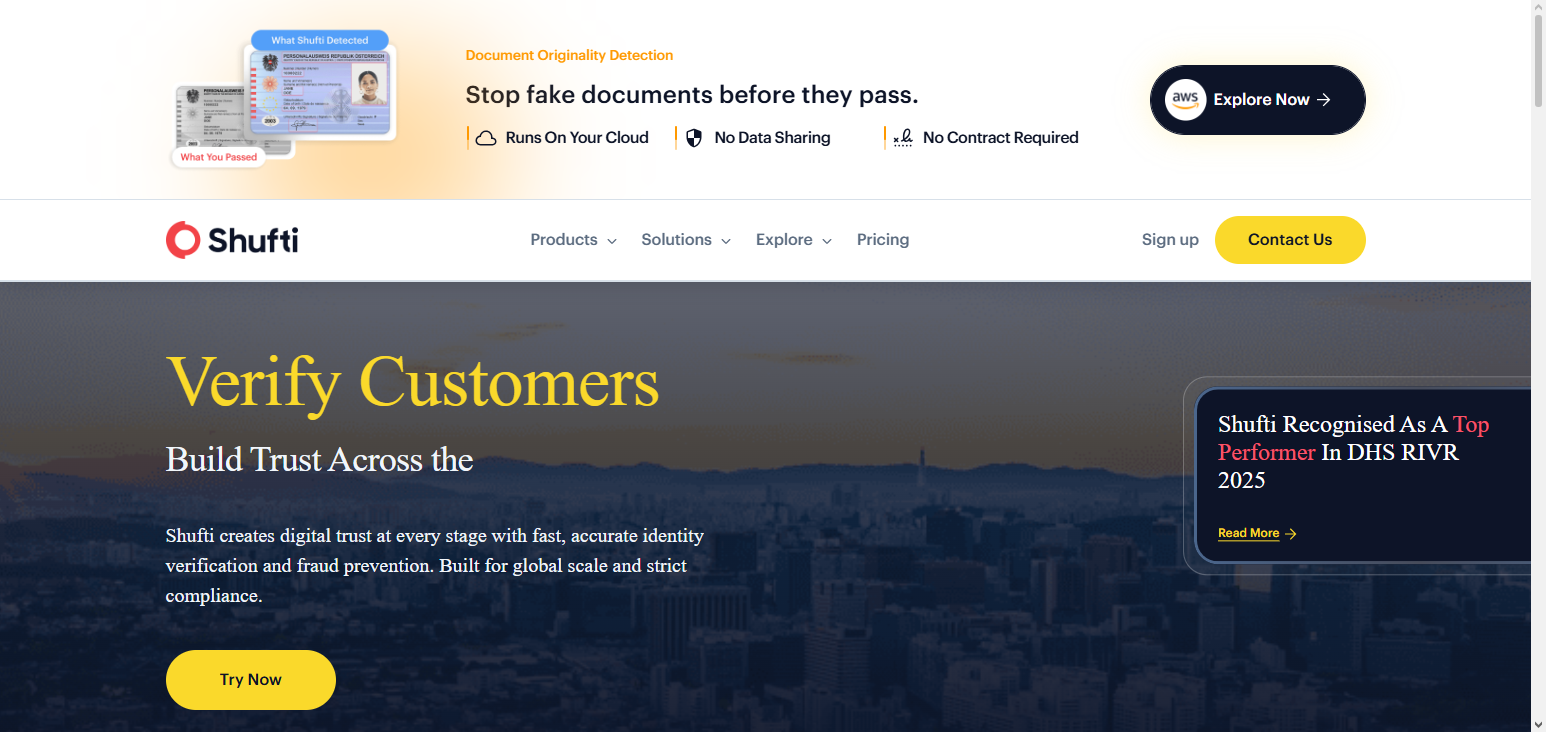
The software assists enterprises in preventing identity fraud and adhering to international regulatory standards by automating identity verification and risk screening.
Because it integrates identity verification with AML screening and fraud detection capabilities, Shufti Pro is frequently regarded as one of the Best Fraud Detection Software for Banks in the digital onboarding and compliance ecosystem. Banks are able to avoid fraud during account setup and financial transactions because to this integrated approach.
Shufti Pro Features
- Identity Verification (KYC) – Authenticating documents is used to verify the identity of a customer.
- Biometric Facial Recognition – Secure onboarding is done using facial verification.
- AML Screening – Users are screened through worldwide sanctions and watchlists.
- Document Verification – Passports, IDs, and driver’s licenses are validated.
- Real-Time Fraud Prevention – Identity fraud is detected as accounts are made to prevent identity fraud.
Shufti Pro
| Pros | Cons |
|---|---|
| Fast identity verification using AI and biometric technology. | Accuracy depends on document quality and image clarity. |
| Supports global KYC and AML compliance requirements. | Some advanced verification features cost extra. |
| Real-time identity and document verification. | API integration may require developer support. |
| Supports multiple languages and document types. | May not provide full enterprise fraud analytics. |
| Useful for digital onboarding and remote verification. | Performance may vary depending on region and data sources. |
9. Kount (Equifax)
Kount, a digital fraud prevention technology that is now a part of Equifax, evaluates transaction risk using machine learning, device intelligence, and identity data. To find suspect activity, the system analyzes signals including transaction patterns, location data, user behavior, and device fingerprints. Kount is used by banks and payment companies to stop identity theft, payment fraud, and account takeovers.
Because it uses a worldwide identity trust network to evaluate billions of interactions, it is considered one of the Best Fraud Detection Software for Banks in the current digital banking architecture. This makes it possible for financial institutions to identify fraud more quickly while preserving a flawless client experience.
Kount (Equifax) Features
- Device Fingerprinting Technology – recognizes devices involved in transactions.
- Identity Trust Network – analyzes global identity data to pinpoint fraudulent activities.
- Machine Learning Risk Models – identifies payment fraud and account takeovers.
- Omnichannel Fraud Protection – safeguards payments made online, through mobile, and in physical stores.
- Automated Fraud Decisioning – makes instantaneous decisions to approve, decline, or review transactions.
Kount (Equifax)
| Pros | Cons |
|---|---|
| Uses a global identity trust network for fraud detection. | Machine learning capabilities may be weaker than newer platforms. |
| Provides strong account takeover and payment fraud protection. | Data enrichment options can be limited. |
| Easy integration with digital commerce platforms. | Reporting setup can be complex initially. |
| Custom rule creation for tailored fraud strategies. | Integration with Equifax data may feel fragmented. |
| Strong identity and device intelligence technology. | May require tuning for high-volume enterprise use. |
10. Palantir Foundry (fraud use cases)
Governments, banks, and businesses use Palantir Foundry, a potent data integration and analytics platform, to identify financial crime and fraud. The system creates a uniform data environment for analysis by integrating data from many sources, including as transactions, client information, and external datasets.

To find suspect links and hidden fraud tendencies, analysts might employ machine learning models, advanced analytics, and visual network mapping.
Because it allows investigators to examine intricate financial networks and spot coordinated fraud schemes, Foundry is regarded as one of the Best Fraud Detection Software for Banks in many major financial organizations. Its data-driven methodology enhances financial crime investigations and decision-making.
Palantir Foundry (Fraud Use Cases) Features
- Data Integration Platform – merges data from various sources into a single structure for unified analytics.
- Advanced Fraud Analytics – employs machine learning to identify fraudulent behavior and anomalies.
- Network & Relationship Analysis – uncovers fraud networks and concealed relationships between individuals.
- Visual Investigation Tools – empowers analysts to navigate dashboards detailing networks of financial crimes.
- Scalable Big-Data Processing – handles data at an enterprise scale for large scale fraud investigations.
Palantir Foundry (Fraud Use Cases)
| Pros | Cons |
|---|---|
| Powerful data integration across multiple data sources. | Implementation and deployment can be expensive. |
| Advanced analytics and machine learning for fraud detection. | Requires skilled data engineers and analysts. |
| Strong network analysis for identifying fraud rings. | Not specifically designed only for fraud detection. |
| Highly scalable big-data processing platform. | Complex interface may require training. |
| Used by governments and large enterprises for investigations. | Deployment time can be longer than SaaS fraud tools. |
Conclusion
It is important to identify the Best Fraud Detection Software for Banks as it safeguards banks from increasing cyber attacks, fraud in payments, and laundering of funds. Modern fraud hindrance solutions identify and mitigate the risk of financial loss by analyzing fraud detection in real time, using artificial intelligence, machine learning, and behavioral analytics.
Bank fraud detection solutions such as Featurespace, Feedzai, ComplyAdvantage, Quantexa, and Palantir Foundry offer advanced data analytics and risk scoring to detect fraud and identify suspicious networks.
Using the best fraud detection platforms, banks can strengthen cybersecurity, compliance to regulations, and can strengthen the trust of customers. As customers increasingly adopt digital banking transactions, the cost of fraud will increase and the Best Fraud Detection Software for Banks will become imperative.
FAQ
Fraud detection software for banks is a specialized technology platform that monitors financial transactions, customer behavior, and account activities to identify suspicious or fraudulent actions. These systems use advanced analytics, machine learning, and real-time monitoring to detect anomalies such as unusual payment patterns, account takeover attempts, or identity fraud. By analyzing large volumes of transaction data and behavioral signals, banks can quickly flag high-risk activities and prevent financial losses.
Fraud detection software works by analyzing multiple data points such as transaction amounts, device information, geolocation, and customer behavior. Machine learning algorithms build profiles of normal user activity and automatically detect anomalies when transactions deviate from typical patterns. The system then generates risk scores and alerts investigators or blocks suspicious transactions in real time. This proactive monitoring allows banks to stop fraudulent activities before funds are transferred or accounts are compromised.
Banks need fraud detection software to protect customers, reduce financial losses, and comply with regulatory requirements such as AML and KYC rules. With the rise of digital banking, online payments, and mobile transactions, fraud risks have increased significantly. Modern fraud detection tools provide automated monitoring, behavioral analytics, and predictive models that help banks detect threats faster than traditional manual processes. These solutions also improve operational efficiency and build customer trust by ensuring secure banking transactions.