
In this article, we will explore which E-Commerce Fraud Prevention Tools help online businesses defend themselves against scams, chargebacks, and unauthorized transactions.
Fraud is becoming more sophisticated, and choosing the right tools is critical for defending against unauthorized payments, stolen data, and fraudulent chargebacks.
These tools, for example, have advanced machine learning and artificial intelligence and are capable of real-time fraud monitoring.
Key Points & Best Fraud Prevention Tools For E-Commerce
| Tool | Key Point |
|---|---|
| Sift | AI-driven fraud detection with dynamic risk scoring |
| Mastercard Identity Review 360 | Real-time payment verification and identity analysis |
| Signifyd | Guaranteed fraud protection with chargeback coverage |
| ClearSale | Global fraud prevention supported by analyst review |
| NoFraud | Automated, real-time order screening |
| SEON | Flexible modular APIs with digital footprinting |
| Kount | AI-powered identity trust protection |
| Riskified | Account protection against takeover fraud |
| Forter | Instant yes/no transaction decisions |
| Fraud.net | Cloud-based collective intelligence network |
10 Best Fraud Prevention Tools For E-Commerce
1. Sift
Sift is an artificial intelligence-based system, built primarily for the prevention of fraud in the e-commerce sector.
The company uses real-time learning to spot fraudulent transactions through techniques in machine learning, including behavioral analysis, device fingerprinting, and identification of anomalous transactions.
Apart from fraudulent transactions, Sift also includes the prevention of payment account takeovers, promotional abuse, and spam.
The company’s automation makes the systems less reliant on manual process review and streamlines operations for greater efficiency and improved conversion rates.
The system’s global learning capabilities offer highly accurate and flexible fraud detection and prevention for internet merchants.
Sift – Features
AI Risk Scoring: Employs ML models that have been trained with a variety of fraud data to evaluate the risk of a given transaction and score it in real-time.
Behavioral Analytics: Monitors the user’s session, and throughout their time logged in, their behavior to discover account takeover anomalies.
Multi-Channel Safeguarding: Protects your business from fraud in a variety of transaction and promotion methods, as well as in the user account login and content systems.
Automated Workflows: Takes action on manually assigned orders that are classified as high risk and helps to decrease the volume of orders that need human attention.
| Pros | Cons |
|---|---|
| Uses powerful AI/ML to detect fraud in real time with high accuracy. | Can be expensive for small e‑commerce businesses. |
| Protects beyond payments — includes account takeover, promo abuse, spam prevention. | Advanced customization may require technical expertise. |
| Reduces manual review work and improves approval rates. | Some merchants report onboarding complexity. |
| Continuously learns from a global fraud network. | Detailed analytics might be overwhelming initially. |
2. Mastercard Identity Review 360
Mastercard Identity Check 360 strengthens and streamlines the process of secure online transactions thus improving the overall customer experience and reducing security fraud in the online marketplace.
It uses behavioral biometrics, device fingerprinting, and password entry along with multifactor authentication to ensure the user’s identity during the online purchases.
The service enables customer to detect fraudulent activities and evaluate the level of risk associated with the transaction, and with this information in hand, the sellers are able to make better decisions.
It can be easily assimilated within existing payment frameworks to make the payment processes even more seamless. The system is designed to remove fraudulent transactions using large volumes of transactional data.
Mastercard Identity Check 360 – Features
Multi-Factor Authentication (MFA): Verifies the user’s identity visiting a webpage by cross-checking with information from their device, their bio, or some other verification methods.
Behavioral Biometrics: Recognizes movement fraud by monitoring the user’s mouse usage and keystrokes for uncharacteristic behavior.
Device Fingerprinting: Monitors and characterizes usage patterns of individual devices.
Seamless Checkout Experience: Eliminates unnecessary steps in the payment process for genuine users in an effort to enhance the system’s security.
| Pros | Cons |
|---|---|
| Strong identity verification combining biometrics, device signals, and MFA. | Focused mainly on authentication, not full fraud lifecycle. |
| Helps reduce unauthorized transactions and increases trust at checkout. | Less comprehensive outside Mastercard payment ecosystem. |
| Can improve conversion by reducing false declines. | May require integration effort with existing systems. |
| Leverages Mastercard’s global risk data. | Not a standalone fraud management platform. |
3. Signifyd
Signifyd offers a complete answer for fraud protection to online retail stores. It offers a guarantee for the orders of merchants by assuming financial liability for all transactions that it approves.
This offers merchants assurance and comfort. The platform employs machine learning for the detection of fraud by analyzing potential transaction signals, device information, and behavioral patterns of the buyer.
Aside from that, Signifyd offers protection for account takeovers, chargebacks, and abuse of refunds. Their automated systems accelerate the review processes for cases that require manual reviews which helps e-commerce platforms maintain high approval rates at low losses.
Signifyd’s services covering the globe helps merchants to operate at high efficiency in a number of different markets.
Signifyd – Features
Guaranteed Fraud Protection: Takes on the risk of chargebacks for orders processed with their payment system.
Advanced Machine Learning: Monitors user behavior in real-time and uses prior data to evaluate the risk of fraud.
Order Automation: Approvals or declines of orders are automated based on a preset level of risk.
Global Coverage: They also support entry of merchants globally through various multi-currencies and marketplace integration.
| Pros | Cons |
|---|---|
| Offers guaranteed fraud protection — assumes chargeback liability. | Higher pricing due to the financial guarantee model. |
| Automates order decisions with strong AI scoring. | Less flexibility for custom risk rules. |
| Helps increase order approvals and reduce manual reviews. | Setup and integration can be technical. |
| Works globally and scales with business growth. | Dashboard can be complex for beginners. |
4. ClearSale
ClearSale merges technological tools and human insights to enhance accuracy when preventing fraud. They implement machine learning to analyze and assess every transaction in real-time, flagging suspicious orders.
To reduce false positives and maintain customer satisfaction, fraud orders are manually vetted. They help e-commerce merchants and marketplaces worldwide combat payment fraud, chargebacks, and identity theft.

The solution integrates with all major payment processors and provides merchants and customers with dependable safety, lower processing costs, and smoother transactional pathways.
ClearSale – Features
Hybrid Review System: Works on coupling automated scoring of fraud with manual fraud data.
Reducing False Positives: Through unnecessary review fraud order processes are reduced.
Real-Time Decisioning: Processes decisions on order in real-time so that smooth checkout remains.
Custom Rules & Reports: System is bordered with flexibility and automated analytical reporting.
| Pros | Cons |
|---|---|
| Combines machine learning with expert human review, reducing false positives. | Decisions requiring human review may take longer. |
| Excellent for complex or high‑risk transactions. | Higher pricing due to blended human services. |
| Works well in global markets with multi‑currency support. | May not suit very small merchants. |
| Integrates with major payment processors. | Manual review adds operational lag. |
5. NoFraud
NoFraud saves online sellers from having to slow down their checkout processes while still providing real-time fraud detection and prevention.
Each transaction is evaluated with machine learning and risk rules and fraud is detected before a payment is processed.
They accept and support global payments and for verified orders, they take on chargeback liability. They integrate seamlessly with most e-commerce platforms and payment processes.
Automation and risk management fraud protection reduces costs and operational friction while also increasing approval rates.
As a result, customers are assured a safe and frictionless shopping experience and businesses are protected from fraud.
NoFraud – Features
Real-Time Risk Evaluation: Checks every transaction and processes only those who’ve cleared.
Protecting Against Chargeback Liability: Optimally protects merchants transactions through coverage on liable transactions.
Easy Integration: Primarily works with top e-commerce and payment gateway systems.
Scalable Decisioning: Designed to support rapid growth of business and without complicated installations.
| Pros | Cons |
|---|---|
| Real‑time fraud detection with affordable pricing. | Smaller network compared to enterprise fraud leaders. |
| Chargeback liability coverage included. | Limited advanced analytics features. |
| Easy integration with major platforms and gateways. | Customization can be basic for advanced needs. |
| Helps reduce manual reviews and false declines. | Doesn’t provide deep identity intelligence. |
6. SEON
SEON focuses on supporting online merchants and online fraud prevention through data enrichment, device fingerprinting, and behavioral analytic fraud detection solutions.
Identifying and analyzing user behavior is crucial to informing any fraud detection solutions. SEON assists user behavior analysi
Identifying fraud transactions, creation of fake accounts, and identifying user behavior to assess chargeback risks.
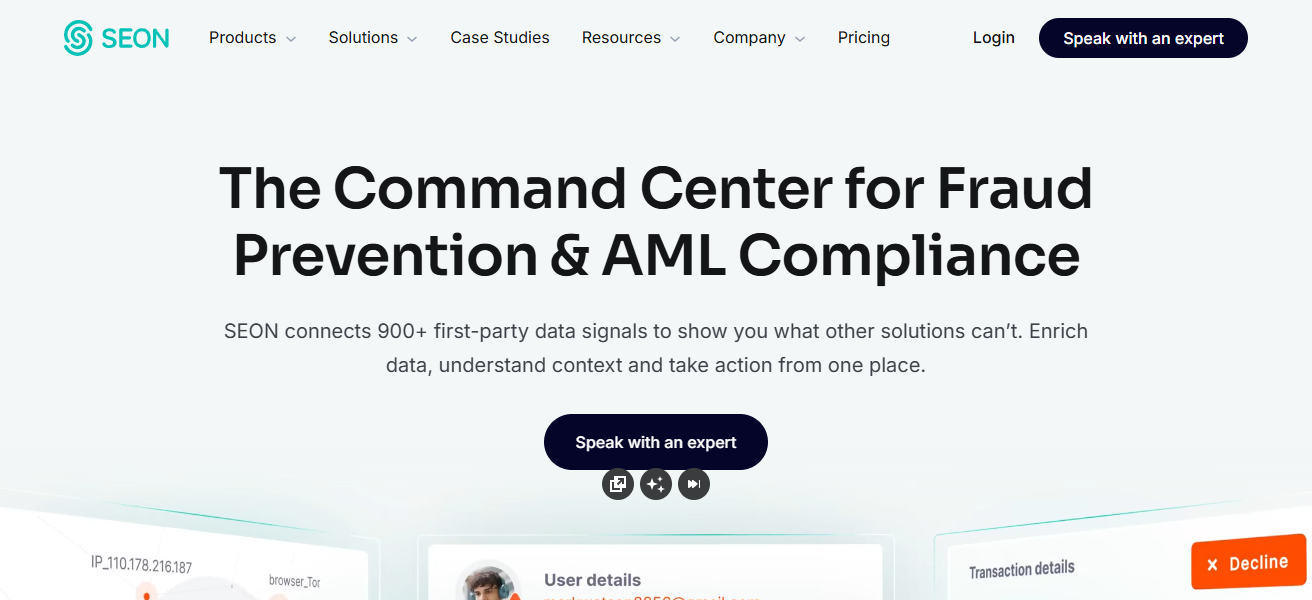
SEON’s risk score automation empowers merchants to automate transactions reviews, eliminating manual review.
SEON aids account takeover prevention, improves user acceptance, and assists merchants to protect a seamless experience on legitimate users.
With SEON’s integration of online fraud prevention and digital global commerce, merchants protect their digital commerce integrations seamlessly.
SEON – Features
Data Enrichment: Supplements its data with owned and public data.
Device Fingerprinting: Monitors individual phones by documenting and tracking device_ids and captures their fingerprints to identify and stop impersonation.
Custom Risk Scoring: Empowers merchants to design their preferred controls and solicited metric accentuations.
No-Code & API Options: Offers flexible and easy to incorporate strategies for technical and no technical developers at inclusion.
| Pros | Cons |
|---|---|
| Strong data enrichment & device fingerprinting. | Interface can be complex for beginners. |
| Customizable risk scoring & rules engine. | Requires tuning to maximize performance. |
| APIs and no‑code integrations available. | Some merchants need training to optimize. |
| Good visibility into threats like fake accounts and chargebacks. | Smaller community compared to big enterprise tools. |
7. Kount
Kount, employs AI technology in its fraud prevention activities, protecting its clients from online payment fraud, account takeovers, and charge-back fraud.
The company uses machine learning, device fingerprinting, and identity verification methods for evaluating transaction risk in real-time.
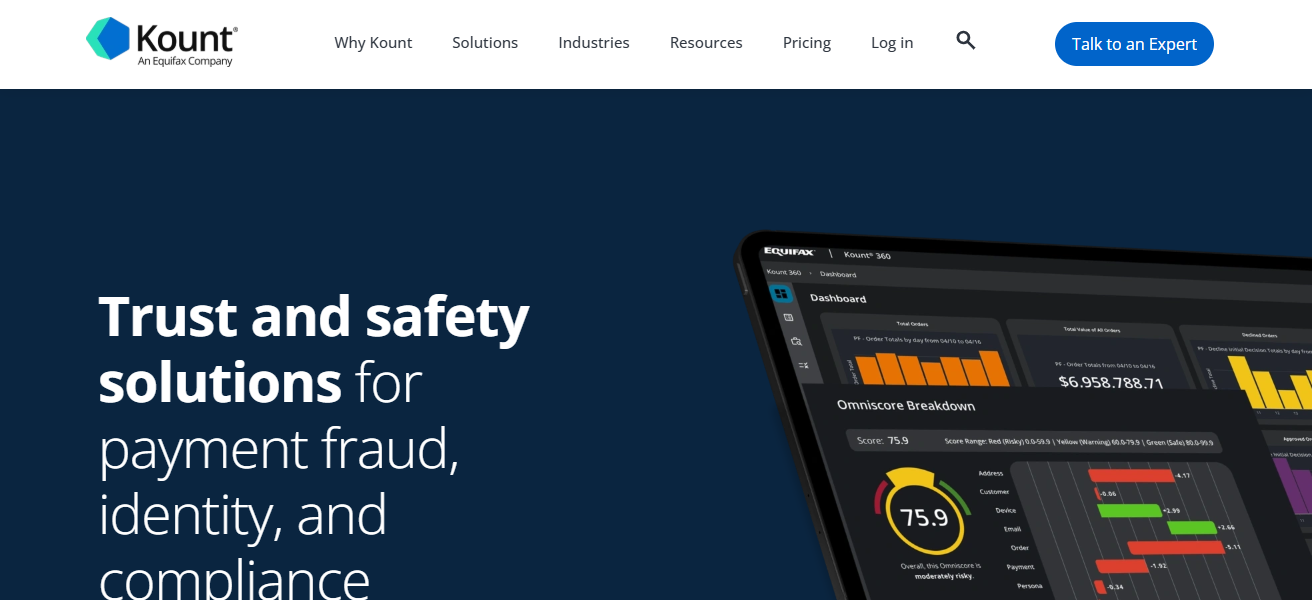
With Kount’s automation solutions fraud risk decisioning is automated, but also provides clients with insights for manual review.
Kount improves operational efficiency by helping clients turn fraudulent charge-back scenarios from losses to revenues and also reduces customer fraud charge-back risk.
Kount – Features
AI & Machine Learning: Increasingly sophisticated models are used to determine level of risk in transactions.
Identity Trust Signals: Verifying users is done through their behaviours, gadgets used and their associated email and/or internet protocol.
Comprehensive Dashboard: Managing risk parameters and supervision in one place.
Automated Decisions: Lessens the need for manual reviews through customizable decision requirements.
| Pros | Cons |
|---|---|
| Industry‑leading AI and global fraud network. | Premium pricing may deter small merchants. |
| Reduces false declines and improves approval rates. | Implementation and tuning can take effort. |
| Deep analytics and dashboard for manual review. | May be overkill for low‑volume stores. |
| Identity verification and device intelligence included. | Support sometimes reported as slower. |
8. Riskified
Riskified protects online sellers against fraud and loss of revenue. For Riskified, order fraud is detected and removed automatically through approved order fraud detection mechanisms that utilize machine learning and behavioral analytics.
Riskified assumes chargeback liability in order to provide financial protection to merchants. Riskified’s solution is fully integrated into e-commerce systems and payment systems, providing uninterrupted checkout experiences and real-time decision processes.
Without minimizing e-commerce functionality, Riskified offers account protection, fraud loss, and chargeback loss services. Riskified supports sellers in to selling more to satisfied and fraud loss safe customers.
Riskified – Features
Chargeback Guarantee: Financial protection for merchants in the case of positive authorized fraudulent orders.
Real-Time Fraud Decisions: Fraudulent orders are prevented through instantaneous scoring without causing delays to the checkout process.
Global Commerce Support: Partnership with merchants and marketplaces across the globe.
Detailed Analytics: Fraud patterns and performance data are made available.
| Pros | Cons |
|---|---|
| Real‑time decisions that boost conversions. | Costs scale with order volume and chargeback guarantees. |
| Chargeback guarantee lowers financial risk. | API integration may require developer resources. |
| Works at global scale across regions and platforms. | Can be pricey for mid‑sized e‑commerce. |
| Strong analytics and fraud insights. | Learning curve for admin users. |
9. Forter
Forter is an online payment protection platform that specializes in e-commerce scalability and customer experience.
Behavioral analytics in real-time, identity verification, and machine learning are used to identify fraud before it gets to the transaction approval stage.
For validated transactions, Forter provides total chargeback protection resulting in liability shift from merchants. Forter\’s global network mitigates risk based on new threats.
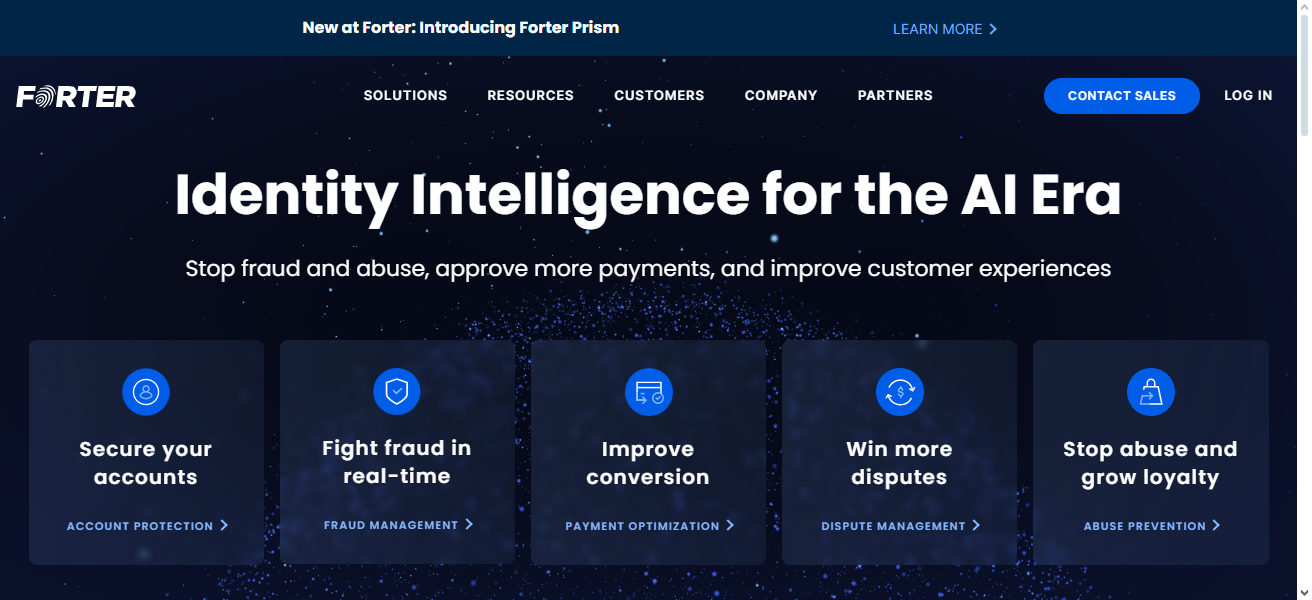
Forter mitigates the fraud within a transaction and the fraud detection process improving security while improving.
With a balance of automation and adaptive intelligence, it provides merchants of all sizes seamless service and strong fraud prevention.
Forter – Features
Behavioral Analytics: Tracks participant activities and actions to identify genuine and dishonest behaviors.
Full Protection & Guarantees: Protection against chargebacks for positive fraudulent orders.
Adaptive Learning: New information is used to adjust risk models.
Instant Decisions: Real-time scoring available without disrupting the checkout proces
| Pros | Cons |
|---|---|
| Excellent real‑time behavioral analytics. | Higher cost for small/mid businesses. |
| Full chargeback protection available. | Onboarding and training required. |
| Adapts quickly to new fraud patterns. | Implementation can require technical setup. |
| Improves conversions by reducing false declines. | Some customization limits if needs are niche. |
10. Fraud.net
Fraud.net merges innovative technology with machine learning and AI. It specializes in online commercial threats ranging from payment fraud to account takeovers to identity theft.
It even helps assess risk in real-time on an easy-to-use interconnected dashboard. Fraud.net scours a plethora of datasets, customizes automated operating processes, and develops targeted fraudulent behavior recognition systems.

Fraud.net notably is capable of managing risks to reduce chargeback and false denial rates and works with E-commerces to profitably sustain a fraud prevention system while retaining balanced global transactional processes.
Fraud.net – Features
Collaborative Intelligence: Combines data from multiple organizations to identify and combat fraud patterns.
Custom Rule Engine: Create specific risk rule sets that align with the operations of your business.
Central Risk Dashboard: Single platform for supervision of risk incidents and actions taken.
Multi-Layer Detection: Identification of payment fraud, account takeover, and identity theft.
| Pros | Cons |
|---|---|
| Collaborative platform with shared threat intelligence. | May require manual tuning and continuous oversight. |
| Flexible risk rule customization. | Not as plug‑and‑play as turnkey solutions. |
| Comprehensive dashboard with multiple tools. | Smaller network effect than big enterprise platforms. |
| Detects payment fraud, account takeover & identity theft. | Setup can be technical for non‑dev teams. |
How We Choose Best Fraud Prevention Tools for E-Commerce
- Capable of Accuracy, AI, and Machine Learning: You need products that have real-time risk scoring and predictive machine learning.
- Chargeback Protection: It is important to know whether protection for fraudulent charge losses exists.
- Simple Integration: You should check for integration with your online selling software and payment processors.
- False Positive Minimization: Compliance should result in fewer declines of legitimate orders.
- Universal Coverage: Ability to fraudulently manipulate data across multiple countries/regions and in different currencies.
- Flexible Customization: A business should be able to set risk tolerance levels.
- Advanced Reporting and Analytics: Data points should create a foundation for more efficient fraud prevention actions.
Conclsuion
In conclusion, choosing the Best Fraud Prevention Tools for E-Commerce mitigates the risk of losing money as well the valuable trust of the customer and \protects the reputation of of the business.
Tools such as Sift, Signifyd, and Forter provide and fully integrate real-time fraud protection, automated chargeback protection, and drop-in protective AI. E-commerce companies can safely process and mitigate the risk of loss and provide their customers with seamless shopping.
FAQ
A tool that helps e-commerce businesses detect and prevent fraudulent transactions, protecting revenue and customer trust.
It reduces chargebacks, prevents financial loss, and maintains customer confidence during online transactions.
Signifyd, Riskified, Forter, and ClearSale provide chargeback guarantees for approved transactions.
Yes, tools like NoFraud and SEON are affordable and scalable for small to medium e-commerce stores.
Most, including Sift, Kount, and Forter, leverage AI/ML to detect fraud patterns in real time.